
The Cost Average Effect with Bitcoin: What Twelve Instalments Really Deliver
Twelve monthly instalments of 100 euros produced an average price of 66,472 euros and ran 33.6 percentage points ahead of the lump sum purchase on the same starting day. The calculation also shows when the savings plan is the worse route.





Which topics should we dive deeper into?
Select what genuinely interests you. Your picks feed directly into our editorial planning.
Crypto news that's actually worth your time.
Weekly. 60 seconds. Carefully curated by our editors: no hype, no promo flood, no spam.
The cost average effect describes how, with constant instalments, you get more units for the same money when the price falls and fewer when it rises. What follows is an average price that lies below the average of the prices. How large that gap actually is goes unmentioned in most guides. So we calculated it ourselves: for twelve monthly instalments of 100 euros each in Bitcoin it comes to 3.67 percent, and against a lump sum purchase on the same starting day the savings plan portfolio is 33.6 percentage points ahead. This analysis was compiled by cryptoticker.io itself on September 19, 2026.
The figure alone does not yet say whether a savings plan is the right tool for you. The lead arose in a year in which the Bitcoin price gave up a good third from its high. In a rising market the result turns around. This article shows both sides using the same data.
What the cost average effect is and what it does not achieve
The term comes from the fund business and means a purely arithmetical consequence of fixed instalments. If you buy for 100 euros every month, then at a price of 50,000 euros you receive twice as many units as at 100,000 euros. Because the cheap months automatically carry more weight, your average price sinks below the arithmetic mean of the prices.
Two things the effect expressly does not achieve. It does not protect against losses: if the price falls lastingly, the value of your portfolio falls too, only more slowly than with a lump sum purchase at the starting price. And it does not generate a return out of nothing. What it delivers is a better entry price than the chance of a single buying day, as long as prices fluctuate.
Dollar cost averaging, DCA for short, is the English term for the same method and means the regular purchase of fixed amounts irrespective of the price level.
The calculation: what twelve instalments of 100 euros since October 2025 produced
How we calculated
The data basis is 366 daily closing prices for Bitcoin in euros from September 20, 2025 to September 19, 2026 through the public price interface of CoinGecko. We simulated twelve instalments of 100 euros each, in each case on the first day of the month from October 1, 2025 to September 1, 2026, 1,200 euros in total. Valuation was at the price of September 19, 2026, which stood at 70,536.29 euros.
What this calculation does not contain: order fees, spreads between buying and selling price, the exact time of execution within the purchase day, and tax effects. Providers settle differently, and a savings plan is rarely executed at exactly the daily closing price. The values show the mechanics cleanly; they are not the statement of an actual portfolio.
What the figures show
The period was unusually eventful. The high was on October 7, 2025 at 107,019.40 euros, the low on July 1, 2026 at 51,473.91 euros. Between the two points lies a factor of 2.08. From the high to the cut-off date there is a decline of 34.1 percent.
| Purchase date | Price per bitcoin | Quantity bought | Average price after |
|---|---|---|---|
| October 1, 2025 | €97,215.68 | 0.00102864 BTC | €97,215.68 |
| November 1, 2025 | €94,506.90 | 0.00105812 BTC | €95,842.15 |
| December 1, 2025 | €77,843.13 | 0.00128463 BTC | €88,983.82 |
| January 1, 2026 | €74,525.49 | 0.00134182 BTC | €84,867.63 |
| February 1, 2026 | €66,363.23 | 0.00150686 BTC | €80,384.81 |
| March 1, 2026 | €56,991.79 | 0.00175464 BTC | €75,237.76 |
| April 1, 2026 | €58,760.27 | 0.00170183 BTC | €72,339.83 |
| May 1, 2026 | €65,065.83 | 0.00153690 BTC | €71,342.87 |
| June 1, 2026 | €63,253.57 | 0.00158094 BTC | €70,343.31 |
| July 1, 2026 | €51,473.91 | 0.00194273 BTC | €67,855.84 |
| August 1, 2026 | €54,453.33 | 0.00183643 BTC | €66,370.77 |
| September 1, 2026 | €67,612.11 | 0.00147903 BTC | €66,472.48 |
At the end there are 0.01805258 bitcoin in the portfolio, bought at an average price of 66,472.48 euros. By the cut-off date that has become 1,273.36 euros, a gain of 6.1 percent on the 1,200 euros paid in. Eleven of the twelve purchase days lay below the price of the first purchase day.

Why the average price lies below the average market price
The arithmetic mean of the twelve purchase prices is 69,005.44 euros. At 66,472.48 euros your actual average price lies 2,532.96 euros below it, so 3.67 percent cheaper. That is the cost average effect in its pure form, and it is nothing more than that.
Mathematically what lies behind it is the harmonic mean, the average that results when you buy fixed amounts instead of fixed quantities. With fluctuating prices it always lies below the arithmetic mean, and the gap grows with the range of fluctuation. At an asset that more than doubles and halves again within a year, it turns out markedly larger than at a broad equity index.
A sober conclusion follows from this: the 3.67 percent is the price advantage the method itself generates. Everything beyond that in our calculation stems from the price path and not from the savings plan.
 Bitcoin savings plans: providers and costs compared
The honest counter test: when the lump sum purchase wins
Had you invested the 1,200 euros in one go on October 1, 2025, it would have become 0.01234369 bitcoin. By the cut-off date that is 870.68 euros, a loss of 27.4 percent. The savings plan is therefore 402.68 euros or 33.6 percentage points ahead.
The worst conceivable entry would have been October 7, 2025, the high of the period. From 1,200 euros there would have been 790.92 euros, a loss of 34.1 percent. The best entry was on July 1, 2026 at the low: 1,644.40 euros, a gain of 37.0 percent. This value is the most important in the entire analysis, because it shows the reverse side. Whoever hits the low beats every savings plan by a clear margin.
Nobody hits it reliably. The savings plan, by contrast, buys with certainty in July 2026 and in August 2026 as well, the two cheapest months of the year, without you having to make a decision about it. That precisely is its contribution. In a year of rising prices the same mechanism would have led to nothing but more expensive follow-up purchases, and the lump sum at the start would have won. Which of the two situations comes along you do not know beforehand. How to weigh the two routes against each other we wrote up using the example of a specific price level in our analysis of savings plan or lump sum when buying more.
What the calculation conceals about fees and spreads
A savings plan buys twelve times a year, a lump sum purchase once. With percentage fees that hardly matters; with fixed minimum fees per order it very much does. A flat rate of one euro per execution costs you one percent of the purchase amount on a 100 euro instalment, so around a quarter of the entire cost average advantage of 3.67 percent.
On top of that comes the spread, the gap between the price at which a provider buys and the one at which it sells. With crypto savings plans it frequently lies between 0.5 and 1.5 percent and appears in no fee table, because it is contained in the price. Count it in before you compare providers. Which houses offer Bitcoin savings plans in Germany and how their cost models differ can be found in our comparison of providers for Bitcoin savings plans.
What routes exist in Germany and how to tell them apart
For regular Bitcoin purchases, essentially three routes come into question in Germany, and the difference rarely lies in the price. It lies in what you actually own at the end.
When buying through a trading venue authorised under MiCA you acquire the coins themselves; MiCA is the EU regulation for markets in crypto assets which since 2024 has set uniform authorisation duties for service providers. With an exchange traded certificate on Bitcoin, usually called an ETN, you hold a debt security of the issuer that tracks the price. With an offering that has no option to withdraw into a wallet of your own, you hold in the end merely a claim against the provider.
The difference only becomes visible when it matters, that is in an insolvency or a disruption at the provider. Before your first savings plan, therefore, check whether a withdrawal to an address of your own is possible and which minimum amounts apply to it. The selection of regulated trading venues is set out in the overview of crypto exchanges.
Holding period, FIFO and December 31, 2026: why every instalment has its own clock
For tax purposes a savings plan is not a single event but a chain. Every instalment is an acquisition of its own with a date of its own. Under section 23 of the Income Tax Act, gains from private disposal transactions are tax free if more than a year lies between acquisition and sale; the wording can be found at Gesetze im Internet. With twelve instalments, then, twelve periods run in parallel.
If you sell part of the holding, in practice the FIFO method applies, first in, first out: what counts as sold is the holding bought first. In our simulation that would be the instalment of October 1, 2025 at 97,215.68 euros, the most expensive of the whole period. Anyone selling in September 2026 would thereby have realised a loss on paper and not the cheap July entry. The details on this are in our article on holding period and FIFO with a Bitcoin savings plan.
Added to that is a date currently under discussion. On September 8, 2026 the Federal Ministry of Finance submitted a draft bill for interdepartmental coordination which would treat crypto assets as income from capital assets and subject them to withholding tax. As the draft stands, only assets acquired after December 31, 2026 would be affected. A draft is not applicable law, and the further path through departmental coordination, cabinet and parliament is open. For a running savings plan it does mean, however, that instalments from January 2027 onwards may under certain circumstances be treated differently from those before. Keep the acquisition dates cleanly recorded.
How large the instalment should be and when you are better off pausing
A solid rule runs: the instalment has to remain bearable even if the price falls for twelve months. That very case occurred in our analysis, and the savings plan only worked because buying continued through the weak months. Anyone who had paused in March 2026 at just under 57,000 euros would have missed the three cheapest instalments of the year.
From this follows the most important practical pointer of this article. The instalment is not measured by what is possible in good months, but by the amount you can do without for twelve months at a stretch. You should pause a savings plan if you need the money for running costs or if debts at higher interest are outstanding. The price level, by contrast, is not a good reason, because pausing when prices fall inverts the mechanics exactly.
A common fallacy
Many investors raise the instalment after strong price rises and lower it after declines. That way you systematically buy more at high and less at low prices, and the cost average effect disappears. If you change the instalment, do it by reference to your income and not to the chart.
What speaks against the savings plan
Three objections are factually justified. First, the lump sum purchase regularly beats the savings plan in rising markets, because the entire capital is invested from the start; with equity indices this is the case in the majority of historical periods. Second, twelve purchases a year produce twelve acquisitions that you have to document, which noticeably increases the effort at tax return time. Third, the automation tempts you never to review the position.
The second point can be solved with tools that carry the acquisition dates and the FIFO order along automatically; we give an overview in the comparison of crypto tax tools. The first and third points remain a question of your investment horizon and your discipline.
Using the cost average effect: what to take away
- Count on 3.67 percent, not on a promise. That is the advantage twelve equal instalments generated against the average market price in our analysis. Everything beyond that came from the price path. Check first whether this advantage is not already eaten up by fees and spread at your provider, and compare the models in the savings plan comparison.
- Clarify before the first instalment what you are really buying. Coin, certificate or a mere claim against a provider are three different things, and the difference shows only when it matters. Check the authorisation and the withdrawal option of your trading venue using the overview of crypto exchanges.
- Document every instalment with date and price. With twelve instalments twelve one-year periods run, and on a sale FIFO reaches for the oldest. Should the draft bill of September 8, 2026 become law, the acquisition date will additionally decide the taxation. A tool from the tax tool comparison takes this bookkeeping off your hands.
(As of September 19, 2026. This article is not investment advice. Prices and fee structures change; check the terms with the provider before you buy.)
Transparency note: This article was produced with the assistance of artificial intelligence and reviewed by our editorial team before publication. All figures and claims were checked against the primary sources linked in the text. The feature image was generated with AI.
Related articles
- Buying More Bitcoin at $77,000: Savings Plan or Lump Sum
- Fed Rate Decision of September 16: What It Means for Your Bitcoin Savings Plan
- DCA Crypto: How to Survive Crypto Crashes with Dollar Cost Averaging and Invest for the Long Term
- Bitcoin Back Above $80,000: Buy More, Hold or Take Profits? What to Check Now
- Bitcoin Savings Plan and Tax: How the Holding Period, FIFO and the Exemption Limit Interact on Monthly Buys
Which topics should we dive deeper into?
Select what genuinely interests you. Your picks feed directly into our editorial planning.
Crypto news that's actually worth your time.
Weekly. 60 seconds. Carefully curated by our editors: no hype, no promo flood, no spam.

September 1, 2026 12:19 PM

Von der Leyen Wants Your Bank Deposits: Here Is How to Keep Control of Them
Brussels wants Europe's 10 trillion euros in deposits funding its companies. What it means for savers, and why Bitcoin savings plans matter.

October 3, 2026 4:40 PM

Investing in Bitcoin With a Savings Plan or a Lump Sum: What the December 31 Tax Cut-Off Changes
Anyone putting money into Bitcoin now chooses between a lump sum, a monthly instalment and an ETN in a securities account. The German finance ministry’s draft bill would keep the one-year holding period only for holdings bought by December 31, 2026.
September 24, 2026 10:19 PM

Bitcoin for Retirement: What Applies from 2027 and What You Decide Now
Bitcoin is not permitted in any state-subsidised retirement product, including the new retirement savings account from 2027. Anyone who still wants to use crypto assets for their own pension goes through private assets, and there a cutoff date at the end of 2026 is shifting the tax rules right now.
September 9, 2026 4:29 PM
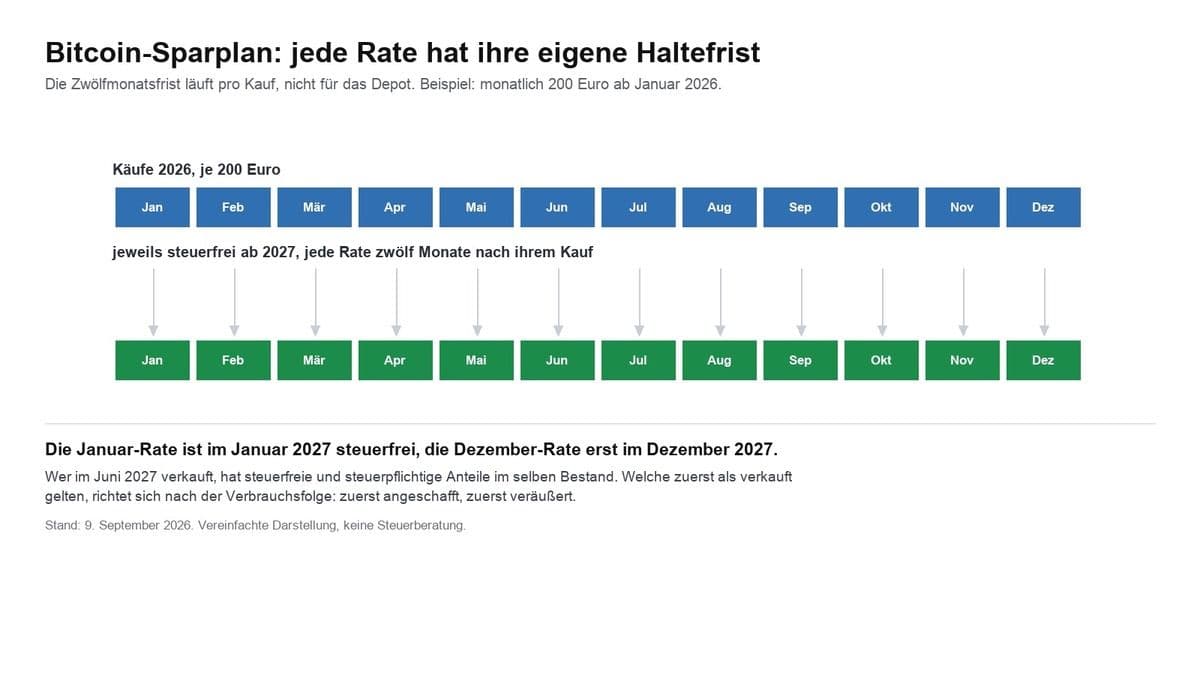
Bitcoin and Taxes in Germany: Holding Period, Savings Plan, ETP and Mining
Bitcoin gains are tax-free after twelve months. What that means for a savings plan with twelve deadlines, why ETPs are taxed differently, and what applies to mining, gifts and losses.
August 24, 2026 10:26 AM
Bitcoin Savings Plan in Austria: How the Purchase Price Is Calculated
Bought bitcoin through a savings plan? For multiple purchases Austria applies the moving average price as a matter of principle when working out taxable gains.
August 20, 2026 4:24 PM

Bitcoin Across Multiple Wallets: How Austria Works Out the Acquisition Cost
Bitcoin spread across several wallets? How Austria works out the acquisition cost and the rolling average price for tax purposes.
August 5, 2026 10:33 PM
$130 Million Gone Because the Randomness Was Predictable: Which Hardware Wallet You Can Still Buy
The Coldcard flaw proved the most respected wallet is not the safest. Which vendor has which track record – and why now is the wrong moment to pause your savings plan.

September 22, 2026 4:12 PM

Nearly $1 Billion Into Bitcoin ETFs: What to Check on ETNs, Portfolio and Holding Period
US spot bitcoin ETFs took in a net $999 million on September 21, the third consecutive day of inflows. German investors cannot reach these funds: what ETNs, the holding period and your buying route mean for you.
September 20, 2026 1:11 PM

Bitcoin Golden Cross: What Twelve Signals Since 2014 Really Show
Bitcoin's 50-day line has crossed its 200-day line. We evaluated all twelve golden crosses since 2014 ourselves and measured what happened afterwards. The result argues against the common reading of the signal.
September 9, 2026 4:13 PM

Bitcoin 29 Percent Below Last Year: Which Crypto Losses You Can Still Use Before the One-Year Holding Period Expires
Nine out of ten major crypto assets trade lower today than exactly twelve months ago, Bitcoin alone by 29.2 percent. We measured the price series ourselves and show why the purchase date alone decides the tax value of your loss.
September 27, 2026 4:12 AM

Bitcoin ETF Inflows Turn 2026 Positive: How to Tell If the Demand Holds
US spot Bitcoin ETFs took in roughly $2.4 billion in the week to September 25, the strongest week since October 2025, and that turns the 2026 year-to-date balance positive. Why the daily inflow fell 87 percent within the same week, and what to check on buying route, holding period and custody.

September 24, 2026 4:11 PM

Bitcoin Cash Falls 5.5 Percent After a 50 Percent Week: Check Your Buy Route, Leverage and Holding Period
Bitcoin Cash fell to $335.19 on September 24, 2026, after gaining almost 50 percent in seven days. The rally was set off by CME's announcement of September 22; what that means for buy route, leverage, holding period and custody is set out here.
September 25, 2026 10:26 PM

Selling bitcoin privately: the tax in Germany and the records you need
A direct sale to a private individual falls under the same one-year rule as an exchange sale, but there is no tax report to go with it. This guide walks through the calculation, the 1,000 euro threshold and the records the tax office wants to see.
September 17, 2026 10:22 PM

Selling Bitcoin at a Loss and Buying It Straight Back: What That Does to Your Holding Period
Germany has no wash sale rule: the loss stays deductible even if you buy back immediately. The buyback, however, restarts the one-year period for every new unit.
September 10, 2026 4:15 PM

BW-Bank Opens Bitcoin Trading Inside the Securities Account: What to Check Before Your First Buy
Since September 9, 2026, BW-Bank customers have been able to trade ten crypto assets through their securities account, executed and held in custody by Bitpanda. The familiar securities-account setting hides three points you should settle before your first order.
August 18, 2026 4:45 PM

Crypto Savings Plans Compared: What Bison, justTRADE and Kraken State on Fees, Minimum Instalment and Interval
Crypto savings plans advertise free execution, yet the price almost always sits in the spread. On August 14, 2026 we retrieved nine provider pages and evaluated which terms actually stand there.

November 24, 2024 10:08 AM
How to Invest in Bitcoin in 2025: A Comprehensive Guide for Beginners
Curious about Bitcoin? Get to know its history, why it’s a great investment, and how to get started in 2025.
August 11, 2026 5:35 PM

Is Bitcoin a Good Buy at Current Prices?
Bitcoin trades about a third below its twelve-month high and has reclaimed both moving averages. What chart structure, RSI and trading volume say about buying at current prices.
August 14, 2026 6:18 PM

Bitcoin From a Foreign Exchange to Austria: Which Tax Data You Need
Transferring Bitcoin from a foreign exchange to an Austrian platform: which tax data can be missing for the withholding tax. And what investors need to watch out for.
August 18, 2026 4:22 AM

Bitcoin for gold: is the swap taxable in Austria?
Swapping bitcoin directly for gold? In Austria this can already trigger 27.5 percent tax on the capital gain. What investors should know.
September 24, 2026 10:12 AM

XRP Falls 9.7 Percent: What to Check on Holding Period and Buying Route
XRP is down around 9.7 percent on the morning of September 24, twice as much as the typical large crypto asset. Our count of 18 coins shows who the pullback hits and which three things hold true regardless of the price.
September 14, 2026 10:23 AM

Take Ethereum Profits or Wait Out the Holding Period? What the Price Jump Means for Your Tax Bill
Ether reached its highest level since the end of January on September 11, 2026, and many are asking whether to sell now. In Germany the answer hangs on the purchase date first: we work out which tranches are tax free and which of them are showing a gain at all.
September 9, 2026 4:22 PM
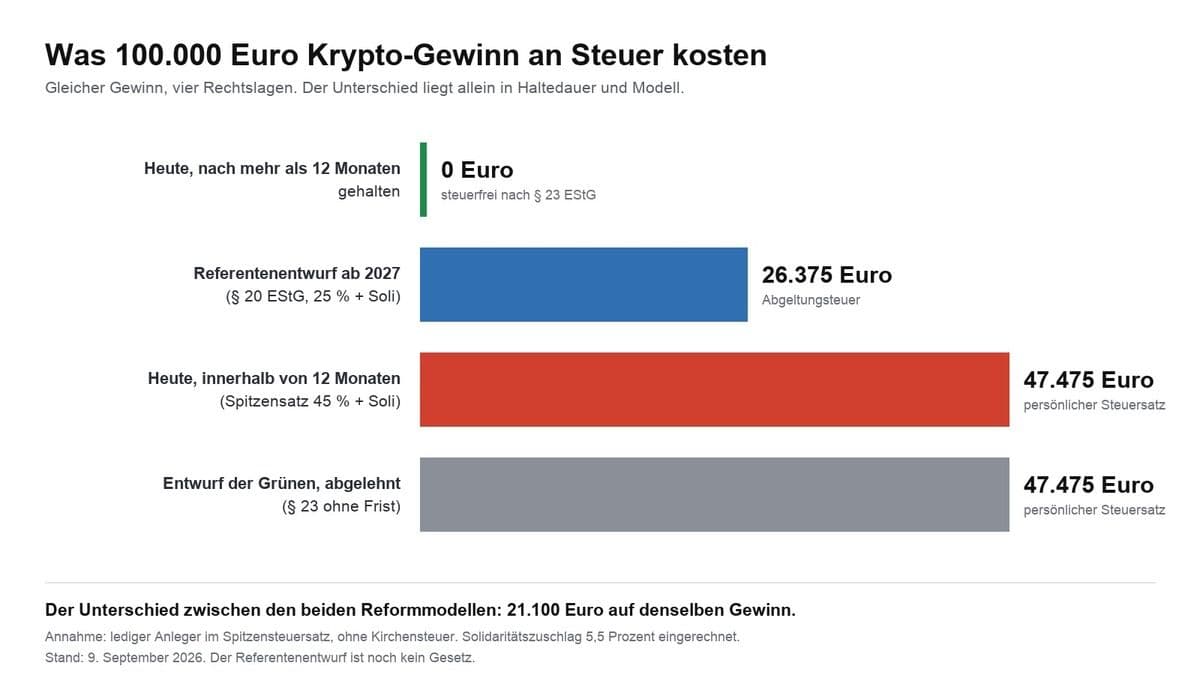
Crypto Tax in Germany: What Applies in 2026 and What Is Set to Change in 2027
Crypto gains are tax-free after twelve months; before that your personal tax rate of up to 45 percent applies. What triggers tax, how the holding period is calculated, what happens with staking and losses, and what the draft bill would change from 2027.
September 8, 2026 1:19 AM

Germany's Crypto Holding Period: What Happens Now Signing for Petition 201716 Closed on September 15
Recap as of September 27, 2026: the signature period for German parliamentary petition 201716, which asks for the one-year crypto holding period to be preserved, closed on September 15, 2026. This article explains what ended that day, how the petitions committee proceeds and why no investor has to sell because of it.
September 23, 2026 4:34 PM

A Bitcoin State Reserve by Statute: What the US Bill H.R. 8957 Means for German Holders
On September 16, 2026 the US House financial services committee advanced a bill that would make government Bitcoin holdings unsellable for 20 years. What the text actually says, what Saxony's sale of 49,858 Bitcoin sets against it, and the three points German holders should check now.
September 22, 2026 1:28 PM

Selling Bitcoin and Cashing Out in Euros: How It Works in Germany
Between the sell order and the euros in your current account stand the exchange, your bank and the tax office. Knowing the order of events saves fees, waiting time and, in the best case, the entire tax on the gain.
September 24, 2026 10:11 PM

Bitcoin Price Prediction: What to Check on Levels, Holding Period and Leverage Before the October 28 Rate Decision
Bitcoin is trading at around $83,800, a third below its October 2025 high, while the sentiment index reads greed. Which dates, levels and deadlines over the coming weeks really decide your net gain, and which of them you steer yourself.
More from CryptoTicker