
Bitcoin 29 Percent Below Last Year: Which Crypto Losses You Can Still Use Before the One-Year Holding Period Expires
Nine out of ten major crypto assets trade lower today than exactly twelve months ago, Bitcoin alone by 29.2 percent. We measured the price series ourselves and show why the purchase date alone decides the tax value of your loss.





Which topics should we dive deeper into?
Select what genuinely interests you. Your picks feed directly into our editorial planning.
Crypto news that's actually worth your time.
Weekly. 60 seconds. Carefully curated by our editors: no hype, no promo flood, no spam.
Anyone who bought into crypto assets twelve months ago is sitting on a paper loss almost everywhere today. On September 9, 2026 we compared the daily closing prices of ten major crypto assets against their level exactly one year earlier: nine of the ten trade lower, many of them sharply. For tax purposes this is the decisive moment, because in Germany a loss from a private disposal is only worth something when no more than one year lies between purchase and sale. Anyone who lets the deadline pass keeps the coin and loses the option of ever offsetting that loss against a gain.
Bitcoin 29 Percent Below Last Year: Nine of Ten Major Coins Are in the Red
The comparison is deliberately blunt. It sets the daily close of September 9, 2025 against the price level of September 9, 2026, which is exactly the day the one-year holding period expires for a purchase made back then.
Bitcoin stood at $111,541 a year ago and trades at around $78,925 today. That is 29.2 percent less. Ethereum falls harder still, from $4,308.23 to $2,490.88, a decline of 42.2 percent. XRP lost 51.8 percent, Solana 52.3 percent, Chainlink 46.9 percent, Dogecoin 62.5 percent, Avalanche 69.5 percent and Cardano 74.8 percent. Only two assets in the field stand higher than a year ago: Tron with a gain of 1.2 percent and Zcash, which moved from $48.22 to $1,235.92.
These figures say nothing about where prices are heading. For your tax file they say a great deal. If you bought in the autumn of 2025 and are still holding today, your portfolio very probably contains a loss whose usability for tax purposes is running out in these very days.
Measured In-House: 7,210 Daily Candles From Ten Price Pairs, Checked on September 9, 2026
cryptoticker.io collected this analysis itself on September 9, 2026. The method in one sentence: for ten widely traded crypto assets, selected by availability on European venues and not as an exact top-ten list by market capitalisation, we pulled 721 daily candles against the US dollar each from the public price interface of the Kraken exchange, took from them the closing price of September 9, 2025 and the current level of September 9, 2026, and calculated the change ourselves.
Ten price pairs with a combined 7,210 daily candles were checked. As a cross-check we pulled the same price level from a second, independent market data service: there Bitcoin stood at $78,935 against $78,925 from the candle series, Ethereum at $2,491.95 against $2,490.88, XRP at $1.42 against $1.4202. The deviations move in the per-mille range and stem from the fact that the current day's candle has not yet closed. We present the values as what they are: a snapshot from the morning of September 9, 2026.
Two assets in the field deserve a note of their own. Zcash is the only major asset with a multiplying trajectory over the twelve months, which lets its percentage figure dominate the picture; for the tax question of this article it is the counter-case, because a gain arose there and no loss. Tron sits so close to the zero line at 1.2 percent that for a single purchase the sign depends on the price of the specific purchase day and not on the year-on-year comparison.
The One-Year Holding Period Under Section 23 EStG: Why the Purchase Date Decides the Tax Value
Held as private assets, crypto assets count among the other economic goods within the meaning of Section 23 of the German Income Tax Act. Paragraph 1 sentence 1 number 2 states the condition without any leeway: a private disposal exists when the period between acquisition and disposal is not more than one year.
Private disposal in one sentence: a sale or a swap out of private assets that tax law captures at all, because it takes place within the statutory deadline. Everything outside that deadline does not exist for tax purposes, and that is precisely the point most investors know in one direction only.
Why the Deadline Works in Both Directions
The one-year holding period is known as a benefit: hold for longer than twelve months and you sell tax-free. The same mechanism applies to losses in mirror image. A sale after the deadline has expired is not a taxable event, so no loss arises from it that you could offset against anything. The economic damage remains, the tax effect falls away.
For a purchase made in September 2025 this means the window is open now and closes on the anniversary of that individual purchase. That single day is what counts; neither the end of the month nor the turn of the year plays any role.

How to Check Which of Your Positions Are Affected at All
The check needs three figures per position, and all three sit in your transaction history: the acquisition date, the acquisition cost in euros and today's value. If today's value is below the acquisition cost and the acquisition date is less than twelve months back, the position is still movable for tax purposes. If the purchase goes back further, there is no need to calculate anything at all.
Anyone with more than a handful of purchases quickly reaches the limits of a spreadsheet. The common tax and portfolio tools read in the history from exchanges and wallets and assign an acquisition date to every position; an overview of the providers sits in our comparison of crypto tax tools and portfolio trackers. What matters is less the range of features than the question of whether the tool maps the consumption order cleanly, which is the subject of the next section.
FIFO and Individual Allocation: Which Purchase Is Used Up First on a Sale
Anyone who has bought again and again over months actually holds a series of individual acquisitions with different dates and prices, even where the exchange shows only a single line for them. On a sale the question therefore arises which of those acquisitions is being sold. Whether a loss that matters for tax purposes arises at all depends on the answer.
A precision that many guides skip is worth having here. The text of the law itself prescribes the first in, first out order expressly only for foreign currency amounts, in Section 23 paragraph 1 sentence 1 number 2 sentence 3. For crypto assets the consumption order follows from the administrative position: in its circular on individual questions of the income tax treatment of crypto assets of March 6, 2025, the Federal Ministry of Finance gives priority to individual allocation and permits the FIFO method where the individual units cannot be attributed.
FIFO in one sentence: on a sale, the units acquired first count as the units disposed of first. In practice that means a sale clears out your oldest purchases first, and where the entry lies more than twelve months back those are often exactly the ones that have grown out of the deadline. Anyone who wants to lift the loss from the more recent purchases therefore has to be able to document the allocation cleanly. How FIFO compares with the alternative is something we took apart in our article on FIFO and LIFO for crypto in Germany.
Loss Offsetting Under Section 23 Paragraph 3: Narrower Than Most Assume
Suppose you realise the loss in time. Then comes the second hurdle, and it is the genuinely painful one. Sentence 7 of the third paragraph says in so many words that losses may be offset only up to the amount of the gain the taxpayer achieved from private disposals in the same calendar year, and that they may not be deducted under Section 10d.
In plain terms: a crypto loss reduces neither your salary nor your investment income from shares, funds or interest. It works exclusively against gains from private disposals, and alongside crypto assets those include gold, collectibles or foreign currency transactions within the one-year period. Anyone without such a gain in 2026 offsets nothing this year.
The loss is still not gone. Sentence 8 opens two routes: the loss reduces gains from private disposals of the immediately preceding assessment period, a carry-back into the previous year, or it is carried forward into the following years and waits there for the next gain of the same kind. The tax office determines the remaining amount separately.
Why a Carry-Back Into 2025 Is Interesting Right Now
The carry-back meets a special starting position. Prices in the autumn of 2025 stood at a markedly higher level than today, with Bitcoin alone 41 percent above the current level. Anyone who sold at a gain in that phase and taxed the gain in the 2025 tax return holds exactly the counter-position against which a loss realised in 2026 can run.

The 1,000-Euro Exemption Threshold: The Point Where Selling at a Loss Does Not Pay
Sentence 5 of the third paragraph leaves gains tax-free where the total gain achieved from private disposals in the calendar year came to less than 1,000 euros. This is an exemption threshold and no allowance: at a total gain of 999 euros everything stays tax-free, at 1,000 euros the full amount becomes taxable.
An uncomfortable consequence follows for the loss question. If your total gain from private disposals this year sits below the threshold anyway, an additionally realised loss brings you nothing for tax purposes in the current year, because you had nothing to tax. Its value then lies solely in the carry-back or the carry-forward. Anyone realising the loss only to lower a figure in the return may have paid trading fees and a spread and received nothing for them.

Staking and Lending: What the Ten-Year Rule in Sentence 4 Really Means
The same section contains a sentence that regularly causes uncertainty. Sentence 4 extends the period to ten years for economic goods from whose use as a source of income revenue is generated in at least one calendar year. Anyone who has lent out their coins or put them into staking reads that as a threat at first.
For crypto assets the tax administration has settled this question. Under its circular of March 6, 2025 the Federal Ministry of Finance does not apply the extension to ten years to staking and lending; the one-year period remains. That statement comes from the administrative position and not from the wording of the law, and it can change with a new version. If your case hangs on it, that is the point where tax advice genuinely pays for itself.
In practice for the loss question this means: even for staked holdings the anniversary of the purchase decides, and there too the window closes to the day.
What We Could Not Measure and Where This Analysis Ends
The survey answers a single question: how ten major crypto assets have developed over twelve months. What it expressly does not answer is whether you personally are down. That hangs on your specific purchase price, your purchase date and your consumption order, and we do not know those three figures.
We also did not check the pricing of individual German trading venues, which can deviate from an international exchange; the conversion into euros, which delivers a result of its own where the exchange rate fluctuates; and every asset outside the ten pairs measured. Anyone invested in smaller tokens will find no statement about their holdings in our series.
A further limit concerns the law. On the question of whether a sale followed by a repurchase on the same day is recognised for tax purposes, Section 23 EStG contains no express bar of the kind other jurisdictions provide for securities. Whether such an arrangement holds up in an individual case is decided by the responsible tax office, and there is no blanket answer for it.
Crypto Losses Before the One-Year Holding Period: What to Take Away
- Pull your purchase dates before you sell anything. Every position whose acquisition lies more than twelve months back is finished for tax purposes, for better and for worse. Only the more recent purchases carry a usable loss. A tool that reads in your history and maps the consumption order sits in our comparison of crypto tax tools and portfolio trackers.
- Settle beforehand what the loss is meant to run against. Without a gain from a private disposal in the same year, without a gain in the previous year for the carry-back and without the prospect of future gains of the same kind, the realised loss stays a booking without effect. If you decide to sell, compare the costs of the trading venue first in our overview on selling Bitcoin.
- Document the transaction on the same day. Date, quantity, price, trading venue and the chosen consumption order belong in your records, because the tax office will want to see them later in exactly that form. Which exchange suits your plan and what export functions it offers is shown by our comparison of the best crypto exchanges.
This article is no substitute for tax advice. It places the wording of the law and a price measurement of our own in context; every individual case hangs on figures only you and your tax adviser know.
Further reading: selling crypto at a loss and using loss offsetting, together with the records the tax office requires when documenting crypto losses.
(As of September 9, 2026. This article is not investment advice. Prices and fee structures change; check the terms with the provider before you buy.)
Transparency note: This article was produced with the assistance of artificial intelligence and reviewed by our editorial team before publication. All figures and claims were checked against the primary sources linked in the text. The feature image was generated with AI.
Related articles
- Selling bitcoin privately: the tax in Germany and the records you need
- Crypto Holding Period and Grandfathering: Why December 31, 2026 Becomes the Cut-Off in Germany's Draft Bill
- Writing Off a Total Crypto Loss: When the Tax Office Recognises Worthless Coins
- Offsetting Crypto Losses Against Share Gains: What Is Really Allowed in Germany
- Selling Bitcoin at a Loss and Buying It Straight Back: What That Does to Your Holding Period
Which topics should we dive deeper into?
Select what genuinely interests you. Your picks feed directly into our editorial planning.
Crypto news that's actually worth your time.
Weekly. 60 seconds. Carefully curated by our editors: no hype, no promo flood, no spam.

September 16, 2026 7:12 PM

Borrowing Against Bitcoin Instead of Selling: When German Tax Still Applies
Posting Bitcoin as collateral for a loan is not a sale in Germany, because section 39 of the Fiscal Code keeps the coins attributed to you for tax purposes. Tax arises only when the collateral is liquidated, and then the one thing that decides the bill is how long you held the coins beforehand.
September 16, 2026 1:20 PM

Crypto Loss Carryforward in Germany: What Happens to Old Losses Under the 2027 Tax Plan
Losses from crypto sales land in a ring-fenced pot and can only be set against gains of the same kind. The draft bill for 2027 moves future gains into a different pot, and we show you what that means for your assessed carryforward and what your tax notice should say.
September 8, 2026 1:19 AM

Germany's Crypto Holding Period: What Happens Now Signing for Petition 201716 Closed on September 15
Recap as of September 27, 2026: the signature period for German parliamentary petition 201716, which asks for the one-year crypto holding period to be preserved, closed on September 15, 2026. This article explains what ended that day, how the petitions committee proceeds and why no investor has to sell because of it.
August 11, 2026 9:13 PM

Germany's Crypto Holding Period Faces Abolition: What Petition 201716 and the Cabinet Decision Mean for Your Tax
Petition 201716 in the German Bundestag calls for the one-year holding period for crypto assets to be kept and has already passed the quorum of 30,000 signatures. This article sets out what the cabinet decision of July 6, 2026 provides for, how much of it is binding and which records you should be pulling together now.
September 7, 2026 7:22 AM

German Crypto Holding Period Stays: The Income Tax Reform 2027 Leaves Section 23 Untouched
On September 2, 2026 the German federal cabinet adopted the draft of an Income Tax Reform Act 2027, and crypto assets do not appear in it. The one-year holding period under Section 23 of the Income Tax Act therefore continues to apply unchanged.
September 26, 2026 1:19 AM

Germany’s Crypto Holding Period Is Wobbling: What to Check Before December 31
A CDU member of the Bundestag makes it plain: the coalition agreement does not guarantee that the one-year holding period for crypto assets will survive. What that means for purchases made before the planned cutoff date of December 31, 2026.
September 24, 2026 1:13 AM

Solana DEX Trades Overtake the NYSE: What to Check on Swaps, Tax and Oversight
Solana's decentralised exchanges settled roughly 208 million trades in a single week and overtook the New York Stock Exchange for the first time. The figure is real, but it measures something other than the comparison suggests, and for German investors it carries tax duties that no provider takes on.
September 9, 2026 4:22 PM
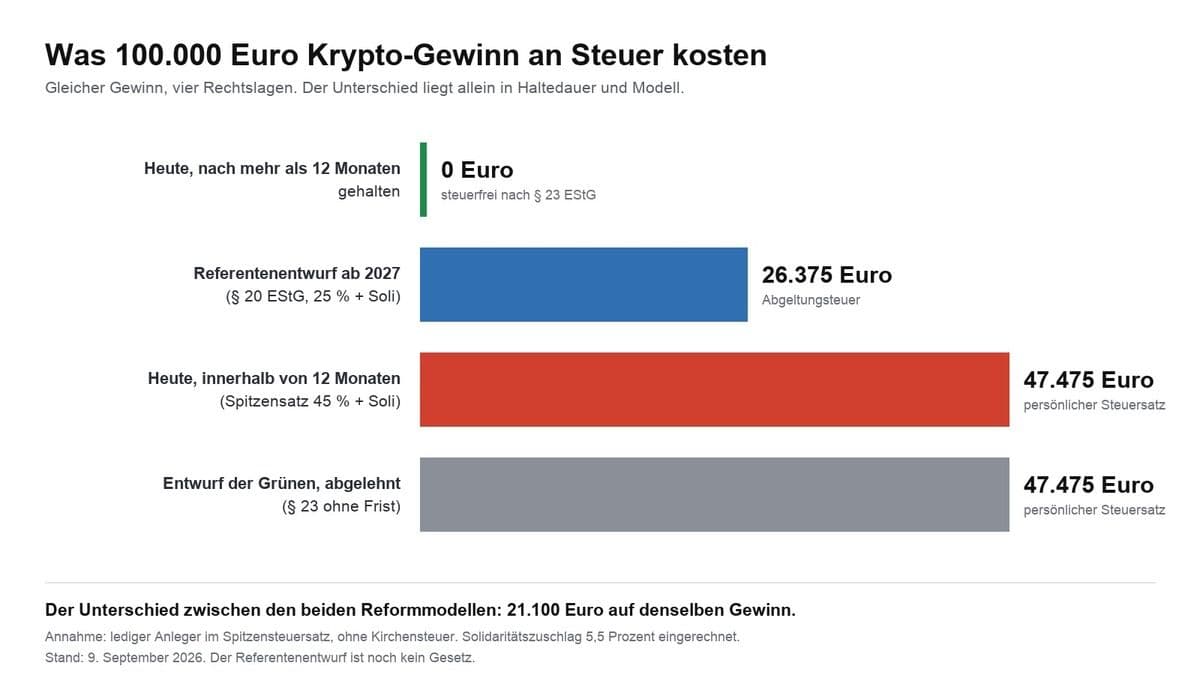
Crypto Tax in Germany: What Applies in 2026 and What Is Set to Change in 2027
Crypto gains are tax-free after twelve months; before that your personal tax rate of up to 45 percent applies. What triggers tax, how the holding period is calculated, what happens with staking and losses, and what the draft bill would change from 2027.

September 27, 2026 1:17 PM
Dogecoin Price: What to Check on Holding Period and Custody Before the Year End
The Dogecoin price stands at $0.0977 on September 27, 2026 and has barely moved in a day. That calm is exactly the moment to work through the holding period, the reporting duty from 2026 and custody without any time pressure.
August 12, 2026 9:12 AM

Bitcoin Losses and Dividends in Austria: How the Tax Offset Works
Can a Bitcoin loss be offset against dividends? This is how loss offsetting works in Austria. It also shows when a tax return is needed for it.
September 17, 2026 7:12 PM

Gifting Bitcoin to Children: Allowance, Holding Period and the Tax Office Report
Transferring Bitcoin to your child hands over your holding period and your entry price along with the coins. This guide sets out what really applies in Germany on the allowance, the reporting deadline, representation and custody.
August 21, 2026 4:24 AM

Forced Sale on a Crypto Exchange: Which Moment Counts for the Holding Period and What You Must Document
At Luno, Kraken and Valour the deadlines are running out, after which the provider realises the remaining holding itself. For tax purposes that is a disposal, and what governs it is the exchange's timestamp.
September 22, 2026 10:13 AM

Circle Lends Against Bitcoin via cirBTC: Why the Wrapper Can Cost You the German Holding Period
Circle launched loans against deposited bitcoin on September 21, 2026. In Germany, the detour through the cirBTC token is very likely a swap, and a swap restarts your one-year holding period.
August 24, 2026 4:22 AM

Selling XRP After a 53 Percent Week: What the Holding Period Costs
XRP trades at $1.51 after a weekly gain of a good 50 percent, yet your net proceeds are decided by the purchase date. This article works through the holding period, the exemption limit and FIFO at measured reference-date prices.
August 14, 2026 6:23 AM

Bitcoin Savings Plan and Tax: How the Holding Period, FIFO and the Exemption Limit Interact on Monthly Buys
Every savings plan instalment is a separate acquisition for tax purposes, with a holding period of its own. How the exemption limit, the order of disposal and record-keeping duties interact on monthly Bitcoin buys, with the sources from the statute and the Ministry of Finance circular.
September 24, 2026 4:28 AM

Crypto Trading Bots and Tax: What Applies With Thousands of Trades a Year
A bot turns one investment decision into hundreds of disposals, and the tax office counts every single one. This guide explains the holding period, FIFO, the exemption limit and the record-keeping duties, and what to set up before the bot makes its first trade.
August 26, 2026 10:25 PM

Selling Bitcoin at a Loss: Loss Offsetting in Austria
Sold Bitcoin at a loss? Austria allows the loss to be offset against certain investment income. When loss offsetting is possible and which limits apply.
September 18, 2026 10:13 AM

Bitcoin and the German Exit Tax: What Applies When You Move Abroad
Anyone emigrating with Bitcoin expects an exit tax on unrealised gains and finds nothing of the sort in the statute. Where the real risks sit is decided at four points: residence, the holding period, the legal form of your investment, and automatic reporting from 2026.
September 14, 2026 10:23 AM

Take Ethereum Profits or Wait Out the Holding Period? What the Price Jump Means for Your Tax Bill
Ether reached its highest level since the end of January on September 11, 2026, and many are asking whether to sell now. In Germany the answer hangs on the purchase date first: we work out which tranches are tax free and which of them are showing a gain at all.
August 16, 2026 6:14 AM
Crypto Credit Card Tax in Germany: Why Every Payment Is a Disposal
Paying with a crypto credit card means disposing of your coins for tax purposes. What that means for the holding period, the exemption threshold and your record-keeping duties, and which card design keeps the effort small.
August 24, 2026 10:16 AM

Crypto Tax: Why You Have to Secure Your Transaction History Before the Exchange Closes Your Account
Deadlines run out at several crypto exchanges by early September, after which accounts close and holdings are sold off by force. Anyone who does not export the trading record beforehand faces the tax return with no proof of acquisition date and purchase price.
August 22, 2026 4:47 PM

Offsetting Bitcoin Losses Against Stock Gains in Austria
Offset bitcoin losses against gains on shares? Austria allows it in principle, but only under certain conditions and usually via the tax return.
September 3, 2026 10:21 AM

Bitcoin Lost in a Wallet Hack: What Tax Applies in Austria?
Bitcoin lost to hackers? In Austria, the theft of privately held coins generally does not create a capital loss you can use for tax. Only a later payout can change that.
September 9, 2026 1:15 AM

Germany's Crypto Tax: 160 Million Euros for a 555-Billion Budget
The German finance ministry's draft bill puts a figure on the crypto tax for the first time: 160 million euros from 2028. What that number means in the 2027 federal budget, how 11.4 billion became 160 million, and what investors can read from it.

September 24, 2026 10:19 AM

Uniswap Falls 11.8 Percent After a 114 Percent Month: What to Check on Profit Taking, Holding Period and Leverage
UNI lost 11.75 percent on Wednesday morning but is still up 113.85 percent over the month. Anyone realising gains now almost certainly triggers a taxable disposal in Germany.
August 12, 2026 6:24 PM

Tokenized Stocks and Tax in Germany: When the One-Year Holding Period Applies and When the Flat Tax Bites
If you buy a tokenized stock, you often apply the crypto rule: hold for a year, then the gain is tax-free. For these products that assumption usually does not hold, and this article shows from the wording of the law which feature decides the tax regime and how to find it in the issuer documents.
October 2, 2026 4:39 AM

Donating bitcoin: when does the full market value count, when only the purchase price?
A bitcoin donation to a charitable organisation is deductible as a donation in kind, and the donation itself produces no taxable gain. The size of the deduction turns solely on whether a sale would have been taxable on the day of the transfer.
More from CryptoTicker