


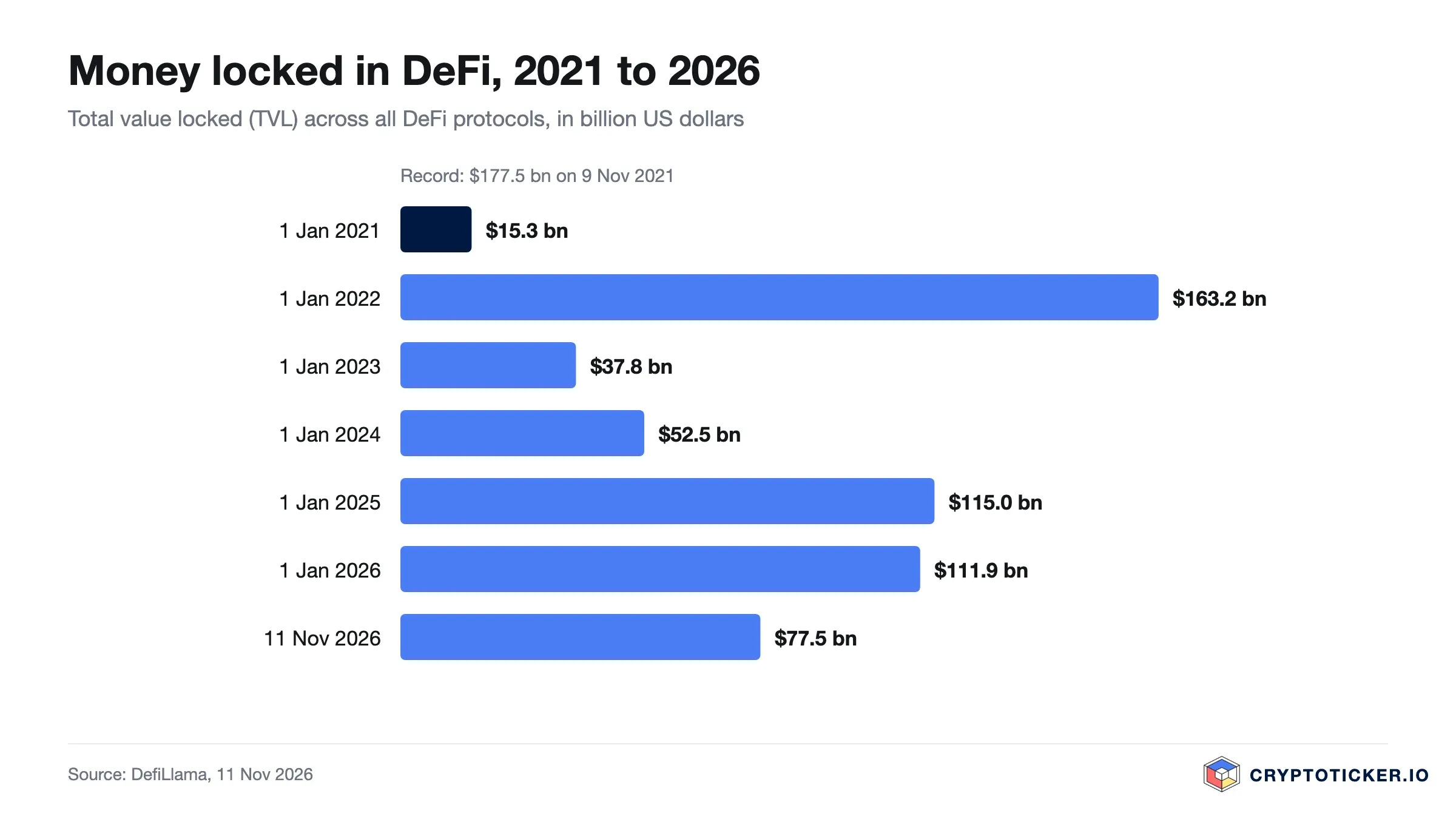
DeFi (decentralized finance) means financial services such as lending, trading and earning interest that run on smart contracts on a blockchain instead of through banks or brokers. Anyone with a crypto wallet can use them. On 11 November 2026, DeFi protocols held $77.5 billion in total value locked (TVL), according to DefiLlama; that is 44% of the record of $177.5 billion from November 2021. Ethereum hosts 53% of that money.
DeFi at a glance
- Size: $77.5 billion locked in DeFi protocols on 11 November 2026 (DefiLlama).
- Trading: decentralized exchanges handled $252.7 billion of trades in the past 30 days.
- Stablecoins: $291.7 billion in dollar stablecoins circulate, the cash of DeFi (DefiLlama).
- Largest protocol: Lido with $20.0 billion, followed by Aave with $15.1 billion.
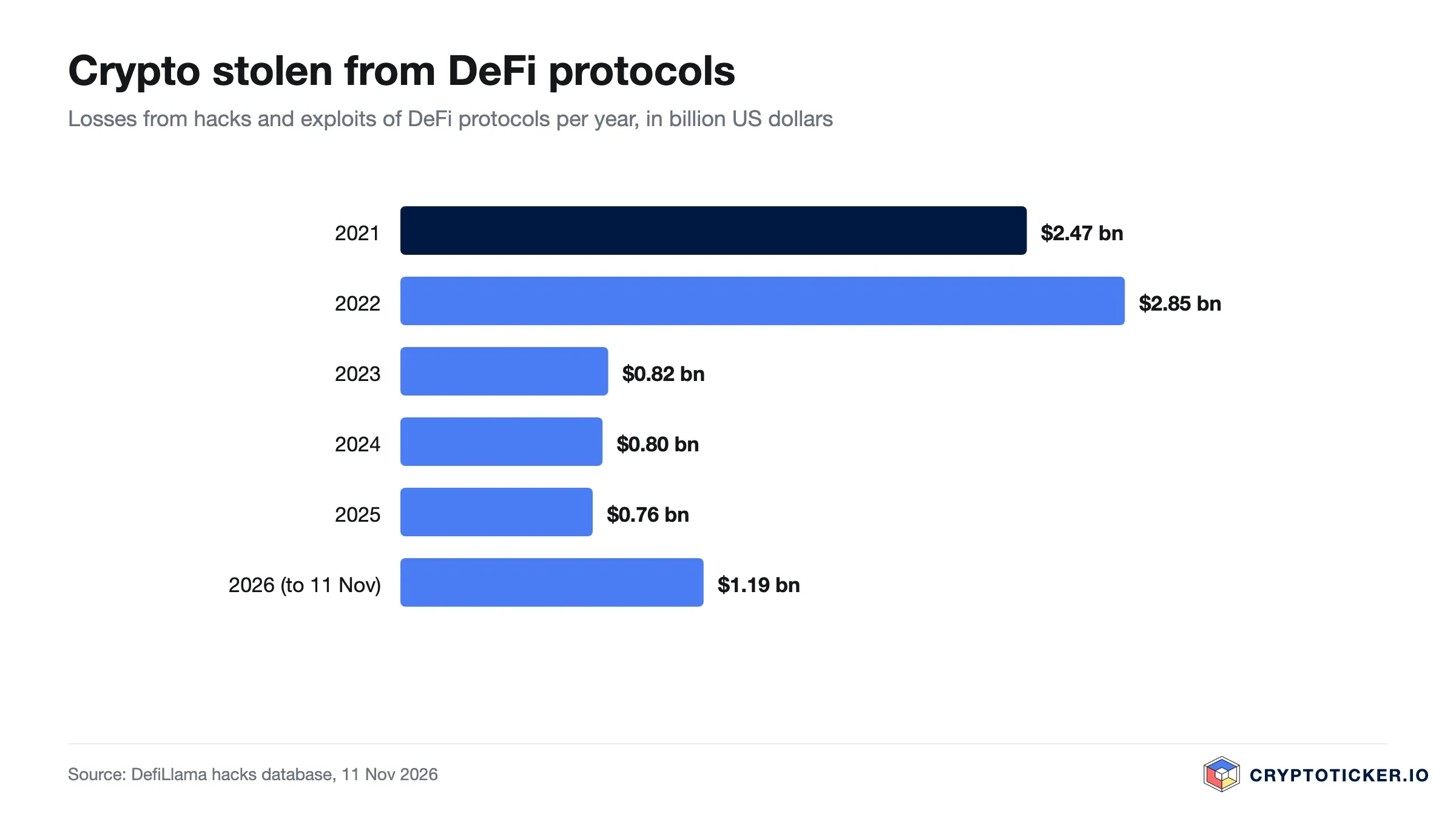
- Risk: hacks of DeFi protocols cost $0.76 billion in 2025 and $1.19 billion in 2026 so far.
- Rules: the EU's MiCA regulation leaves services that are fully decentralized, without any intermediary, outside its scope.
What is Decentralized Finance (DeFi)?
Decentralized Finance, or DeFi, represents a shift from traditional, centralized financial systems to peer-to-peer finance enabled by decentralized technologies built on Ethereum and other smart-contract blockchains such as Solana (SOL), BNB Chain (BNB), Base and Tron (TRX). DeFi leverages smart contracts to create protocols that replicate existing financial services in a more open, interoperable, and transparent way. It encompasses a variety of financial applications in cryptocurrency or blockchain geared toward disrupting financial intermediaries.
How Does DeFi Work?
DeFi operates on the principle of removing intermediaries from financial transactions. Utilizing blockchain technology, mainly Ethereum, DeFi applications (dApps) enable financial transactions to be executed automatically through smart contracts, without the need for banks, brokers, or other third parties.
- Smart contracts: These are self-executing contracts with the terms of the agreement directly written into code. They run on blockchain networks and automatically execute transactions when predetermined conditions are met.
- dApps: DeFi applications, built on blockchain, offer various financial services, including lending, borrowing, earning interest, and asset trading.
- Decentralized Exchanges (DEXs): Platforms that allow users to trade cryptocurrencies without an intermediary.
- Tokens and Cryptocurrencies: Serve as digital assets or utilities within the DeFi ecosystem.
Why is DeFi Important?
DeFi is gaining attention for several compelling reasons:
- Accessibility: DeFi opens financial services to anyone with internet access, irrespective of geography.
- Transparency : Blockchain's inherent transparency allows for open and fair financial systems.
- Innovation: DeFi is a breeding ground for financial innovation, offering novel services and products.
- Interoperability : DeFi protocols and services are designed to integrate and work together seamlessly.
- Control and Ownership: Users have more control over their assets without the need for intermediaries.
Applications of DeFi
DeFi's applications are broad and varied, including:
- Lending and Borrowing: Platforms where users can lend or borrow cryptocurrencies, earning or paying interest.
- Yield Farming and Liquidity Mining: Earning rewards for providing liquidity to a DeFi protocol.
- Stablecoins : Cryptocurrencies pegged to traditional currencies, reducing volatility.
- Insurance: Decentralized insurance protocols to mitigate risks in the crypto space.
- Asset Management: Tools for managing and optimizing digital asset portfolios.
Risks and challenges
Despite its potential, DeFi is not without risks:
- Smart Contract Vulnerabilities: Bugs or flaws in smart contract code can lead to significant losses.
- Regulatory Uncertainty: The evolving regulatory landscape poses challenges.
- Market Volatility: Crypto markets can be highly volatile, impacting DeFi protocols.
- Scalability: DeFi on Ethereum faces scalability and high gas fee issues, although solutions like Layer 2 scaling are emerging.
Future of DeFi
The future of DeFi is promising, with ongoing developments focused on scalability, interoperability, and enhanced security. As the space matures, it could become a key component of a more inclusive and efficient global financial system.
DeFi in Numbers: How Big Is Decentralized Finance (DeFi) in 2026?
The total value locked measures how much crypto users have deposited into DeFi protocols. It rose from $15.3 billion at the start of 2021 to the record in November 2021, crashed in 2022 after the collapse of Terra and FTX, and climbed back to $115.0 billion at the start of 2025. With falling crypto prices it dropped to $77.5 billion by 11 November 2026, because TVL is counted in dollars.
Where DeFi runs: the largest blockchains
| Blockchain | Value locked in DeFi | Share |
|---|---|---|
| Ethereum | $40.9 bn | 52.6% |
| Base | $5.8 bn | 7.4% |
| Solana | $5.1 bn | 6.5% |
| BNB Chain | $5.1 bn | 6.5% |
| Tron | $4.9 bn | 6.3% |
| Bitcoin | $3.9 bn | 5.0% |
Values on 11 November 2026, according to DefiLlama.
The largest DeFi projects and protocols
| Protocol | Type | Value locked |
|---|---|---|
| Lido | Liquid staking | $20.0 bn |
| Aave V3 | Lending | $15.1 bn |
| Morpho Blue | Lending | $10.8 bn |
| Binance staked ETH | Liquid staking | $8.0 bn |
| EigenCloud | Restaking | $5.3 bn |
| Ethena USDe | Synthetic dollar | $5.0 bn |
| SparkLend | Lending | $4.5 bn |
| Sky Lending | Stablecoin issuer (CDP) | $4.0 bn |
Liquid staking and lending dominate: Lido holds staked ether, Aave and Morpho lend crypto against collateral. Uniswap, the largest decentralized exchange, locks less money but moves billions in trades. Our guide on how to stake crypto explains liquid staking, and our crypto lending comparison shows where you can lend crypto.
How to Use DeFi: A Step-by-Step Guide
- Set up a self-custody wallet: MetaMask, Rabby or Phantom. Keep the seed phrase offline; our guide on how to store crypto explains the options.
- Fund it: buy ETH, SOL or a stablecoin on an exchange and withdraw it to your wallet. Keep a little of the network's coin for gas fees.
- Open the dApp by its official address: type it yourself or use a bookmark, never a link from an ad or a direct message, and connect your wallet.
- Start small: swap a small amount on a decentralized exchange or deposit into a lending market such as Aave, and check what the transaction does before you sign.
- Revoke what you no longer use: token approvals stay active until you revoke them; remove old ones with your wallet or a block explorer.
DeFi vs. Centralized Finance and Traditional Finance
Banks, brokers and centralized exchanges (CeFi) hold your money and decide who may use their financial services. In DeFi, smart contracts on public blockchains take that role, and you keep the private keys.
| DeFi | Traditional finance | |
|---|---|---|
| Access | Anyone with a wallet and internet | Account, identity check, often minimum balances |
| Opening hours | 24/7, settlement in minutes | Business hours, settlement in days |
| Who holds your money | You, in your wallet | The bank or broker |
| Protection | No deposit insurance; code and collateral decide | Deposit insurance and regulators |
| Transparency | Every transaction public on the blockchain | Private ledgers |
DeFi Risks in Numbers
Hacks are the biggest risk in DeFi. According to the DefiLlama hacks database, attackers took $2.85 billion from DeFi protocols in 2022, the worst year so far, and $1.19 billion in 242 incidents in 2026 up to 11 November. Common causes are flawed smart contract code, stolen keys of bridges and admins, and price oracle manipulation.
Our assessment: the large, audited protocols that have run for years are far safer than new ones promising high yields, but no DeFi deposit is risk-free. Spread your funds, avoid protocols you do not understand and never put in money you cannot afford to lose.
Is DeFi Regulated?
Only partly. The EU's MiCA regulation covers crypto-asset service providers, but its recital 22 states that services provided in a fully decentralized manner without any intermediary should not fall within its scope. Front ends, stablecoin issuers and companies behind protocols can still be regulated, and in the US the rules depend on the activity. DeFi income and trades are taxable; see our guide on how to file crypto taxes.
How Decentralized Exchanges and Liquidity Pools Work
A decentralized exchange such as Uniswap has no order book. Liquidity providers deposit two tokens into a liquidity pool, and a formula in the smart contract sets the price when someone trades against the pool. The providers earn the trading fees. Because DeFi apps can call each other on chain like building blocks, developers call them money legos.
Ways to Earn With DeFi: Lending, Liquidity Mining and Staking
- Lending: deposit crypto in a lending market and earn interest from borrowers.
- Liquidity providing: supply two tokens to a decentralized exchange and earn a share of the trading fees, at the risk of impermanent loss.
- Staking and liquid staking: earn network rewards and keep a tradable token.
- Flash loans: borrow without collateral, as long as you repay in the same transaction; if not, the transaction reverts. Traders use them for arbitrage, attackers have used them to manipulate prices.
- Prediction markets: bet on events such as elections or sporting events with stablecoins.
- Airdrops: early users of new protocols sometimes receive tokens; see our crypto airdrop guide.
The tools that track yields and risks are collected in our list of the best crypto tools.
DeFi FAQ

Rudy Fares
Equity Trader, Financial Consultant, Musician and Blockchain Aficionado. I spend my time doing Technical and Fundamental Analyses for Stocks, Currencies, Commodities and Cryptocurrencies.