
Bitcoin Back Above $80,000: Buy More, Hold or Take Profits? What to Check Now
Bitcoin is back above $80,000, for the first time since September 7. Whether you buy more, hold or take profits depends less on the daily price than on three things you can check yourself: your holding period, the way you buy, and where your coins are kept.





Which topics should we dive deeper into?
Select what genuinely interests you. Your picks feed directly into our editorial planning.
Crypto news that's actually worth your time.
Weekly. 60 seconds. Carefully curated by our editors: no hype, no promo flood, no spam.
Bitcoin is back above $80,000. According to CoinGecko data, BTC traded at around $81,000 on the evening of Friday, September 18, 2026, up a good 6 percent on the day and at its highest level since September 7. Many investors now face the same question: buy more, hold or take profits? The answer depends less on the daily price than on three points you can check yourself: your holding period, the way you buy, and where your coins are kept.
The price, liquidation and ETF figures in this article are documented. Where it turns to what comes next, this is an assessment by our editorial team, and we mark it as such. We summarised the day's news flow in our article Bitcoin price back above $80,000.
Bitcoin above $80,000: the numbers at a glance
The daily range ran from $76,205 to $81,213. Over the week Bitcoin is up a good 4 percent, over 30 days close to 19 percent. Market capitalisation stands at around $1.63 trillion. The wider picture is more sober: over twelve months BTC is down around 31 percent, and a good third still separates the price from the all-time high of $126,080 set in October 2025.
Why is Bitcoin rising? Three reasons for the recovery
First, regulation. The US derivatives watchdog CFTC sent two rule proposals for crypto markets to the White House for review on September 17, two days after the CLARITY Act failed in the US Senate. The market read that as a sign that regulation in the US is moving ahead even without a new law.
Second, liquidations. According to CoinDesk, short positions on Bitcoin worth around $238 million were force-closed within 24 hours, and around $470 million across the market as a whole. Traders who had bet on falling prices with leverage had to buy back, which accelerated the move.
Third, ETF demand. US spot Bitcoin ETFs recorded net inflows of around $159.5 million again on Thursday, according to financial media. Inflows mean the fund providers have to buy Bitcoin in the market.
What still argues against Bitcoin despite the rise
Interest rates are going up. The US Federal Reserve raised its benchmark rate by 0.25 percentage points this week, and the Bank of Japan followed overnight into Friday. Higher rates make risk assets less attractive, and Bitcoin currently trades closely in step with US technology stocks. Our assessment: as long as central banks are tightening, every recovery stays exposed to setbacks.
 Buying Bitcoin: the best providers compared
Buying more Bitcoin at $80,000: lump sum or savings plan?
Anyone who wants to buy now faces a choice. A lump-sum purchase uses the current price in full, but carries the risk of entering right before a pullback. A savings plan buys a fixed amount at fixed intervals, so less Bitcoin when prices are high and more when they are low. That effect is called dollar cost averaging: the average entry price evens out over time, without you having to pick the right moment.
Our assessment: after a daily gain of 6 percent that rests in good part on liquidations, there is a strong case for spreading a planned larger purchase across several dates. If you want to invest regularly anyway, you can automate it with a Bitcoin savings plan. Providers for one-off purchases are listed in our overview of where to buy Bitcoin.
Limit order instead of market order on volatile days
On days with wide swings, the order type is worth a look. A market order is executed immediately at the best available price, which can differ noticeably from the quoted price in hectic moments. A limit order sets the maximum price you are prepared to pay. It may not be filled straight away, but it protects you from a worse price.
Hold or sell Bitcoin: what the holding period decides
If you are thinking about taking profits, look at your purchase date first. In Germany, Bitcoin counts as a private disposal transaction under section 23 of the Income Tax Act. If you sell at a profit within one year, the gain is taxed at your personal income tax rate, provided all private disposal gains for the year together exceed the exemption limit of 1,000 euros. Above that amount the gain is taxable in full. After a holding period of more than one year, the gain is tax free.
That has a practical consequence: anyone who bought in October 2025 and is close to the end of the one-year period may hand a large share of the gain to the tax office by selling a few weeks too early. Where there have been several purchases, the FIFO principle applies: the coins bought first count as the ones sold first.
Locking in Bitcoin gains: partial sale and stop-loss
There are middle paths between holding and selling. A partial sale secures part of the gain and lets the rest run, which takes the edge off the decision. A stop-loss order sells automatically when the price falls below a set threshold. It limits losses, but with Bitcoin it comes with a catch: in fast downward moves it is executed at the next available price, which can be well below the threshold. If you place such an order, do not set the threshold too tightly, or a normal daily swing will trigger it.
 Storing Bitcoin safely: hardware wallets compared
Storing Bitcoin: exchange or your own wallet?
After a purchase the coins sit at the exchange at first. That is convenient, but it means the exchange holds the keys. For small amounts and active trading it is defensible, not least because licensed providers have had to keep client assets separate since MiCA. If you want to hold Bitcoin for years, for instance to reach the tax-free holding period, you are safer with your own hardware wallet. There the private key sits offline on a device you control yourself. The seed phrase, the word list used for recovery, belongs on paper or metal and never in a photo or a cloud. Suitable devices are weighed up in our hardware wallet comparison.
If the coins stay at an exchange, it is worth checking the provider. Since the German transition period ended at the close of 2025, platforms serving clients in Germany need authorisation as a crypto-asset service provider under the EU regulation MiCA. Whether a provider holds one is shown in the public register of the European securities regulator ESMA. Where the entry is missing, so are the protections that come with authorisation.
Bitcoin price: which levels investors are watching now
The $80,000 mark is the first test. It has been resistance several times in recent weeks, a price area where sellers dominated supply. If Bitcoin holds it as support into the weekend, that argues for more than a brief countermove. On the downside, the daily low at around $76,200 marks the next zone; on the upside lies the area around $82,000, where sellers are gathering according to CoinDesk.
Our assessment: weekends in Bitcoin are often marked by thin trading because the US ETFs do not trade then. Larger swings in both directions are therefore more likely until Monday than during the week. That is a further reason not to place larger purchases on a Friday evening of all times.
Bitcoin above $80,000: what to take away
- Spread your purchases instead of betting on the daily price. After a rise that rests in good part on liquidations, a staggered entry through a Bitcoin savings plan is often the calmer choice.
- Check the holding period before every sale. A sale shortly before the one-year period expires can turn out expensive. A crypto tax tool shows you which coins are already tax free.
- Keep long-term holdings yourself. Anyone counting on the tax-free holding period should not leave coins at an exchange for years. Suitable devices are listed in our hardware wallet comparison.
(As of September 18, 2026. This article is not investment advice. Prices and fee structures change; check the terms with the provider before you buy.)
Transparency note: This article was produced with the assistance of artificial intelligence and reviewed by our editorial team before publication. All figures and claims were checked against the primary sources linked in the text. The feature image was generated with AI.
Related articles
- Bitcoin for Retirement: What Applies from 2027 and What You Decide Now
- XRP Falls 9.7 Percent: What to Check on Holding Period and Buying Route
- Bitcoin Price Prediction: What to Check on Levels, Holding Period and Leverage Before the October 28 Rate Decision
- Bitcoin Savings Plan in Austria: How the Purchase Price Is Calculated
- Bitcoin Forecast: What to Check on Levels, Holding Period and Buying Route Before the Quarter Ends
Which topics should we dive deeper into?
Select what genuinely interests you. Your picks feed directly into our editorial planning.
Crypto news that's actually worth your time.
Weekly. 60 seconds. Carefully curated by our editors: no hype, no promo flood, no spam.

September 30, 2026 4:14 AM

Bitcoin Price Before the Core PCE at 14:30 CEST: Will the $82,735 Level Hold?
At 14:30 CEST today the Bureau of Economic Analysis publishes the core PCE deflator for August, the inflation gauge the Fed anchors its 28 October rate decision to. Bitcoin stands at $83,329, less than $600 above its daily low, and anyone holding on leverage decides this morning.
September 27, 2026 4:12 AM
Bitcoin ETF Inflows Turn 2026 Positive: How to Tell If the Demand Holds
US spot Bitcoin ETFs took in roughly $2.4 billion in the week to September 25, the strongest week since October 2025, and that turns the 2026 year-to-date balance positive. Why the daily inflow fell 87 percent within the same week, and what to check on buying route, holding period and custody.
September 20, 2026 1:11 PM

Bitcoin Golden Cross: What Twelve Signals Since 2014 Really Show
Bitcoin's 50-day line has crossed its 200-day line. We evaluated all twelve golden crosses since 2014 ourselves and measured what happened afterwards. The result argues against the common reading of the signal.

September 10, 2026 4:15 PM

BW-Bank Opens Bitcoin Trading Inside the Securities Account: What to Check Before Your First Buy
Since September 9, 2026, BW-Bank customers have been able to trade ten crypto assets through their securities account, executed and held in custody by Bitpanda. The familiar securities-account setting hides three points you should settle before your first order.
August 24, 2026 10:29 AM
Buying More Bitcoin at $77,000: Savings Plan or Lump Sum
Bitcoin stands at $77,256 after gaining 22.78 percent in a week. This guide shows you how to buy more cleanly at this price and which method fits which starting position.

September 24, 2026 1:11 PM

Stellar Becomes a Payment Rail at Mastercard's BVNK: What XLM Holders Should Check on Buying Route, Memo and Holding Period
BVNK has switched on Stellar as a payment rail for business customers in more than 130 countries. On the same trading day XLM falls by around seven percent — we separate what the news means from what the pullback means for your portfolio.
September 19, 2026 7:17 AM

Chainlink Jumps Above $12: What LINK Holders Should Check Now
Chainlink trades at $12.34, 7.4 percent higher than yesterday. What part of the move is the broad market rally, what Chainlink itself contributes, and the three things you should check as a LINK holder.
September 9, 2026 4:22 PM
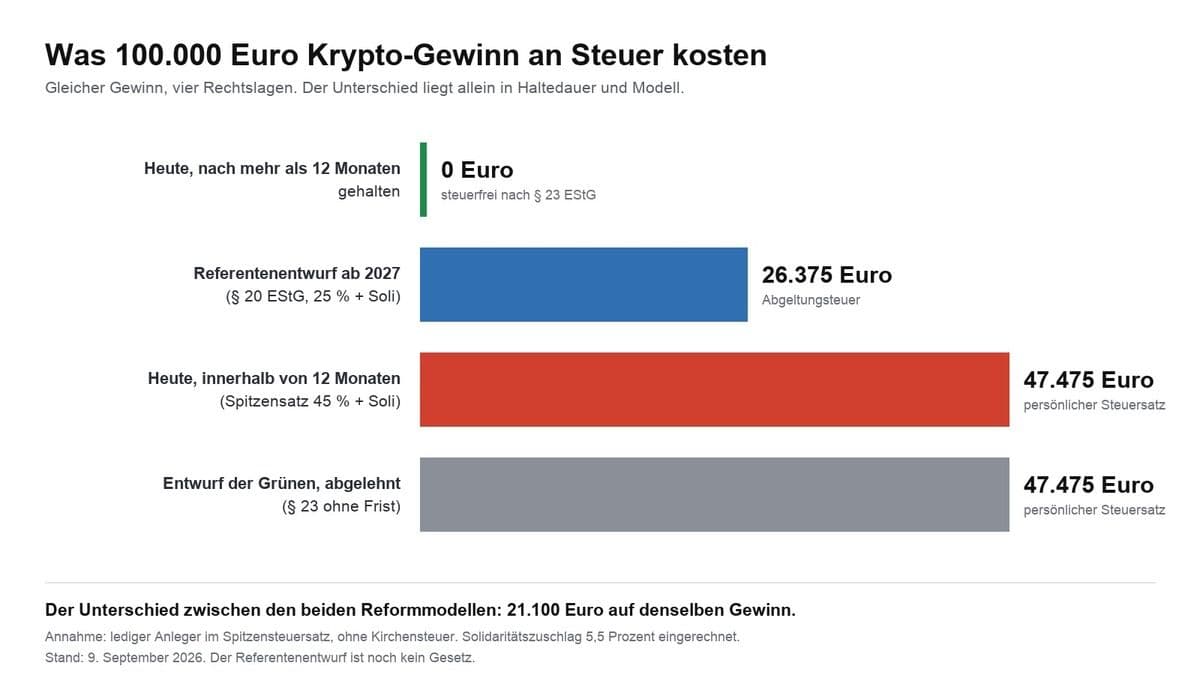
Crypto Tax in Germany: What Applies in 2026 and What Is Set to Change in 2027
Crypto gains are tax-free after twelve months; before that your personal tax rate of up to 45 percent applies. What triggers tax, how the holding period is calculated, what happens with staking and losses, and what the draft bill would change from 2027.
October 3, 2026 4:40 PM

Investing in Bitcoin With a Savings Plan or a Lump Sum: What the December 31 Tax Cut-Off Changes
Anyone putting money into Bitcoin now chooses between a lump sum, a monthly instalment and an ETN in a securities account. The German finance ministry’s draft bill would keep the one-year holding period only for holdings bought by December 31, 2026.

June 25, 2024 12:18 PM

After Bitcoin Crash, Will Altcoins Gains Reach 500%?
In the latest Bitcoin News today, and mainly after the Bitcoin Crash, crypto analysts predict a major shift towards altcoins with market corrections near the end and BTC dominance drop. Will the altcoins gain reach 500%?
September 25, 2026 7:14 PM

Chainlink Above the September High: What Open Interest, Funding Rate and Liquidation Risk Mean for LINK
Chainlink stands at $13.86, 11.2 percent higher than 24 hours ago. Our own query at OKX and Hyperliquid shows funding at the baseline rate, and what that means for leverage, buying route and tax.
September 24, 2026 10:38 AM
Fed Rate Hike in October: What to Check on Leverage, Liquidation and Holding Period After the PMI Jump
The flash US purchasing managers' index has jumped to 58.4 points, its highest level since July 2021, and input prices are rising at a pace last seen in October 2022. The futures market now prices a further Fed rate hike on October 28 at almost 70 percent, and the crypto market is falling broadly.
September 27, 2026 1:17 PM
Dogecoin Price: What to Check on Holding Period and Custody Before the Year End
The Dogecoin price stands at $0.0977 on September 27, 2026 and has barely moved in a day. That calm is exactly the moment to work through the holding period, the reporting duty from 2026 and custody without any time pressure.
September 9, 2026 4:13 PM

Bitcoin 29 Percent Below Last Year: Which Crypto Losses You Can Still Use Before the One-Year Holding Period Expires
Nine out of ten major crypto assets trade lower today than exactly twelve months ago, Bitcoin alone by 29.2 percent. We measured the price series ourselves and show why the purchase date alone decides the tax value of your loss.
September 8, 2026 1:19 AM

Germany's Crypto Holding Period: What Happens Now Signing for Petition 201716 Closed on September 15
Recap as of September 27, 2026: the signature period for German parliamentary petition 201716, which asks for the one-year crypto holding period to be preserved, closed on September 15, 2026. This article explains what ended that day, how the petitions committee proceeds and why no investor has to sell because of it.
September 24, 2026 4:11 PM

Bitcoin Cash Falls 5.5 Percent After a 50 Percent Week: Check Your Buy Route, Leverage and Holding Period
Bitcoin Cash fell to $335.19 on September 24, 2026, after gaining almost 50 percent in seven days. The rally was set off by CME's announcement of September 22; what that means for buy route, leverage, holding period and custody is set out here.
September 25, 2026 10:26 PM

Selling bitcoin privately: the tax in Germany and the records you need
A direct sale to a private individual falls under the same one-year rule as an exchange sale, but there is no tax report to go with it. This guide walks through the calculation, the 1,000 euro threshold and the records the tax office wants to see.
September 27, 2026 10:14 AM

Shiba Inu Price Prediction: What to Check on SHIB Before the December 31 Deadline
SHIB trades at $0.00000592 on September 27, 2026, around 93 percent below its all-time high. For German investors one date matters more than the chart right now: December 31, 2026.
September 24, 2026 1:34 PM

Cardano Slides Below $0.24: What ADA Holders Should Check on Leverage, Liquidation and Holding Period
Cardano has given back its move above $0.25 and trades around seven percent below the high of the past 24 hours. What that means for leveraged positions, the holding period of your tranches and the buying route under MiCA.
September 17, 2026 7:12 PM

Gifting Bitcoin to Children: Allowance, Holding Period and the Tax Office Report
Transferring Bitcoin to your child hands over your holding period and your entry price along with the coins. This guide sets out what really applies in Germany on the allowance, the reporting deadline, representation and custody.
August 14, 2026 6:23 AM

Bitcoin Savings Plan and Tax: How the Holding Period, FIFO and the Exemption Limit Interact on Monthly Buys
Every savings plan instalment is a separate acquisition for tax purposes, with a holding period of its own. How the exemption limit, the order of disposal and record-keeping duties interact on monthly Bitcoin buys, with the sources from the statute and the Ministry of Finance circular.
October 2, 2026 5:02 PM

Bitcoin or Ethereum in the fourth quarter of 2026: the two largest crypto-assets compared
Bitcoin is scarce by protocol rule, Ethereum only as scarce as its utilisation, and on access and tax in Germany the paths part again. This comparison puts the verifiable figures on supply, usage, staking and purchase route side by side, without making a price call.
September 24, 2026 4:16 AM

Trump-Xi Summit at the White House: The Crypto Positions to Check Before the Meeting
Xi Jinping is on a state visit to Donald Trump today, and the crypto market comes into the meeting carrying the gains of an exceptionally strong week. What to check on leverage, holding period and custody before the first headline runs.
September 19, 2026 10:35 AM

The Cost Average Effect with Bitcoin: What Twelve Instalments Really Deliver
Twelve monthly instalments of 100 euros produced an average price of 66,472 euros and ran 33.6 percentage points ahead of the lump sum purchase on the same starting day. The calculation also shows when the savings plan is the worse route.
September 17, 2026 10:22 PM
Selling Bitcoin at a Loss and Buying It Straight Back: What That Does to Your Holding Period
Germany has no wash sale rule: the loss stays deductible even if you buy back immediately. The buyback, however, restarts the one-year period for every new unit.
September 16, 2026 7:12 PM

Borrowing Against Bitcoin Instead of Selling: When German Tax Still Applies
Posting Bitcoin as collateral for a loan is not a sale in Germany, because section 39 of the Fiscal Code keeps the coins attributed to you for tax purposes. Tax arises only when the collateral is liquidated, and then the one thing that decides the bill is how long you held the coins beforehand.
September 14, 2026 4:19 AM
Fed Rate Decision of September 16: What It Means for Your Bitcoin Savings Plan
Recap as of September 27, 2026: this article appeared before the US Federal Reserve's rate decision on September 16, 2026, when futures markets mostly expected a hike. It describes what a hike means for your monthly instalment, a running crypto loan and your holding periods.
More from CryptoTicker