
Bitcoin Savings Plan and Tax: How the Holding Period, FIFO and the Exemption Limit Interact on Monthly Buys
Every savings plan instalment is a separate acquisition for tax purposes, with a holding period of its own. How the exemption limit, the order of disposal and record-keeping duties interact on monthly Bitcoin buys, with the sources from the statute and the Ministry of Finance circular.





Which topics should we dive deeper into?
Select what genuinely interests you. Your picks feed directly into our editorial planning.
Crypto news that's actually worth your time.
Weekly. 60 seconds. Carefully curated by our editors: no hype, no promo flood, no spam.
A Bitcoin savings plan takes the timing question off your hands. You buy a fixed amount every month, whether the price is rising or falling. Tax law grants you no such convenience: twelve instalments a year become twelve separate acquisitions, each with its own date, its own price and its own clock.
For you as an investor, that has one consequence. Whether a later sale stays tax-free is decided at the level of the individual tranche and the order in which the tax authorities treat those tranches as sold, never at the level of your total holding. Sell after three years of a savings plan and you do not hold one uniform stock of Bitcoin; you hold 36 acquisitions with 36 deadlines. This article sorts out the mechanics: holding period, exemption limit, order of disposal, valuation and record-keeping, each with its source.
Why a Bitcoin savings plan consists of many separate purchases for tax purposes
A savings plan is technically a standing order to buy: the exchange executes an order on a fixed date and credits you with the fraction of a Bitcoin you have acquired. For tax purposes, each of those executions is an acquisition within the meaning of German income tax law, with its own point in time, its own acquisition cost and its own holding period.
The savings plan therefore differs from a one-off purchase only in the number of events. Invest €6,000 in a single trade and you have one deadline to watch. Invest €250 a month for 24 months and you have 24 of them. Which providers in Germany offer automated instalments at all, and at what cost, is set out in our comparison of Bitcoin savings plans. The tax mechanics behind them are identical at every provider.
The one-year holding period under Section 23 EStG runs separately for every instalment
Gains from selling privately held crypto assets are private disposal transactions. The governing provision is Section 23(1) sentence 1 no. 2 of the German Income Tax Act: disposals of other assets are taxable where the period between acquisition and disposal is no more than one year. Where more than a year passes between purchase and sale, the gain falls outside taxation.
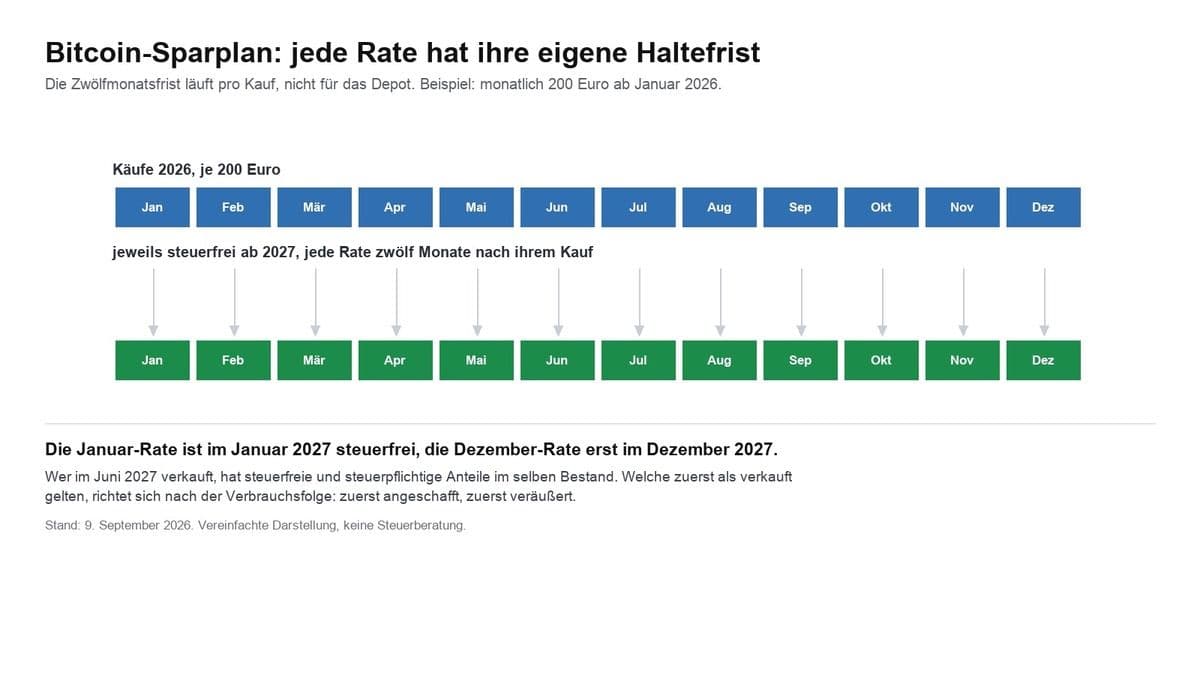
For a savings plan, this amounts to a rolling exemption. The March 2025 instalment is out of the period from March 2026, the April 2025 instalment from April 2026. If you sell part of your holding in May 2026, one and the same sale can contain tax-free and taxable portions at once.
What “other assets” means under Section 23 EStG
That crypto assets fall under this provision has been settled at the highest judicial level and is more than administrative opinion. In its judgment of February 14, 2023 (case no. IX R 3/22), the Federal Fiscal Court held that crypto assets are other assets within the meaning of the provision; the Federal Ministry of Finance cites the judgment at margin no. 53 of its circular. In practice: no flat-rate withholding tax, no saver’s allowance, and instead your personal income tax rate on gains realised inside the one-year window.
The €1,000 exemption limit: why one euro more makes the entire gain taxable
Section 23(3) sentence 5 EStG is precise: gains remain tax-free where the total gain from private disposal transactions in the calendar year came to less than €1,000. This is an exemption limit rather than a tax-free allowance. At €999 of gain you pay nothing; at exactly €1,000 the full amount becomes taxable.
Two details are regularly overlooked with savings plans. The limit applies to all private disposal transactions of a calendar year taken together, so gold sales inside the one-year window count as well. And the figure that is tested is the total gain, never gross turnover: losses from other deadline-bound sales in the same year reduce the tax base before the limit is applied.
 Crypto tax tools and portfolio trackers compared
Order of disposal: individual identification, FIFO and the average-cost method
When you sell out of a holding built from many instalments, it has to be clear which tranche counts as disposed of. The Federal Ministry of Finance circular of March 6, 2025 on individual questions of the income tax treatment of certain crypto assets settles this at margin no. 61, in three steps.
The starting point is individual identification: where the specific unit can be allocated individually, that unit counts as sold. Where this is not possible, the crypto assets of a given trading designation acquired first are deemed disposed of for the purposes of the holding period, and the average-cost method applies to the valuation. As a simplification, you may assume that the units acquired first were sold first, that is first in, first out.
In practice this means the order of purchase is unavoidable for the deadline, while for valuation you have a choice between the average-cost method and FIFO. On a savings plan that has been running for years, that choice quickly amounts to a three-figure sum, because the early instalments were executed at prices far removed from the later ones.
Wallet-by-wallet treatment: why the spread of your purchases across wallets counts
The order is not formed across your entire holding. Margin no. 61 makes clear that a wallet-by-wallet view applies. Within a wallet, the chosen method has to be retained until all crypto assets of that trading designation there have been sold in full; only after a subsequent new acquisition may you switch. If you later move holdings to your own wallet in portions, document those transfers. Without a record of which tranche went where, individual identification drops out as an option.
The ten-year period for currency tokens: why lending does not tie up your savings plan holdings for longer
Section 23(1) sentence 1 no. 2 sentence 4 EStG extends the period to ten years where income is generated from an asset in at least one calendar year. For a long time it was open whether staking or lending would therefore burst the one-year window for Bitcoin. Margin no. 63 of the circular answers this unambiguously: for currency or payment tokens, that extension does not apply.
The income itself is untouched by this. The circular allocates lending income to other income under Section 22 no. 3 EStG at margin no. 65, and the crypto assets received for it count as acquired at the moment they accrue. A fresh one-year period therefore starts for the income.
Daily price and price source: how you may value a monthly instalment
A savings plan instalment is rarely executed at a round price. Margin no. 91 therefore permits you to apply a daily price determined according to documented rules instead of the market price at the moment of execution, provided a consistent valuation is ensured. The daily average price, a fixed time of day and the daily closing price are all admissible.
Consistency is missing, according to the same margin number, where you draw on different sources or different points in time for acquisition costs and disposal proceeds. Settle on one price source and one time of day, and hold to both for the entire term.
 Bitcoin savings plans: providers compared
Record-keeping duties: what the tax office expects after five years of a savings plan
Part III of the circular deals for the first time in detail with filing, cooperation and record-keeping duties. Margin no. 89 gets specific: where crypto assets are bought or sold through the centralised trading platforms of a foreign operator, this triggers an extended duty to cooperate under Section 90(2) of the Fiscal Code. That expressly includes retrieving transaction statements regularly and in full.
The sentence that matters most to savings plan investors comes at the end of the same margin number: missing records and data losses, for instance through the insolvency of a platform, are borne by the taxpayer. Margin no. 29a adds that retrieval is limited in time at some providers. Anyone who runs 60 instalments over five years and goes looking for the documents only at the point of sale carries that risk alone.
Tax reports and portfolio trackers: what they deliver and where their limit lies
Margin no. 29b of the circular describes the tax reports of private-sector providers with remarkable sobriety. Such reports resemble the tax certificates issued by banks on the surface, but they are built on wallet information and transaction statements that the taxpayer supplies. Their completeness therefore depends materially on the underlying data, and the results can be adjusted manually.
A report therefore carries none of the authority of a tax certificate. It is a calculation aid resting on your own data. For a savings plan with many small tranches it remains the most sensible tool nonetheless, because it carries the holding period forward for each individual tranche. A look at the comparison of crypto tax tools and portfolio trackers pays off above all on the question of whether the tool maps wallet-by-wallet methods and method retention cleanly at all.
Fees, spread and selling costs: what reduces the taxable gain
Under Section 23(3) sentence 1 EStG, the gain is the difference between the disposal proceeds on one side and the acquisition costs plus income-related expenses on the other. Order fees on a savings plan execution increase the acquisition costs; transaction fees on disposal are to be taken into account as income-related expenses under margin no. 59.
With percentage-based fees, this adds up over the years to an amount that noticeably reduces the taxable gain. The condition is that the fee per execution is evident from your records. At providers who price their margin into the spread, the cost is already contained in the execution price and therefore in the acquisition costs.
Loss offsetting: why savings plan losses only run against private disposal transactions
Section 23(3) sentence 7 EStG limits the offset: losses may be set off only up to the amount of the gain you realised from private disposal transactions in the same calendar year, and a deduction under Section 10d EStG is excluded. Sentence 8 allows a carry-back to the immediately preceding year and a carry-forward to future years, in each case again only within the same category of income.
A loss from a savings plan sale cannot be offset against your salary or against gains on shares. One further point matters: a loss after the one-year period has run is irrelevant for tax, because the transaction is no longer taxable. If you want to close out a position at a loss, you need to know which tranches are still inside the window.
The 2026 holding period debate: what savings plan investors should factor in now
The one-year period is politically contested. On August 9, 2026, CryptoTicker summarised the state of the discussion around abolishing the holding period and the associated Bundestag petition, in the article Germany’s crypto holding period faces abolition. What governs your tax return until further notice is the statutory text, and that still contains the one-year period unchanged. Any change presupposes an amendment to the Income Tax Act.
When a new rule would take effect, and whether existing holdings would be protected, is open and cannot be responsibly anticipated. The only thing you can steer today is your documentation. Anyone who keeps acquisition dates, price source and wallet allocation in good order will cope with any conceivable transitional rule.
What to take away
- Keep a tranche list from the very first instalment. Date, amount, quantity, execution price, fee and wallet all belong in it. Which providers run savings plans with traceable statements is shown in the savings plan comparison.
- Fix the valuation method once per wallet and stick to it. Average cost or FIFO, one price source, one time of day. A tool that maps wallet-by-wallet methods is in the comparison of crypto tax tools.
- Retrieve your transaction statements every year and archive them yourself. The extended duty to cooperate applies at foreign platforms, and data losses are borne by you. Which trading venues are regulated is set out in the comparison of regulated crypto exchanges.
(As of August 11, 2026. This article is not investment advice. Prices and fee structures change; check the terms with the provider before you buy. This text is no substitute for individual tax advice.)
Transparency note: This article was produced with the assistance of artificial intelligence and reviewed by our editorial team before publication. All figures and claims were checked against the primary sources linked in the text. The feature image was generated with AI.
Related articles
- Selling XRP After a 53 Percent Week: What the Holding Period Costs
- Bitcoin 29 Percent Below Last Year: Which Crypto Losses You Can Still Use Before the One-Year Holding Period Expires
- Borrowing Against Bitcoin Instead of Selling: When German Tax Still Applies
- Selling bitcoin privately: the tax in Germany and the records you need
- Crypto Tax: Why You Have to Secure Your Transaction History Before the Exchange Closes Your Account
Which topics should we dive deeper into?
Select what genuinely interests you. Your picks feed directly into our editorial planning.
Crypto news that's actually worth your time.
Weekly. 60 seconds. Carefully curated by our editors: no hype, no promo flood, no spam.

September 24, 2026 4:28 AM

Crypto Trading Bots and Tax: What Applies With Thousands of Trades a Year
A bot turns one investment decision into hundreds of disposals, and the tax office counts every single one. This guide explains the holding period, FIFO, the exemption limit and the record-keeping duties, and what to set up before the bot makes its first trade.
September 17, 2026 7:12 PM

Gifting Bitcoin to Children: Allowance, Holding Period and the Tax Office Report
Transferring Bitcoin to your child hands over your holding period and your entry price along with the coins. This guide sets out what really applies in Germany on the allowance, the reporting deadline, representation and custody.
August 21, 2026 1:42 PM

Writing Off a Total Crypto Loss: When the Tax Office Recognises Worthless Coins
A token that has collapsed only reduces your tax once you actually dispose of it. What applies to delisting, exchange insolvency and worthless holdings under Section 23 of the German Income Tax Act, and how you offset losses.
September 14, 2026 10:23 AM

Take Ethereum Profits or Wait Out the Holding Period? What the Price Jump Means for Your Tax Bill
Ether reached its highest level since the end of January on September 11, 2026, and many are asking whether to sell now. In Germany the answer hangs on the purchase date first: we work out which tranches are tax free and which of them are showing a gain at all.
August 24, 2026 10:29 AM

Buying More Bitcoin at $77,000: Savings Plan or Lump Sum
Bitcoin stands at $77,256 after gaining 22.78 percent in a week. This guide shows you how to buy more cleanly at this price and which method fits which starting position.
October 3, 2026 4:40 PM

Investing in Bitcoin With a Savings Plan or a Lump Sum: What the December 31 Tax Cut-Off Changes
Anyone putting money into Bitcoin now chooses between a lump sum, a monthly instalment and an ETN in a securities account. The German finance ministry’s draft bill would keep the one-year holding period only for holdings bought by December 31, 2026.
September 24, 2026 10:19 PM

Bitcoin for Retirement: What Applies from 2027 and What You Decide Now
Bitcoin is not permitted in any state-subsidised retirement product, including the new retirement savings account from 2027. Anyone who still wants to use crypto assets for their own pension goes through private assets, and there a cutoff date at the end of 2026 is shifting the tax rules right now.
September 9, 2026 4:22 PM
Crypto Tax in Germany: What Applies in 2026 and What Is Set to Change in 2027
Crypto gains are tax-free after twelve months; before that your personal tax rate of up to 45 percent applies. What triggers tax, how the holding period is calculated, what happens with staking and losses, and what the draft bill would change from 2027.
September 23, 2026 10:25 AM

Airdrop tax: when free coins are taxable in Germany
Whether you have to pay tax on an airdrop is decided by a single question: did you do something for the coins? This guide takes you through both cases, the valuation at the market price, and the records the tax office has demanded since the 2025 assessment period.
September 17, 2026 10:22 PM

Selling Bitcoin at a Loss and Buying It Straight Back: What That Does to Your Holding Period
Germany has no wash sale rule: the loss stays deductible even if you buy back immediately. The buyback, however, restarts the one-year period for every new unit.
September 25, 2026 4:20 AM

Crypto as a Down Payment for a German Mortgage: What Banks Require
Since April 2023 a house in Germany can no longer be paid for in Bitcoin; section 16a of the Money Laundering Act bans it outright. Your crypto holdings still work as a down payment, provided you take the route through the euro and prove the origin without gaps.
September 8, 2026 1:19 AM

Germany's Crypto Holding Period: What Happens Now Signing for Petition 201716 Closed on September 15
Recap as of September 27, 2026: the signature period for German parliamentary petition 201716, which asks for the one-year crypto holding period to be preserved, closed on September 15, 2026. This article explains what ended that day, how the petitions committee proceeds and why no investor has to sell because of it.
September 9, 2026 4:29 PM
Bitcoin and Taxes in Germany: Holding Period, Savings Plan, ETP and Mining
Bitcoin gains are tax-free after twelve months. What that means for a savings plan with twelve deadlines, why ETPs are taxed differently, and what applies to mining, gifts and losses.

September 27, 2026 1:17 PM

Dogecoin Price: What to Check on Holding Period and Custody Before the Year End
The Dogecoin price stands at $0.0977 on September 27, 2026 and has barely moved in a day. That calm is exactly the moment to work through the holding period, the reporting duty from 2026 and custody without any time pressure.
October 2, 2026 4:39 AM

Donating bitcoin: when does the full market value count, when only the purchase price?
A bitcoin donation to a charitable organisation is deductible as a donation in kind, and the donation itself produces no taxable gain. The size of the deduction turns solely on whether a sale would have been taxable on the day of the transfer.
September 18, 2026 10:13 AM

Bitcoin and the German Exit Tax: What Applies When You Move Abroad
Anyone emigrating with Bitcoin expects an exit tax on unrealised gains and finds nothing of the sort in the statute. Where the real risks sit is decided at four points: residence, the holding period, the legal form of your investment, and automatic reporting from 2026.
September 16, 2026 1:20 PM

Crypto Loss Carryforward in Germany: What Happens to Old Losses Under the 2027 Tax Plan
Losses from crypto sales land in a ring-fenced pot and can only be set against gains of the same kind. The draft bill for 2027 moves future gains into a different pot, and we show you what that means for your assessed carryforward and what your tax notice should say.
August 21, 2026 4:24 AM

Forced Sale on a Crypto Exchange: Which Moment Counts for the Holding Period and What You Must Document
At Luno, Kraken and Valour the deadlines are running out, after which the provider realises the remaining holding itself. For tax purposes that is a disposal, and what governs it is the exchange's timestamp.
September 22, 2026 10:13 AM

Circle Lends Against Bitcoin via cirBTC: Why the Wrapper Can Cost You the German Holding Period
Circle launched loans against deposited bitcoin on September 21, 2026. In Germany, the detour through the cirBTC token is very likely a swap, and a swap restarts your one-year holding period.
August 11, 2026 9:13 PM

Germany's Crypto Holding Period Faces Abolition: What Petition 201716 and the Cabinet Decision Mean for Your Tax
Petition 201716 in the German Bundestag calls for the one-year holding period for crypto assets to be kept and has already passed the quorum of 30,000 signatures. This article sets out what the cabinet decision of July 6, 2026 provides for, how much of it is binding and which records you should be pulling together now.
September 7, 2026 7:22 AM

German Crypto Holding Period Stays: The Income Tax Reform 2027 Leaves Section 23 Untouched
On September 2, 2026 the German federal cabinet adopted the draft of an Income Tax Reform Act 2027, and crypto assets do not appear in it. The one-year holding period under Section 23 of the Income Tax Act therefore continues to apply unchanged.
September 23, 2026 10:32 AM

Switching crypto exchange: what happens to the holding period and the tax when you transfer
A transfer to another exchange or to your own wallet triggers no tax and does not reset the one-year period. What does get lost is the acquisition data, and that is exactly what you need later as evidence.
August 16, 2026 6:14 AM

Crypto Credit Card Tax in Germany: Why Every Payment Is a Disposal
Paying with a crypto credit card means disposing of your coins for tax purposes. What that means for the holding period, the exemption threshold and your record-keeping duties, and which card design keeps the effort small.
September 26, 2026 1:19 AM

Germany’s Crypto Holding Period Is Wobbling: What to Check Before December 31
A CDU member of the Bundestag makes it plain: the coalition agreement does not guarantee that the one-year holding period for crypto assets will survive. What that means for purchases made before the planned cutoff date of December 31, 2026.
September 8, 2026 10:21 PM

Crypto Holding Period and Grandfathering: Why December 31, 2026 Becomes the Cut-Off in Germany's Draft Bill
A ministerial draft bill from Germany's finance ministry names a cut-off date for the first time: crypto assets acquired after December 31, 2026 are to fall under the flat-rate withholding tax. What that means for legacy holdings, running savings plans and staking income, and why nothing has been decided yet.
September 18, 2026 10:14 PM

Bitcoin Back Above $80,000: Buy More, Hold or Take Profits? What to Check Now
Bitcoin is back above $80,000, for the first time since September 7. Whether you buy more, hold or take profits depends less on the daily price than on three things you can check yourself: your holding period, the way you buy, and where your coins are kept.
September 22, 2026 4:12 PM

Nearly $1 Billion Into Bitcoin ETFs: What to Check on ETNs, Portfolio and Holding Period
US spot bitcoin ETFs took in a net $999 million on September 21, the third consecutive day of inflows. German investors cannot reach these funds: what ETNs, the holding period and your buying route mean for you.
More from CryptoTicker