
Trading Demo Account Without Signing Up: Practise Free With Real Prices (2026)
A demo account shows you whether your rule set holds before it costs money. What demo trading can do, where broker demo accounts are steering you, and how to practise at real prices without signing up.


Which topics should we dive deeper into?
Select what genuinely interests you. Your picks feed directly into our editorial planning.
Crypto news that's actually worth your time.
Weekly. 60 seconds. Carefully curated by our editors: no hype, no promo flood, no spam.
The information provided in this article is for informational purposes only and does not constitute financial advice. Cryptocurrency investments carry a high degree of risk.
A trading demo account is a trading account with play money: you place orders at real prices, but no money moves and no trade reaches an exchange. The point is not to practise making profits, but to make mistakes where they cost nothing. European regulators have put a figure on how expensive the alternative is: when ESMA adopted restrictions on CFD trading with retail clients on March 27, 2018, it cited analyses by national authorities finding that 74 to 89 percent of retail client accounts lost money, on average between 1,600 and 29,000 euros per client. This article explains what demo trading is, which demo account suits which goal, how a broker's demo account differs from an independent simulator, and how you can start with $10,000 of play money at real prices without signing up.
What Demo Trading Is and What It Is Not
Demo trading means the prices are real and the execution is simulated. You see the same charts as a trader using real money, you place the same order types, and the account calculates profit, loss, fees and, with leveraged products, liquidation too. The difference lies in three points:
- No market contact. Your order moves no price, because it never reaches an exchange. In liquid markets such as bitcoin or ether that is no problem for retail position sizes; in thin markets it is.
- No pain. A 20 percent drawdown in play money is a number; in a real account it is a feeling. That is why demo accounts train discipline only in part.
- No barrier to starting over. A demo account can be reset, a real-money account cannot. Anyone who starts again after every loss learns how to start again, not how to handle a loss.
What a demo account does very well, on the other hand, is test your rule set: setting a stop loss before entering, calculating position size from your risk, keeping to a daily limit. Whether those rules hold shows up after two weeks with play money just as reliably as with real money, only without the bill.
Trading Demo Account Without Signing Up: How to Start
Most demo accounts require registration first. The trading simulator in the CryptoTicker Trading Hub takes the other route, as of September 28, 2026:
- Open the demo account. No account, no email address, no credit card. $10,000 of play money is ready, and prices for the 50 largest coins with more than $50 million in daily volume come in live from the exchange.
- Trade without limits. An order ticket with stop loss and take profit, a chart with indicators, long or short, leverage of up to 10x or up to 100x. There is no cap on the number of trades and nothing is ranked. Fees are calculated and reduce your result, so that you do not learn a strategy that only works without costs.
- Keep your progress. Your progress is saved in the browser. You only need an account to continue on a second device, and you can reset at any time.
- Compete only if you want to. Separate from the demo account there is a trading game for adults aged 18 and over: two leagues with leverage of up to 10x and up to 100x, ranked by the CT Score, which divides return by the largest drawdown. Until the end of 2026 it runs as a pre-season, free and without prize money.
All of it runs in the browser, on a phone as on a computer, and can be added to the home screen as a web app. An app from the store is not needed.
Which Demo Account Is Best for Trading?
The best demo account is not the one with the most play money, but the one whose conditions come closest to how you will trade for real. Which one that is depends on your goal:
| Your goal | Suitable demo account | What to watch |
|---|---|---|
| Get to know a specific broker | that broker's demo account | duration, spreads and products as in the funded account |
| Practise CFDs and forex | a demo account at a regulated CFD broker | according to ESMA, 74 to 89 percent of retail accounts lost money (2018 analysis) |
| Follow stocks and ETFs over weeks | a paper portfolio at a broker or finance portal | registration, price delay, fees |
| Test chart analysis and strategies | paper trading on a charting platform | set the starting balance to what you will invest later |
| Crypto with leverage, instantly and without signing up | an independent crypto simulator | real prices around the clock, fees, liquidation |
If you have not chosen a provider yet, start where no registration is needed and commit only once your rules hold. If you already know your provider, practise in its demo account, because interface and costs will match.
Is Demo Trading Free?
Yes, in all three main forms. Brokers offer demo accounts for free because they are the route to a funded account; in return they usually ask for registration with an email address, often a phone number too. Charting platforms offer paper trading for free with a user account. The CryptoTicker trading simulator is free and needs no signup, as of September 28, 2026.
A free demo account is not always without strings, though. Watch out for sales calls after registering, or a demo that expires after 30 days and pushes you into a funded account before your rules have settled.
Broker Demo Account or Independent Simulator?
Both simulate trades at real prices. The difference lies in whom the demo account serves. The statements about broker demo accounts apply to the market as a whole, not to any particular provider; individual brokers handle it differently.
| Feature | Broker demo account (typical) | Independent simulator, such as the Trading Hub |
|---|---|---|
| Sign-up | usually registration with an email address, often a phone number too | none; an account is optional, for example for a second device |
| Duration | frequently time-limited, around 30 days, sometimes extendable | no expiry date, progress stays in the browser |
| Starting capital | often 10,000 to 100,000 virtual, sometimes freely selectable | $10,000, so that position sizes stay realistic |
| Prices | the broker's real prices, in part with the broker's spreads | real exchange prices, fees are calculated |
| Purpose | getting to know the platform, then moving to a funded account | practising without a ranking; competition only in the separate trading game |
| Products | the broker's: CFDs, forex, equities, crypto | 50 coins, long and short, leverage up to 100x |
| After the demo | advertising for the funded account, often with a deposit bonus | no real-money account exists |
A broker demo account is the right choice if you have already settled on a provider and want to get to know its interface. An independent simulator is the right choice if you want to learn the craft before you settle on a provider. Anyone who uses both in that order arrives at the broker with routine rather than with hope.
What to Look For in Any Demo Account
- Realistic starting capital. Anyone practising with $100,000 of play money who later deposits $2,000 has learned position sizes they will never trade. Set the demo account to the amount you would actually commit later, or convert every position to that amount.
- Real prices, not delayed ones. A demo account with a 15-minute price delay trains the wrong reflex. Ask whether the prices are live.
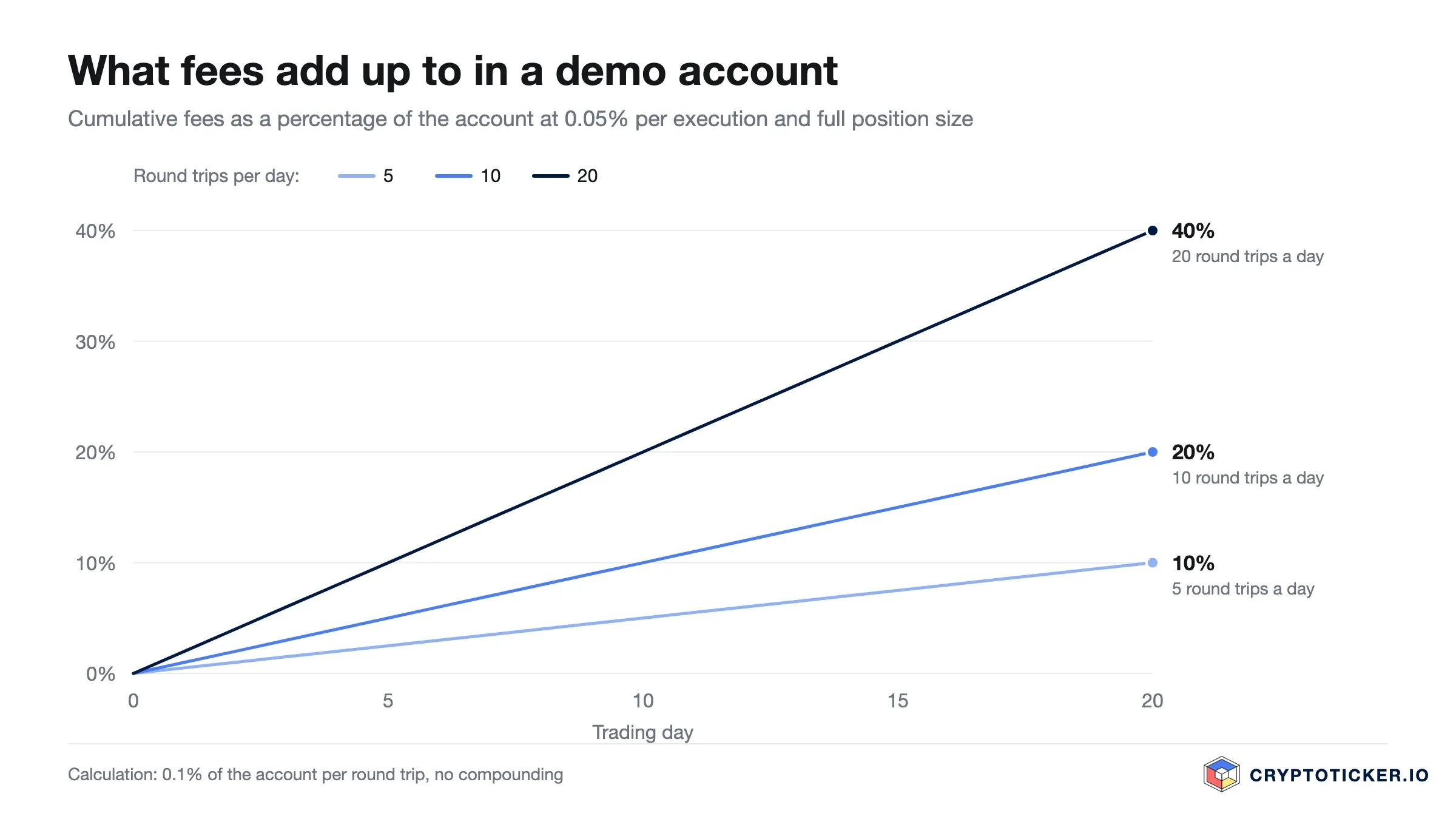
- Fees and spread in the demo. A demo account without fees makes every strategy more profitable than it is. At 0.05 percent per execution and full position size, every round trip costs 0.1 percent of the account; trading in and out 20 times a day adds up to 40 percent of your starting capital in fees after 20 trading days.
- No time pressure. A demo account that expires after 30 days pushes you towards a funded account before the rules have settled. Four weeks are the beginning, not the end.
- The same rules as later. One percent risk per trade, stop before entry, daily limit. Anyone who trades differently in the demo account than planned is measuring nothing.
Crypto Demo Account: Three Differences From Equities and Forex
A crypto demo account differs in three respects from a demo account for equities or currencies, and all three are worth experiencing with play money before they cost money:
- No close of trading. Bitcoin trades around the clock, seven days a week. A stop that is not triggered overnight is a bigger problem than on Xetra, where trading ends at 5:30 pm on weekdays.
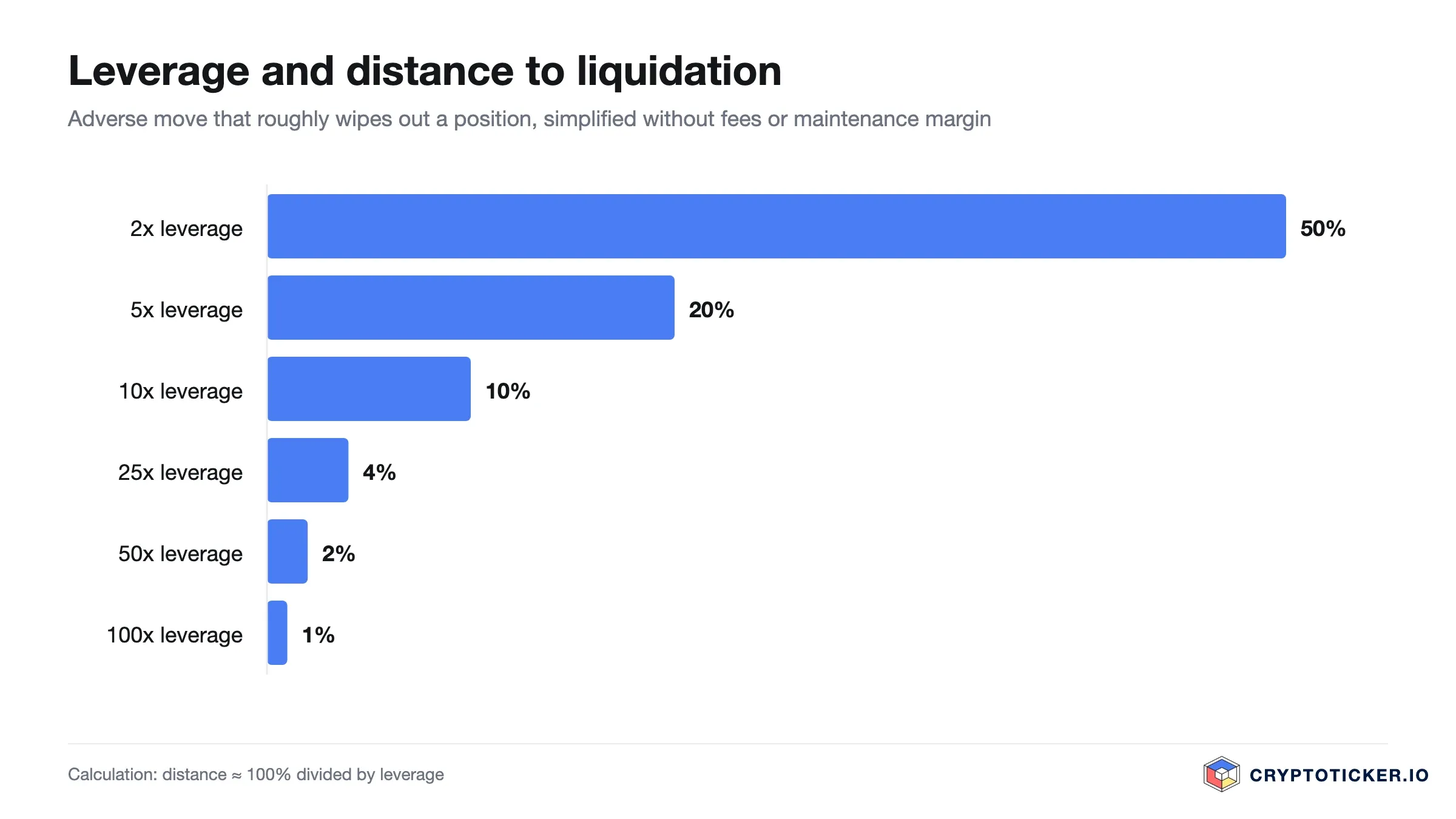
- Leverage up to 100x. Perpetual futures on crypto allow leverage that does not exist for retail clients in equities. Tenfold leverage means that roughly ten percent of adverse movement is enough to liquidate the position, before fees are counted; at 100x it is roughly one percent. How perpetuals work is set out in our comparison of the best perp DEXs.
- Swings of ten percent in a day. They are normal with smaller coins. A stop that would be generous with equities is triggered constantly here; the position size has to be correspondingly smaller.
Can I Learn Day Trading With a Demo Account?
The technique, yes; the nerves, only in part. In a demo account you learn order types, position sizing, stop discipline and how quickly fees add up when you trade many times a day. What you do not learn is how to handle a real loss: according to research by Amos Tversky and Daniel Kahneman (1992), people weigh a loss about 2.25 times as heavily as an equal gain, and that pressure is missing with play money. So the same rule applies to day trading in a demo account as to any practice: first several weeks without breaking a rule, then continue with a small real stake.
From the Demo Account to a Real Account
The switch is only worth it once three numbers hold up over several weeks: the number of rule breaches (zero), the largest drawdown (known and endured) and the result in relation to it. Then the question is not which provider is the best, but which suits your style: a regulated exchange for spot without leverage, a broker or perp DEX for derivatives. Fees, regulation and reviews are in our comparison of the best crypto brokers and our comparison of the best crypto exchanges. Your first real stake should be smaller than the play money, not larger.
Frequently Asked Questions
What is demo trading?
Trading with play money at real prices. Orders are filled in a simulation, no money moves and no order reaches an exchange. It serves to test a platform and your rule set before real capital is in the market.
Which demo account is best for trading?
The one whose conditions come closest to your later real trading: your broker's demo account if you have already chosen one, paper trading on a charting platform for analysis, and for crypto without signing up an independent simulator with real prices, fees and liquidation.
Is demo trading free?
Yes. Broker demo accounts and paper trading on charting platforms are usually free, mostly with registration. The CryptoTicker trading simulator is free and needs no signup, as of September 28, 2026.
Is there a trading demo account without signing up?
Yes. In the CryptoTicker trading simulator you trade without an account, email address or credit card, with $10,000 of play money and no cap on the number of trades. Your progress is saved in the browser.
Can I learn day trading with a demo account?
The technique, yes: order types, position sizing, stops and the effect of fees. A demo account trains your handling of real losses only in part, so move on to a small real stake afterwards, not a large one.
How long should I practise in a demo account?
Until you keep to your rules for several weeks without a breach and know your largest drawdown. A demo account that expires after 30 days is often too short for that.
Which demo account is suitable for crypto?
One with real prices around the clock, selectable leverage and calculated fees, so that liquidation and costs are realistic. The CryptoTicker trading simulator offers 50 coins, long and short, and leverage of up to 10x or up to 100x.
Do gains in a demo account count anywhere?
Not as money. Nothing is ranked in the trading simulator. If you want to compete, you play in the separate trading game, where the CT Score counts: the result in relation to the largest drawdown.
The basic terms, the position-size calculation and the four-week practice plan are in our guide to learning to trade online for free; anyone planning a first real trade after the demo account will find fees, regulation and leverage limits in our comparison of the best crypto brokers.
Sources
- ESMA, press release of 27.03.2018: ESMA agrees to prohibit binary options and restrict CFDs to protect retail investors
- Deutsche Börse, Xetra trading calendar and trading hours
- Amos Tversky, Daniel Kahneman: Advances in Prospect Theory: Cumulative Representation of Uncertainty. Journal of Risk and Uncertainty 5 (1992), pp. 297 to 323.
- CryptoTicker Trading Hub, trading simulator, as of 28.09.2026.
Transparency note: This article was produced with the assistance of artificial intelligence and reviewed by our editorial team before publication. All figures and claims were checked against the primary sources linked in the text. The feature image was generated with AI.
Related articles
- Crypto Paper Trading: Practise Free Without Signing Up, and Where the Simulation Falls Short
- Learn Trading Online for Free: Practise With Play Money and Real Prices
- Free Stock Market Games: Six Contests Compared, Three of Them With Crypto (2026)
- How to Buy Bitcoin with No KYC in 2026: 3 Ways to Do It
- BXB Market Review 2026: Platform, Pricing, and What Traders Should Know
Which topics should we dive deeper into?
Select what genuinely interests you. Your picks feed directly into our editorial planning.
Crypto news that's actually worth your time.
Weekly. 60 seconds. Carefully curated by our editors: no hype, no promo flood, no spam.

May 30, 2024 2:46 PM
How to Buy Ethereum (ETH) on eToro: A Comprehensive Guide
How to buy Ether (ETH) on eToro is made simple, with our step-by-step guide. From account creation to making your first purchase, we cover all you need to know...

September 30, 2026 7:47 PM
Crypto Virtual Portfolio: Track 50 Coins at Real Prices Without an Account
A virtual portfolio shows you how your selection would have developed without risking a single euro. Why crypto behaves differently from equities here, and how to start without registering.
September 23, 2026 10:19 PM
OKX delists ICX, STORJ and ELF: by when you have to trade or withdraw
OKX is taking DORA, ICX, STORJ, ZEUS and ELF off the market. The euro pairs end on September 30, 2026, the USDT pairs on October 3, withdrawals only on December 23. We sort out the four deadlines and show, from our own measurement of the order book, why a hurried sale can turn expensive.
September 10, 2026 4:15 PM
BW-Bank Opens Bitcoin Trading Inside the Securities Account: What to Check Before Your First Buy
Since September 9, 2026, BW-Bank customers have been able to trade ten crypto assets through their securities account, executed and held in custody by Bitpanda. The familiar securities-account setting hides three points you should settle before your first order.

April 15, 2026 8:44 PM

TradeEU Global Review 2026: What Traders Should Know Before Signing Up
Is TradeEU Global the right broker for you? We tested the platform, compared account tiers, and reviewed the full trading experience for 2026.
August 20, 2024 7:00 PM
Top Crypto Tax-Free Countries in 2024: A Guide for Crypto Investors
Here are 2024's top countries where you can trade crypto tax-free! Explore this full guide on the adopted taxation options in the current global landscape of cryptocurrency taxation.

October 31, 2023 7:13 PM

Celebrating 15 Years of Bitcoin: A Revolutionary Journey
Authored by the pseudonym Satoshi Nakamoto, the white paper titled "Bitcoin: A Peer-to-Peer Electronic Cash System.
June 19, 2021 10:01 AM
Tether El Salvador Plan – Anatomy Of A Commercial Paper
Tether is in the news as it's founder claims to have led the "Bitcoin delegation", but what's the significance of USDT in El Salvador's plan?
December 3, 2019 8:28 PM
Top 3 Methods To Withdraw Bitcoin to Bank Account
Want to withdraw Bitcoin to your bank account? Or Did you know that you can Withdraw Bitcoin to Bank Account? Unlike Fiat currency, Bitcoin is much simple to withdraw, and you may not have to wait for days to obtain […]
March 27, 2026 9:53 PM
OpenClaw AI Trading 2026: Can AI Trading Really Make You Money?
AI trading agents like OpenClaw are trending, but a $441,000 error and a 62% loss by GPT-5 reveal the brutal reality of autonomous crypto bots in 2026.

February 7, 2026 6:56 AM
Crypto Trading 101: How to Spot High-Probability Setups During Volatility
Master crypto trading 101 and learn how to trade Bitcoin during volatility. Here are professional crypto trading tips to spot high-probability setups now.
August 30, 2025 11:00 PM

Bitcoin Robot That Trades for You Making Big Gains, Read On...
Here's how to start bot trading on OKX, the world’s leading crypto exchange. Automate your trades, save time, and unlock up to 60,000 USDC in rewards.

February 14, 2025 11:26 AM
Crypto AI Trading: How to use Algo Trading to your Advantage
AI-powered trading bots are revolutionizing the crypto market, offering precision, speed, and emotion-free trading. Discover how Bitget's AI-driven trading bots simplify crypto investing and help traders maximize their profits.
May 29, 2026 1:12 PM
Best Crypto-Friendly Business Accounts for Corporates (2026 Guide)
Looking for a crypto-friendly business account? Discover how platforms like Revolut Business streamline corporate onboarding and digital asset management.
May 18, 2026 8:15 AM
Bitget Review 2026: Is Bitget a Good Crypto Exchange? What You Need to Know
Explore the key insights and safety considerations of trading on Bitget. Make informed decisions before you start trading. Read the full review now!

August 5, 2023 3:09 PM
Comprehensive Guide to Cryptocurrency Trading Bots
Delve into our comprehensive guide to cryptocurrency trading bots. Understand their importance, factors to consider when selecting a bot, and an in-depth analysis of top bots. Amplify your crypto trading potential.
June 15, 2022 9:35 AM

Best Cryptocurrency Exchanges To Short Sell During the Crash and Make Money
This post is all about the best cryptocurrency exchanges to short sell during the crash. Let's take a look at it in more detail

August 24, 2021 10:33 AM
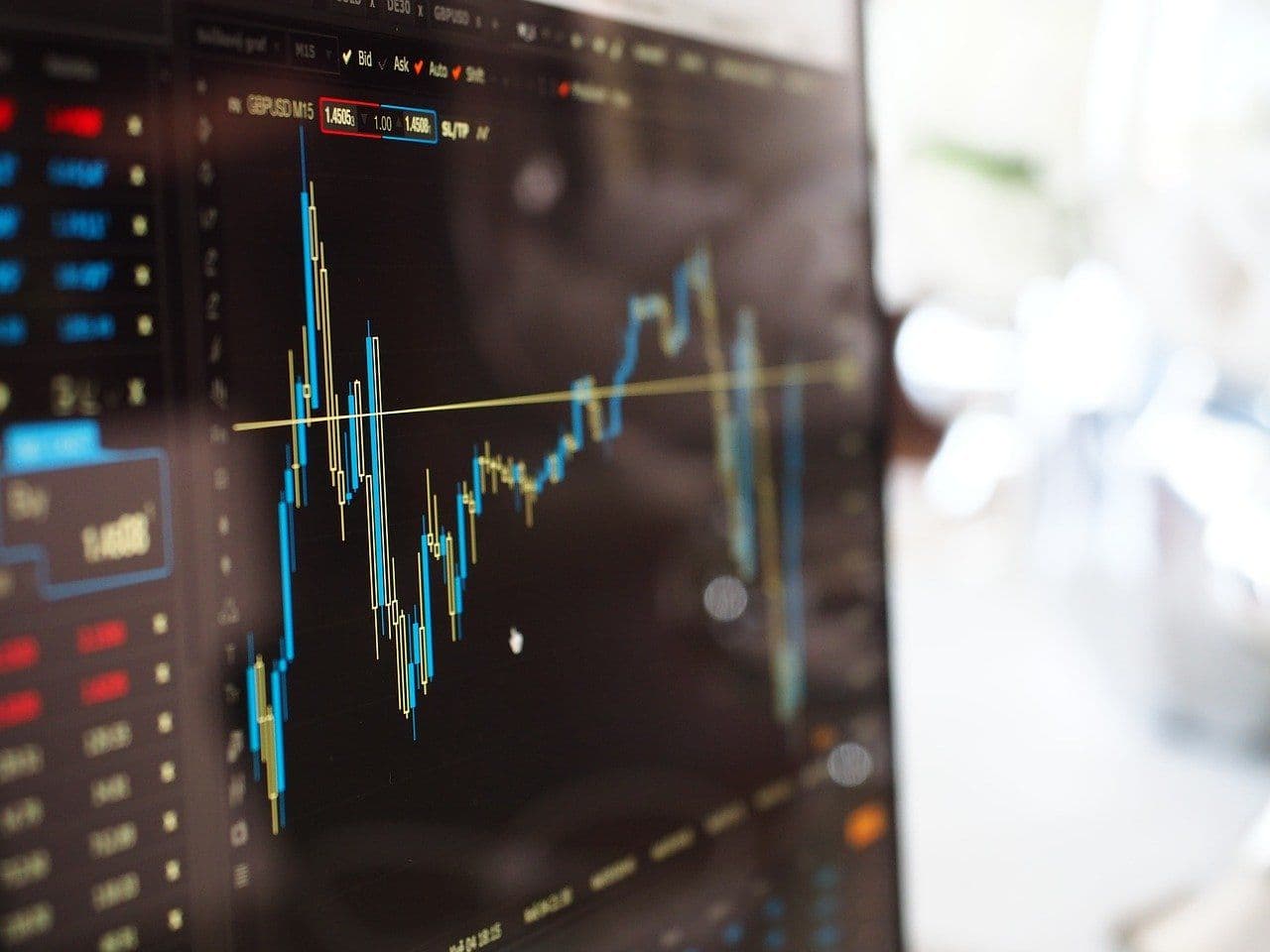
What are long and short positions in cryptocurrencies?
The concept of long and short is simple and easy to understand. The basic principle behind Crypto Trading is necessary for every trader. Long and short
September 25, 2026 4:46 PM
Binance Funding Account Becomes Stocks Account: What to Check Before September 29
From September 29, 2026, Binance moves crypto balances out of the Funding Account into the Spot Account; in January 2027 the account is renamed Stocks Account. What to check beforehand, why an outdated app version hides your balance, and what happens to savings plans and API connections.
September 24, 2026 10:29 AM

Bank Closed Your Account Over Crypto: Your Rights and the Route to a Replacement Account
After a withdrawal from a crypto exchange, banks repeatedly end the banking relationship, usually without giving a reason. What the German Payment Accounts Act guarantees you anyway, which notice period applies, and in what order you approach the supervisor, arbitration and the courts.
September 22, 2026 1:51 PM

Learning to Trade With Books: 12 Titles for Basics, Technical Analysis and Psychology
Twelve books that genuinely help when you are learning to trade, from Michael Voigt on market technique through Murphy's standard work to Kahneman and Douglas, sorted by reading order.
September 11, 2026 1:40 PM
Inactivity Fees at Crypto Exchanges: How to Check Whether Your Dormant Account Loses Money Every Month
Two providers have just raised their rates for dormant accounts, one of them to as much as 52 US dollars a month. Our own survey of 15 fee pages shows why you will almost never find the answer for your account without logging in.
August 20, 2026 1:28 PM
Crypto Trading Bots: How They Work, What They Cost and When They Pay Off
A crypto trading bot trades around the clock to fixed rules, and every one of those rules costs a fee. This guide works the costs through over twelve months, sets out the German tax position under Section 23 EStG and shows when a provider needs a BaFin licence.
July 8, 2026 12:35 PM
Bitpanda Launches 20x Margin Trading on Real Stocks and ETFs — a First for Europe
Bitpanda just went live with leveraged trading on 875+ real stocks and ETFs at up to 20x — no CFDs, no synthetic contracts, just direct exposure.
May 27, 2026 3:53 PM
Robinhood Launches AI Agent Trading Beta for Automated Investing
Robinhood introduces Agentic Trading, a feature allowing third-party AI agents to trade equities and automate retail portfolio strategies.
More from CryptoTicker