


To stake crypto, you lock coins of a proof-of-stake blockchain such as Ethereum, Solana or Cardano so that they help secure the network, and receive new coins as a reward. You can stake through an exchange with a few clicks, delegate to a validator from your own wallet, use a liquid staking token such as stETH or run your own validator. On 11 November 2026, staking paid about 2.2 percent a year on Ethereum and 4.6 to 5.5 percent on Solana, according to the yield data of DefiLlama. More than $47 billion sat in liquid staking protocols alone.
This guide explains how staking works, compares the ways to stake, shows current rewards and walks you through the steps, including the risks and how staking income is taxed.
Crypto staking: the key facts
- 2.25 percent: annual yield of Lido's staked ETH (stETH) on 11 November 2026, according to DefiLlama; Solana staking tokens paid 4.65 to 5.47 percent.
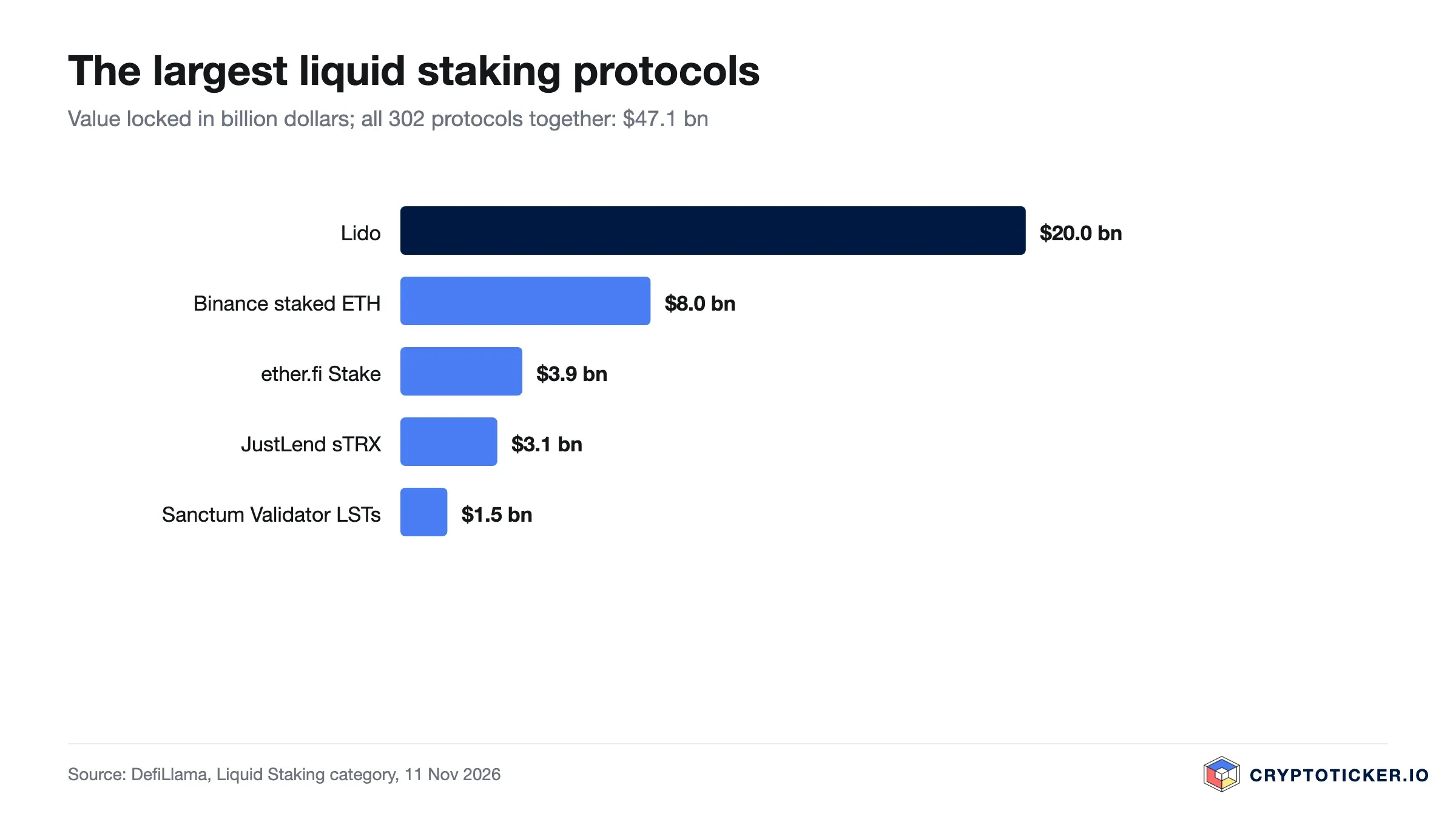
- $47.1 billion: value locked in 302 liquid staking protocols tracked by DefiLlama, led by Lido with $20.0 billion.
- 32 ETH: the minimum to run your own Ethereum validator; exchanges and liquid staking let you start with any amount.
- Not securities: the staff of the US SEC said on 29 May 2025 that protocol staking on proof-of-stake networks does not involve the offer and sale of securities.
- Taxable on receipt: in the US, staking rewards count as income when you gain control over them (IRS Revenue Ruling 2023-14).
- Not risk-free: staked coins keep their price risk, can be locked for days and can be cut by slashing if a validator misbehaves.
What is Crypto Staking?
Crypto staking is a way for crypto holders to earn rewards by locking funds of a cryptocurrency to support the operations of a blockchain network. Proof of stake is the consensus mechanism behind it: in a proof-of-stake (PoS) system, validators confirm transactions and add new blocks; to be allowed to do so, they put coins at stake as a security deposit. In return they receive rewards from new issuance and transaction fees. Whoever stakes coins either acts as a validator or lends their stake to one and shares in the rewards. The staked assets stay yours; they are only locked or delegated for the staking period.

How Does Staking Work?
In a PoS blockchain, transactions are validated by holders who stake their cryptocurrencies in the network. Here's a simplified breakdown of the crypto staking process:
- Choosing a coin to stake: Not all cryptocurrencies are stakable. Ethereum (ETH), Solana (SOL), Cardano (ADA), Avalanche (AVAX) and Polkadot (DOT) use proof of stake; Bitcoin uses proof of work and cannot be staked natively.
- Choosing a way to stake: an exchange, your own wallet with delegation, a liquid staking protocol or your own validator node.
- Staking your coins: the coins are locked or delegated. On Ethereum they back a validator; on Solana and Cardano you delegate to a validator of your choice.
- Validating transactions: validators propose and confirm blocks. If they are offline or act against the rules, they lose rewards or part of their stake.
- Earning rewards: rewards arrive in the same coin, minus the fee of the validator, pool or exchange.
Staking rewards in November 2026
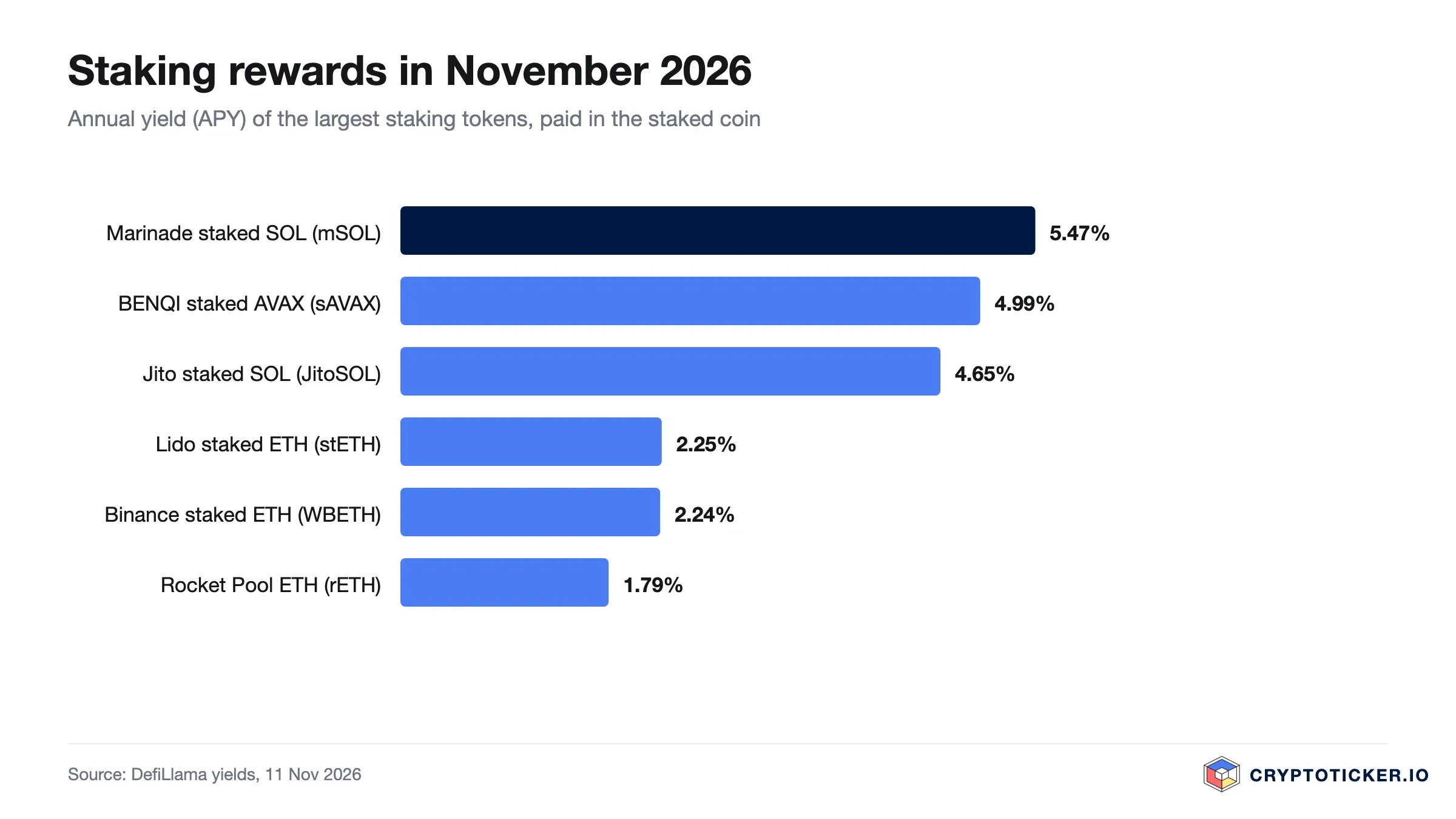
What staking pays depends on the network's issuance, the share of coins that is staked and the fees. The table shows the annual yields of the largest staking tokens on 11 November 2026, according to DefiLlama. Yields change daily, and they are paid in the staked coin, not in dollars.
| Staking token | Blockchain | Yield per year (APY) | Staked value |
|---|---|---|---|
| Lido staked ETH (stETH) | Ethereum | 2.25% | $19.96 bn |
| Binance staked ETH (WBETH) | Ethereum | 2.24% | $7.54 bn |
| Rocket Pool ETH (rETH) | Ethereum | 1.79% | $0.99 bn |
| Jito staked SOL (JitoSOL) | Solana | 4.65% | $0.85 bn |
| Marinade staked SOL (mSOL) | Solana | 5.47% | $0.19 bn |
| BENQI staked AVAX (sAVAX) | Avalanche | 4.99% | $0.20 bn |
Ethereum pays less than Solana or Avalanche because a large part of all ETH is already staked and new issuance is low. A higher yield is no free lunch: it usually comes with higher inflation of the coin, which dilutes holders who do not stake. Current Ethereum and Solana developments are covered in our reports on the Ethereum staking queue and on Solana's staking yield versus its price.
Benefits of Staking Cryptocurrencies
- Passive income: staking turns coins you hold anyway into a source of additional coins.
- Energy efficiency: compared to mining, staking needs no powerful computing hardware.
- Supporting the network: stakers contribute to the network's security and decentralization.
- Simplicity: staking on an exchange or in a wallet takes a few clicks and no technical knowledge.

Risks and Considerations
- Liquidity risk: staked assets can be locked. Many networks have an unbonding period, also called lock-up period, before you get your coins back: 21 days on the Cosmos Hub and 28 days on Polkadot. Unstaking ETH means waiting in the exit queue, which can take days or weeks when many stakers leave at once; Solana needs about two to three days to deactivate a stake.
- Market volatility: a yield of 2 to 5 percent is wiped out by a price drop of the same size within hours.
- Validator responsibilities: as a validator, you must keep your node online and up to date.
- Slashing: on networks such as Ethereum, validators that sign conflicting blocks lose part of their stake, and so do the stakers behind them. Cardano has no slashing.
- Counterparty risk: when an exchange or lender holds your staked coins, they are only as safe as that company. Customers of the lender Celsius could not withdraw from June 2022 onward.
- Liquid staking risk: staking tokens can trade below the value of the coins behind them in a market panic, as stETH did in June 2022, and they add smart contract risk.
How to Stake Cryptos
Step 1: Choose a Cryptocurrency
Research and select a proof-of-stake cryptocurrency you would also hold without staking. The yield is a bonus; the price of the coin decides whether you make or lose money. Check the yield, the lockup period and whether the network uses slashing.
Step 2: Acquire the Cryptocurrency
Buy the coin on a regulated exchange. Many exchanges offer staking right after the purchase, which is the simplest way to start; compare their fees and conditions first.

Step 3: Select a Staking Platform or Wallet
Choose between staking on the exchange, crypto staking from your own crypto wallet (for example Phantom or Solflare for Solana, or the official Cardano wallets) or a liquid staking protocol. If you want to keep control of your keys, use your own wallet; how to keep it safe is explained in our guide on how to store crypto.
Step 4: Stake Your Coins
On an exchange, select the coin and confirm the staking offer. In your own wallet, choose a validator and delegate your coins; look at its fee, uptime and size, and prefer smaller reliable validators to keep the network decentralized. For liquid staking, swap your coins for the staking token on the protocol's official website, never through a link in a message.
Step 5: Monitor Your Investment
Check your rewards and the validator's performance regularly. Note the unstaking period and any penalties for early withdrawal, and keep a record of every reward for your tax return.
Ways to stake crypto compared
There are five ways of crypto staking. They differ in who holds the keys, how much you need and how quickly you get your coins back:
| Way to stake | Who holds the keys | Minimum | Main risk |
|---|---|---|---|
| Exchange staking | The exchange | Any amount | Exchange insolvency, fees |
| Delegated staking from your wallet | You | Small amounts (Solana, Cardano) | Choice of validator |
| Liquid staking (stETH, JitoSOL) | A smart contract | Any amount | Contract risk, discount in a panic |
| Staking pool | Pool operator or contract | Small amounts | Pool fees, operator reliability |
| Own validator | You | 32 ETH on Ethereum | Downtime, slashing, technical effort |
Exchange staking
The simplest way to start: the exchange stakes for you and passes on the rewards minus a fee. You need no technical skills and no minimum amount, but you give up control over your coins.
Delegated staking
On Solana, Cardano, Polkadot or Cosmos, you keep the coins in your own wallet and delegate them to a validator. The chosen validator does the work, you receive rewards, and the coins never leave your wallet.
Liquid staking
You deposit coins into a protocol such as Lido or Jito and receive a token like stETH or JitoSOL in return. It grows with the staking rewards and can be sold or used in DeFi at any time, which solves the problem of the lock-up period.
Pooled staking
Pooled staking combines the coins of many crypto holders so that they reach the minimum for a validator together. Rocket Pool on Ethereum is an example: node operators and stakers share the rewards.
Running your own validator
On Ethereum you need 32 ETH, your own hardware or a server and technical know-how to run a validator node. You keep all the rewards, but you also carry the risk of downtime and slashing.
Staking Pools and Services
For those who don't want to stake alone or don't have enough coins to meet the minimum requirement, staking pools are a viable option. These pools combine the stakes of many investors and run the validators for them. Research and select a reputable staking pool, as risks include pool fees and the reliability of the operator. Liquid staking protocols are a special form: you receive a token that represents your stake plus rewards and can still be traded or used in DeFi. The largest by far is Lido with $20.0 billion on 11 November 2026, followed by Binance's staked ETH and ether.fi, according to DefiLlama.
Restaking goes one step further: staked ETH secures additional services and earns extra rewards, but it stacks risks on top of each other. What happened when users left one of the large restaking protocols is described in our report on ether.fi and EigenLayer. Whoever compares platforms for interest on crypto finds them in our crypto lending comparison.
Is crypto staking legal and how are staking rewards taxed?
Crypto staking is legal in the US, the UK and the EU. In the US, the staff of the Securities and Exchange Commission stated on 29 May 2025 that protocol staking, whether done yourself, through a third party that does not take custody or through a custodian, does not involve the offer and sale of securities (SEC statement on protocol staking). The statement does not cover every model; liquid staking and restaking were left aside.
For tax purposes, staking rewards are usually income. The US Internal Revenue Service ruled that rewards received count as gross income in the year you gain control over them, valued at their market price on that day (Revenue Ruling 2023-14); a later sale can add a capital gain or loss. In the UK, staking returns are generally taxed as income as well. Details are in our guides on crypto tax in the USA, crypto tax in the UK and how to file crypto tax.
Bottom line: staking pays, but it is not a savings account
Crypto staking is the simplest way to earn a return on coins you hold anyway, and it helps secure the networks you invest in. The yield is modest, 2 to 5 percent a year on the large networks, and it does not protect against price drops. Whoever stakes should prefer their own wallet or a well-known protocol, know the unstaking period and keep records for taxes. More on the basics of decentralized finance is in our DeFi guide, and all guides are on the guides page.
Staking FAQ

Rudy Fares
Equity Trader, Financial Consultant, Musician and Blockchain Aficionado. I spend my time doing Technical and Fundamental Analyses for Stocks, Currencies, Commodities and Cryptocurrencies.