

Bitcoin Ordinals are a way to inscribe data such as images, text or code directly onto individual satoshis, the smallest unit of bitcoin, so that each inscribed sat becomes a unique digital artifact. The Ordinals protocol launched in January 2023 with version 0.4.0 of the ord software; since then, 128,336,663 inscriptions have been created, according to the ordinals.com index on 11 November 2026. Ordinals live fully on the Bitcoin blockchain and inherit the security and decentralization of the Bitcoin network, but they compete with ordinary bitcoin transactions for block space.
Key takeaways: Bitcoin Ordinals
- Size of the market: 128,336,663 inscriptions and 217,264 Runes tokens exist (ordinals.com, 11 November 2026).
- First inscription: inscription 0, a 793-byte image, was mined in block 767,430 on 14 December 2022 for a fee of 322 sats (ordinals.com).
- Technology: inscriptions became possible with the Taproot upgrade, activated in block 709,632 on 14 November 2021.
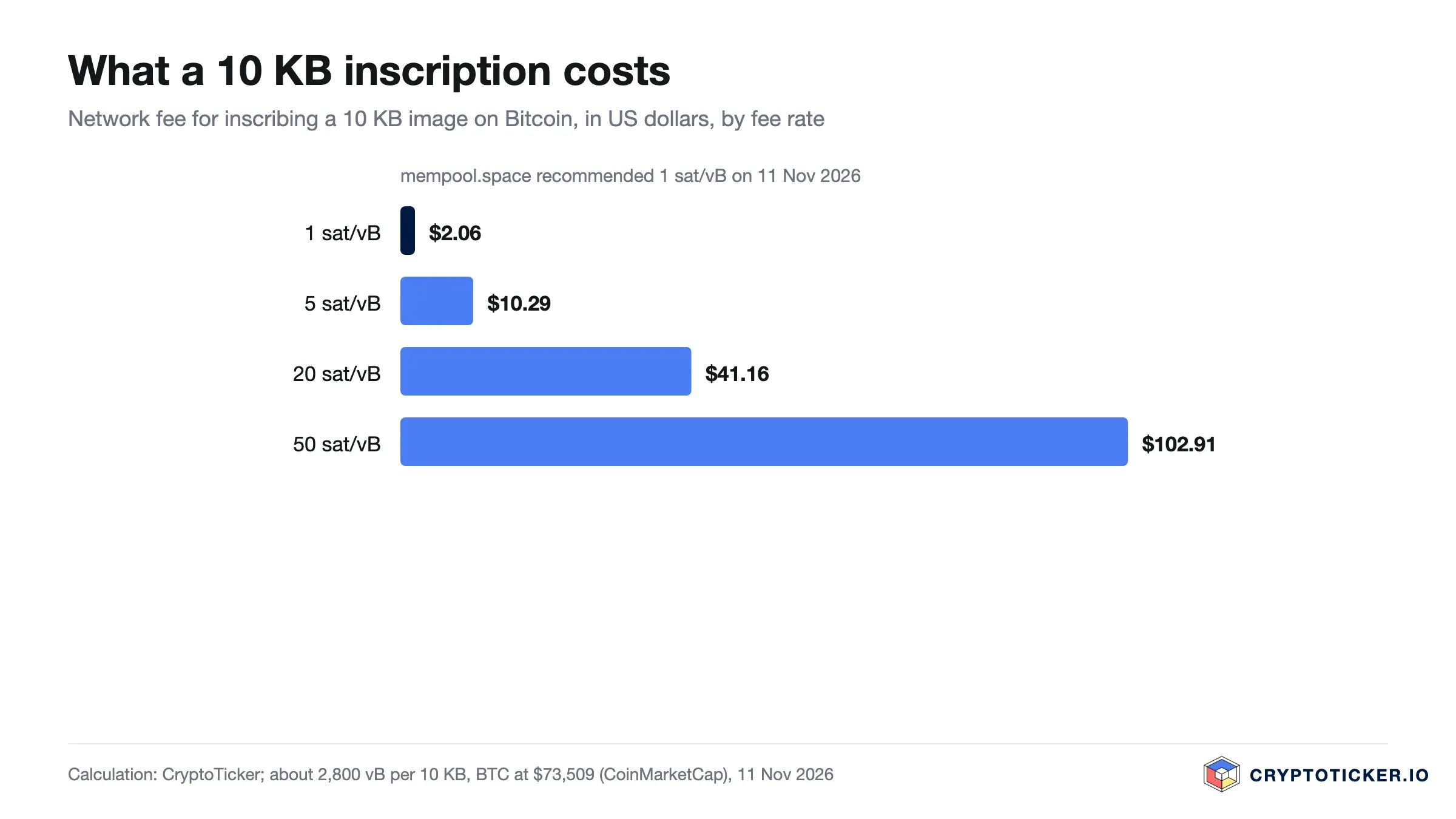
- Cost: inscribing a 10 KB image cost about 2,800 sats, or $2.06, at 1 sat per virtual byte on 11 November 2026.
- Tokens: ORDI, the first BRC-20 token, traded at $3.21, 97% below its record of $96.17 from March 2024 (CoinMarketCap).
- Wallets: use an Ordinals wallet such as Xverse, UniSat or Magic Eden's wallet, never a plain bitcoin wallet.
How Bitcoin Ordinals Work: Ordinal Theory and Inscriptions
Ordinal theory gives every satoshi a serial number based on the order in which it was mined. With 21 million bitcoin of 100 million sats each, there will be 2.1 quadrillion sats, and each one can be tracked from transaction to transaction. An inscription attaches content to one of these sats. According to the ord documentation, inscribing takes two bitcoin transactions: a commit transaction that locks a tapscript containing the content, and a reveal transaction that spends it, puts the content on chain and inscribes it on the first sat of that input.
The data sits in the witness portion of the transaction, which Taproot made large enough for files and which the network counts at a quarter of its size when calculating transaction fees. That is why images became affordable on Bitcoin. The ord software sends each new inscription with 10,000 sats of postage by default, so the inscribed sat always sits in a spendable output. Supporters argue that Ordinals bring new users and fees to miners; critics say they fill block space meant for payments.
Bitcoin Ordinals Guide: A Beginner's Overview
What is Bitcoin Ordinal?
Bitcoin Ordinals introduce a fresh approach to encoding data onto the Bitcoin blockchain, resulting in unique digital assets known as Digital Artifacts. In this guide, we'll delve into the basics of Bitcoin Ordinals, understanding how they function and why they matter.
Understanding Bitcoin Ordinals
Bitcoin Ordinals assign numerical values to Satoshis (sats), the smallest units of Bitcoin, to create distinct Digital Artifacts directly on the blockchain. These inscriptions can include various content types like text, images, or videos, stored within the witness portion of a Bitcoin transaction.
Difference between Bitcoin NFT and Ethereum NFT
Bitcoin Ordinals and Ethereum NFTs share the common purpose of creating, representing, and trading unique digital assets. However, they differ significantly in terms of storage, validation, data storage methods, flexibility, royalties, and scalability. While Bitcoin Ordinals store data on individual Satoshis, Ethereum NFTs often store artwork off-chain or on different layers of the Ethereum blockchain. Additionally, Ethereum NFTs benefit from established standards, interoperability, and marketplace support, leading to a more developed ecosystem compared to Bitcoin Ordinals.
| Area | Bitcoin Ordinals | Ethereum NFTs |
|---|---|---|
| Purpose | Create and trade unique digital assets | Create and trade unique digital assets |
| Storage | Stored on individual Satoshis on Bitcoin blockchain | Stored on Ethereum blockchain or off-chain layers |
| Validation | Receive validation similar to other Bitcoin transactions | Smart contracts validate ownership and transactions |
| Data Storage | Data and content stored on Satoshis, increasing tx size | Heavy data stored off-chain, with references on-chain |
| Flexibility | Immutable, on-chain data; cannot be changed or enhanced | Off-chain storage allows for changes or enhancements |
| Royalties | Creators do not receive royalties | Royalties possible, set by marketplaces and smart contracts |
| Scalability | Developed later, still evolving ecosystem | Established standards, interoperability, and support |
Use Cases of Bitcoin Ordinals and Ethereum NFTs
Artificial intelligence (AI) is increasingly revolutionizing digital artwork creation, enabling artists to produce music, art, in-game items, and videos with unprecedented efficiency and creativity. As this trend continues, both Bitcoin Ordinals and Ethereum NFTs offer unique opportunities for artists and creators to leverage AI-generated content.
Interoperability is another significant trend in the blockchain space, with users seeking seamless connectivity between different blockchain networks. A notable development in this realm is the emergence of the BRC-721E standard, enabling traders to bridge Ethereum-based NFTs to the Bitcoin network. This interoperability facilitates cross-platform trading and expands the reach of digital assets across diverse blockchain ecosystems.
Moreover, ongoing efforts are underway to achieve true cross-chain compatibility for both Ordinals and NFTs. These developments aim to break down barriers between different blockchain networks, allowing for greater flexibility and accessibility in the creation and trading of digital assets.
Integrating digital art with real-world assets (RWAs) presents yet another compelling use case for both Ordinals and NFTs. By transforming RWAs into digital tokens, whether in the form of Ordinals on the Bitcoin blockchain or NFTs on Ethereum, it becomes possible to fractionalize ownership and enable overseas trading. This transformation enhances liquidity for traditionally illiquid assets, broadens the market base, and streamlines the process of buying and selling underlying physical assets.
What is Bitcoin Mempool?
The Bitcoin Mempool serves as a temporary holding area for pending transactions within the Bitcoin network. Transactions wait in the Mempool until they can be processed and included in the next block by a miner. Priority for inclusion is determined by transaction fees offered by users.
How to Store Bitcoin Ordinals?
To securely receive and store Bitcoin Ordinals, it's crucial to use a separate address from your primary Bitcoin wallet. Specialized Bitcoin wallets like Hiro Wallet and Xverse fully support Ordinals, providing a user-friendly interface for easy management. UniSat and the Magic Eden wallet support Ordinals too. Such wallets keep inscriptions on a Taproot address, which starts with bc1p, and separate inscribed sats from the bitcoin you spend, so you do not pay away an inscription as a fee by accident. Our guide on how to store crypto explains wallets and seed phrases.
Ordinals, BRC-20 and Runes: Bitcoin Inscriptions Compared
Three kinds of assets grew out of ordinal theory. They share the Bitcoin blockchain but work differently:
| Type | What it is | Fungible? | Start |
|---|---|---|---|
| Ordinal inscriptions | Images, text or code inscribed on one sat: Bitcoin NFTs | No | January 2023 |
| BRC-20 tokens | Text inscriptions that deploy, mint and transfer tokens such as ORDI | Yes | 2023 |
| Runes | A token standard that stores balances in transaction outputs, without inscriptions | Yes | Block 840,000, 20 April 2024 |
Runes launched with the fourth bitcoin halving at block 840,000, mined on 20 April 2024, according to mempool.space. By 11 November 2026, 217,264 Runes had been created. BRC-20 tokens rose and fell fast: ORDI cost $3.21 on 11 November 2026, 97% below its record from March 2024. Rare sats are a fourth niche: collectors pay extra for sats with special serial numbers, such as the first sat of a block.
What Does an Inscription Cost? A Worked Example
The fee depends on the size of the file and on how busy the Bitcoin network is. Because witness data counts at a quarter, a 10 KB image takes about 2,500 virtual bytes, plus roughly 300 for the commit and reveal transactions. On 11 November 2026, mempool.space recommended 1 sat per virtual byte, and one bitcoin cost $73,509 (CoinMarketCap). The postage of 10,000 sats is not a fee: it stays with the inscription in your wallet.
| Fee rate | Typical situation | Fee for a 10 KB image | In US dollars |
|---|---|---|---|
| 1 sat/vB | quiet network (11 Nov 2026) | 2,800 sats | $2.06 |
| 5 sat/vB | normal day | 14,000 sats | $10.29 |
| 20 sat/vB | busy day | 56,000 sats | $41.16 |
| 50 sat/vB | fee spike | 140,000 sats | $102.91 |
Our assessment: on a quiet day, inscribing costs less than a coffee. During a hyped mint, the same file can cost fifty times more, so check the fee rate before you inscribe and avoid launches with crowded mempools.
How to Buy Bitcoin Ordinals: Ordinals Marketplaces
You buy Bitcoin Ordinals on ordinals marketplaces, which work like an NFT marketplace for Bitcoin:
- Set up an Ordinals wallet: Xverse, UniSat or the Magic Eden wallet. Write down the seed phrase.
- Fund it with bitcoin: buy BTC on an exchange and send it to the wallet's payment address.
- Choose a marketplace: Magic Eden, OKX and UniSat list the large ordinals collections. Compare listing fees and check that the collection is verified.
- Buy: marketplaces use partially signed bitcoin transactions (PSBTs): the seller signs first, you add your payment and sign, and the trade settles in a single bitcoin transaction. Some offer bulk buying of several items at once.
- Check the delivery: the inscription appears on your wallet's Ordinals address after the transaction confirms.
The ordinals market of 2026 is small compared with 2024. Floor prices of large collections, according to CoinGecko on 11 November 2026:
| Collection | Items | Floor price | In US dollars | Holders |
|---|---|---|---|---|
| NodeMonkes | 10,000 | 0.0232 BTC | $1,498 | 4,499 |
| Bitcoin Puppets | 10,001 | 0.0102 BTC | $662 | 6,021 |
| Quantum Cats | 3,333 | 0.0104 BTC | $675 | 1,638 |
| Bitcoin Frogs | 10,000 | 0.0040 BTC | $259 | 5,143 |
For a broader view of NFTs on Ethereum (ETH) and Solana (SOL), read our NFT guide; our comparison of NFT marketplaces is linked at the top of this page.
The Block Space Debate
Ordinals split the bitcoin community. Inscriptions pushed fees up in busy phases and gave miners extra income, which matters as the block subsidy halves every four years. Critics see data storage as a misuse of block space. The debate continues: Bitcoin Core 30.0 raised the default limit for data in OP_RETURN outputs to 100,000 bytes, which makes another way to store data on Bitcoin easier to relay. Not everyone agrees with that change, and some node operators run software with stricter limits.
Are Bitcoin Ordinals Taxable?
In the US, Ordinals are digital assets: buying them with bitcoin is a taxable disposal of that bitcoin, and selling an inscription at a profit creates a capital gain. If an inscription represents a work of art, the IRS may treat it as a collectible with a higher rate on long-term gains, as explained in our NFT guide. Our guide on how to file crypto taxes explains the reporting.
Are Bitcoin Ordinals Worth It?
As a technology, Ordinals proved that Bitcoin can carry more than payments: over 128 million inscriptions are permanent records on the most secure blockchain. As an investment, they are risky: ORDI is 97% below its record, and many collections have few buyers. If you collect, buy what you like, use a dedicated Ordinals wallet and never spend money you cannot afford to lose. For the price outlook of the coin underneath it all, see our bitcoin price prediction.
FAQ

Rudy Fares
Equity Trader, Financial Consultant, Musician and Blockchain Aficionado. I spend my time doing Technical and Fundamental Analyses for Stocks, Currencies, Commodities and Cryptocurrencies.