
Bitcoin and Taxes in Germany: Holding Period, Savings Plan, ETP and Mining
Bitcoin gains are tax-free after twelve months. What that means for a savings plan with twelve deadlines, why ETPs are taxed differently, and what applies to mining, gifts and losses.




Which topics should we dive deeper into?
Select what genuinely interests you. Your picks feed directly into our editorial planning.
Crypto news that's actually worth your time.
Weekly. 60 seconds. Carefully curated by our editors: no hype, no promo flood, no spam.
Gains from selling Bitcoin are tax-free in Germany when more than twelve months lie between purchase and sale. Sell earlier and you tax the gain at your personal income tax rate of up to 45 percent plus the solidarity surcharge. An exemption threshold of 1,000 euros a year stays tax-free.
So much for the rule. In practice most people come unstuck not on the rule itself but on the cases it does not cover: a savings plan with twelve different deadlines, a Bitcoin ETP taxed under different rules, or the transfer from an exchange into your own wallet. This article works through the Bitcoin-specific cases. The general basics covering all cryptocurrencies are in our guide to crypto tax in Germany.
The Basic Rule for Bitcoin in Two Sentences
For tax purposes Bitcoin is not a security but an "other economic good". Its sale out of private assets is a private disposal under Section 23 of the German Income Tax Act, and there the holding period decides the tax. The Federal Fiscal Court confirmed this by ruling of February 14, 2023 (case number IX R 3/22).
From that follows the difference from a share: anyone selling shares always pays 25 percent flat withholding tax, no matter how long they have held them. Anyone selling Bitcoin after thirteen months pays nothing, and that holds for a gain of 500,000 euros as well.
Bitcoin Savings Plan: Twelve Purchases, Twelve Deadlines
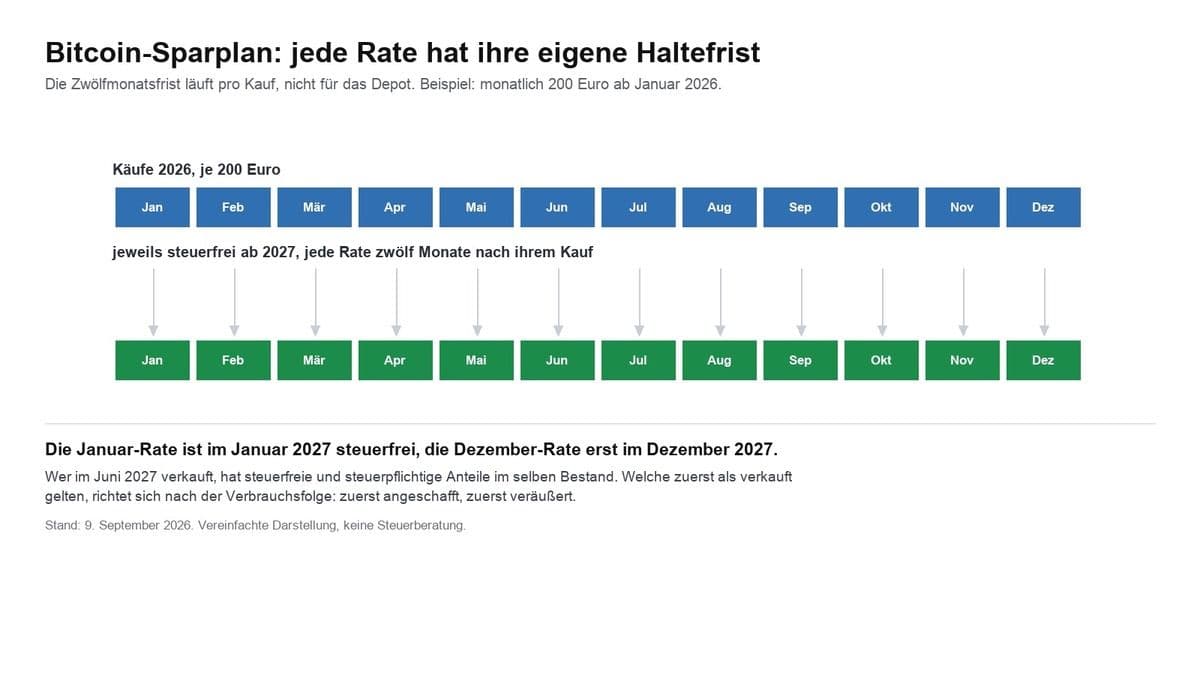
The most common misconception concerns the savings plan. The twelve-month period applies neither to your portfolio nor to the calendar year, but to each individual acquisition.
Anyone investing 200 euros a month from January 2026 holds twelve positions with twelve different cut-off dates at the end of the year. The January instalment is tax-free in January 2027, the December instalment only in December 2027.
If you sell part of your holding in June 2027, tax-free and taxable shares sit side by side within it. Which ones count as sold is settled by the consumption order: under the Federal Ministry of Finance circular of March 6, 2025, individual allocation applies first, and where that is not possible the coins acquired first count as the ones disposed of first. That order works in your favour, because it uses up the oldest and therefore tax-free positions first.
In practice that means: keep a record of the date, amount and price for every savings plan instalment. Most brokers supply this listing, but not all of them in a form the tax office accepts. How to automate it is shown by our comparison of Bitcoin savings plans.
What Counts as a Sale With Bitcoin
For tax purposes it is not only a sale for euros that is a disposal. These three events trigger the tax as well where the position is younger than twelve months:
- Swapping into another cryptocurrency. Anyone swapping Bitcoin for Ether realises the Bitcoin gain even though no euro moves. For the Ether a new period starts at the same moment.
- Paying with Bitcoin. The purchase is a disposal at the day's price for tax purposes.
- Swapping into a stablecoin. USDT and USDC are crypto assets too, so the swap is a disposal.
Not taxable, by contrast, is the transfer between your own addresses. Anyone sending Bitcoin from an exchange to a hardware wallet disposes of nothing, interrupts no period and triggers no tax. You do have to carry the acquisition data across, though; otherwise nobody can prove later when the coins were bought.
Bitcoin ETP, ETN and ETC: The Second Tax World
Anyone buying Bitcoin not directly but through an exchange-traded product may land somewhere else for tax purposes. This concerns products such as the physically backed ETPs from CoinShares, Invesco or 21Shares, which many investors buy through their ordinary securities account.
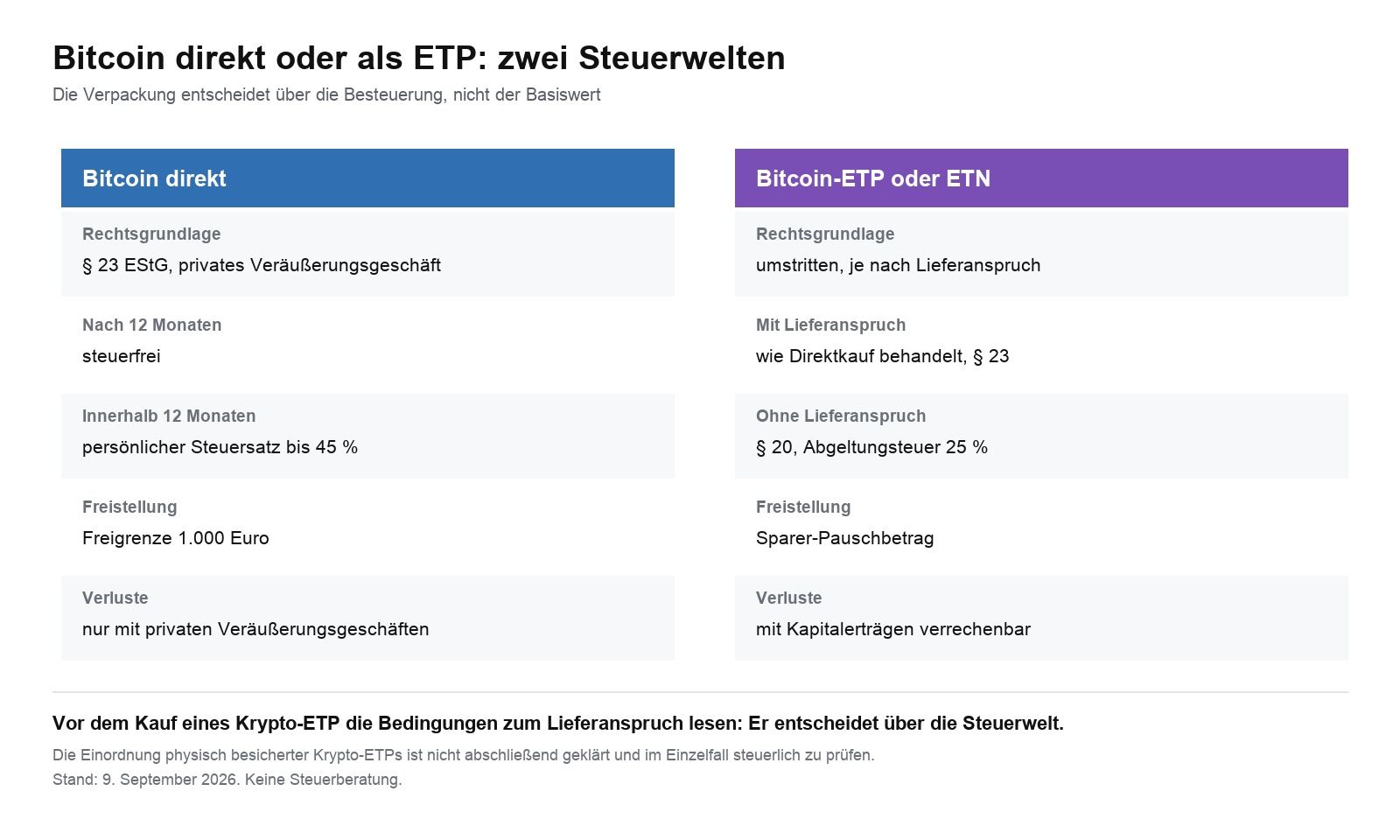
The decisive point is the delivery claim. Where the product grants you the right to demand delivery of the Bitcoin deposited, there is much to be said for treating it like direct ownership: Section 23 EStG with the twelve-month period. This line rests on the case law on Xetra-Gold, where the Federal Fiscal Court ruled the same way.
Where the delivery claim is absent, an other capital claim suggests itself. Section 20 EStG then applies with 25 percent flat withholding tax, regardless of the holding period, but with loss offsetting inside the investment income pot.
This classification is not conclusively settled. There is no supreme court decision on crypto ETPs, and the custodian banks do not treat the products uniformly. Some withhold the flat tax even though the investor claims the twelve-month period. Anyone needing certainty here cannot avoid advice on their individual case. Before buying, a look at the product terms is worth it: the delivery claim is expressly set out there, or it is not.
Bitcoin Mining and the Question of Commercial Activity
With mining the scale is what matters. Anyone mining occasionally earns income from other services under Section 22 number 3 EStG, with an exemption threshold of 256 euros per year. Anyone mining on a sustained basis with the intention of making a profit is engaged in a commercial activity, and then trade tax, bookkeeping obligations and the delineation of business assets come along with it.
For block rewards from running your own hardware the tax administration regularly assumes a commercial activity. The value of the coins mined at the moment they accrue is the business income, and at the same time it is the acquisition cost for a later sale.
Important for miners holding coins as business assets: there is no twelve-month period there. The tax exemption after a year has passed applies to private assets only.
Giving Bitcoin Away and Passing It On
A gift is not a disposal, so it triggers no income tax. Gift tax applies instead, with its allowances: 500,000 euros between spouses, 400,000 euros per child, 20,000 euros between people who are not related, in each case every ten years.
The recipient steps into the giver's shoes: they take over the giver's date of acquisition and the giver's acquisition cost. Where the giver bought the coins more than twelve months ago, the recipient can sell them tax-free straight away. The same principle applies on inheritance.
For that to work the origin has to be documented. Without evidence of the date of acquisition and the cost, the tax office will in case of doubt assume the variant less favourable to you.
Losses With Bitcoin
Losses from Bitcoin sales within the one-year period can only be offset against gains from other private disposals of the same year. Offsetting against employment income or share gains is ruled out. What remains goes back one year or forward without limit.
One point is often overlooked: you have to declare losses, otherwise they do not exist for tax purposes. The tax office only determines them where they appear in Annex SO. Anyone not declaring a loss-making year gives away the offset against future gains.
A total loss, through an insolvent exchange or a lost key for instance, is harder to handle for tax purposes. It is not a disposal, and the tax administration recognises it only under narrow conditions.
Bitcoin Through Brokers and Neobrokers
Anyone buying Bitcoin through a neobroker should check what they are actually acquiring. Some providers deliver real coins into a wallet, others track the price through a derivative or an ETP. For tax that makes the difference between Section 23 and Section 20.
A second point concerns withdrawability. If you can move your Bitcoin out to an address of your own, the better arguments point to genuine ownership. Where that is not possible, the classification is trickier. What this means for one specific provider is something we worked through in the case of Trade Republic.
What Is Set to Change in 2027
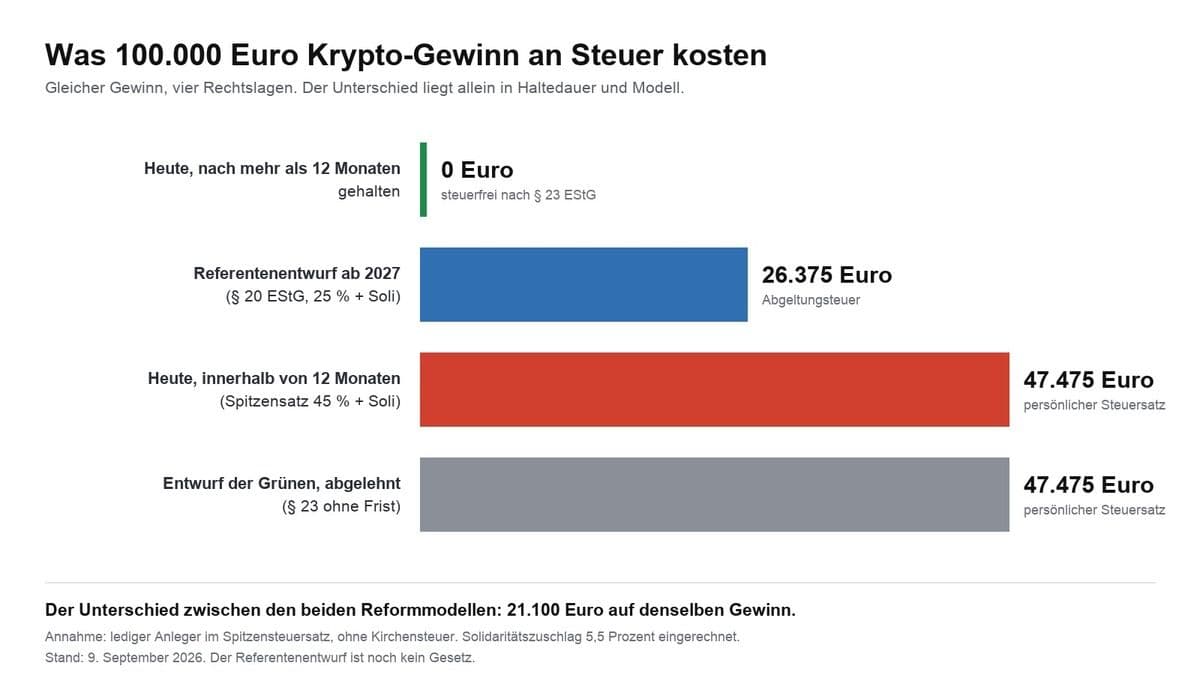
On September 8, 2026 the Federal Ministry of Finance sent a draft bill into interdepartmental coordination. It would treat Bitcoin in future as investment income: 25 percent flat withholding tax plus the solidarity surcharge, regardless of the holding period.
Two points are decisive for Bitcoin investors. First, the cut-off date is meant to lie in the future: only coins acquired after December 31, 2026 would be covered. What you buy up to then would remain under today's rules as the draft stands. Second, nothing has been adopted. Ahead of the draft lie the hearing of the associations, the cabinet, three readings in the Bundestag and the Bundesrat.
The details on the cut-off date are in our article on grandfathering and the cut-off date, and the two models under discussion in our comparison of the tax models.
Frequently Asked Questions on Bitcoin Tax
How much tax do I pay on Bitcoin gains?
After a holding period of more than twelve months, nothing. Within the period your personal income tax rate of 14 to 45 percent applies, plus the solidarity surcharge.
When are Bitcoin gains tax-free?
When more than one year lies between acquisition and sale, or when your total gain from private disposals in the year stays below 1,000 euros.
Do I have to declare Bitcoin in my tax return?
Taxable sales belong in Annex SO. Sales after the one-year period has expired do not have to be declared; losses should be.
Does the holding period apply to a savings plan too?
Yes, but to each instalment separately. Every monthly execution is an acquisition of its own with a cut-off date of its own.
How are Bitcoin ETPs taxed?
That depends on the structure. With a delivery claim there is much to be said for treatment like direct ownership with the twelve-month period, without one for the flat withholding tax. The question is not conclusively settled.
Is the transfer to a hardware wallet taxable?
No. A transfer between your own addresses is not a disposal and does not interrupt the holding period.
What happens if I give Bitcoin away?
The gift triggers no income tax, though it may trigger gift tax. The recipient takes over the date of acquisition and the acquisition cost.
Sources
- Federal Fiscal Court, ruling of February 14, 2023, case number IX R 3/22
- Federal Ministry of Finance circular of March 6, 2025, individual questions on the income tax treatment of certain crypto assets, reference IV C 1 - S 2256/00042/064/043
- Section 23 and Section 22 number 3 of the German Income Tax Act, Section 20 EStG for investment income
- Inheritance and Gift Tax Act, Section 16 on the allowances
- German Bundestag, introduction of the 2027 federal budget: bundestag.de
- Details of the draft bill following the reporting of September 8, 2026. The full text has not been officially published so far.
On exchange-traded products there is a separate guide with the details of their structure: ETP Bitcoin tax.
(As of September 9, 2026. This article is not tax advice and not investment advice. It does not replace advice on your individual case, and the legal position can change.)
Transparency note: This article was produced with the assistance of artificial intelligence and reviewed by our editorial team before publication. All figures and claims were checked against the primary sources linked in the text.
Related articles
- Investing in Bitcoin With a Savings Plan or a Lump Sum: What the December 31 Tax Cut-Off Changes
- Bitcoin for Retirement: What Applies from 2027 and What You Decide Now
- Buying More Bitcoin at $77,000: Savings Plan or Lump Sum
- Bitcoin Savings Plan and Tax: How the Holding Period, FIFO and the Exemption Limit Interact on Monthly Buys
- Gifting Bitcoin to Children: Allowance, Holding Period and the Tax Office Report
Which topics should we dive deeper into?
Select what genuinely interests you. Your picks feed directly into our editorial planning.
Crypto news that's actually worth your time.
Weekly. 60 seconds. Carefully curated by our editors: no hype, no promo flood, no spam.

September 9, 2026 4:13 PM

Bitcoin 29 Percent Below Last Year: Which Crypto Losses You Can Still Use Before the One-Year Holding Period Expires
Nine out of ten major crypto assets trade lower today than exactly twelve months ago, Bitcoin alone by 29.2 percent. We measured the price series ourselves and show why the purchase date alone decides the tax value of your loss.

September 18, 2026 10:14 PM

Bitcoin Back Above $80,000: Buy More, Hold or Take Profits? What to Check Now
Bitcoin is back above $80,000, for the first time since September 7. Whether you buy more, hold or take profits depends less on the daily price than on three things you can check yourself: your holding period, the way you buy, and where your coins are kept.
September 19, 2026 10:35 AM

The Cost Average Effect with Bitcoin: What Twelve Instalments Really Deliver
Twelve monthly instalments of 100 euros produced an average price of 66,472 euros and ran 33.6 percentage points ahead of the lump sum purchase on the same starting day. The calculation also shows when the savings plan is the worse route.
September 14, 2026 4:19 AM

Fed Rate Decision of September 16: What It Means for Your Bitcoin Savings Plan
Recap as of September 27, 2026: this article appeared before the US Federal Reserve's rate decision on September 16, 2026, when futures markets mostly expected a hike. It describes what a hike means for your monthly instalment, a running crypto loan and your holding periods.
September 22, 2026 7:23 AM

Gifting Bitcoin to Your Spouse: Allowance, Holding Period and the Report to the Tax Office
Thanks to a 500,000 euro allowance, a gift to a spouse is almost always free of gift tax, and it is not a disposal either. What matters is what travels with it: your purchase date, your purchase price and with them the state of the one-year holding period.
September 9, 2026 4:22 PM
Crypto Tax in Germany: What Applies in 2026 and What Is Set to Change in 2027
Crypto gains are tax-free after twelve months; before that your personal tax rate of up to 45 percent applies. What triggers tax, how the holding period is calculated, what happens with staking and losses, and what the draft bill would change from 2027.
September 8, 2026 1:19 AM

Germany's Crypto Holding Period: What Happens Now Signing for Petition 201716 Closed on September 15
Recap as of September 27, 2026: the signature period for German parliamentary petition 201716, which asks for the one-year crypto holding period to be preserved, closed on September 15, 2026. This article explains what ended that day, how the petitions committee proceeds and why no investor has to sell because of it.
September 19, 2026 4:26 PM

Crypto Mining and Tax: When the Tax Office Treats Your Mining as a Business
Anyone mining crypto-assets earns taxable income from the very first reward; according to the Federal Ministry of Finance, mining is never private asset management. This guide uses the margin numbers of the Ministry's circular to show when your mining becomes commercial and what you can deduct.
August 24, 2026 10:26 AM
Bitcoin Savings Plan in Austria: How the Purchase Price Is Calculated
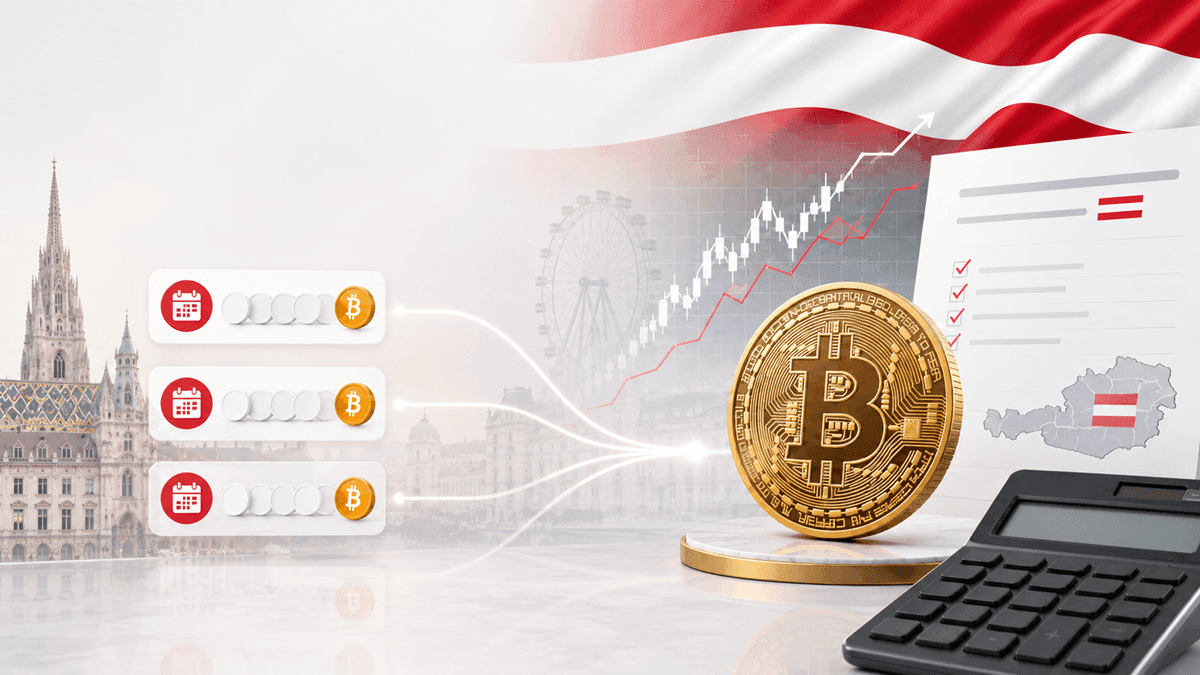
Bought bitcoin through a savings plan? For multiple purchases Austria applies the moving average price as a matter of principle when working out taxable gains.
October 2, 2026 4:39 AM

Donating bitcoin: when does the full market value count, when only the purchase price?
A bitcoin donation to a charitable organisation is deductible as a donation in kind, and the donation itself produces no taxable gain. The size of the deduction turns solely on whether a sale would have been taxable on the day of the transfer.
September 22, 2026 10:13 AM

Circle Lends Against Bitcoin via cirBTC: Why the Wrapper Can Cost You the German Holding Period
Circle launched loans against deposited bitcoin on September 21, 2026. In Germany, the detour through the cirBTC token is very likely a swap, and a swap restarts your one-year holding period.
September 22, 2026 1:28 PM
Selling Bitcoin and Cashing Out in Euros: How It Works in Germany
Between the sell order and the euros in your current account stand the exchange, your bank and the tax office. Knowing the order of events saves fees, waiting time and, in the best case, the entire tax on the gain.
September 22, 2026 4:12 PM

Nearly $1 Billion Into Bitcoin ETFs: What to Check on ETNs, Portfolio and Holding Period
US spot bitcoin ETFs took in a net $999 million on September 21, the third consecutive day of inflows. German investors cannot reach these funds: what ETNs, the holding period and your buying route mean for you.
September 22, 2026 1:37 AM

Swapping Bitcoin for Gold: What Happens for Tax in Germany
Moving from coins into gold is a sale in the eyes of the tax office, and the one-year period decides the bill. Where bars, gold ETCs and tokenised gold diverge for tax, and which records you need.
September 18, 2026 10:13 AM

Bitcoin and the German Exit Tax: What Applies When You Move Abroad
Anyone emigrating with Bitcoin expects an exit tax on unrealised gains and finds nothing of the sort in the statute. Where the real risks sit is decided at four points: residence, the holding period, the legal form of your investment, and automatic reporting from 2026.
September 16, 2026 7:12 PM

Borrowing Against Bitcoin Instead of Selling: When German Tax Still Applies
Posting Bitcoin as collateral for a loan is not a sale in Germany, because section 39 of the Fiscal Code keeps the coins attributed to you for tax purposes. Tax arises only when the collateral is liquidated, and then the one thing that decides the bill is how long you held the coins beforehand.
August 21, 2026 1:42 PM

Writing Off a Total Crypto Loss: When the Tax Office Recognises Worthless Coins
A token that has collapsed only reduces your tax once you actually dispose of it. What applies to delisting, exchange insolvency and worthless holdings under Section 23 of the German Income Tax Act, and how you offset losses.
October 3, 2026 1:41 PM

Dogecoin Price Prediction: $0.10 as the Ceiling, and What to Watch at a 2.5 Percent ETP Fee
Dogecoin trades at $0.0927 on October 3 and therefore sits on its 200-day average. More important than the mark at $0.10 is the route question for German investors: a 2.50 percent fee in the Xetra ETP against the one-year holding period on a direct purchase.
September 25, 2026 10:26 PM

Selling bitcoin privately: the tax in Germany and the records you need
A direct sale to a private individual falls under the same one-year rule as an exchange sale, but there is no tax report to go with it. This guide walks through the calculation, the 1,000 euro threshold and the records the tax office wants to see.
September 17, 2026 10:22 PM

Selling Bitcoin at a Loss and Buying It Straight Back: What That Does to Your Holding Period
Germany has no wash sale rule: the loss stays deductible even if you buy back immediately. The buyback, however, restarts the one-year period for every new unit.
August 11, 2026 9:13 PM

Germany's Crypto Holding Period Faces Abolition: What Petition 201716 and the Cabinet Decision Mean for Your Tax
Petition 201716 in the German Bundestag calls for the one-year holding period for crypto assets to be kept and has already passed the quorum of 30,000 signatures. This article sets out what the cabinet decision of July 6, 2026 provides for, how much of it is binding and which records you should be pulling together now.

September 1, 2026 12:19 PM

Von der Leyen Wants Your Bank Deposits: Here Is How to Keep Control of Them
Brussels wants Europe's 10 trillion euros in deposits funding its companies. What it means for savers, and why Bitcoin savings plans matter.
August 14, 2026 6:18 PM

Bitcoin From a Foreign Exchange to Austria: Which Tax Data You Need
Transferring Bitcoin from a foreign exchange to an Austrian platform: which tax data can be missing for the withholding tax. And what investors need to watch out for.
August 10, 2026 5:15 PM
Bitcoin Lending in Austria: When Tax Falls Due
Lending Bitcoin and earning interest: when lending income is taxed at 27.5 percent in Austria and which exchange rate counts.
August 12, 2026 9:12 AM

Bitcoin Losses and Dividends in Austria: How the Tax Offset Works
Can a Bitcoin loss be offset against dividends? This is how loss offsetting works in Austria. It also shows when a tax return is needed for it.
October 1, 2026 11:19 AM

Dogecoin at $0.0946: the level that decides before the ETF closes on October 14
Dogecoin stands at $0.0946 on October 1 and fails once again at the zone around $0.098. At the same time a deadline is running: the US ETF BWOW stops trading on October 14. For investors in Germany, though, it is not the fund that decides but the buying route between a direct purchase and a Xetra ETP.
September 25, 2026 4:20 AM

Crypto as a Down Payment for a German Mortgage: What Banks Require
Since April 2023 a house in Germany can no longer be paid for in Bitcoin; section 16a of the Money Laundering Act bans it outright. Your crypto holdings still work as a down payment, provided you take the route through the euro and prove the origin without gaps.
More from CryptoTicker