
Crypto futures trading: perpetual futures explained simply
Crypto futures and perpetual futures explained: how futures trading works, what the funding rate really costs and which exchanges are licensed for it in the EU.





Which topics should we dive deeper into?
Select what genuinely interests you. Your picks feed directly into our editorial planning.
Crypto news that's actually worth your time.
Weekly. 60 seconds. Carefully curated by our editors: no hype, no promo flood, no spam.
Crypto futures are forward contracts on bitcoin and other cryptocurrencies. They let you trade the price without owning the coins, bet on rising or falling prices and use leverage. The most common form is perpetual futures: futures without an expiry date that stay close to the spot price through a regular balancing payment, the funding rate. In Germany, futures trading is permitted for retail clients. Legally, futures are financial instruments under the Markets in Financial Instruments Directive MiFID II, not crypto-assets under MiCA. You trade them on crypto exchanges that are additionally licensed as investment firms in the EU, or through your broker on futures exchanges such as CME and Eurex. How this works, what it costs and which providers are licensed is explained here.
Crypto futures in brief: the key figures
- A CME bitcoin future covers 5 bitcoin, the micro contract 0.1 bitcoin and the Eurex nano contract 0.01 bitcoin.
- Perpetual futures have no expiry date; at OKX the funding rate is settled every 8 hours.
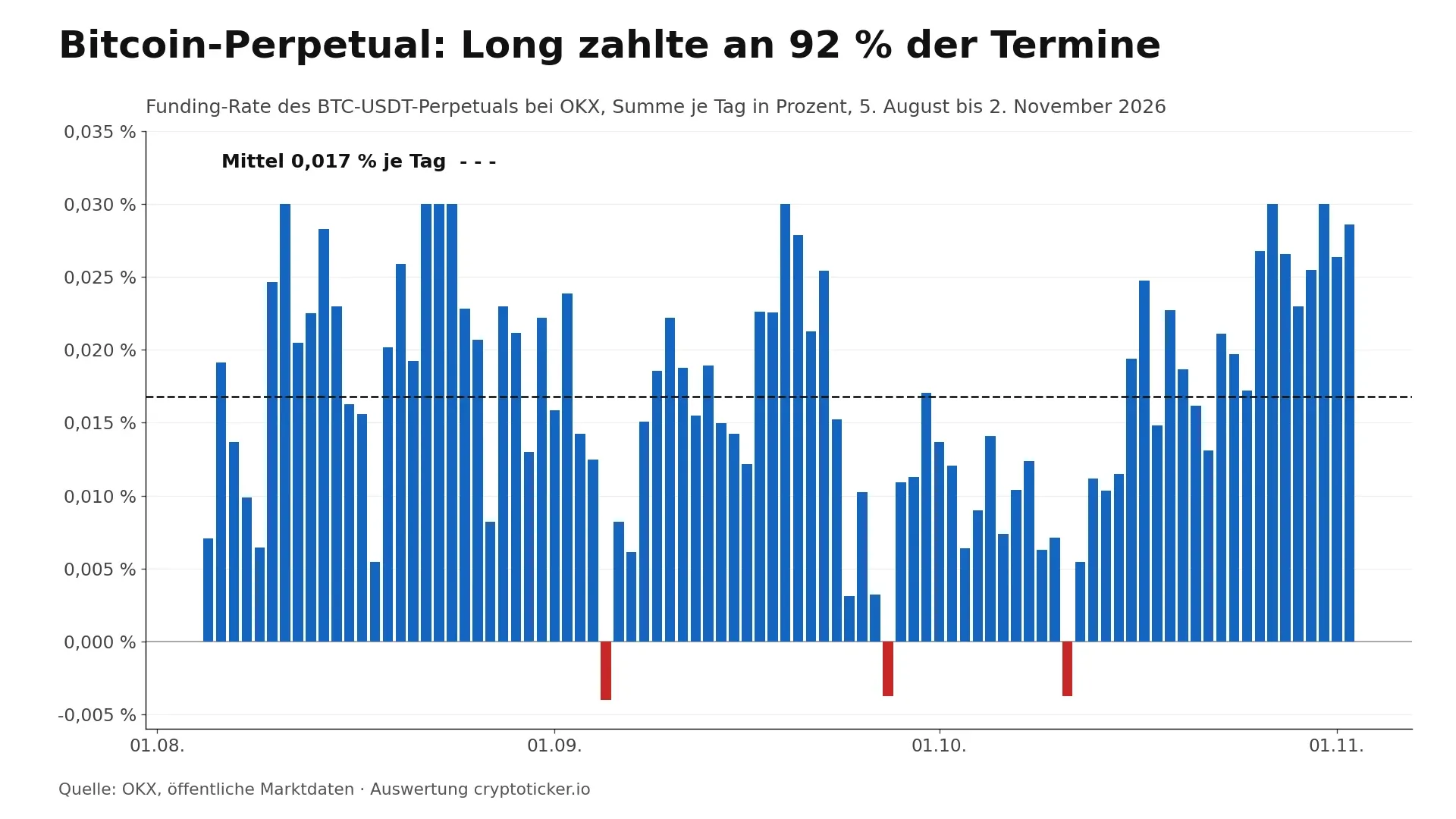
- On OKX’s bitcoin perpetual, long positions paid at 92 percent of the 270 settlements from August 5 to November 2, 2026.
- In total, holding a long position over these 90 days cost 1.51 percent of its value.
- Since February 24, 2026, ESMA has made clear that perpetual futures for retail clients can fall under the rules for contracts for difference.
- In Germany, gains from futures are taxed at a 25 percent flat-rate withholding tax, with no holding period.
What are crypto futures? Forward contracts with an expiry date
A future is a contract to buy or sell an underlying asset on a set date at a price agreed today. With crypto futures, the underlying is a coin or an index on a coin. Physical delivery almost never happens: on the expiry date, the difference between the agreed price and the settlement price is paid in cash. So you are not buying bitcoin, but a right to the price difference.
Classic bitcoin futures trade on regulated futures exchanges. At CME Group in Chicago, the standard contract covers 5 bitcoin and the micro contract a tenth of a bitcoin. Eurex in Frankfurt lists futures on the FTSE Bitcoin Index, a standard contract worth one bitcoin and, since May 5, 2025, a nano contract of one hundredth. For these futures you need a broker with access to futures trading that approves you after checking your experience. Contract sizes, margin and expiry dates are explained in our guide to bitcoin futures.
There is almost always a gap between the future and the spot price, known as the basis. If the future trades above spot, this is called contango; if below, backwardation. The gap closes on the expiry date, because the future is then settled at the spot price. Anyone wanting to hold a position for longer has to roll it into the next contract before expiry and pays the basis in the process.
Perpetual futures: futures without an expiry date
A perpetual future, or perp, is a future without an expiry date. You can hold the position for as long as you like, as long as your margin suffices. To stop the contract price from drifting away from the spot price, there is the funding rate. If the perp trades above spot, long positions pay a small percentage to short positions at fixed intervals. If it trades below, the payment flows the other way. This makes it worthwhile for traders to close any gap, and the contract stays close to the market.
What determines your position is not the last traded price but the mark price. The exchange derives it from an index of several spot markets, so that a single outlier in its own order book does not trigger liquidations. Settlement is usually in stablecoins such as USDT or USDC, and for some contracts in the coin itself.
Perpetual futures are so popular with traders because they combine three things: short positions without borrowing, leverage without a loan, and no expiry date to keep track of. The price for this is the funding rate, which almost always applies to a long position.

Futures or perpetual futures: the differences at a glance
| Future with expiry | Perpetual future | |
|---|---|---|
| Term | fixed expiry date, such as the last Friday of the month | unlimited |
| Link to the spot price | basis closes at expiry | funding rate every few hours |
| Ongoing costs | rolling into the next contract | funding, usually paid by the long side |
| Trading venue | futures exchanges such as CME and Eurex, also crypto exchanges | crypto exchanges and decentralised perp exchanges |
| Contract size | fixed, from 0.01 to 5 bitcoin | freely selectable in small increments |
| Settlement | cash settlement in dollars or euros | usually in USDT or USDC |
| Access in Germany | broker with futures trading | crypto exchange with MiFID licence |
In practice, that means: if you want to hedge a holding for a few weeks or have a clear view on a particular date, a future with expiry works well. If you trade short term and want to open and close positions flexibly, you choose the perp and factor the funding rate into your costs.

Funding rate: what a perpetual position really costs
The funding rate is the running price of a perpetual future. It is charged on the value of the position, not on your margin, and at fixed times. At OKX this happens every eight hours, three times a day. Anyone holding a position at the settlement time pays or receives the amount, regardless of how long the position has been open.
We analysed all 270 settlements of the bitcoin, ether and Solana perpetuals at OKX from August 5 to November 2, 2026, using the exchange’s public market data. The result is clear: on the bitcoin perpetual, long positions paid at 92 percent of settlements, on the ether perpetual at 89 percent and on Solana at 71 percent. The individual rate is small, averaging 0.0056 percent per settlement for bitcoin. Over 90 days, however, it adds up.
| Perpetual at OKX | Long paid | Funding over 90 days | Annualised | At 10x leverage on $1,000 margin |
|---|---|---|---|---|
| Bitcoin (BTC-USDT) | 92% of settlements | 1.51% | 6.1% | $151 |
| Ether (ETH-USDT) | 89% of settlements | 1.22% | 5.0% | $122 |
| Solana (SOL-USDT) | 71% of settlements | 0.93% | 3.8% | $93 |
For a long position with ten times leverage, that means anyone who held $10,000 worth of bitcoin for three months paid $151 in funding, a good 15 percent of their $1,000 stake. Trading fees for opening and closing come on top. Short positions received these amounts over the same period. The calculation shows why perpetual futures are designed for short-term trades rather than long-term holding. How the funding rate is made up of a premium and an interest component, and how to calculate your own payment, is shown in our guide to the funding rate.
Perpetual futures and ESMA’s rules
Futures and perpetual futures on crypto-assets are derivatives and therefore financial instruments under the MiFID II directive. The crypto regulation MiCA does not cover them; it applies to buying, exchanging and storing crypto-assets. For you as an investor, that means an exchange needs a MiCA licence for spot trading and an additional licence as an investment firm for futures. Many large exchanges have therefore set up separate companies for derivatives in the EU.
On February 24, 2026, the European Securities and Markets Authority ESMA made clear that the product name does not matter: contracts marketed as perpetuals can also fall under the rules for contracts for difference. For retail clients, these rules impose a maximum leverage of 2:1 on crypto-assets, a forced close-out at 50 percent of required margin and protection against losing more than the account balance. What the industry has submitted to the European Commission on this is set out in our analysis of perpetual futures and the CFD rules.

Crypto futures in Germany: exchanges with an EU licence
Five crypto exchanges offer retail clients in Germany futures or perpetual futures through a dedicated company licensed as an investment firm in the EU. All five allow up to ten times leverage on bitcoin. The table shows the position as of November 2, 2026, based on the providers’ contract documents and help pages.
| Exchange | Company and supervisor | Product | Leverage for retail clients | In the EU since |
|---|---|---|---|---|
| Coinbase | Coinbase Financial Services Europe, Cyprus (CySEC) | futures with a five-year term and hourly funding, plus monthly and quarterly futures | up to 10x on bitcoin and ether | March 9, 2026 |
| Kraken | Payward Europe Digital Solutions, Cyprus (CySEC) | perpetual futures without expiry, plus futures with expiry on bitcoin, ether and Solana | up to 10x on most contracts | May 20, 2025 |
| OKX | OKX Europe Markets, Malta (MFSA) | X-Perps: futures with a five-year term, funding every eight hours | up to 10x | April 15, 2026 |
| Gemini | Gemini Intergalactic EU Artemis, Malta (MFSA) | perpetual futures, settled in USDC | 10x as standard | September 5, 2025 |
| Robinhood | Robinhood Europe, Lithuania | perpetual futures on crypto-assets and other underlyings | up to 10x on bitcoin | summer 2025 |
Coinbase and OKX structure their perpetuals as futures with a five-year term. For you as a trader, they behave like perpetuals, because a funding rate keeps them at the spot price. Legally they are futures, and futures are exempt from the rules for contracts for difference, as the BaFin general administrative act also states. Kraken, Gemini and Robinhood offer perpetuals without an expiry date. Kraken routes orders to a regulated trading venue of its UK subsidiary Crypto Facilities, Coinbase to its US futures exchange. At OKX, the exchange itself is your counterparty and hedges every trade within the OKX group, as the X-Perps product page and the terms of use describe.
For getting started, the exchanges where you also buy coins on the spot market are a natural choice. At OKX and Coinbase, the spot account and the futures account sit under the same brand, and both exchanges hold a MiCA licence for spot trading. Before you can trade futures, the exchange checks your knowledge and experience with derivatives, as MiFID II requires.
You can reach futures with an expiry date on the large futures exchanges through a broker that offers futures trading. Eurex in Frankfurt has listed bitcoin futures since April 17, 2023 and ether futures since August 12, 2024, and CME in Chicago offers the micro contract of 0.1 bitcoin. Which brokers provide this access is shown in our crypto broker comparison.
Margin and liquidation in futures trading
For every futures position you post collateral, the margin. The ratio of position value to margin gives your leverage: if you post $1,000 for a $10,000 position, you are trading with ten times leverage. If the price moves against you, the margin shrinks. If it falls below the maintenance margin, the exchange forcibly closes the position; that is the liquidation. At ten times leverage, a move of around 9.5 percent against you is enough. How to calculate the liquidation price and position size yourself is shown in our guide to leverage trading with crypto.
Most exchanges offer two types of margin. With isolated margin, only the collateral of the individual position is at stake; with cross margin, your entire account balance serves as collateral. Cross margin delays liquidation but can cost the whole account if things go wrong.
Perp DEX: perpetual futures without a central exchange
Perpetual futures are also available on decentralised exchanges, known as perp DEXs. There you trade directly from your own wallet, without an account and usually without identity verification. Settlement is handled by a smart contract or a dedicated blockchain, and your collateral sits in a contract rather than with an exchange. The best-known perp DEX is Hyperliquid, alongside platforms such as Lighter, Aster and dYdX. Fees, leverage and liquidity are compared in our comparison of the best perp DEXs.
In its terms of use, Hyperliquid excludes persons from the US, the Canadian province of Ontario and sanctioned territories; Germany is not among them. The platform allows up to 40 times leverage on bitcoin and up to 25 times on ether. Perp DEXs have no licence in the EU, and the protective rules for retail clients do not apply there: there is no leverage cap under EU law, no negative balance protection and no supervisor in the event of a dispute. On top of that come their own risks, such as smart contract bugs or a failure of the price feed. How a perp DEX is built technically and who holds the keys is explained in our guide what is a perp DEX.
Tax on crypto futures in Germany
For tax purposes, futures and perpetual futures are forward transactions under Section 20(2) of the German Income Tax Act, because you receive a cash settlement of the difference, not coins. Gains are taxed at the 25 percent flat-rate withholding tax plus solidarity surcharge and, where applicable, church tax. The one-year period after which gains from held coins become tax-free does not apply to futures. Funding payments form part of the position’s result.
Losses from futures can be offset against other capital income; the 2024 Annual Tax Act removed the former limit of €20,000 a year for all open cases. Futures losses cannot, however, be offset against gains from sold coins. Foreign exchanges do not withhold any tax, so you enter the results yourself in Annex KAP of your tax return. The details are set out in our guide to tax on crypto futures. This section is not tax advice.
Who crypto futures trading suits: our conclusion
Crypto futures are a powerful tool for two tasks. They let you hedge a holding against falling prices without selling coins and interrupting a running holding period. And they let you act on a view of the price with little capital tied up, in either direction. Low leverage is enough for both.
Our recommendation: trade perpetual futures at an exchange licensed as an investment firm in the EU, and factor in the funding rate as a fixed cost. Our analysis shows that a long position in the bitcoin perpetual almost always pays; anyone who wants to stay long for more than a few weeks will often find it cheaper to buy the coin directly. For buying without leverage, you will find the licensed providers in our comparison of regulated crypto exchanges. If you want to share as little data as possible when buying, the routes are covered in our guide to buying bitcoin without KYC.
Futures and perpetual futures are complex leveraged products, and a total loss of the stake is possible. This guide is not investment advice. The links to OKX and Coinbase are partner links; they involve no extra cost for you.
Frequently asked questions about crypto futures and perpetual futures
Transparency note: This article was produced with the assistance of artificial intelligence and reviewed by our editorial team before publication. All figures and claims were checked against the primary sources linked in the text. The feature image was generated with AI.
Related articles
- Binance Launches FX Perpetuals With 100x Leverage: What Is Allowed in Germany
- $489 million in liquidations in one hour: where your leverage breaks first
- CFTC Registers Coinbase Clearing for Fully Collateralised Derivatives: What Matters for Investors in Europe
- NEAR Falls Almost 8 Percent After a 62 Percent Week: What to Check on Perps, Buying Route and Holding Period
- Perp DEX Explained: How Funding Rate, Liquidation and Taxes Work on Perpetual Futures
Which topics should we dive deeper into?
Select what genuinely interests you. Your picks feed directly into our editorial planning.
Crypto news that's actually worth your time.
Weekly. 60 seconds. Carefully curated by our editors: no hype, no promo flood, no spam.

September 22, 2026 4:12 AM

Open Interest Climbs After the Short Squeeze: Why the Longs Are Paying Now
The short squeeze of September 21 wiped out $648 million in bearish bets, yet open interest rose instead of falling. A survey of our own across four exchanges shows the funding rate is positive on 24 of the 25 largest bitcoin perpetuals.

May 31, 2026 12:25 PM
HYPE Token Hits $70 All-Time High: 4 Reasons for the Surge
Hyperliquid ($HYPE) hit a $70 all-time high, entering the top 10 cryptos. Here are the regulatory changes and revenue fundamentals driving the pump.

October 16, 2026 1:22 PM

CME lists Uniswap futures on October 19: why UNI is up 8.3 percent three days out
CME Group opens trading in futures on Uniswap on Monday, October 19. Three days ahead the UNI price stands at $7.49, well below the level it reached right after the announcement.
October 9, 2026 10:32 PM

Bitcoin Cash Recovers Only 16 Percent of the Slide, Bitcoin 88 Percent: The Level That Decides
Bitcoin Cash is down 7.3 percent at $273.80 while Bitcoin recovers almost all of the October 8 slide. There is no news specific to BCH, and the exchange ratio against Bitcoin falls by 7.9 percent.
October 1, 2026 1:34 AM

Shorting Quant: Where QNT Can Be Traded After Its Sixfold Run and What It Costs
Quant has almost sextupled within a week. Anyone wanting to bet on falling prices will find QNT futures on seven large exchanges, but is currently paying daily fees to the buyers. The routes, the costs and the biggest risk at a glance.
November 11, 2025 10:25 AM

US Government Reopens After 41 Days – What It Means for Bitcoin, Crypto, and Global Markets
The US government reopens after a record 41-day shutdown. Rate cuts, QT ending, and new crypto laws could reshape markets—here’s what investors must know.
October 21, 2026 4:14 AM

Pump.fun launches perpetual futures with 40x leverage: what to watch now
Pump.fun has traded perpetual futures on Bitcoin and Ethereum since October 16, 2026, with leverage of up to 40 times and Hyperliquid as the technical operator. At that leverage a 2.5 percent price move is enough for liquidation, and a MiCA licence for the EU market is missing.
August 16, 2023 7:46 PM
Crypto News: Coinbase Approved for Crypto Futures Trading in US
Crypto News: Coinbase has recently received the green light to delve into the futures market within the United States.
September 30, 2026 10:13 PM
Robinhood Announces Perp Futures With 10x Leverage for US Customers: “Markets don’t work without traders”
Robinhood plans to offer eligible US customers perpetual futures on eight cryptocurrencies, with up to 10x leverage on Bitcoin and Ethereum. Nothing is tradable yet, and a different leverage cap applies in Europe.

February 4, 2019 11:00 PM

Kraken Acquires Crypto Facilities
Cryptocurrency exchange services provider Kraken has formally acquired crypto derivatives trading platform and index provider, Crypto Facilities, in a nine-figure deal, reported Fortune. After this acquisition, some Kraken users can obtain both spot and futures dealing. The firm also has […]
October 16, 2026 10:41 AM
Bitcoin futures at 5 BTC per contract: what to watch on margin and the expiry date
A Bitcoin future gives you a price and a date, not coins. What contract size, margin and expiry on the last Friday of the month mean for your account, and why the route to the futures market in Germany runs through the broker.
September 22, 2026 7:13 PM

CME Lists Bitcoin Cash and Uniswap Futures From October 19: What Retail Investors Must Check With Their Broker
CME Group brings futures on Bitcoin Cash and Uniswap to market on October 19, and BCH jumps 24 percent on the news. For retail investors in Germany, however, a BaFin order decides whether they may trade the contracts at all.
August 26, 2026 7:34 AM

Coinbase Delisting on August 26: Ten Perpetual Futures Go, Open Positions Are Settled
Coinbase is removing ten perpetual futures from trading on August 26, 2026, among them the contracts on The Sandbox, Axie Infinity and Blur. Anyone leaving a position open does not sell it themselves but is settled at an average price from the final hour of trading.
September 28, 2019 3:17 PM
Bitcoin Hash Rate Doubles Regardless of Price Drop: Why Hash rate Matters?
Bitcoin hasn’t had the best of days. After Sunday, the cryptocurrency has dropped in price by more than 20%. Due to the unexpected movement, investors also tried to figure out possible spurs. BTC price dropped but Bitcoin Hashcrash never happened? […]
October 27, 2026 12:30 PM
Dogecoin funding rate at 7.4 percent a year: the next step
Analysis: long positions in Dogecoin have been paying funding costs again on OKX since Monday afternoon, annualised at 7.4 percent as of Tuesday morning. At the same time, almost five long accounts come for every short account while open interest shrinks.
September 26, 2026 1:11 AM

Funding Rate on Perpetual Futures: How to Calculate What Your Position Really Costs
A rate of 0.01 percent per interval sounds like nothing and works out at almost 11 percent of the notional value over a year. This guide walks through the calculation, the timestamp effect and the way leverage multiplies the burden.
June 7, 2026 11:00 AM
How to Buy Bitcoin with No KYC in 2026: 3 Ways to Do It
Protect your data and maintain privacy. Here are the three most secure ways to buy Bitcoin without identity verification (KYC) in 2026.
December 1, 2022 8:16 PM

Limited Offer: Crypto Bonus up to $30,030 with ByBit, here’s how!
Bybit is a crypto derivatives broker offering a crypto bonus of up to $30,030. Let's see how to take advantage of all the Bybit bonuses.

December 17, 2017 7:54 PM
How CME’s Bitcoin Futures Will Affect Bitcoin Prices
On the 17th of December 2017, the Chicago Mercantile Exchange & Chicago Board of Trade (CME Group) will be launching their very own Bitcoin Futures contract as they seek to capitalize on the recent surge of the digital currency. CME’s […]
April 4, 2025 5:17 PM
Crypto Funding Rate Crash as Trump’s Tariffs Spark Market Fear
The crypto market is reacting to Trump’s trade war, with funding rates falling below 0.005%. As fears of global economic disruption rise, investors show extreme caution, sending volatility indicators flashing red.
November 1, 2026 9:15 PM
Bitcoin price prediction: will $77,370 hold without a futures premium?
Analysis: the bitcoin futures curve pays around 5.6 percent a year across every maturity out to September 2027, barely more than the dollar money market. What that missing premium means for the levels at $77,370 and $78,134.
December 22, 2017 10:07 PM
Bitcoin: Correction or Crash?
Over the last few days, the price of Bitcoin has been going downhill ever since the bearish valuations at the launch of CME’s Bitcoin futures last Sunday. Taking a $3,000 plunge due to the introduction of Bitcoin Cash to Coinbase, […]

October 15, 2026 10:13 PM

NEAR up 9 percent, and longs pay in 74 of 86 perp markets: What it means for your coins
NEAR trades at around $5.26 on October 15, 2026 and gains 9.25 percent, while Bitcoin adds only 0.96 percent. Our own survey of 86 perpetual markets shows the buy side paying for its position in 74 of them.
October 15, 2026 7:29 AM

17 of 20 top coins down, Ethereum at $2,380: where the sell-off is measured
Ether loses 5.41 percent over 24 hours and falls to a daily low of $2,332.43. Our own count of the 25 largest cryptocurrencies shows how broadly the sell-off really carries.
October 9, 2026 10:25 PM

Dogecoin: 94 Percent of Liquidations Hit Long Positions, and How the Leverage Compares With Bitcoin
On the Dogecoin futures market $7.82 million was force closed within 24 hours, almost all of it on the long side. Our count of 106 contracts shows how much leverage really sits in the market and how much of it is open to retail investors in Europe.
January 11, 2026 8:38 PM

Polymarket in January 2026: 90% Chance of a 50 Bps Rate Cut in 2026? What the Fed Did Instead
In January 2026 Polymarket traders put the odds of 50 basis points of Fed cuts in 2026 at 90%. By September the Fed had not cut once and raised rates by a quarter point instead.

More from CryptoTicker