


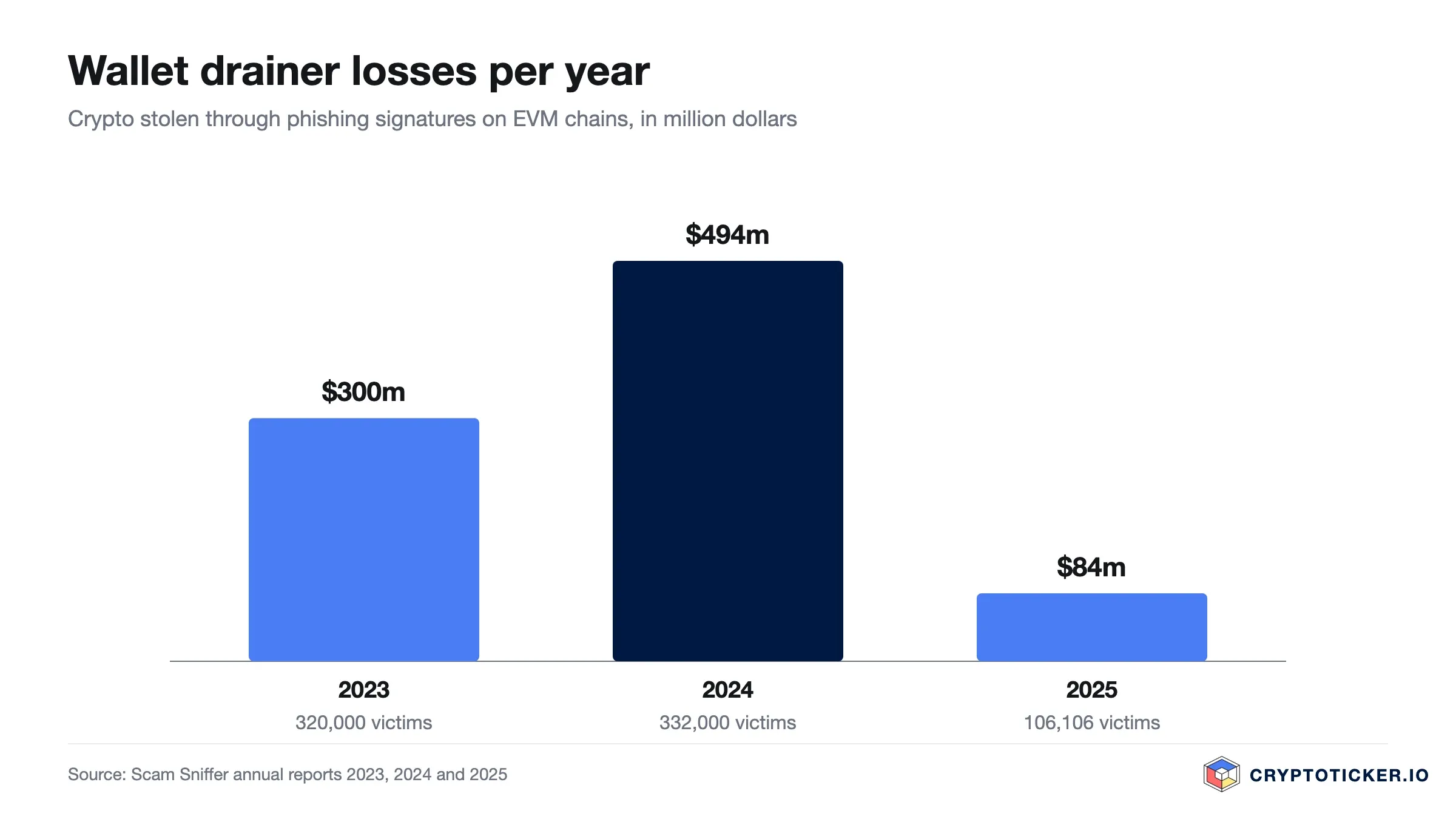
A crypto airdrop is a free distribution of tokens to many wallet addresses at once. Blockchain projects use airdrops to reward early adopters, spread ownership and raise awareness for a new token. The best-known example: on 16 September 2020, Uniswap gave 400 UNI to each of 251,534 addresses that had used the exchange. At today's price those 400 tokens are worth about $2,679; at the 2021 peak they were worth $17,990. The flip side: wallet drainers stole $84 million from 106,106 victims in 2025, according to Scam Sniffer, often with fake airdrop claim pages.
Crypto airdrops at a glance
- Free tokens: a genuine airdrop never asks you to send crypto first; at most you pay a small gas fee to claim.
- Snapshot decides: Arbitrum took its snapshot on 6 February 2023 and opened claims on 23 March 2023 (Arbitrum Foundation).
- Big numbers: Arbitrum airdropped 1.162 billion ARB, 11.62% of all tokens, to users; Starknet sent more than 700 million STRK to nearly 1.3 million addresses in February 2024.
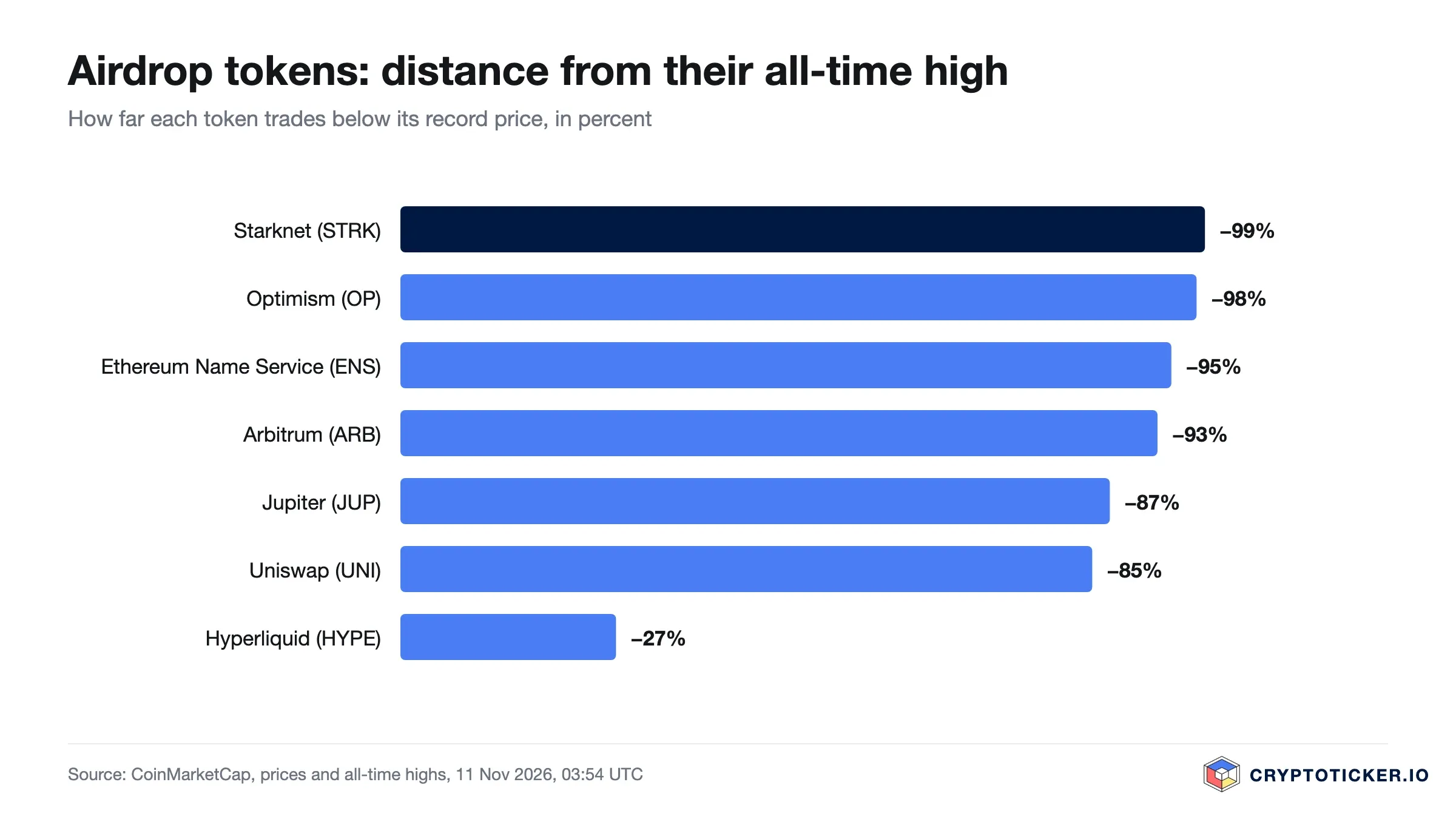
- Prices fall: six of seven large airdrop tokens trade 85% to 99% below their all-time high (CoinMarketCap, 11 November 2026).
- Taxes: in the US, airdropped tokens count as ordinary income at their market value on the day you can move them.
- Scams: wallet drainers took $494 million in 2024 and $84 million in 2025; airdrops are one of their main lures.
What Are Airdrops and Why Do They Happen?
What are Crypto Airdrops?
Airdrops are a marketing strategy of blockchain projects: they distribute tokens for free to holders of a particular cryptocurrency or to users of an application. The tokens arrive in, or can be claimed to, a wallet address you control. Projects use cryptocurrency airdrops to promote a new token, to reward existing users and to attract attention to a specific blockchain network. Unlike initial coin offerings (ICOs), where buyers pay for new tokens, the recipients of an airdrop pay nothing.
Why Do Crypto Airdrops Happen?
Airdrops serve several purposes for crypto projects. They bootstrap a community, put tokens into many hands at once, drive user adoption and generate buzz on social media. Since 2020 there is a second motive: governance. When Uniswap, Arbitrum or the Ethereum Name Service handed out their tokens, they also handed out votes in their DAOs, so the people who use a protocol help decide how it develops. An airdrop is cheaper than paid advertising and reaches exactly the users a project wants: people who already hold a wallet and know how to use it.
How Do Crypto Airdrops Work?
Most crypto airdrops work in four steps:
- Announcement or surprise: some projects announce an airdrop campaign on social media, forums, Discord and X. Others, like Uniswap, surprise their users with a retroactive airdrop.
- Snapshot: the project records balances or activity at a fixed block. Every wallet address that meets the criteria at that moment is eligible.
- Eligibility rules: criteria can be simple (held a token, used the app once) or detailed points systems that weigh volume, number of transactions, months of activity or liquidity you provided.
- Distribution or claim: a few projects send tokens straight into existing wallets. Most open an official claim page where you connect your wallet and sign one transaction through the project's smart contracts. Claim windows are limited: Starknet's ran for four months.
Types of Crypto Airdrops
Crypto projects use several types of airdrops to reach their goals:
- Standard Airdrop: anyone who signs up with a valid wallet address receives a fixed amount, often on a first-come, first-served basis. Today this type is rare, because bots claim most of it.
- Bounty Airdrop: recipients complete simple tasks, such as following an account, sharing a post or joining a Telegram group, to earn free tokens.
- Holder Airdrop: users who hold a certain amount of existing tokens at the time of a snapshot receive new tokens in proportion to their balance.
- Hard Fork Airdrop: when a blockchain splits into two, holders of the original coin usually receive the same number of new coins. Bitcoin Cash, created from Bitcoin in 2017, is the best-known case.
- Exclusive Airdrop: rewards depend on loyalty, such as time spent on a project, testnet activity or engagement within a community. Points programs are the modern form.
- Retroactive Airdrop: early users of a protocol receive tokens for what they did before the token existed. Uniswap, Arbitrum, Starknet and Jupiter used this model.
- Raffle Airdrop: winners are drawn at random from all participants, often as an add-on to other airdrop methods.
Exploring Famous Airdrops: Notable Examples
The table shows the largest airdrops with figures published by the projects themselves.
| Airdrop | Date | Tokens for users | Recipients |
|---|---|---|---|
| Uniswap (UNI) | 16 Sep 2020 | 150 million UNI (15% of supply), 400 UNI per user | 251,534 users and 49,192 liquidity providers |
| Ethereum Name Service (ENS) | Snapshot 31 Oct 2021 | ENS governance tokens | Holders of an ENS name |
| Arbitrum (ARB) | Claims from 23 Mar 2023 | 1.162 billion ARB (11.62%) | Users of Arbitrum, plus 113 million ARB for DAOs |
| Starknet (STRK) | 20 Feb 2024 | More than 700 million STRK | Nearly 1.3 million addresses |
1. Ethereum (ETH): sold for bitcoin, not airdropped
Ethereum did not start with an airdrop. Its first ether was sold in a public presale that ran for 42 days until 2 September 2014: buyers paid in bitcoin, at 2,000 ETH per BTC at first and 1,337 ETH per BTC at the end. Ethereum's role in airdrops came later: most airdrop tokens since 2017 are ERC-20 tokens on Ethereum or on its layer-2 networks, and the airdrop logic runs in Ethereum smart contracts.
2. Uniswap (UNI): DeFi's Game-Changer
Uniswap, a leading decentralized exchange, surprised its users on 16 September 2020: every address that had ever called the Uniswap contracts could claim 400 UNI, and liquidity providers received about 49 million UNI more, weighted by how long and how early they provided liquidity. The Uniswap airdrop became the template for retroactive airdrops.
3. Solana (SOL): The Meteoric Rise
Solana itself did not hand out SOL in a series of airdrops. The big airdrops came from applications built on Solana: the exchange aggregator Jupiter (JUP) launched its token with an airdrop in January 2024, and other Solana apps did the same. These drops rewarded early Solana users and pulled new users into the network, one reason why the ecosystem grew so fast in 2024.
4. Arbitrum (ARB): rewards for months of activity
Arbitrum, a layer-2 network for Ethereum, set aside 1.162 billion ARB for users who had bridged funds, made transactions or used the network over several months before the snapshot on 6 February 2023. At the all-time high in January 2024 that allocation was worth $2.79 billion; at today's price it is worth about $191 million.
5. Starknet (STRK): 1.3 million addresses
Starknet's Provisions program sent more than 700 million STRK to nearly 1.3 million addresses on 20 February 2024, including developers on GitHub and Ethereum stakers. STRK reached its record price on the day of the airdrop: the tokens were worth $2.56 billion at that moment and about $27 million today.
6. Ethereum Name Service (ENS): rewarding domain holders
The Ethereum Name Service airdropped its governance token to everyone who held an ENS name on 31 October 2021. The project states clearly that no further airdrop is planned, and warns that notices about new ENS airdrops can be fraudulent: a useful rule for every project that has already distributed its token.
How Much Are Airdropped Tokens Worth Later?
Most airdropped tokens lose value after the claim. Many recipients sell immediately, and the project's team and investor tokens unlock in the following months. Of seven large airdrop tokens, six trade between 85% and 99% below their all-time high, according to CoinMarketCap on 11 November 2026. Only Hyperliquid (HYPE), whose token launched with an airdrop to its users, trades 27% below its record from September 2026.
Our assessment: an airdrop is a windfall, not an investment plan. If you receive tokens you would not buy with your own money, selling part of them soon after the claim locks in the gain. If you believe in the project, holding is a bet like any other purchase, made with tokens that cost you only time and gas fees.
How to Know When Airdrops Occur?
1. Follow Airdrop Platforms
Platforms dedicated to listing upcoming airdrops, such as AirdropAlert, CoinMarketCap, and Airdropster, can help you discover new airdrop opportunities and stay informed about the latest developments. Such an airdrop aggregator lists the tasks, the deadlines and the blockchain of each campaign. Treat these lists as a starting point and confirm every airdrop on the project's own website. Our weekly overview of the most profitable crypto airdrops lists open claims with their deadlines, and the guide to crypto withdrawal deadlines shows where time is running out.
2. Engage with Crypto Communities
Joining cryptocurrency communities on platforms like Telegram, Discord, and Reddit can provide valuable insights and early access to airdrop announcements. Follow the official accounts of projects without a token yet: new airdrops usually come from networks and apps that have users but no token. Engage with like-minded individuals, but never trust a direct message about an airdrop.
3. Stay Vigilant and Do Your Due Diligence
Be cautious of scams and phishing attempts disguised as legitimate airdrops. Always verify the authenticity of airdrop projects, double-check instructions, and research the teams behind them before participating. Trust your instincts and prioritize security at all times.
Stay Updated on the Latest Airdrops!
Subscribe now to receive updates on upcoming airdrops, along with the latest crypto news and expert insights. Join our community today and elevate your crypto journey.
Free, every week, unsubscribe any time.
Subscribe on SubstackThe signup form is provided by Substack and needs marketing cookies to load.
How to Participate in Crypto Airdrops: A Step-by-Step Guide
Getting crypto airdrops takes a wallet, some activity on the right networks and patience. These steps apply to most airdrops in 2026:
1. Research and Stay Informed
Keep an eye on cryptocurrency forums, social media channels, and dedicated airdrop platforms to stay updated on upcoming airdrops. Joining relevant communities and following project announcements can provide valuable insights into potential airdrop opportunities. Read how a project describes its points or rewards program: it tells you which activity counts.
2. Prepare Your Wallet
Ensure you have a compatible wallet that supports the tokens being airdropped. Popular choices include MetaMask, MyEtherWallet, and Trust Wallet for Ethereum-based tokens, while Trust Wallet also works for BNB Chain tokens. Exchanges sometimes credit airdrops to their customers, but most airdrops require a self-custodial wallet where you hold the private keys.
3. Use the Protocols Early
Retroactive airdrops reward real use: transactions over several months, bridging funds, trading, staking or the liquidity you provide. Many recent airdrops came from DeFi protocols and new layer-2 networks. Each transaction costs gas fees, so weigh the cost against a reward that may never come.
4. Follow Instructions Carefully
Each airdrop will have specific requirements and instructions for participation. These may include tasks such as joining Telegram groups, following X accounts, or completing KYC (Know Your Customer) verification. Follow the instructions meticulously to ensure eligibility for the airdrop.
5. Claim on the Official Page
When the claim opens, reach the claim page through the project's official website or documentation, never through a link in a message or an advertisement. Connect your wallet, check what the transaction does and confirm. Claim within the deadline: Starknet, for example, returns unclaimed STRK to its pool.
6. Secure Your Private Keys
Never share your private keys or seed phrases with anyone, as this could lead to unauthorized access to your funds. Exercise caution when interacting with airdrop-related platforms and always prioritize security.
Airdrop Scams: How to Avoid Them?
Airdrop scams are the most common way people lose crypto around free tokens. The pattern is almost always the same: a fake claim page asks you to connect your wallet and sign a transaction that hands control of your tokens to the scammer. Scam Sniffer counted $300 million in such losses in 2023, $494 million in 2024 and $84 million in 2025. The 2023 report links a spike in thefts to the Arbitrum airdrop in March, when the project's Discord was hacked.
To avoid falling victim to airdrop scams, exercise caution and conduct thorough research. Firstly, be wary of unsolicited airdrops that appear too good to be true, especially those requiring you to provide personal information or access to your wallet. Always verify the legitimacy of the project and its team by checking official websites, social media accounts, and community forums.
Additionally, scrutinize the smart contract code to ensure transparency and security. Avoid interacting with suspicious links or third party sites claiming to facilitate airdrops, as these could be phishing attempts aimed at stealing your private keys or funds. Lastly, trust your instincts and prioritize security over the allure of free tokens. If something feels off or too risky, it's better to err on the side of caution and refrain from participating.
Five rules that stop most potential scams:
- Never pay to receive: a real airdrop never asks for a deposit or an upfront fee.
- Use a separate wallet: connect new claim pages only with a wallet that holds little value.
- Read what you sign: a claim needs a simple transaction, not an approval or permit for all your tokens.
- Ignore unknown tokens: tokens that appear unasked in your wallet and point to a website are bait.
- Check the official channels: projects that already distributed their token often say so, like ENS. A recent example is the fake Shiba Inu airdrop from October 2026.
Are Crypto Airdrops Taxable?
In the US, yes. The IRS says that cryptocurrency received from an airdrop following a hard fork is ordinary income equal to its fair market value when it is recorded on the blockchain, provided you can transfer, sell or exchange it (Revenue Ruling 2019-24). Other airdrops are generally treated the same way: the tokens count as taxable income at their market value when you gain control over them. When you later sell, the difference to that value is a capital gain or loss.
The tax implications differ by country, so keep a record of every airdrop with date, amount and value in US dollars. Our guide on how to file crypto taxes explains the reporting step by step.
Are Crypto Airdrops Worth It?
For active users, airdrops can pay off: an early Uniswap user received 400 UNI worth about $2,679 today without paying for them. For people who chase airdrops with dozens of wallets and hundreds of transactions, the math is less clear: gas fees, time and the risk of scams add up, and most tokens lose value after the claim. Use the protocols you actually need, keep your main wallet separate and treat every airdrop as a bonus.
Correction, 11 November 2026: an earlier version of this guide described Ethereum's launch as an airdrop to Bitcoin holders and Solana as running its own airdrop series. Ether was sold for bitcoin in 2014, and the large Solana airdrops came from applications on the network. Both sections now say so.
Airdrops FAQ

Rudy Fares
Equity Trader, Financial Consultant, Musician and Blockchain Aficionado. I spend my time doing Technical and Fundamental Analyses for Stocks, Currencies, Commodities and Cryptocurrencies.