
Von der Leyen Wants Your Bank Deposits: Here Is How to Keep Control of Them
Brussels wants Europe's 10 trillion euros in deposits funding its companies. What it means for savers, and why Bitcoin savings plans matter.





Which topics should we dive deeper into?
Select what genuinely interests you. Your picks feed directly into our editorial planning.
Crypto news that's actually worth your time.
Weekly. 60 seconds. Carefully curated by our editors: no hype, no promo flood, no spam.
The President of the European Commission stood in front of a room full of French business leaders last week and said the quiet part out loud. Europeans have roughly 10 trillion euros parked in bank accounts, that money is "sitting idle", and Europe now needs to put it to work for European companies.
She was not proposing to raid anyone's account. But the language matters, because it tells you exactly how your savings are viewed from Brussels: not as your money, but as a national resource that is currently being wasted. Here is what is actually happening, and what you can do about it that does not involve waiting for a policy to be designed for you.
 Compare the best Bitcoin savings plans
What Did Von der Leyen Actually Say About Europe's Savings?
Speaking at the La REF business conference in Paris on 27 August, Ursula von der Leyen argued that Europe's old economic model is finished. Cheap imported energy is gone, easy access to global trade is gone, and the assumption that someone else would handle Europe's security is gone.
Her answer is money. Specifically, your money. Around 10 trillion euros in household savings sit in European bank deposits, and a large share of Europe's savings ends up invested outside the continent, mostly in the United States. Meanwhile European companies stall out, get bought, or move abroad for funding.
The President of the European Commission stood in front of a room full of French business leaders last week and said the quiet part out loud. Europeans have roughly 10 trillion euros parked in bank accounts, that money is "sitting idle", and Europe now needs to put it to work for European companies.
She was not proposing to raid anyone's account. But the language matters, because it tells you exactly how your savings are viewed from Brussels: not as your money, but as a national resource that is currently being wasted. Here is what is actually happening, and what you can do about it that does not involve waiting for a policy to be designed for you.
What Did Von der Leyen Actually Say About Europe's Savings?
Speaking at the La REF business conference in Paris on 27 August, Ursula von der Leyen argued that Europe's old economic model is finished. Cheap imported energy is gone, easy access to global trade is gone, and the assumption that someone else would handle Europe's security is gone.
Her answer is money. Specifically, your money. Around 10 trillion euros in household savings sit in European bank deposits, and a large share of Europe's savings ends up invested outside the continent, mostly in the United States. Meanwhile European companies stall out, get bought, or move abroad for funding.
The vehicle for fixing this is the Savings and Investments Union, or SIU. The Commission says the package of measures on securitisation, bank and insurance investment rules, market integration and supervision could unlock up to 470 billion euros in additional investment.
Is the EU Really Taking Money From Your Savings Account?
No, and anyone telling you otherwise is selling something. There is no confiscation, no forced conversion, no deposit levy in the SIU.
What the SIU does is change the plumbing. It makes it easier and cheaper for banks, insurers and asset managers to move retail money into capital markets, it pushes simplified investment products and pension wrappers, and it leans hard on financial literacy campaigns to convince you that your deposit account is underperforming.
On the last point, they are not wrong. The Commission's own framing is that bank deposits are safe and easy to access but usually earn less than capital market investments. That is true. The awkward part is the second half of the pitch: the goal is not only better returns for you, it is cheaper capital for European companies. You are being asked to become the funding source for an industrial policy.
There is also a detail that rarely gets mentioned. Your savings were never idle. Banks lend deposits out. They always have. What Brussels means by "idle" is that the money is not flowing into the specific channels the EU wants it to flow into.
Why Are Bank Deposits Losing You Money Anyway?
Forget the politics for a second. The case against leaving everything in a savings account is much older than the SIU.
A euro sitting in a deposit account earns a nominal rate. Inflation eats the real value. Across most of the last decade, the combination has meant a slow, quiet loss of purchasing power for European savers, even during periods when headline rates looked respectable. You do not see it, because the number on your statement never goes down. Only what it buys does.
That is the actual problem. Von der Leyen is right that 10 trillion euros of deposits is a bad outcome for savers. Where reasonable people disagree is on the solution.
What Does It Actually Mean to Control Your Own Money?
Here is the test. If someone else can change the rules, freeze the account, redirect the flow, or inflate away the value while you sleep, you do not fully control that money. You have a claim on it.
That applies to a bank deposit, and it applies just as much to whichever tidy EU investment wrapper gets rolled out in 2027 with a nice acronym and a tax incentive attached.
Bitcoin is the opposite design. Fixed supply of 21 million, no issuer, no board meeting that can change the schedule, and if you hold your own keys, no intermediary that can freeze it. That is the entire point of the asset. Whether you like the volatility or not, nobody in Brussels, Frankfurt or Washington can decide that your bitcoin is sitting idle and needs to be redirected.
How Does a Bitcoin Savings Plan Work?
A Bitcoin savings plan is the least dramatic way to own bitcoin. You set a fixed amount, weekly or monthly, and it buys automatically. That is it.
The mechanism is dollar cost averaging. When the price drops you buy more sats for the same money, when it rises you buy fewer. Over a full cycle your average entry smooths out, and more importantly, you stop trying to time a market that has humiliated far better traders than you.
It also fixes the behavioural problem. Most people who say they want to buy bitcoin never do, because there is never a comfortable moment. An automated plan removes the decision entirely. At the time of writing bitcoin trades around 78,000 dollars, roughly 37 percent below its all time high near 126,000 dollars. Uncomfortable for lump sum buyers. Exactly the environment a savings plan is built for.
We compared the main providers offering Bitcoin savings plans in Europe, including minimum amounts, fees and whether you can actually withdraw to your own wallet: Bitcoin savings plan comparison
Where Can You Build the Rest of the Portfolio?
$Bitcoin should not be the whole plan. The boring part of a portfolio still matters, and the same automated logic works for stocks and ETFs.
If you want the equity side handled in one place, XTB offers commission free investing in real shares and ETFs up to a monthly turnover threshold, with fractional shares and recurring investment plans, so you can run an ETF savings plan next to your Bitcoin savings plan.

What Are the Risks of a Bitcoin Savings Plan?
This is the part most articles skip, so here it is plainly.
- Bitcoin is volatile. Drawdowns of 50 percent or more have happened repeatedly and will happen again. A savings plan reduces timing risk, it does not remove market risk, and it does not guarantee a profit.
- Never automate money you need soon. Emergency fund first, in cash, in a bank account, boring and accessible. Savings plans are for capital you can leave alone through a full cycle.
- Custody is a real decision. If your provider holds the coins, you are trusting that provider. Check before you sign up whether you can withdraw to your own wallet, because a plan you cannot withdraw from is an IOU, not bitcoin.
- Tax rules differ by country. Holding periods, exemptions and reporting obligations vary across the EU, so check your local rules or ask an advisor.
Frequently asked questions about the EU Savings and Investments Union
Related articles
- The Cost Average Effect with Bitcoin: What Twelve Instalments Really Deliver
- $130 Million Gone Because the Randomness Was Predictable: Which Hardware Wallet You Can Still Buy
- How to Invest in Bitcoin in 2025: A Comprehensive Guide for Beginners
- Bitcoin Back Above $80,000: Buy More, Hold or Take Profits? What to Check Now
- Buying More Bitcoin at $77,000: Savings Plan or Lump Sum
Which topics should we dive deeper into?
Select what genuinely interests you. Your picks feed directly into our editorial planning.
Crypto news that's actually worth your time.
Weekly. 60 seconds. Carefully curated by our editors: no hype, no promo flood, no spam.

June 6, 2026 3:56 PM
DCA Crypto: How to Survive Crypto Crashes with Dollar Cost Averaging and Invest for the Long Term
Bitcoin from $120,000 to $60,000? With the DCA strategy, you invest step by step and use crypto crashes as an opportunity instead of selling in a panic.

October 3, 2026 4:40 PM

Investing in Bitcoin With a Savings Plan or a Lump Sum: What the December 31 Tax Cut-Off Changes
Anyone putting money into Bitcoin now chooses between a lump sum, a monthly instalment and an ETN in a securities account. The German finance ministry’s draft bill would keep the one-year holding period only for holdings bought by December 31, 2026.
August 18, 2026 4:45 PM

Crypto Savings Plans Compared: What Bison, justTRADE and Kraken State on Fees, Minimum Instalment and Interval
Crypto savings plans advertise free execution, yet the price almost always sits in the spread. On August 14, 2026 we retrieved nine provider pages and evaluated which terms actually stand there.
September 24, 2026 10:19 PM
Bitcoin for Retirement: What Applies from 2027 and What You Decide Now
Bitcoin is not permitted in any state-subsidised retirement product, including the new retirement savings account from 2027. Anyone who still wants to use crypto assets for their own pension goes through private assets, and there a cutoff date at the end of 2026 is shifting the tax rules right now.

June 24, 2024 10:37 AM

Bitcoin Price Prediction: Can BTC Price Fall Below 50K?
The profitability of Bitcoin futures cash-and-carry trades has plummeted amid a significant crypto market selloff. What are the reasons behind the decline and what can traders expect next?
September 14, 2024 12:01 PM
Bitcoin Surges Past $60K: The Start of a Major Rally or Just Another Bull Trap?
Bitcoin has surged past $60,000, sparking optimism among investors. But with looming market volatility and whale activity, is this the start of a new rally or just another bull trap?
August 18, 2026 4:22 AM

Bitcoin for gold: is the swap taxable in Austria?
Swapping bitcoin directly for gold? In Austria this can already trigger 27.5 percent tax on the capital gain. What investors should know.
February 15, 2025 11:34 AM
Bitcoin Price Surges Amid International Governmental Adoption - Can It Break $100K?
Bitcoin price is on the rise, fueled by massive international adoption and growing interest in crypto custody services. Will these developments push Bitcoin past the elusive $100K mark?
August 24, 2026 4:13 AM
Volksbank Crypto: Which Banks Already Offer Bitcoin in the VR App
Three of 14 cooperative banks we checked ran a public page on crypto trading with meinKrypto on August 23, 2026, and a fourth points to a different route. What the service can do, what it costs and which question to ask before your first purchase.
September 9, 2026 4:29 PM
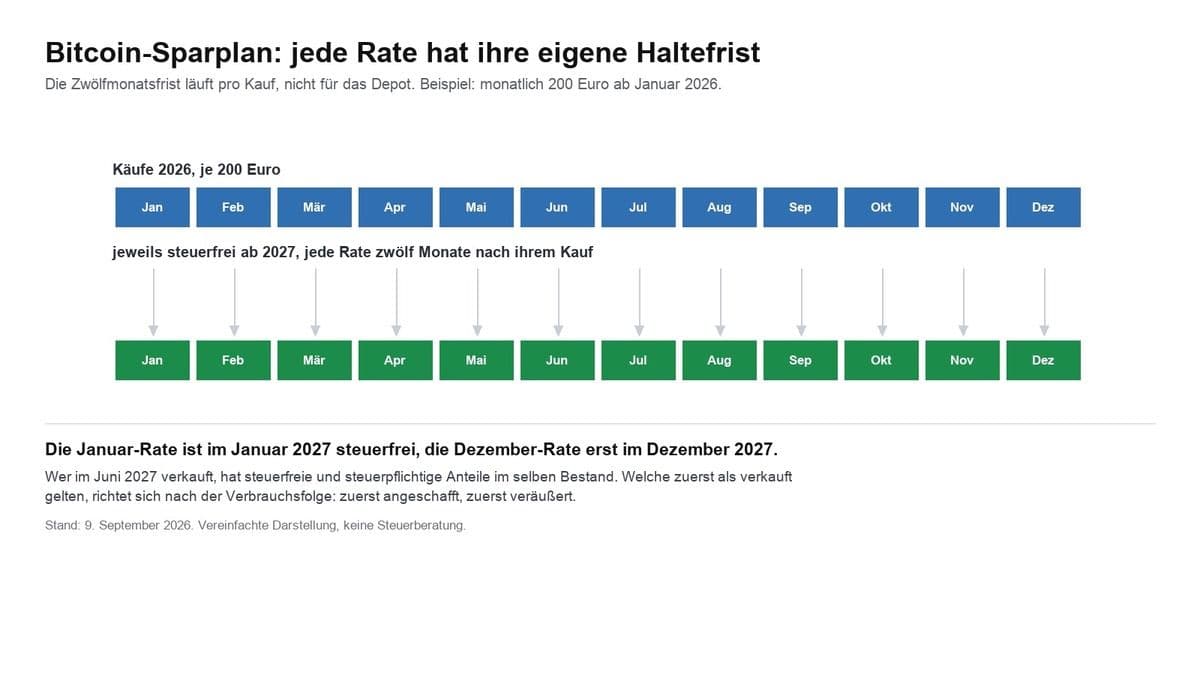
Bitcoin and Taxes in Germany: Holding Period, Savings Plan, ETP and Mining
Bitcoin gains are tax-free after twelve months. What that means for a savings plan with twelve deadlines, why ETPs are taxed differently, and what applies to mining, gifts and losses.
May 20, 2024 11:17 PM

Bitcoin Price Reaches 70K,Why Is Bitcoin (BTC) PRICE UP?
With BTC surpassing the $70K a while ago, a downtrend was kicked off. And everyone can't help but wonder, how low will it go? And what will the next adjustment price be for BTC?
September 22, 2026 1:27 AM
Bitcoin ATM in Germany: Fees, BaFin Authorisation and Tax
Bitcoin ATMs stand in kiosks and shopping arcades, and buying there costs a multiple of the online route. What BaFin demands of the operator, at what amount your ID becomes due, and how you evidence the purchase for tax.
August 24, 2026 10:26 AM
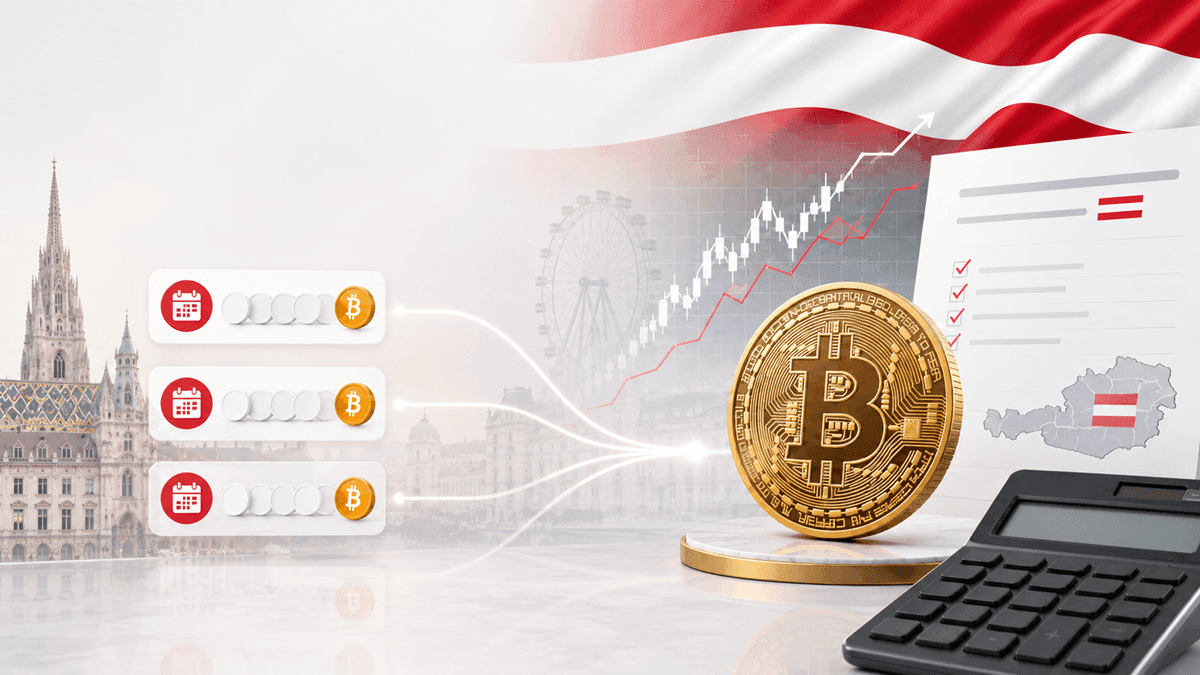
Bitcoin Savings Plan in Austria: How the Purchase Price Is Calculated
Bought bitcoin through a savings plan? For multiple purchases Austria applies the moving average price as a matter of principle when working out taxable gains.
September 14, 2026 4:19 AM
Fed Rate Decision of September 16: What It Means for Your Bitcoin Savings Plan
Recap as of September 27, 2026: this article appeared before the US Federal Reserve's rate decision on September 16, 2026, when futures markets mostly expected a hike. It describes what a hike means for your monthly instalment, a running crypto loan and your holding periods.
September 10, 2026 4:15 PM

BW-Bank Opens Bitcoin Trading Inside the Securities Account: What to Check Before Your First Buy
Since September 9, 2026, BW-Bank customers have been able to trade ten crypto assets through their securities account, executed and held in custody by Bitpanda. The familiar securities-account setting hides three points you should settle before your first order.
September 22, 2026 1:12 PM

Buying Bitcoin With PayPal in Germany: What Really Works and What It Costs
PayPal runs no crypto service of its own in Germany, but it works as a deposit route at regulated exchanges. What the detour costs, which withdrawal hold follows it and why buyer protection does not apply here.
August 14, 2026 6:23 AM

Bitcoin Savings Plan and Tax: How the Holding Period, FIFO and the Exemption Limit Interact on Monthly Buys
Every savings plan instalment is a separate acquisition for tax purposes, with a holding period of its own. How the exemption limit, the order of disposal and record-keeping duties interact on monthly Bitcoin buys, with the sources from the statute and the Ministry of Finance circular.
May 1, 2026 6:08 PM

Crypto Market Rally Faces New Test as Trump’s EU Tariffs Threaten Inflation Comeback
Bitcoin holds above $78K as Trump’s EU tariff threat revives inflation fears. Can the crypto market rally survive renewed trade tensions?

November 21, 2020 11:14 PM

Deutsche Bank: Bitcoin More Popular than Gold as a Store of Value Investment!
A rising number of investors now choose Bitcoin over gold as a hedge against inflation says Deutsche Bank. At the time of writing this article, the Bitcoin price is trading at $18,238.71.
November 3, 2019 2:49 PM
How to earn money with Bitcoin Lending?
If you hold some Bitcoins, you may desire to earn some money with the help of them instead of lazing around in a Bitcoin wallet. Bitcoin Lending in cryptocurrencies has the great purpose of giving funding for world cities where […]
September 1, 2026 10:13 AM

BaFin Crypto Knowledge Survey: Four Assumptions Owners Believe Are True
BaFin has measured what crypto owners know about their products: 57 percent of the answers were correct, 31 percent wrong. Four false assumptions come up especially often, and each of them changes your own investment decision.
July 28, 2026 5:16 PM
Russia Just Passed Its Own Crypto Clarity Act While the US Senate Keeps Stalling
Russia's crypto trading law is on its way to Putin's desk while the US CLARITY Act sits unvoted on a shelf. Here is what the split means for prices.
July 19, 2026 1:59 PM
Top 5 Altcoins to Buy in July 2026 if the Crypto Recovery Holds
Bitcoin found support near its 21-month low around $58K. Here are 5 altcoins under $2B with real utility that could outperform if July's recovery holds.
July 18, 2026 12:46 PM
US National Debt Hits Record $39.5 Trillion — What It Means for Your Wallet and Your Crypto
The US debt just set a fresh all-time high near $39.5 trillion. Here's how it hits normal households — and why it matters for $BTC and crypto.
September 9, 2024 8:00 AM
How Fed Rate Cuts Could Shake Global Markets and Boost Tokenized Treasuries
With looming Fed rate cuts, global markets are bracing for impact. Check how these changes could affect risk-on assets like Bitcoin and tokenized treasuries.



More from CryptoTicker