
MiCA Register 2026: Only 21 of 329 Licences Are Real Exchanges
ESMA publishes the register of MiCA-authorised providers as an open file. We worked through all of it — and the result is not what the phrase “licensed crypto exchange” suggests.



Which topics should we dive deeper into?
Select what genuinely interests you. Your picks feed directly into our editorial planning.
Crypto news that's actually worth your time.
Weekly. 60 seconds. Carefully curated by our editors: no hype, no promo flood, no spam.
Since 1 July 2026, any platform serving customers in the EU needs a granted MiCA authorisation. An application in progress no longer counts. Anyone who wants to know which firms actually cleared that bar does not have to take a press release on trust: the European Securities and Markets Authority publishes the register of authorised providers as an open file, no login required.
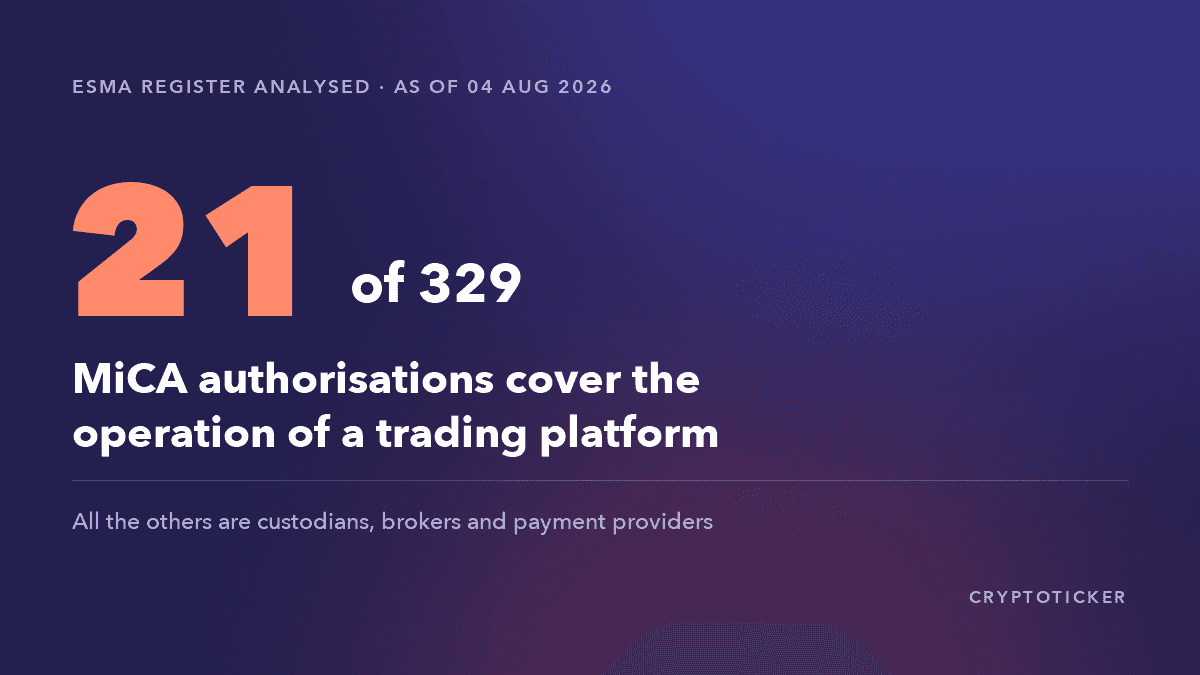
We downloaded that file and worked through all of it. The register is dated 4 August 2026 and was pulled on 6 August. What comes out of it matches the industry's self-description only in part. The most striking finding sits further down and reads: of 329 authorisations, exactly 21 permit the operation of a trading platform.
What the register actually says
At the cut-off date the register holds 329 authorisations, spread across 322 legal entities with their own LEI code and 26 states of the European Economic Area. The gap between the two figures comes down to companies appearing more than once, typically where an authorisation was later extended.
The raw data is available as a CSV. Anyone who wants to redo the arithmetic will find it here: CASPS.csv in the ESMA register. The folder in the path reads 2024-12, but the contents are kept current. The authority's own MiCA overview page is here.
Germany accounts for one authorisation in five
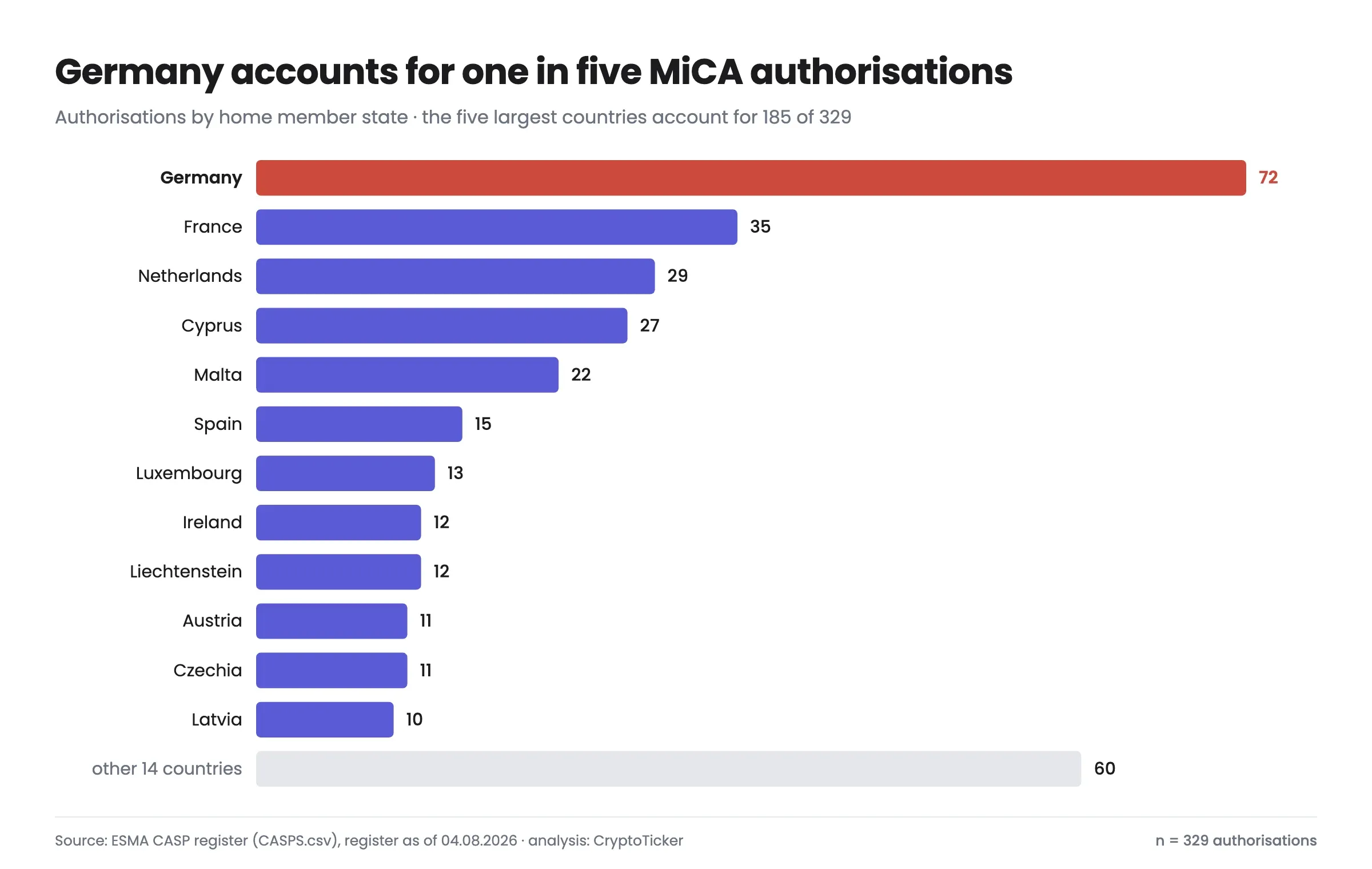
The geographic spread is far more lopsided than the public debate about Malta and Cyprus would suggest. With 72 authorisations Germany leads the field, more than twice as many as second-placed France with 35. The Netherlands follow with 29, Cyprus with 27 and Malta with 22.
Why Germany leads
Together those five countries account for 185 of the 329 authorisations, or 56 per cent. The remaining 21 states share what is left. The German lead has a cause that has little to do with crypto, though: a large share of the domestic authorisations sits with banks, savings-bank networks and investment firms that offer crypto trading as an add-on to an existing business. Of the 72 German authorisations only two permit the operation of a trading platform, and 56 apply to the German market alone.
Germany does not lead because an unusual number of trading venues sprang up here. It leads because the established financial sector filed as a bloc.
The finding that matters most: authorised rarely means exchange
MiCA defines ten separate services, each authorised individually. An authorisation is therefore not a blanket seal but a list of permitted activities. We counted how often each of those ten activities appears in the register.
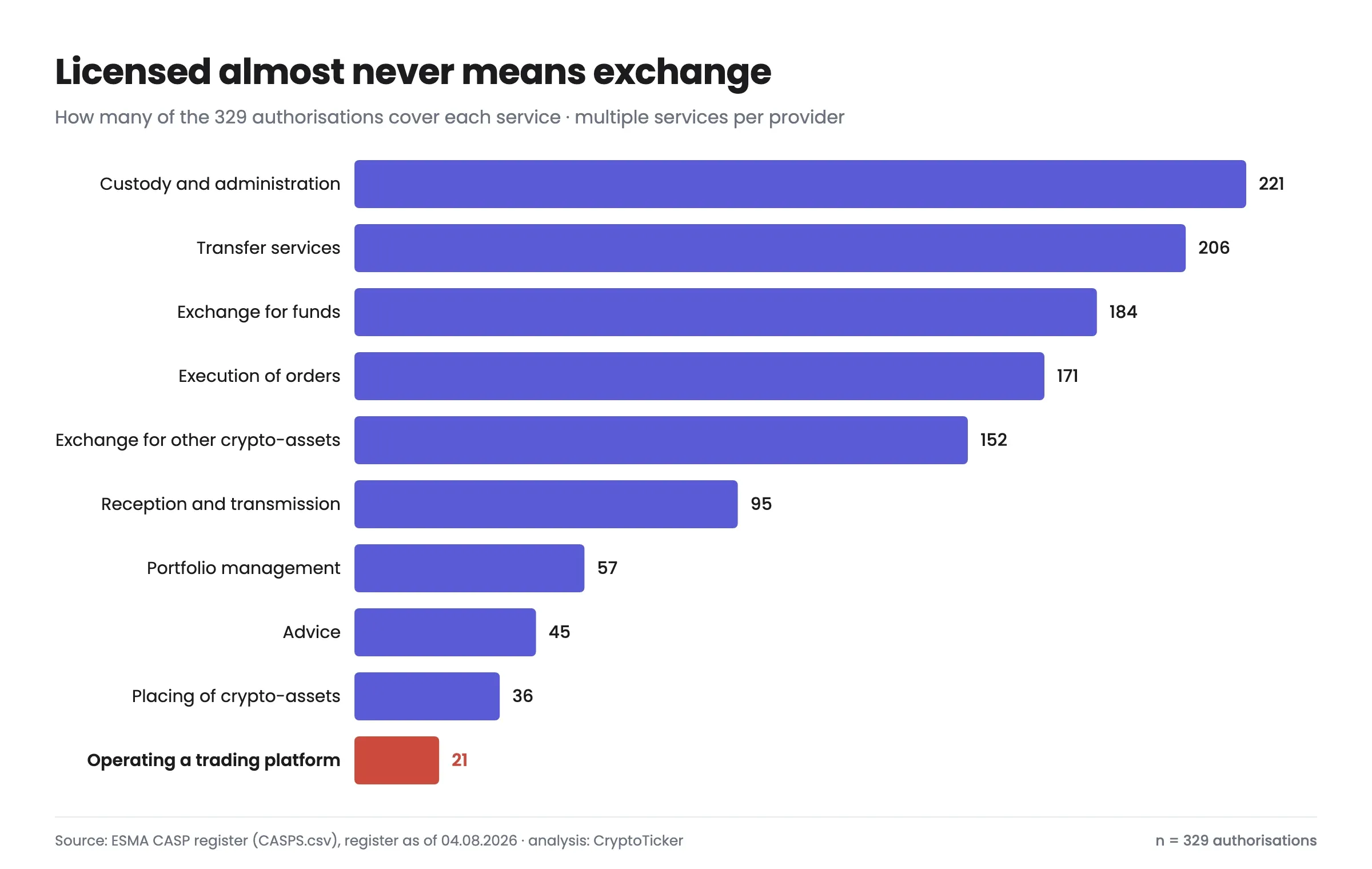
Custody of crypto-assets is the most common at 221 mentions, followed by transfer services at 206 and exchange for euros or other currencies at 184. At the bottom sits the service most people have in mind when they say "crypto exchange": operating a trading platform appears 21 times. That is 6.4 per cent of all authorisations.
What the difference means in practice
A trading platform under the regulation brings together the orders of different clients in an order book. You trade against other users; the operator only provides the venue. The far more common service, "exchange of crypto-assets for funds", works differently: there the provider is your counterparty. It quotes you a price and you take it or leave it.
Both are legal, both are regulated, and for many retail investors the broker model is in fact more convenient. The pricing simply works differently. In the register 170 providers may exchange against funds without running a trading platform. With them the margin sits in the spread, the gap between the buying and the selling quote, and that is rarely disclosed as clearly as a percentage fee.
Confusing the two models means comparing costs that are not comparable. That is precisely why our comparison of regulated crypto exchanges lists the legal entity and the actual trading costs separately for every provider.
Only half of them use the EU passport
MiCA's central promise is the European passport: an authorisation from one member state is valid across the single market. A provider authorised in Ireland may operate in Spain, Poland and Finland without a further procedure. In practice this is used far less often than expected.
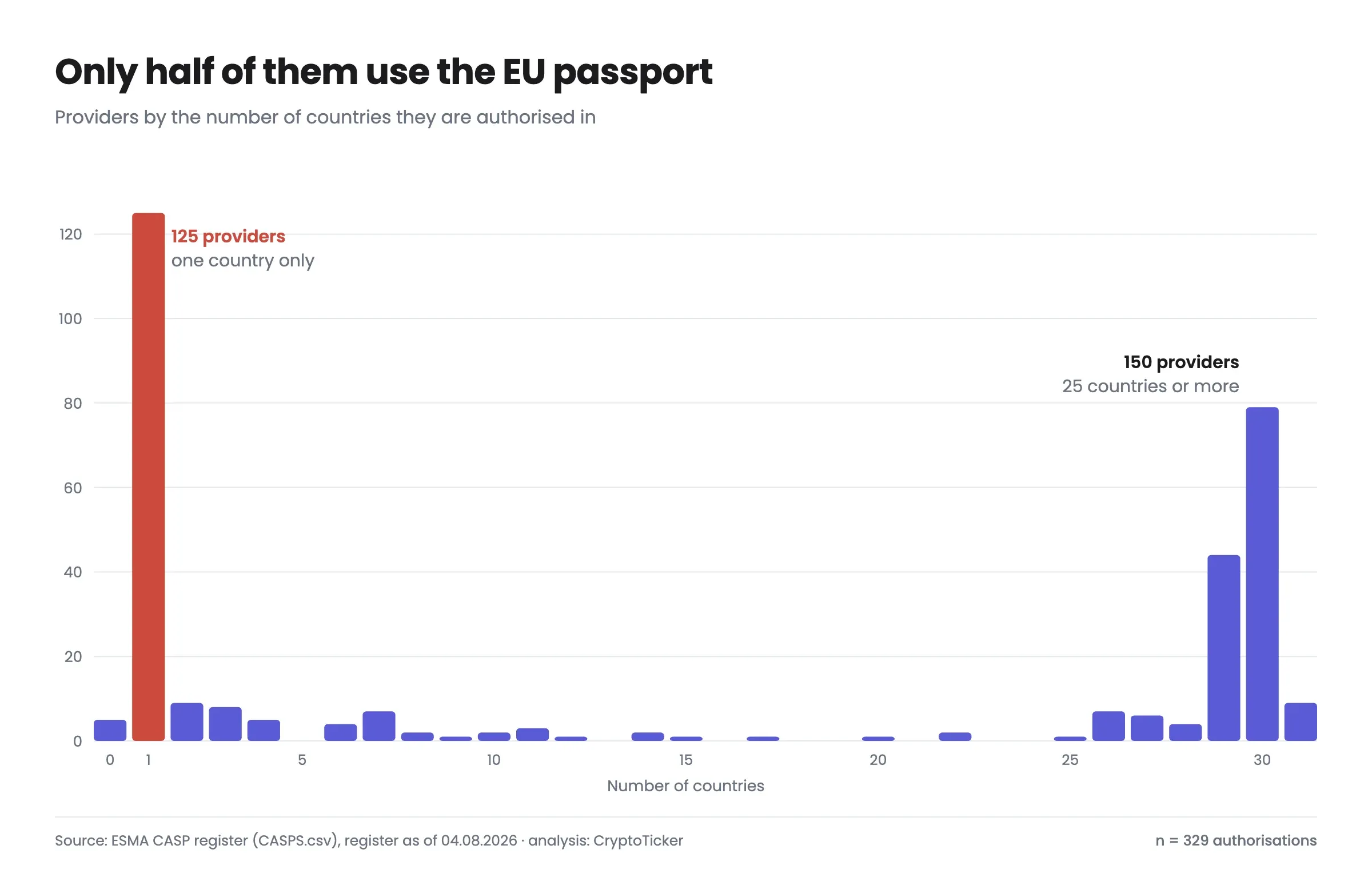
The distribution splits into two camps with almost nothing in between. 125 authorisations cover exactly one country. 150 cover 25 countries or more, most of them 29 or 30. The middle is missing: only 49 providers sit somewhere between two and 24 countries.
Two very different business models sit behind that. One group are regional institutions, often banks, serving an existing client base with no interest in going abroad. The other are platforms that think in European terms from the outset and treat the passport as the actual reason for applying. For consumers this matters, because a provider holding a single national authorisation may not serve you if you live elsewhere.
The June peak and what followed
Plot the authorisations by month and a pattern emerges that supervisors know from other regulatory projects.
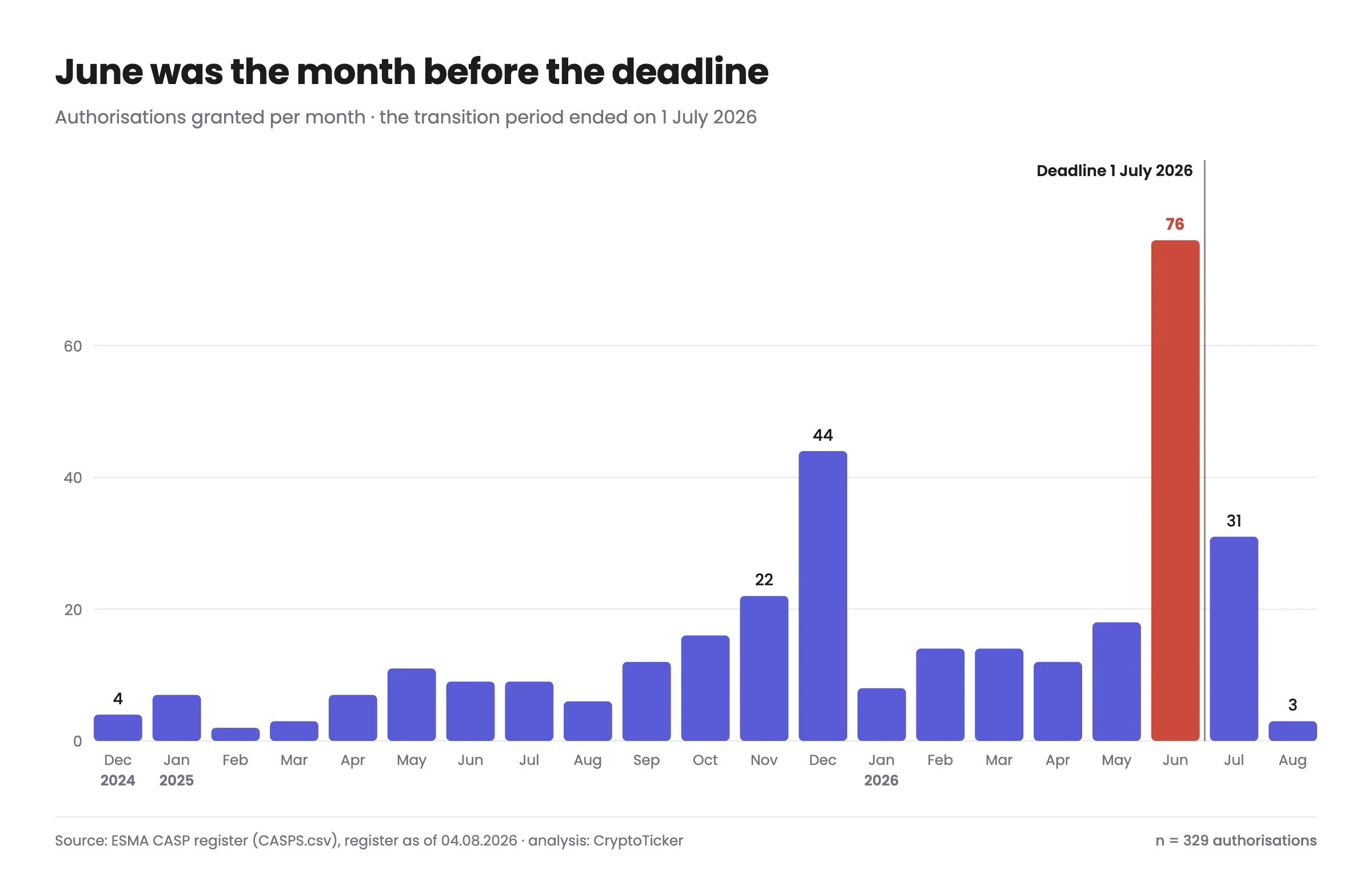
For a year and a half monthly authorisations moved in the low double digits. December 2025 brought a first spike to 44. Then, in June 2026, the last month before the deadline, 76 authorisations were granted, more than in the preceding five months combined. July brought 31, August three up to the register date.
The effect has an uncomfortable side. Firms that made it through in June often filed late. Supervisors had little time, and the review period of up to four months that MiCA allows for a complete file is likely to have been used to the limit in many cases.
For others the deadline became the exit. In July 2026 AscendEX, BitMEX and BitMart announced they would give up their EU business or close entirely. At BitMart trading ends on 26 August 2026 and the platform shuts on 31 January 2027. AscendEX ceased operations on 1 July, with withdrawals available only on a limited basis. Anyone still holding balances there should arrange to move them rather than wait for an extension.
The brand is not the legal entity
The most useful point in the register is also the easiest to miss. MiCA protection does not attach to a brand. It attaches to the specific legal person that received the authorisation, and that entity is almost never named after the app on your phone.
Kraken appears in the register as Payward Global Solutions Limited and Payward Europe Solutions Limited, both in Ireland. Crypto.com is listed as Foris DAX MT Limited in Malta. Behind Coinbase sits Coinbase Luxembourg S.A., behind the European Bybit entity Bybit EU GmbH in Austria. Bitpanda holds three authorisations: in Austria, in Germany and through BP23 CA Limited in Malta.
The one-minute check
Look in the terms and conditions or the legal notice to see which company you are actually contracting with. That is the name to search for in the register, not the brand. If the contracting party is based outside the EEA, MiCA protection does not apply, even where a sister company holds an EU authorisation.
What we noticed while working through the data
A word on data quality, because it explains why figures circulating about this register diverge. The field listing the authorised services is not filled in consistently. Most supervisors prefix the service letter, as in b. operation of a trading platform. In 20 of the 329 entries that letter is missing altogether, mostly in Cypriot and Estonian authorisations. Search for the letter alone and those entries drop out of the count, among them one trading platform.
At one German institution the letters are shifted by a position, so the text and the label no longer agree. One provider is entered twice with an identical record, and two French companies share the same LEI code. We therefore identified the services from the descriptive text and cross-checked the result against the letter-based method. The analysis script is on file with the newsroom.
None of this is a charge against ESMA, which consolidates what national authorities report. It is a reminder that any number drawn from this register should travel with the method that produced it.
Why we curate at all
A register answers the question of who may operate legally. It does not answer where it makes sense to trade. A Latvian payment provider with a single national authorisation and a pan-European trading venue are worlds apart, yet both sit in the same register and both may legitimately advertise as "MiCA licensed".
That is why we think a curated selection earns its place. Our comparison of MiCA-regulated crypto exchanges states for each provider the legal entity and the date of authorisation, each checked against the register. For a broader view there is the general exchange comparison; and anyone holding for the long run is independent of any platform's licence with a hardware wallet anyway.
What to take away
- Check the legal entity, not the brand. Find out from the terms which company you are contracting with, then search that name in the ESMA register. It takes a minute and it is the only evidence that holds.
- Establish whether you trade on a venue or against the provider. Only 21 authorisations cover the operation of a trading platform. Under the more common broker model the cost sits in the spread rather than in a stated fee. Our comparison of regulated exchanges reports both separately.
- Move balances off platforms leaving the EU market. AscendEX, BitMEX and BitMart have announced their withdrawal. At BitMart trading ends on 26 August 2026. Waiting means negotiating later under time pressure.
Disclosure: some of the providers named in our comparison work with us through partner programmes. This has no bearing on the analysis of the ESMA register — every figure in this article comes from the official file and can be reproduced from it. Whether a provider is a partner changes nothing about its licence status.
This article is not investment advice and not a recommendation to buy or sell crypto-assets. Crypto-assets are highly volatile and a total loss is possible. Analysis as of 6 August 2026; ESMA register as of 4 August 2026.
Transparency note: This article was produced with the assistance of artificial intelligence and reviewed by our editorial team before publication. All figures and claims were checked against the primary sources linked in the text.
Related articles
- Binance Is Out of the EU: How to Move to a MiCA-Regulated Exchange
- ESMA puts reverse solicitation on its 2027 watch list: what investors need to know about exchanges without an EU licence
- How to Switch from Binance to a MiCA Regulated Crypto Exchange
- Your Crypto Exchange Is Telling You to Withdraw: How to Spot Phishing After the MiCA Deadline
- Binance Reveals Where Its EU Users Went After MiCA
Which topics should we dive deeper into?
Select what genuinely interests you. Your picks feed directly into our editorial planning.
Crypto news that's actually worth your time.
Weekly. 60 seconds. Carefully curated by our editors: no hype, no promo flood, no spam.

July 9, 2026 10:12 AM
MiCA Wiped Out 92% of Europe's Crypto Firms: Here's Who Survived and Who's Cashing In
The July 1 deadline turned 3,000+ EU crypto firms into a few hundred. Binance is out, Tether's gone, and a handful of winners now own the market.
June 26, 2026 5:35 PM
Binance Is Leaving the EU on July 1 — What It Means for Your Funds
Binance will stop serving EU customers from July 1 after failing to secure a MiCA licence. Here's what it means for your funds and your next move.

August 15, 2026 9:31 PM

Crypto Exchange Shutting Down: What to Do Before the Deadline Passes
Binance, BitMart, Luno and Revolut have ended or cut back their European business within seven weeks. This guide shows which deadline expires first, how a forced sale is treated for tax, and what to secure before the account closes.
June 17, 2026 7:21 PM

Binance EU Access at Risk: What MiCA Could Mean for BNB and Crypto Users
Binance is facing one of its biggest regulatory tests in Europe as the MiCA deadline approaches. Could this put BNB and EU crypto users under pressure?
September 25, 2026 4:11 AM
Bitget Hack of $351 Million: What to Check at Your Crypto Exchange Now
Bitget reports unauthorised outflows of around $351.6 million and has suspended withdrawals. For existing customers in Europe, that closes the one route MiCA had left them.
June 25, 2026 11:19 AM
Binance Pulls Its EU Licence Bid: What It Means for Your Crypto
Binance just withdrew its MiCA licence application in Greece days before the EU deadline. Here's what it means for users, your funds, and the crypto market.

October 3, 2026 1:56 PM

Stellar Drops a Good 5 Percent, Altcoin Exchange Deposits at Their Highest Since October 2025: Why XLM Is Falling
Stellar falls to around $0.214 on October 3, 2026, without any bad news of its own. The documented background is a wave of deposits to trading venues that CryptoQuant puts at the highest level since October 2025.
September 27, 2026 4:32 AM

Hester Peirce Leaves the SEC: What Now Applies to Your Custody in Germany
The most crypto-friendly voice at the US securities regulator goes on October 2, 2026, and the commission shrinks to two members. For investors in Germany it is still the European rulebook that decides, and there a deadline falls in July 2027.

September 19, 2026 7:17 AM

Chainlink Jumps Above $12: What LINK Holders Should Check Now
Chainlink trades at $12.34, 7.4 percent higher than yesterday. What part of the move is the broad market rally, what Chainlink itself contributes, and the three things you should check as a LINK holder.
August 19, 2026 10:26 PM

EU warning list for crypto providers: 167 entries, 165 of them from Italy, none from BaFin
ESMA maintains a Europe-wide register of non-compliant crypto providers. We counted it on August 16, 2026 and called up every web address stored in it. Three of 30 supervisory authorities supply any entries at all, and BaFin is not among them.
September 30, 2026 10:40 PM

ESMA Calls for Advertising Rules on Crypto Influencers: Six Changes Now Sitting With the EU Commission
The EU securities watchdog filed its response to the MiCA review on the final day of the consultation. Among the demands are disclosure on staking, a licensable DeFi gateway and the power to freeze crypto assets.
July 6, 2026 11:17 AM

XRP Just Got a Massive EU Green Light — But There's a Catch Nobody's Talking About
Ripple scored preliminary MiCA approval to run crypto services across all 30 EEA countries — and $XRP is up ~8% this week. Here's what it really means.
August 20, 2026 10:24 PM

MiCA Review: What the European Commission Could Change About the EU Crypto Rules
The European Commission has reopened MiCA for review after barely two years and is asking 86 questions covering the stablecoin interest ban, staking, lending and DeFi. Brussels is taking responses until September 30, 2026.
September 19, 2026 4:11 PM

MiCA Consultation Closes September 30: What to Check and Submit Before Then
The European Commission is reviewing the MiCA crypto regulation and will accept submissions until September 30, 2026 at 23:59 CEST. Staking, DeFi, lending, stablecoins and custody are all under examination, and you can take part without a lawyer.
October 1, 2026 2:16 PM

Open USD is live but absent from the EU register: what matters now for investors in Europe
The dollar stablecoin Open USD launched on September 30, 2026, backed by Coinbase, Mastercard, Shopify, Stripe and Visa. On October 1, 2026 the token was not notified in the MiCA register, and that decides what you can do with it in Europe.
September 20, 2026 4:13 AM

Zcash Above $1,500: What ZEC Holders Should Check on Tax and Custody
Zcash rose above $1,500 on September 19 for the first time since 2016 and, after an intraday high of $1,590.80, trades back at around $1,474. For German holders three questions hang on that jump: the one-year holding period, the planned year-end cut-off and the EU anti-money-laundering regulation from July 2027.
September 15, 2026 4:12 AM

Using Hyperliquid from Germany: What Applies to Your Funds Without a MiCA Licence
Hyperliquid is not entered in any EU register as an authorised crypto-asset service provider, and for perpetual futures a MiCA licence would be the wrong paperwork anyway. Here is what that means in concrete terms for your funds, your keys and your tax return.
September 10, 2026 1:21 AM
Crypto Exchanges Head to Head: Which Pairing Is Cheaper Where
Before opening an account, the question is rarely which exchange is best overall, but whether it should be this one or that one. This article sorts through the most searched head-to-heads, puts the cost per 1,000 euros side by side and explains the most expensive mix-up: one provider with two interfaces and a factor of seventeen between them.
July 7, 2025 8:12 PM
BIG Crypto News: EU Approves 14 Stablecoin Issuers Under MiCA
Six months into the MiCA rollout, Europe’s crypto regulatory landscape is taking shape. From authorized stablecoin issuers to licensed crypto service providers, here’s the full July 2025 update.
September 24, 2026 10:12 AM

XRP Falls 9.7 Percent: What to Check on Holding Period and Buying Route
XRP is down around 9.7 percent on the morning of September 24, twice as much as the typical large crypto asset. Our count of 18 coins shows who the pullback hits and which three things hold true regardless of the price.
October 1, 2026 7:32 AM

Starting a crypto company in Germany: legal form, BaFin licence and capital
Setting up a crypto company in Germany: which business models need BaFin authorisation under MiCA, GmbH or UG, how much capital is required and where public support is available.
September 29, 2026 10:40 AM
“We have created the essential conditions …”: bitcoin.de has stood still for three months, the MiCAR licence is missing
Bitcoin Group SE published its half-year report on September 29, 2026: trading on bitcoin.de has been idle since the end of June because the MiCAR authorisation is missing. The new platform is finished, but no launch date is set.
September 26, 2026 7:40 AM

The RAIN Token After the Enlivex Termination: What to Check on Access, Forced Sale and Holding Period
Enlivex terminated a share placement of 66,666,667 shares payable in RAIN tokens on September 22, 2026. The token sits 46.4 percent below its all-time high, and at Kraken the withdrawal deadline expired long ago.
September 26, 2026 4:21 AM

Operation Herakles disconnects 13,888 phone numbers: what to check on crypto investment calls
Six authorities have disconnected 13,888 phone numbers used by investment fraudsters to call their victims in Operation Herakles, 9,304 of them in the past three months alone. What the Federal Network Agency now requires of telecoms providers and which three checks protect you from the scheme.
August 21, 2026 10:27 AM
Complaining About a Crypto Exchange: the Deadlines Article 71 MiCAR Sets and Why BaFin Will Not Decide Your Case
Authorised crypto providers have to run a formal complaints procedure, and Delegated Regulation (EU) 2025/294 sets a hard limit of two months for it. Our own analysis of the ESMA list shows at the same time that no complaints link is on file for Germany to this day.
September 24, 2026 1:11 PM
Stellar Becomes a Payment Rail at Mastercard's BVNK: What XLM Holders Should Check on Buying Route, Memo and Holding Period
BVNK has switched on Stellar as a payment rail for business customers in more than 130 countries. On the same trading day XLM falls by around seven percent — we separate what the news means from what the pullback means for your portfolio.
September 13, 2026 4:33 AM

Your Volksbank's Crypto Licence: Why You Have to Check Custody Separately
14 of the 16 newest CASP entries in the ESMA register were German cooperative banks, and each one carries order execution only. Our count of the BaFin database shows that not one of the 21 cooperative institutions is registered as a crypto custodian.
More from CryptoTicker