
Hester Peirce Leaves the SEC: What Now Applies to Your Custody in Germany
The most crypto-friendly voice at the US securities regulator goes on October 2, 2026, and the commission shrinks to two members. For investors in Germany it is still the European rulebook that decides, and there a deadline falls in July 2027.





Which topics should we dive deeper into?
Select what genuinely interests you. Your picks feed directly into our editorial planning.
Crypto news that's actually worth your time.
Weekly. 60 seconds. Carefully curated by our editors: no hype, no promo flood, no spam.
Hester Peirce leaves the US securities regulator, the SEC, on October 2, 2026. For your portfolio in Germany that departure changes nothing directly: what you may buy, how you may custody it and what you have to pay tax on is set out in European and German law, not in the staffing of a US agency. The appointment becomes interesting at the points where American decisions feed through to products and prices that also affect European investors. This piece separates the two and names the points you can actually check in the coming days.
Hester Peirce's Resignation: What Happens on October 2, 2026
Peirce announced her resignation on September 25, 2026 and published her farewell letter on the platform X. According to reports by CoinDesk and American Banker the same day, she thanked the President for the opportunity to hold the office and said she expected the agency to continue striking a balance between regulation and individual freedom of choice. Her last working day is October 2, 2026.
Peirce has sat on the commission since January 2018. Her second five-year term already ended in June 2025; she stayed in office after that because US law allows a commissioner to continue working until a successor is appointed. Since February 2025 she had led the agency's Crypto Task Force, the working group preparing the American classification of digital assets. After her departure she moves in November to the law faculty of Regent University in Virginia.
In the industry she carried the nickname Crypto Mom, because over the years she voted against enforcement proceedings involving crypto projects and defended the right to self-custody. That point in particular is why the move is drawing attention beyond the United States.
Two Commissioners Instead of Three: How the SEC Works With a Reduced Bench
After October 2 the commission consists of two members, chair Paul Atkins and Mark Uyeda. The agency's rules of procedure allow two members to form a quorum when the commission is understaffed, so the work does not stop. The White House has so far nominated nobody for the vacant seat, and a Senate confirmation process takes six to twelve months by experience. The third place can therefore stay empty well into 2027.
In practice a two-member bench means contested rules become easier to attack. Anyone challenging a provision in court argues more easily against a thin majority. According to the available reports the Crypto Task Force is to continue its work, though without the commissioner who built it. Whether the agency carries on its current course on custody, token classification and exemptions will only become clear in the next decisions. To judge that beforehand would be speculation.

Why the European Rulebook Counts for Your Portfolio in Germany
Anyone buying in Germany through an exchange or a broker sits under European supervision. The basis is the regulation on markets in crypto-assets, MiCA for short, whose transition periods in the European Union expired on July 1, 2026. Since then every provider serving clients in the EU needs authorisation as a crypto-asset service provider. The European securities regulator ESMA had publicly called on unlicensed providers in June 2026 to wind down their EU business in an orderly fashion.
From this follows a simple allocation for you. Complaints about a platform authorised in Germany go to BaFin. Claims over the loss of client funds are governed by MiCA and German law. SEC decisions do not touch that chain. If you want to check whether your platform falls within this framework at all, a look at regulated crypto exchanges with European authorisation helps more than any report out of Washington.
 Regulated Crypto Exchanges Compared
Self-Custody and the AMLR: What Is Banned From July 10, 2027
The actual rule change for European investors has long been in the official journal and has nothing to do with the SEC. The deadline is in the EU anti-money-laundering regulation.
What Article 79 Prohibits Providers From Doing
Regulation (EU) 2024/1624 was adopted on May 31, 2024 and applies from July 10, 2027. Its Article 79 prohibits credit institutions, financial institutions and crypto-asset service providers from maintaining anonymous accounts. Expressly covered are accounts for crypto-assets that permit the anonymisation of transactions, as well as dealing in coins whose purpose is to obscure payment flows. In practice that means regulated trading venues in the EU will have to remove assets such as Monero and Zcash from their offering by that deadline.
Why Your Own Wallet Is Not Covered by It
The regulation addresses obliged entities, meaning banks, financial institutions and service providers. It does not forbid private individuals from holding such coins in a wallet of their own or sending them directly to another wallet. Self-custody means you hold the private keys to your coins yourself and no service provider keeps them for you. What changes in 2027 is the way in and out: deposits, withdrawals and exchanges run through providers, and those are precisely the parties that are bound.
Anyone owning assets from this group therefore has a time frame and two routes. Either the move into their own custody while withdrawals are still open, or a sale within the regulated offering. Both want preparing; our guide to withdrawing into self-custody works through the sequence.
MiCA, BaFin and Authorisation: Which Supervisor Applies to Your Exchange
A crypto-asset service provider in the sense of MiCA is a company that exchanges, custodies, brokers or trades crypto-assets for clients and holds an official licence for it. Such a licence has effect throughout the EU: obtain it in one member state and you may serve clients in all the others. For you that means your provider's supervisor is not necessarily based in Germany, while its obligations are the same everywhere. What those obligations are in detail is set out in our overview of the MiCA duties for crypto companies.
Before every deposit it is worth comparing against the competent authority's public register. A provider missing from it may not serve you in the EU, and in a dispute no European supervisor stands at your side.
US Spot ETF or European ETP: Which Buying Route Is Open to You
This is where American regulation becomes concrete for you, and in a direction that is often misunderstood. The spot ETFs on crypto-assets authorised in the United States are as a rule not tradable for retail investors in Germany through German brokers, because they lack the European investor information documents. The European route runs through exchange-traded debt securities, usually called ETN or ETP: securities that track the price of a crypto-asset and are in many cases physically backed with it.
For tax purposes these products are not the same as owning coins directly. How a crypto ETP is treated depends on its structure; the one-year period from income tax law applies to crypto-assets held directly. Settle that point before the purchase, not in the tax return. Which products are accessible in Germany at all is listed on our page on crypto ETFs and ETPs in Germany.
Holding Period and Records: What Applies When You Move to Self-Custody
A transfer from an exchange to your own wallet is not a disposal. Under common practice the original acquisition date is preserved, so the one-year period under Section 23 of the Income Tax Act keeps running and does not start afresh. Sell at a profit within a year of acquisition and that profit is taxable; after a year of holding it stays tax-free. For gains within the period an exemption limit of 1,000 euros per calendar year has applied since 2024, and it falls away entirely once exceeded.
What matters is the evidence. Since January 1, 2026 crypto-asset service providers have been reporting transaction and personal data to the tax authorities; the first transmission for 2026 takes place in 2027. So the tax office sees movements whose tax classification you have to justify yourself. Document your acquisition dates and transfers without gaps and, in case of doubt, you argue with paperwork rather than memory. Our guide to switching exchanges and the holding period shows which records count, and the tax and portfolio tools compared take the allocation of transactions off your hands.
 Hardware Wallets Compared
Hardware Wallet and Seed Phrase: Three Checks Before the Move
Self-custody shifts the risk. No service provider can freeze your coins any more, and nobody but you can bring them back. A seed phrase is the sequence of words from which all the private keys of a wallet can be restored; whoever has it has the coins.
Three things belong before the first large transfer. First, backing up the word sequence on paper or metal, never as a photo, as a note in the cloud or in a password manager hanging off a browser. Second, a test amount: send a small sum, restore the wallet from the backup on a second device, send the amount back. Only then does the rest follow. Third, checking what your device shows you before an approval, because a signature whose content you cannot read is a blank cheque.
A device is no substitute for care. The most common losses do not arise from broken encryption but from lost backups and from approvals the owner granted themselves.
Levels Above and Below: How to Read the Current Market Situation
At the time of this analysis, on September 26, 2026, Bitcoin traded at $84,146 according to CoinGecko, up 0.39 percent on the previous day and 3.31 percent over seven days. Zcash stood at $1,675.92, 9.31 percent above the previous day's value, and Monero at $555.71 with a change of 0.57 percent.
On the upside the $87,000 mark is the obvious reference point: that is where the rise at the start of the week failed, before the price fell back below $84,000 according to reports of September 26. On the downside the area around $84,000 therefore marks the zone that has only just given way. Both are reference points taken from the price history and no forecast. Price targets quoted in analyses belong to the person or the house voicing them, and not to the market.
For the question this text is about, the price situation is secondary anyway. The July 2027 deadline is fixed regardless of it, and the holding period runs on calendar days, not on prices.
SEC Departure and Self-Custody: What to Take Away
- Check your platform's authorisation, not the personnel news from Washington. The change at the SEC does not alter your rights. Whether your provider sits under European supervision decides your claims in a dispute. The overview of regulated crypto exchanges makes that comparison easier.
- Settle custody before 2027 if you hold coins with an anonymity function. From July 10, 2027 providers in the EU may no longer carry them. Moving to a wallet of your own stays permitted and needs preparation; the devices and their differences are in the hardware wallet comparison.
- Document acquisition dates before the first report goes out. From 2027 service providers transmit the 2026 data to the tax authorities. Being able to prove your holding periods saves you follow-up questions; the allocation is handled by the tax and portfolio tools.
(As of September 26, 2026. This article is not investment advice. Prices and fee structures change; check the terms with the provider before you buy.)
Transparency note: This article was produced with the assistance of artificial intelligence and reviewed by our editorial team before publication. All figures and claims were checked against the primary sources linked in the text. The feature image was generated with AI.
Related articles
- Privacy Coins and EU Anti-Money-Laundering Law: An Assessment of the Ban From July 2027
- Dogecoin Price: What to Check on Holding Period and Custody Before the Year End
- XRP Falls 9.7 Percent: What to Check on Holding Period and Buying Route
- The RAIN Token After the Enlivex Termination: What to Check on Access, Forced Sale and Holding Period
- Forced Sale on a Crypto Exchange: Which Moment Counts for the Holding Period and What You Must Document
Which topics should we dive deeper into?
Select what genuinely interests you. Your picks feed directly into our editorial planning.
Crypto news that's actually worth your time.
Weekly. 60 seconds. Carefully curated by our editors: no hype, no promo flood, no spam.

September 20, 2026 4:13 AM

Zcash Above $1,500: What ZEC Holders Should Check on Tax and Custody
Zcash rose above $1,500 on September 19 for the first time since 2016 and, after an intraday high of $1,590.80, trades back at around $1,474. For German holders three questions hang on that jump: the one-year holding period, the planned year-end cut-off and the EU anti-money-laundering regulation from July 2027.

September 16, 2026 1:12 PM
Bitvavo Delisting of Kava, Nano and Ravencoin: What to Do Before Friday, 2 p.m.
Bitvavo drops KAVA, XNO and RVN on September 18, 2026, and three deadlines expire in a single afternoon. Nano has no withdrawal route at all, and the automatic euro conversion on September 28 counts as a sale for tax purposes.
August 23, 2026 7:34 PM

Buying Zcash Despite the EU Trading Ban: What Happens to Your ZEC From July 2027
From July 10, 2027 the EU anti-money-laundering regulation takes anonymity-enhancing crypto-assets out of regulated trading venues. What Article 79 forbids in its actual wording, why your own ZEC holding is not caught by it and what to sort out before then.
September 9, 2026 4:22 PM
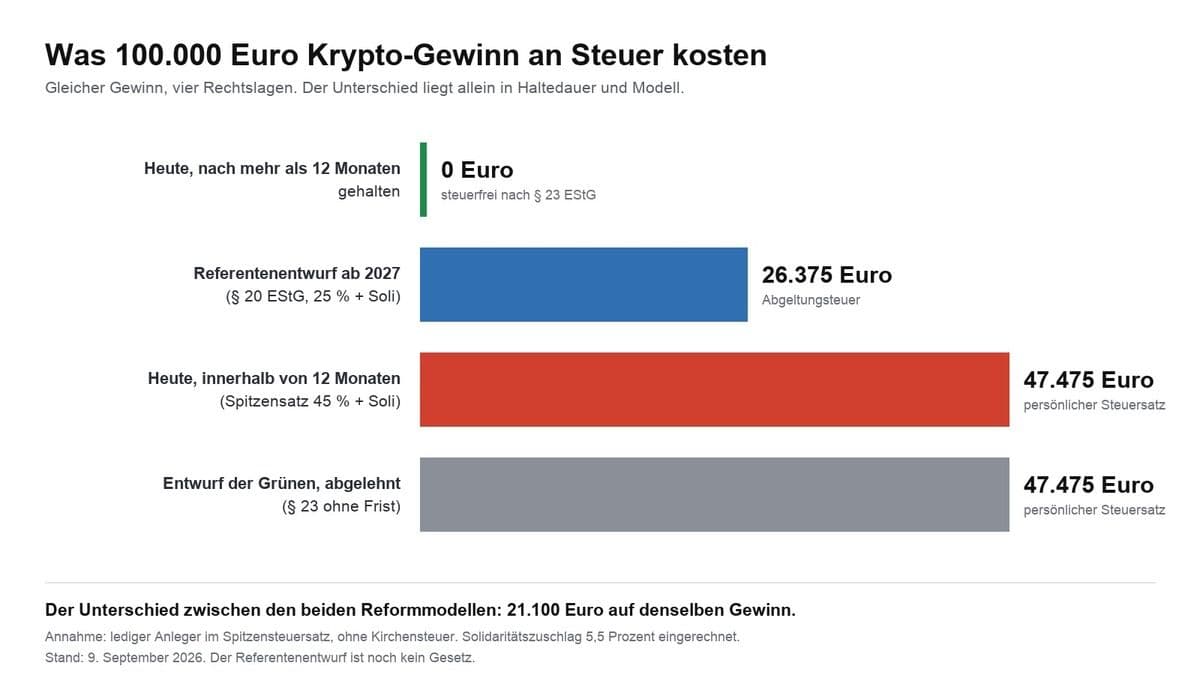
Crypto Tax in Germany: What Applies in 2026 and What Is Set to Change in 2027
Crypto gains are tax-free after twelve months; before that your personal tax rate of up to 45 percent applies. What triggers tax, how the holding period is calculated, what happens with staking and losses, and what the draft bill would change from 2027.
August 21, 2026 1:42 PM

Writing Off a Total Crypto Loss: When the Tax Office Recognises Worthless Coins
A token that has collapsed only reduces your tax once you actually dispose of it. What applies to delisting, exchange insolvency and worthless holdings under Section 23 of the German Income Tax Act, and how you offset losses.
September 24, 2026 4:16 AM

Trump-Xi Summit at the White House: The Crypto Positions to Check Before the Meeting
Xi Jinping is on a state visit to Donald Trump today, and the crypto market comes into the meeting carrying the gains of an exceptionally strong week. What to check on leverage, holding period and custody before the first headline runs.
September 24, 2026 1:13 AM

Solana DEX Trades Overtake the NYSE: What to Check on Swaps, Tax and Oversight
Solana's decentralised exchanges settled roughly 208 million trades in a single week and overtook the New York Stock Exchange for the first time. The figure is real, but it measures something other than the comparison suggests, and for German investors it carries tax duties that no provider takes on.
September 8, 2026 10:21 PM

Crypto Holding Period and Grandfathering: Why December 31, 2026 Becomes the Cut-Off in Germany's Draft Bill
A ministerial draft bill from Germany's finance ministry names a cut-off date for the first time: crypto assets acquired after December 31, 2026 are to fall under the flat-rate withholding tax. What that means for legacy holdings, running savings plans and staking income, and why nothing has been decided yet.

September 24, 2026 1:11 PM

Stellar Becomes a Payment Rail at Mastercard's BVNK: What XLM Holders Should Check on Buying Route, Memo and Holding Period
BVNK has switched on Stellar as a payment rail for business customers in more than 130 countries. On the same trading day XLM falls by around seven percent — we separate what the news means from what the pullback means for your portfolio.
September 23, 2026 10:11 AM
Kraken: 45 coins are on cancel only, 21 were announced – what to check when trading pairs are blocked
On September 23, 2026 we counted the public market directories of three trading venues. At Kraken, 82 of 1,450 trading pairs are listed as cancel only, a state in which an order can only be cancelled and no longer executed. The 45 underlying assets affected include just 21 that appear in the delisting notice we reported on September 3.
September 19, 2026 7:17 AM

Chainlink Jumps Above $12: What LINK Holders Should Check Now
Chainlink trades at $12.34, 7.4 percent higher than yesterday. What part of the move is the broad market rally, what Chainlink itself contributes, and the three things you should check as a LINK holder.
August 24, 2026 1:22 PM
Phantom Wallet Ends Sui and Monad Support: What to Do Before the Deadlines
Phantom Wallet removes Monad from its app on August 26 and Sui on September 24. The balances are not lost, but only one of the two ways out leaves your tax position untouched.
September 25, 2026 7:24 PM

Bitcoin Forecast: What to Check on Levels, Holding Period and Buying Route Before the Quarter Ends
Bitcoin stands at $83,877 at 16:40 UTC on September 25, 2026, and the measured volatility of the past 30 days spans a band of $73,600 to $94,200 for the coming month. More important than that band before the quarter ends are three checks: holding period, buying route under MiCA and the reporting duty in force since January 2026.
September 26, 2026 1:19 AM
Germany’s Crypto Holding Period Is Wobbling: What to Check Before December 31
A CDU member of the Bundestag makes it plain: the coalition agreement does not guarantee that the one-year holding period for crypto assets will survive. What that means for purchases made before the planned cutoff date of December 31, 2026.
September 27, 2026 7:22 AM

CoinEx Forced Conversion: Withdraw Non-USDT Balances by September 29
On September 29 at 02:00 UTC spot trading ends at CoinEx, and all holdings outside USDT are sold or delisted after that. What this means for your holding period, your tax bill and your withdrawal.
September 9, 2026 1:15 AM

Germany's Crypto Tax: 160 Million Euros for a 555-Billion Budget
The German finance ministry's draft bill puts a figure on the crypto tax for the first time: 160 million euros from 2028. What that number means in the 2027 federal budget, how 11.4 billion became 160 million, and what investors can read from it.
September 14, 2026 10:23 AM

Take Ethereum Profits or Wait Out the Holding Period? What the Price Jump Means for Your Tax Bill
Ether reached its highest level since the end of January on September 11, 2026, and many are asking whether to sell now. In Germany the answer hangs on the purchase date first: we work out which tranches are tax free and which of them are showing a gain at all.
September 9, 2026 4:13 PM

Bitcoin 29 Percent Below Last Year: Which Crypto Losses You Can Still Use Before the One-Year Holding Period Expires
Nine out of ten major crypto assets trade lower today than exactly twelve months ago, Bitcoin alone by 29.2 percent. We measured the price series ourselves and show why the purchase date alone decides the tax value of your loss.
September 8, 2026 1:19 AM

Germany's Crypto Holding Period: What Happens Now Signing for Petition 201716 Closed on September 15
Recap as of September 27, 2026: the signature period for German parliamentary petition 201716, which asks for the one-year crypto holding period to be preserved, closed on September 15, 2026. This article explains what ended that day, how the petitions committee proceeds and why no investor has to sell because of it.
September 19, 2026 4:34 AM

Monero Jumps 11 Percent to $575: What XMR Holders in Germany Should Check Now
Monero gained 11.19 percent in 24 hours and is outrunning the wider market. For German holders, however, the decisive date is July 10, 2027: from then on, authorized exchanges may no longer carry XMR.
October 2, 2026 1:33 PM

Crypto tax before the cabinet on October 14: “Comments are only possible until October 6”
Germany's Federal Ministry of Finance sent the draft bill on crypto taxation to the associations on September 30, 2026, and the cabinet is to decide on October 14. For your holdings one date counts above all: December 31, 2026.
September 29, 2026 10:14 AM
387.5 million dollars at Bitget: the attack ran through a bought-in security product, what to watch now
Bitget has disclosed how the attackers reached its withdrawal systems on September 24: through a previously unknown flaw in a security product it had bought in. The second stage of the withdrawal schedule opens today at 08:00 UTC, and for the balance you keep on any exchange the case changes the arithmetic.
September 29, 2026 10:33 AM
ESMA puts reverse solicitation on its 2027 watch list: what investors need to know about exchanges without an EU licence
ESMA presented its work programme for 2027 on September 28, 2026 and made reverse solicitation a supervisory priority. What that means if your coins sit with a provider without EU authorisation, and which three steps make sense now.
September 16, 2026 1:20 PM

Crypto Loss Carryforward in Germany: What Happens to Old Losses Under the 2027 Tax Plan
Losses from crypto sales land in a ring-fenced pot and can only be set against gains of the same kind. The draft bill for 2027 moves future gains into a different pot, and we show you what that means for your assessed carryforward and what your tax notice should say.
September 10, 2026 4:15 PM

BW-Bank Opens Bitcoin Trading Inside the Securities Account: What to Check Before Your First Buy
Since September 9, 2026, BW-Bank customers have been able to trade ten crypto assets through their securities account, executed and held in custody by Bitpanda. The familiar securities-account setting hides three points you should settle before your first order.
September 25, 2026 10:26 PM

Selling bitcoin privately: the tax in Germany and the records you need
A direct sale to a private individual falls under the same one-year rule as an exchange sale, but there is no tax report to go with it. This guide walks through the calculation, the 1,000 euro threshold and the records the tax office wants to see.
September 18, 2026 7:12 PM

Zcash NU7 Upgrade on November 5, 2026: What You Must Do With Your ZEC
Zcash activates the NU7 network upgrade on November 5, 2026, bringing 25-second blocks and the end of v4 transactions. Anyone holding ZEC has nothing to move; action is only needed from those running their own node, indexer or block explorer.
More from CryptoTicker