
Philippines VASP regulation: BSP draft would pause new payment operator applications for twelve months
A BSP draft could suspend OPS applications for twelve months and apply stricter checks to payment relationships with VASP-adjacent firms. What applies to providers and customers.


Which topics should we dive deeper into?
Select what genuinely interests you. Your picks feed directly into our editorial planning.
Crypto news that's actually worth your time.
Weekly. 60 seconds. Carefully curated by our editors: no hype, no promo flood, no spam.
Several trade publications have reported in recent weeks on possible new restrictions for crypto-adjacent payment services in the Philippines. Those reports rest on a policy exposure draft published in 2026 by the Bangko Sentral ng Pilipinas (BSP), the Philippine central bank. The BSP draft covers two distinct subjects: a possible suspension of new applications for Operators of Payment Systems (OPS), and tighter requirements for payment relationships with companies that work with virtual assets. One point matters throughout: a draft of this kind becomes binding only once it is formally issued. Content, timing and transitional rules can still change before then.
What the BSP draft actually proposes
The draft describes several measures that still have to be read in the conditional, since none has been finally adopted. New OPS registration applications would no longer be accepted, or their processing would be suspended, for twelve months from the date the final circular takes effect. Applications already filed would, according to the draft, continue to be reviewed, but would be neither approved nor rejected during the suspension.
VASP-related companies would in addition be classified as high-risk merchants. Payment relationships would then be envisaged only as a direct merchant relationship, while multi-tier or “layered” arrangements would have to undergo particular scrutiny. The draft also provides for enhanced due diligence, ongoing monitoring and risk-appropriate transaction and settlement limits, settlement being the clearing or final discharge of a payment. For existing layered relationships the draft names a review within six months and adjustments within a further six months. Here too: these deadlines are the content of a draft, not confirmed obligations.

 Compare licensed crypto exchanges in Germany
Why payment providers and crypto service providers are not the same thing
Placing this in context is easier with a look at the legal basis of payment operator registration. Under the National Payment Systems Act (Republic Act No. 11127), operators of payment systems must be registered with the BSP, which in turn oversees the safety, efficiency and reliability of the payment system. An OPS is a person or company that manages, processes or enables digital or cash-based money transfers and clearing.
A VASP, a virtual asset service provider, is by contrast a provider that transfers or exchanges virtual assets. The BSP places VASPs within the wider supervisory framework for money service businesses. In practice an exchange offering peso deposits and withdrawals may, alongside its crypto functions, also use payment processes, and therefore have several regulatory points of contact at once. A pure payment provider, on the other hand, is not automatically a VASP. For platform operators this distinction is central, because what counts is the services actually provided, the contractual structure and the respective registration, not a company's label alone.
Consequences for market entry, existing platforms and customers
For new providers, a final halt to OPS applications could delay market entry, particularly where a business model depends on holding its own OPS role, or a corresponding partnership, for fiat payment processing. That does not mean every new crypto platform would inevitably be affected. For existing providers, possible stricter VASP checks in the payment environment would bear above all on documentation, risk analysis, monitoring of merchant relationships and adjustment of limits, in other words on classic AML measures (anti-money laundering) and KYC processes (identity verification).
Users and investors may see more cautious deposit and withdrawal channels, longer onboarding processes or a narrower range of new products. The draft makes no mention of existing accounts being blocked. It is worth adding that the BSP has already set out further standing expectations for VASPs: the 2026 listing guidelines require due diligence on tokens, continuous monitoring and delisting thresholds, while privacy coins may not be supported. These listing rules, already in force, should not be confused with the new payments draft.
An existing moratorium must not be mixed up with the new draft
The BSP had already restricted the regular application window for new VASP licences back in September 2022. According to the current BSP Citizen’s Charter, that moratorium was continued by Memorandum M-2025-031 with effect from September 1, 2025, subject to further reassessment. The difference matters: the existing VASP licence moratorium concerns access to a VASP licence, while the new draft deals with OPS registration applications and integrity controls in payments. Earlier moratoria also contained transitions and limited exemptions, which is why market participants should expect neither identical exemptions nor identical consequences automatically.
Find the right exchange for your tokensThese documents are the ones market participants should check now
Anyone who could actually be affected should rely on solid sources rather than headlines:
- Check the final BSP issuance and any consultation notices: date of application, definitions, exemptions and transitional periods.
- Check separately in the BSP Verifier and the official OPS list what status payment service providers and crypto providers hold. An entry in a register is not a guarantee of safety or creditworthiness.
- Document your own business model: who accepts peso payments, who holds the crypto assets in custody, who is the customer’s contractual partner, and do direct or layered merchant relationships exist?
- Base no business or investment decision on media reports or social networks alone.
Reading the regional trend without false equivalences
Crypto regulation in Asia is moving in a similar direction across many markets: licensing, anti-money-laundering measures and consumer protection for crypto providers are gaining weight. National categories, agency responsibilities and transitional rules are not interchangeable, however. The FATF notes in its report that differing national licensing and supervisory approaches can create regulatory gaps, which is why activity-based registration, risk-based supervision and cross-border cooperation remain relevant. For international platforms that means local Philippine requirements have to be assessed separately; EU standards do not replace a local classification.
Philippines VASP regulation: three questions decide the actual effect
With Philippines VASP regulation, three questions ultimately decide the real reach: which business models and companies are covered? From when do final obligations apply? And what transitions apply to companies already registered, to pending applications and to existing merchant relationships? The BSP draft could noticeably affect access for new providers and the payment connections of crypto businesses, but until official finalisation its scope and practical consequences remain open. This article offers general orientation and does not replace legal advice.
Partner links: some links on this page are partner links. If you become a customer through one of them, we may earn a commission at no extra cost to you. Selection, ratings and ranking are decided independently by our editorial team. Ethics and Independence · Ownership and Funding
Transparency note: This article was produced with the assistance of artificial intelligence. Figures and claims are based on the primary sources linked in the text.
For later? Save this article and find it again in your profile.
Related articles
- Gibraltar Crypto License: GFSC Fees, Application Process and MiCA Limits
- Bitstamp exchange review: a 0.40 percent taker fee and a MiCA licence from Luxembourg
- Eurojust raid on fake trading platforms: more than 100 servers seized, seven arrests
- Russia Opens Crypto to Retail Investors on November 17: What Bitcoin, Ethereum and USDT Access Really Means
- What is KYC in crypto? The five details no exchange will let you trade without
Which topics should we dive deeper into?
Select what genuinely interests you. Your picks feed directly into our editorial planning.
Crypto news that's actually worth your time.
Weekly. 60 seconds. Carefully curated by our editors: no hype, no promo flood, no spam.

November 5, 2026 10:06 AM

Midterms Recap: The Crypto Roadmap to January 3, When the CLARITY Act Expires
Democrats take over both chambers of the US Congress in January. For the CLARITY Act that is a hard deadline: if the Senate does not act by January 3, the bill expires. The roadmap and what it means for crypto investors.
November 4, 2026 11:36 AM

Crypto exchanges without KYC: under MiCA, every licensed exchange asks for your ID
Since the MiCA transition periods ended, there is no longer any EU-licensed crypto exchange without KYC. Which routes without ID remain, from DEX to P2P, and where the risks, limits and tax obligations lie.

November 2, 2026 7:33 PM

US Midterms Tomorrow: 5 Scenarios for Bitcoin, XRP and Solana
America votes on Tuesday and crypto has over 170 million dollars riding on it. Five election outcomes and what each one would mean for Bitcoin (BTC), XRP and Solana (SOL) prices.
October 31, 2026 12:37 PM

Floin Cyberattack: MiCA Crypto Platform From Liechtenstein Goes Offline
Liechtenstein-based crypto platform Floin reports a cyberattack, remains offline and has now confirmed a data breach. What is known about the MiCA-licensed company, which customer data may be affected and what investors should do now.
October 23, 2026 4:57 PM

South Korea Makes Stablecoins an Official Means of Payment: What the New Rule Really Says
South Korea is rewriting its forex law to classify stablecoins as a means of payment. Crypto Twitter calls it adoption. The fine print says surveillance.
October 21, 2026 10:13 PM

Revolut wins a crypto licence in Gibraltar, but your German account stays with Cyprus
The Gibraltar Financial Services Commission has authorised Revolut Global Digital Assets Limited for order execution, custody and staking. For customers in Germany the Cypriot EU entity remains the counterparty, and that is what decides which regulator and which MiCA rights apply to your balance.
October 21, 2026 2:13 PM

Crypto lending under MiCA: BTCS Strategy Advisor Wojciech Kaszycki on the EBA's plans
The EBA wants crypto lending and access to DeFi brought under MiCA. Wojciech Kaszycki, Strategy Advisor at BTCS S.A., explains in this interview which part of the market stays in the EU and where the rules reach their limit.
October 21, 2026 7:16 AM

FinCEN crypto fraud report: what 33,904 filings and $12.7 billion actually show
FinCEN reviewed 33,904 suspicious activity filings covering $12.7 billion in activity. Why the data are a warning signal but not a confirmed loss statement.
October 18, 2026 7:15 PM

“To effectively combat cross-border tax evasion”: Bundestag opens crypto tax reporting to non-EU states
On 8 October 2026 the Bundestag passed the treaty act on the international reporting framework for crypto-assets, opening the exchange of tax data to states outside the EU. This piece sets out which details flow, from when they flow, and what records a data match requires.
October 16, 2026 1:35 PM

Kraken parent Payward buys Saldo Bank: the first crypto firm with a bank of its own in the EU
Payward, the parent of Kraken, agreed on October 14 to buy the Lithuanian Saldo Bank and would be the first crypto firm with a bank of its own in the EU. What is established, what stays open until the planned completion in 2027 and what may change for the protection of your euros.
October 16, 2026 4:15 AM

241 scam sites taken offline, the recovery scam lives on: what to check now
The Brooklyn District Attorney and the FBI shut down a fraud network of 241 websites and 112 servers on 14 October 2026; the second stage of the scheme was a purported recovery service. Five days earlier, German regulator BaFin had warned about exactly this pattern at a purported bank.
October 14, 2026 1:29 AM

South Korea blocks 27 unregistered exchanges, KuCoin and MEXC are on the list
South Korea's anti-money-laundering unit blocked access to 27 websites of unregistered foreign exchanges on October 13, 2026, KuCoin, MEXC and BingX among them. In Germany the grandfathering for legacy providers lapsed back on December 31, 2025, and at KuCoin a granted EU licence stands against an order that still prohibits the commencement of business.
October 13, 2026 10:37 PM

ESMA will supervise only 10 to 15 of 360 crypto firms: your exchange stays with its home regulator
On October 9, 2026 EU finance ministers agreed to place only the largest crypto service providers under direct ESMA supervision. For the vast majority of the roughly 360 authorised firms, the national authority stays in charge, in Germany BaFin.
October 12, 2026 6:50 PM
Kraken Lands Full Dubai Licence: Dirham Trading Goes Live for UAE Crypto Investors
Kraken has won full VARA approval in Dubai, clearing the way for dirham trading, margin, staking and tokenized stocks. Here is what UAE traders get.
October 6, 2026 10:32 AM

FinCEN drops the reporting duty for withdrawals to private wallets: what matters now for European investors
The US anti-money-laundering agency FinCEN withdrew two proposals on October 5, 2026 covering the reporting duty for self-custodied wallets and for mixers. In the EU the development runs in exactly the opposite direction: proof of ownership from 1,000 euros today, a ban on anonymous accounts from July 2027.
October 5, 2026 1:15 AM

Five of nine BaFin warnings cite the Crypto Markets Supervision Act: "This is a case of identity misuse"
Within four days at the end of September, BaFin publicly named nine providers, five of them over unauthorised crypto-asset services. Behind the warnings stands the Crypto Markets Supervision Act, and since the transitional period ran out there is no grey area left for crypto providers in Germany.
September 29, 2026 11:10 AM
CLARITY Act 2.0: What Happens to US Crypto Regulation After the Senate Defeat?
The CLARITY Act failed 49-50 in the Senate. A rewrite is taking shape while the SEC and CFTC move on their own. Where US crypto regulation stands now.

September 24, 2026 7:12 AM

Litecoin Runs Against the Market: What MWEB Balances Mean for Exchanges, Holding Periods and AML Rules
Litecoin is the only one of the 19 scored top assets with a clear gain on September 24, 2026, while Uniswap, Dogecoin and XRP fall by double digits or close to it. We put the record balance in the MWEB layer in context and show what to check on deposits, holding periods and EU anti-money laundering law.
September 19, 2026 4:11 PM

MiCA Consultation Closes September 30: What to Check and Submit Before Then
The European Commission is reviewing the MiCA crypto regulation and will accept submissions until September 30, 2026 at 23:59 CEST. Staking, DeFi, lending, stablecoins and custody are all under examination, and you can take part without a lawyer.
September 6, 2026 7:11 PM

EUDI Wallet: The EU Deadline Falls on December 24, 2026, Germany Targets January 2, 2027
Two deadlines, both verifiable, and both counted from the implementing acts of December 2024 rather than from the day the regulation entered into force. Plus the honest answer to the question of whether crypto exchanges have to accept the wallet.
August 21, 2026 4:14 AM

Euro Deposit to a Crypto Exchange Rejected: Why the Transfer Fails and What You Can Do
Since October 9, 2025 your payment service provider matches the payee name against the IBAN on every euro transfer. On deposits to an exchange account that is precisely where the payment most often comes to a halt.
August 20, 2026 4:24 PM

Bitcoin Across Multiple Wallets: How Austria Works Out the Acquisition Cost
Bitcoin spread across several wallets? How Austria works out the acquisition cost and the rolling average price for tax purposes.
August 6, 2026 3:05 PM
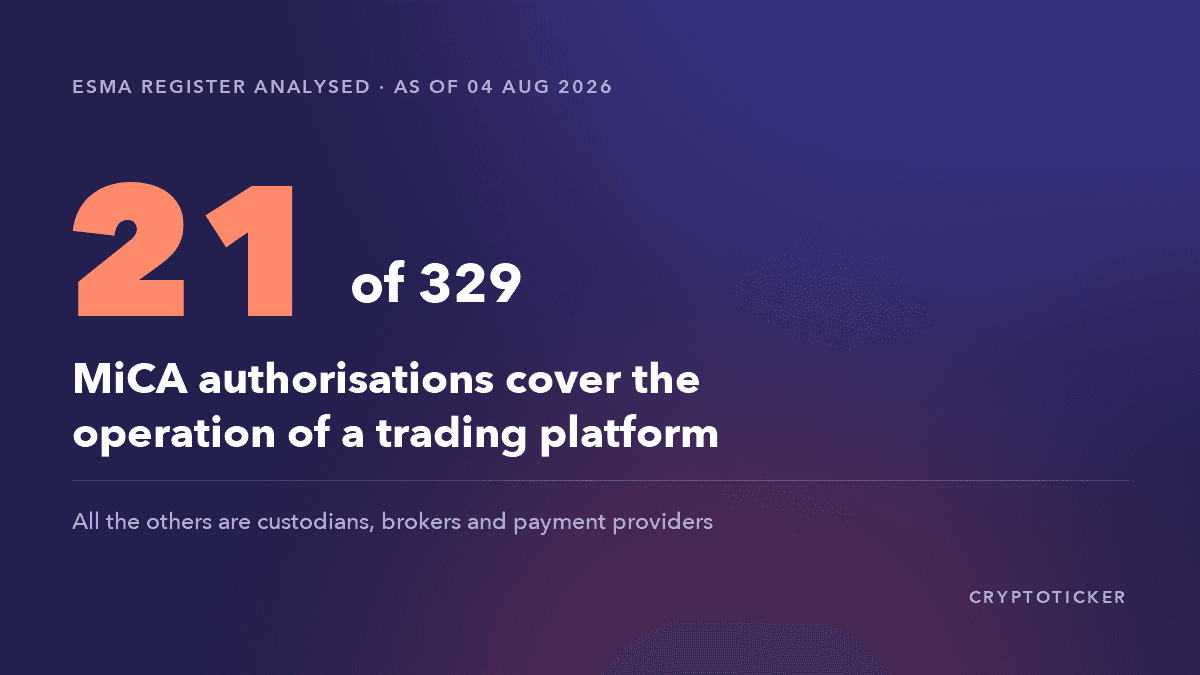
MiCA Register 2026: Only 21 of 329 Licences Are Real Exchanges
ESMA publishes the register of MiCA-authorised providers as an open file. We worked through all of it — and the result is not what the phrase “licensed crypto exchange” suggests.

July 10, 2026 10:30 AM
Binance Reveals Where Its EU Users Went After MiCA
Binance just revealed where most departing EU users moved their crypto after MiCA — and the answer is raising hard questions about the new rulebook.
July 2, 2026 8:59 PM
Binance Is Out of the EU: How to Move to a MiCA-Regulated Exchange
Binance has left the EU market. Which exchanges hold a MiCA licence, how to verify an authorisation is real, and how to move your holdings across step by step.

More from CryptoTicker