
MiCA Consultation Closes September 30: What to Check and Submit Before Then
The European Commission is reviewing the MiCA crypto regulation and will accept submissions until September 30, 2026 at 23:59 CEST. Staking, DeFi, lending, stablecoins and custody are all under examination, and you can take part without a lawyer.





Which topics should we dive deeper into?
Select what genuinely interests you. Your picks feed directly into our editorial planning.
Crypto news that's actually worth your time.
Weekly. 60 seconds. Carefully curated by our editors: no hype, no promo flood, no spam.
The European Commission is reviewing MiCA, the EU's crypto regulation, and the deadline for submissions falls on September 30, 2026 at 23:59 CEST. Anyone who wants to tell the Commission what works in Europe's crypto rules and what does not has until that evening. Brussels then evaluates what it has received, and the questions that will sit on the table for the coming years are settled.
For an investor in Germany this has two sides. The first is immediate: you can take part, free of charge and without a lawyer. The second matters more. What the consultation asks about is a preview of where the EU could tighten its rules. Staking, DeFi, lending and tokenized deposits appear in it explicitly as open points. Those are the services many German portfolios now use without any clear rule on who is liable for them.
What the European Commission's MiCA review actually is
MiCA is the Markets in Crypto-Assets Regulation, the single EU rulebook for crypto service providers, for token issuers and for stablecoins. Among other things it requires a firm to hold an authorization before it offers trading, custody or exchange services in the EU, and to be supervised by a national regulator. In Germany that regulator is BaFin.
The regulation builds in its own review. Articles 140 and 142 oblige the Commission to report on how MiCA works in practice and what has changed in the markets since it took effect. A legislative proposal may be attached to that report if the assessment shows a need for change. The current consultation is the evidence-gathering step behind it: the Commission is asking whether the regulation is still, in its own words, fit for purpose.
The process opened on May 20, 2026. We broke down the substantive direction of travel in a separate analysis at the time. What has been added since is mainly time pressure.
Deadline September 30, 2026: the dates that apply in the MiCA consultation
The consultation was originally due to close on August 31, 2026. The Commission extended the deadline at the end of June, according to the regulatory service Regulation Tomorrow from Norton Rose Fulbright on June 29, 2026 and on the basis of a notice in the Commission's Finance News Hub. The official consultation page has shown September 30, 2026, 23:59 CEST, ever since.
An extended procedure is not a signal that something will follow quickly. The specialist assessment by FinanceFeeds dates the reports under Articles 140 and 142 to June 30, 2027. Only after that will it be decided whether a legislative proposal follows, and such a proposal would then still have to pass through the usual procedure between Parliament and Council. Realistically, we are talking about changes that would take effect in 2028 at the earliest.
Why the deadline counts anyway
Submissions that arrive after September 30 no longer feed into the assessment. Anyone who reacts only once a draft law is on the table is arguing about a text whose basic direction was set long before. Industry bodies and law firms know this and file early.

Targeted consultation or public consultation: which track applies to you
The Commission is running two tracks, and they address different audiences. The targeted consultation is intended, according to the description on the Commission's page, for a specialist audience: crypto service providers, issuers, national and European supervisory authorities, central banks, finance ministries. The questionnaire there assumes technical knowledge and runs through a form in the EU Survey system.
Alongside it there is a public consultation on the Have your say portal, which is open to everyone, including private individuals with no industry background. If you invest yourself and want to describe where the rules help you in daily practice or get in your way, that is your track. Both tracks belong to the same initiative, the evaluation of the EU legal framework for crypto-asset markets.
One pointer that will save you trouble: the deadline stated on the targeted consultation page is September 30, 2026. For the public track, the portal displays the deadline that applies there. Check it before you start typing, and do not plan on the last evening.
 Regulated crypto exchanges compared
DeFi, staking and lending: the biggest gap in MiCA's scope
The part of the questionnaire most relevant to retail investors concerns what is currently unregulated or only half regulated. Assessments by several commercial law firms consistently list a block on new activities: decentralized finance applications, staking, lending and borrowing of crypto-assets, and the question of who is liable when access to a protocol runs through an app, a wallet or a web interface.
Staking is the case that touches the largest number of German portfolios. Briefly defined: in staking you deposit tokens in a network that uses them to secure transactions, and you receive an ongoing reward in return. MiCA does not settle conclusively whether and when a provider that carries out this deposit for you needs its own authorization. The differences between providers are correspondingly wide, and we have written up separately which arrangements require authorization in Germany.
In practice this means: if a material part of your income comes from staking or lending, the security of that income depends not only on the price but also on whether your provider holds an authorization and whether the EU explicitly captures this field in future. A look at the comparison of regulated crypto exchanges shows which firms are licensed in the EU and which services they offer under that license.
Stablecoins under MiCA: reserves, the right of redemption and significance thresholds
The second large block concerns stablecoins. MiCA recognizes two categories: e-money tokens, which are pegged to exactly one official currency, and asset-referenced tokens, which track a basket of currencies, commodities or other assets. Both are subject to requirements on own funds, on the composition and liquidity of the reserve, and on the right of holders to redeem at par at any time.
The consultation asks whether these requirements are calibrated correctly, how the thresholds for tokens classified as significant work in practice, and how to handle tokens issued in parallel inside and outside the EU. That sounds technical, but it has a very concrete consequence for you: whether a particular stablecoin remains tradable in Europe hangs on precisely these rules. In August 2026 the forced conversion of a large stablecoin at one provider showed how quickly such a decision reaches your own account.
Tokenized shares and hybrid tokens: where MiCA meets MiFID II
A third block of questions turns on the boundary. MiCA applies to crypto-assets that are not financial instruments. As soon as a token qualifies as a financial instrument, securities law applies instead, with MiFID II and the Prospectus Regulation. In between lies a grey area: tokenized fund units, tokenized money market instruments, governance tokens, wrapped tokens that represent another asset, and synthetic constructions that behave economically like a share but are legally something else.
The Commission wants to know where the boundary remains unclear in practice. This concerns you as soon as you hold products that replicate a share, because the answer determines which rights sit behind them and which authority is responsible.

Tokenized deposits and custody: who owns your balance if things go wrong
The block that is perhaps most underestimated concerns tokenized bank deposits and custody. The Commission asks how such deposits are to be classified under civil law, who owns the assets in a custody relationship, and how they relate to statutory deposit protection. For euro bank balances the position is clearly settled. For crypto-assets in a customer account, the decisive question is whether they can be separated out in an insolvency, meaning they do not fall into the estate.
A sober look at your own setup is worthwhile here. What sits with an authorized provider is covered by that firm's regulatory duty to segregate client assets from its own. What sits in a self-managed wallet is subject to no supervision, but also to no one else's insolvency risk. Both have drawbacks, and the consultation will change nothing about that split in the short term.
 Staking providers compared
MiCA after the deadline: what does not change on October 1, 2026
So that no false expectation arises: on the day after the deadline, exactly the same law applies as before. The consultation changes not a single provision. The procedure gathers material for a report due in 2027. Anyone telling you that staking rewards will be banned or self-custody restricted as of October 1 has either misunderstood the process or is trying to sell you something.
What is worth doing today is taking stock of your providers. A count of the ESMA register by cryptoticker.io on August 6, 2026 found 329 authorizations granted, of which only 21 went to trading platforms. The number of licensed firms is therefore smaller than the range of offers available in Germany would suggest. Check the public ESMA register to see whether your provider is actually listed, and do not rely on marketing claims on its homepage.
Submitting a response: how to proceed before September 30
The process is manageable. You open the Commission's consultation page, decide which track fits you and fill in the form. Registration in the Transparency Register is not required for private individuals, but you do have to state in what capacity you are responding.
What makes a submission useful
Contributions that carry weight in an assessment describe a concrete case rather than a general attitude. So it is better to set out which service was available in Germany, which one disappeared, what information was missing when you switched, which fee was not visible beforehand. Accounts of that kind are more valuable to the Commission than a position for or against regulation in principle. You do not have to answer every question; leaving blocks unanswered is explicitly provided for.
You will find the two entry points here: the targeted consultation on the MiCA review on the European Commission's site and the public consultation on the Have your say portal.
MiCA consultation: what to take away
- Check where your income comes from. Staking and lending are named explicitly in the consultation as open points. If a relevant share of your return comes from them, look into the license your provider works under. The comparison of staking providers sets terms and lock-up periods side by side.
- Verify the authorization status of your trading venues. Not every service reachable from Germany is licensed in the EU, and with unlicensed providers the regulatory protection does not apply. The exchange comparison places the common firms in context.
- Document your transactions properly. Every shift in the legal framework raises the likelihood of additional record-keeping and reporting duties. A continuous history is not something you can save yourself later, so keep it now; the tax and tracking tools in comparison take the manual work off your hands.
(As of September 19, 2026. This article is not investment advice. Prices and fee structures change; check the terms with the provider before you buy.)
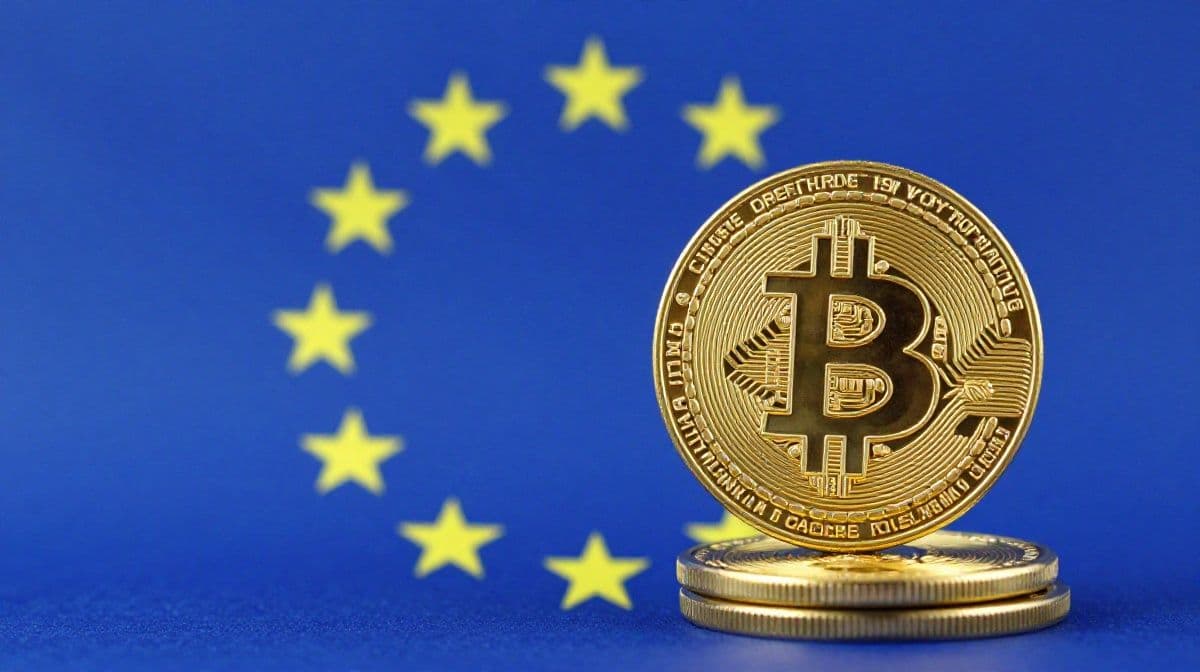
Transparency note: This article was produced with the assistance of artificial intelligence and reviewed by our editorial team before publication. All figures and claims were checked against the primary sources linked in the text. The feature image was generated with AI.
Related articles
- MiCA Review: What the European Commission Could Change About the EU Crypto Rules
- MiCA Wiped Out 92% of Europe's Crypto Firms: Here's Who Survived and Who's Cashing In
- Chainlink Jumps Above $12: What LINK Holders Should Check Now
- ESMA Calls for Advertising Rules on Crypto Influencers: Six Changes Now Sitting With the EU Commission
- Binance EU Access at Risk: What MiCA Could Mean for BNB and Crypto Users
Which topics should we dive deeper into?
Select what genuinely interests you. Your picks feed directly into our editorial planning.
Crypto news that's actually worth your time.
Weekly. 60 seconds. Carefully curated by our editors: no hype, no promo flood, no spam.

February 22, 2025 3:35 PM
EU Approves 10 Stablecoin Issuers Under MiCA – But WHY Was Tether Left OUT?
The European Union has approved 10 stablecoin issuers under its MiCA regulations, notably excluding Tether's USDT. This decision raises questions about the future of stablecoin regulation and market dynamics within the EU.

June 30, 2026 11:20 PM

How to Switch from Binance to a MiCA Regulated Crypto Exchange
Binance is winding down EU services after missing the MiCA deadline. Here's why it's happening and how to move your funds to a regulated platform safely.
August 29, 2026 5:02 PM
CLARITY Act: The Senate Votes September 15, And Traders Give It A 14% Chance
The US Senate votes on crypto's biggest bill on September 15. Here is what the CLARITY Act actually does and why the market is betting against it.
May 9, 2026 10:16 AM
Crypto Clarity Act Vote: Could May 14 Finally Push US Crypto Regulation Forward?
The Crypto Clarity Act heads to a May 14 Senate Banking vote as banks, Coinbase, and lawmakers clash over stablecoin rewards.

August 6, 2026 3:05 PM
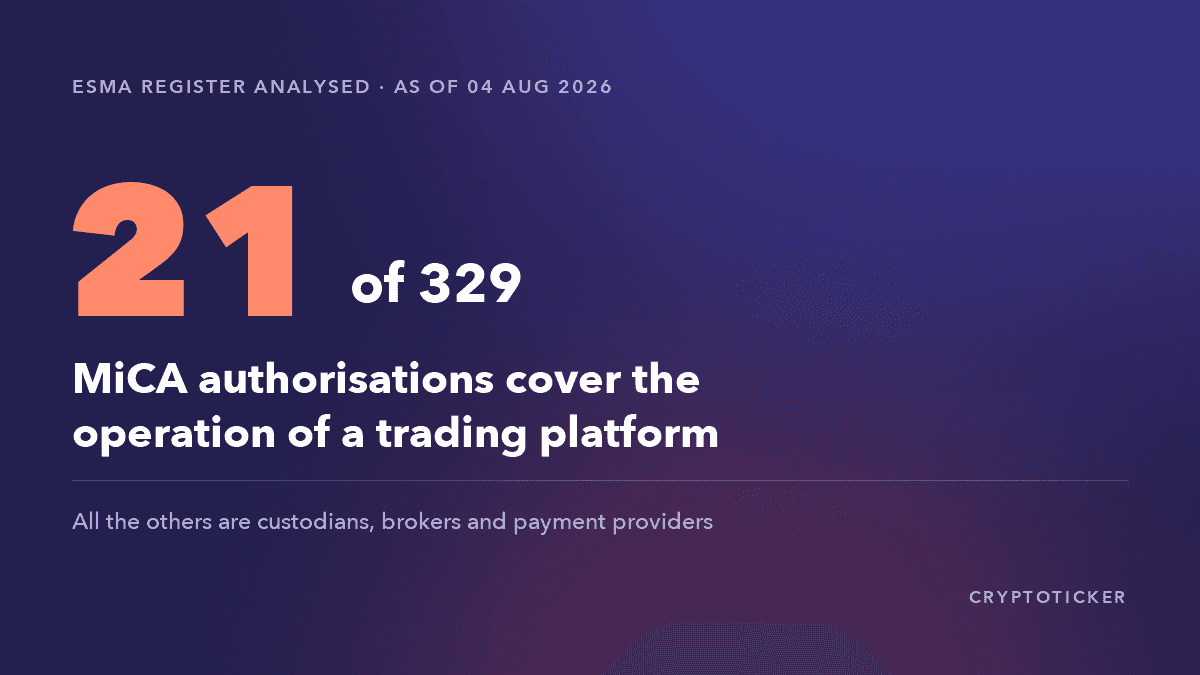
MiCA Register 2026: Only 21 of 329 Licences Are Real Exchanges
ESMA publishes the register of MiCA-authorised providers as an open file. We worked through all of it — and the result is not what the phrase “licensed crypto exchange” suggests.
May 12, 2025 9:05 PM

US-EU Trade Tensions Rise as US-China Conflict Cools Down
Just as the long-standing US-China trade war appears to ease, new tensions are emerging between the United States and the European Union. With Trump calling Europe “nastier than China,” are we about to witness a new transatlantic trade conflict?
July 7, 2025 8:12 PM
BIG Crypto News: EU Approves 14 Stablecoin Issuers Under MiCA
Six months into the MiCA rollout, Europe’s crypto regulatory landscape is taking shape. From authorized stablecoin issuers to licensed crypto service providers, here’s the full July 2025 update.
July 10, 2026 10:30 AM
Binance Reveals Where Its EU Users Went After MiCA
Binance just revealed where most departing EU users moved their crypto after MiCA — and the answer is raising hard questions about the new rulebook.
June 25, 2026 11:19 AM

Binance Pulls Its EU Licence Bid: What It Means for Your Crypto
Binance just withdrew its MiCA licence application in Greece days before the EU deadline. Here's what it means for users, your funds, and the crypto market.
March 11, 2026 12:37 PM

Why Crypto Projects Are Failing: The Hidden Truth Behind the 2026 Stagnation
The crypto gold rush has hit a wall. Why are retail projects stalling as institutional giants and strict regulations reshape the market in 2026?
September 22, 2026 10:15 PM

Stablecoin Reserves: Why the ECB Wants the Bank Deposit Rule Scrapped
The European System of Central Banks filed its response to the MiCA review on September 22 and calls in it for an end to the requirement to hold 30 to 60 percent of stablecoin reserves as a bank deposit. What lies behind it, and what you can check on your own token.
August 21, 2026 10:27 AM

Complaining About a Crypto Exchange: the Deadlines Article 71 MiCAR Sets and Why BaFin Will Not Decide Your Case
Authorised crypto providers have to run a formal complaints procedure, and Delegated Regulation (EU) 2025/294 sets a hard limit of two months for it. Our own analysis of the ESMA list shows at the same time that no complaints link is on file for Germany to this day.

September 24, 2026 1:34 PM

Cardano Slides Below $0.24: What ADA Holders Should Check on Leverage, Liquidation and Holding Period
Cardano has given back its move above $0.25 and trades around seven percent below the high of the past 24 hours. What that means for leveraged positions, the holding period of your tranches and the buying route under MiCA.
September 24, 2026 1:24 PM

NEAR Falls Almost 8 Percent After a 62 Percent Week: What to Check on Perps, Buying Route and Holding Period
NEAR Protocol loses up to 7.9 percent on September 24, 2026 and is still more than 55 percent higher over the week. The rally was carried by a confidential perp offering via Hyperliquid, which raises questions of its own on buying route, leverage and holding period in Germany.
September 6, 2026 10:20 PM

Bison App: a 1.25 Percent Spread, 27 Percent of the Staking Rewards and Trading Without an Order Book
The crypto app of Boerse Stuttgart advertises freedom from fees. You pay through the spread instead. What the licences actually cover, why there is no order book, and why the tax report loses its value once you transfer coins out.
August 5, 2026 11:20 AM
CLARITY Act Countdown: The Senate Has Days Left to Move Crypto's Biggest Bill
The Senate breaks for recess on Friday and the CLARITY Act still has no cloture motion filed. Galaxy just cut its 2026 passage odds from 50 to 30 percent.
July 25, 2026 7:02 PM
AI Stocks Went From A Few Trillion To $22 Trillion. Can The CLARITY Act Do The Same For Crypto?
The CLARITY Act is one Senate floor vote from law. Here is what the viral AI-stock comparison gets right — and what it gets badly wrong.
July 6, 2026 11:17 AM

XRP Just Got a Massive EU Green Light — But There's a Catch Nobody's Talking About
Ripple scored preliminary MiCA approval to run crypto services across all 30 EEA countries — and $XRP is up ~8% this week. Here's what it really means.
July 2, 2026 8:59 PM
Binance Is Out of the EU: How to Move to a MiCA-Regulated Exchange
Binance has left the EU market. Which exchanges hold a MiCA licence, how to verify an authorisation is real, and how to move your holdings across step by step.
May 15, 2026 9:47 AM

Top 10 Altcoins to Buy in May 2026 as Bitcoin Recovers
Here are the top 10 altcoins to buy in May 2026 as Bitcoin rebounds near $80K and market momentum shifts.
October 1, 2026 4:21 AM

Velocity Replaces Drift After the 285 Million Dollar Hack: What Changes for Investors in Germany
The Solana perp DEX Drift is back as Velocity, and since September 29, 2026 a new team has been running it. What the overhaul after the outflow of 285 million dollars means for your deposits, for settlement in USDT and for the legal position in Germany.
September 20, 2026 4:13 AM

Zcash Above $1,500: What ZEC Holders Should Check on Tax and Custody
Zcash rose above $1,500 on September 19 for the first time since 2016 and, after an intraday high of $1,590.80, trades back at around $1,474. For German holders three questions hang on that jump: the one-year holding period, the planned year-end cut-off and the EU anti-money-laundering regulation from July 2027.
August 22, 2026 1:23 AM

Binance Withdrawal Deadline September 9: What ALCX, ARDR, NFP and POND Holders Should Know Now It Has Passed
Recap as of September 27, 2026: Binance had announced it would stop withdrawals of ALCX, ARDR, NFP and POND on September 9, 2026 at 03:00 UTC. Spot trading in these tokens had been suspended since July 10, and the exchange is winding down its EU business. This article describes the situation before the deadline.
July 1, 2026 10:47 AM

Crypto News Today: Binance Exits the EU, Circle Craters, and Bitcoin Slides Below $59K
MiCA reshapes the market as Binance leaves the EU, a 140-firm stablecoin rocks Circle, and Bitcoin sags near multi-year lows. Here's what's moving crypto today.

September 25, 2023 5:47 AM

Binance Anticipates Delisting Stablecoins Due to Upcoming MiCA Regulation
Unravel the implications of the EU's MiCA regulation on Binance's potential stablecoin delisting. Discover how evolving regulations shape the cryptocurrency landscape.
June 12, 2025 3:50 PM

GENIUS Act Now in Play: A Turning Point for Crypto Regulation and Stablecoins?
After the U.S. Senate pushed the GENIUS Act closer to becoming law, this groundbreaking crypto legislation could reshape the future of stablecoins, digital assets, and global crypto adoption. But how?

More from CryptoTicker