
Crypto Exchange Shutting Down: What to Do Before the Deadline Passes
Binance, BitMart, Luno and Revolut have ended or cut back their European business within seven weeks. This guide shows which deadline expires first, how a forced sale is treated for tax, and what to secure before the account closes.





Which topics should we dive deeper into?
Select what genuinely interests you. Your picks feed directly into our editorial planning.
Crypto news that's actually worth your time.
Weekly. 60 seconds. Carefully curated by our editors: no hype, no promo flood, no spam.
Four providers have closed or sharply cut back their European business within seven weeks. The question worth asking is a practical one: what happens to the coins still sitting in your account when a crypto exchange shuts down?
It is almost always asked too late. A withdrawal from the market runs in stages, and the deadline that takes away the most room to act is usually the first one to expire.
This guide sets out the sequence all four cases share, and answers the point most people only notice afterwards: what a forced sale means for tax. If you are already thinking about where your holdings should sit in future, it is worth looking first at regulated crypto exchanges with EU authorisation.
Four crypto exchange exits in seven weeks: what the cases have in common
In order: at the end of June 2026, cryptoticker reported that Binance was restructuring its EU business as of July 1. The end of July brought BitMart's announcement that it would cease operations. In early August, Luno said it would close accounts in several EU regions, and Revolut announced it would remove the stablecoin USDT from its European offering by the end of August.
Four different providers, four different reasons. All of them follow the same pattern, and that pattern will apply again next time:
- An announcement by email and in the help centre, often several weeks ahead.
- A first block that switches off one specific function while everything else keeps running.
- A cut-off date up to which you can sell and move money out.
- An automatic measure for anything still in the account after that.
- A cost mechanism that eats into the remaining balance.
Once you know the sequence, you read those emails differently. The decisive information is rarely in the headline; it sits further down, in the list of dates.
MiCA as the driver: why the authorisation requirement is thinning the crypto market
The common background is MiCA, the Markets in Crypto-Assets Regulation. Since the transitional arrangements ran out, every provider offering crypto services in the EU needs an authorisation as a Crypto-Asset Service Provider, or CASP. Obtaining one means going through a formal procedure and then staying under continuous supervision.
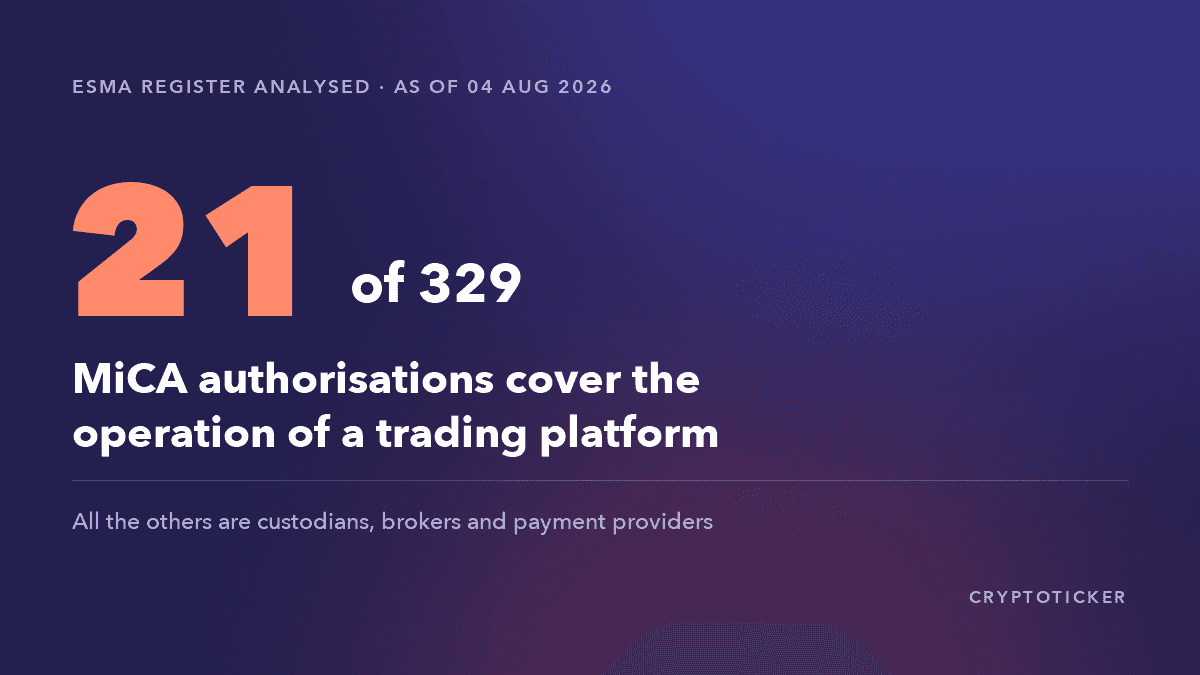
For you as a customer, three obligations matter most. An authorised provider has to hold client funds and client crypto-assets separately from its own, capital requirements apply, and there are disclosure duties covering risks, fees and complaints procedures. Those requirements are exactly what explains the exits. A provider essentially has two options: go through the procedure and carry the running cost, or give up the EU business. How thin the field really is shows in the analysis of the MiCA register from August 6, 2026: of the 329 authorisations counted there at the time, only 21 went to trading platforms. Further exits are therefore more likely than a return to the old line-up.
The ESMA register as the first check before any crypto trading venue
Whether a provider is authorised can be looked up publicly. The European Securities and Markets Authority, ESMA, keeps a register of authorised CASPs. It shows which company was authorised in which member state, and which services the authorisation covers. The check takes two minutes and is worth doing before any larger deposit: search ESMA's CASP register for the company name. For providers with a German authorisation, BaFin also maintains its own company database.
What to look for in the register
An entry is not a seal of approval for service quality; it only says that a provider is supervised. Check the company name carefully, because the brand and the legal entity often differ. No match does not automatically mean a dubious provider, but it does mean the MiCA safeguards do not apply there.
The three deadlines when a crypto exchange withdraws: crypto withdrawal, sale, euro payout
When a provider pulls out, it almost always sets three separate dates, in this order:
- End of crypto withdrawals. From this point you can no longer send your coins to your own wallet or to another provider.
- End of trading. From here the position can no longer be sold.
- End of euro payouts. After that, even the cash no longer reaches your bank account.
The documented case here is Luno. According to the provider, transfers to external wallets ended at the end of June 2026, while selling and euro payouts remained possible until August 31, 2026.
Between the first and the last date there were a good two months. Anyone who missed the first deadline could still get to their money, but only in euros. That distinction is the most important point in this article.
Why the crypto withdrawal is blocked first
That the transfer to your own wallet is the first thing to go seems illogical, but it makes sense from the provider's side. External transfers are the most demanding part of the operation, because they require blockchain connections, anti-money-laundering monitoring and a department for misaddressed transfers.
For you this has a consequence that goes beyond any single provider. Once external withdrawals are blocked, you no longer have a choice between holding and selling. A custody problem turns into a taxable event, at a moment you do not control. So when an email arrives carrying the words discontinuation, withdrawal or closure, look first at the date from which no coins may leave the building.
Forced conversion and forced sale: when the crypto exchange decides without you
What happens to holdings still there after the cut-off date? Providers solve this differently, but always without asking. In Revolut's USDT delisting, the announced mechanism is an automatic conversion: anyone who has neither sold nor withdrawn the stablecoin by the end of August 2026 will have the remaining balance converted into the account's main currency at the rate applying on the day. According to the available reports, the trigger was that the issuer of USDT did not seek a MiCA authorisation for the stablecoin.
Two variants need to be kept apart:
- Conversion into fiat. The crypto-asset becomes euros. That is a sale, with everything that follows for tax.
- Conversion into another crypto-asset. USDT becomes an authorised stablecoin, for example. That counts as a swap too, even if the euro amount barely moves.
The second case surprises many people. Swapping one stablecoin for another feels like nothing at all, and still amounts to a disposal of the old holding for tax purposes.
Tax consequences in Germany: a forced crypto sale is a disposal
For private individuals with unlimited tax liability in Germany, gains from selling crypto-assets fall under private disposal transactions in Section 23 of the Income Tax Act. That applies whether you sell voluntarily or an exchange triggers the sale by withdrawing; the law offers no discount for involuntary disposals.
Three points from this are worth knowing. The holding period is one year, and once it has passed a disposal gain is no longer taxable. An exemption threshold applies to the total gains of a calendar year, and it falls away entirely once exceeded. And you have to be able to identify which units were acquired when, which is usually handled with the FIFO method per wallet or account.
The practical twist lies in how this meets the exit. If your position is eleven months old and the forced sale hits in the twelfth month, you lose the tax exemption that would have arrived four weeks later. With staggered purchases through a savings plan, that is the normal case. If you still have the option of moving the coins to your own wallet, the holding period continues untouched, because a transfer between your own addresses does not count as a disposal.
What to secure before the account disappears
The step most often overlooked has nothing to do with money. Once an account is closed, you can no longer reach the transaction history, and that is exactly what you need for your tax return. So before the cut-off date, pull:
- the full transaction export as a CSV file, covering the entire life of the account if possible,
- the trade confirmations and fee statements,
- the records of euro deposits and withdrawals,
- and the provider's closure notice, because it documents the reason for the sale.
Custody fees after the deadline: how a residual crypto balance melts away
One detail sits far down in the announcements: after the cut-off date the account often stays open and starts costing money. In Luno's case, monthly fees were announced for remaining balances, rising over time. That mainly hits accounts nobody thinks about any more, such as old secondary accounts and amounts below the level at which a payout feels worth the effort.
The emergency plan if you have missed the deadline
Suppose it has already happened: the cut-off date is behind you, and the app no longer offers a sell button. The money is usually not lost, but the route to it becomes awkward. At Luno, access after the cut-off date runs through customer service, which asks for a bank statement no older than three months. Self-service turns into an identification procedure.
Get in touch in writing, using the official address from the provider's help centre rather than a link from an email. Record the date and content of every message, and explicitly request the transaction history. Also check which supervisory authority is responsible, because with an authorised company there is a complaints route beyond customer service.
A warning belongs here. Around every announced closure, messages appear claiming to help rescue the balance and leading to fake login pages. No reputable provider asks you by email to enter your credentials or your seed phrase.
Early warning signs: spotting a crypto exchange exit before the email arrives
Exits announce themselves. None of the following signals proves anything on its own, but when several come together it is worth a second look at your choice of provider:
- Trading pairs disappear, particularly for stablecoins and smaller tokens.
- New deposits are capped or switched off for certain routes.
- An unusual wave of identity verification requests goes out.
- The fee structure changes at short notice to the disadvantage of small accounts.
- The company does not appear in the relevant registers, or only for a few categories of service. This point is the most reliable one, because it can be checked objectively.
Self-custody as the consequence: what hardware and software wallets do
As long as your coins sit with a provider, your access depends on that provider's business decisions and on its authorisation. Holdings in your own custody remove that risk, and in exchange you carry sole responsibility for the backup.
That responsibility should not be played down. Lose the seed phrase and there is no hotline; store it digitally without protection and you have swapped a provider risk for a theft risk. For larger amounts, a device with separate key storage is the usual route, while for everyday use many people find a software wallet on their phone enough.
What to take away when a crypto exchange closes
- Look for the date, not the headline. With every closure email, note first the date from which crypto withdrawals stop. After that you can decide calmly whether to move your holdings to your own address, or sell and settle the proceeds with a provider offering reliable euro payouts.
- Get long-term holdings out of third-party custody. What sits at your own address cannot be forced out by any exit. Which device is suitable for that is shown in the hardware wallet comparison.
- Secure the records before the account closes. Transaction export, fee statement and closure notice belong in your archive. A crypto tax tool or portfolio tracker keeps acquisition dates and holding periods even when the exchange is gone.
(As of August 11, 2026. This article is not investment advice. Prices and fee structures change; check the terms with the provider before you buy.)
Transparency note: This article was produced with the assistance of artificial intelligence and reviewed by our editorial team before publication. All figures and claims were checked against the primary sources linked in the text. The feature image was generated with AI.
Related articles
- Bitget Hack of $351 Million: What to Check at Your Crypto Exchange Now
- Kraken Delists 21 Tokens: Trading End on September 11 Has Passed, Withdrawals Run Until December 10
- ESMA puts reverse solicitation on its 2027 watch list: what investors need to know about exchanges without an EU licence
- Kraken: 45 coins are on cancel only, 21 were announced – what to check when trading pairs are blocked
- Bitget Withdrawals Resume on September 28: What to Check on a Residual Balance Now
Which topics should we dive deeper into?
Select what genuinely interests you. Your picks feed directly into our editorial planning.
Crypto news that's actually worth your time.
Weekly. 60 seconds. Carefully curated by our editors: no hype, no promo flood, no spam.

August 20, 2026 4:20 AM

Crypto Exchange Delisting: What Happens to Your Tokens When Trading and Withdrawals Close
A delisting runs in four stages, and only one of them is genuinely dangerous: the end of the withdrawal deadline. Using two live OKX dates as the example, we show what happens at each stage and how to tell whether it affects you.
August 23, 2026 1:34 PM

BitMart Before the Trading Halt: Which Coins Already Have Withdrawals Blocked
At BitMart, trading ends at 01:00 UTC on August 26, 2026, and the deadline for withdrawal requests at 05:00 UTC. Our own measurement of the public interface shows that for a large share of the listed crypto assets, withdrawal is no longer enabled four days beforehand.

July 2, 2026 8:59 PM

Binance Is Out of the EU: How to Move to a MiCA-Regulated Exchange
Binance has left the EU market. Which exchanges hold a MiCA licence, how to verify an authorisation is real, and how to move your holdings across step by step.
August 23, 2026 4:25 AM
Crypto Exchange Closure: What Happens to Your Residual Balance and When the Fee Starts
When a crypto exchange stops operating, trading ends on a set date but the account does not. Anyone leaving a residual balance behind now pays a monthly fee at the wind-downs currently under way.
August 22, 2026 10:37 PM
Transferring Delisted Tokens: 16 of 21 Kraken Assets Have No Fallback Exchange
On 27 August at 14:00 UTC Kraken closes withdrawals for 21 delisted tokens, and from 1 September the exchange sells the remainder itself. Our count of 34 tokens against six venues shows which assets still have a transfer destination at all.
August 11, 2026 9:18 AM

Your Crypto Exchange Is Telling You to Withdraw: How to Spot Phishing After the MiCA Deadline
Unauthorised crypto providers now have to tell their EU customers to withdraw, which leaves fraudsters an easy run with faked requests. Here is how to check in two minutes whether the message is genuine.
September 29, 2026 7:12 PM
MEXC Refunds $340,000: The Attacker's API Key Survived the Account Freeze
During an account takeover at MEXC, an attacker created an API key with withdrawal rights that the exchange did not revoke when it restored the account. Twenty-seven minutes after the withdrawal freeze expired, roughly $340,000 was gone.
August 6, 2026 3:05 PM
MiCA Register 2026: Only 21 of 329 Licences Are Real Exchanges
ESMA publishes the register of MiCA-authorised providers as an open file. We worked through all of it — and the result is not what the phrase “licensed crypto exchange” suggests.
September 29, 2026 10:14 AM
387.5 million dollars at Bitget: the attack ran through a bought-in security product, what to watch now
Bitget has disclosed how the attackers reached its withdrawal systems on September 24: through a previously unknown flaw in a security product it had bought in. The second stage of the withdrawal schedule opens today at 08:00 UTC, and for the balance you keep on any exchange the case changes the arithmetic.
August 22, 2026 1:23 AM

Binance Withdrawal Deadline September 9: What ALCX, ARDR, NFP and POND Holders Should Know Now It Has Passed
Recap as of September 27, 2026: Binance had announced it would stop withdrawals of ALCX, ARDR, NFP and POND on September 9, 2026 at 03:00 UTC. Spot trading in these tokens had been suspended since July 10, and the exchange is winding down its EU business. This article describes the situation before the deadline.
September 27, 2026 4:32 AM

Hester Peirce Leaves the SEC: What Now Applies to Your Custody in Germany
The most crypto-friendly voice at the US securities regulator goes on October 2, 2026, and the commission shrinks to two members. For investors in Germany it is still the European rulebook that decides, and there a deadline falls in July 2027.
September 16, 2026 1:28 PM

Crypto Withdrawal to Your Own Wallet: Ten Providers Checked, Three Will Not Let Your Coins Out
Seven of ten providers available in Germany offer a payout to a wallet address you control yourself; three do not. Our survey of September 16, 2026, shows how to spot the difference before you buy, and why the question matters right now.
August 21, 2026 4:17 PM

Crypto Withdrawals to Your Own Wallet: Why Exchanges Demand Proof of Address Ownership Above €1,000
Above €1,000 your provider has to establish whether the destination address really belongs to you. Article 14(5) of the transfer of funds regulation, five permitted methods, and the reason a withdrawal stalls without this step.
September 15, 2026 10:12 AM
CoinEx Is Shutting Down: The Deadline to Withdraw Your Balance
Crypto exchange CoinEx is winding down and the withdrawal channel closes on December 22, 2026. Our own measurement on the day of the first wind-down stage shows which 37 currencies cannot be withdrawn right now and why the chain you pick decides a double-digit percentage of your residual balance.
September 9, 2026 1:14 PM

OKX Delists GODS, PRCL and DUCK: You Can Still Withdraw the Tokens Until November 7, 2026
OKX ended trading in GODS, PRCL and DUCK in August, but withdrawals stay open until November 7, 2026. What to do in those three months, where the tokens now sit in your account, and why the exchange leaves open what happens to them afterwards.
August 21, 2026 4:27 PM

Wallet App Without BaFin Authorisation: When Holding Crypto-Assets Requires a Licence
On 19 August 2026 BaFin published two consumer notices on wallet offerings. Who controls the means of access decides whether an authorisation is needed.
September 16, 2026 1:12 PM
Bitvavo Delisting of Kava, Nano and Ravencoin: What to Do Before Friday, 2 p.m.
Bitvavo drops KAVA, XNO and RVN on September 18, 2026, and three deadlines expire in a single afternoon. Nano has no withdrawal route at all, and the automatic euro conversion on September 28 counts as a sale for tax purposes.
August 30, 2026 10:38 PM

Crypto Cards: Where Your Card Balance Really Sits and What the August 28 Solana Exploit Reveals About It
An attack on a card balance contract on Solana took the loaded balance from 1,685 users while their wallets stayed untouched. The case shows why it matters whether your crypto card holds funds as e-money at a licensed institution or in a smart contract.
September 13, 2026 4:33 AM

Your Volksbank's Crypto Licence: Why You Have to Check Custody Separately
14 of the 16 newest CASP entries in the ESMA register were German cooperative banks, and each one carries order execution only. Our count of the BaFin database shows that not one of the 21 cooperative institutions is registered as a crypto custodian.
July 26, 2026 7:57 AM
BitMart Shuts Down: Second Major Crypto Exchange to Announce Closure in One Week
BitMart is winding down just three days after BitMEX. Here are the withdrawal deadlines, what triggered the closures, and what it means for CEX users.
September 27, 2026 7:22 AM
CoinEx Forced Conversion: Withdraw Non-USDT Balances by September 29
On September 29 at 02:00 UTC spot trading ends at CoinEx, and all holdings outside USDT are sold or delisted after that. What this means for your holding period, your tax bill and your withdrawal.
September 10, 2026 7:17 PM
Binance Delists USDP: You Have Until November 24 to Withdraw Your Pax Dollar
Binance is removing the Pax Dollar stablecoin from its platform altogether. For holders in the European Economic Area the date that counts is the withdrawal deadline on November 24, 2026, well after the trading halt on September 24.
September 5, 2026 10:33 AM

ZIL Withdrawals Frozen: Why Your Zilliqa Balance Is Stuck After the Hard Fork
The Zilliqa hard fork of September 2, 2026 moved the ZIL balances of ten exchanges to new addresses. Three days later, deposits and withdrawals were still halted at the three venues we checked: what that means for your balance, what self-custodians are waiting for, and why the announced compensation is not a decision yet.
September 4, 2026 10:26 PM

Pocket Bitcoin Data Breach: When Name, Home Address and Bitcoin Address Circulate Together
The Swiss Bitcoin service Pocket Bitcoin closed its investigation on September 3, 2026: 5,411 people affected, and for 291 of them the Bitcoin addresses they used along with copies of identity documents. Why this one data pairing has lasting effect, and what you should check with your own provider.
September 4, 2026 10:17 AM
Cypher Shutdown on September 6: What Users Should Know Now the Withdrawal Deadline Has Passed
Recap as of September 27, 2026: Cypher had announced it would take its app, dApp and withdrawal window offline on September 6, 2026 and end the token protocol. This article describes the situation before the deadline, how the payout worked and what our own measurement showed at the time about what was left of the CYPR token.
August 23, 2026 4:46 PM

BitMart Plans Restructuring Instead of Wind-Down: What Customers Should Know Now the August 26 Deadline Has Passed
Recap as of September 27, 2026: BitMart announced a possible restructuring plan on August 21, 2026, but the dates did not change: trading was set to end on August 26 at 01:00 UTC and withdrawal requests had to be submitted by 05:00 UTC. This article describes the situation before the deadline.
August 18, 2026 10:11 AM

Kraken Delisting: 56 Tokens Face Forced Liquidation, Two Withdrawal Deadlines Have Passed, the Third Ends November 6
As of September 27, 2026: Kraken is removing 56 cryptocurrencies from trading across three cycles. The withdrawal deadlines of August 27 and September 25, 2026 have passed. For the 21 tokens from the July cycle, withdrawals remain open until November 6, 2026 at 14:00 UTC, after which the exchange sells any remaining balances itself.
More from CryptoTicker