
Hardware wallet lost: how to rescue your coins and what the tax office accepts
Your hardware wallet is gone, your coins are still on the blockchain: all that matters is whether you still have your recovery phrase. What goes wrong during a restore, and why the tax office as a rule does not recognise permanently lost access as a loss under Section 23 of the Income Tax Act.




Which topics should we dive deeper into?
Select what genuinely interests you. Your picks feed directly into our editorial planning.
Crypto news that's actually worth your time.
Weekly. 60 seconds. Carefully curated by our editors: no hype, no promo flood, no spam.
If your hardware wallet is gone, your coins are almost never gone. Your holdings are still on the blockchain, exactly where they always were. The device never stored them; it only kept the keys you use to dispose of them. That is why a single question decides everything: do you still have your recovery phrase?
If the answer is yes, the rest is routine and done in half an hour. If it is no, the second and more uncomfortable question arises, and this article is mainly about that one: can you at least write the loss off against tax? The short answer for investors in Germany, under current administrative practice, is no. A lost key is not a sale, and without a sale German income tax law recognises no deductible loss on crypto-assets held privately. There are counter-arguments, they deserve to be taken seriously, and they appear further down. Do not rely on them.
This article takes you through both halves of the problem: first the technical rescue, then the tax position along with the evidence you need for it.
Hardware wallet lost: why the device is not your coins
A hardware wallet is a small device that generates and stores your private keys offline and signs transactions without ever handing the key to the computer. The private key is the secret number that allows a transaction to be signed with legal effect. Whoever holds it controls the coins. Whoever does not hold it can watch, but move nothing.
The holdings themselves sit in the public ledger of the blockchain concerned. With Bitcoin you can look up your address in any block explorer and see your balance still standing there while the device lies in a moving box or at the bottom of a lake. That is precisely why a lost device is, as a rule, not a financial loss.
Financial loss only arises once nobody can reconstruct the key any more. And the key does not sit in the device; it sits in your backup.
Recovery phrase to hand? How to restore your wallet under the BIP39 standard
The recovery phrase, often also called the seed phrase, is a sequence of usually twelve or twenty-four words from which all the private keys of a wallet can be recalculated. The underlying standard is called BIP39 and comes from the Bitcoin ecosystem, but almost every common device and software wallet supports it. The words come from a fixed list of 2,048 terms, which is why a single typo stands out and can often still be corrected.
The restore procedure is always the same. You obtain a new device or a reputable software wallet, choose the restore option during setup instead of the option for a new wallet, type your words in the correct order and wait until the wallet has synchronised with the chain. Your balance is then back.
Two points are non-negotiable here. First, you enter the words only on a device you trust, never on a website and never in a support chat. Second, you are not tied to the manufacturer of the lost device: the standard is open, and a phrase created under BIP39 can as a rule also be loaded at another provider. We have described the pitfalls involved in detail in our guide to restoring a seed phrase with a different manufacturer. If you need a new device anyway while you are at it, our hardware wallet comparison will help you choose.
Passphrase, Shamir backup and derivation path: why a restore fails despite the phrase
When the words are right and an empty account still appears, one of three technical peculiarities is almost always behind it.
The passphrase is a self-chosen additional word that some devices offer as a twenty-fifth word. That additional word turns the same sequence of words into a completely different wallet. Anyone who set a passphrase and later forgot it faces an empty balance despite a complete phrase, because there is no recovery for that one word.
The Shamir backup, standardised technically as SLIP39, splits the backup into several parts, of which a defined minimum number has to be brought together. Anyone who finds only one part has precisely nothing. Such fragments also cannot be typed into a device that only understands BIP39.
The derivation path, finally, is the calculation rule by which the individual addresses are derived from the phrase. Different wallets use different defaults. If an empty account appears after a restore, it is worth looking into the advanced settings before panic breaks out: the balance is frequently on a different path of the same phrase.
Only once phrase, passphrase and path have been exhausted is access really lost. From that point on, a technical problem becomes a tax problem.

Why Section 23 of the Income Tax Act sees no disposal in a lost key
Crypto-assets held privately belong to the category of so-called other assets. Under Section 23(1) sentence 1 no. 2 of the German Income Tax Act, a private disposal transaction is one in which no more than a year lies between acquisition and disposal. The Federal Fiscal Court confirmed this classification in its judgment of February 14, 2023 under case number IX R 3/22 and declared gains from the sale and the exchange of currency tokens within the one-year period taxable.
That very classification works against you in the event of a loss. The statute attaches to a disposal, that is, to a transaction in which an asset changes owner for consideration. A device that ended up in household waste changes nothing. There is no acquirer, no disposal price and therefore, on the wording of the provision, no gain and no loss. The same applies to theft: there, too, a disposal transaction is missing, which is why tax offices regularly refuse to recognise such losses.
This is the position you have to prepare for. It is unsatisfactory, because gains in the same window are very much taxed. It nevertheless remains the starting point of any realistic planning.
 Replace your wallet: hardware wallets compared
The one-year period of Section 23 also decides the fate of your loss
The one-year holding period works in both directions. Anyone who held their coins for longer than a year pays no income tax on the gain. Read the other way round, the same sentence means that a loss is worthless for tax purposes once that period has expired, even if it hurts economically.
For your case this means: lost access can only become relevant for tax at all if less than a year lies between the purchase of the coins and the moment access was finally gone. With a device that sat in a cupboard for years, the question is usually answered before it is asked.
One widespread worry can be crossed off at this point. The extension of the disposal period to ten years, which the statute provides for assets generating ongoing income, does not apply to crypto-assets in the view of the tax authorities; the current letter from the Federal Ministry of Finance devotes its own section to this point, headed "Keine Verlängerung der Veräußerungsfrist auf zehn Jahre", no extension of the disposal period to ten years. So anyone who staked or lent stays with the one-year period.
What tax lawyers argue in favour of recognising the loss
The legal position is less clear-cut than the wording of the statute sounds, because an express rule for crypto-assets that have gone missing is still absent today. In a specialist article of March 10, 2025, written by Malika May, the WINHELLER law firm collected several arguments in favour of taking such losses into account for tax purposes.
The first is an analogy to the case law on shares: the Federal Fiscal Court has recognised the uncompensated withdrawal of shares following a capital reduction to zero for tax purposes, and both cases concern privately held assets that perish through no fault of the owner. The second is the principle of taxation according to economic capacity, from which it is hard to justify why gains are taxed while losses are ignored. The third is the risks inherent in trading crypto-assets, from attacks on wallets to the technical loss of access credentials.
The same source openly names the limit of that argument: recognising losses that only materialise after the one-year period has expired is likely to be hard to justify. The counter-position, which dominates the practice of the tax offices, remains the simpler one: no disposal transaction, no loss.
In practical terms this means that your case will, in case of doubt, only get anywhere with an appeal and with professional support. Expect resistance, budget for the effort, and treat recognition as a possibility rather than as a tax saving you have already banked.
Realise the loss instead of hoping: what a sale at token amounts achieves
For holdings that have become worthless but are still accessible there is a viable route: anyone who actually disposes of the coins, even at a symbolic price, thereby creates the transaction the statute requires. We have worked through in detail how that functions with delisting, worthless tokens and an insolvent exchange in our guide to writing off a total crypto loss.
That route is precisely what a lost key closes off, and therein lies the decisive difference between the two groups of cases. You cannot sell what you cannot sign. Anyone offering to unlock "blocked" coins against an advance payment, or to buy them from you without ever gaining access, is running a well-known scam. Do not transfer money to recovery services in this situation.
If access to part of your holdings remains intact, a sober calculation across the whole tax year is worthwhile. Realised losses from other positions can reduce gains from private disposal transactions in the same year, and that effect is often larger than the prospect of eventually having the lost key recognised.
Duty to provide evidence: what you have to document after the Ministry letter of March 6, 2025
On March 6, 2025 the Federal Ministry of Finance published a revised letter on individual questions on the income tax treatment of certain crypto-assets, file reference IV C 1 - S 2256/00042/064. New compared with the previous version is a main section of its own on tax return, cooperation and record-keeping obligations, with a subsection on the cooperation and retention obligations for privately held assets as well as separate sections on wallets, keys and transactions, on transaction overviews and on tax reports.
The thrust of those sections is unambiguous: anyone declaring income from crypto-assets must be able to document the path the coins took. For a loss case that means a burden of proof you can only meet in advance, because you will no longer produce the records after the loss.
So while you still have access, secure the following: the purchase receipts with date, quantity and price, the withdrawal from the exchange to your own address with the associated transaction ID, your public addresses or the public master key of your wallet, and an export of your transaction history. If the worst happens, you add a coherent account of the events with a date, plus everything that documents the incident, from the correspondence with the manufacturer to the police report. A tax report from a portfolio tracker makes this work considerably easier; our comparison of crypto tax tools and portfolio trackers shows which tools are up to the job.


DAC8 and the German crypto tax transparency act: why the tax office knows your purchase but not your loss
Since January 1, 2026 the Crypto-Asset Tax Transparency Act, KStTG for short, has applied in Germany. It implements the European DAC8 directive and obliges providers of crypto-asset services to report details about their users and their transactions to the Federal Central Tax Office. The act regulates in separate sections the reporting obligation, the reporting period, which corresponds to the calendar year, the information to be reported and an electronic reporting procedure using an officially prescribed data record; breaches carry fines.
For those affected this creates an imbalance worth knowing about. The purchase of your coins on a reporting platform is documented and travels into the data holdings of the tax authorities. So does the withdrawal to your own wallet. What happens there afterwards is invisible to everyone: a lost recovery phrase generates no report, and an address nobody can access any more looks, from the outside, no different from an address where someone is waiting patiently.
That is no reason for alarm, but it is a reason for care. If your data shows an inflow with no sale to match it, you should be able to explain why. Clean documentation is no formality here; it is the difference between a query and an estimate.
Loss offsetting and loss carry-forward under Section 10d: what happens to recognised losses
Suppose your case is recognised, or you realise losses elsewhere: a tight set of rules then applies. Losses from private disposal transactions may only be offset up to the amount of the gains you made from private disposal transactions in the same calendar year. They cannot be set against your salary, against interest or against dividends.
What is left over is not forfeited. Through the reference to Section 10d of the Income Tax Act, such losses reduce the income from private disposal transactions of the immediately preceding year or of the following years. A loss year therefore lives on until it meets a year with gains. The condition is that the loss is declared and formally assessed; nobody carries it forward on their own initiative.
Note the exemption threshold of 1,000 euros as well: gains from private disposal transactions remain tax free if the total gain for a calendar year stays below it. Anyone already under that threshold gains nothing from an elaborate argument about losses.
Theft, hack or fraud: where the line to a lost device runs
For tax purposes all these cases end up at the same problem, the missing disposal transaction. In practice they differ considerably, and the difference decides what you do first.
If only the device has disappeared and your recovery phrase is safely stored, nobody has access and you have time for a clean restore. If your words have fallen into someone else's hands, however, through photos in the cloud, a phishing call or a break-in, every minute counts: you then transfer your holdings immediately to a freshly generated wallet whose phrase the attacker has never seen. If the coins have already gone, the case is a criminal offence with everything that entails. How to proceed and why a police report makes sense even without any prospect of recovery is set out in our guide to what to bear in mind with stolen crypto-assets and the police report.
Keep the distinction clean, including towards the tax office. A self-inflicted loss of the backup, a theft and an investment fraud are three different sets of facts, to be described differently and documented differently.
Prevention: what to change today so the case never arises
The best way to handle this topic is never to need it in practice. Four habits do the bulk of the work.
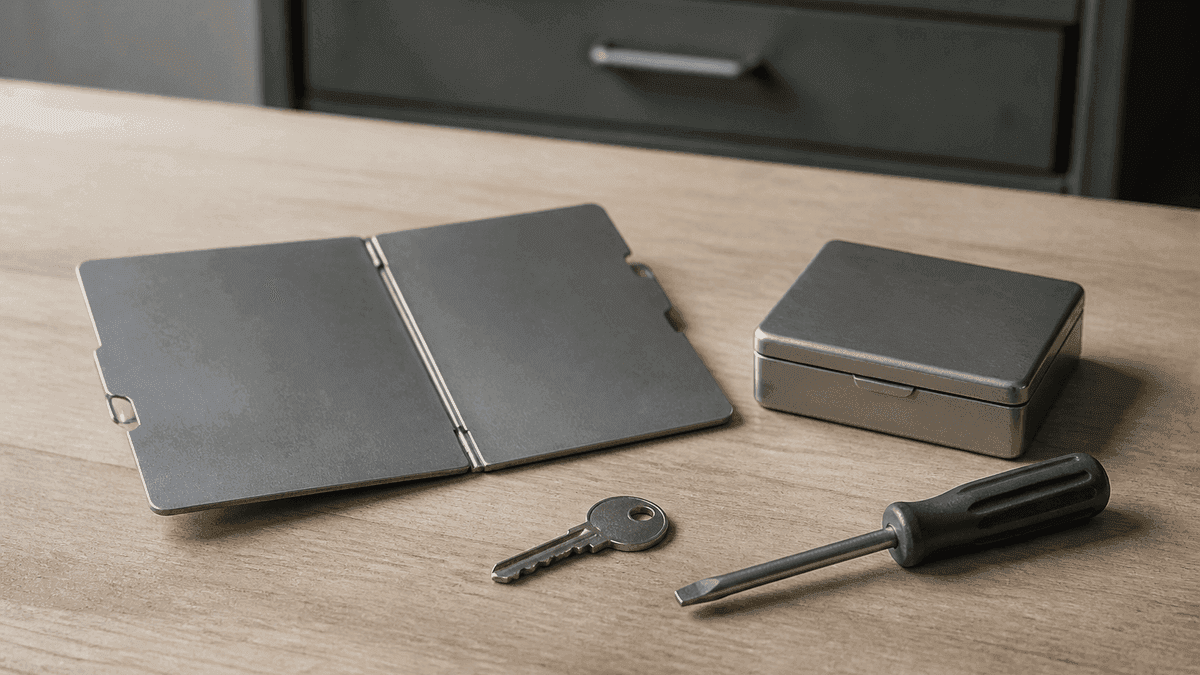
Never store your recovery phrase digitally, neither as a photo nor in a password manager that sits in a cloud. Keep it in two physically separate places so that water damage or a fire does not catch both copies; a stamped metal plate survives considerably more than paper. Test the restore once with a small amount before you move larger sums, because a backup that has never been checked is a hope and not a backup. And keep your tax records up to date alongside, because in an emergency they serve the same function as the backup itself.
If you are reorganising your custody anyway, our overview of software wallets compared will help with the question of which amounts belong on a device at all and which are better kept elsewhere.
Hardware wallet lost and tax: what you should take away
- Rescue first, calculate later. Check the recovery phrase, the passphrase and the derivation path before you treat the loss as final. A new device following the open BIP39 standard is enough for that; you will find suitable models in our hardware wallet comparison.
- Secure the records while you still can. Purchase receipts, transaction IDs, addresses and an export of your history are the only documents that allow any argument to be made later. A tax report from one of the tools in our comparison of crypto tax tools and portfolio trackers handles that continuously instead of once a year.
- Keep your tax expectations low. Without a disposal the tax authorities regularly refuse to recognise the loss, and once the one-year period has expired even a recognised loss becomes worthless. Reorganise your custody instead, for instance with the help of our software wallet comparison, and plan your tax around the positions you can still move.
(As of September 18, 2026. This article is not investment advice. Prices and fee structures change; check the terms with the provider before you buy.)
Transparency note: This article was produced with the assistance of artificial intelligence and reviewed by our editorial team before publication. All figures and claims were checked against the primary sources linked in the text. The feature image was generated with AI.
Related articles
- Writing Off a Total Crypto Loss: When the Tax Office Recognises Worthless Coins
- Bitcoin Lost in a Wallet Hack: What Tax Applies in Austria?
- Bitcoin Lost to a Scam: What Counts as a Tax Loss in Austria
- Crypto Loss Carryforward in Germany: What Happens to Old Losses Under the 2027 Tax Plan
- Offsetting Crypto Losses Against Share Gains: What Is Really Allowed in Germany
Which topics should we dive deeper into?
Select what genuinely interests you. Your picks feed directly into our editorial planning.
Crypto news that's actually worth your time.
Weekly. 60 seconds. Carefully curated by our editors: no hype, no promo flood, no spam.

September 26, 2026 7:29 PM

Coins Stolen in an Exchange Hack: What the German Tax Office Accepts as a Loss
After the attack on Bitget on September 24, a question the reports leave out arises for those affected in Germany: can a stolen balance be written off against tax? The answer hangs on a single term in the Income Tax Act, and it is decided by your records.
September 16, 2026 7:12 PM

Borrowing Against Bitcoin Instead of Selling: When German Tax Still Applies
Posting Bitcoin as collateral for a loan is not a sale in Germany, because section 39 of the Fiscal Code keeps the coins attributed to you for tax purposes. Tax arises only when the collateral is liquidated, and then the one thing that decides the bill is how long you held the coins beforehand.
August 16, 2026 6:14 AM
Crypto Credit Card Tax in Germany: Why Every Payment Is a Disposal
Paying with a crypto credit card means disposing of your coins for tax purposes. What that means for the holding period, the exemption threshold and your record-keeping duties, and which card design keeps the effort small.
August 24, 2026 10:16 AM

Crypto Tax: Why You Have to Secure Your Transaction History Before the Exchange Closes Your Account
Deadlines run out at several crypto exchanges by early September, after which accounts close and holdings are sold off by force. Anyone who does not export the trading record beforehand faces the tax return with no proof of acquisition date and purchase price.
August 24, 2026 4:22 AM

Selling XRP After a 53 Percent Week: What the Holding Period Costs
XRP trades at $1.51 after a weekly gain of a good 50 percent, yet your net proceeds are decided by the purchase date. This article works through the holding period, the exemption limit and FIFO at measured reference-date prices.
September 9, 2026 4:13 PM

Bitcoin 29 Percent Below Last Year: Which Crypto Losses You Can Still Use Before the One-Year Holding Period Expires
Nine out of ten major crypto assets trade lower today than exactly twelve months ago, Bitcoin alone by 29.2 percent. We measured the price series ourselves and show why the purchase date alone decides the tax value of your loss.
August 25, 2026 10:31 PM

Crypto Wallet Phishing by Letter: Why the QR Code From Your Postbox Wants Your Recovery Phrase
Letters carrying a QR code urge a supposedly urgent wallet update on grounds of quantum resistance and lead to a page that asks for the recovery phrase. The Federal Office for Cybersecurity reported the ploy on August 18, 2026.
August 11, 2026 1:32 PM
How to Store a Seed Phrase Safely: What Steel, a Passphrase and Multisig Do for Your Wallet Backup
The Coldcard case pushed the manufacturer question to the front, while barely touching on where the backup is kept. This guide places paper, steel, the passphrase and splitting methods against the BIP-39 and SLIP-0039 standards.
August 14, 2026 6:23 AM

Bitcoin Savings Plan and Tax: How the Holding Period, FIFO and the Exemption Limit Interact on Monthly Buys
Every savings plan instalment is a separate acquisition for tax purposes, with a holding period of its own. How the exemption limit, the order of disposal and record-keeping duties interact on monthly Bitcoin buys, with the sources from the statute and the Ministry of Finance circular.

September 10, 2026 9:13 AM
Trezor Hack Scare: That STM32 Entropy Email Is a Phishing Attack
Trezor users received a fake STM32 entropy warning sent from a real Trezor address. Here is what happened and what to do if you clicked.
August 20, 2026 4:24 PM

Bitcoin Across Multiple Wallets: How Austria Works Out the Acquisition Cost
Bitcoin spread across several wallets? How Austria works out the acquisition cost and the rolling average price for tax purposes.
August 21, 2026 7:26 PM

Restoring a Seed on Another Manufacturer's Wallet: What BIP39 Guarantees and What It Does Not
Your seed is yours; the device belongs to a company. This article explains what the open BIP39 standard actually guarantees, why a wrong derivation path makes a full wallet look empty, and the test that settles both in twenty minutes.
September 11, 2026 10:18 AM

Bitcoin Tax Audit: What Proof Austria Requires
Which bitcoin records can the Austrian tax office examine? Purchase dates, wallet transfers, acquisition costs and sale proceeds are what count.
September 23, 2026 4:12 AM
How to Set Up a Crypto Wallet: Securing Your Coins in Seven Steps
Your own crypto wallet is set up in twenty minutes, yet a single step decides everything that follows. This guide takes you through wallet type, recovery words and the test amount, and sets out what BaFin and the tax office expect.
September 17, 2026 4:14 PM

D'CENT App Wallet: How to Tell If Your Recovery Phrase Has to Move Now
Manufacturer IoTrust reports suspicious asset transfers in the D'CENT app wallet and asks users to move their holdings. One question decides the matter: has your recovery phrase ever been entered into the app?
September 17, 2026 7:12 PM

Gifting Bitcoin to Children: Allowance, Holding Period and the Tax Office Report
Transferring Bitcoin to your child hands over your holding period and your entry price along with the coins. This guide sets out what really applies in Germany on the allowance, the reporting deadline, representation and custody.
September 20, 2026 4:15 PM

Crypto Phishing After a Data Breach: The Warning Signs in a Fake Exchange Email
After every major data breach, the number of phishing emails sent in the name of crypto exchanges and wallet manufacturers rises. This article shows you how to recognise such a message, which data a reputable provider never requests by email, and what to do in the first hour after a click.
October 2, 2026 10:36 AM
Hot Wallet or Cold Wallet: the Private Key Decides How Safe Your Coins Are
Hot wallet or cold wallet: the difference rests solely on whether the private key is online. What separates the two forms, where the limits of hardware lie and why moving to your own device triggers no tax.
September 24, 2026 4:28 AM

Crypto Trading Bots and Tax: What Applies With Thousands of Trades a Year
A bot turns one investment decision into hundreds of disposals, and the tax office counts every single one. This guide explains the holding period, FIFO, the exemption limit and the record-keeping duties, and what to set up before the bot makes its first trade.
September 30, 2026 7:16 AM
Tangem Wallet: The Card Without a Seed Phrase vs the Classic Hardware Wallet
The Tangem Wallet secures crypto with two or three identical cards instead of 24 words. What the sets cost, what the EAL6+ chip delivers and why losing every card is final.
September 28, 2026 10:26 AM

Phantom Wallet and Solscan: What a Solana Transfer Really Costs and Where It Fails
A transfer on Solana costs 0.000005 SOL, a new token account ties up 0.00148844 SOL once — both values measured on-chain by us today. This practical guide shows how to set up Phantom, how to get there from the exchange, how to read Solscan and what applies for tax in Germany.
September 25, 2026 10:26 PM

Selling bitcoin privately: the tax in Germany and the records you need
A direct sale to a private individual falls under the same one-year rule as an exchange sale, but there is no tax report to go with it. This guide walks through the calculation, the 1,000 euro threshold and the records the tax office wants to see.

September 24, 2026 1:34 PM

Cardano Slides Below $0.24: What ADA Holders Should Check on Leverage, Liquidation and Holding Period
Cardano has given back its move above $0.25 and trades around seven percent below the high of the past 24 hours. What that means for leveraged positions, the holding period of your tranches and the buying route under MiCA.
September 4, 2026 10:17 AM

Cypher Shutdown on September 6: What Users Should Know Now the Withdrawal Deadline Has Passed
Recap as of September 27, 2026: Cypher had announced it would take its app, dApp and withdrawal window offline on September 6, 2026 and end the token protocol. This article describes the situation before the deadline, how the payout worked and what our own measurement showed at the time about what was left of the CYPR token.
September 7, 2026 7:26 PM
Stolen Keys Beat Code Flaws: Why the Private Key Is the Way In for 2026 Crypto Hacks
Compromised private keys overtook smart contract code flaws as the most common attack route for the first time in 2026. What sits behind the shift, and how to check your own setup for its single point of failure.
April 8, 2022 10:30 AM
Forgot Your Bitcoin Password? How to Recover Your Crypto, and When It Is Lost for Good
Bitcoin has no password reset. Whoever loses the private key or the recovery phrase cannot restore access. What you can still try, and how to keep your coins safe.

December 28, 2018 3:02 PM

How To Use a Trezor Wallet?
Trezor is a hardware wallet which gives exceptional security for managing Bitcoin and other cryptocurrencies private keys.It incorporates and deposits personal keys securely and enables users to carry trade without an Internet link. Trezor grants its users with numerous benefits, […]
More from CryptoTicker