
Offsetting Crypto Losses Against Share Gains: What Is Really Allowed in Germany
Crypto losses and share gains sit in separate loss buckets in Germany, and there is no offsetting between them. Where the line runs, why crypto derivatives are the exception, and how you can still use losses through carryback and carryforward.





Which topics should we dive deeper into?
Select what genuinely interests you. Your picks feed directly into our editorial planning.
Crypto news that's actually worth your time.
Weekly. 60 seconds. Carefully curated by our editors: no hype, no promo flood, no spam.
The short answer is no. Losses from selling Bitcoin or other cryptocurrencies cannot be offset against gains from shares in Germany. The two belong to different categories of income, and the Income Tax Act keeps their loss buckets strictly apart. There is an exception all the same, and it affects more investors than you might think: losses from crypto derivatives fall under the same provision as share gains and can be offset there. Which of your losses belongs in which bucket, the order in which the tax office does the sums, and what you can still steer before the year is out, is set out in this guide.
Why crypto losses and share gains end up in different categories of income
If you buy coins as private assets and sell them again within a year, that is a private disposal transaction under section 23 EStG. A private disposal transaction is the sale of an asset within the statutory speculation period, which for crypto-assets means within the one-year holding period. The gain is charged at your personal income tax rate, not at the flat-rate withholding tax.
Shares run through section 20 EStG instead, income from capital assets. There the separate tax rate of 25 percent applies, plus the solidarity surcharge and, where applicable, church tax, and the bank withholds the tax directly. Two provisions, two systems, two loss circles: that is the whole reason your crypto loss does not make the gain in your share portfolio any smaller.
A loss bucket is nothing more than a legally delimited offsetting circle within which gains and losses may be netted. Across the boundaries of these circles no offsetting takes place, not even when both transactions happened in the same year on the same account.
What you may actually offset losses from private disposal transactions against
Section 23(3) sentence 7 EStG puts it literally: losses from private disposal transactions may be deducted only up to the amount of the gain you have made in the same calendar year from other private disposal transactions. That is narrow, but not as narrow as many believe. This bucket holds more than coins.
- Gains from the sale of other crypto-assets within the holding period, from the large coin to the small altcoin
- Gains from swapping coin for coin, because for tax purposes a swap is a sale followed by a purchase
- Gains from the sale of physical precious metals such as gold bars or silver coins within a year
- Gains from the sale of art, collectibles, classic cars and similar movable assets within the period
- Gains from the sale of a property within the ten-year period, to the extent it was not owner-occupied
A crypto loss can therefore certainly neutralise the gain from your gold sale. It simply cannot touch the dividend and the capital gain from your share portfolio. The exemption threshold matters as well: if your total gain from private disposal transactions in the calendar year stays below €1,000, it remains tax free. An exemption threshold is not an allowance; it falls away entirely once it is exceeded, and the whole gain is then taxable.
Losses on coins you have held for longer than a year are worth nothing for tax. Once the holding period has expired the sale is tax free, and that exemption works in both directions. On September 7, 2026 we set out in our report on the Annual Tax Act that the one-year period survives the legislative process now under way.
A special case that often comes up in practice: coins that are effectively gone through an exchange insolvency, a hack or a token that has been switched off. Such a total loss is not a disposal, because nobody is buying anything. How to proceed in that case, and which evidence the tax office wants to see, is described in our guide to the crypto total loss.

The exception: crypto derivatives meet share gains in the capital bucket
Now it gets interesting for everyone who does not merely hold coins but trades with leverage. A derivative transaction is a contract whose value is derived from an underlying and which is directed at a cash settlement of the difference. Crypto CFDs, bitcoin futures and comparable derivatives fall under it. Gains and losses from them count under section 20(2) number 3 EStG as income from capital assets, which is to say in precisely the bucket where your share gains also sit.
Up to and including 2023 that helped little, because losses from derivative transactions could be offset only up to €20,000 a year and only against gains of the same kind. The legislature deleted this restriction in section 20(6) sentences 5 and 6 EStG without replacement in the Annual Tax Act 2024, retroactively for all open cases through the application rule in section 52(28) EStG. Since then, losses from derivative transactions can be offset against all income from capital assets: against gains from share sales, against dividends, against interest, against income from funds.
The reverse direction stays blocked. Losses from the sale of shares may still, under section 20(6) sentence 4 EStG, be offset only against gains from share sales. In concrete terms that means the loss on the bitcoin future may push down the share gain, while the loss on the share may not touch the future gain.
In practice a great deal depends on where you trade. If your provider runs a domestic securities account, it carries out the offsetting within the calendar year itself and withholds only the remaining capital gains tax. If you trade through a foreign broker, you have to declare the income yourself in Annex KAP. Which providers supply German tax data and which do not is shown in our crypto broker comparison. Incidentally, you need a loss certificate from your bank only if you want to carry losses from one securities account to another; it has to be applied for by December 15 of the current year.
 Crypto tax tools and portfolio trackers compared
Staking, lending and interest: section 22 number 3 EStG opens a third bucket
Anyone lending coins or putting them to work in a network often collects income that does not come from a sale at all. Staking rewards, lending interest and fees for providing liquidity are income from other services under section 22 number 3 EStG. An other service is any act or forbearance that triggers a consideration and is neither a disposal nor an investment of capital in the narrower sense.
This third circle is the narrowest of all. Losses from other services may be set only against income of the same kind, and here too there is an exemption threshold, which stands at €256 in the calendar year. A crypto loss from a sale therefore cannot neutralise a high staking yield, even though both happened in the same wallet. Anyone receiving rewards should value their accrual to the day, because the value at the moment of accrual is at the same time the later acquisition value for the holding period.
That leaves you with three offsetting circles, each obeying rules of its own: the circle of private disposal transactions with coins, gold and art; the capital bucket with shares, dividends and derivatives; and the circle of other services with staking and lending. Not one euro moves across these boundaries.
The order in which gains and losses are offset
Within an offsetting circle the tax office works through a fixed sequence, and it matters more than any individual optimisation, because it determines when money comes back.
- First the offsetting in the current year: all gains and losses of the same circle from the same calendar year are netted. Only if a minus remains does it go any further.
- Then the loss carryback: the remaining loss may be carried back one year, against the previous year's gain from the same circle. The legal basis is section 23(3) sentence 8 EStG in conjunction with section 10d EStG. The tax office amends the old assessment for this and refunds tax paid in excess.
- Finally the loss carryforward: whatever is then left moves into the following years without a time limit and waits there for the next gain from the same circle.
Whether the carryback is worthwhile depends on your tax rate. If your taxable income was high last year and is low this year, the carryback brings more than the carryforward. On application you can waive the carryback and have the full amount carried forward; this waiver is expressly open to you in the tax return.

Loss assessment: why the carryforward is worthless without a notice
A carried-forward loss exists for tax purposes only once the tax office has separately assessed it. The loss assessment under section 10d(4) EStG is a notice in its own right, which records the amount as at the year end in binding form and is automatically set against the next profitable year. You get it only if you declare the loss in the tax return for the loss year.
That is precisely where most people come unstuck. Anyone who had only losses in a year and therefore files no tax return gives the carryforward away. Check the assessment notice every year for the amount stated and file it with the documents you keep permanently. If the figure differs from your own calculation, you have one month to lodge an objection.
The figures behind it have to hold up. Under the Federal Ministry of Finance circular of March 6, 2025 on the income tax treatment of certain crypto-assets, extended record-keeping and cooperation obligations apply to you, particularly with foreign exchanges. The circular replaces the 2022 version and describes which documents the tax authorities expect. A clean annual report from a tax tool is therefore the basis of your return and no longer a convenience; which programs correctly reproduce German forms and FIFO is shown in our comparison of crypto tax tools.
 The best crypto brokers compared
Tax loss harvesting before the year end: what works within the speculation period
Tax loss harvesting means deliberately realising paper losses in order to net them against gains from the same offsetting circle. A paper loss is a pure price loss on paper; for tax it counts only once you sell or swap. Because the offsetting is tied to the calendar year, December is the month in which this is decided.
The process is manageable. You gather your transactions from all wallets and exchanges in one place, determine the cost base for each position using the FIFO method, check which positions are down and still within the holding period, and work out how much loss you need to bring your taxable gains from private disposal transactions to zero. FIFO means the coins bought first count as sold first; for crypto-assets held as private assets this method is what the tax authorities require, and there is no free choice of the most convenient acquisition.
You should know two limits. First, the exercise achieves nothing if you have no gains at all from the same circle in the same year; you then merely create a carryforward that may sit there for years. Second, a position close to the end of the holding period loses its future tax exemption through the sale. Anyone selling a position two weeks before its anniversary at a small loss trades a certain tax-free gain for a small tax effect.
Buying back the same day: wash sale risk and abuse of structuring
The question comes up immediately when the portfolio is down: can I sell, take the loss and buy back straight away? German tax law knows no wash sale rule that forbids this; such blocking periods exist in the United States, for example. In Germany the question is instead one of abuse of structuring, meaning a legal arrangement that serves only to save tax and cannot be explained in economic terms.
The Federal Fiscal Court has ruled on this for securities: anyone selling paper at a loss and buying it back the same day in the same kind and quantity, but at a different price, is not abusing structuring options within the meaning of section 42 of the Fiscal Code (judgment of August 25, 2009, case number IX R 60/07). The decision was handed down on private disposal transactions under section 23 EStG and is therefore readily transferable to crypto-assets. A supreme court decision specifically on coins does not yet exist.
For practical purposes that means the buyback is possible, but it starts a new holding period for the coins bought back, and the price can move between sale and repurchase. Document both transactions with a time stamp, quantity and price, so that in case of doubt it can be shown that two genuine market transactions took place.
Annex SO: where crypto losses go in the tax return
Private disposal transactions belong in Annex SO of your income tax return, in the section on disposals of other assets. There you enter the sale proceeds, the acquisition costs and the income-related expenses for each transaction; the minus follows from the calculation, and there is no separate field for the loss. Gains from derivative transactions and shares run through Annex KAP instead, while staking and lending income goes in Annex SO in the section on other services.
Anyone with many trades submits the individual schedule as an attachment to the return and refers to it in the form. That the tax authorities now also receive the data from elsewhere is the second reason to be precise: since January 1, 2026, crypto service providers have been reporting master data and aggregated transactions to the tax authorities, and as we reported on September 13, 2026, it is gross amounts and not gains that are transmitted. A return that departs from these reports stands out.
Five pitfalls that cost you the loss offset
- No tax return is filed in a pure loss year. No return means no assessment notice, and no notice means no carryforward.
- The loss is entered in the wrong bucket. A CFD loss in Annex SO is just as wrong as a coin loss in Annex KAP.
- Coin-for-coin swaps are overlooked. Every swap is a disposal followed by an acquisition for tax purposes, even without a euro reaching the account.
- The holding period is tracked per wallet instead of per acquisition. What counts is the individual entry under FIFO, not the place where the coins sit.
- Fees are left out. Trading and network fees increase the acquisition costs or reduce the proceeds, and thereby enlarge the deductible loss.
None of these points is spectacular. Together, though, they decide whether your tax burden ends up falling by the amount the law grants you, or whether part of your losses goes unused.
Offsetting crypto losses: what to take away
- Sort your positions by offsetting circle before you sell anything: coins and precious metals into the bucket for private disposal transactions, CFDs and futures into capital income, staking and lending into other services. Where your provider supplies German tax data and where you have to declare it yourself is shown in the broker comparison.
- Pull a complete transaction report across all wallets and exchanges before the turn of the year and check which paper losses are still within the holding period. You will find a tool that reproduces FIFO and the German forms in the comparison of tax tools.
- Declare even a pure loss year in your tax return and check the notice on the loss assessment. When you go on to plan gains, the same tax tool comparison will help you set the carried-forward amount off cleanly.
(As of September 19, 2026. This article is not investment advice. Prices and fee structures change; check the terms with the provider before you buy. This text does not replace tax advice in an individual case.)
Transparency note: This article was produced with the assistance of artificial intelligence and reviewed by our editorial team before publication. All figures and claims were checked against the primary sources linked in the text. The feature image was generated with AI.
Related articles
- Bitcoin 29 Percent Below Last Year: Which Crypto Losses You Can Still Use Before the One-Year Holding Period Expires
- Crypto Loss Carryforward in Germany: What Happens to Old Losses Under the 2027 Tax Plan
- Selling bitcoin privately: the tax in Germany and the records you need
- Selling Bitcoin at a Loss and Buying It Straight Back: What That Does to Your Holding Period
- Selling Bitcoin at a Loss: Loss Offsetting in Austria
Which topics should we dive deeper into?
Select what genuinely interests you. Your picks feed directly into our editorial planning.
Crypto news that's actually worth your time.
Weekly. 60 seconds. Carefully curated by our editors: no hype, no promo flood, no spam.

September 16, 2026 7:12 PM

Borrowing Against Bitcoin Instead of Selling: When German Tax Still Applies
Posting Bitcoin as collateral for a loan is not a sale in Germany, because section 39 of the Fiscal Code keeps the coins attributed to you for tax purposes. Tax arises only when the collateral is liquidated, and then the one thing that decides the bill is how long you held the coins beforehand.
August 12, 2026 9:12 AM

Bitcoin Losses and Dividends in Austria: How the Tax Offset Works
Can a Bitcoin loss be offset against dividends? This is how loss offsetting works in Austria. It also shows when a tax return is needed for it.
August 22, 2026 4:47 PM

Offsetting Bitcoin Losses Against Stock Gains in Austria
Offset bitcoin losses against gains on shares? Austria allows it in principle, but only under certain conditions and usually via the tax return.
August 21, 2026 1:42 PM

Writing Off a Total Crypto Loss: When the Tax Office Recognises Worthless Coins
A token that has collapsed only reduces your tax once you actually dispose of it. What applies to delisting, exchange insolvency and worthless holdings under Section 23 of the German Income Tax Act, and how you offset losses.
August 31, 2026 10:30 PM

Taxing Crypto Lending: Your Personal Rate Instead of Withholding Tax, and the Right Federal Fiscal Court Case Number
According to the only tax court ruling so far, income from crypto lending falls under Section 22(3) of the German Income Tax Act and therefore under your personal tax rate. The appeal is pending at the Federal Fiscal Court under VIII R 22/25, not under the case number given in many professional articles.
September 8, 2026 10:21 PM

Crypto Holding Period and Grandfathering: Why December 31, 2026 Becomes the Cut-Off in Germany's Draft Bill
A ministerial draft bill from Germany's finance ministry names a cut-off date for the first time: crypto assets acquired after December 31, 2026 are to fall under the flat-rate withholding tax. What that means for legacy holdings, running savings plans and staking income, and why nothing has been decided yet.
September 7, 2026 7:22 AM

German Crypto Holding Period Stays: The Income Tax Reform 2027 Leaves Section 23 Untouched
On September 2, 2026 the German federal cabinet adopted the draft of an Income Tax Reform Act 2027, and crypto assets do not appear in it. The one-year holding period under Section 23 of the Income Tax Act therefore continues to apply unchanged.
August 16, 2026 6:14 AM
Crypto Credit Card Tax in Germany: Why Every Payment Is a Disposal
Paying with a crypto credit card means disposing of your coins for tax purposes. What that means for the holding period, the exemption threshold and your record-keeping duties, and which card design keeps the effort small.
September 24, 2026 1:13 AM

Solana DEX Trades Overtake the NYSE: What to Check on Swaps, Tax and Oversight
Solana's decentralised exchanges settled roughly 208 million trades in a single week and overtook the New York Stock Exchange for the first time. The figure is real, but it measures something other than the comparison suggests, and for German investors it carries tax duties that no provider takes on.
September 8, 2026 1:19 AM

Germany's Crypto Holding Period: What Happens Now Signing for Petition 201716 Closed on September 15
Recap as of September 27, 2026: the signature period for German parliamentary petition 201716, which asks for the one-year crypto holding period to be preserved, closed on September 15, 2026. This article explains what ended that day, how the petitions committee proceeds and why no investor has to sell because of it.
September 26, 2026 1:19 AM

Germany’s Crypto Holding Period Is Wobbling: What to Check Before December 31
A CDU member of the Bundestag makes it plain: the coalition agreement does not guarantee that the one-year holding period for crypto assets will survive. What that means for purchases made before the planned cutoff date of December 31, 2026.
August 21, 2026 4:24 AM

Forced Sale on a Crypto Exchange: Which Moment Counts for the Holding Period and What You Must Document
At Luno, Kraken and Valour the deadlines are running out, after which the provider realises the remaining holding itself. For tax purposes that is a disposal, and what governs it is the exchange's timestamp.
August 11, 2026 9:13 PM

Germany's Crypto Holding Period Faces Abolition: What Petition 201716 and the Cabinet Decision Mean for Your Tax
Petition 201716 in the German Bundestag calls for the one-year holding period for crypto assets to be kept and has already passed the quorum of 30,000 signatures. This article sets out what the cabinet decision of July 6, 2026 provides for, how much of it is binding and which records you should be pulling together now.

September 27, 2026 1:17 PM
Dogecoin Price: What to Check on Holding Period and Custody Before the Year End
The Dogecoin price stands at $0.0977 on September 27, 2026 and has barely moved in a day. That calm is exactly the moment to work through the holding period, the reporting duty from 2026 and custody without any time pressure.
September 3, 2026 10:21 AM

Bitcoin Lost in a Wallet Hack: What Tax Applies in Austria?
Bitcoin lost to hackers? In Austria, the theft of privately held coins generally does not create a capital loss you can use for tax. Only a later payout can change that.
August 18, 2026 7:13 AM

Bitcoin Tax Reporting in Austria 2026: What Applies
Bitcoin tax reporting in Austria: which data investors can request from crypto exchanges in 2026, and when the report matters for the tax return.
August 27, 2026 10:16 AM

Bitcoin Tax Return in Austria: When You Must File
Even with a crypto exchange, a tax return can still be necessary in Austria. Foreign platforms, missing capital gains tax withholding and cross-provider losses are the typical triggers.
September 9, 2026 7:11 PM
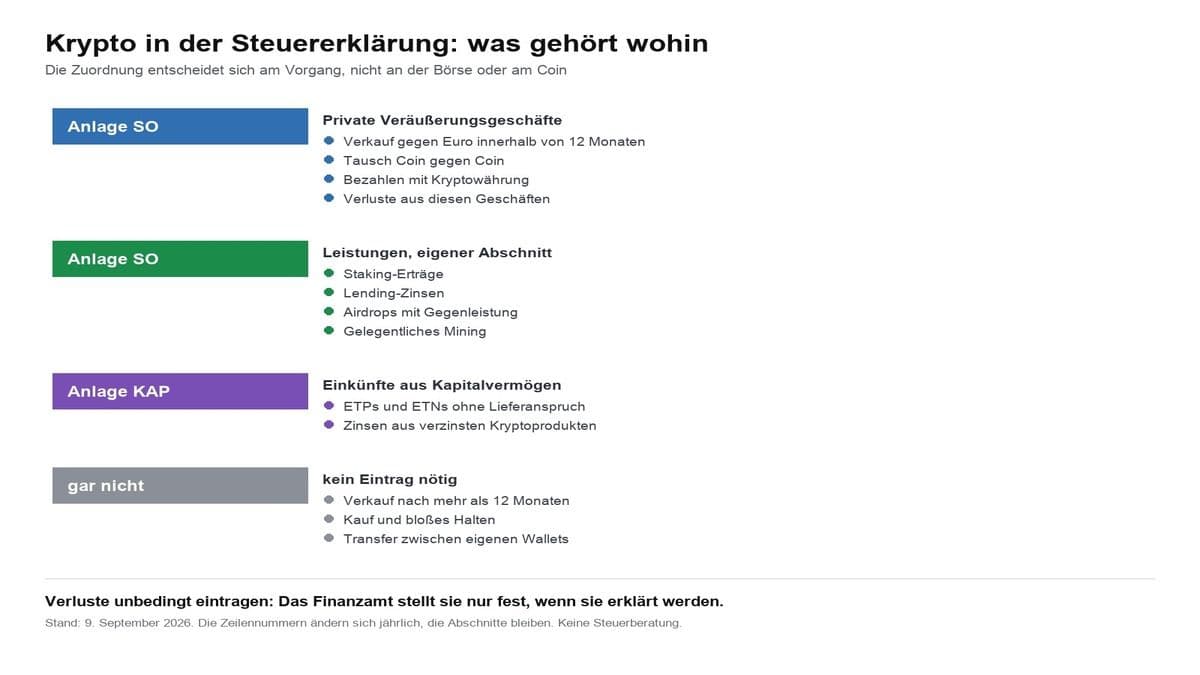
Crypto in Your Tax Return: Where Gains, Losses and Staking Go
Crypto belongs in Annex SO, but in two different sections. When you have to declare at all, where gains, losses and staking income go, and why line numbers from older guides lead you astray.
September 26, 2026 7:29 PM

Coins Stolen in an Exchange Hack: What the German Tax Office Accepts as a Loss
After the attack on Bitget on September 24, a question the reports leave out arises for those affected in Germany: can a stolen balance be written off against tax? The answer hangs on a single term in the Income Tax Act, and it is decided by your records.
September 17, 2026 7:12 PM

Gifting Bitcoin to Children: Allowance, Holding Period and the Tax Office Report
Transferring Bitcoin to your child hands over your holding period and your entry price along with the coins. This guide sets out what really applies in Germany on the allowance, the reporting deadline, representation and custody.
August 24, 2026 4:22 AM

Selling XRP After a 53 Percent Week: What the Holding Period Costs
XRP trades at $1.51 after a weekly gain of a good 50 percent, yet your net proceeds are decided by the purchase date. This article works through the holding period, the exemption limit and FIFO at measured reference-date prices.
September 22, 2026 10:13 AM

Circle Lends Against Bitcoin via cirBTC: Why the Wrapper Can Cost You the German Holding Period
Circle launched loans against deposited bitcoin on September 21, 2026. In Germany, the detour through the cirBTC token is very likely a swap, and a swap restarts your one-year holding period.
August 13, 2026 6:18 AM

Revolut Delists USDT: Forced Conversion on August 31, 2026 Counts as a Sale
Revolut is taking USDT off the table on August 31, 2026: purchases have already stopped, deposits are blocked, and anyone who fails to act before the deadline faces an automatic conversion that counts as a sale for tax purposes. This article explains the deadlines, the tax treatment under section 23 of the German Income Tax Act and what you can do now.
September 9, 2026 4:22 PM
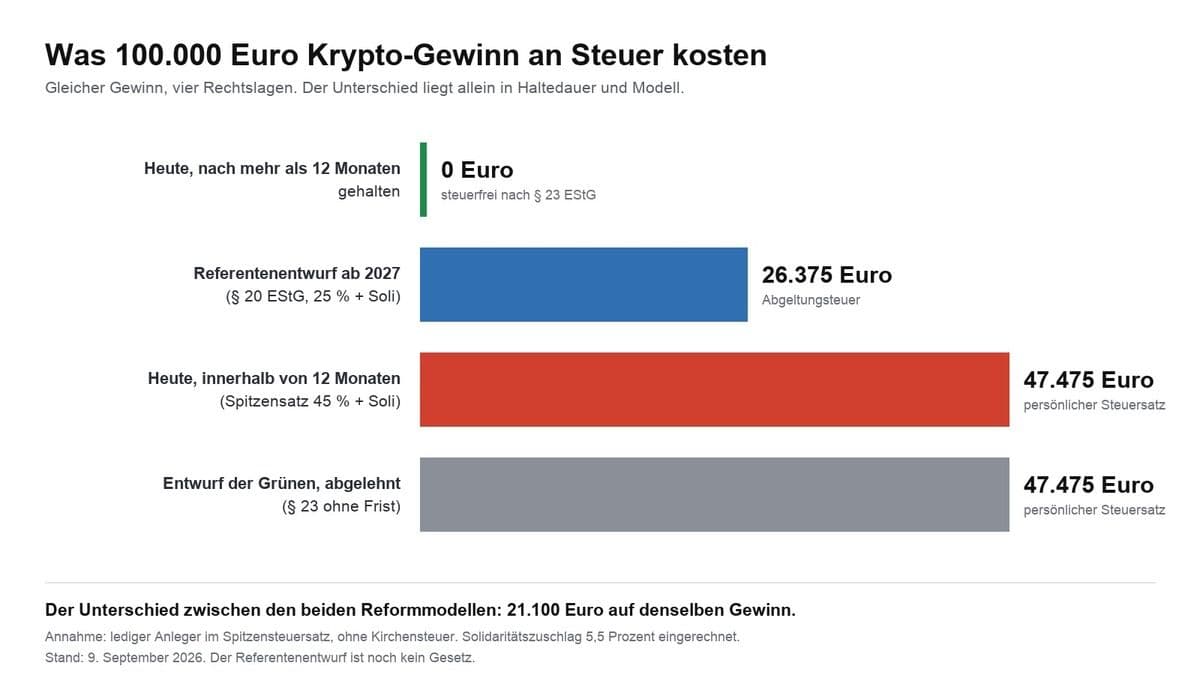
Crypto Tax in Germany: What Applies in 2026 and What Is Set to Change in 2027
Crypto gains are tax-free after twelve months; before that your personal tax rate of up to 45 percent applies. What triggers tax, how the holding period is calculated, what happens with staking and losses, and what the draft bill would change from 2027.
September 24, 2026 4:28 AM

Crypto Trading Bots and Tax: What Applies With Thousands of Trades a Year
A bot turns one investment decision into hundreds of disposals, and the tax office counts every single one. This guide explains the holding period, FIFO, the exemption limit and the record-keeping duties, and what to set up before the bot makes its first trade.
August 27, 2026 10:32 AM

A Securities Account at the Crypto Exchange: Why Capital Gains Tax and Anlage KAP Are on You
On August 18, 2026 Kraken opened trading in more than 7,000 US stocks to customers in the European Economic Area, provided by a Cypriot investment firm. That puts the securities account abroad, and German capital gains tax, loss offsetting and the saver’s allowance now run through your own tax return.
September 9, 2026 1:15 AM

Germany's Crypto Tax: 160 Million Euros for a 555-Billion Budget
The German finance ministry's draft bill puts a figure on the crypto tax for the first time: 160 million euros from 2028. What that number means in the 2027 federal budget, how 11.4 billion became 160 million, and what investors can read from it.
More from CryptoTicker