
Crypto Loss Carryforward in Germany: What Happens to Old Losses Under the 2027 Tax Plan
Losses from crypto sales land in a ring-fenced pot and can only be set against gains of the same kind. The draft bill for 2027 moves future gains into a different pot, and we show you what that means for your assessed carryforward and what your tax notice should say.





Which topics should we dive deeper into?
Select what genuinely interests you. Your picks feed directly into our editorial planning.
Crypto news that's actually worth your time.
Weekly. 60 seconds. Carefully curated by our editors: no hype, no promo flood, no spam.
A crypto loss carryforward is the part of your losses from crypto sales that the tax office has formally assessed at year-end because it could not be offset in the same year. It does not sit in your account or in your app but in a notice of its own, and it can only be set against one very particular kind of gain. If you have realised losses during the current year, you should therefore keep two things apart: how much loss arose, and what that loss may actually be set against later.
The question is gaining weight right now. In September 2026 the Federal Ministry of Finance circulated a draft bill that would assign gains from crypto assets to income from capital assets from 2027 onwards and tax them at a flat 25 percent. Existing holdings are to remain under the current system. It is precisely at that seam that the fate of an assessed loss carryforward is decided: whether it still finds a counterpart. The market provides the occasion: Bitcoin traded at 75,887 US dollars on September 16, 2026, roughly 1.7 percent below the previous day (source: CoinGecko).
Crypto loss carryforward: what the term in your tax notice means
In Germany, gains and losses from selling crypto assets within a year of purchase fall under private disposal transactions in section 23 of the Income Tax Act. In its judgment of February 14, 2023 (case number IX R 3/22), the Federal Fiscal Court confirmed that Bitcoin, Ether and Monero are other economic assets within the meaning of that provision. The same logic therefore applies to them as to gold, collectibles or foreign currency balances.
A private disposal transaction is a sale in which no more than one year lies between acquisition and disposal. A loss carryforward is the amount of unrelieved negative income that the tax office assesses separately as at December 31 of a year so that it can still be used in later years. Together, the two produce the situation at issue here: you can hold a loss that exists for tax purposes without it doing anything for you the following year.
Why the carryforward does not arise automatically
The assessment does not happen by itself. It requires the losses to have been declared in your tax return, as a rule in Annex SO. Anyone who did not report their sales at all, because the bottom line was negative anyway, frequently has no assessed carryforward either. If you never declared your sales, you can make that good through Annex SO for the year in question, provided the year is still open under procedural rules.
Section 23 ITA: why crypto losses land in a ring-fenced pot
The decisive sentence sits in section 23(3) sentence 7 of the Income Tax Act and is short: losses may only be offset up to the amount of the gain the taxpayer realised in the same calendar year from private disposal transactions. In the same sentence, the statute explicitly rules out the general loss deduction under section 10d. Sentence 8 then opens a narrow door: the losses reduce the income you realise from private disposal transactions in the immediately preceding or in subsequent assessment periods.
In practice that means a crypto loss from 2026 may be carried back against a crypto gain from 2025 or carried forward against gains from 2027 and later, as long as those gains are also private disposal transactions. It does not run against your salary, your rental income or your dividends. This is not an innovation of crypto taxation but the basic mechanics of this category of income, and they have applied unchanged for decades.
The second pot sits in section 20(6) of the Income Tax Act and works as a mirror image. Losses from capital assets may not be offset against income from other categories; they only reduce income you realise from capital assets in subsequent assessment periods. Within that pot there are narrower compartments still, such as the familiar special pot for share disposals. There is no connection between the section 23 pot and the section 20 pot.

Checking your tax notice: where the remaining loss carryforward is shown
The assessment follows section 10d(4) of the Income Tax Act: the loss carryforward remaining at the end of an assessment period is to be assessed separately, by the tax office responsible for the taxation. In practice you receive a notice of its own for this, headed with the separate assessment of the remaining loss carryforward, or a corresponding section in your income tax notice.
What to look for when you check:
- Is an amount shown for losses from private disposal transactions, and does it match your own calculation?
- Is the assessment year the year in which you realised the losses?
- Is there a second assessment alongside it for losses from capital assets, from shares or certificates for instance? These two amounts do not belong together and must not be added up.
- Has the tax office cut amounts or applied different figures? Then the one-month objection period runs from notification.
Anyone who would rather not assemble the figures by hand usually works with a portfolio or tax tool that sorts disposals by holding period and maps the acquisition sequence. Which programs cover the German rules and what they cost is set out in our comparison of crypto tax tools and portfolio trackers. What matters in every case is reconciling with the notice: the tool calculates, the tax office assesses.
The 1,000 euro exemption limit: how it changes loss relief in the current year
Section 23(3) sentence 5 of the Income Tax Act provides that gains remain tax-free if the total gain realised from private disposal transactions in the calendar year came to less than 1,000 euros. The figure used to be 600 euros; the higher threshold has applied since the 2024 assessment period. It is an exemption limit and not an allowance: exceed it and the entire gain is taxable, not merely the excess.
For the loss side, what matters is that the exemption limit applies to the total gain for the year. If you realise gains and losses in the same year, you offset within the year first; only the result is measured against the threshold. A small gain pushed below the threshold by losses therefore stays tax-free, but it consumes the losses used. That is the point at which realising a loss shortly before year-end becomes an arithmetic exercise: the loss is spent and the tax saving is zero, because no tax would have fallen due on the gain in any case.
Flat withholding tax from 2027: what the draft bill proposes for crypto assets
The Federal Ministry of Finance's draft bill from September 2026 proposes to assign gains from crypto assets to income from capital assets irrespective of the holding period and to charge them at the special rate of 25 percent. Together with the solidarity surcharge that works out at 26.375 percent, with church tax on top where applicable. Income from lending and staking would also be treated as investment income under the draft.
A draft bill is a working document of the ministry. It passes through coordination within the federal government, then goes to the Bundesrat as a government bill, and only after that to the Bundestag. At the time of writing, no bill on this question is before the Bundestag. Everything set out here about the period after December 31, 2026, therefore describes a planned position and not the law in force.
What matters in the draft for holders of losses
There are two points. First, the assignment to section 20 ITA moves future gains into the capital assets pot, where an old section 23 carryforward achieves nothing. Second, under the draft the switch would apply only to crypto assets acquired after the cut-off date. Together, those two points determine how large your future counterpart still is.
Grandfathering at December 31, 2026: which coins stay in which system
Under the draft, the new rules would cover only crypto assets acquired after December 31, 2026. Whatever you bought before that would remain in the current system with its one-year holding period, and thus within the scope of section 23 ITA. That produces a situation many investors underestimate: from 2027, two groups of coins could sit side by side in your portfolio, treated under different tax rules, with their gains landing in different offset pots.
For the allocation, what counts is the acquisition date of the individual unit, not the date you opened the account. Anyone buying regularly, through a savings plan for example, accumulates tranches from both worlds across the turn of the year. How the cut-off date affects new purchases is covered in detail in our article on the holding period and grandfathering.

The bottleneck for the carryforward: when the offsetting pool shrinks
Here lies the actual finding, and it is milder than the widespread shorthand suggests. An assessed loss carryforward from private disposal transactions does not expire on a cut-off date. It has no time limit and remains in place until matching gains arise. What would change under the draft is not the shelf life of the carryforward but the pool of gains it can run against.
That pool shrinks more slowly than it first appears. Three sources remain:
- Existing holdings. Coins acquired before the cut-off date would stay in the old system. A sale within the one-year window still produces a gain under section 23 ITA, against which the carryforward runs.
- Other economic assets. Section 23 ITA covers more than crypto assets. Gains from selling physical gold, collectibles or foreign currency balances within the one-year window belong in the same pot.
- Real property. Gains from disposing of real estate within the ten-year window also fall under section 23 ITA.
Anyone who holds crypto assets exclusively, only buys more after the cut-off date and leaves existing holdings untouched beyond the one-year window does genuinely have a problem: hardly any gains then arise that fit the old pot, and the carryforward sits unused. It is not an expiry, it is an idle run.
Why realising gains for their own sake rarely pays
From this situation people readily derive the advice to realise gains in 2026 in order to use up the carryforward. The thought is arithmetically comprehensible and economically risky. A sale made purely for tax reasons changes your position in the market, costs fees and spread, and exposes you to the risk of having to buy back at a higher price. Whether it pays depends on your personal tax rate, the size of the carryforward and your provider's trading costs. The fee side can be checked beforehand, for instance through our comparison of the best crypto exchanges.
Claiming a loss assessment retrospectively: which deadlines apply to past years
Many investors never declared their losses from the years 2022 to 2025, because there was nothing to pay anyway. That carryforward then does not exist for tax purposes. Whether it can be assessed retrospectively depends on whether an assessment is still possible for the year in question. Section 10d(4) sentence 4 ITA ties the assessment to the tax bases of the income tax notice, and whether a notice can still be amended is governed by the Fiscal Code.
Put simply: as long as an income tax return can still be filed for a year, or a notice is still procedurally open, an assessment comes into consideration. Where the notice has become final and can no longer be amended, it is generally ruled out. This classification turns on the individual case, particularly on provisional clauses and on whether there was an obligation to file. It belongs in the hands of a tax adviser, and this article does not replace that.
One point matters on the evidence side: without solid records of the acquisition date, acquisition cost and disposal price, making a loss plausible becomes difficult. With worthless or delisted tokens there is the further problem that, as a rule, no loss arises under section 23 ITA without a disposal event. A token that has merely fallen in value and is still sitting in your wallet produces nothing at all for tax purposes.

Lending and staking: why this income sits in a third pot
Income from lending and staking is not a disposal gain. Under the law in force it is regularly captured as other income under section 22 no. 3 ITA and charged at your personal tax rate. On January 26, 2026, the Cologne Tax Court ruled that income from Bitcoin lending is not subject to the flat withholding tax but to the often higher personal rate; the classification is therefore not conclusively settled, and objections against such notices are a topic we took up in our article on the taxation of lending.
For your loss carryforward the consequence is this: a loss from a crypto sale does not reduce your lending income. That income sits in a different category. Should the draft bill become law in this form, lending and staking would move into investment income in future, leaving them just as far out of reach for the old carryforward as future disposal gains from new purchases.
Three figures you need for your own calculation
Before you decide anything, you need three values, documented rather than estimated:
- The size of your assessed carryforward from the most recent assessment notice, split between private disposal transactions and capital assets.
- The extent of your existing holdings, meaning which units were acquired before December 31, 2026, and how large the unrealised gains on them are.
- The cost of realising at your provider, meaning the trading fee and spread on the amount you would move.
Without these three figures, any statement about whether a sale before the turn of the year is worthwhile is guesswork. With them it becomes a calculation that you or your tax adviser can set out in a few minutes.
Checking your crypto loss carryforward: what to take away
- Dig out the notice and check whether a carryforward has been assessed at all. Make sure that losses from private disposal transactions and losses from capital assets are shown separately. If you lack the basis for the reconciliation, put your records in order first; the programs for that are in our comparison of crypto tax tools and portfolio trackers.
- Sort your holdings by acquisition date. As long as the draft has not been passed, nothing changes; if the decision comes, December 31, 2026, determines which unit sits in which system. Savings plan investors should look especially closely, because there every execution is a tranche of its own with its own acquisition date; which providers document executions cleanly is set out in our comparison of Bitcoin savings plans.
- Weigh the costs before every realisation. Fees and spread can eat up the tax advantage, especially on smaller amounts; you will find providers' terms in our comparison of the best crypto exchanges. A tax-driven transaction that does economic damage is a poor trade.
The sober summary: your loss carryforward does not run out. It only becomes worthless if you never again realise a gain that fits the same drawer. Whether that happens depends less on the legislator than on your own conduct over the coming years.
(As of September 16, 2026. This article is not investment advice. Prices and fee structures change; check the terms with the provider before you buy. It is not tax advice either: legislative proposals change, so have individual tax questions clarified by a tax adviser.)
Sources: section 23 ITA and section 10d ITA as published on gesetze-im-internet.de.
Transparency note: This article was produced with the assistance of artificial intelligence and reviewed by our editorial team before publication. All figures and claims were checked against the primary sources linked in the text. The feature image was generated with AI.
Related articles
- Bitcoin 29 Percent Below Last Year: Which Crypto Losses You Can Still Use Before the One-Year Holding Period Expires
- Offsetting Crypto Losses Against Share Gains: What Is Really Allowed in Germany
- Germany’s Crypto Holding Period Is Wobbling: What to Check Before December 31
- Crypto Holding Period and Grandfathering: Why December 31, 2026 Becomes the Cut-Off in Germany's Draft Bill
- Borrowing Against Bitcoin Instead of Selling: When German Tax Still Applies
Which topics should we dive deeper into?
Select what genuinely interests you. Your picks feed directly into our editorial planning.
Crypto news that's actually worth your time.
Weekly. 60 seconds. Carefully curated by our editors: no hype, no promo flood, no spam.

September 24, 2026 10:19 PM

Bitcoin for Retirement: What Applies from 2027 and What You Decide Now
Bitcoin is not permitted in any state-subsidised retirement product, including the new retirement savings account from 2027. Anyone who still wants to use crypto assets for their own pension goes through private assets, and there a cutoff date at the end of 2026 is shifting the tax rules right now.
September 25, 2026 10:26 PM

Selling bitcoin privately: the tax in Germany and the records you need
A direct sale to a private individual falls under the same one-year rule as an exchange sale, but there is no tax report to go with it. This guide walks through the calculation, the 1,000 euro threshold and the records the tax office wants to see.
September 8, 2026 1:19 AM

Germany's Crypto Holding Period: What Happens Now Signing for Petition 201716 Closed on September 15
Recap as of September 27, 2026: the signature period for German parliamentary petition 201716, which asks for the one-year crypto holding period to be preserved, closed on September 15, 2026. This article explains what ended that day, how the petitions committee proceeds and why no investor has to sell because of it.
September 17, 2026 10:22 PM

Selling Bitcoin at a Loss and Buying It Straight Back: What That Does to Your Holding Period
Germany has no wash sale rule: the loss stays deductible even if you buy back immediately. The buyback, however, restarts the one-year period for every new unit.
September 7, 2026 7:22 AM

German Crypto Holding Period Stays: The Income Tax Reform 2027 Leaves Section 23 Untouched
On September 2, 2026 the German federal cabinet adopted the draft of an Income Tax Reform Act 2027, and crypto assets do not appear in it. The one-year holding period under Section 23 of the Income Tax Act therefore continues to apply unchanged.
August 24, 2026 4:22 AM

Selling XRP After a 53 Percent Week: What the Holding Period Costs
XRP trades at $1.51 after a weekly gain of a good 50 percent, yet your net proceeds are decided by the purchase date. This article works through the holding period, the exemption limit and FIFO at measured reference-date prices.
September 9, 2026 1:15 AM

Germany's Crypto Tax: 160 Million Euros for a 555-Billion Budget
The German finance ministry's draft bill puts a figure on the crypto tax for the first time: 160 million euros from 2028. What that number means in the 2027 federal budget, how 11.4 billion became 160 million, and what investors can read from it.
August 21, 2026 1:42 PM

Writing Off a Total Crypto Loss: When the Tax Office Recognises Worthless Coins
A token that has collapsed only reduces your tax once you actually dispose of it. What applies to delisting, exchange insolvency and worthless holdings under Section 23 of the German Income Tax Act, and how you offset losses.
August 21, 2026 4:24 AM

Forced Sale on a Crypto Exchange: Which Moment Counts for the Holding Period and What You Must Document
At Luno, Kraken and Valour the deadlines are running out, after which the provider realises the remaining holding itself. For tax purposes that is a disposal, and what governs it is the exchange's timestamp.
September 24, 2026 1:13 AM

Solana DEX Trades Overtake the NYSE: What to Check on Swaps, Tax and Oversight
Solana's decentralised exchanges settled roughly 208 million trades in a single week and overtook the New York Stock Exchange for the first time. The figure is real, but it measures something other than the comparison suggests, and for German investors it carries tax duties that no provider takes on.
August 26, 2026 10:25 PM

Selling Bitcoin at a Loss: Loss Offsetting in Austria
Sold Bitcoin at a loss? Austria allows the loss to be offset against certain investment income. When loss offsetting is possible and which limits apply.
September 24, 2026 4:28 AM

Crypto Trading Bots and Tax: What Applies With Thousands of Trades a Year
A bot turns one investment decision into hundreds of disposals, and the tax office counts every single one. This guide explains the holding period, FIFO, the exemption limit and the record-keeping duties, and what to set up before the bot makes its first trade.
August 22, 2026 4:47 PM

Offsetting Bitcoin Losses Against Stock Gains in Austria
Offset bitcoin losses against gains on shares? Austria allows it in principle, but only under certain conditions and usually via the tax return.

September 27, 2026 1:17 PM
Dogecoin Price: What to Check on Holding Period and Custody Before the Year End
The Dogecoin price stands at $0.0977 on September 27, 2026 and has barely moved in a day. That calm is exactly the moment to work through the holding period, the reporting duty from 2026 and custody without any time pressure.
August 27, 2026 10:16 AM
Bitcoin Tax Return in Austria: When You Must File
Even with a crypto exchange, a tax return can still be necessary in Austria. Foreign platforms, missing capital gains tax withholding and cross-provider losses are the typical triggers.
October 1, 2026 7:36 PM

Crypto tax and withholding at source from 2028: what to check now
The German Federal Ministry of Finance’s draft bill goes to cabinet on October 14, 2026. The underexposed part of it is the deduction of tax from 2028: which providers are to withhold the tax on investment income, why self-custody and foreign platforms stay exempt from it, and what you should document by December 31.
September 18, 2026 10:13 AM

Bitcoin and the German Exit Tax: What Applies When You Move Abroad
Anyone emigrating with Bitcoin expects an exit tax on unrealised gains and finds nothing of the sort in the statute. Where the real risks sit is decided at four points: residence, the holding period, the legal form of your investment, and automatic reporting from 2026.
October 1, 2026 10:44 AM

German crypto tax reform: without a receipt, half the sale price is taxed
The Federal Ministry of Finance's draft bill goes to the cabinet on October 14. Anyone who cannot prove their acquisition cost pays tax on 50 percent of the sale proceeds under the substitute assessment.
September 9, 2026 4:22 PM
Crypto Tax in Germany: What Applies in 2026 and What Is Set to Change in 2027
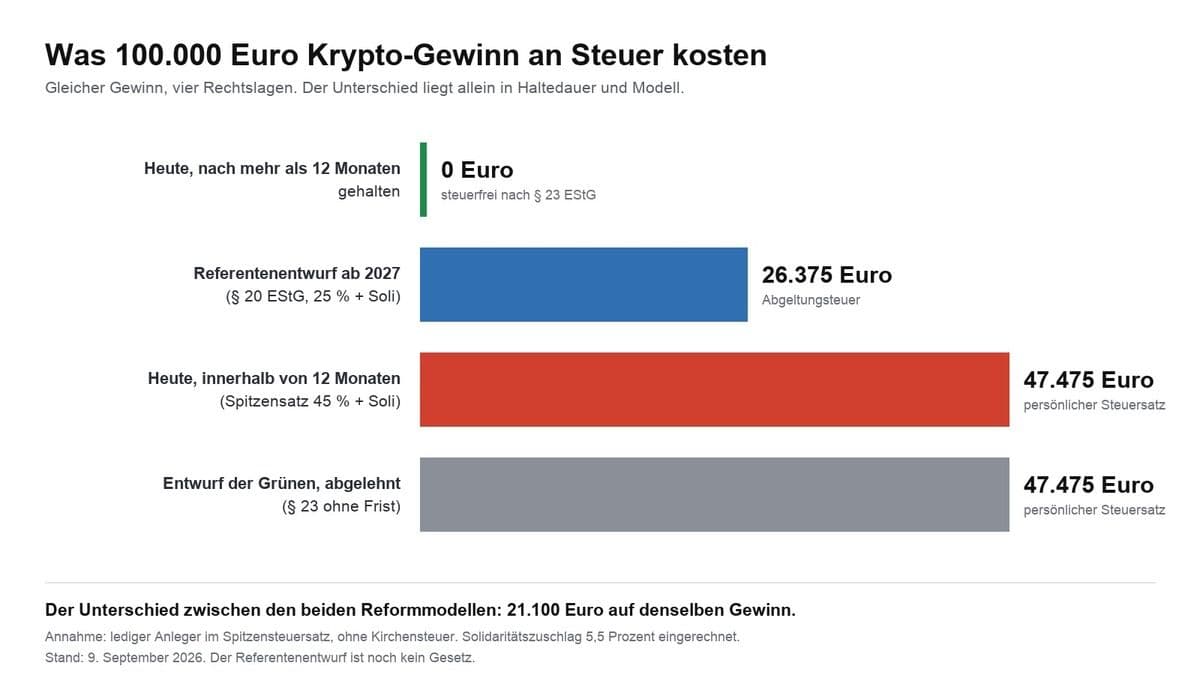
Crypto gains are tax-free after twelve months; before that your personal tax rate of up to 45 percent applies. What triggers tax, how the holding period is calculated, what happens with staking and losses, and what the draft bill would change from 2027.
September 27, 2026 10:35 AM

Crypto Exchange Tax Report Wrong: How to Correct It Before the Tax Office Does
Missing acquisition costs, transfers booked as sales, holding periods restarted: your exchange's report is an aid and not proof. How to check it, how to correct it and which deadline is running.
September 17, 2026 7:12 PM

Gifting Bitcoin to Children: Allowance, Holding Period and the Tax Office Report
Transferring Bitcoin to your child hands over your holding period and your entry price along with the coins. This guide sets out what really applies in Germany on the allowance, the reporting deadline, representation and custody.
August 12, 2026 9:12 AM

Bitcoin Losses and Dividends in Austria: How the Tax Offset Works
Can a Bitcoin loss be offset against dividends? This is how loss offsetting works in Austria. It also shows when a tax return is needed for it.
August 11, 2026 9:13 PM

Germany's Crypto Holding Period Faces Abolition: What Petition 201716 and the Cabinet Decision Mean for Your Tax
Petition 201716 in the German Bundestag calls for the one-year holding period for crypto assets to be kept and has already passed the quorum of 30,000 signatures. This article sets out what the cabinet decision of July 6, 2026 provides for, how much of it is binding and which records you should be pulling together now.
September 27, 2026 10:14 AM

Shiba Inu Price Prediction: What to Check on SHIB Before the December 31 Deadline
SHIB trades at $0.00000592 on September 27, 2026, around 93 percent below its all-time high. For German investors one date matters more than the chart right now: December 31, 2026.

September 24, 2026 10:19 AM

Uniswap Falls 11.8 Percent After a 114 Percent Month: What to Check on Profit Taking, Holding Period and Leverage
UNI lost 11.75 percent on Wednesday morning but is still up 113.85 percent over the month. Anyone realising gains now almost certainly triggers a taxable disposal in Germany.
August 18, 2026 7:13 AM

Bitcoin Tax Reporting in Austria 2026: What Applies
Bitcoin tax reporting in Austria: which data investors can request from crypto exchanges in 2026, and when the report matters for the tax return.
August 31, 2026 10:30 PM

Taxing Crypto Lending: Your Personal Rate Instead of Withholding Tax, and the Right Federal Fiscal Court Case Number
According to the only tax court ruling so far, income from crypto lending falls under Section 22(3) of the German Income Tax Act and therefore under your personal tax rate. The appeal is pending at the Federal Fiscal Court under VIII R 22/25, not under the case number given in many professional articles.
More from CryptoTicker