
Crypto Tax Software Compared: What CoinTracking, Blockpit, Koinly, Divly and Waltio Cost
On September 2, 2026 we retrieved the pricing pages of five crypto tax software providers and laid their tiers side by side. The entry point sits at €39 to €49 everywhere; above a thousand transactions a year the prices diverge widely.





Which topics should we dive deeper into?
Select what genuinely interests you. Your picks feed directly into our editorial planning.
Crypto news that's actually worth your time.
Weekly. 60 seconds. Carefully curated by our editors: no hype, no promo flood, no spam.
Crypto tax software costs between €39 and €999 a year depending on the provider and the number of transactions, and the pricing is not built to be compared: some bill annually, others charge once per tax year. On September 2, 2026 we retrieved the pricing pages of five providers and laid their tiers side by side. cryptoticker.io collected this data itself on September 2, 2026.
The result first: the cheapest entry point sits close together at all five providers, at €39 to €49. The prices only diverge above roughly a thousand transactions a year. That is where it is decided whether the same volume of data costs you €89 or €249.
What crypto tax software does and what it cannot deliver
Crypto tax software is a program that reads in your purchases, sales, swaps and inflows from various exchanges and wallets, applies a valuation method to them and produces a report that you transfer into your tax return. The import runs through the exchanges' application programming interfaces, through uploaded trading files or through the public address of a wallet.
The distinction matters. These programs replace neither a tax adviser nor a legal review. What they organize is data; the decision on how a single transaction is to be treated in your case remains yours. For staking, lending, airdrops and wrapped tokens the providers' classifications diverge from one another, and none of the default settings is therefore automatically the right one for you.
If you first want to know which transactions count for tax at all, the basics are in our overview of holding period, FIFO and the exemption threshold for monthly purchases. An overview of the programs themselves is in the comparison of crypto tax tools and portfolio trackers.
The survey: ten addresses, five providers, one cut-off date
The method in one sentence: on September 2, 2026 we retrieved ten pricing and provider addresses from five crypto tax providers over HTTP, read out the German-language pricing section reachable in each case and took over the tier names, annual prices and transaction limits unchanged.
Four of the five pricing pages were directly readable and answered with status code 200: CoinTracking, Blockpit, Divly and Waltio. Koinly blocks automated requests and answered with status code 403. The price figures for this provider therefore come from research and are marked as such below. Two further addresses, CoinTracker and Accointing, also blocked and are left out.
What this survey does not deliver is set out in a section of its own further down. For now only this much: we collected prices and did not test programs. A test requires our own user accounts and our own data set, and we have neither.
CoinTracking: four tiers from €39 to €769 a year
CoinTracking bills in the classic annual subscription. On the day of the survey the provider's pricing page showed four paid tiers: Starter at €39 a year with 200 transactions, Pro at €129 with 3,500 transactions, Expert at €219 with a range of 20,000 to 100,000 transactions and Unlimited at €769 with no volume cap. For companies the page names a Corporate package from €1,599 a year for three unlimited accounts.
Alongside that sits a free variant limited to the portfolio view, plus a seven-day trial period with unlimited imports. The page also advertises two-year packages and lifetime access. We did not collect those prices, because they become visible only during the ordering process.
The jump from 200 to 3,500 transactions is the most expensive step in this tier structure. Anyone with 250 transactions a year already pays CoinTracking's Pro price and uses less than a tenth of the allowance.
Blockpit: a one-off payment per tax year instead of a running subscription
Blockpit sells the tax report as a one-off payment per tax year and not as a continuing subscription. The German-language pricing page lists five tiers: Small at €49 up to 50 transactions, Medium at €99 up to 1,000, Large at €149 up to 3,000, X-Large at €229 up to 10,000 and XX-Large at €549 above 10,000 transactions.
Pure portfolio tracking is free at Blockpit. In addition the page names an add-on package called PLUS at €3.99 a month with annual billing, a half-hour Expert Check at €99 and advice from €199 an hour. For proof of the source of funds there are credit packages from €19.99 for one to €79.99 for five confirmations.
The one-off model has a consequence that often gets lost in price tables. Anyone who has to work through three past tax years pays Blockpit three times. With CoinTracking's annual subscription, by contrast, one paid year covers the analysis of the entire imported record.

Koinly: free tracking, paid export of the tax report
Koinly blocks automated requests. On the day of the survey the pricing page answered with status code 403; in a reader's browser it is reachable as normal. According to consistent statements by German-language specialist portals, the prices are €39 a year for 100 transactions, €89 for 1,000 and €169 for 10,000 transactions.
What sets this provider apart is the shape of its free tier. Tracking the portfolio and generating the report are possible without payment; what is paid for is the export of the finished tax report, and that per tax year. For German investors the same sources name an additional effort, because the figures for the Anlage SO have to be transferred by hand.
Divly and Waltio: two smaller providers with clear tiers
Divly sets its free tier strikingly wide: portfolio tracking with up to 25,000 transactions, plus an unlimited number of blockchains, wallets and exchanges. The three paid packages are called Essentials at €39, Experten-Check at €99 and Rundum-sorglos at €599, each as a one-off purchase. How they map onto the transaction classes, and the page names classes up to 100, up to 1,000, up to 10,000 and up to 100,000 transactions, resolves only during the ordering process. Which package price belongs to which class was something we could not conclusively determine from outside.
Waltio shows the clearest tier structure in the field. After the free tier come Lite at €39 with 50 transactions, Starter at €99 with 1,000, Smart at €249 with 10,000 and Unlimited at €999 with no volume cap. The provider comes from France. Whether the German reporting section is sufficient in your case is something you should check against the sample report before buying.
 Crypto Tax Tools Compared
Price per transaction: where the tiers tip over
The list price alone says little. More meaningful is what a tier costs per transaction if you actually use it up. At a thousand transactions a year, Blockpit Medium and Waltio Starter are level at €99 each, Koinly sits below them at €89 according to the researched figures, and CoinTracking charges €129 for the matching Pro tier, which covers 3,500 transactions.
Above ten thousand transactions the picture turns. Waltio asks €249 for the Smart tier, Blockpit €229 for X-Large, CoinTracking €219 for Expert with an upper limit that, depending on the arrangement, reaches 100,000 transactions. Anyone with very many transactions comes off cheaper at the providers with widely drawn upper tiers.
There is one number you should know before you buy, and it is your own: how many tax-relevant transactions did you really have last year? Every swap from one coin into another counts, every fee entry can count, and automated savings plans generate twelve or fifty-two transactions a year without it feeling like trading.
Anlage SO, FIFO and the holding period: which feature counts for German investors
FIFO stands for first in, first out and describes the assumption that the units bought first also count as the ones sold first. This method determines which acquisition price is assigned to a sale, and with it the size of your gain.
For private investors in Germany the holding period hangs on this. Under Section 23 of the German Income Tax Act, a private disposal transaction covers other assets where the period between acquisition and disposal is not more than one year. For the total gain of a calendar year the same provision names an exemption threshold: gains remain tax-free if the total gain achieved from private disposal transactions in the calendar year came to less than €1,000.
In practice this means: a program is usable for you only if it carries the holding period per inflow, relates the exemption threshold to the calendar year and outputs the figures in a form you can enter into the Anlage SO. Providers differ noticeably on this last point, and that is exactly what you should look at in the sample report before you pay.
How the exemption threshold plays out with ongoing purchases is something we have worked through using the example of monthly savings plans. Anyone who has already realized gains should also keep an eye on the advance tax payment.
Exchange export and interface: where most analyses fail
The biggest source of error is the data situation itself. Exchanges deliver export files of varying completeness, some only for limited periods, some without fees, some with divergent timestamps. If a single inflow is missing, the software calculates with an acquisition price of zero and reports a gain that is too high.
That is why the question of the export belongs in the choice of your trading venue, long before the tax return. Our comparison of crypto exchanges shows which providers supply an interface and how far back their history data reaches. Anyone leaving an exchange should download the complete export while the account is still open.
In 2026 this is no theoretical worry. Several trading venues have ceased operations or delisted tokens, and with the account the access to the trading history usually disappears as well.

DAC8 and the record-keeping duties: why documentation is becoming more important
DAC8 is the eighth amendment to the EU directive on administrative cooperation and obliges providers of crypto-asset services to report details of their users and those users' transactions to the tax administration, which then exchanges this data between the member states. The obligations have applied since January 1, 2026. According to consistent specialist accounts, the first report for the year 2026 is due by July 31, 2027.
In parallel, the German Federal Ministry of Finance set out detailed requirements on tax filing, cooperation and record-keeping duties for crypto assets for the first time in its letter of March 6, 2025. According to the accounts of several tax firms, taxpayers should regularly retrieve and retain the transaction overviews made available by foreign trading platforms; missing records count against them.
For the choice of a software this means two things. The complete import gains in importance, because your figures may in future stand alongside reported data. And the archive becomes more valuable: a program that permanently holds the imported raw data and makes it exportable helps you more with a later query than one that only outputs a finished report.
 The Market Picture Every Morning
What this survey does not show
We collected prices and did not test programs. Without our own user accounts and without our own data set, there is no way to check how well an import actually works, nor how a provider classifies staking, lending or wrapped tokens.
Three further limits belong with this. The prices for Koinly come from research, because the pricing page blocks automated requests. With Divly it was not possible to resolve from outside which package price applies to which transaction class. Discount campaigns, two-year packages and lifetime access become visible at several providers only during the ordering process and are not contained in this analysis.
Prices also change continuously. The cut-off date of this survey is September 2, 2026, and every figure in this article refers to that day.
How to turn the figures into a decision
What makes sense is an order of steps that begins with your data and not with the price. First count your transactions from the past year. Then check whether the exchanges and wallets you use are supported by the provider. Only after that look at which tier covers that. A cheap package that does not read in your trading venues will cost you more than an expensive one that does.
Anyone with only a few purchases a year who keeps to the holding period frequently needs no paid package at all, but a clean statement and the records to go with it. As soon as swaps, staking inflows or several trading venues come together, the calculation tips the other way. For the classification of stablecoin transactions we have looked at USDT, USDC and EURC separately.
Choosing crypto tax software: what you take away from this
- Count your transactions before you choose a tier. The prices separate only above roughly a thousand transactions a year; below that all five providers sit between €39 and €99. The tiers and features are in the comparison of crypto tax tools and portfolio trackers.
- Secure the trading history while the account is open. Missing inflows produce gains that are too high, and after an account closure the history is usually gone. Which trading venues offer a usable export is shown by our comparison of crypto exchanges.
- Check the sample report for holding period, exemption threshold and Anlage SO. Only when these three points appear in the output is a program usable for a German tax return. The tax mechanics behind it are in our article on holding period, FIFO and the exemption threshold.
(As of September 2, 2026. This article is not investment advice. Prices and fee structures change; check the terms with the provider before you buy.)
Transparency note: This article was produced with the assistance of artificial intelligence and reviewed by our editorial team before publication. All figures and claims were checked against the primary sources linked in the text. The feature image was generated with AI.
Related articles
- Bitcoin Tax Report Wrong: What Austrian Investors Can Do
- Bitcoin With No Cost Basis: How Austria Taxes the Sale
- Bitcoin Tax Reporting in Austria 2026: What Applies
- Bitcoin Tax Audit: What Proof Austria Requires
- Crypto Tax Software Compared: What Blockpit, Divly, Waltio and Coinpanda Charge for One Tax Year
Which topics should we dive deeper into?
Select what genuinely interests you. Your picks feed directly into our editorial planning.
Crypto news that's actually worth your time.
Weekly. 60 seconds. Carefully curated by our editors: no hype, no promo flood, no spam.

May 16, 2026 11:57 AM
CoinTracking Review 2026 – Crypto Taxes, Portfolio Tracking & Full-Service Support
Manage your crypto taxes effortlessly with our comprehensive guide to CoinTracking. Learn how to track transactions and simplify your tax reporting today!
September 7, 2026 10:24 AM

Gifting Bitcoin to Children: Tax Rules in Austria
Giving bitcoin to your children? When a gift notification is required in Austria, and which acquisition costs the child takes over.
August 24, 2026 10:26 AM
Bitcoin Savings Plan in Austria: How the Purchase Price Is Calculated
Bought bitcoin through a savings plan? For multiple purchases Austria applies the moving average price as a matter of principle when working out taxable gains.
September 9, 2026 4:22 PM
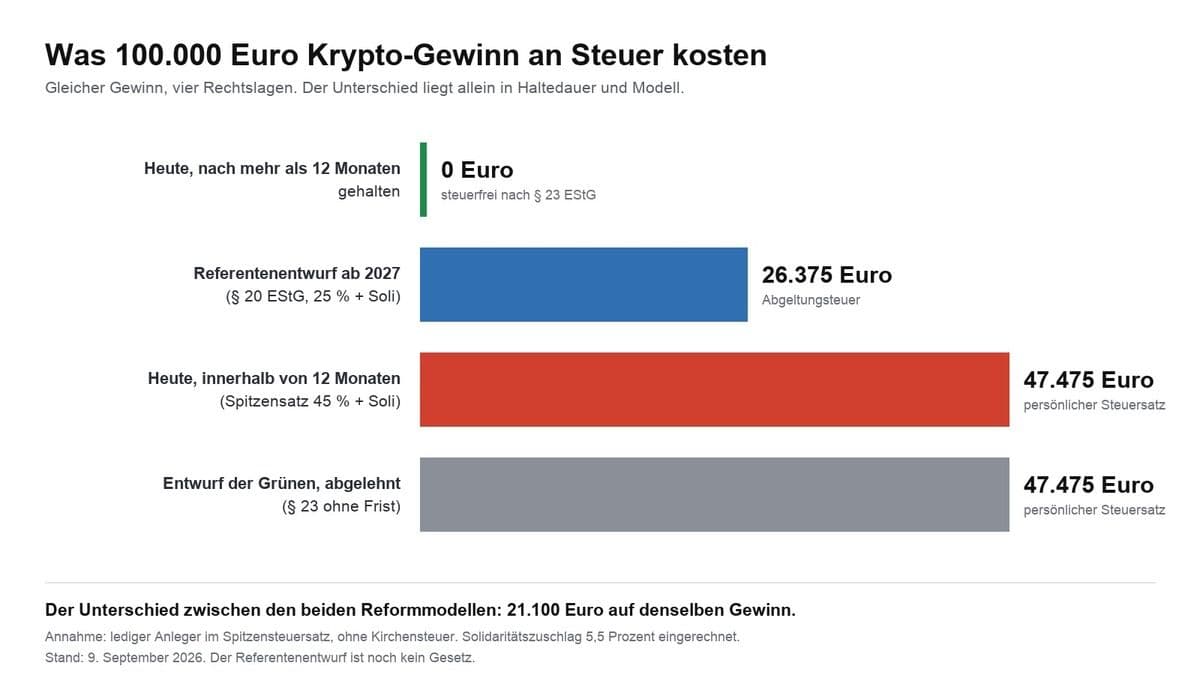
Crypto Tax in Germany: What Applies in 2026 and What Is Set to Change in 2027
Crypto gains are tax-free after twelve months; before that your personal tax rate of up to 45 percent applies. What triggers tax, how the holding period is calculated, what happens with staking and losses, and what the draft bill would change from 2027.

August 20, 2024 3:00 PM

New US Senate Proposal Submitted For Crypto Tax Exemption
The US Senate has recently submitted a new proposal to exempt crypto transactions from federal taxes. Here are more details of this submission, and a list of exempted countries it could be joining...
August 26, 2026 10:25 PM

Selling Bitcoin at a Loss: Loss Offsetting in Austria
Sold Bitcoin at a loss? Austria allows the loss to be offset against certain investment income. When loss offsetting is possible and which limits apply.
August 12, 2026 9:12 AM

Bitcoin Losses and Dividends in Austria: How the Tax Offset Works
Can a Bitcoin loss be offset against dividends? This is how loss offsetting works in Austria. It also shows when a tax return is needed for it.
September 9, 2026 1:15 AM

Germany's Crypto Tax: 160 Million Euros for a 555-Billion Budget
The German finance ministry's draft bill puts a figure on the crypto tax for the first time: 160 million euros from 2028. What that number means in the 2027 federal budget, how 11.4 billion became 160 million, and what investors can read from it.
August 31, 2026 10:23 AM

Bitcoin Abroad: The Tax Duty Austrian Investors Carry Themselves
Sold bitcoin through a foreign platform? When Austrian investors have to declare gains themselves and account for the 27.5 percent tax rate.
August 22, 2026 4:47 PM

Offsetting Bitcoin Losses Against Stock Gains in Austria
Offset bitcoin losses against gains on shares? Austria allows it in principle, but only under certain conditions and usually via the tax return.
September 19, 2026 7:12 PM

Bitcoin Sold Without Austrian Tax Withheld: What to Do Next
Sold Bitcoin but no Austrian capital gains tax was withheld? That does not make the sale tax free. When investors have to declare the gain themselves at 27.5 percent.
September 26, 2026 1:19 AM

Germany’s Crypto Holding Period Is Wobbling: What to Check Before December 31
A CDU member of the Bundestag makes it plain: the coalition agreement does not guarantee that the one-year holding period for crypto assets will survive. What that means for purchases made before the planned cutoff date of December 31, 2026.
August 27, 2026 10:16 AM
Bitcoin Tax Return in Austria: When You Must File
Even with a crypto exchange, a tax return can still be necessary in Austria. Foreign platforms, missing capital gains tax withholding and cross-provider losses are the typical triggers.
February 18, 2026 11:00 AM

Top 5 Tax Reporting Tips to Prepare for the 2026 Season
Prepare for the 2026 crypto tax season with our top 5 tips on reporting, tax-loss harvesting, and new IRS rules to avoid penalties.
October 1, 2026 7:36 PM

Crypto tax and withholding at source from 2028: what to check now
The German Federal Ministry of Finance’s draft bill goes to cabinet on October 14, 2026. The underexposed part of it is the deduction of tax from 2028: which providers are to withhold the tax on investment income, why self-custody and foreign platforms stay exempt from it, and what you should document by December 31.
August 31, 2026 10:30 PM

Taxing Crypto Lending: Your Personal Rate Instead of Withholding Tax, and the Right Federal Fiscal Court Case Number
According to the only tax court ruling so far, income from crypto lending falls under Section 22(3) of the German Income Tax Act and therefore under your personal tax rate. The appeal is pending at the Federal Fiscal Court under VIII R 22/25, not under the case number given in many professional articles.
September 10, 2026 7:14 AM

Bitcoin Loan Liquidated: Tax Consequences in Austria
If a lender liquidates Bitcoin pledged as loan collateral, a taxable capital gain can arise in Austria. That holds even when the investor never chose to sell.
September 4, 2026 1:34 PM

Bitcoin as Loan Collateral: When No Tax Applies in Austria
Pledging Bitcoin as collateral for a loan? As long as the coins are not realised, no sale arises in Austria in principle.
February 13, 2026 9:07 PM

Netherlands Approves 36% Tax on Unrealized Crypto Gains starting 2028
The Dutch House of Representatives has officially passed a controversial 36% tax on unrealized gains for crypto and stocks, effective January 2028.
September 16, 2026 1:20 PM

Crypto Loss Carryforward in Germany: What Happens to Old Losses Under the 2027 Tax Plan
Losses from crypto sales land in a ring-fenced pot and can only be set against gains of the same kind. The draft bill for 2027 moves future gains into a different pot, and we show you what that means for your assessed carryforward and what your tax notice should say.
August 21, 2026 4:24 AM

Forced Sale on a Crypto Exchange: Which Moment Counts for the Holding Period and What You Must Document
At Luno, Kraken and Valour the deadlines are running out, after which the provider realises the remaining holding itself. For tax purposes that is a disposal, and what governs it is the exchange's timestamp.
January 22, 2026 9:59 AM

Netherlands to Tax Unrealized Crypto Gains: What You Need to Know
The Netherlands is moving toward taxing unrealized crypto gains by 2028. Learn how the new "Box 3" system impacts your Bitcoin and digital assets.
October 2, 2026 1:33 PM

Crypto tax before the cabinet on October 14: “Comments are only possible until October 6”
Germany's Federal Ministry of Finance sent the draft bill on crypto taxation to the associations on September 30, 2026, and the cabinet is to decide on October 14. For your holdings one date counts above all: December 31, 2026.
September 16, 2026 7:12 PM

Borrowing Against Bitcoin Instead of Selling: When German Tax Still Applies
Posting Bitcoin as collateral for a loan is not a sale in Germany, because section 39 of the Fiscal Code keeps the coins attributed to you for tax purposes. Tax arises only when the collateral is liquidated, and then the one thing that decides the bill is how long you held the coins beforehand.
September 7, 2026 7:22 AM

German Crypto Holding Period Stays: The Income Tax Reform 2027 Leaves Section 23 Untouched
On September 2, 2026 the German federal cabinet adopted the draft of an Income Tax Reform Act 2027, and crypto assets do not appear in it. The one-year holding period under Section 23 of the Income Tax Act therefore continues to apply unchanged.
August 10, 2026 9:15 PM

Selling Bitcoin at an ATM: Tax Rules in Austria
Selling bitcoin for cash at an ATM: when the 27.5 percent rate applies in Austria and which records you need to keep.
September 19, 2026 7:26 AM

Offsetting Crypto Losses Against Share Gains: What Is Really Allowed in Germany
Crypto losses and share gains sit in separate loss buckets in Germany, and there is no offsetting between them. Where the line runs, why crypto derivatives are the exception, and how you can still use losses through carryback and carryforward.
More from CryptoTicker