
Crypto Gains 2026: Why the September 10 Advance Tax Payment Decides Your Interest Bill
The third income tax advance payment falls due on September 10, yet for most crypto investors none was ever set. We checked four provisions in full text and show when the interest period for 2026 starts and how you can shrink it yourself.





Which topics should we dive deeper into?
Select what genuinely interests you. Your picks feed directly into our editorial planning.
Crypto news that's actually worth your time.
Weekly. 60 seconds. Carefully curated by our editors: no hype, no promo flood, no spam.
The third income tax advance payment of the year falls due on September 10. For most crypto investors the date carries no meaning, because the tax office never set an advance payment for them in the first place. That is exactly the point at issue here: anyone who realised meaningful gains on crypto assets in 2026 owes income tax on them, yet will probably not pay the tax office a single cent this year. The bill arrives only with the assessment notice, and from a certain date onwards it costs extra in interest.
This article sets out which dates the law fixes, from what point an advance payment is set at all, when the interest period for the 2026 tax year begins, and which application lets you shrink your later interest bill yourself. The basis is four provisions that we retrieved and analysed in the official full text on August 27, 2026.
Advance Tax Payment on Crypto Gains: What Falls Due on September 10
An income tax advance payment is an instalment on the current year's tax that the tax office sets up front and later credits against the final liability. The statute names four fixed dates in the year: March 10, June 10, September 10 and December 10. Each payment covers the tax you are expected to owe for the current year.
September 10, 2026 is therefore the third of four dates for the 2026 tax year. Anyone holding an advance payment notice should pay on that day. Anyone holding none needs to do nothing, but is accumulating a tax debt that later falls due in a single sum.
The timing is no quirk of this year; it is the statutory default. What makes it interesting in 2026 is the market backdrop: according to consistent market reports, bitcoin briefly traded above $81,000 in late August after the price had risen a good twenty percent within a week. Anyone who closed positions in that move that had been held for less than twelve months has realised a taxable gain. However the bitcoin price prediction develops from here changes nothing about the tax already incurred on those sales.
Checking Your Advance Payment Notice: How to Tell Whether This Affects You
The first step takes five minutes. Search your files or your Elster mailbox for a notice that expressly sets advance payments. This assessment often sits at the end of the previous year's income tax notice and names four amounts with the four due dates listed above.
If you find such a notice, the rule is simple: the amount stated there is payable on September 10, regardless of how your year has developed since. If you find none, you belong to the group this article was really written for. Because a missing advance payment is not an advantage, only a postponement.
400 Euros a Year and 100 Euros per Date: When the Tax Office Sets Anything at All
The law draws a clear floor. Advance payments are only to be set if they come to at least 400 euros in the calendar year and at least 100 euros for a single advance payment date. If the expected tax falls below that, no assessment is made.
Separate thresholds apply to raising an assessment that already exists. An increase is only made if the additional amount reaches at least 100 euros per advance payment date. For a subsequent increase that hits only the final advance payment of the year, the threshold is 5,000 euros. That second figure explains why a late adjustment is rare in practice and only comes into play for larger amounts.
Why Your Advance Payment Usually Contains No Crypto Gains at All
The measurement basis is the decisive point. Advance payments are measured in principle by the income tax that resulted from the last assessment, that is, by your most recently processed tax year. The tax office is projecting the past forward.
A gain from selling crypto assets fits that pattern badly. It arises irregularly, often in a single year and on a scale that did not occur the year before. For an employee whose wage tax is withheld as they go, the last assessment usually produces no meaningful closing payment at all. So the tax office sets nothing, even though a substantial tax liability is building up in the current year.
The result is a lag of two to three years between the sale and the payment. During that period the money sits with you, and that is precisely why the interest rule covered in the next section bites. If your portfolio is spread across several venues, pull all the accounts together for your estimate; a look at your holdings on the regulated crypto exchanges helps you avoid overlooking a partial sale.

Late Payment Interest Under Section 233a AO: When the Clock Starts Running for 2026
Late payment interest is interest on the amount by which the assessed tax exceeds the withholding amounts and advance payments already made. This interest is not a penalty and requires no fault. The claim arises automatically as soon as enough time has passed between the tax arising and its assessment.
The interest period begins 15 months after the end of the calendar year in which the tax arose. Income tax for 2026 arises at the close of December 31, 2026. For every crypto gain you realised this year, the interest period therefore begins on April 1, 2028. It ends with the close of the day on which the tax assessment takes effect, that is, with the notice.
Two details belong here, because they are often confused. First, advance payments themselves do not bear interest; the provision expressly excludes their assessment. Second, only full months count, and part months are left out of account. A notice that takes effect on the 20th of a month therefore brings no further interest for that month. You can read the wording in Section 233a of the German Fiscal Code.
 Crypto Tax Tools and Portfolio Trackers Compared
0.15 Percent a Month: What 1.8 Percent a Year Means in Euros
Since the reform covering periods from January 1, 2019, the rate has stood at 0.15 percent for each month, expressly quantified in the statute as 1.8 percent for each year. The amount that bears interest is first rounded down to the next amount divisible by 50 euros.
A worked example built solely from those two retrieved figures: assume your 2026 sales produce an additional payment of 6,000 euros and the notice takes effect in October 2028. The interest period begins on April 1, 2028 and therefore covers six full months. Six times 0.15 percent gives 0.9 percent, so 54 euros on 6,000 euros. If processing drags on into autumn 2029, that is eighteen full months and 162 euros.
The order of magnitude stays manageable as long as the additional payment stays small and the notice arrives promptly. Both together let the amount grow. With an additional payment in the five-figure range and a processing time of two years after the interest period starts, the interest quickly reaches four figures. More important than the absolute number is that this item is the only one in the whole bill you can influence by acting during the current year.
Shrinking the Difference Amount: How a Higher Advance Payment Cuts the Interest
The lever sits in the calculation formula. What counts for the interest charge is the assessed tax, reduced by the creditable withholding amounts and by the advance payments set before the interest period begins. That remainder is called the difference amount, and only it bears interest.
The effect is therefore clear: every euro set as an advance payment for 2026 by April 1, 2028 reduces the difference amount by the same euro and drops out of the interest calculation. Anyone who applies for an advance payment during the current year, or has an existing one raised, is swapping a later interest-bearing debt for an earlier interest-free payment.
Whether that pays off is a plain comparison: on one side stand the 1.8 percent a year you save, on the other the return the same money would have earned elsewhere until the tax fell due. Everyone can only make that judgement for themselves, and it comes out differently with high overnight deposit rates than with low ones.

Applying for an Adjustment: The Deadline Section 37 EStG Sets the Tax Office
The adjustment is provided for by law. The tax office may adjust advance payments to the income tax that is expected to result for the assessment period. It has a deadline for that: the end of the 15th calendar month following the assessment period. For 2026, that window runs until March 31, 2028.
The date coincides with the start of the interest period for a reason. The two provisions are aligned with each other: until the last day on which an advance payment can still be adjusted, no interest runs, and from the first day after that it does. Anyone wanting to use the adjustment therefore has a clearly bounded period, and it by no means ends on September 10, 2026.
In practice it works through an informal application to your local tax office, setting out your expected income for the current year. The evidence comes from your exchange tax report, which you should pull separately for every venue you use. If the increase is decided late in the year and hits only the final advance payment, the additional amount is payable within one month of the notice being served.
Adjusting Downwards: What Applies If 2026 Brings Losses Instead of Gains
The adjustment works in both directions. Anyone with a running advance payment whose basis has fallen away can apply for a reduction. That affects everyone whose last assessment was shaped by a good year while the current year is running distinctly worse.
For crypto investors this is the mirror image of the rest of this article, and it is by no means rare, because winning years and losing years sit close together in this market. The offsetting logic matters here: losses from private disposal transactions do not reduce any tax at will, but initially only gains of the same kind. What is deductible in the event of a total loss and what is not therefore helps decide whether a reduction can be justified at all.
A forced sale belongs in that calculation too. When an exchange liquidates residual holdings itself after a deadline expires, that creates a taxable event you did not trigger; you should know the consequences of such a forced sale on a crypto exchange before you submit your estimate for the current year.
 The Best Crypto Exchanges Compared
Holding Period and Allowance: Which Crypto Gains Belong in the Calculation
Before you apply for anything, you need a number. Only what is actually taxable belongs in the estimate. Two rules narrow it down.
The first is the holding period. Gains from selling crypto assets that were held for more than a year stay outside the tax net; the details are set out in our overview of the holding period for cryptocurrencies. Positions sold in the 2026 upswing that had been held for less than twelve months, by contrast, fall inside it.
The second is the allowance. Gains stay tax-free if the total gain from private disposal transactions in the calendar year came to less than 1,000 euros. The German term Freigrenze is to be taken literally: once the threshold is reached, the entire gain is taxable and not merely the excess. Why that produces the most common mistake in thinking about crypto gains is something we have written up separately.
What the Exchanges' Reporting Duty Changes About This Calculation
Since January 1, 2026, crypto service providers in the EU have automatically reported user and transaction data to the tax authorities. For the advance payment that changes nothing directly, because the reporting goes into the tax administration's data stock and not into your advance payment account.
Indirectly it changes the starting position all the same. The likelihood that a realised gain goes unnoticed falls, and the request to file a return may come early. Which documents should be on hand for that is set out in our summary on the crypto tax return.
Our Own Analysis: Four Provisions Checked in Full Text
cryptoticker.io compiled this analysis itself on August 27, 2026. Method: we retrieved the four relevant provisions in the official full text on gesetze-im-internet.de the same day, each with HTTP status 200, stripped the text of its markup and counted the dates, monetary thresholds, deadlines and interest rates named there sentence by sentence.
Exactly four provisions were checked, each in full: Section 37 EStG with the advance payment dates, the measurement basis, the adjustment deadline and the minimum amounts; Section 233a AO with the start of the interest period, the exception for advance payments and the calculation of the difference amount; Section 238 AO with the interest rate and the rounding; and Section 23(3) EStG with the allowance.
We name three limits of this analysis expressly. First, it is a snapshot of the law as it stood on August 27, 2026; future changes are not included in it. Second, it says nothing about how an individual tax office will decide an adjustment application in a specific case, because the law grants discretion there. Third, we evaluated no administrative instructions and no case law, only the wording of the statute; you will find the full version in Section 37 EStG in the official full text.
Checking Your Crypto Advance Tax Payment: What to Take Away
For most crypto investors, September 10 is not a payday. It is a fitting occasion to work through your own position once, while the window for an adjustment still stands wide open.
- Pull your numbers together. Export the annual report for every account and separate the sales inside the one-year period from those outside it. Anyone using several venues will struggle without a tool; our overview of crypto tax tools and portfolio trackers shows which programs read which exchanges.
- Estimate the tax and decide on the application. If the expected additional payment is well above 400 euros a year, weigh 1.8 percent annual interest on the amount from April 1, 2028 against the return the same money would bring until then. If the sum favours the application, file it informally with your tax office. If you still have to close positions to do so, you will find the venues' terms in the comparison on selling bitcoin.
- Put the money aside if you do not adjust. Without an advance payment the tax stays your money until the notice arrives, but it stays a debt. A separate account stops the amount disappearing into the next purchase; which venue suits that and where the fees sit is covered in our comparison of the best crypto exchanges.
(As of August 27, 2026. This article is not investment advice. Prices and fee structures change; check the terms with the provider before you buy.)
Transparency note: This article was produced with the assistance of artificial intelligence and reviewed by our editorial team before publication. All figures and claims were checked against the primary sources linked in the text. The feature image was generated with AI.
Related articles
- German Crypto Holding Period Stays: The Income Tax Reform 2027 Leaves Section 23 Untouched
- Germany's Crypto Holding Period Faces Abolition: What Petition 201716 and the Cabinet Decision Mean for Your Tax
- Germany’s Crypto Holding Period Is Wobbling: What to Check Before December 31
- Taxing Crypto Lending: Your Personal Rate Instead of Withholding Tax, and the Right Federal Fiscal Court Case Number
- Forced Sale on a Crypto Exchange: Which Moment Counts for the Holding Period and What You Must Document
Which topics should we dive deeper into?
Select what genuinely interests you. Your picks feed directly into our editorial planning.
Crypto news that's actually worth your time.
Weekly. 60 seconds. Carefully curated by our editors: no hype, no promo flood, no spam.

September 16, 2026 7:12 PM

Borrowing Against Bitcoin Instead of Selling: When German Tax Still Applies
Posting Bitcoin as collateral for a loan is not a sale in Germany, because section 39 of the Fiscal Code keeps the coins attributed to you for tax purposes. Tax arises only when the collateral is liquidated, and then the one thing that decides the bill is how long you held the coins beforehand.
September 19, 2026 7:26 AM

Offsetting Crypto Losses Against Share Gains: What Is Really Allowed in Germany
Crypto losses and share gains sit in separate loss buckets in Germany, and there is no offsetting between them. Where the line runs, why crypto derivatives are the exception, and how you can still use losses through carryback and carryforward.

March 2, 2026 11:30 AM

How to Generate a Steady Income During Crypto Market Volatility
Crypto market crashing hard? Learn how to use stablecoins to generate a reliable income while protecting your capital from market swings.
September 24, 2026 1:13 AM

Solana DEX Trades Overtake the NYSE: What to Check on Swaps, Tax and Oversight
Solana's decentralised exchanges settled roughly 208 million trades in a single week and overtook the New York Stock Exchange for the first time. The figure is real, but it measures something other than the comparison suggests, and for German investors it carries tax duties that no provider takes on.
September 17, 2026 10:22 PM

Selling Bitcoin at a Loss and Buying It Straight Back: What That Does to Your Holding Period
Germany has no wash sale rule: the loss stays deductible even if you buy back immediately. The buyback, however, restarts the one-year period for every new unit.
September 8, 2026 10:21 PM

Crypto Holding Period and Grandfathering: Why December 31, 2026 Becomes the Cut-Off in Germany's Draft Bill
A ministerial draft bill from Germany's finance ministry names a cut-off date for the first time: crypto assets acquired after December 31, 2026 are to fall under the flat-rate withholding tax. What that means for legacy holdings, running savings plans and staking income, and why nothing has been decided yet.
September 8, 2026 1:19 AM

Germany's Crypto Holding Period: What Happens Now Signing for Petition 201716 Closed on September 15
Recap as of September 27, 2026: the signature period for German parliamentary petition 201716, which asks for the one-year crypto holding period to be preserved, closed on September 15, 2026. This article explains what ended that day, how the petitions committee proceeds and why no investor has to sell because of it.
September 25, 2026 10:26 PM

Selling bitcoin privately: the tax in Germany and the records you need
A direct sale to a private individual falls under the same one-year rule as an exchange sale, but there is no tax report to go with it. This guide walks through the calculation, the 1,000 euro threshold and the records the tax office wants to see.
September 9, 2026 4:13 PM

Bitcoin 29 Percent Below Last Year: Which Crypto Losses You Can Still Use Before the One-Year Holding Period Expires
Nine out of ten major crypto assets trade lower today than exactly twelve months ago, Bitcoin alone by 29.2 percent. We measured the price series ourselves and show why the purchase date alone decides the tax value of your loss.
September 9, 2026 4:22 PM
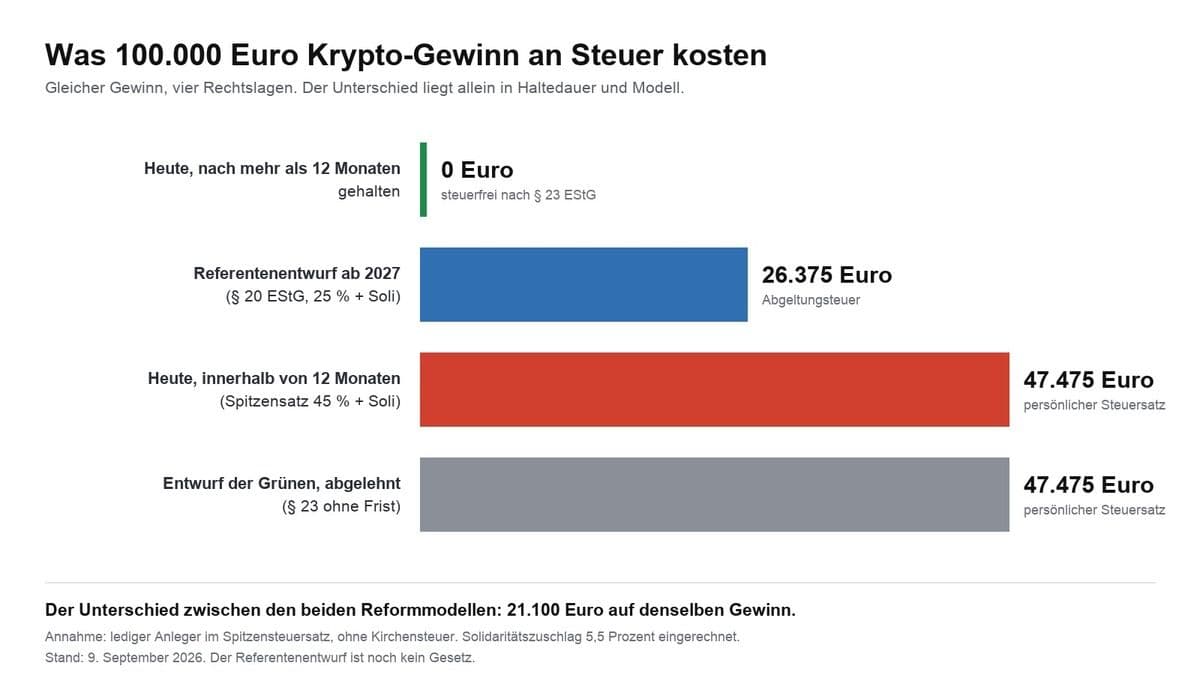
Crypto Tax in Germany: What Applies in 2026 and What Is Set to Change in 2027
Crypto gains are tax-free after twelve months; before that your personal tax rate of up to 45 percent applies. What triggers tax, how the holding period is calculated, what happens with staking and losses, and what the draft bill would change from 2027.
August 10, 2026 5:15 PM

Bitcoin Lending in Austria: When Tax Falls Due
Lending Bitcoin and earning interest: when lending income is taxed at 27.5 percent in Austria and which exchange rate counts.
August 18, 2026 7:13 AM

Bitcoin Tax Reporting in Austria 2026: What Applies
Bitcoin tax reporting in Austria: which data investors can request from crypto exchanges in 2026, and when the report matters for the tax return.
August 31, 2026 10:23 AM

Bitcoin Abroad: The Tax Duty Austrian Investors Carry Themselves
Sold bitcoin through a foreign platform? When Austrian investors have to declare gains themselves and account for the 27.5 percent tax rate.
September 19, 2026 7:12 PM

Bitcoin Sold Without Austrian Tax Withheld: What to Do Next
Sold Bitcoin but no Austrian capital gains tax was withheld? That does not make the sale tax free. When investors have to declare the gain themselves at 27.5 percent.
October 1, 2026 7:36 PM

Crypto tax and withholding at source from 2028: what to check now
The German Federal Ministry of Finance’s draft bill goes to cabinet on October 14, 2026. The underexposed part of it is the deduction of tax from 2028: which providers are to withhold the tax on investment income, why self-custody and foreign platforms stay exempt from it, and what you should document by December 31.
September 26, 2026 7:29 PM

Coins Stolen in an Exchange Hack: What the German Tax Office Accepts as a Loss
After the attack on Bitget on September 24, a question the reports leave out arises for those affected in Germany: can a stolen balance be written off against tax? The answer hangs on a single term in the Income Tax Act, and it is decided by your records.
September 22, 2026 4:37 AM

Crypto Tax Audit: What Evidence the Tax Office May Demand
If the tax office asks about your crypto gains, the only thing that counts is what you can produce. The German Fiscal Code governs what may be demanded and what happens when the documents are missing.
September 16, 2026 1:20 PM

Crypto Loss Carryforward in Germany: What Happens to Old Losses Under the 2027 Tax Plan
Losses from crypto sales land in a ring-fenced pot and can only be set against gains of the same kind. The draft bill for 2027 moves future gains into a different pot, and we show you what that means for your assessed carryforward and what your tax notice should say.
August 20, 2026 4:12 AM

Wrapped Bitcoin in Austria: Is Converting BTC to WBTC Tax-Neutral?
Swapping BTC for Wrapped Bitcoin: when the move to WBTC can be tax-neutral in Austria, and which tax risks investors should know about. Acquisition costs carry over, but the classification of the token decides the outcome.

January 1, 2026 3:12 PM
Crypto Taxes 2026 in Germany: Automatic Reporting Under DAC8, What Applies Now
Since 1 January 2026 crypto providers in the EU must record their customers' transactions for the tax authorities. The first report for 2026 follows in 2027. What investors need to know.
August 16, 2026 6:14 AM
Crypto Credit Card Tax in Germany: Why Every Payment Is a Disposal
Paying with a crypto credit card means disposing of your coins for tax purposes. What that means for the holding period, the exemption threshold and your record-keeping duties, and which card design keeps the effort small.
July 31, 2026 10:59 AM
German Crypto Tax Return 2025: What You Should Know Now the July 31 Deadline Has Passed
Recap as of September 27, 2026: the deadline for the 2025 German tax return ended on July 31, 2026 at midnight. This article describes the situation on the day of the deadline: what crypto investors had to report and what happens if the deadline is missed.
October 2, 2026 4:39 AM

Donating bitcoin: when does the full market value count, when only the purchase price?
A bitcoin donation to a charitable organisation is deductible as a donation in kind, and the donation itself produces no taxable gain. The size of the deduction turns solely on whether a sale would have been taxable on the day of the transfer.
October 2, 2026 1:33 PM

Crypto tax before the cabinet on October 14: “Comments are only possible until October 6”
Germany's Federal Ministry of Finance sent the draft bill on crypto taxation to the associations on September 30, 2026, and the cabinet is to decide on October 14. For your holdings one date counts above all: December 31, 2026.
October 1, 2026 10:44 AM

German crypto tax reform: without a receipt, half the sale price is taxed
The Federal Ministry of Finance's draft bill goes to the cabinet on October 14. Anyone who cannot prove their acquisition cost pays tax on 50 percent of the sale proceeds under the substitute assessment.
September 22, 2026 10:13 AM

Circle Lends Against Bitcoin via cirBTC: Why the Wrapper Can Cost You the German Holding Period
Circle launched loans against deposited bitcoin on September 21, 2026. In Germany, the detour through the cirBTC token is very likely a swap, and a swap restarts your one-year holding period.
August 13, 2026 6:18 AM

Revolut Delists USDT: Forced Conversion on August 31, 2026 Counts as a Sale
Revolut is taking USDT off the table on August 31, 2026: purchases have already stopped, deposits are blocked, and anyone who fails to act before the deadline faces an automatic conversion that counts as a sale for tax purposes. This article explains the deadlines, the tax treatment under section 23 of the German Income Tax Act and what you can do now.
More from CryptoTicker