
Bitcoin Tax Reporting in Austria 2026: What Applies
Bitcoin tax reporting in Austria: which data investors can request from crypto exchanges in 2026, and when the report matters for the tax return.





Which topics should we dive deeper into?
Select what genuinely interests you. Your picks feed directly into our editorial planning.
Crypto news that's actually worth your time.
Weekly. 60 seconds. Carefully curated by our editors: no hype, no promo flood, no spam.
Bitcoin tax reporting in Austria: what investors can request from crypto exchanges in 2026
Austrian crypto investors can fall back on a new instrument for the first time in 2026, one meant to make the tax return and the offsetting of losses considerably easier. For income accruing from the 2025 calendar year onwards, certain parties obliged to withhold capital gains tax must produce a standardised tax report on request. Alongside banks, that expressly includes providers of crypto-asset services.
For investors, the effect is straightforward. Anyone who holds or sells Bitcoin through an Austrian crypto service provider can have a structured overview of the previous calendar year’s tax-relevant transactions issued to them.

What the Austrian Bitcoin tax report contains
The tax report is intended to cover the data relevant to the individual investor on the transactions and on the capital assets managed by the provider over one calendar year. Its precise structure is prescribed by the Austrian tax reporting regulation.
For cryptocurrencies, it may contain information on tax-relevant income and losses in particular. The official template distinguishes, among other things, between crypto income that can be taken into account in the automatic offsetting of losses and income that was left out of it.
The report can therefore help investors trace:
- which crypto income was recorded for tax purposes,
- which losses were taken into account,
- which income did not feed into an automatic loss offset,
and which capital gains tax has already been accounted for or remitted.
One caveat matters, though. The tax report generally covers only income that is subject to capital gains tax withholding in the first place. Income without such withholding does not have to be shown under the tax reporting regulation.
Who can request the tax report in Austria?
The entitlement applies to persons with unlimited tax liability, vis-à-vis parties obliged to withhold capital gains tax. The Austrian finance ministry expressly names domestic banks and providers of crypto-asset services as the typical cases.
That does not mean, however, that every international crypto exchange has to issue Austrian investors an Austrian tax report under this regulation.
Anyone who holds Bitcoin exclusively with a foreign provider, where no Austrian withholding takes place, cannot automatically rely on this standardised Austrian report.

Most useful across several banks and crypto exchanges
The practical benefit of the tax report shows up above all in the offsetting of losses.
Suppose an investor earns dividend income at an Austrian bank while selling Bitcoin at a loss through an Austrian crypto service provider. The automatic loss offset between the bank and the crypto platform does not happen across providers.
The tax report supplies the information needed to bring such investment income together in the income tax assessment. The finance ministry points out expressly that the comprehensive report replaces the mandatory automatic loss offset certificate used previously.
That makes the document particularly interesting for investors who:
- use several crypto exchanges,
- hold equities and Bitcoin at the same time,
- make losses with one provider and gains with another,
want to carry out a voluntary loss offset through their tax return.

Not every transaction shows up in the tax report automatically
A tax report should not be confused with a complete blockchain or transaction history. The tax reporting regulation calls for the tax-relevant data held by the party obliged to withhold. Income that is not subject to capital gains tax withholding is expressly excluded.
A mere transfer of Bitcoin between two of an investor’s own wallets, for example, is generally not a taxable disposal. A tax-neutral crypto-to-crypto exchange is likewise treated differently from a sale for euros. Section 27b of the Austrian Income Tax Act states expressly that exchanging one cryptocurrency for another does not constitute a realisation.
The tax report therefore does not replace an investor’s own documentation of wallet transfers, acquisition costs or historical transactions.
What happens to Bitcoin from a foreign crypto exchange?
This is precisely where a gap can open up. If an investor moves Bitcoin from a foreign exchange to an Austrian provider, the new platform may not automatically hold all the historical tax data. The acquisition date and the acquisition costs are among the details that can be missing.
Separate rules govern how the tax data for cryptocurrencies is determined. The Austrian cryptocurrency regulation covers the valuation and allocation of holdings across wallets and cryptocurrency addresses, among other points.
The tax report can only build on the data that the withholding agent actually uses for tax treatment. With Bitcoin transferred in from outside in particular, investors should check whether the acquisition costs on file match their own transaction history.
 See the crypto tax tool comparison
Why investors should check the Austrian tax report
A standardised document does not automatically mean that all the historical data in it is correct.
Cases that warrant particularly close scrutiny involve:
- Bitcoin from external wallets,
- earlier crypto-to-crypto exchanges,
- several purchases at different prices,
- legacy holdings from the period before March 2021,
- transfers between different platforms,
- acquisition costs disclosed after the fact.
The cryptocurrency regulation contains special rules for holdings of the same cryptocurrency in the same wallet, for example. Details of this kind can affect how a gain is calculated later on.
When investors may need the Bitcoin tax report
The document can be especially useful when an income tax return is being filed or when losses are to be offset across providers.
Even though correct Austrian capital gains tax withholding can in principle have a final taxation effect, situations remain in which investors want or need to include their investment income in an assessment. The finance ministry expressly distinguishes between finally taxed investment income and income that has to be reported in an income tax return.
The report creates a uniform data basis for that purpose, yet it does not replace an examination of the individual tax position.
Conclusion on Bitcoin tax reporting in Austria
In 2026, Austrian Bitcoin investors can draw on the new standardised tax report for a full preceding calendar year for the first time. The obligation applies to income from 2025 onwards and concerns Austrian banks and crypto-asset service providers required to withhold capital gains tax in particular.
The report can be helpful above all with loss offsetting, where several providers are involved, and when checking capital gains tax that has already been withheld.
It does not replace a complete crypto tax history, though. Wallet transfers, foreign exchanges, historical acquisition costs and transactions that carry no withholding can fall outside the report. Investors should therefore keep the tax report and their own transaction history together and reconcile the two.
(As of August 14, 2026. This article is not investment advice. Prices and fee structures change; check the terms with the provider before you buy.)
Transparency note: This article was produced with the assistance of artificial intelligence and reviewed by our editorial team before publication. All figures and claims were checked against the primary sources linked in the text.
Related articles
Which topics should we dive deeper into?
Select what genuinely interests you. Your picks feed directly into our editorial planning.
Crypto news that's actually worth your time.
Weekly. 60 seconds. Carefully curated by our editors: no hype, no promo flood, no spam.

August 10, 2026 9:15 PM
Selling Bitcoin at an ATM: Tax Rules in Austria
Selling bitcoin for cash at an ATM: when the 27.5 percent rate applies in Austria and which records you need to keep.
September 19, 2026 7:12 PM

Bitcoin Sold Without Austrian Tax Withheld: What to Do Next
Sold Bitcoin but no Austrian capital gains tax was withheld? That does not make the sale tax free. When investors have to declare the gain themselves at 27.5 percent.
August 31, 2026 10:23 AM

Bitcoin Abroad: The Tax Duty Austrian Investors Carry Themselves
Sold bitcoin through a foreign platform? When Austrian investors have to declare gains themselves and account for the 27.5 percent tax rate.
August 14, 2026 6:18 PM

Bitcoin From a Foreign Exchange to Austria: Which Tax Data You Need
Transferring Bitcoin from a foreign exchange to an Austrian platform: which tax data can be missing for the withholding tax. And what investors need to watch out for.
August 21, 2026 1:33 PM

Bitcoin With No Cost Basis: How Austria Taxes the Sale
Bitcoin purchase price no longer provable? How Austria works out the capital gains tax, when a flat-rate cost basis applies and what investors can do.
September 11, 2026 10:18 AM

Bitcoin Tax Audit: What Proof Austria Requires
Which bitcoin records can the Austrian tax office examine? Purchase dates, wallet transfers, acquisition costs and sale proceeds are what count.
August 24, 2026 10:26 AM

Bitcoin Savings Plan in Austria: How the Purchase Price Is Calculated
Bought bitcoin through a savings plan? For multiple purchases Austria applies the moving average price as a matter of principle when working out taxable gains.
September 9, 2026 4:22 PM
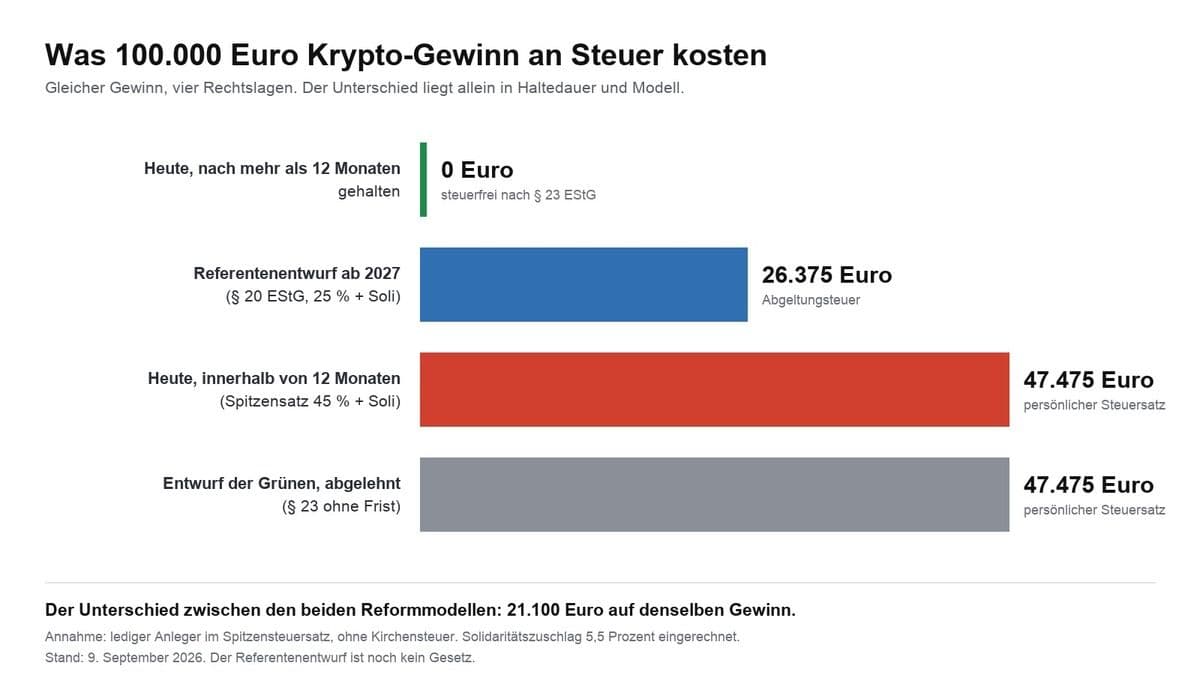
Crypto Tax in Germany: What Applies in 2026 and What Is Set to Change in 2027
Crypto gains are tax-free after twelve months; before that your personal tax rate of up to 45 percent applies. What triggers tax, how the holding period is calculated, what happens with staking and losses, and what the draft bill would change from 2027.
August 16, 2026 9:11 PM

Swapping Bitcoin for Stablecoins: Does Austria Charge Tax?
Anyone swapping bitcoin for USDT or another stablecoin usually pays no tax in Austria yet. When the swap does become taxable after all.
August 17, 2026 10:24 PM

Bitcoin Capital Gains Tax in Austria: When Exchanges Withhold 27.5 Percent
When Austrian crypto exchanges deduct 27.5 percent capital gains tax automatically, which Bitcoin gains are affected and when investors have to declare the income themselves.
September 14, 2026 1:27 PM

Bitcoin Lost to a Scam: What Counts as a Tax Loss in Austria
Lost bitcoin to a scam? Why Austria generally does not recognise the damage as a tax loss for privately held assets, and when compensation payments start to matter.
September 10, 2026 7:14 AM

Bitcoin Loan Liquidated: Tax Consequences in Austria
If a lender liquidates Bitcoin pledged as loan collateral, a taxable capital gain can arise in Austria. That holds even when the investor never chose to sell.
September 24, 2026 1:13 AM

Solana DEX Trades Overtake the NYSE: What to Check on Swaps, Tax and Oversight
Solana's decentralised exchanges settled roughly 208 million trades in a single week and overtook the New York Stock Exchange for the first time. The figure is real, but it measures something other than the comparison suggests, and for German investors it carries tax duties that no provider takes on.
September 4, 2026 1:34 PM

Bitcoin as Loan Collateral: When No Tax Applies in Austria
Pledging Bitcoin as collateral for a loan? As long as the coins are not realised, no sale arises in Austria in principle.
September 3, 2026 10:21 AM

Bitcoin Lost in a Wallet Hack: What Tax Applies in Austria?
Bitcoin lost to hackers? In Austria, the theft of privately held coins generally does not create a capital loss you can use for tax. Only a later payout can change that.
September 7, 2026 10:24 AM

Gifting Bitcoin to Children: Tax Rules in Austria
Giving bitcoin to your children? When a gift notification is required in Austria, and which acquisition costs the child takes over.
August 20, 2026 4:12 AM

Wrapped Bitcoin in Austria: Is Converting BTC to WBTC Tax-Neutral?
Swapping BTC for Wrapped Bitcoin: when the move to WBTC can be tax-neutral in Austria, and which tax risks investors should know about. Acquisition costs carry over, but the classification of the token decides the outcome.

September 24, 2026 1:34 PM

Cardano Slides Below $0.24: What ADA Holders Should Check on Leverage, Liquidation and Holding Period
Cardano has given back its move above $0.25 and trades around seven percent below the high of the past 24 hours. What that means for leveraged positions, the holding period of your tranches and the buying route under MiCA.
August 22, 2026 7:31 AM

Bitcoin Exit Tax in Austria: Which Value Counts?
Anyone emigrating from Austria with Bitcoin can trigger exit tax. What is decisive in principle is the market value at the moment the taxing right is lost.
September 16, 2026 1:20 PM

Crypto Loss Carryforward in Germany: What Happens to Old Losses Under the 2027 Tax Plan
Losses from crypto sales land in a ring-fenced pot and can only be set against gains of the same kind. The draft bill for 2027 moves future gains into a different pot, and we show you what that means for your assessed carryforward and what your tax notice should say.
September 19, 2026 7:26 AM

Offsetting Crypto Losses Against Share Gains: What Is Really Allowed in Germany
Crypto losses and share gains sit in separate loss buckets in Germany, and there is no offsetting between them. Where the line runs, why crypto derivatives are the exception, and how you can still use losses through carryback and carryforward.

February 18, 2026 11:00 AM

Top 5 Tax Reporting Tips to Prepare for the 2026 Season
Prepare for the 2026 crypto tax season with our top 5 tips on reporting, tax-loss harvesting, and new IRS rules to avoid penalties.
September 17, 2026 7:12 PM

Gifting Bitcoin to Children: Allowance, Holding Period and the Tax Office Report
Transferring Bitcoin to your child hands over your holding period and your entry price along with the coins. This guide sets out what really applies in Germany on the allowance, the reporting deadline, representation and custody.
September 17, 2026 10:22 PM

Selling Bitcoin at a Loss and Buying It Straight Back: What That Does to Your Holding Period
Germany has no wash sale rule: the loss stays deductible even if you buy back immediately. The buyback, however, restarts the one-year period for every new unit.
August 20, 2026 4:24 PM

Bitcoin Across Multiple Wallets: How Austria Works Out the Acquisition Cost
Bitcoin spread across several wallets? How Austria works out the acquisition cost and the rolling average price for tax purposes.
February 13, 2026 9:07 PM

Netherlands Approves 36% Tax on Unrealized Crypto Gains starting 2028
The Dutch House of Representatives has officially passed a controversial 36% tax on unrealized gains for crypto and stocks, effective January 2028.
September 9, 2026 4:13 PM

Bitcoin 29 Percent Below Last Year: Which Crypto Losses You Can Still Use Before the One-Year Holding Period Expires
Nine out of ten major crypto assets trade lower today than exactly twelve months ago, Bitcoin alone by 29.2 percent. We measured the price series ourselves and show why the purchase date alone decides the tax value of your loss.
More from CryptoTicker