
Crypto in Your Tax Return: Where Gains, Losses and Staking Go
Crypto belongs in Annex SO, but in two different sections. When you have to declare at all, where gains, losses and staking income go, and why line numbers from older guides lead you astray.



Which topics should we dive deeper into?
Select what genuinely interests you. Your picks feed directly into our editorial planning.
Crypto news that's actually worth your time.
Weekly. 60 seconds. Carefully curated by our editors: no hype, no promo flood, no spam.
Crypto belongs in your tax return as soon as you have sold, swapped or spent it within twelve months and your gain is above 1,000 euros. Staking and lending income has to be declared as well. Anyone who held for more than a year before selling enters nothing at all. Losses are worth declaring in every case, because otherwise they are gone.
The rest of this article answers the question most people get stuck on: exactly where each transaction belongs.
When you have to declare crypto and when you do not
The obligation attaches to the transaction, not to the account. These four cases trigger a filing duty:
- A sale within twelve months with a total gain above 1,000 euros across all private disposal transactions of the year.
- A swap of one cryptocurrency for another inside that window, even when no euro changed hands.
- Staking, lending or mining income above the annual exemption threshold of 256 euros.
- Losses, if you want to offset them against future gains.
Nothing has to be declared for a purchase, for simply holding, for transfers between your own wallets, or for sales after a holding period of more than twelve months. These transactions are not relevant for tax, and the tax office expects no entry for them.
The basics of which transaction is taxable in the first place are set out in detail in our guide to crypto tax in Germany.
Which transaction goes into which annex
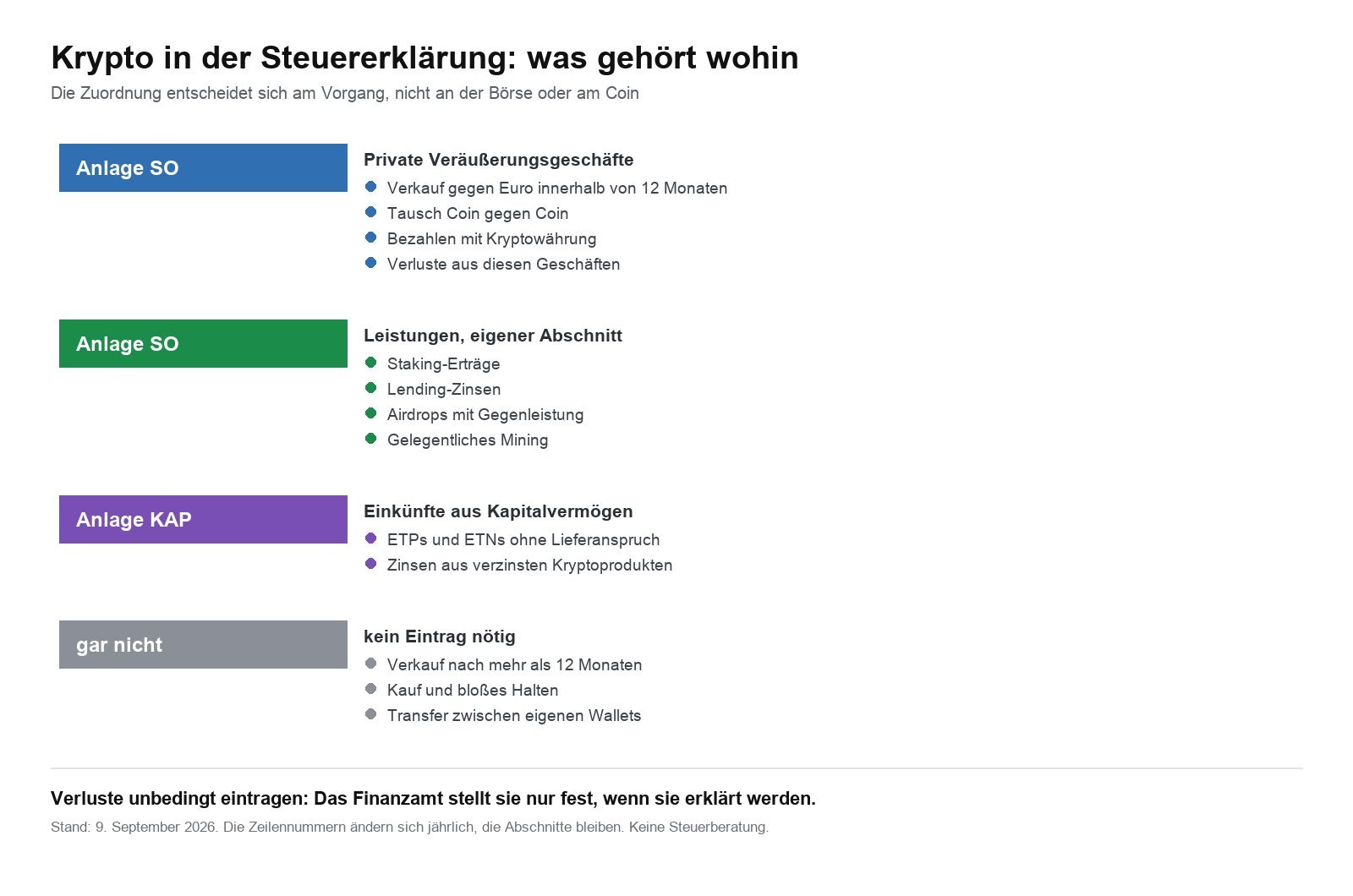
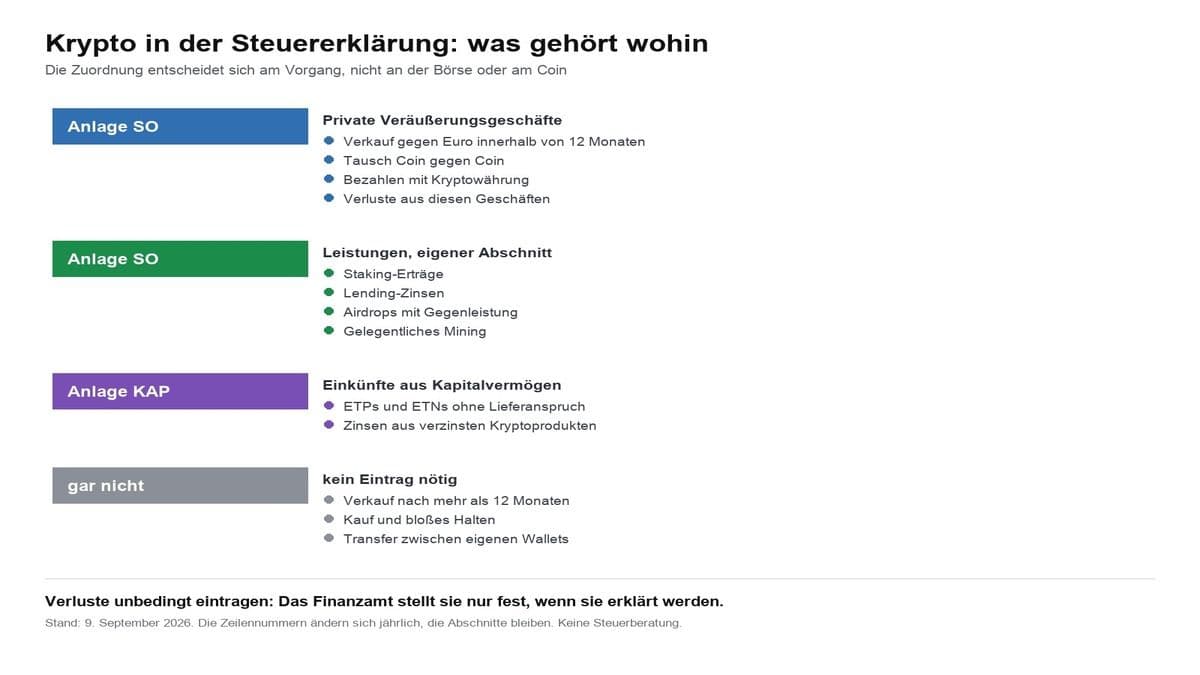
Annex SO is the main place. It is headed «other income» and contains two separate sections, both of which can apply to crypto.
The section on private disposal transactions covers sales, swaps and payments made in cryptocurrency, provided the position was younger than twelve months. For each transaction you enter the acquisition date, the disposal date, the disposal proceeds and the acquisition cost. Losses go into the same section, with a negative sign.
The section on services covers staking income, lending interest, airdrops received in return for something, and occasional mining. What counts is the market value at the moment the income arrives.
Annex KAP only concerns you with certain products. Anyone holding bitcoin through an ETP or ETN without a delivery claim may be earning investment income, which belongs there. The classification depends on how the product is structured and has not been settled conclusively. More on this in our article on bitcoin and tax.
One warning about line numbers: they change from year to year. Anyone following a guide with fixed line numbers from an earlier year will enter the figures in the wrong field. The section headings are reliable, and in ELSTER the input mask walks you through the fields anyway.
Through the tax return in four steps
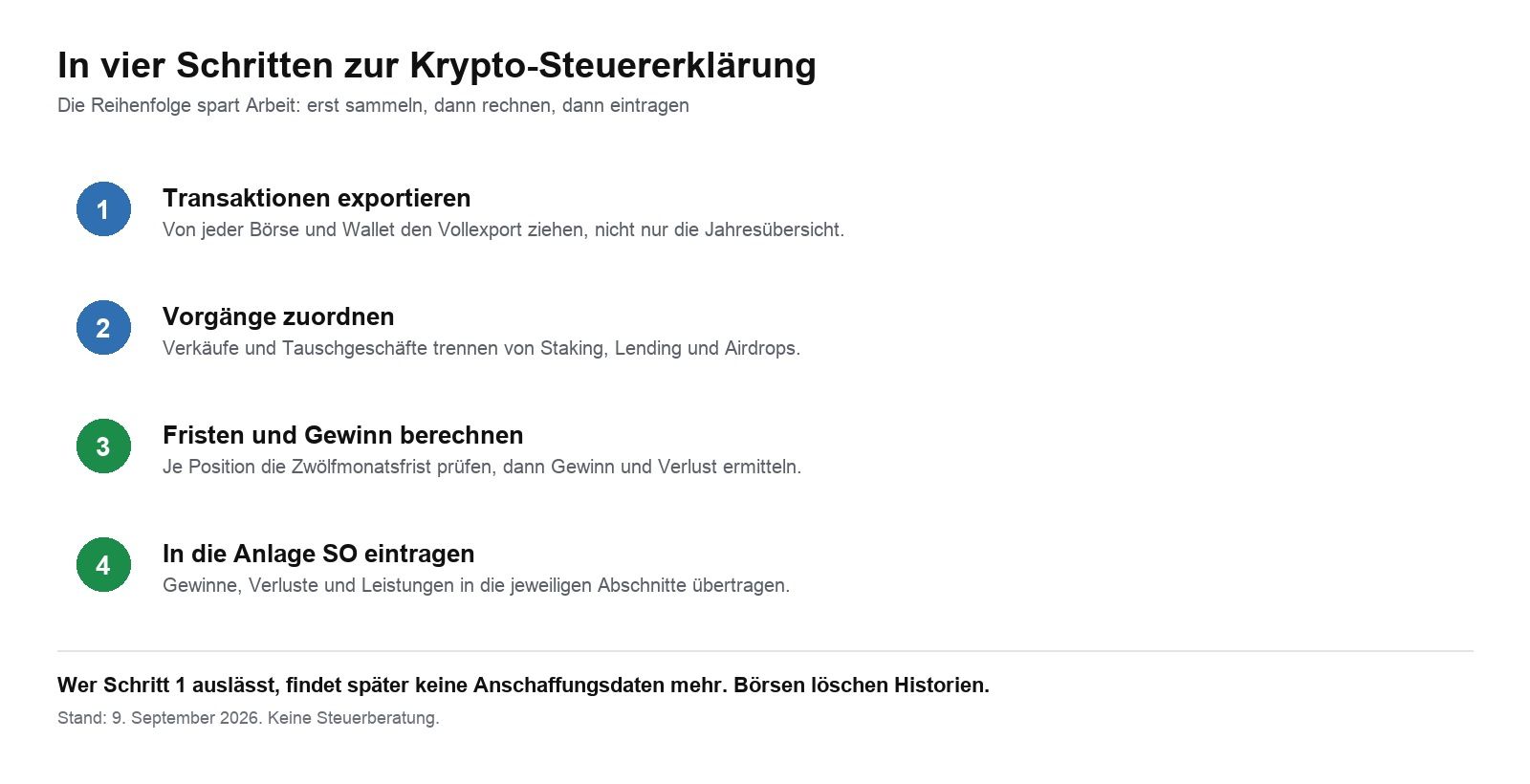
Step 1: export your transactions. Pull the complete export from every exchange and every wallet, not just the annual summary. You need every single transaction with date, time, quantity and price. Exchanges delete histories after a while or shut down altogether, which makes this the most important step.
Step 2: sort the transactions. Separate sales and swaps from staking, lending and airdrops. Both groups end up in Annex SO, but in different sections and with a different calculation.
Step 3: work out holding periods and gains. For every position sold, check whether more than twelve months passed between acquisition and sale. Where the same currency was bought several times, the consumption order from the Federal Ministry of Finance letter of 6 March 2025 applies: individual identification first, and where that is not possible, the coins acquired first count as the ones sold first.
Step 4: make the entries. Transfer the totals into Annex SO. You do not have to submit an itemised list, but you must be able to produce one on request. Many tax offices ask for it where larger amounts are involved.
Losses: the part most people forget
Losses from crypto sales inside the one-year window reduce your tax, but only if you declare them. The tax office establishes a loss carryforward only when it appears in the return. Anyone who skips a loss-making year because no tax is due anyway gives away the offset against future gains.
These losses can be offset only against gains from other private disposal transactions in the same year. Offsetting them against employment income or share gains is ruled out. Whatever is left over goes back one year or forward indefinitely.
Losses are entered in the same place as gains, in the private disposal transactions section of Annex SO.
What happens if you declare nothing
Since 1 January 2026 all centralised crypto service providers have been reporting to the tax authorities under the EU directive DAC8. The tax office knows about your exchange accounts without you saying a word.
Anyone who fails to declare taxable transactions risks tax evasion under section 370 of the German Fiscal Code. The limitation period there is ten years. A voluntary disclosure is possible, but it is tied to strict conditions: it has to be complete and it has to come in time, meaning before the offence is discovered.
The more honest route is the complete return. Anyone who can no longer assemble full records should disclose that and estimate, instead of leaving transactions out.
 Crypto exchanges compared: where you can buy bitcoin
Deadlines
The tax return for 2026 is due by 31 July 2027 if you file it yourself. With a tax adviser the deadline runs until the end of February 2028. Anyone who is not obliged to file but declares voluntarily has four years.
For crypto investors the filing obligation is reached quickly: anyone with secondary income above 410 euros has to submit a return. Gains from private disposal transactions count towards that.
Frequently asked questions
Do I have to declare crypto in my tax return?
Yes, if you have sold, swapped or paid within twelve months and your total gain from private disposal transactions is above 1,000 euros. Staking and lending income above 256 euros belongs in there as well.
Where do I enter crypto gains?
In Annex SO, in the private disposal transactions section. Staking and lending belong in the services section of the same annex.
Where do I enter crypto losses?
In the same place as gains, in the private disposal transactions section of Annex SO. Without an entry the tax office establishes no loss carryforward.
Do I have to declare crypto if I held for more than a year?
No. Once the twelve-month period has passed the gain is tax free and does not have to be declared.
Do I have to list every single transaction?
The totals are enough in the return itself. But you have to be able to produce the itemised list if the tax office asks for it.
What about coins on an exchange that has gone insolvent?
A default is not a disposal. The tax authorities recognise total losses only under narrow conditions, and advice on the individual case pays off here.
Do I need a tax tool?
With a handful of transactions a spreadsheet is enough. With savings plans, swaps or several exchanges it quickly becomes hard to follow: crypto tax tools compared.
Sources
- Federal Ministry of Finance letter of 6 March 2025, individual questions on the income tax treatment of certain crypto assets, file reference IV C 1 - S 2256/00042/064/043
- Section 23 and section 22 number 3 of the German Income Tax Act
- Section 370 of the German Fiscal Code on tax evasion, section 371 on voluntary disclosure
- Directive (EU) 2023/2226 (DAC8) on the reporting obligation of crypto service providers since 1 January 2026
The submission process from preparation through to filing is described in our article on filing a crypto tax return, and a step-by-step guide to making the entries is set out in our crypto tax instructions.
(As of 9 September 2026. This article is not tax advice and does not replace advice on your individual case. Line numbers and deadlines can change.)
Transparency note: This article was produced with the assistance of artificial intelligence and reviewed by our editorial team before publication. All figures and claims were checked against the primary sources linked in the text.
Related articles
- Offsetting Crypto Losses Against Share Gains: What Is Really Allowed in Germany
- Taxing Crypto Lending: Your Personal Rate Instead of Withholding Tax, and the Right Federal Fiscal Court Case Number
- Offsetting Bitcoin Losses Against Stock Gains in Austria
- Selling Bitcoin at a Loss: Loss Offsetting in Austria
- Bitcoin Losses and Dividends in Austria: How the Tax Offset Works
Which topics should we dive deeper into?
Select what genuinely interests you. Your picks feed directly into our editorial planning.
Crypto news that's actually worth your time.
Weekly. 60 seconds. Carefully curated by our editors: no hype, no promo flood, no spam.

August 31, 2026 10:23 AM

Bitcoin Abroad: The Tax Duty Austrian Investors Carry Themselves
Sold bitcoin through a foreign platform? When Austrian investors have to declare gains themselves and account for the 27.5 percent tax rate.
September 19, 2026 7:12 PM

Bitcoin Sold Without Austrian Tax Withheld: What to Do Next
Sold Bitcoin but no Austrian capital gains tax was withheld? That does not make the sale tax free. When investors have to declare the gain themselves at 27.5 percent.

February 13, 2026 9:07 PM

Netherlands Approves 36% Tax on Unrealized Crypto Gains starting 2028
The Dutch House of Representatives has officially passed a controversial 36% tax on unrealized gains for crypto and stocks, effective January 2028.
September 25, 2026 10:26 PM

Selling bitcoin privately: the tax in Germany and the records you need
A direct sale to a private individual falls under the same one-year rule as an exchange sale, but there is no tax report to go with it. This guide walks through the calculation, the 1,000 euro threshold and the records the tax office wants to see.
September 9, 2026 4:22 PM
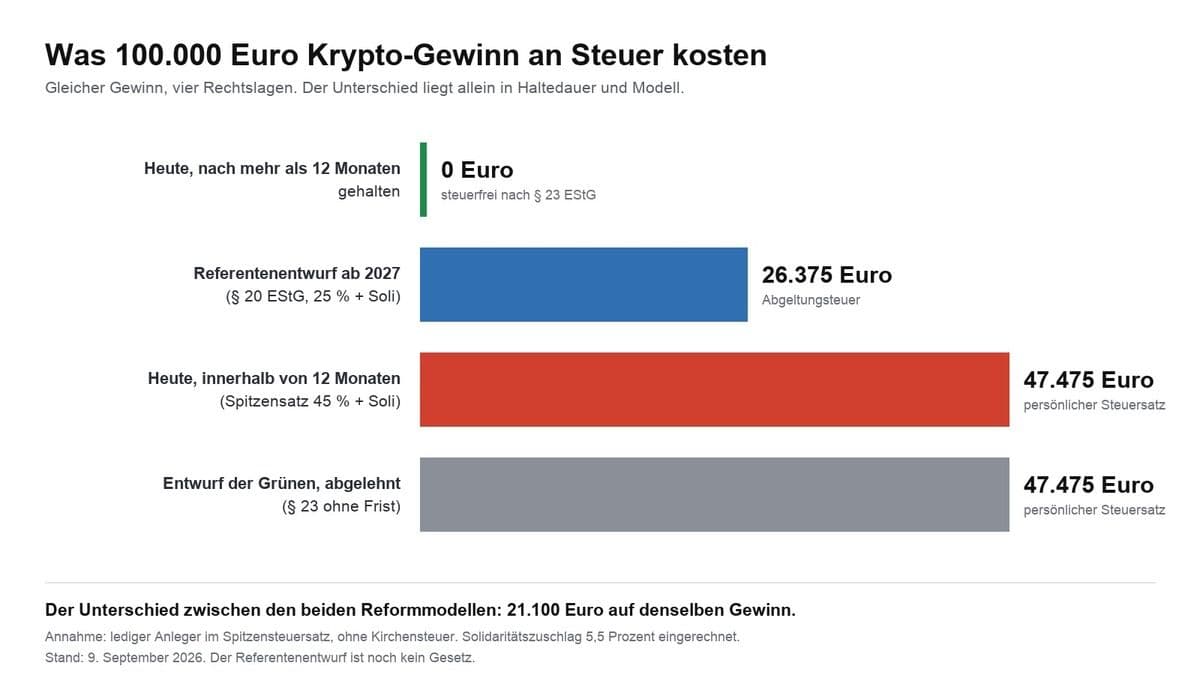
Crypto Tax in Germany: What Applies in 2026 and What Is Set to Change in 2027
Crypto gains are tax-free after twelve months; before that your personal tax rate of up to 45 percent applies. What triggers tax, how the holding period is calculated, what happens with staking and losses, and what the draft bill would change from 2027.
August 27, 2026 10:16 AM

Bitcoin Tax Return in Austria: When You Must File
Even with a crypto exchange, a tax return can still be necessary in Austria. Foreign platforms, missing capital gains tax withholding and cross-provider losses are the typical triggers.
August 18, 2026 7:13 AM

Bitcoin Tax Reporting in Austria 2026: What Applies
Bitcoin tax reporting in Austria: which data investors can request from crypto exchanges in 2026, and when the report matters for the tax return.
October 1, 2026 7:36 PM

Crypto tax and withholding at source from 2028: what to check now
The German Federal Ministry of Finance’s draft bill goes to cabinet on October 14, 2026. The underexposed part of it is the deduction of tax from 2028: which providers are to withhold the tax on investment income, why self-custody and foreign platforms stay exempt from it, and what you should document by December 31.
September 1, 2026 1:25 PM

Bitcoin Tax Report Wrong: What Austrian Investors Can Do
Errors in a Bitcoin tax report are not unusual. This is the data Austrian investors should check, and how a wrong capital gains tax deduction is put right.
August 21, 2026 1:33 PM

Bitcoin With No Cost Basis: How Austria Taxes the Sale
Bitcoin purchase price no longer provable? How Austria works out the capital gains tax, when a flat-rate cost basis applies and what investors can do.
August 10, 2026 9:15 PM
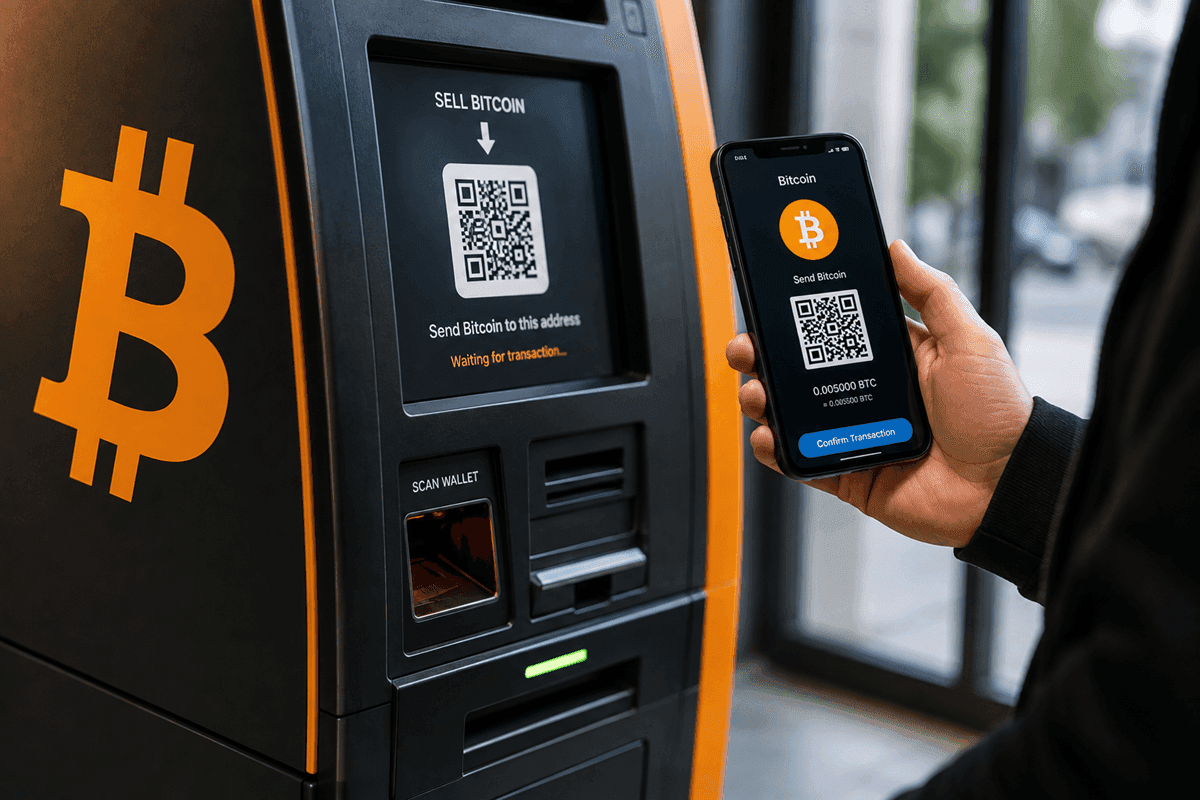
Selling Bitcoin at an ATM: Tax Rules in Austria
Selling bitcoin for cash at an ATM: when the 27.5 percent rate applies in Austria and which records you need to keep.
September 17, 2026 7:12 PM

Gifting Bitcoin to Children: Allowance, Holding Period and the Tax Office Report
Transferring Bitcoin to your child hands over your holding period and your entry price along with the coins. This guide sets out what really applies in Germany on the allowance, the reporting deadline, representation and custody.
September 25, 2026 1:30 PM

NEAR Staking ETP Passes $100 Million: What to Check on Yield, Brokerage Account and Holding Period
The Bitwise NEAR staking ETP has crossed $100 million in assets under management while NEAR climbs to $4.99. Our own retrieval of the issuer's figures shows the price made the jump, not the inflows.
September 7, 2026 10:24 AM

Gifting Bitcoin to Children: Tax Rules in Austria
Giving bitcoin to your children? When a gift notification is required in Austria, and which acquisition costs the child takes over.
August 19, 2026 1:31 AM

Crypto Tax Software Compared: What Blockpit, Divly, Waltio and Coinpanda Charge for One Tax Year
On August 14, 2026 we retrieved thirteen pricing pages from providers of crypto tax software and set the four evaluable ones with a German focus side by side. The comparison shows why three of them charge the same price at 1,000 transactions and where the expensive difference really lies.

September 24, 2026 1:34 PM

Cardano Slides Below $0.24: What ADA Holders Should Check on Leverage, Liquidation and Holding Period
Cardano has given back its move above $0.25 and trades around seven percent below the high of the past 24 hours. What that means for leveraged positions, the holding period of your tranches and the buying route under MiCA.
September 9, 2026 4:13 PM

Bitcoin 29 Percent Below Last Year: Which Crypto Losses You Can Still Use Before the One-Year Holding Period Expires
Nine out of ten major crypto assets trade lower today than exactly twelve months ago, Bitcoin alone by 29.2 percent. We measured the price series ourselves and show why the purchase date alone decides the tax value of your loss.
May 15, 2026 9:47 AM

Top 10 Altcoins to Buy in May 2026 as Bitcoin Recovers
Here are the top 10 altcoins to buy in May 2026 as Bitcoin rebounds near $80K and market momentum shifts.
August 20, 2024 3:00 PM

New US Senate Proposal Submitted For Crypto Tax Exemption
The US Senate has recently submitted a new proposal to exempt crypto transactions from federal taxes. Here are more details of this submission, and a list of exempted countries it could be joining...
October 2, 2026 10:38 PM

0 euros in acquisition costs in the crypto tax draft: how to check salary paid in Bitcoin
The draft bill recognises crypto assets flowing in for services not taxed under the new regime at acquisition costs of zero euros. With salary, rent and fees in Bitcoin the same amount would enter the tax calculation twice.
August 20, 2026 4:12 AM

Wrapped Bitcoin in Austria: Is Converting BTC to WBTC Tax-Neutral?
Swapping BTC for Wrapped Bitcoin: when the move to WBTC can be tax-neutral in Austria, and which tax risks investors should know about. Acquisition costs carry over, but the classification of the token decides the outcome.

September 22, 2026 7:20 PM

ETH Price Prediction: What to Check at the $2,800 Mark Now
Ether stands at $2,735.96 on September 22, 2026, right below the zone at which it has failed repeatedly. Instead of a target number, you get four checks that count before your next order: holding period, buying route, the staking line and the distance to liquidation.
September 9, 2026 1:15 AM

Germany's Crypto Tax: 160 Million Euros for a 555-Billion Budget
The German finance ministry's draft bill puts a figure on the crypto tax for the first time: 160 million euros from 2028. What that number means in the 2027 federal budget, how 11.4 billion became 160 million, and what investors can read from it.
May 9, 2024 1:47 PM

Altcoins to SELL in May 2024: Risky Levels Reached
With levels reaching their risk limits, some altcoins are a good idea to sell now. Can you guess which are the top 5?
August 16, 2026 9:11 PM
Swapping Bitcoin for Stablecoins: Does Austria Charge Tax?
Anyone swapping bitcoin for USDT or another stablecoin usually pays no tax in Austria yet. When the swap does become taxable after all.
August 10, 2026 5:15 PM

Bitcoin Lending in Austria: When Tax Falls Due
Lending Bitcoin and earning interest: when lending income is taxed at 27.5 percent in Austria and which exchange rate counts.
September 26, 2026 1:19 AM

Germany’s Crypto Holding Period Is Wobbling: What to Check Before December 31
A CDU member of the Bundestag makes it plain: the coalition agreement does not guarantee that the one-year holding period for crypto assets will survive. What that means for purchases made before the planned cutoff date of December 31, 2026.
More from CryptoTicker