
Bitcoin and the German Exit Tax: What Applies When You Move Abroad
Anyone emigrating with Bitcoin expects an exit tax on unrealised gains and finds nothing of the sort in the statute. Where the real risks sit is decided at four points: residence, the holding period, the legal form of your investment, and automatic reporting from 2026.





Which topics should we dive deeper into?
Select what genuinely interests you. Your picks feed directly into our editorial planning.
Crypto news that's actually worth your time.
Weekly. 60 seconds. Carefully curated by our editors: no hype, no promo flood, no spam.
The short answer first: if you hold Bitcoin privately and move away from Germany, the move itself triggers no tax on your capital gains. There is no deemed sale on the day you deregister and no taxation of unrealised gains on your wallet balance. The exit tax that so many emigrants warn about catches something other than crypto assets.
The move can still become expensive if you overlook the four places where German tax law reaches you even after departure: the moment your tax residence genuinely ends, the one-year holding period that keeps running when you sell, the legal form of your crypto investment, and the question of what your tax office will learn automatically from the 2026 reporting year onwards. This article works through those points in order, under German law, with the statutory references you can put in front of your tax adviser if in doubt.
Does the exit tax under Section 6 AStG apply to Bitcoin held privately?
Exit taxation means the state treats an asset as if you had sold it on the day you left and taxes the increase in value, although not a single euro has reached you. That is a hard intervention, and it is precisely why the legislator drew the scope narrowly.
Section 6 of the Foreign Transactions Tax Act attaches to shareholdings within the meaning of Section 17(1) sentence 1 EStG, meaning holdings in corporations from a stake of one percent upwards. Shares in a German GmbH fall under it, and so do equity blocks above that threshold. A Bitcoin, an Ether or a stablecoin in your own wallet is not a holding in a corporation. The wording of the provision leaves no room here, and that is why there is no German exit tax on directly held crypto assets in private hands. You can read the statute yourself if you want to: Section 6 AStG on the portal of the Federal Ministry of Justice.
The distinction matters in both directions. Anyone holding their coins through their own GmbH is not safe merely because the underlying asset is crypto. In that case the GmbH share is the asset that triggers the exit tax, and the value of the coins inside it helps determine how much tax falls due. The structure is widespread among German investors, and it turns the outcome on its head. Readers interested in the motives behind such departures will find the reasons and the destination countries set out in our survey of why crypto investors emigrate.
When does your unlimited tax liability end: residence under Section 8 AO and habitual abode under Section 9 AO
The decisive question when you leave is not when you boarded the plane but when your unlimited tax liability ends. You are subject to unlimited tax liability for as long as you have a residence or your habitual abode in Germany. The German tax authorities then capture your worldwide income, including gains made on a crypto exchange in Singapore.
Residence: the key counts, not the deregistration certificate
Section 8 of the Fiscal Code defines residence by the facts on the ground: you keep a dwelling under circumstances suggesting that you will retain and use it. Deregistering at the residents' registration office is evidence of that and nothing more. Anyone who leaves the old flat standing empty, who keeps a room in the family home available at any time, or who has held on to the key to a shared flat risks the tax office treating the residence, and with it full tax liability, as continuing. A genuine tenancy agreement solves the problem. An accommodation arranged as a favour among relatives usually does not.
Habitual abode: the six-month line
Section 9 of the Fiscal Code adds the habitual abode: anyone staying in Germany for more than six consecutive months is subject to unlimited tax liability even without a dwelling, and short interruptions count towards the period. For emigrants with a German client base this is the most common trap. Spend every summer in Germany without ever documenting the days and you will have nothing to set against a tax audit later. Keep a plain travel log from day one, with dates, border crossings and evidence.
If your unlimited tax liability ends mid-year, you also need a tax report that separates the periods cleanly. Many portfolio tools default to full calendar years. Which programs handle partial periods and several tax jurisdictions is set out in our comparison of crypto tax software and portfolio trackers.
The one-year holding period under Section 23 EStG keeps running when you leave
For as long as you are subject to unlimited tax liability in Germany, gains on the sale of crypto assets are private disposal transactions under Section 23(1) sentence 1 no. 2 EStG. If more than a year lies between acquisition and sale, the gain stays tax-free. Below that it counts as taxable income and is charged at your personal rate. An exemption limit of 1,000 euros applies to all private disposal transactions of a year taken together. An exemption limit is not an allowance: one euro above it makes the entire gain taxable.
Leaving the country does not interrupt that period, it only shifts who taxes at the end. What counts is the actual sale or swap, and where you are tax resident at that moment. From this follows the most practical rule in this article: do not sell while your change of residence is still incomplete. Cash in coins inside the one-year period two weeks before you deregister and you pay the full German rate on the entire gain.
The reverse holds as well. Your acquisition data does not disappear because you leave the country. Your new country of residence will ask, by its own rules, when you bought and at what price, and some states use the value at the time of arrival. Which records support a German holding period is something we have written up in detail elsewhere, and the same paperwork will serve you abroad.

Crypto ETPs, ETFs and fund units: where the exit tax under Section 19 InvStG does bite
This is where matters turn unexpectedly serious for many German investors. Since 1 January 2025 the Investment Tax Act has had its own exit tax for fund units held privately. Under Section 19(3) InvStG, the end of unlimited tax liability through giving up a residence or a habitual abode is treated as a disposal at fair market value. The tax authorities therefore act as though you had sold your fund units on the day you left.
That is triggered only above two thresholds, either of which suffices: you held at least one percent of a fund's issued units at some point in the past five years, or your units in that fund carry acquisition costs of at least 500,000 euros. Anyone with a larger portfolio of broad equity ETFs alongside a crypto allocation breaches the second threshold sooner than they would like.
Whether your crypto position itself falls under this depends purely on the legal form of the product. An investment unit is a unit in an investment fund within the meaning of the Investment Tax Act. The crypto ETPs common in Europe, by contrast, are mostly structured as debt securities, meaning ETNs, and therefore precisely not fund units. A US spot ETF on Bitcoin, on the other hand, is a fund. Check each position individually for what you actually hold, and use the terms of issue or the key information document for that, not the product name on your brokerage statement. On departure this distinction decides a five-figure tax bill.
 Document your crypto taxes properly
Extended limited tax liability under Section 2 AStG: when a low-tax country holds you for ten years
Extended limited tax liability is a run-on. Germany continues to tax you after you leave, though only on certain categories of income and only under narrow conditions. It is governed by Section 2 AStG and catches only those who meet every criterion at once.
First, in the ten years before the end of your unlimited tax liability you must have been subject to unlimited income tax as a German national for at least five years in total. Second, you must be resident in a low-tax territory or in no state at all; the law measures this against a comparative income of 77,000 euros and a burden of less than two thirds of the German income tax. Third, you need substantial economic interests in Germany, which Section 2(3) AStG assumes among other things where domestic income exceeds 62,000 euros or domestic assets exceed 154,000 euros. Where all of that applies, the run-on lasts until ten years after the end of the year of departure, and it takes effect only above 16,500 euros of income subject to limited tax liability in an assessment period.
For crypto investors the point is delicate, because Section 2 AStG captures all income that does not constitute foreign income within the meaning of Section 34d EStG. A gain on the sale of coins can be allocated neither to foreign real estate nor to a foreign permanent establishment, so the classification has to be settled case by case. Anyone moving to Dubai, Paraguay or a similarly taxing country while keeping German rental income or a stake in a German company should settle that question with a tax adviser before the move rather than after it.
Commercial trading and business assets: deemed disposal instead of exit tax
If you hold your crypto assets as business assets, a different system applies. Deemed disposal means that Germany treats an asset as withdrawn as soon as the German right of taxation over it is excluded or restricted; the legal basis is Section 4(1) sentence 3 EStG. Move your business abroad and cessation of business under Section 16(3a) EStG comes into play on top.
So anyone trading commercially, mining commercially or running a trading structure can well trigger taxation of unrealised gains on departure, and that without Section 6 AStG being needed at all. The line between private asset management and a trade depends on scale, external financing, organisation and outward appearance. If that question gives you pause, that in itself is a sign that a case-by-case review is needed.
Double tax treaties: who taxes when both states see you as resident
In the first months after a move it often happens that two states treat you as tax resident at the same time. German double tax treaties provide an order of precedence for this, modelled on Article 4 of the OECD Model Convention: first the permanent home, then the centre of vital interests, then the habitual abode, and finally nationality.
The centre of vital interests is where most emigrants come unstuck, and it is measured by mundane things. Where does your family live, where is your doctor, where is the sports club, where is the current account that pays the running costs. You do not change country with a passport alone. Most treaties, incidentally, allocate gains on the sale of crypto assets to the state of residence, because they fall under the catch-all clause for other property. That too is what makes a clean determination of residence so important.

Where your coins sit: self-custody, exchange accounts and the duty to cooperate under Section 90 AO
The location of your coins is irrelevant for tax purposes; the location of your records is not. The Federal Ministry of Finance circular of 6 March 2025 on individual questions of the income tax treatment of certain crypto assets regulated the duties to cooperate and to keep records explicitly for the first time, and it replaces the older circular of 10 May 2022. Anyone buying or selling through centralised trading platforms run by foreign operators is subject to the extended duty to cooperate in cross-border matters under Section 90(2) AO. In plain terms, you have to establish the facts and obtain the evidence yourself, and the tax office may estimate if you cannot. The full text is available as a PDF from the Federal Ministry of Finance.
That creates a practical difference between the forms of custody. An exchange account is tied to an identity and to a country: many providers block or restrict accounts when the registered address changes to a country they do not serve, and exporting the trading history then becomes difficult. A self-custody wallet moves with you and needs nobody's consent. The price is that nobody else keeps your records. If you are switching to self-custody, do it before you leave rather than after, and download every transaction history first. Which device suits you is covered in our hardware wallet comparison.
 Custody that moves with you
What the tax office learns about your crypto accounts from 2026: DAC8 and the KStTG
DAC8 is EU Directive 2023/2226 on cooperation between tax administrations, which obliges providers of crypto services to report on their customers. Germany implemented it through the Crypto Asset Tax Transparency Act, which came into force on 1 January 2026. The first reporting period is the 2026 calendar year; providers transmit the data by 31 July 2027 to the Federal Central Tax Office, which exchanges it with partner states.
For a departure that has two consequences. First, your master data and aggregated transactions for 2026 are reported even if you move away in the course of that year, and the comparison with your final German tax return does take place. Second, the report follows the country of residence that you give your provider. An out-of-date address in your customer account therefore generates reports to the wrong country, and untangling that costs more time than updating it in good time. How the reported amount is arrived at, and why it does not correspond to your gain, is explained in our piece on crypto reporting duties and the difference between the gross amount and the gain.
The misconceptions that get expensive when you emigrate with Bitcoin
“I have deregistered, so I am out.” Deregistration is registration law, not tax law. What counts is dwelling and abode under Sections 8 and 9 AO.
“Crypto falls under the exit tax.” For directly held coins in private assets it does not arise. For fund units above the thresholds of Section 19 InvStG, and for shares in corporations, the picture is different.
“After the move I can sell tax-free.” That holds only if your unlimited tax liability had genuinely ended at the time of sale, no run-on under Section 2 AStG applies, and your new country of residence does not tax the transaction itself.
“My exchange is abroad, so nobody finds out.” Since the 2026 reporting year that is a mistaken assumption made with fair warning, and the cross-border element triggers the stricter duty to cooperate on top.
“I will sort that out after the move.” Almost every planning option in this article requires you to use it before the cut-off date. After that, all you are doing is documenting.
Which records to secure before you move
The burden of proof for the date and the cost of acquisition lies with you, and it does not lapse with your residence. Before you leave, download the complete transaction export as a CSV from every platform, along with the annual statements, the bank's deposit and withdrawal receipts, and the account statements showing the euro inflows.
What is usually missing once it is needed
Records from trading venues that have since closed. Wallet addresses you never wrote down and whose link to you only you know. Documentation of swaps between two coins that never touched a euro account and are therefore absent from the bank statement. Evidence of staking and lending income, which many platforms keep for only twelve months. And the record of which units were disposed of in a partial sale, which you have to keep per wallet anyway once you use more than one.
Put the export on a medium that survives the move and keep a second copy separately. A tax report that cleanly closes out your German period is the best investment of this move.
Bitcoin and moving abroad: what to take away
- Settle the cut-off date first, not the tax. Determine the date on which your dwelling and abode in Germany demonstrably end, and place every sale deliberately before or after it. Keep your position data cleanly separated as you go; the tools that handle partial periods are in the comparison of crypto tax software.
- Check every position for its legal form. Directly held coins are not caught by the exit tax, while fund units from 500,000 euros of acquisition costs and holdings in corporations are. At the same time, move your custody into a form that travels with you: the options are in the hardware wallet comparison.
- Secure the records before you go. Complete transaction export, bank records, wallet addresses and a closing report for your German period. If you notice that a year has gaps, close it now with one of the portfolio trackers and not when the tax office asks.
This article sets out the legal position and does not replace tax advice in an individual case. On departure in particular the outcome turns on details that only someone who knows your paperwork can judge.
(As of September 18, 2026. This article is not investment advice. Prices and fee structures change; check the terms with the provider before you buy.)
Transparency note: This article was produced with the assistance of artificial intelligence and reviewed by our editorial team before publication. All figures and claims were checked against the primary sources linked in the text. The feature image was generated with AI.
Related articles
- Germany's Crypto Holding Period: What Happens Now Signing for Petition 201716 Closed on September 15
- Dogecoin Price: What to Check on Holding Period and Custody Before the Year End
- Circle Lends Against Bitcoin via cirBTC: Why the Wrapper Can Cost You the German Holding Period
- Bitcoin 29 Percent Below Last Year: Which Crypto Losses You Can Still Use Before the One-Year Holding Period Expires
- Germany's Crypto Holding Period Faces Abolition: What Petition 201716 and the Cabinet Decision Mean for Your Tax
Which topics should we dive deeper into?
Select what genuinely interests you. Your picks feed directly into our editorial planning.
Crypto news that's actually worth your time.
Weekly. 60 seconds. Carefully curated by our editors: no hype, no promo flood, no spam.

September 16, 2026 7:12 PM

Borrowing Against Bitcoin Instead of Selling: When German Tax Still Applies
Posting Bitcoin as collateral for a loan is not a sale in Germany, because section 39 of the Fiscal Code keeps the coins attributed to you for tax purposes. Tax arises only when the collateral is liquidated, and then the one thing that decides the bill is how long you held the coins beforehand.
September 7, 2026 7:22 AM

German Crypto Holding Period Stays: The Income Tax Reform 2027 Leaves Section 23 Untouched
On September 2, 2026 the German federal cabinet adopted the draft of an Income Tax Reform Act 2027, and crypto assets do not appear in it. The one-year holding period under Section 23 of the Income Tax Act therefore continues to apply unchanged.
September 26, 2026 1:19 AM

Germany’s Crypto Holding Period Is Wobbling: What to Check Before December 31
A CDU member of the Bundestag makes it plain: the coalition agreement does not guarantee that the one-year holding period for crypto assets will survive. What that means for purchases made before the planned cutoff date of December 31, 2026.
September 27, 2026 10:35 AM

Crypto Exchange Tax Report Wrong: How to Correct It Before the Tax Office Does
Missing acquisition costs, transfers booked as sales, holding periods restarted: your exchange's report is an aid and not proof. How to check it, how to correct it and which deadline is running.
September 25, 2026 10:26 PM

Selling bitcoin privately: the tax in Germany and the records you need
A direct sale to a private individual falls under the same one-year rule as an exchange sale, but there is no tax report to go with it. This guide walks through the calculation, the 1,000 euro threshold and the records the tax office wants to see.
September 17, 2026 10:22 PM

Selling Bitcoin at a Loss and Buying It Straight Back: What That Does to Your Holding Period
Germany has no wash sale rule: the loss stays deductible even if you buy back immediately. The buyback, however, restarts the one-year period for every new unit.
September 8, 2026 10:21 PM

Crypto Holding Period and Grandfathering: Why December 31, 2026 Becomes the Cut-Off in Germany's Draft Bill
A ministerial draft bill from Germany's finance ministry names a cut-off date for the first time: crypto assets acquired after December 31, 2026 are to fall under the flat-rate withholding tax. What that means for legacy holdings, running savings plans and staking income, and why nothing has been decided yet.
September 17, 2026 7:12 PM

Gifting Bitcoin to Children: Allowance, Holding Period and the Tax Office Report
Transferring Bitcoin to your child hands over your holding period and your entry price along with the coins. This guide sets out what really applies in Germany on the allowance, the reporting deadline, representation and custody.
October 2, 2026 4:39 AM

Donating bitcoin: when does the full market value count, when only the purchase price?
A bitcoin donation to a charitable organisation is deductible as a donation in kind, and the donation itself produces no taxable gain. The size of the deduction turns solely on whether a sale would have been taxable on the day of the transfer.
September 16, 2026 1:20 PM

Crypto Loss Carryforward in Germany: What Happens to Old Losses Under the 2027 Tax Plan
Losses from crypto sales land in a ring-fenced pot and can only be set against gains of the same kind. The draft bill for 2027 moves future gains into a different pot, and we show you what that means for your assessed carryforward and what your tax notice should say.
August 21, 2026 4:24 AM

Forced Sale on a Crypto Exchange: Which Moment Counts for the Holding Period and What You Must Document
At Luno, Kraken and Valour the deadlines are running out, after which the provider realises the remaining holding itself. For tax purposes that is a disposal, and what governs it is the exchange's timestamp.
September 9, 2026 4:22 PM
Crypto Tax in Germany: What Applies in 2026 and What Is Set to Change in 2027
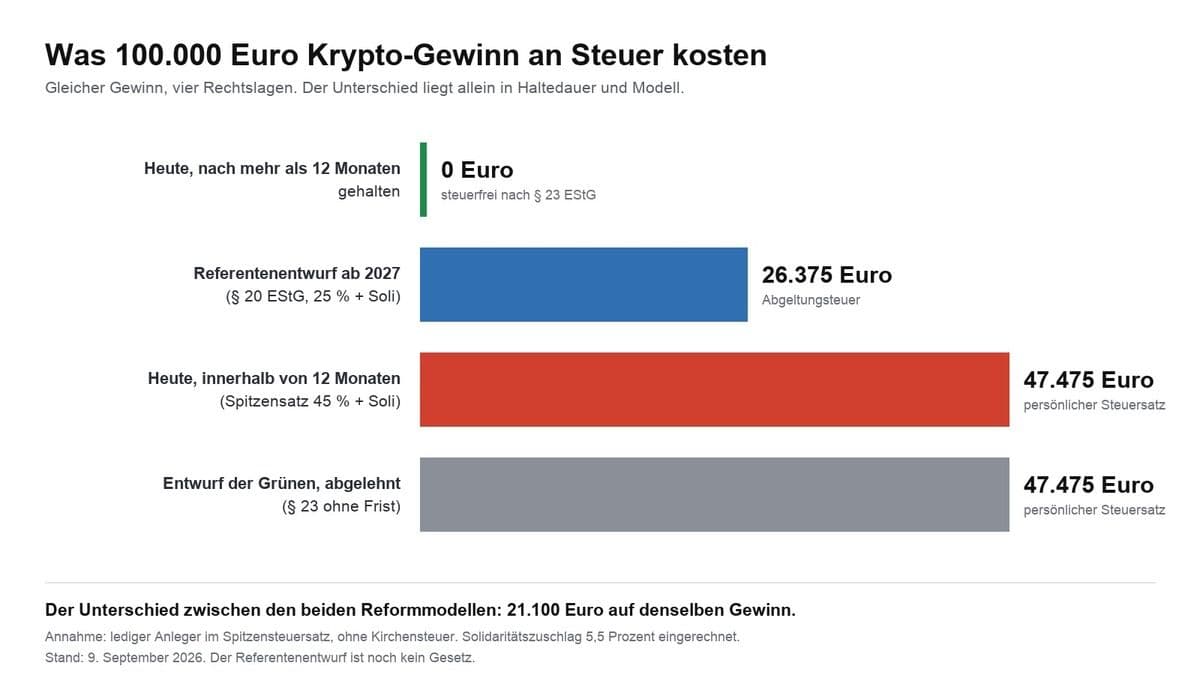
Crypto gains are tax-free after twelve months; before that your personal tax rate of up to 45 percent applies. What triggers tax, how the holding period is calculated, what happens with staking and losses, and what the draft bill would change from 2027.
September 24, 2026 1:13 AM

Solana DEX Trades Overtake the NYSE: What to Check on Swaps, Tax and Oversight
Solana's decentralised exchanges settled roughly 208 million trades in a single week and overtook the New York Stock Exchange for the first time. The figure is real, but it measures something other than the comparison suggests, and for German investors it carries tax duties that no provider takes on.
September 9, 2026 1:15 AM

Germany's Crypto Tax: 160 Million Euros for a 555-Billion Budget
The German finance ministry's draft bill puts a figure on the crypto tax for the first time: 160 million euros from 2028. What that number means in the 2027 federal budget, how 11.4 billion became 160 million, and what investors can read from it.
September 25, 2026 4:20 AM

Crypto as a Down Payment for a German Mortgage: What Banks Require
Since April 2023 a house in Germany can no longer be paid for in Bitcoin; section 16a of the Money Laundering Act bans it outright. Your crypto holdings still work as a down payment, provided you take the route through the euro and prove the origin without gaps.
August 22, 2026 7:31 AM

Bitcoin Exit Tax in Austria: Which Value Counts?
Anyone emigrating from Austria with Bitcoin can trigger exit tax. What is decisive in principle is the market value at the moment the taxing right is lost.
September 22, 2026 7:23 AM

Gifting Bitcoin to Your Spouse: Allowance, Holding Period and the Report to the Tax Office
Thanks to a 500,000 euro allowance, a gift to a spouse is almost always free of gift tax, and it is not a disposal either. What matters is what travels with it: your purchase date, your purchase price and with them the state of the one-year holding period.

July 31, 2026 10:59 AM

German Crypto Tax Return 2025: What You Should Know Now the July 31 Deadline Has Passed
Recap as of September 27, 2026: the deadline for the 2025 German tax return ended on July 31, 2026 at midnight. This article describes the situation on the day of the deadline: what crypto investors had to report and what happens if the deadline is missed.
September 25, 2026 7:24 PM

Bitcoin Forecast: What to Check on Levels, Holding Period and Buying Route Before the Quarter Ends
Bitcoin stands at $83,877 at 16:40 UTC on September 25, 2026, and the measured volatility of the past 30 days spans a band of $73,600 to $94,200 for the coming month. More important than that band before the quarter ends are three checks: holding period, buying route under MiCA and the reporting duty in force since January 2026.
September 24, 2026 10:19 PM

Bitcoin for Retirement: What Applies from 2027 and What You Decide Now
Bitcoin is not permitted in any state-subsidised retirement product, including the new retirement savings account from 2027. Anyone who still wants to use crypto assets for their own pension goes through private assets, and there a cutoff date at the end of 2026 is shifting the tax rules right now.
August 24, 2026 10:16 AM

Crypto Tax: Why You Have to Secure Your Transaction History Before the Exchange Closes Your Account
Deadlines run out at several crypto exchanges by early September, after which accounts close and holdings are sold off by force. Anyone who does not export the trading record beforehand faces the tax return with no proof of acquisition date and purchase price.
August 12, 2026 6:24 PM

Tokenized Stocks and Tax in Germany: When the One-Year Holding Period Applies and When the Flat Tax Bites
If you buy a tokenized stock, you often apply the crypto rule: hold for a year, then the gain is tax-free. For these products that assumption usually does not hold, and this article shows from the wording of the law which feature decides the tax regime and how to find it in the issuer documents.
October 1, 2026 10:44 AM

German crypto tax reform: without a receipt, half the sale price is taxed
The Federal Ministry of Finance's draft bill goes to the cabinet on October 14. Anyone who cannot prove their acquisition cost pays tax on 50 percent of the sale proceeds under the substitute assessment.
August 14, 2026 6:23 AM

Bitcoin Savings Plan and Tax: How the Holding Period, FIFO and the Exemption Limit Interact on Monthly Buys
Every savings plan instalment is a separate acquisition for tax purposes, with a holding period of its own. How the exemption limit, the order of disposal and record-keeping duties interact on monthly Bitcoin buys, with the sources from the statute and the Ministry of Finance circular.
September 22, 2026 4:12 PM

Nearly $1 Billion Into Bitcoin ETFs: What to Check on ETNs, Portfolio and Holding Period
US spot bitcoin ETFs took in a net $999 million on September 21, the third consecutive day of inflows. German investors cannot reach these funds: what ETNs, the holding period and your buying route mean for you.


More from CryptoTicker