
A Securities Account at the Crypto Exchange: Why Capital Gains Tax and Anlage KAP Are on You
On August 18, 2026 Kraken opened trading in more than 7,000 US stocks to customers in the European Economic Area, provided by a Cypriot investment firm. That puts the securities account abroad, and German capital gains tax, loss offsetting and the saver’s allowance now run through your own tax return.




Which topics should we dive deeper into?
Select what genuinely interests you. Your picks feed directly into our editorial planning.
Crypto news that's actually worth your time.
Weekly. 60 seconds. Carefully curated by our editors: no hype, no promo flood, no spam.
If you buy US stocks through a crypto exchange, nobody withholds German capital gains tax on your behalf. Dividends and sale proceeds are credited to you gross, and the settlement with the tax office runs entirely through your income tax return. This is no grey area and no negligence on the provider’s part; it follows directly from where the securities account is held.
Since August 18, 2026 the question has become practical for considerably more people. That was the day Kraken opened US stock trading to customers in the European Economic Area. Anyone who previously held only Bitcoin and a few altcoins on the platform can now buy Apple, Nvidia or Tesla shares there as well. For tax purposes they land in a body of rules that has nothing to do with crypto and that many investors encounter for the first time.
Kraken brings 7,000 US stocks to the EEA: what applies since August 18
According to the exchange’s own announcement, eligible customers in the EEA have been able to trade more than 7,000 US stocks since August 18, 2026, alongside more than 600 crypto assets and more than 700 so-called xStocks. Trading in the shares is commission-free; in the small print the exchange states expressly that further costs such as spreads and currency conversion charges can arise. Trading is offered through the app and through Kraken Pro.
According to consistent trade reporting, Germany was among the first markets in which the offering ran in a limited pilot phase, together with France and the Netherlands. The go-live on August 18 completed that roll-out across the entire economic area. The exchange itself names no list of countries in its announcement and refers throughout to eligible customers in the EEA.
Decisive for everything that follows is one sentence from the legal section of that same announcement: the investment services are provided by Payward Europe Digital Solutions (CY) Limited, an investment firm authorised under the European markets in financial instruments directive and supervised by the Cypriot securities regulator CySEC. Your securities account therefore sits in Cyprus.
Domestic or foreign securities account: how to tell the difference
A foreign securities account is one held by an institution domiciled outside Germany, even when the app speaks German, you deposit in euros and the provider is regulated in the EU. The domicile of the custodian institution decides, not your address and not the language of the interface.
The difference is invisible in daily use and highly visible in the tax return. A German institution deducts the tax directly on every dividend and every sale at a profit, pays it over to the tax office and sends you a tax certificate at year end in which everything has already been offset. A foreign institution does none of that. It credits you the full amount and leaves the rest to you.
How to spot it without turning lawyer: look in the contract documents or in the footer of the trading platform for the name of the company providing the investment service, and for the competent supervisory authority. If a foreign regulator is named there, you hold a foreign securities account. At Kraken that is the Cypriot CySEC and the Payward company named above. If you are losing track of several accounts, our overview of crypto tax tools and portfolio trackers lists programs that consolidate accounts and wallets and prepare the annual figures for the return.
Why a Cypriot investment firm withholds no capital gains tax
The Income Tax Act governs automatic withholding not through the question of how well a provider is regulated but through a very narrow definition. Under section 44 paragraph 1 of the Income Tax Act, the paying agent, meaning whoever has to carry out the deduction, is in the cases relevant here the domestic credit, financial services or securities institution that holds or administers the securities.
The paying agent is, in tax law, the body that pays out your investment income and is therefore obliged to withhold the tax for you. The word domestic in that provision is the whole difference. An investment firm domiciled in Cyprus is no domestic institution, so the obligation does not apply to it. The firm may not withhold the German tax and consequently does not.
The same holds for providers from Ireland, the Netherlands or Malta, and it holds regardless of whether the provider carries a MiCA licence for its crypto business. Regulation and tax withholding are two separate questions that are frequently confused. A European authorisation protects your securities account and gives you a supervisory route; it does not make the provider a German paying agent.

Anlage KAP becomes mandatory: what section 32d paragraph 3 EStG requires
Because nobody withholds the tax, the law shifts the duty onto you. The wording is short and leaves no room: taxable investment income that has not been subject to capital gains tax must be declared by the taxpayer in their income tax return. And the following sentence states that in this case an assessment is to be carried out, irrespective of the other rules on who has to file a return at all.
In plain terms that means two things. First, the income from the foreign account belongs in Anlage KAP, the schedule of the German income tax return for investment income. Second, anyone who would otherwise not have to file a return at all is obliged to file by this income. An employee with no other income who has never submitted a return slips into mandatory assessment.
The tax rate does not change as a result. Income tax on investment income is 25 percent under section 32d paragraph 1 of the Income Tax Act, plus the solidarity surcharge of 5.5 percent on that amount, which together gives 26.375 percent, plus church tax where applicable. Only the route is different: instead of a deduction at source, the tax office sets the amount in the assessment notice and you pay it afterwards.
 Crypto tax tools compared
The saver’s allowance without an exemption order: how to claim the 1,000 euros
The saver’s lump-sum allowance is 1,000 euros under section 20 paragraph 9 of the Income Tax Act, or 2,000 euros for spouses assessed jointly. You do not lose it in a foreign account. The usual route to it, however, is blocked.
An exemption order takes effect only towards whoever is obliged to withhold. Since the Cypriot investment firm is under no such obligation, it cannot accept an exemption order either. There is simply no form for it in this account, and anyone looking for one is looking in vain.
You claim the allowance through the tax return instead. That works reliably, but it has a side effect that costs money in practice: if you also run a German securities account and have an exemption order there for the full 1,000 euros, the allowance is already used up before the foreign income even enters the calculation. Anyone using both in parallel should reduce the exemption order at the German provider accordingly and keep the remainder for the assessment.
Loss offsetting in a foreign account: why the bank’s loss pots are missing
A loss pot is an account that a German institution runs for you and in which it collects your losses during the year in order to offset them against later gains. Under section 43a paragraph 3 of the Income Tax Act, the paying agent offsets negative investment income in the current calendar year up to the amount of the positive income; whatever remains it carries forward to the following year automatically. On request it issues a loss certificate instead, and the irrevocable application for it must reach the agent by December 15 of the current year.
This entire apparatus does not exist for your Cypriot account. There is no loss pot there, no automatic carry-forward and no loss certificate, because all of it is tied to the duties of a domestic paying agent. You offset losses from share sales only in the assessment, and subject to the relevant restrictions: losses from the disposal of shares may be offset only against gains from the disposal of shares, not against dividends or interest.
In practice that means you have to keep the books yourself. The platform supplies you with transaction lists but no annual statement prepared for tax purposes under German law. Anyone who also holds crypto assets already has a record-keeping duty and knows the drill; anyone who has only ever had a German securities account has to learn it. An overview of brokers and trading venues together with their tax treatment helps in deciding whether the effort is worth it for you or whether a German provider with automatic withholding is the quieter choice.

US withholding tax on dividends: what the W-8BEN form changes
Withholding tax is the tax retained by the state from which the income originates, before the money reaches your account. On dividends from US companies the US side deducts that amount. For investors who have filed no W-8BEN form it is high; with the form on file, the lower rate from the double taxation treaty between Germany and the United States applies.
The W-8BEN form is a self-declaration to the US tax authority in which you confirm that you are resident for tax purposes outside the United States. Brokers usually ask for it when the account is opened, and it is time-limited. After opening, check in the account area whether it is on file and still valid. The specific rates and the handling in an individual case are set out in the provider’s contract documents and in the statements for each individual dividend.
Tax paid abroad is not lost. Under section 32d paragraph 5 of the Income Tax Act, foreign tax assessed and paid is credited against the German tax, though at most 25 percent of foreign tax on each individual item of taxable investment income. This crediting too happens exclusively in the assessment with a foreign account, because in a domestic account the bank would already have taken it into account at the point of deduction.
Real share or xStock: why two tax regimes run in the same account
Kraken advertises the combination expressly: real shares and tokenised shares side by side in one account. An xStock is a token that tracks a US share and, according to the exchange, is backed one to one by the underlying share. The legal annex to the announcement states that the xStocks are issued by Backed Assets (JE) Limited, domiciled in Jersey, and offered through Payward Digital Solutions Ltd, licensed in Bermuda, and that they are not registered with any local securities regulator and will not be registered.
What looks convenient is a fork in the road for tax purposes within the same account. Whether a token that tracks a share is treated for tax like a share or like another asset is the decisive question, and it depends on the legal form of the token. We covered it in detail in our piece on tokenised shares and their taxation in Germany; anyone using both product types should record them separately and not mix them in a joint annual statement.
A second point concerns backing. In June 2026 we described a case in which the backing of an xStock on a paper with no available trading inventory began to slip; the details are in our analysis of the shortfall on an xStock. For the tax question that changes nothing; for the risk question it does.
 Crypto brokers compared
Our own analysis: what the statutes actually say
cryptoticker.io compiled this analysis itself on August 27, 2026. Method: on the same day we retrieved the four relevant provisions of the Income Tax Act as well as the surcharge rate of the Solidarity Surcharge Act in the official full text on gesetze-im-internet.de and analysed the governing paragraphs in their wording. Five provisions were examined, each in full.
- Section 44 paragraph 1 EStG: the paying agent that has to carry out the deduction is, in the cases relevant here, the domestic credit, financial services or securities institution. The word domestic appears in the statutory text.
- Section 32d paragraph 3 EStG: investment income that has not been subject to capital gains tax is to be declared in the income tax return, and an assessment is to be carried out.
- Section 32d paragraph 5 EStG: foreign tax is credited, at most 25 percent on each individual item of taxable investment income.
- Section 43a paragraph 3 EStG: loss offsetting and loss carry-forward are duties of the paying agent; the application for a loss certificate must reach it by December 15 of the current year.
- Section 20 paragraph 9 EStG and section 4 SolzG 1995: saver’s lump-sum allowance of 1,000 euros, or 2,000 euros on joint assessment; solidarity surcharge of 5.5 percent of the assessment base.
Some points remain open. First, we hold no account with the provider and could therefore not look at which statements and annual summaries the platform actually issues. Second, the statement that Germany was among the pilot markets rests on trade reporting and not on a statement by the exchange. Third, the specific withholding rates in an individual case depend on how the account is set up, which we cannot verify without access to a real dividend statement.
Information exchange: why the tax office learns of your foreign account anyway
The notion that an account abroad stays undetected has been out of date for years. For securities accounts at foreign financial institutions, the automatic exchange of information on financial accounts applies, in which Cyprus participates like every EU state. For crypto assets, the European reporting obligation for crypto-asset service providers has applied since 2026, with the first data deliveries expected the following year.
The two channels are separate and concern different types of assets, but they arrive at the same place. Anyone holding shares and crypto assets at one provider is reported through two routes. That is no reason for nerves but a reason to make your own return complete: discrepancies between what the tax office receives and what you declare now show up automatically. How this interacts across the individual asset classes is something we worked through using the taxation of stablecoins as an example.
Records for the tax return: which documents to collect from now on
Because nobody issues you a German tax certificate, your own filing becomes the basis of the return. It makes sense to secure the documents continuously rather than once in April of the following year, because trading platforms shorten export periods and make accounts available only to a limited extent after closure. The BitMEX case showed in 2026 how quickly access to a platform can become tight.
These are the records you need:
- All purchase and sale statements with date, quantity, price and currency, from which acquisition costs and disposal proceeds can be derived.
- All dividend statements showing the foreign withholding tax retained, because without that disclosure no crediting is possible.
- The conversion rates on the relevant date where settlement was in US dollars.
- Proof of the W-8BEN form on file and its period of validity.
- An annual overview of all positions, separated into real shares and tokenised paper.
A note on our own account: this text places the legal position in context and replaces no tax advice. With larger amounts, with losses across several years or with a mixture of shares, tokenised paper and crypto assets, a trip to a tax adviser is the cheaper option.
A securities account at the crypto exchange: what to take away
- Check where your account is held. Look in the contract documents for the company providing the investment service and for the competent supervisor. If a foreign authority is named there, you hold a foreign account and have to declare the income yourself. Which providers work with a European authorisation is shown by our overview of regulated crypto exchanges.
- Set up your document filing before the first purchase goes through. Download statements monthly and file them separately by real shares and tokenised paper. A tool from our comparison of crypto tax tools and portfolio trackers takes the consolidation off your hands.
- Weigh the effort against the price advantage. Commission-free trading is cheaper only once spreads, currency conversion costs and your own declaration work are counted in. If you do not want that effort, the comparison of crypto brokers lists providers where the tax is paid over automatically.
You can look up the governing provisions yourself: section 32d of the German Income Tax Act covers the tax rate, the filing obligation and the crediting of foreign taxes in one place. The exchange’s product announcement with the legal annex is in the Kraken blog of August 18, 2026.
(As of August 27, 2026. This article is not investment advice. Prices and fee structures change; check the terms with the provider before you buy.)
Transparency note: This article was produced with the assistance of artificial intelligence and reviewed by our editorial team before publication. All figures and claims were checked against the primary sources linked in the text. The feature image was generated with AI.
Related articles
- Bitcoin Losses and Dividends in Austria: How the Tax Offset Works
- Selling Bitcoin at a Loss: Loss Offsetting in Austria
- Crypto Loss Carryforward in Germany: What Happens to Old Losses Under the 2027 Tax Plan
- Offsetting Bitcoin Losses Against Stock Gains in Austria
- Offsetting Crypto Losses Against Share Gains: What Is Really Allowed in Germany
Which topics should we dive deeper into?
Select what genuinely interests you. Your picks feed directly into our editorial planning.
Crypto news that's actually worth your time.
Weekly. 60 seconds. Carefully curated by our editors: no hype, no promo flood, no spam.

September 9, 2026 4:13 PM

Bitcoin 29 Percent Below Last Year: Which Crypto Losses You Can Still Use Before the One-Year Holding Period Expires
Nine out of ten major crypto assets trade lower today than exactly twelve months ago, Bitcoin alone by 29.2 percent. We measured the price series ourselves and show why the purchase date alone decides the tax value of your loss.
September 24, 2026 10:19 PM

Bitcoin for Retirement: What Applies from 2027 and What You Decide Now
Bitcoin is not permitted in any state-subsidised retirement product, including the new retirement savings account from 2027. Anyone who still wants to use crypto assets for their own pension goes through private assets, and there a cutoff date at the end of 2026 is shifting the tax rules right now.
September 9, 2026 1:15 AM

Germany's Crypto Tax: 160 Million Euros for a 555-Billion Budget
The German finance ministry's draft bill puts a figure on the crypto tax for the first time: 160 million euros from 2028. What that number means in the 2027 federal budget, how 11.4 billion became 160 million, and what investors can read from it.
September 19, 2026 7:12 PM

Bitcoin Sold Without Austrian Tax Withheld: What to Do Next
Sold Bitcoin but no Austrian capital gains tax was withheld? That does not make the sale tax free. When investors have to declare the gain themselves at 27.5 percent.
September 26, 2026 1:19 AM

Germany’s Crypto Holding Period Is Wobbling: What to Check Before December 31
A CDU member of the Bundestag makes it plain: the coalition agreement does not guarantee that the one-year holding period for crypto assets will survive. What that means for purchases made before the planned cutoff date of December 31, 2026.
September 17, 2026 10:22 PM

Selling Bitcoin at a Loss and Buying It Straight Back: What That Does to Your Holding Period
Germany has no wash sale rule: the loss stays deductible even if you buy back immediately. The buyback, however, restarts the one-year period for every new unit.
September 8, 2026 10:21 PM

Crypto Holding Period and Grandfathering: Why December 31, 2026 Becomes the Cut-Off in Germany's Draft Bill
A ministerial draft bill from Germany's finance ministry names a cut-off date for the first time: crypto assets acquired after December 31, 2026 are to fall under the flat-rate withholding tax. What that means for legacy holdings, running savings plans and staking income, and why nothing has been decided yet.
August 27, 2026 10:16 AM

Bitcoin Tax Return in Austria: When You Must File
Even with a crypto exchange, a tax return can still be necessary in Austria. Foreign platforms, missing capital gains tax withholding and cross-provider losses are the typical triggers.
August 31, 2026 10:30 PM

Taxing Crypto Lending: Your Personal Rate Instead of Withholding Tax, and the Right Federal Fiscal Court Case Number
According to the only tax court ruling so far, income from crypto lending falls under Section 22(3) of the German Income Tax Act and therefore under your personal tax rate. The appeal is pending at the Federal Fiscal Court under VIII R 22/25, not under the case number given in many professional articles.
October 1, 2026 7:36 PM

Crypto tax and withholding at source from 2028: what to check now
The German Federal Ministry of Finance’s draft bill goes to cabinet on October 14, 2026. The underexposed part of it is the deduction of tax from 2028: which providers are to withhold the tax on investment income, why self-custody and foreign platforms stay exempt from it, and what you should document by December 31.
September 17, 2026 7:12 PM

Gifting Bitcoin to Children: Allowance, Holding Period and the Tax Office Report
Transferring Bitcoin to your child hands over your holding period and your entry price along with the coins. This guide sets out what really applies in Germany on the allowance, the reporting deadline, representation and custody.
September 23, 2026 10:11 PM

BitMEX shutdown: what to check now for residual balances and your 2026 tax return
BitMEX halted trading for good at 04:00 UTC on September 23, 2026, force-closing every position still open. What that realises for tax, which account fee now runs on residual balances, and which documents you need to secure.
September 8, 2026 1:19 AM

Germany's Crypto Holding Period: What Happens Now Signing for Petition 201716 Closed on September 15
Recap as of September 27, 2026: the signature period for German parliamentary petition 201716, which asks for the one-year crypto holding period to be preserved, closed on September 15, 2026. This article explains what ended that day, how the petitions committee proceeds and why no investor has to sell because of it.
September 25, 2026 10:26 PM

Selling bitcoin privately: the tax in Germany and the records you need
A direct sale to a private individual falls under the same one-year rule as an exchange sale, but there is no tax report to go with it. This guide walks through the calculation, the 1,000 euro threshold and the records the tax office wants to see.
September 22, 2026 1:28 PM

Selling Bitcoin and Cashing Out in Euros: How It Works in Germany
Between the sell order and the euros in your current account stand the exchange, your bank and the tax office. Knowing the order of events saves fees, waiting time and, in the best case, the entire tax on the gain.
September 10, 2026 4:15 PM

BW-Bank Opens Bitcoin Trading Inside the Securities Account: What to Check Before Your First Buy
Since September 9, 2026, BW-Bank customers have been able to trade ten crypto assets through their securities account, executed and held in custody by Bitpanda. The familiar securities-account setting hides three points you should settle before your first order.
September 9, 2026 4:22 PM
Crypto Tax in Germany: What Applies in 2026 and What Is Set to Change in 2027
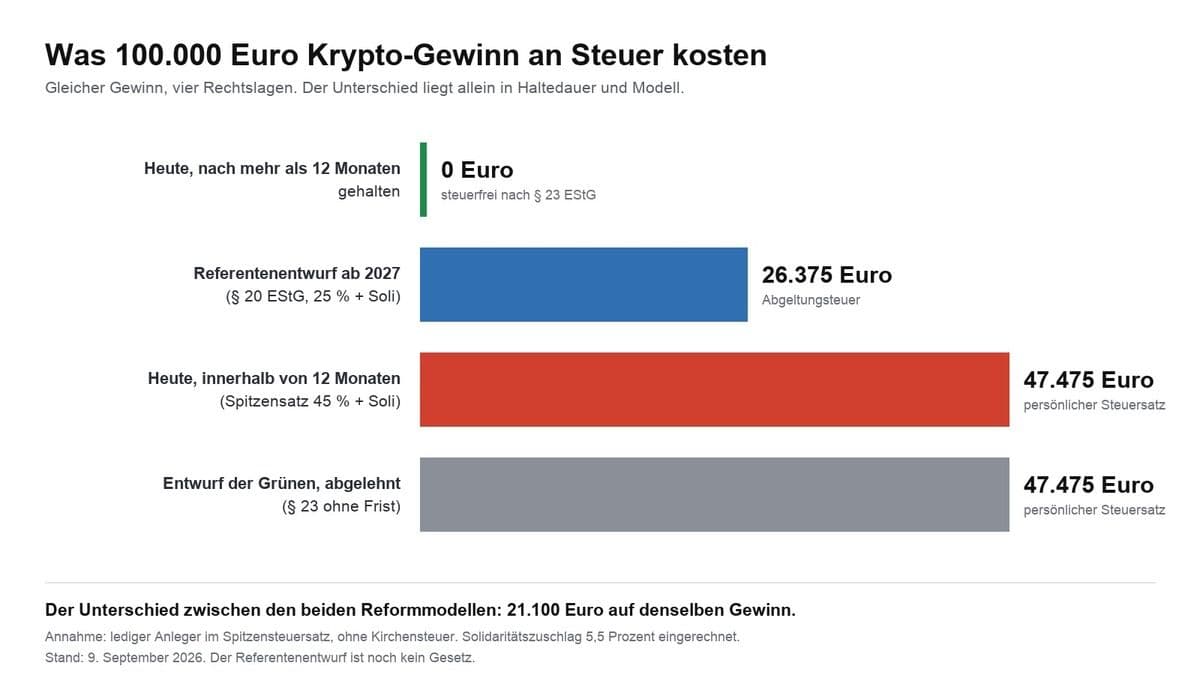
Crypto gains are tax-free after twelve months; before that your personal tax rate of up to 45 percent applies. What triggers tax, how the holding period is calculated, what happens with staking and losses, and what the draft bill would change from 2027.

August 20, 2024 3:00 PM

New US Senate Proposal Submitted For Crypto Tax Exemption
The US Senate has recently submitted a new proposal to exempt crypto transactions from federal taxes. Here are more details of this submission, and a list of exempted countries it could be joining...

September 28, 2026 4:15 AM

NEAR Rises More Than 29 Percent in Seven Days: Why Ondo Stocks and Zcash Trading Are Driving the Price
NEAR gains 29.23 percent within seven days and is the strongest of the 25 largest cryptocurrencies on September 27. Two documented drivers sit behind the move: the launch of tokenised US equities and ETFs from Ondo on the chain, and growing Zcash trading through NEAR Intents.
August 31, 2026 10:23 AM

Bitcoin Abroad: The Tax Duty Austrian Investors Carry Themselves
Sold bitcoin through a foreign platform? When Austrian investors have to declare gains themselves and account for the 27.5 percent tax rate.
August 21, 2026 1:42 PM

Writing Off a Total Crypto Loss: When the Tax Office Recognises Worthless Coins
A token that has collapsed only reduces your tax once you actually dispose of it. What applies to delisting, exchange insolvency and worthless holdings under Section 23 of the German Income Tax Act, and how you offset losses.
August 17, 2026 10:24 PM
Bitcoin Capital Gains Tax in Austria: When Exchanges Withhold 27.5 Percent
When Austrian crypto exchanges deduct 27.5 percent capital gains tax automatically, which Bitcoin gains are affected and when investors have to declare the income themselves.
August 18, 2026 7:13 AM

Bitcoin Tax Reporting in Austria 2026: What Applies
Bitcoin tax reporting in Austria: which data investors can request from crypto exchanges in 2026, and when the report matters for the tax return.
October 2, 2026 1:33 PM

Crypto tax before the cabinet on October 14: “Comments are only possible until October 6”
Germany's Federal Ministry of Finance sent the draft bill on crypto taxation to the associations on September 30, 2026, and the cabinet is to decide on October 14. For your holdings one date counts above all: December 31, 2026.
September 25, 2026 10:14 PM

Sequans sells its last 314 bitcoin: what to check if you hold a treasury stock
Semiconductor maker Sequans has wound down its bitcoin reserve completely, 15 months after setting a target of one hundred thousand coins. What the case reveals about treasury stocks, and which tax rule applies to the share and to the coin.
August 14, 2026 6:18 PM

Bitcoin From a Foreign Exchange to Austria: Which Tax Data You Need
Transferring Bitcoin from a foreign exchange to an Austrian platform: which tax data can be missing for the withholding tax. And what investors need to watch out for.
August 21, 2026 4:24 AM

Forced Sale on a Crypto Exchange: Which Moment Counts for the Holding Period and What You Must Document
At Luno, Kraken and Valour the deadlines are running out, after which the provider realises the remaining holding itself. For tax purposes that is a disposal, and what governs it is the exchange's timestamp.
More from CryptoTicker