
Selling Bitcoin at a Loss and Buying It Straight Back: What That Does to Your Holding Period
Germany has no wash sale rule: the loss stays deductible even if you buy back immediately. The buyback, however, restarts the one-year period for every new unit.





Which topics should we dive deeper into?
Select what genuinely interests you. Your picks feed directly into our editorial planning.
Crypto news that's actually worth your time.
Weekly. 60 seconds. Carefully curated by our editors: no hype, no promo flood, no spam.
Anyone who sells a bitcoin position at a loss in order to use that loss for tax purposes, and buys the same quantity back shortly afterwards, triggers two things at once in Germany. The loss is realized and remains deductible. At the same time, the one-year holding period starts again from scratch for the quantity bought back. That is the price of the decision, and it hangs on a single date: the acquisition date of the new units.
The occasion is this week's slide. On September 17, 2026, Bitcoin stood at $76,555, or €66,712, and Ethereum at $2,453 and €2,138. Cryptoticker.io retrieved these figures on the same day through CoinGecko's public price interface. Many positions opened over the past year are therefore under water, and the question of whether to take the loss and get straight back in is coming up in a great many German portfolios at the same time.
Selling at a loss and buying back: what really happens for tax
In Germany, crypto assets count as other economic assets. Selling them therefore falls under private disposal transactions in section 23 of the Income Tax Act, not under the flat withholding tax. That sounds like a technicality, but it determines everything that follows.
A private disposal transaction is a sale within one year of acquisition. The gain from it is taxed at your personal income tax rate, and in return the loss from it can be offset. Anyone who sells after the year has elapsed stays tax-free, and that cuts both ways: the gain goes untaxed, but the loss is equally without effect.
That second half is routinely overlooked. A position bought eighteen months ago and sitting 30 percent under water today no longer carries any usable tax loss. That position is outside the period. Selling it brings nothing except liquidity.
The three figures you need for every lot
For each individual lot in your holdings, three pieces of information count: the acquisition date, the acquisition cost and the quantity. The acquisition date tells you whether the one-year period is still running. The acquisition cost tells you whether there is a loss at all. The quantity tells you how much of it you can move without touching other lots. Crypto tax software with portfolio tracking shows you these three values separately for each purchase, and without them the decision about a loss sale cannot be taken cleanly.
The one-year period in section 23: why a buyback starts a new clock
The holding period is the time between the acquisition and the disposal of a particular unit. That period attaches to the unit, not to the coin and not to the account. Every purchase starts its own clock.
From this follows the central point of this article. If you sell 0.3 bitcoin today that you bought in January 2026, and buy 0.3 bitcoin again ten minutes later, you have not restored the same position. You have a new position with a new acquisition date. The old eight months of holding time are not transferable; they were used up by the sale. The new unit does not become tax-free until September 2027.
On a position that is only a few weeks old anyway, this costs almost nothing. On a position that would have reached the one-year mark in three months, it costs those three months plus another twelve. That is the real calculation, and it comes out differently for every lot.

Is there a wash sale rule in Germany as there is in the US?
No. Under US tax law, a wash sale is a loss-making sale in which the same or a substantially identical security is bought back within thirty days before or after the sale. Section 1091 of the Internal Revenue Code denies the deduction of the loss in that case; it is added to the cost basis of the new position instead.
German income tax law has no equivalent for private disposal transactions. Section 23 contains no blocking period for re-entry, and there is no provision that shifts the loss into the new acquisition cost. The loss stays where it arose, in the year of the sale.
Anyone reading American guides or using an international tax tool should know this difference before deriving rules for the German tax office from them. The thirty-day window that regularly appears in such texts has no bearing on a German tax return.
Section 42 of the Fiscal Code and the same-day buyback: what the Federal Fiscal Court decided
That leaves the objection tax offices occasionally raise in such cases: abuse of legal structuring. Under section 42 of the German Fiscal Code, this exists where a legal arrangement essentially serves to obtain a tax advantage not provided for by law.
There is a decision directly on point, and it concerns precisely the provision discussed here. In a judgment of August 25, 2009, case reference IX R 60/07, the Federal Fiscal Court held that there is no abuse of structuring where a taxpayer sells securities at a loss within the one-year period and buys back securities of the same type and number at a different price on the same day. Sale and buyback, the court held, are to be assessed as separate transactions. The matter in dispute was a private disposal transaction under section 23, that is, the same provision crypto assets fall under today.
The judgment was handed down on shares and not on crypto assets, and it is not a blank cheque. It is, however, the closest thing to a supreme court statement on this constellation, and it supports the view that re-entry as such does not endanger the loss. Anyone wanting full certainty should have the case reviewed by a tax adviser before filing; a binding ruling from the tax office is the only route to genuine legal certainty in an individual case.
 Crypto tax under control: tools compared
FIFO: why the bitcoin you buy back joins the back of the queue
FIFO stands for first in, first out and means that the unit acquired first counts as the one disposed of first. For crypto assets, the German Federal Ministry of Finance set out this consumption order in more detail in its circular of March 6, 2025, together with the record-keeping and cooperation duties attached to it. The circular carries the file number IV C 1 - S 2256/00042/064/043 and replaces the version from May 2022. It is publicly available from the Federal Ministry of Finance.
In practice that means your purchases stand in a line, ordered by date. When you sell, the line is cleared from the front. The buyback joins the end of that line.
This creates a trap that springs particularly often in a drawdown. The units at the front of the line are the oldest, and therefore often the ones with the longest holding time and the best tax position. Anyone triggering a partial sale in order to realize a loss reaches, under FIFO, for exactly those old units first, and those may well not be under water at all. A loss sale that hits the wrong lot produces a taxable gain instead of a usable loss.
How to keep them apart in practice
The wording of the law can be read in the full text of section 23 of the Income Tax Act. The consumption order can only be controlled cleanly if holdings are kept separately per wallet and per exchange account, because under the ministry circular the assessment is made in principle per individual wallet or per individual account. Anyone holding the same coin on three platforms has three separate lines and not one shared one. Which exchange gives you which export formats differs considerably; a look at our crypto exchange comparison is worth the time before you plan a loss sale spanning several accounts.
The price of the buyback: when you trade an almost tax-free lot for a loss
The decision can be boiled down to one question: which is worth more, the loss today or the remaining holding time?
On a lot that is only two months old, the answer is usually clear. Ten months of remaining period is a manageable stake, and the loss takes effect immediately. On a lot that is eleven months old, the picture flips. One month separates it from tax exemption; a buyback resets it to twelve months and extends the window in which a later gain would be taxable by eleven months.
On top of that comes a point easily lost in the arithmetic: a loss is only worth something if a gain from a private disposal transaction stands against it in the same year or in a later one. Losses under section 23 land in their own offsetting pot. They cannot be set against employment income, rental income or investment income from shares. Anyone not expecting corresponding gains realizes a loss that sits unused for years. We set out the mechanics of this offsetting and the deadlines in detail in our article on crypto losses before the one-year period expires of September 9, 2026.

The 1,000 euro exemption threshold: when a loss sale is worth it at all
An exemption threshold is a limit at which the entire amount becomes taxable once it is exceeded, not just the excess. For private disposal transactions it stands at €1,000 of total gains in a calendar year.
For the buyback decision this means two things. If your annual gain from private disposal transactions stays below the threshold anyway, an additionally realized loss is worthless for tax, because there is nothing to reduce. And conversely: if you are just above the threshold, a targeted loss sale can push the total gain below €1,000 and thereby make the entire amount tax-free. That is the only case in which a loss sale pays off in a jump rather than proportionally.
Grandfathering at December 31, 2026: what a buyback next year could change
A draft bill on the future taxation of crypto assets is on the table, providing for a switch to the flat withholding tax from 2027 and for grandfathering of holdings acquired before then. It is a draft and not applicable law; none of it has been adopted, and the cut-off date may move or disappear entirely.
But if it does come to pass, the acquisition date takes on a second meaning beyond the one-year period. Units you buy back today would have been acquired before the cut-off date. Units you only buy back in January would not. Anyone already weighing a loss sale with a subsequent buyback therefore has an argument for not pushing it into next year. We gathered the state of the draft and the open questions in our piece on the holding period and grandfathering of September 8, 2026.
What matters is the order of certainty: the one-year period applies today and is law. Grandfathering is an expectation. A decision resting on the expectation alone stands on one leg.
 Crypto exchanges compared
What proof the tax office wants for the loss and the buyback
The ministry circular of March 6, 2025 framed the record-keeping and cooperation duties considerably more sharply than its predecessor. For a loss sale with a buyback this means, concretely: both transactions must be individually documented, with time, quantity, price and platform.
In practice you need the exchange's transaction export for the sale and for the buyback, each with a timestamp. If the position came from your own wallet, proof of origin is required on top. A statement showing the holding only as a total is not enough, because the one-year period attaches to the individual lot.
The mistake that is hardest to correct
Export the data promptly. Anyone who discovers after a delisting, an account closure or a change of provider that the history is no longer retrievable has lost the proof and with it the loss. That is not a theoretical risk: in the past few weeks alone, several trading venues have set deadlines for withdrawing balances, after which the account interface was no longer reachable.
Three cases from the current drawdown worked through
The amounts below are freely chosen worked examples and not a price forecast. The cases only show how the variables interact.
Case one, a young lot at a loss. Bought in July 2026 for €8,000, current value €6,400. Loss €1,600, remaining period around ten months. A sale with an immediate buyback realizes the loss and resets the clock to twelve months. Anyone with gains from other crypto sales in the same year comes out clearly ahead here.
Case two, an old lot just short of the finish line. Bought in October 2025 for €10,000, current value €8,500. The loss of €1,500 is real, but the period runs out in a few weeks. A buyback trades an almost achieved tax exemption for a loss that is only worth something if there are enough offsettable gains. In most portfolios, waiting is the calmer option here.
Case three, a lot outside the period. Bought in February 2025, current value well below. Nothing happens for tax on a sale, neither a gain nor a usable loss. A sale here is a pure investment decision with no tax effect. We worked through a similar constellation on the gains side for Ethereum profits and the holding period on September 14, 2026.
Bitcoin losses and buybacks: what to take away
- Sort by acquisition date first, not by price. Check for each lot whether the one-year period is still running. Only within the period is a loss worth anything at all, and only there does a buyback cost you holding time. Tax software with portfolio tracking compiles this list automatically for each purchase.
- Weigh the loss against the remaining period. Young lots at a loss are the obvious candidates, lots just short of the anniversary the most expensive. And check beforehand whether you have any gains from private disposal transactions in the same year for the loss to be offset against.
- Secure the records the same day. Export the sale and the buyback with timestamps, separated by wallet and account. Which exports your exchange offers is shown in our crypto exchange comparison; if the proof is missing later, the loss goes with it.
(As of September 17, 2026. This article is not investment advice. Prices and fee structures change; check the terms with the provider before you buy.)
Transparency note: This article was produced with the assistance of artificial intelligence and reviewed by our editorial team before publication. All figures and claims were checked against the primary sources linked in the text. The feature image was generated with AI.
Related articles
- Selling bitcoin privately: the tax in Germany and the records you need
- Bitcoin 29 Percent Below Last Year: Which Crypto Losses You Can Still Use Before the One-Year Holding Period Expires
- Forced Sale on a Crypto Exchange: Which Moment Counts for the Holding Period and What You Must Document
- Borrowing Against Bitcoin Instead of Selling: When German Tax Still Applies
- Germany’s Crypto Holding Period Is Wobbling: What to Check Before December 31
Which topics should we dive deeper into?
Select what genuinely interests you. Your picks feed directly into our editorial planning.
Crypto news that's actually worth your time.
Weekly. 60 seconds. Carefully curated by our editors: no hype, no promo flood, no spam.

September 7, 2026 7:22 AM

German Crypto Holding Period Stays: The Income Tax Reform 2027 Leaves Section 23 Untouched
On September 2, 2026 the German federal cabinet adopted the draft of an Income Tax Reform Act 2027, and crypto assets do not appear in it. The one-year holding period under Section 23 of the Income Tax Act therefore continues to apply unchanged.
September 8, 2026 1:19 AM

Germany's Crypto Holding Period: What Happens Now Signing for Petition 201716 Closed on September 15
Recap as of September 27, 2026: the signature period for German parliamentary petition 201716, which asks for the one-year crypto holding period to be preserved, closed on September 15, 2026. This article explains what ended that day, how the petitions committee proceeds and why no investor has to sell because of it.
August 11, 2026 9:13 PM

Germany's Crypto Holding Period Faces Abolition: What Petition 201716 and the Cabinet Decision Mean for Your Tax
Petition 201716 in the German Bundestag calls for the one-year holding period for crypto assets to be kept and has already passed the quorum of 30,000 signatures. This article sets out what the cabinet decision of July 6, 2026 provides for, how much of it is binding and which records you should be pulling together now.
September 8, 2026 10:21 PM

Crypto Holding Period and Grandfathering: Why December 31, 2026 Becomes the Cut-Off in Germany's Draft Bill
A ministerial draft bill from Germany's finance ministry names a cut-off date for the first time: crypto assets acquired after December 31, 2026 are to fall under the flat-rate withholding tax. What that means for legacy holdings, running savings plans and staking income, and why nothing has been decided yet.
September 16, 2026 1:20 PM

Crypto Loss Carryforward in Germany: What Happens to Old Losses Under the 2027 Tax Plan
Losses from crypto sales land in a ring-fenced pot and can only be set against gains of the same kind. The draft bill for 2027 moves future gains into a different pot, and we show you what that means for your assessed carryforward and what your tax notice should say.
September 9, 2026 4:22 PM
Crypto Tax in Germany: What Applies in 2026 and What Is Set to Change in 2027
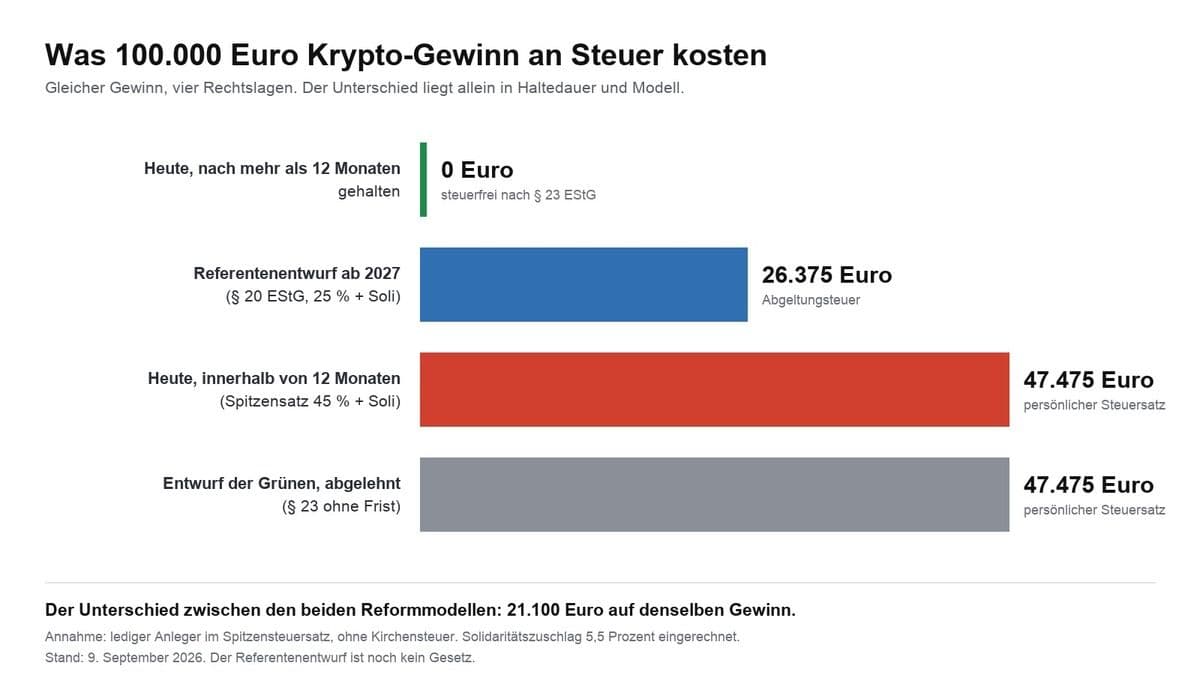
Crypto gains are tax-free after twelve months; before that your personal tax rate of up to 45 percent applies. What triggers tax, how the holding period is calculated, what happens with staking and losses, and what the draft bill would change from 2027.
September 19, 2026 7:26 AM

Offsetting Crypto Losses Against Share Gains: What Is Really Allowed in Germany
Crypto losses and share gains sit in separate loss buckets in Germany, and there is no offsetting between them. Where the line runs, why crypto derivatives are the exception, and how you can still use losses through carryback and carryforward.
September 17, 2026 7:12 PM

Gifting Bitcoin to Children: Allowance, Holding Period and the Tax Office Report
Transferring Bitcoin to your child hands over your holding period and your entry price along with the coins. This guide sets out what really applies in Germany on the allowance, the reporting deadline, representation and custody.
October 2, 2026 4:39 AM

Donating bitcoin: when does the full market value count, when only the purchase price?
A bitcoin donation to a charitable organisation is deductible as a donation in kind, and the donation itself produces no taxable gain. The size of the deduction turns solely on whether a sale would have been taxable on the day of the transfer.
September 14, 2026 10:23 AM

Take Ethereum Profits or Wait Out the Holding Period? What the Price Jump Means for Your Tax Bill
Ether reached its highest level since the end of January on September 11, 2026, and many are asking whether to sell now. In Germany the answer hangs on the purchase date first: we work out which tranches are tax free and which of them are showing a gain at all.
August 26, 2026 10:25 PM

Selling Bitcoin at a Loss: Loss Offsetting in Austria
Sold Bitcoin at a loss? Austria allows the loss to be offset against certain investment income. When loss offsetting is possible and which limits apply.
September 24, 2026 1:13 AM

Solana DEX Trades Overtake the NYSE: What to Check on Swaps, Tax and Oversight
Solana's decentralised exchanges settled roughly 208 million trades in a single week and overtook the New York Stock Exchange for the first time. The figure is real, but it measures something other than the comparison suggests, and for German investors it carries tax duties that no provider takes on.

September 27, 2026 1:17 PM
Dogecoin Price: What to Check on Holding Period and Custody Before the Year End
The Dogecoin price stands at $0.0977 on September 27, 2026 and has barely moved in a day. That calm is exactly the moment to work through the holding period, the reporting duty from 2026 and custody without any time pressure.
August 31, 2026 10:30 PM

Taxing Crypto Lending: Your Personal Rate Instead of Withholding Tax, and the Right Federal Fiscal Court Case Number
According to the only tax court ruling so far, income from crypto lending falls under Section 22(3) of the German Income Tax Act and therefore under your personal tax rate. The appeal is pending at the Federal Fiscal Court under VIII R 22/25, not under the case number given in many professional articles.
September 26, 2026 7:29 PM

Coins Stolen in an Exchange Hack: What the German Tax Office Accepts as a Loss
After the attack on Bitget on September 24, a question the reports leave out arises for those affected in Germany: can a stolen balance be written off against tax? The answer hangs on a single term in the Income Tax Act, and it is decided by your records.
September 18, 2026 10:13 AM

Bitcoin and the German Exit Tax: What Applies When You Move Abroad
Anyone emigrating with Bitcoin expects an exit tax on unrealised gains and finds nothing of the sort in the statute. Where the real risks sit is decided at four points: residence, the holding period, the legal form of your investment, and automatic reporting from 2026.
October 2, 2026 1:33 PM

Crypto tax before the cabinet on October 14: “Comments are only possible until October 6”
Germany's Federal Ministry of Finance sent the draft bill on crypto taxation to the associations on September 30, 2026, and the cabinet is to decide on October 14. For your holdings one date counts above all: December 31, 2026.
September 22, 2026 10:13 AM

Circle Lends Against Bitcoin via cirBTC: Why the Wrapper Can Cost You the German Holding Period
Circle launched loans against deposited bitcoin on September 21, 2026. In Germany, the detour through the cirBTC token is very likely a swap, and a swap restarts your one-year holding period.
September 9, 2026 1:15 AM

Germany's Crypto Tax: 160 Million Euros for a 555-Billion Budget
The German finance ministry's draft bill puts a figure on the crypto tax for the first time: 160 million euros from 2028. What that number means in the 2027 federal budget, how 11.4 billion became 160 million, and what investors can read from it.
August 10, 2026 9:15 PM
Selling Bitcoin at an ATM: Tax Rules in Austria
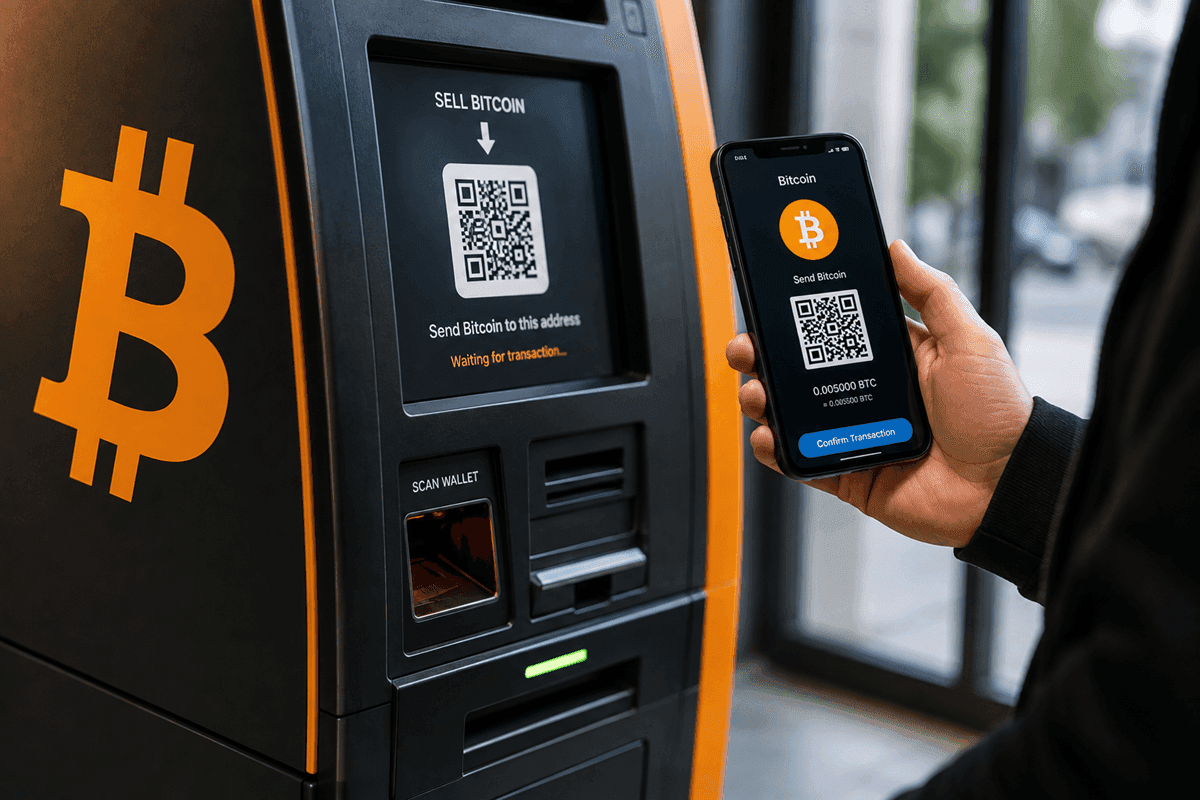
Selling bitcoin for cash at an ATM: when the 27.5 percent rate applies in Austria and which records you need to keep.
August 21, 2026 1:42 PM

Writing Off a Total Crypto Loss: When the Tax Office Recognises Worthless Coins
A token that has collapsed only reduces your tax once you actually dispose of it. What applies to delisting, exchange insolvency and worthless holdings under Section 23 of the German Income Tax Act, and how you offset losses.
August 12, 2026 9:12 AM

Bitcoin Losses and Dividends in Austria: How the Tax Offset Works
Can a Bitcoin loss be offset against dividends? This is how loss offsetting works in Austria. It also shows when a tax return is needed for it.
September 24, 2026 10:19 PM

Bitcoin for Retirement: What Applies from 2027 and What You Decide Now
Bitcoin is not permitted in any state-subsidised retirement product, including the new retirement savings account from 2027. Anyone who still wants to use crypto assets for their own pension goes through private assets, and there a cutoff date at the end of 2026 is shifting the tax rules right now.
August 24, 2026 4:22 AM

Selling XRP After a 53 Percent Week: What the Holding Period Costs
XRP trades at $1.51 after a weekly gain of a good 50 percent, yet your net proceeds are decided by the purchase date. This article works through the holding period, the exemption limit and FIFO at measured reference-date prices.
October 1, 2026 10:44 AM

German crypto tax reform: without a receipt, half the sale price is taxed
The Federal Ministry of Finance's draft bill goes to the cabinet on October 14. Anyone who cannot prove their acquisition cost pays tax on 50 percent of the sale proceeds under the substitute assessment.
August 14, 2026 6:23 AM

Bitcoin Savings Plan and Tax: How the Holding Period, FIFO and the Exemption Limit Interact on Monthly Buys
Every savings plan instalment is a separate acquisition for tax purposes, with a holding period of its own. How the exemption limit, the order of disposal and record-keeping duties interact on monthly Bitcoin buys, with the sources from the statute and the Ministry of Finance circular.


More from CryptoTicker