
Bitget Futures Trading: Your First Trade, Leverage and Risk
How to trade futures on Bitget step by step: USDT-M contracts, leverage up to 150x, how far Bitcoin can move before your margin is gone, what fees and funding cost per day and how a stop-loss protects you.


Which topics should we dive deeper into?
Select what genuinely interests you. Your picks feed directly into our editorial planning.
Crypto news that's actually worth your time.
Weekly. 60 seconds. Carefully curated by our editors: no hype, no promo flood, no spam.
Bitget futures trading takes four steps: you move USDT, the Tether stablecoin, from your spot account into your futures account, pick a contract such as BTCUSDT, set the leverage and open a long or short position. According to Bitget’s fee schedule on 13 November 2026, a USDT-M futures trade costs 0.02 percent as a maker and 0.06 percent as a taker, and Bitget offers leverage of up to 150x on BTCUSDT. Most of the risk comes from leverage. On 13 November 2026 Bitcoin fell 3.6 percent within a day to just under $69,000, according to CoinMarketCap, a move that would have wiped out the margin of any long position above roughly 28x.
Bitget futures: the key facts
- Contract types: USDT-M, USDC-M and Coin-M futures, perpetual and delivery contracts.
- Fees: 0.02% maker and 0.06% taker at the standard level, for all three types.
- Leverage: up to 150x on BTCUSDT; Bitget itself advises beginners to stay between 5x and 10x.
- Funding: settled every eight hours at 00:00, 08:00 and 16:00 UTC, between traders, not to Bitget.
- Liquidation: at 10x, a 10 percent move against you consumes the whole margin.
This guide walks you through your first Bitget futures trade with real numbers: the steps, how far a price can move at each leverage level, what a position costs per day and how a stop-loss protects you. How perpetual contracts work in general is explained in our guide to crypto futures and perpetual futures. Bitget is not listed in ESMA’s register of crypto-asset service providers authorised under MiCA, so this guide is for readers outside the EU in countries where Bitget operates.
How Bitget futures work: USDT-M, USDC-M and Coin-M
A futures contract is a derivative: it lets you bet on the price of an asset without owning it. With a long position you gain when the price rises, with a short position you gain when it falls. Bitget offers three families of futures, which differ in the currency you post as margin and in which profits are paid.
| Bitget futures type | Margin and settlement | Example | Suits |
|---|---|---|---|
| USDT-M futures | USDT | BTCUSDT perpetual | Most traders: profit and loss in a stablecoin |
| USDC-M futures | USDC | BTCUSDC perpetual | Traders who hold USDC instead of USDT |
| Coin-M futures | The coin itself, e.g. BTC | BTCUSD perpetual | Holders who want to hedge coins they already own |
Most contracts are perpetual futures: they have no expiry date and track the spot price through the funding rate. Delivery futures settle on a fixed date. For a first trade, USDT-M perpetuals are the simplest choice, because your margin, your profit and your fees are all counted in USDT.
How to trade futures on Bitget in six steps
Bitget’s own beginner’s guide to futures uses USDT-M futures as its example. The steps are the same in the app and on the website.
| Step | What you do | What to watch |
|---|---|---|
| 1 | Open an account, verify your identity and secure it with two-factor authentication | The referral field takes a code once, at sign-up |
| 2 | Deposit USDT or buy it in the spot market | Pick a cheap network for the deposit |
| 3 | Transfer funds in USDT from Spot to USDT-M Futures under Assets | The funds appear in your futures account instantly |
| 4 | Go to Futures, choose USDT-M and a pair such as BTCUSDT | Check the margin mode: isolated or cross |
| 5 | Set the leverage, choose a limit or market order and the size | A limit order pays the maker fee of 0.02 percent |
| 6 | Click Open Long or Open Short and set take-profit and stop-loss | The estimated liquidation price appears under Positions |
Every other market pair works the same way, for example ETHUSDT, SOLUSDT or XRPUSDT. The trading pairs differ in their maximum leverage, which the order screen shows as soon as you move the leverage slider, and in how much trading volume they attract. In the Bitget app you track every open position, its margin and its estimated liquidation price under Positions on the futures screen.
If you do not have an account yet, you can open Bitget’s sign-up page with our referral code already filled in; our page on the Bitget referral code explains the welcome pack and its conditions.
Bitget leverage: how far the price can move before your margin is gone
Leverage multiplies your position, not your money. With 100 USDT of margin and 10x leverage you control a position worth 1,000 USDT, and a 10 percent move against you costs the full 100 USDT. Bitget uses exactly this example in its guide to avoiding liquidation. The table shows the move that consumes your initial margin at each leverage level, applied to a long position opened at Bitcoin’s price on 13 November 2026.
| Leverage | Move against you that consumes the margin | BTC price for a long opened at $68,972 |
|---|---|---|
| 2x | 50% | $34,486 |
| 5x | 20% | $55,178 |
| 10x | 10% | $62,075 |
| 20x | 5% | $65,523 |
| 50x | 2% | $67,593 |
| 100x | 1% | $68,282 |
| 150x | 0.67% | $68,512 |
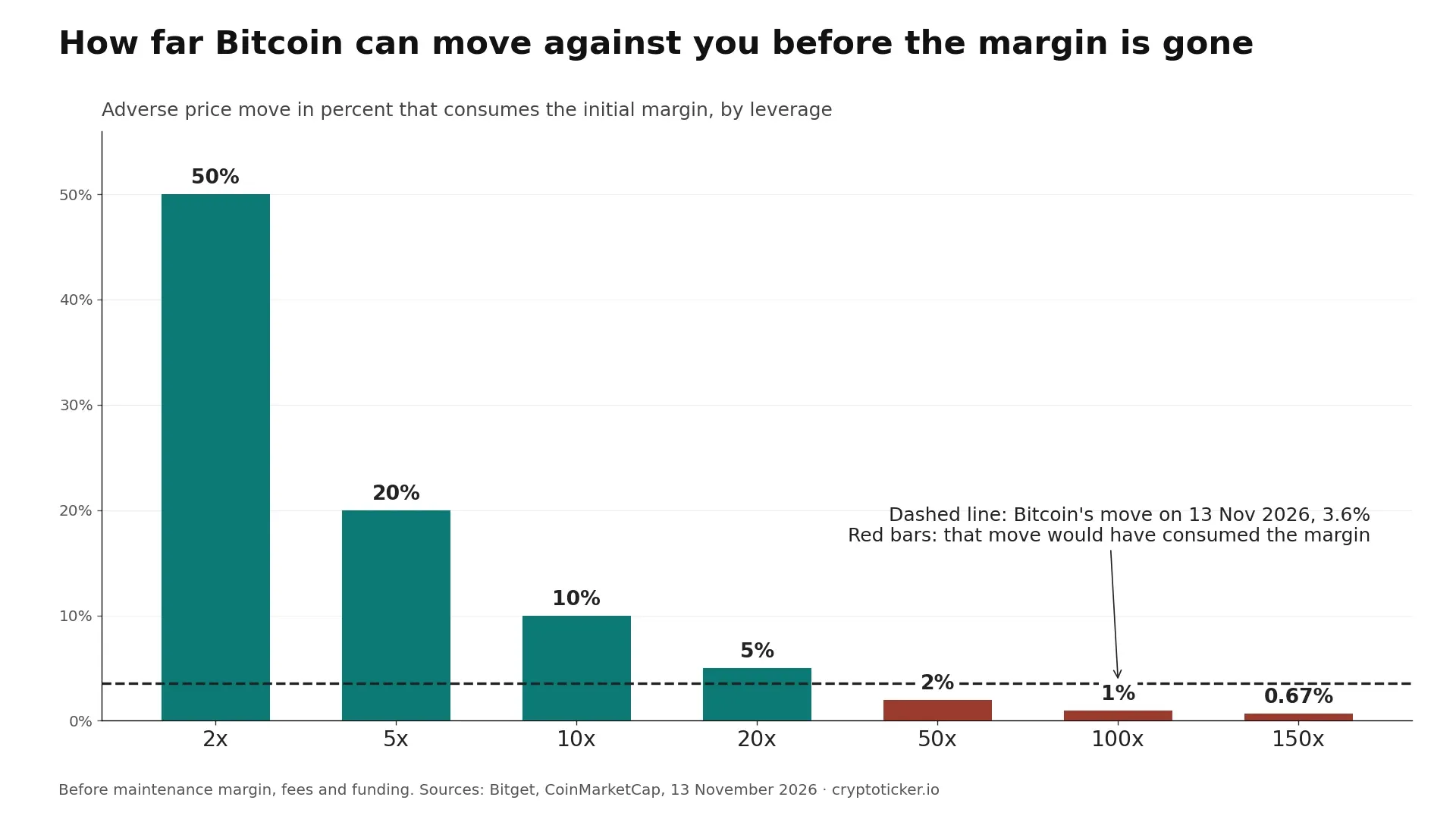
In practice the liquidation comes a little earlier than the table shows, because your position must always cover a maintenance margin, and fees and funding reduce your balance. Bitget shows the estimated liquidation price for every open position. Its guide recommends 5x to 10x for beginners and advises against more than 20x, where a 5 percent move is enough to liquidate a position.
 Crypto exchanges compared
Isolated or cross margin on Bitget futures
Before you open a position, Bitget asks for the margin mode. In isolated margin, a position can only lose the margin you assigned to it. In cross margin, all positions share the balance of your futures account, which keeps a single position alive longer but puts the whole account at risk.
- Isolated margin: the loss is capped at the margin of that position. Bitget states that liquidation can still happen, but the rest of your balance stays untouched.
- Cross margin: the whole futures balance backs your positions. When the margin ratio reaches its limit, Bitget cancels all open orders, nets opposing positions and reduces positions step by step.
- For a first trade: isolated margin with a small amount makes the maximum loss visible before you click.
Bitget calculates a margin ratio as maintenance margin divided by margin balance. Between 80 and 90 percent you receive an email warning; at 100 percent the system begins a partial liquidation. Any margin left after a liquidation goes to Bitget’s insurance fund, so in most cases nothing comes back.
Bitget futures fees and funding rate: what a trade really costs
A futures position costs money twice: once in trading fees when you open and close it, and every eight hours in funding while you hold it. The fee is charged on the full position value, not on your margin, so leverage also multiplies your costs.
Funding keeps the perpetual price close to the spot price. According to Bitget’s funding rate guide, it is settled at 8:00 AM, 4:00 PM and 12:00 AM in UTC+8, which is 00:00, 08:00 and 16:00 UTC; some contracts settle every two or four hours. When the rate is positive, longs pay shorts; when it is negative, shorts pay longs. Bitget does not keep these payments. You only pay or receive funding if you hold a position at the settlement time.
The example uses a position of 1,000 USDT at 10x leverage, so 100 USDT of margin, taker orders on both sides and a funding rate of 0.01 percent per eight hours, the base interest rate in Bitget’s formula.
| Holding period | Trading fees, open and close | Funding paid | Total cost | Share of your 100 USDT margin |
|---|---|---|---|---|
| 1 day | 1.20 USDT | 0.30 USDT | 1.50 USDT | 1.5% |
| 7 days | 1.20 USDT | 2.10 USDT | 3.30 USDT | 3.3% |
| 30 days | 1.20 USDT | 9.00 USDT | 10.20 USDT | 10.2% |
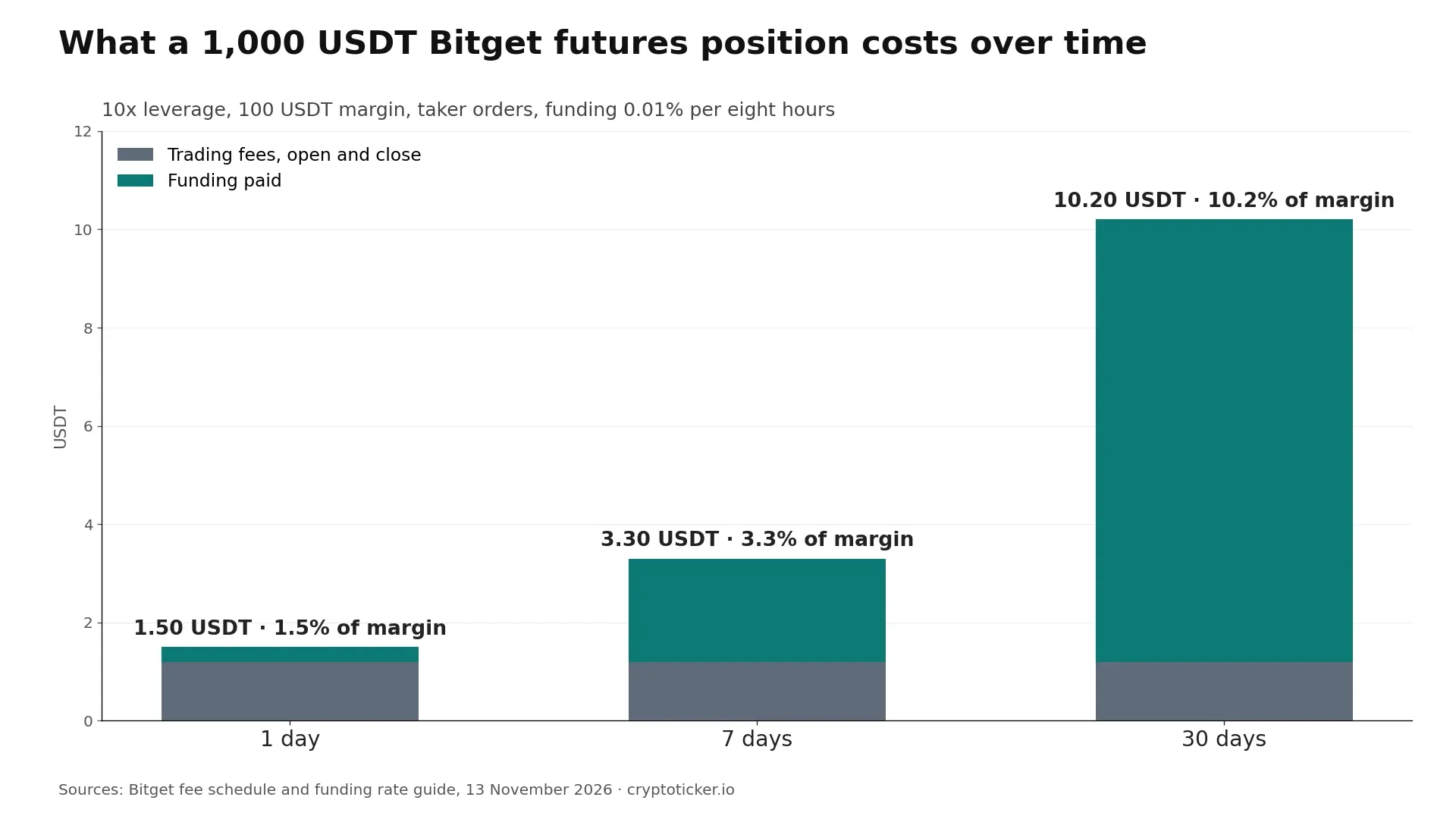
Two levers lower these costs. Limit orders that wait in the order book pay the maker fee of 0.02 percent, so the same round trip costs 0.40 USDT instead of 1.20 USDT. And short holding periods keep funding small. All VIP levels and the spot rates are listed in our overview of Bitget fees.
Stop-loss and take-profit on Bitget futures
A stop-loss closes your position at a price you set in advance, a take-profit locks in a gain. Both can be attached when you open the trade or added later under Positions. Bitget’s guide gives three rules that also work for a first trade:
- Risk 1 to 2 percent per trade. With 1,000 USDT in your futures account, a single trade should not cost more than 10 to 20 USDT if the stop-loss is hit.
- Keep the stop-loss well above the liquidation price for a long, and well below it for a short, so the stop fires before the liquidation does.
- Aim for a risk-reward ratio of 1 to 2. If your stop-loss is 500 dollars away from the entry, your take-profit should be at least 1,000 dollars away.
Position size follows from the stop-loss, not the other way round. If you are willing to lose 10 USDT and your stop-loss sits 2 percent below the entry, your position may be worth 500 USDT. Whether you post that with 5x or 10x leverage changes how much margin is tied up, not how much you lose at the stop.
Open interest and trading volume: reading a Bitget futures market pair
Every market pair on Bitget futures shows two figures that tell you how active it is. Trading volume counts the contracts traded over a period, usually the last 24 hours. Open interest counts the positions that are still open, which Bitget defines as the sum of all long and short positions. Pairs with high trading volume and open interest, such as BTCUSDT and ETHUSDT, have deep order books, so market orders fill close to the displayed price. On thin pairs a single large order can move the price, and a stop-loss may fill noticeably below the level you set.
Read together with the funding rate, open interest shows how crowded a trade is. When open interest climbs while the funding rate stays clearly positive, many leveraged longs are paying to keep their positions open, and a sharp drop can set off a chain of forced closures. How fast such a chain runs showed on 15 October 2026, when liquidations wiped out around $489 million across the market within one hour, as our analysis of the liquidation cascade shows. Falling open interest means that positions are being closed.
Bitget also uses open interest to cap position sizes, according to its help page on open interest risk control and position limits (as of December 2024). The limit is the higher of two values: a fixed notional threshold and a set share of the platform’s open interest. Because open interest counts both sides, Bitget multiplies it by 0.5. In Bitget’s own example, 200,000 USDT of open interest and a 10 percent threshold give an OI-based limit of 10,000 USDT; the notional threshold of 15,000 USDT is higher, so 15,000 USDT applies. Once an account reaches its limit, it can only cancel orders or place reduce-only orders. For a first trade with a few hundred USDT these limits play no role; they matter for large accounts and smaller altcoin pairs.
Regulated crypto exchanges comparedLong and short: two directions with the same mechanics
Futures let you profit from falling prices as well. A short position on BTCUSDT gains when Bitcoin drops: you sell the contract first and buy it back later, with the same fees, funding and liquidation rules as a long, only mirrored: the liquidation price of a short lies above your entry. Our step-by-step guide on how to short Bitcoin on Bitget shows the short side in detail.
Leverage itself is explained independently of any exchange in our guide to leverage trading. If you would rather compare futures venues first, our crypto exchange comparison lists fees and products side by side.
Practice first: Bitget demo trading, copy trading and bots
You do not have to learn futures with real money. Bitget’s demo account gives every user virtual USDT for the same contracts and the same order screen; our guide to Bitget demo trading shows how to switch it on and how to practice with a realistic balance. If you prefer to follow others, Bitget copy trading mirrors the positions of elite traders from 50 USDT, and a Bitget trading bot such as the futures grid trades a price range for you. All three use the same futures engine, so the rules on leverage and liquidation above apply to them as well.
What you accept: the Bitget Futures Services Agreement
Before your first futures trade, Bitget asks you to accept its Futures Services Agreement. Few users read these terms and conditions, yet five provisions shape what can happen to your account:
- Filled orders are final. Once an order is executed, you cannot cancel or amend it; you can only close the position with a new order. Bitget may also refuse an order without giving a reason.
- Leverage and margin can change. Bitget may amend the maximum leverage and the initial and maintenance margin requirements at its own discretion. It publishes changes to its futures products as official announcements in its help centre, so check them if you hold positions for weeks.
- Liquidation runs automatically. When the mark price, Bitget’s fair value of the contract, reaches your liquidation price, the agreement allows Bitget to close the position without further notice.
- Obvious errors can be reversed. Bitget reserves the right to void, cancel or reverse a trade that results from a manifest error, such as a clear misquote. To dispute a statement or confirmation, you have seven days to raise the claim with supporting evidence.
- Risk controls and regions. Bitget can impose a Reduce Only restriction, under which you may only close or reduce positions, and some services are restricted in certain jurisdictions or regions or for certain users.
Who can trade Bitget futures
Bitget operates internationally and holds registrations in several countries, among them a registration with AUSTRAC in Australia and a licence from the FSCA in South Africa. Its availability has clear limits:
- European Union: Bitget is not listed in ESMA’s register of crypto-asset service providers authorised under MiCA (version of 11 November 2026), and the transition period ended on 1 July 2026. EU readers find licensed exchanges in our comparison of regulated crypto exchanges.
- Excluded countries: Bitget’s Terms of Use exclude, among others, the United States, Canada, Singapore, Japan, Hong Kong, Germany, France and Austria.
- Australia: the regulator ASIC has warned investors that Bitget’s crypto futures are not licensed there. Australians use Bitget for spot trading.
Is Bitget good for futures trading? Our assessment
For traders in the countries it serves, Bitget is a capable futures venue: three contract families, standard fees of 0.02 and 0.06 percent that match the large international exchanges, and a risk interface that shows the estimated liquidation price before and after you trade. The tools for a careful start are there, from isolated margin to attached stop-losses.
The decisive factor is not the exchange but the leverage you choose. A 3.6 percent daily move, as on 13 November 2026, is ordinary for Bitcoin, and anything above roughly 28x leaves less room than that. Start with a small amount, isolated margin and a stop-loss, and count funding as a running cost if you hold for days.
Futures with leverage can wipe out your entire stake within hours. This guide explains how the product works; it is not investment advice.
FAQ: Bitget futures trading
Partner links: some links on this page are partner links. If you become a customer through one of them, we may earn a commission at no extra cost to you. Selection, ratings and ranking are decided independently by our editorial team. Ethics and Independence · Ownership and Funding
Transparency note: This article was produced with the assistance of artificial intelligence. Figures and claims are based on the primary sources linked in the text. The feature image was generated with AI.
For later? Save this article and find it again in your profile.
Related articles
- Trade Anthropic stock: ANT perpetuals on Bitget, OKX and Kraken, long or short
- Coinglass explained: what the liquidation heatmap shows and where its limits lie
- Dogecoin news: DOGE futures market shrinks by a quarter since early November as funding turns negative
- Crypto Crash and Taxes: Can Your Losses Cut Your Tax Bill?
- Crypto liquidations: $2 billion in 24 hours, mostly longs on bitcoin and ether
Which topics should we dive deeper into?
Select what genuinely interests you. Your picks feed directly into our editorial planning.
Crypto news that's actually worth your time.
Weekly. 60 seconds. Carefully curated by our editors: no hype, no promo flood, no spam.

November 15, 2026 1:23 AM

Weekend crypto crash: leverage and crypto loans with bitcoin below $66,000
Bitcoin has dropped below $66,000 and ether below $1,850, while the US spot ETFs only reopen on Monday. This guide works through how close leveraged positions and crypto loans are to forced closure.
November 13, 2026 8:37 PM

Bitget Trading Bot: Grid, DCA and Futures Bots Explained
Bitget offers grid, DCA, portfolio, trend and signal bots without a bot fee. Which bot fits which market, a Bitcoin grid example with today's price and Bitget's fees, why too many grids lose money and how to set up your first bot.
November 13, 2026 8:36 PM
Bitget Demo Trading: Practice Futures With Virtual USDT
Bitget demo trading lets you practice futures with virtual USDT on live prices. How to switch it on in the app and on the website, which pairs it covers, how it differs from live trading and a practice plan with a realistic balance.

November 11, 2026 9:25 AM

Cardano open interest climbs to $395 million while ADA falls
Analysis: open interest in the Cardano futures market grows to $395 million while ADA slips below $0.175. What the funding rate, order books and the August low show, and where liquidation looms for leveraged positions.
November 7, 2026 6:58 PM

Bitget Fees: Spot, Futures and How BGB Lowers Them
Bitget charges 0.1 percent on spot and 0.02 or 0.06 percent on futures. All VIP levels, the BGB discount, funding and withdrawal fees, copy trading costs and a comparison with Bybit and OKX Australia.
November 4, 2026 12:00 AM

Trump, Iran and the MOAB: What Moves the Oil Price and Gold Price After the Midterms
Trump's pause on Iran ended with the vote. What is on record about the mother of all bombs, why gold has fallen on most big oil days, and where oil and gold can be traded.
November 3, 2026 9:21 AM

Leverage trading in crypto: how margin and the liquidation price work
With leverage you move a larger crypto position than your stake would allow. We work through margin and liquidation price, show the leverage limits in the EU and which licensed providers offer leverage trading.
November 3, 2026 7:58 AM

Crypto futures trading: perpetual futures explained simply
Crypto futures and perpetual futures explained: how futures trading works, what the funding rate really costs and which exchanges are licensed for it in the EU.
November 1, 2026 7:21 AM

How to Buy USDT in the EU: 7 Platforms Checked, What Still Works
Since ESMA's opinion of 8 October 2026, Tether's stablecoin is disappearing from exchanges in the EU. We checked seven platforms, measured spreads and network fees, and show which routes and alternatives remain on 1 November 2026.
October 30, 2026 9:17 PM

Markets price a December Fed hike: core inflation stuck at 3.1 percent
The Fed held its policy rate at 3.75 to 4.00 percent on October 28, but two members wanted it raised. A day later the BEA reported core inflation of 3.1 percent. That puts a hike on the table for December 9 rather than a cut.
October 30, 2026 6:27 PM

$1.54 billion in crypto liquidations: the next step for leveraged traders
Within 24 hours the crypto market lost leveraged positions worth more than $1.54 billion, spread across 237,314 accounts. What triggered the drop and which rules in Germany cap the loss.
October 29, 2026 9:45 PM

How to Short Bitcoin in the Crash: Step by Step on Bitget and OKX
Bitcoin fell below $79,000 after the Binance hack. If you want to bet on falling prices or hedge, a short does exactly that. How it works on Bitget and, for EU readers, on OKX Europe, a worked example at tonight's price and the risks of shorting after a crash.
October 29, 2026 12:35 PM

21 million dollars in the SHIB futures market: the level that decides
Analysis: the futures market for Shiba Inu holds 21.1 million dollars across four exchanges, 0.74 percent of market value. The positions are documented; we set out what they mean for the price.
October 28, 2026 6:30 AM
Bitcoin Cash: all 81 futures markets are perpetuals, CME is missing
Bitcoin Cash rises to $294.31 and holds a weekly gain as one of the few top-25 assets. A count of our own shows all 81 futures markets are contracts with no expiry date, and half of the open positions hang on a single trading venue.

October 27, 2026 12:30 PM
Dogecoin funding rate at 7.4 percent a year: the next step
Analysis: long positions in Dogecoin have been paying funding costs again on OKX since Monday afternoon, annualised at 7.4 percent as of Tuesday morning. At the same time, almost five long accounts come for every short account while open interest shrinks.
October 23, 2026 1:23 PM
$1.81 billion on a single exchange: Monero open interest figures differ sixfold
Monero is down 6.2 percent at $606.80 over 24 hours, after reaching $653.71 within the same range. An own count of 52 futures contracts shows why reported open interest differs sixfold depending on the data source, and which figure matters for your position size.

October 16, 2026 1:28 PM
Dogecoin: four in five leveraged accounts are long, more one-sided than Bitcoin, Ethereum and Solana
On the OKX derivatives market there are 4.17 long accounts per short account in Dogecoin, more than in any other large coin. What our own Friday morning measurement says about the risk of a chain of forced closures.
October 15, 2026 1:34 PM

$489 million in liquidations in one hour: where your leverage breaks first
Forced closures wiped out around $489 million within one hour on 15 October 2026, more than half the daily total of $942 million. Our analysis of OKX futures market data shows why Ether was hit harder than Bitcoin.
October 15, 2026 7:29 AM

17 of 20 top coins down, Ethereum at $2,380: where the sell-off is measured
Ether loses 5.41 percent over 24 hours and falls to a daily low of $2,332.43. Our own count of the 25 largest cryptocurrencies shows how broadly the sell-off really carries.
October 9, 2026 10:25 PM

Dogecoin: 94 Percent of Liquidations Hit Long Positions, and How the Leverage Compares With Bitcoin
On the Dogecoin futures market $7.82 million was force closed within 24 hours, almost all of it on the long side. Our count of 106 contracts shows how much leverage really sits in the market and how much of it is open to retail investors in Europe.
September 26, 2026 1:11 AM
Funding Rate on Perpetual Futures: How to Calculate What Your Position Really Costs
The funding rate is the payment between the long and the short side of a perpetual future. This guide shows how to calculate it, what Bitcoin longs have just paid, and what the rate reveals about squeeze risk.
September 25, 2026 7:14 PM

Chainlink Above the September High: What Open Interest, Funding Rate and Liquidation Risk Mean for LINK
Chainlink stands at $13.86, 11.2 percent higher than 24 hours ago. Our own query at OKX and Hyperliquid shows funding at the baseline rate, and what that means for leverage, buying route and tax.
September 24, 2026 4:16 AM

Trump-Xi Summit at the White House: The Crypto Positions to Check Before the Meeting
Xi Jinping is on a state visit to Donald Trump today, and the crypto market comes into the meeting carrying the gains of an exceptionally strong week. What to check on leverage, holding period and custody before the first headline runs.
September 22, 2026 4:12 AM

Open Interest Climbs After the Short Squeeze: Why the Longs Are Paying Now
The short squeeze of September 21 wiped out $648 million in bearish bets, yet open interest rose instead of falling. A survey of our own across four exchanges shows the funding rate is positive on 24 of the 25 largest bitcoin perpetuals.
September 19, 2026 7:19 PM

Binance Launches FX Perpetuals With 100x Leverage: What Is Allowed in Germany
Binance launches a perpetual future on the US dollar and the Brazilian real with up to 100x leverage on September 21. For German retail investors, what counts is less the announcement than the question of which leverage is permitted here and which tax rule applies to futures transactions.
September 19, 2026 1:31 AM

Bank of Japan rate move: how to spot a carry trade unwind before it hits your Bitcoin holdings
Japan raises to 1.25 percent, the Fed to 3.75 to 4.00 percent two days earlier, and the crypto market rises anyway. How to tell whether an unwinding of yen-funded positions is under way, and what to check now on leverage, holding period and loss offsetting.
September 11, 2026 4:13 PM
How to Calculate Your Liquidation Price: When the Exchange Closes Your Leveraged Position
The liquidation price is the level at which your exchange force-closes a leveraged position. Here are the formula for long and short, a worked example, and the cost items that squeeze the buffer tighter in practice than the arithmetic suggests.
More from CryptoTicker