
Chainlink Above the September High: What Open Interest, Funding Rate and Liquidation Risk Mean for LINK
Chainlink stands at $13.86, 11.2 percent higher than 24 hours ago. Our own query at OKX and Hyperliquid shows funding at the baseline rate, and what that means for leverage, buying route and tax.




Which topics should we dive deeper into?
Select what genuinely interests you. Your picks feed directly into our editorial planning.
Crypto news that's actually worth your time.
Weekly. 60 seconds. Carefully curated by our editors: no hype, no promo flood, no spam.
Chainlink traded at $13.86 on September 25, 2026, 11.2 percent higher than 24 hours earlier. The break above the September high of roughly $13.70 is real, and the figure most often quoted alongside it is a rise of about 25 percent in open interest. That number is currently being read as evidence of an overheated market. We therefore queried the derivatives data ourselves, and it does not support that reading: funding sits exactly at the baseline rate on both perpetual markets we were able to check.
What that means for your leverage, your route to buying and your tax position is set out below. If you hold Chainlink in your portfolio, or are weighing an entry, these three figures from the derivatives market matter more than any price target.
Chainlink price on September 25, 2026: the numbers behind the breakout
All price figures in this section come from CoinGecko and refer to September 25, 2026. LINK stands at $13.86. Over 24 hours that is a gain of 11.2 percent, over seven days 18.5 percent and over 30 days 22.7 percent. The daily range ran from $12.46 to $14.19.
Market capitalisation is $10.36 billion, which places LINK 13th among all cryptocurrencies. Trading volume over the past 24 hours came to $1.07 billion. Circulating supply is 748.1 million LINK out of a maximum of one billion.
Why the year-on-year comparison tempers the enthusiasm
A look beyond the daily candle puts the jump in perspective. Measured against its level a year ago, LINK is still down 33.5 percent. It sits 73.7 percent below the all-time high of $52.70 set on May 9, 2021. Today's breakout is therefore a move inside a multi-year sideways and downward phase, not a return to former levels. An investor who sizes a position on that basis reaches different conclusions from one who looks only at the daily candle.
Chainlink open interest: what 25 percent more open contracts actually tells you
Open interest is the total of all derivatives contracts open at a given moment that have been neither closed nor settled. The measure captures how much capital is tied up in the futures market, and on its own says nothing about whether that capital is positioned for rising or falling prices.
Industry outlet KuCoin reported on September 25, 2026 that LINK had passed its September high of around $13.70 while open interest rose by some 25 percent; market-wide, the report puts the figure for September 24 at roughly $650.7 million, against a range of $350 million to $450 million in spring and early summer. Financial service FXStreet attributes the move on the same day to institutional demand, positioning in the derivatives market and new partnerships.
Our own measurement confirms the order of magnitude on the two markets we were able to query. At OKX, 2,143,973 LINK were open in the perpetual contract on September 25, 2026, equivalent to $29.9 million. On Hyperliquid the figure was 7,326,573 LINK, equivalent to $102.3 million. Rising open interest alongside a rising price means, in the first instance, only that new positions are being built. Whether they are the risky kind is a question only the financing side answers.
Funding rate tested in-house: why OKX and Hyperliquid show no overheated long book
The funding rate is the periodic payment between the long and short side of a perpetual futures contract that tethers its price to the spot market. When it is clearly positive, buyers pay sellers, and that is taken as a sign of a one-sided, expensively financed long book.
That is precisely not the case here. At OKX the funding rate on the LINK-USDT contract stood at 0.0100 percent per eight-hour period. That is the baseline value the exchange applies as its starting level, and it corresponds to 0.03 percent a day, or just under 11 percent a year. On Hyperliquid the rate was 0.00125 percent per hour, which works out to the same daily figure. Two independently operated markets, one identical result.
For context, that means the eleven percent price jump was not bought by leveraged buyers who had to pay unusually heavily for their positions. Anyone trading perpetual contracts will find the fee and funding models of the individual platforms side by side in our perp DEX comparison; funding is an ongoing cost item there, not a sideshow.
Perp premium and long-short ratio: the second cross-check
The premium on a perpetual contract is the gap between its market price and the oracle price taken from the spot market. On Hyperliquid that gap stood at minus 0.007 percent and, shortly afterwards, at exactly zero. Despite the day's gain, the contract was therefore not trading above the spot price.
The third cross-check comes from the ratio of accounts holding long to short positions at OKX. In the most recent daily slice it stood at 1.60. In the preceding days it ranged between 1.68 and 2.01. The long side is thus more thinly populated relative to the short side than it was a week ago, not more densely. Three measures from two sources point the same way, and that carries more weight than a single number.
How we measured, and what we could not measure
This analysis was carried out by cryptoticker.io itself on September 25, 2026. Method: we queried three public programming interfaces directly, namely CoinGecko's market interface for price and volume, along with the swap endpoints at OKX and the info endpoint at Hyperliquid for open interest, funding rate, premium and position ratio. That covers two perpetual markets and one spot aggregate, with every request returning HTTP status 200.
Binance and Bybit, two of the largest perpetual markets for LINK, are not part of our measurement. Our funding and premium figures describe OKX and Hyperliquid, not the market as a whole. The market-wide open interest figure comes from the report linked above and is not a survey of our own.

LINK liquidation: what a daily range of $12.46 to $14.19 does to your leverage
A liquidation is the forced closure of a leveraged position by the exchange once the collateral posted no longer covers the loss. It is not an edge case but the built-in normal case of every leveraged product, and today's daily range makes that tangible.
There is $1.73 between the day's low and the day's high. Measured from the high that is 12.2 percent, from the low 13.9 percent. Anyone who had gone long near $14.19 with five times leverage would have been down roughly 61 percent on their stake at the daily low of $12.46. At ten times leverage the stake would have been wiped out on paper, meaning the position would have been force-closed before that point. This calculation leaves out fees and financing costs, which make the outcome worse still.
How to work out the distance to your liquidation price before you place the order
The rough rule of thumb is quick to form: at leverage of x, the stake is consumed on paper by an adverse move of 100 divided by x percent. Five times leverage means 20 percent, ten times leverage ten percent, twenty times leverage five percent. The trading interface shows you the actual liquidation price before you submit the order; because of the maintenance margin it always sits somewhat closer to the entry price than the rule of thumb suggests.
The practical step that follows: hold the rule of thumb against the previous day's range. Where that range was close to 14 percent, as it is here, ten times leverage is not an aggressive bet but a position that an entirely ordinary daily move would already have ended. Cutting leverage buys time, and in a sideways phase time is the scarcer commodity, not return.
Buying LINK in Germany: spot orders, MiCA authorisation and what to check beforehand
To buy LINK without leverage you need a trading venue authorised in the EU. The European regulation on markets in crypto-assets has applied in full since December 30, 2024; anyone offering crypto services in Germany requires authorisation as a crypto-asset service provider, granted and supervised in Germany by BaFin. What that authorisation demands of providers ranges from own-funds requirements through the separation of client money from the provider's own assets to ongoing reporting and disclosure duties towards the supervisor.
Three things to check before your first order. First, the provider's authorisation status, which you look up in the supervisor's public register and not on the provider's marketing page. Second, the total cost, meaning trading fee plus spread plus any withdrawal fee, because on small order sizes the spread decides the outcome more than the headline fee does. Third, the withdrawal route for moving the coins to a wallet of your own, because a balance on an exchange remains a claim against that exchange. Our crypto exchange comparison sets these points side by side for the providers available in Germany.
Chainlink tax: one-year holding period for spot, futures treatment for the perp
For tax purposes the spot purchase and leveraged trading are two different worlds, and anyone doing both is best served by keeping two separate sets of records.
Buying LINK on the spot market and selling it later counts as a private disposal under section 23 of the German Income Tax Act. If more than a year passes between purchase and sale, the gain is tax-free. Within the one-year period an exemption limit of 1,000 euros applies to the sum of all private disposals in a year. Exemption limit means that once the total reaches 1,000 euros, the entire gain becomes taxable and not merely a portion of it.
Correction (30 September 2026): An earlier version said the entire gain only becomes taxable once it exceeds 1,000 euros. Under section 23(3) sentence 5 of the German Income Tax Act, total gains from private disposals remain tax-free only if they amount to less than 1,000 euros in the calendar year; from 1,000 euros the entire gain is taxable.
Gains from perpetual futures, by contrast, do not fall under the holding period. Such gains count as investment income and are treated as futures transactions, subject to 25 percent withholding tax plus the solidarity surcharge and, where applicable, church tax. There was one relief in 2024: the previous cap, under which losses from futures transactions could be offset only up to 20,000 euros a year, was abolished outright by the Annual Tax Act 2024 of December 2, 2024 and has not applied to any open case since. Law firm CMS has set out the legislative change in detail.
In practice that means documenting every transaction with its time, quantity and euro value, kept separately for spot and derivatives. Anyone who has to reconstruct that after the fact from exchange exports loses more time than the running effort would have cost. Which tools actually reflect German tax rules and which merely deliver a portfolio overview differs considerably; the relevant comparison is linked below. This section is no substitute for tax advice; for larger amounts or unclear cases the matter belongs with a tax adviser.
 Crypto exchanges for Germany compared
Staking LINK: why a running yield is no substitute for leverage
Chainlink offers staking of its own, in which LINK is locked up for a term and rewarded for it. We covered the points to check in detail on September 19, 2026 in our article on the price move above twelve dollars; the questions raised there about lock-up period, unbonding time and custody still apply unchanged.
For today's situation the distinction matters most. Staking and leveraged trading solve two different problems. Staking locks up capital you intend to hold anyway and delivers a running return on it at unchanged price risk. A leveraged contract raises price risk and delivers no running return; it costs financing instead. An investor looking for a yield finds it in the first instrument; one who wants to take a directional bet takes the second and sizes it accordingly small.
On custody, the unspectacular sentence holds, and it does not wear out: coins you intend to keep for longer than the holding period do not belong on a trading account. A hardware wallet costs a one-off sum and takes away the counterparty risk that every exchange inevitably brings with it.
Levels above and below: resistance at $14.50 and $15, support at $13.00 to $13.20
Technical levels are observations about how the market has behaved in the past, not a forecast. In its analysis of September 25, 2026, financial service FXStreet names the next notable resistance at around $14.50, followed by the round figure of $15; as the nearest support the service cites the zone between $13.00 and $13.20. The daily high of $14.19 therefore sits below the first resistance named.
What argues for a continuation and what argues against it
Arguing for a continuation is the combination of increased open interest and an unremarkable funding rate. That configuration describes a market in which new capital is arriving without the long side being financed at an inflated price. Such configurations have more room than those in which the financing costs have already run away.
Arguing against it is the wider picture. LINK is down 33.5 percent on the year, and the declining long-short ratio shows that part of the market is using the move to exit rather than to add. On top of that, the rise falls into a broadly friendly market environment; a pullback in Bitcoin would in all likelihood take LINK with it. Both readings stand alongside each other, and neither has been settled.
Checking the Chainlink breakout: what to take away
- Check your leverage against the daily range before you add to a position. Almost 14 percent between low and high means that ten times leverage would have been force-closed on paper today. Compare the funding and fee models in the perp DEX comparison before you open a leveraged position, because over a longer holding period the running costs weigh more heavily than the entry price.
- Settle your route to buying if you want in without leverage. Look up your provider's authorisation status in the supervisor's register, add the fee and the spread together, and check whether you can withdraw the coins to a wallet of your own. The side-by-side view of the trading venues available in Germany is in the crypto exchange comparison.
- Keep your records separate for spot and derivatives. The one-year holding period with its 1,000-euro exemption limit runs on the spot holding, while withholding tax on futures transactions applies to perpetual contracts. Which tools keep the two cleanly apart is shown by the crypto tax software comparison.
(As of September 25, 2026. This article is not investment advice. Prices and fee structures change; check the terms with the provider before you buy.)
Transparency note: This article was produced with the assistance of artificial intelligence and reviewed by our editorial team before publication. All figures and claims were checked against the primary sources linked in the text. The feature image was generated with AI.
Related articles
- Trump-Xi Summit at the White House: The Crypto Positions to Check Before the Meeting
- Chainlink Jumps Above $12: What LINK Holders Should Check Now
- Bitcoin Price Before the Core PCE at 14:30 CEST: Will the $82,735 Level Hold?
- Bitcoin Price Prediction: What to Check on Levels, Holding Period and Leverage Before the October 28 Rate Decision
- Fed Rate Hike in October: What to Check on Leverage, Liquidation and Holding Period After the PMI Jump
Which topics should we dive deeper into?
Select what genuinely interests you. Your picks feed directly into our editorial planning.
Crypto news that's actually worth your time.
Weekly. 60 seconds. Carefully curated by our editors: no hype, no promo flood, no spam.

September 24, 2026 1:34 PM
Cardano Slides Below $0.24: What ADA Holders Should Check on Leverage, Liquidation and Holding Period
Cardano has given back its move above $0.25 and trades around seven percent below the high of the past 24 hours. What that means for leveraged positions, the holding period of your tranches and the buying route under MiCA.
September 24, 2026 1:24 PM

NEAR Falls Almost 8 Percent After a 62 Percent Week: What to Check on Perps, Buying Route and Holding Period
NEAR Protocol loses up to 7.9 percent on September 24, 2026 and is still more than 55 percent higher over the week. The rally was carried by a confidential perp offering via Hyperliquid, which raises questions of its own on buying route, leverage and holding period in Germany.

September 24, 2026 10:36 PM

Ethereum Price Prediction: What to Check on Staking, Leverage and Where You Buy After Three Attempts at $2,800
Ether stands at $2,700 and has bounced off the zone around $2,800 three times in thirty days, without a single daily close above it. What our own count shows, and the three things to settle before the next attempt.
September 24, 2026 10:12 AM
XRP Falls 9.7 Percent: What to Check on Holding Period and Buying Route
XRP is down around 9.7 percent on the morning of September 24, twice as much as the typical large crypto asset. Our count of 18 coins shows who the pullback hits and which three things hold true regardless of the price.
September 25, 2026 4:23 PM

Chainlink Jumps 12 Percent to $13.93: What to Check on Buying Route, Holding Period and Staking
Chainlink trades at $13.93 on September 25, 12.21 percent above the previous day; the trigger is the launch of the Paxos token PAXGy, which uses Chainlink's cross-chain rail CCIP as its only route between networks. This piece places the drivers and shows what to check on buying route, holding period, staking, custody and leverage.

September 19, 2026 1:31 AM

Bank of Japan rate move: how to spot a carry trade unwind before it hits your Bitcoin holdings
Japan raises to 1.25 percent, the Fed to 3.75 to 4.00 percent two days earlier, and the crypto market rises anyway. How to tell whether an unwinding of yen-funded positions is under way, and what to check now on leverage, holding period and loss offsetting.
September 24, 2026 1:11 PM
Stellar Becomes a Payment Rail at Mastercard's BVNK: What XLM Holders Should Check on Buying Route, Memo and Holding Period
BVNK has switched on Stellar as a payment rail for business customers in more than 130 countries. On the same trading day XLM falls by around seven percent — we separate what the news means from what the pullback means for your portfolio.

September 8, 2026 10:21 PM

Crypto Holding Period and Grandfathering: Why December 31, 2026 Becomes the Cut-Off in Germany's Draft Bill
A ministerial draft bill from Germany's finance ministry names a cut-off date for the first time: crypto assets acquired after December 31, 2026 are to fall under the flat-rate withholding tax. What that means for legacy holdings, running savings plans and staking income, and why nothing has been decided yet.
September 24, 2026 10:19 AM

Uniswap Falls 11.8 Percent After a 114 Percent Month: What to Check on Profit Taking, Holding Period and Leverage
UNI lost 11.75 percent on Wednesday morning but is still up 113.85 percent over the month. Anyone realising gains now almost certainly triggers a taxable disposal in Germany.
September 22, 2026 4:12 AM

Open Interest Climbs After the Short Squeeze: Why the Longs Are Paying Now
The short squeeze of September 21 wiped out $648 million in bearish bets, yet open interest rose instead of falling. A survey of our own across four exchanges shows the funding rate is positive on 24 of the 25 largest bitcoin perpetuals.
September 18, 2026 10:14 PM

Bitcoin Back Above $80,000: Buy More, Hold or Take Profits? What to Check Now
Bitcoin is back above $80,000, for the first time since September 7. Whether you buy more, hold or take profits depends less on the daily price than on three things you can check yourself: your holding period, the way you buy, and where your coins are kept.
September 9, 2026 1:26 PM

Bitcoin Options Expiry of September 25: What Holders of Leveraged Positions Should Know in Hindsight
Recap as of September 27, 2026: Bitcoin options worth $14.39 billion were due to expire on September 25, alongside Ether options worth $1.81 billion. This article describes the situation before that date, our own count of the derivatives market and what holders of leveraged positions should have checked at the time.
September 27, 2026 1:17 PM
Dogecoin Price: What to Check on Holding Period and Custody Before the Year End
The Dogecoin price stands at $0.0977 on September 27, 2026 and has barely moved in a day. That calm is exactly the moment to work through the holding period, the reporting duty from 2026 and custody without any time pressure.
September 29, 2026 4:26 AM
Chainlink reserve tops 6 million LINK as the price climbs above $15
The Chainlink Reserve holds 6,047,498 LINK, with 373,791 tokens added in September alone. The price stands at $15.56, 10.6 percent higher than the day before.
September 27, 2026 10:14 AM
Shiba Inu Price Prediction: What to Check on SHIB Before the December 31 Deadline
SHIB trades at $0.00000592 on September 27, 2026, around 93 percent below its all-time high. For German investors one date matters more than the chart right now: December 31, 2026.
September 12, 2026 10:11 PM

Crypto CFD or Buying Real Coins? How Leverage, Margin Calls and Tax Differ
With a crypto CFD you own a contract; with a direct purchase you own the crypto asset itself. From that one difference follow the 2:1 leverage cap, forced close-out, the tax burden and the question of who is liable for your money if things go wrong.
September 10, 2026 4:15 PM
BW-Bank Opens Bitcoin Trading Inside the Securities Account: What to Check Before Your First Buy
Since September 9, 2026, BW-Bank customers have been able to trade ten crypto assets through their securities account, executed and held in custody by Bitpanda. The familiar securities-account setting hides three points you should settle before your first order.
September 27, 2026 10:16 PM

Dogecoin Price Prediction: Which Levels Decide the Fourth Quarter
Dogecoin trades at $0.0973 on September 27 and has gained 12.2 percent in seven days. Which three measured levels frame the fourth quarter, how accurate the circulating price targets proved in September, and which four checks are due before the quarter turns.
September 26, 2026 7:40 AM
The RAIN Token After the Enlivex Termination: What to Check on Access, Forced Sale and Holding Period
Enlivex terminated a share placement of 66,666,667 shares payable in RAIN tokens on September 22, 2026. The token sits 46.4 percent below its all-time high, and at Kraken the withdrawal deadline expired long ago.
August 21, 2026 4:24 AM

Forced Sale on a Crypto Exchange: Which Moment Counts for the Holding Period and What You Must Document
At Luno, Kraken and Valour the deadlines are running out, after which the provider realises the remaining holding itself. For tax purposes that is a disposal, and what governs it is the exchange's timestamp.
September 25, 2026 7:24 PM

Bitcoin Forecast: What to Check on Levels, Holding Period and Buying Route Before the Quarter Ends
Bitcoin stands at $83,877 at 16:40 UTC on September 25, 2026, and the measured volatility of the past 30 days spans a band of $73,600 to $94,200 for the coming month. More important than that band before the quarter ends are three checks: holding period, buying route under MiCA and the reporting duty in force since January 2026.
September 21, 2026 1:13 PM

Ethereum Rises While ETF Money Leaves: What ETH Holders Should Check Now
US ether funds lost $140 million in the week to September 18, ending four weeks of inflows. The ETH price still gained a good 5 percent.
October 2, 2026 4:40 PM

Ethereum price prediction: Citi raises its twelve-month target to $3,028, and what you can do now
Citi has raised its twelve-month target for Ethereum from $2,240 to $3,028. Anyone following that horizon also decides the tax on the gain with the purchase date.
September 22, 2026 7:20 PM

ETH Price Prediction: What to Check at the $2,800 Mark Now
Ether stands at $2,735.96 on September 22, 2026, right below the zone at which it has failed repeatedly. Instead of a target number, you get four checks that count before your next order: holding period, buying route, the staking line and the distance to liquidation.
September 9, 2026 4:22 PM
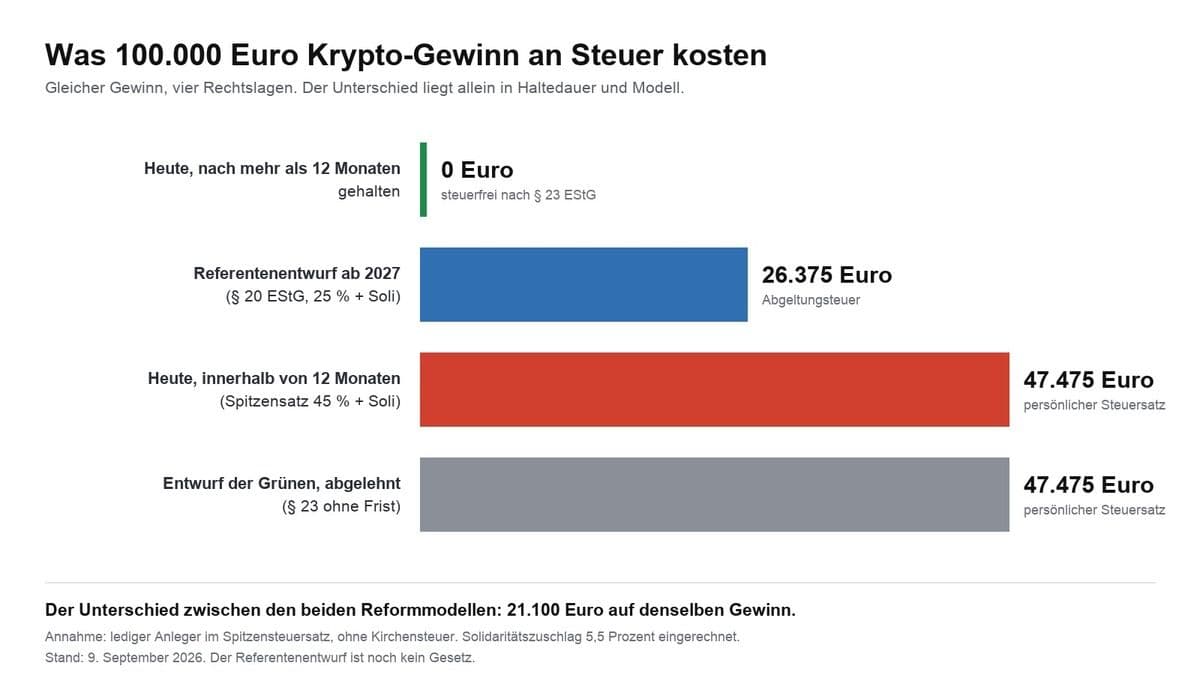
Crypto Tax in Germany: What Applies in 2026 and What Is Set to Change in 2027
Crypto gains are tax-free after twelve months; before that your personal tax rate of up to 45 percent applies. What triggers tax, how the holding period is calculated, what happens with staking and losses, and what the draft bill would change from 2027.
October 2, 2026 10:17 PM
Dogecoin breaks below $0.093: the BWOW fund turns every DOGE into cash on October 14
Dogecoin costs $0.0914 on Friday evening and has lost 3.4 percent in 24 hours. On October 14 the US fund BWOW sells its entire holding, and on the same day the German cabinet takes up the reform of crypto taxation.
September 29, 2026 1:33 AM

Zcash falls 8.5 percent as open interest shrinks 13.5 percent: the level that decides
Zcash trades at around $1,464 on September 28, 2026, 8.5 percent below the previous day. Our own measurement of open interest on OKX shows a fall of 13.5 percent in 24 hours, so more leverage unwinding than price loss.
More from CryptoTicker