
Binance Launches FX Perpetuals With 100x Leverage: What Is Allowed in Germany
Binance launches a perpetual future on the US dollar and the Brazilian real with up to 100x leverage on September 21. For German retail investors, what counts is less the announcement than the question of which leverage is permitted here and which tax rule applies to futures transactions.





Which topics should we dive deeper into?
Select what genuinely interests you. Your picks feed directly into our editorial planning.
Crypto news that's actually worth your time.
Weekly. 60 seconds. Carefully curated by our editors: no hype, no promo flood, no spam.
On Monday, September 21, 2026, at 14:00 UTC, Binance launches a perpetual future on a currency pair: USDBRLUSDT, the US dollar against the Brazilian real, settled in USDT and with leverage of up to 100. The answer to the question of whether you may and should trade this product as a retail investor in Germany is shorter than the announcement itself. The leverage sits far above what BaFin permits retail clients in comparable currency products, and the crypto regulation MiCA does not apply here in the first place.
The exchange files the contract under its TradFi Perpetual product category and has announced further currency pairs. Shunyet Jan, who is responsible for exchange and trading at Binance, justifies the move in the statement by saying that foreign exchange is one of the most fundamental markets in the world, where hedging and macro views are expressed at all hours. Two weeks earlier, Bybit had already introduced round-the-clock perpetuals on EUR/USD, GBP/USD and USD/JPY, likewise settled in USDT and likewise with leverage of up to 100. What is emerging here is a currency market run by crypto rules.
What Binance Launches on September 21: USD/BRL as a Perpetual Future
The contract is called USDBRLUSDT. It tracks the price of the US dollar against the Brazilian real, but settlement happens in USDT rather than in dollars or reais. You post a stablecoin as collateral, trade a currency pair through it, and have any profit or loss credited back to you in USDT. The price you are betting on has no currency link to your collateral balance.
Trading runs continuously, including at weekends. That is precisely the selling point. The classic foreign exchange market closes on Friday and reopens on Sunday evening. Anyone who wants to react to a piece of news in between cannot do so on regulated venues. Binance closes that gap and points out, according to its press release, that its own TradFi perpetuals have already been well ahead of comparable venues in weekend price discovery.
A perpetual future is a futures contract without an expiry date. In theory it can be held indefinitely, as long as the collateral holds up. To stop its price drifting permanently away from the underlying market, the buy and sell sides pay each other a balancing payment at regular intervals, the funding rate. This balancing payment is not a fee to the exchange; it flows between market participants. Whoever stands on the crowded side of the market pays the other side.
Perpetual Future on Currencies: How the Contract Differs From a Classic FX Future
On Eurex or the CME, currency futures have a fixed delivery date, a standardised contract size and a central counterparty that steps between buyer and seller. If a market participant defaults, that clearing house steps in. The perpetual future has neither the delivery date nor the central counterparty. Your counterparty is the exchange itself, or rather its insurance fund.
The second difference concerns the collateral. With a regulated futures contract, margin is posted in the settlement currency and administered by the clearing house. Here it sits as USDT in an exchange account. On top of the price risk of the currency pair, you therefore also carry the risk of the stablecoin and the risk of the custodian. Anyone who does not keep these layers apart systematically underestimates what they are getting into.
The third difference is access. A futures contract on a regulated exchange requires an account with a suitably licensed broker, who assesses your knowledge and experience beforehand. Whether you can reach the Binance contract depends on which group entity your account sits under and which products that entity unlocks for clients from the European Economic Area. The press release names no regional restrictions. That is no assurance that the contract is available in Germany, simply a gap in the statement that you have to close yourself before your first click.

Funding Rate Every Eight Hours: What the 0.375 Percent Cap Means for Holding Costs
Binance settles the funding rate for the contract every eight hours and caps it at plus or minus 0.375 percent. The figure looks small. It is not. Three settlements a day come to 1.125 percent of the position value in the extreme case, and that is per day. Held over a week, at the cap that would be almost eight percent flowing out purely to keep the position open, before the price has moved in any direction at all.
In quiet phases the actual rate is usually well below the cap and can also work in your favour if you stand on the rarer side of the market. You cannot rely on it. With a currency pair whose two sides carry different policy rates, the interest rate differential feeds structurally into the rate. That is exactly why a perpetual on currencies is a different animal from a perpetual on Bitcoin: here the balancing payment has an economic quantity behind it that cannot be diversified away.
For you that means: work out the holding costs before you enter and hold them against your price target. A position meant to deliver three percent of price gain but which has to stay open for two weeks can founder on the funding rate even though the direction was right.
 Trade With Leverage, but Regulated
Weekend Price Discovery: What the Order Book EWMA Method Reveals About the Risk
The most interesting part of the announcement sits in the small print of price discovery. Binance runs two modes. During regular foreign exchange trading hours, Sunday 17:00 to Friday 17:00 New York time, the index draws on real-time prices from third-party providers. From Friday evening to Sunday evening and on public holidays, the system switches to an order book EWMA mode: an exponentially weighted moving average of the prices in its own order book.
Translated, that means there is no external reference price at the weekend. The price at which your position is valued and, if need be, liquidated then arises solely from trading on this one platform. A thin order book, a larger order at the wrong moment, and the price moves with no correspondence whatsoever in the real currency market. The cap that the moving average imposes dampens such swings without preventing them.
This is the point at which a convenient offer turns into a tangible risk. Anyone who stays invested through the weekend on high leverage hands the valuation of their position to a mechanism built deliberately for the case where the actual market is closed. If you want to look at this type of venue more closely, our comparison of perp trading venues sets out the differences in fees, liquidity and liquidation logic side by side.
100x Leverage Against 30:1: Why BaFin Sets German Retail Investors Tighter Limits
For contracts for difference marketed, distributed or sold to retail clients in Germany, a BaFin general administrative act of July 23, 2019 applies, issued on the basis of Article 42 of the regulation on markets in financial instruments. It prescribes a minimum initial margin, requires close-out when a margin threshold is breached, protects retail clients against a negative account balance and prohibits bonus incentives. The leverage caps depend on the underlying: 30:1 for the major currency pairs, 20:1 for the remaining currency pairs and gold, 2:1 for cryptocurrencies.
The Brazilian real does not count among the major currencies within the meaning of that tiering. A provider marketing this pair as a contract for difference to German retail clients could offer leverage of 20 at most. Binance holds out 100, five times as much. Whether the contract is to be classified legally as a contract for difference is not thereby settled; a perpetual future is not automatically a CFD, and the classification hangs on the specific design and on the question of to whom the product is actively distributed, and in which country. As a yardstick for the risk the comparison holds up regardless: the German legislator has drawn a line for comparable currency products, and this product sits far beyond it.
Anyone who wants to take leveraged positions on currencies or crypto legally will get the lower, but bindingly safeguarded, terms at providers licensed in the EU: close-out by rulebook, no negative account balance, no bonus incentives that tempt you into topping up.
MiCA Does Not Govern Derivatives: Why MiFID II Applies to FX Perpetuals, Not the Crypto Regulation
A widespread misconception holds that MiCA has now settled everything to do with crypto. That is not the case. The European crypto regulation covers crypto assets, their issuers and service providers around custody, exchange and trading. Derivatives whose underlying is a crypto asset or a currency do not fall under it; they are financial instruments and are subject to the regime of the markets in financial instruments directive, MiFID II. A MiCA authorisation therefore does not entitle a provider to distribute leveraged futures contracts to European retail clients.
This separation matters to you in practice. An exchange can be fully MiCA-licensed in the EU and still give you no access to its derivatives, because it lacks the investment services permission for them. Conversely, the availability of a product in your app says nothing about whether the provider is allowed to offer it to you in Germany.

Calculating Liquidation: At What Price Move a 100x Position Closes
The arithmetic is uncomfortably simple. Leverage of 100 means your collateral corresponds to one hundredth of the position value, that is, one percent. If the price moves one percent against you, that stake is arithmetically used up. In practice forced closure kicks in earlier, because fees, accrued funding payments and the exchange's maintenance buffer count towards it. One percent thus often becomes only six or seven tenths of a percent of real headroom.
For context: the Brazilian real is an emerging market currency. It reacts to commodity prices, to the interest rate policy of the Brazilian central bank and to domestic political news, and it fluctuates noticeably more than the euro or the yen against the dollar. A daily move of one percent is no exception there, it is routine. At 100x leverage, a position in this pair is therefore arithmetically a bet that an average trading day does not happen.
If you trade on leverage, work out two figures before you enter and write them down: the price at which your position is forcibly closed, and the amount you lose in the process. If either of the two comes out uncomfortably, the leverage is set too high. This calculation costs two minutes and replaces any gut decision.
 Perp Trading Venues Compared
Tax on Futures Transactions: What Applies to Losses Since the 2024 Annual Tax Act
Gains from futures transactions count in Germany as income from capital assets and are charged the flat-rate withholding tax of 25 percent, plus the solidarity surcharge and, where applicable, church tax. The one-year holding period that many know from crypto spot trading does not apply here: it concerns private disposal transactions under section 23 of the Income Tax Act, whereas a futures contract falls under section 20. Anyone moving from spot into derivatives changes their tax logic along with it.
On losses, the situation has improved markedly of late. Since 2021, losses from futures transactions could be offset only against gains from transactions of the same kind, and even then only up to 20,000 euros a year. That special rule in section 20 paragraph 6 sentence 5 of the Income Tax Act was deleted by the 2024 Annual Tax Act. The Bundesrat gave its approval on November 22, 2024, the act was promulgated on December 5, 2024, and the deletion takes effect retroactively in all cases still open. Losses from futures transactions can therefore be offset without restriction against other investment income again. The step was justified by constitutional doubts about the unequal treatment.
What matters in practice is that a foreign exchange issues you no German tax certificate and withholds no flat-rate tax. The filing rests entirely with you, and you have to produce the documentation yourself: every position, every funding payment, every fee, with date and price. Anyone not recording this as they go reconstructs it at year-end from export files and price histories.
Custody and Counterparty Risk: What USDT Settlement Means for Your Balance
Your collateral sits as USDT in an exchange account. That stacks three risks on top of one another which have nothing to do with each other. First, the price risk of the currency pair you have taken on. Second, the risk of the stablecoin itself, which has to hold its peg to the dollar so that your margin keeps the value the exchange ascribes to it. Third, the risk of the platform: as long as your balance sits there, you hold a claim against a company, not a balance in your own custody.
For trading itself this cannot be resolved, margin has to sit where the contract is traded. What you can steer is the size. Transfer only the amount to the trading platform that you need for the planned positions plus a buffer, and leave the rest of your holdings where you want them. This separation costs you a few transaction fees a year and limits the damage if one of the three layers fails.
Checking Binance FX Perpetuals: What to Take Away
The launch on September 21 is no reason to hurry. It is an occasion to settle three things before any money is moved.
- First establish whether you have access at all, and whether you want it. Check in your account which entity it sits under and whether derivatives are unlocked for you. If the answer is no, the question is answered. If you do want to work with leverage, then at a provider with European authorisation, negative balance protection and a binding leverage cap — the candidates are in the broker comparison.
- Work out holding costs and liquidation price before you open a position. Three funding settlements a day, 1.125 percent daily at the cap, plus less than one percent of headroom at 100x leverage. If your price target does not clearly beat those two figures, the approach is wrong. How differently venues handle this is shown by the comparison of perp trading venues.
- Set up your documentation before the first position runs. Futures transactions fall under section 20 of the Income Tax Act, not under the holding period, and a foreign exchange withholds nothing on your behalf. A tool that records positions and funding payments as they happen spares you the reconstruction in spring; the selection is in the comparison of tax and portfolio tools.
Original sources: the Binance statement on the launch of the FX perpetuals and the BaFin general administrative act on contracts for difference.
(As of September 19, 2026. This article is not investment advice. Prices and fee structures change; check the terms with the provider before you buy.)
Transparency note: This article was produced with the assistance of artificial intelligence and reviewed by our editorial team before publication. All figures and claims were checked against the primary sources linked in the text. The feature image was generated with AI.
Related articles
- CFTC Registers Coinbase Clearing for Fully Collateralised Derivatives: What Matters for Investors in Europe
- Perp DEX Explained: How Funding Rate, Liquidation and Taxes Work on Perpetual Futures
- ESMA Places Perpetual Futures Inside the CFD Perimeter: 2:1 Leverage for Retail Clients in the EU
- Robinhood Announces Perp Futures With 10x Leverage for US Customers: “Markets don’t work without traders”
- Cardano Slides Below $0.24: What ADA Holders Should Check on Leverage, Liquidation and Holding Period
Which topics should we dive deeper into?
Select what genuinely interests you. Your picks feed directly into our editorial planning.
Crypto news that's actually worth your time.
Weekly. 60 seconds. Carefully curated by our editors: no hype, no promo flood, no spam.

September 24, 2026 1:24 PM

NEAR Falls Almost 8 Percent After a 62 Percent Week: What to Check on Perps, Buying Route and Holding Period
NEAR Protocol loses up to 7.9 percent on September 24, 2026 and is still more than 55 percent higher over the week. The rally was carried by a confidential perp offering via Hyperliquid, which raises questions of its own on buying route, leverage and holding period in Germany.

September 22, 2026 4:12 AM

Open Interest Climbs After the Short Squeeze: Why the Longs Are Paying Now
The short squeeze of September 21 wiped out $648 million in bearish bets, yet open interest rose instead of falling. A survey of our own across four exchanges shows the funding rate is positive on 24 of the 25 largest bitcoin perpetuals.

September 26, 2026 1:11 AM

Funding Rate on Perpetual Futures: How to Calculate What Your Position Really Costs
A rate of 0.01 percent per interval sounds like nothing and works out at almost 11 percent of the notional value over a year. This guide walks through the calculation, the timestamp effect and the way leverage multiplies the burden.
September 15, 2026 4:12 AM

Using Hyperliquid from Germany: What Applies to Your Funds Without a MiCA Licence
Hyperliquid is not entered in any EU register as an authorised crypto-asset service provider, and for perpetual futures a MiCA licence would be the wrong paperwork anyway. Here is what that means in concrete terms for your funds, your keys and your tax return.
September 30, 2026 4:14 AM

Bitcoin Price Before the Core PCE at 14:30 CEST: Will the $82,735 Level Hold?
At 14:30 CEST today the Bureau of Economic Analysis publishes the core PCE deflator for August, the inflation gauge the Fed anchors its 28 October rate decision to. Bitcoin stands at $83,329, less than $600 above its daily low, and anyone holding on leverage decides this morning.
September 24, 2026 4:16 AM

Trump-Xi Summit at the White House: The Crypto Positions to Check Before the Meeting
Xi Jinping is on a state visit to Donald Trump today, and the crypto market comes into the meeting carrying the gains of an exceptionally strong week. What to check on leverage, holding period and custody before the first headline runs.
September 9, 2026 1:26 PM

Bitcoin Options Expiry of September 25: What Holders of Leveraged Positions Should Know in Hindsight
Recap as of September 27, 2026: Bitcoin options worth $14.39 billion were due to expire on September 25, alongside Ether options worth $1.81 billion. This article describes the situation before that date, our own count of the derivatives market and what holders of leveraged positions should have checked at the time.
September 8, 2026 10:21 PM

Crypto Holding Period and Grandfathering: Why December 31, 2026 Becomes the Cut-Off in Germany's Draft Bill
A ministerial draft bill from Germany's finance ministry names a cut-off date for the first time: crypto assets acquired after December 31, 2026 are to fall under the flat-rate withholding tax. What that means for legacy holdings, running savings plans and staking income, and why nothing has been decided yet.
September 22, 2026 7:13 PM

CME Lists Bitcoin Cash and Uniswap Futures From October 19: What Retail Investors Must Check With Their Broker
CME Group brings futures on Bitcoin Cash and Uniswap to market on October 19, and BCH jumps 24 percent on the news. For retail investors in Germany, however, a BaFin order decides whether they may trade the contracts at all.
August 26, 2026 7:34 AM

Coinbase Delisting on August 26: Ten Perpetual Futures Go, Open Positions Are Settled
Coinbase is removing ten perpetual futures from trading on August 26, 2026, among them the contracts on The Sandbox, Axie Infinity and Blur. Anyone leaving a position open does not sell it themselves but is settled at an average price from the final hour of trading.
September 27, 2026 1:17 PM

Dogecoin Price: What to Check on Holding Period and Custody Before the Year End
The Dogecoin price stands at $0.0977 on September 27, 2026 and has barely moved in a day. That calm is exactly the moment to work through the holding period, the reporting duty from 2026 and custody without any time pressure.
September 14, 2026 10:23 AM

Take Ethereum Profits or Wait Out the Holding Period? What the Price Jump Means for Your Tax Bill
Ether reached its highest level since the end of January on September 11, 2026, and many are asking whether to sell now. In Germany the answer hangs on the purchase date first: we work out which tranches are tax free and which of them are showing a gain at all.
September 24, 2026 1:13 AM

Solana DEX Trades Overtake the NYSE: What to Check on Swaps, Tax and Oversight
Solana's decentralised exchanges settled roughly 208 million trades in a single week and overtook the New York Stock Exchange for the first time. The figure is real, but it measures something other than the comparison suggests, and for German investors it carries tax duties that no provider takes on.
September 23, 2026 10:11 PM
BitMEX shutdown: what to check now for residual balances and your 2026 tax return
BitMEX halted trading for good at 04:00 UTC on September 23, 2026, force-closing every position still open. What that realises for tax, which account fee now runs on residual balances, and which documents you need to secure.

October 1, 2026 1:34 AM

Shorting Quant: Where QNT Can Be Traded After Its Sixfold Run and What It Costs
Quant has almost sextupled within a week. Anyone wanting to bet on falling prices will find QNT futures on seven large exchanges, but is currently paying daily fees to the buyers. The routes, the costs and the biggest risk at a glance.
September 30, 2026 4:36 PM

Dogecoin Price Prediction: 28 Billion DOGE Make $0.098 the Level That Decides
Dogecoin trades at around $0.0973 on Wednesday midday and keeps failing at the zone at $0.098, where roughly 28 billion DOGE changed hands. At the same time $1.50 billion sits in open leveraged positions, and the tax authority's one-year period runs separately for every purchase.
September 25, 2026 7:14 PM

Chainlink Above the September High: What Open Interest, Funding Rate and Liquidation Risk Mean for LINK
Chainlink stands at $13.86, 11.2 percent higher than 24 hours ago. Our own query at OKX and Hyperliquid shows funding at the baseline rate, and what that means for leverage, buying route and tax.
September 25, 2026 1:12 PM

XRP Jumps to $1.56: What Holders Should Check on Buying Route, Holding Period and Leverage
XRP trades at $1.56 on September 25, 2026, up 6.85 percent on the day and 16.64 percent on the week. What the on-chain data and the US ETF inflows actually show, and what investors in Germany should check now on buying route, holding period, leverage and custody.
September 24, 2026 10:11 PM

Bitcoin Price Prediction: What to Check on Levels, Holding Period and Leverage Before the October 28 Rate Decision
Bitcoin is trading at around $83,800, a third below its October 2025 high, while the sentiment index reads greed. Which dates, levels and deadlines over the coming weeks really decide your net gain, and which of them you steer yourself.
September 22, 2026 10:25 PM

Binance Buys Into Circle: What the USDC Deal Means for Your Balance
Binance is taking a $100 million stake in Circle and extending the USDC agreement by five years. For investors in Germany, the sum matters less than the question of who earns money from stablecoins left sitting idle.
September 22, 2026 1:15 AM

Memecoin Rally: Why Memecoins Are Rising and What to Check Before You Buy
The memecoin sector stands 9.01 percent higher, the overall market only 2.90 percent. The arithmetic behind it shows that two tokens carry three quarters of the move and that the sector has no occasion of its own.
September 12, 2026 1:29 AM

Is Polymarket Allowed in Germany? What the ESMA Report Says About Prediction Markets
ESMA has given prediction markets a chapter of their own in its risk report for the first time. It writes that event contracts require an authorisation in the EU that the large platforms do not hold.
August 14, 2026 6:23 AM

Bitcoin Savings Plan and Tax: How the Holding Period, FIFO and the Exemption Limit Interact on Monthly Buys
Every savings plan instalment is a separate acquisition for tax purposes, with a holding period of its own. How the exemption limit, the order of disposal and record-keeping duties interact on monthly Bitcoin buys, with the sources from the statute and the Ministry of Finance circular.
September 9, 2026 4:22 PM
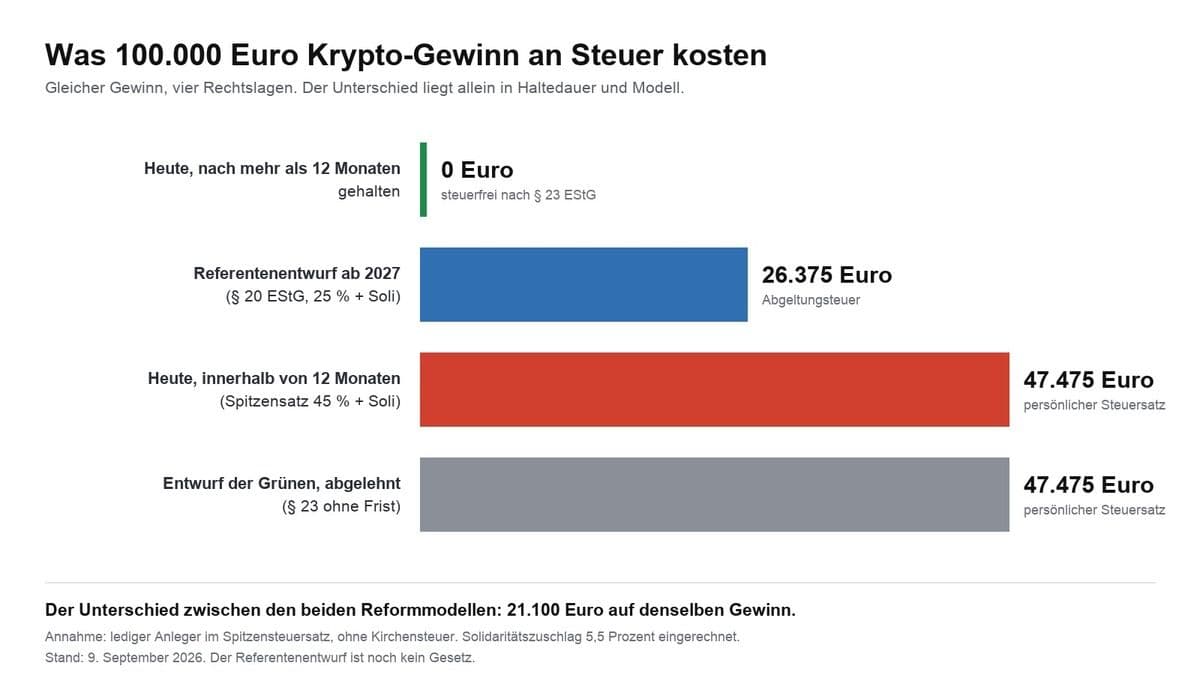
Crypto Tax in Germany: What Applies in 2026 and What Is Set to Change in 2027
Crypto gains are tax-free after twelve months; before that your personal tax rate of up to 45 percent applies. What triggers tax, how the holding period is calculated, what happens with staking and losses, and what the draft bill would change from 2027.
September 26, 2026 1:19 AM

Germany’s Crypto Holding Period Is Wobbling: What to Check Before December 31
A CDU member of the Bundestag makes it plain: the coalition agreement does not guarantee that the one-year holding period for crypto assets will survive. What that means for purchases made before the planned cutoff date of December 31, 2026.
September 9, 2026 1:15 AM

Germany's Crypto Tax: 160 Million Euros for a 555-Billion Budget
The German finance ministry's draft bill puts a figure on the crypto tax for the first time: 160 million euros from 2028. What that number means in the 2027 federal budget, how 11.4 billion became 160 million, and what investors can read from it.
September 8, 2026 1:19 AM

Germany's Crypto Holding Period: What Happens Now Signing for Petition 201716 Closed on September 15
Recap as of September 27, 2026: the signature period for German parliamentary petition 201716, which asks for the one-year crypto holding period to be preserved, closed on September 15, 2026. This article explains what ended that day, how the petitions committee proceeds and why no investor has to sell because of it.
More from CryptoTicker