
Cardano open interest climbs to $395 million while ADA falls
Analysis: open interest in the Cardano futures market grows to $395 million while ADA slips below $0.175. What the funding rate, order books and the August low show, and where liquidation looms for leveraged positions.


Which topics should we dive deeper into?
Select what genuinely interests you. Your picks feed directly into our editorial planning.
Crypto news that's actually worth your time.
Weekly. 60 seconds. Carefully curated by our editors: no hype, no promo flood, no spam.
Traders are betting more on Cardano in the futures market again, even though the price keeps slipping. According to data from analytics firm CoinGlass, analyzed by U.Today on Tuesday, open interest in ADA futures rose 5.42 percent within 24 hours to $395.09 million. At the same time, Cardano slipped below $0.175 on Wednesday morning, November 11, 2026. What is documented: new positions are being added while the price falls, and the funding rate in the perpetual market is just below zero. Our assessment follows further down: rising open interest during a falling price mainly increases the risk of violent swings in both directions, and no bottom can be read from it yet.
On Wednesday morning ADA cost $0.1748 according to CoinGecko and €0.1572 on the Kraken exchange. That is a loss of 2.2 percent over 24 hours, 8.0 percent over seven days and 30.8 percent over 30 days. The daily low was $0.1709. With a market value of around $6.6 billion, Cardano is the 18th-largest cryptocurrency and has lost considerably more since early October than Bitcoin, which gave up around 12 percent over the same period.
Open interest at $395 million: what the CoinGlass figure measures
Open interest is the sum of all open futures contracts on a coin, measured in dollars. Every contract has a buyer and a seller, so the figure does not say whether more money is betting on a rising or a falling price. It shows how much capital is tied up in the futures market and how much leverage is in the system.
If open interest rises while the price falls, traders are opening new positions rather than closing old ones. These are often short sellers betting on further losses. They could just as well be buyers speculating on a rebound after five losing weeks. CoinGlass data offers a clue: in futures on Tuesday, aggressive buying, meaning buy orders executed immediately at the market price, outweighed aggressive selling by 3.9 percent. In the spot market, by contrast, selling dominated, by a net $1.27 million.
The contradiction is typical of a phase in which futures traders position themselves against the trend while holders sell their coins. It usually resolves with a fast move: either the futures buyers give up and sell too, or short sellers have to buy back when the price rises.
Funding rate on OKX: longs and shorts almost evenly matched
A second metric shows which side is under more pressure. The funding rate is the fee that buyers and sellers of perpetual futures, known as perpetuals, pay each other every eight hours. If it is positive, buyers pay, because more money is betting on rising prices. If it is negative, short sellers pay.
For the ADA perpetual against Tether on the OKX exchange, the last settled rate on Wednesday morning was minus 0.0014 percent per eight hours, with the current period at minus 0.0006 percent. Both are very close to zero. Short sellers have a slight upper hand, but there is no sign of a one-sided bet in the market. On OKX itself, around 132 million ADA were held in open perpetual contracts at the same time, equivalent to about $23 million.

Order books at $0.177 to $0.179: where large sell orders sit
The order books of the major exchanges show where supply is piling up. According to CoinGlass, on Tuesday there were around $477,000 in sell orders at $0.179 on Bitget, around $415,000 in the same area on Crypto.com and about $445,400 at $0.177 in the Binance futures market. The $0.177 to $0.179 zone is therefore the first area where a rise would meet a lot of supply.
Below that, buy orders gathered between $0.170 and $0.175. That is exactly the zone the price moved into on Wednesday morning. Large orders in the order book are not a fixed boundary, however: traders can withdraw them at any time, and a wall that stands in the evening has sometimes vanished by the next morning.
 Compare perp DEXs before you trade ADA futures
Since November 9: price almost unchanged, DeFi deposits slightly recovered
On Monday we described Cardano DeFi deposits at their yearly low. ADA cost $0.1741 at the time; today it is $0.1748. The price has barely moved in two days, even though the US inflation data came out on Tuesday in between. According to DefiLlama, deposits in Cardano protocols stood at $48.9 million on Monday and $49.4 million on Wednesday. What is new is the futures market as a second view of the situation: the capital in the protocols stays almost flat, while the capital in futures grows.
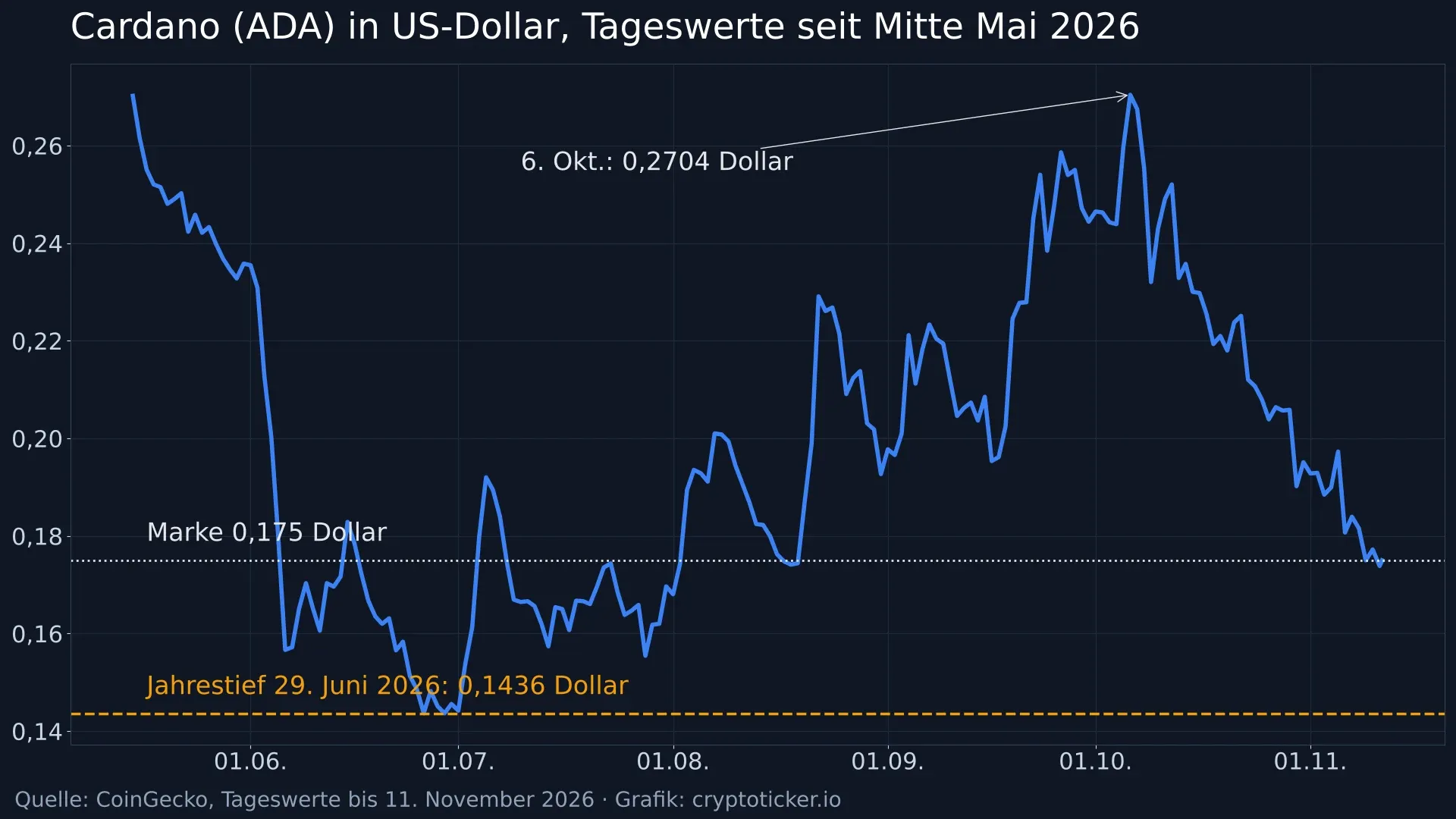
ADA has not returned to the first hurdle of $0.193 named at the time. The yearly low of $0.1436, on the other hand, has come closer; measured from Wednesday morning, it is still 17.8 percent away.
From the August low to the yearly low: what happened at $0.174 last time
A look at our own daily values from CoinGecko shows that the zone around $0.174 is not unfamiliar territory for Cardano. On August 18, 2026, ADA stood at $0.1741. Four days later, on August 22, it was at $0.2291, a rise of around 32 percent. Back then the recovery came without the yearly low of June 29 at $0.1436 being tested again.
The comparison has a limit. In August ADA was coming out of a sideways phase; now the coin is coming off a decline from $0.2704 on October 6, the highest daily value of the past six months. Five consecutive losing weeks have pushed many autumn buyers into the red, and precisely these buyers like to sell at their entry price on any recovery. According to CoinCentral, the analyst More Crypto Online named the zone from $0.1617 to $0.1824 as a possible area for a bottom on November 9, but saw no signal for a low yet.
US inflation data as the trigger: why ADA falls harder than Bitcoin
The latest decline was triggered by US consumer prices for October, which came in higher than expected on Tuesday. We put the figures and the consequences for Bitcoin into context in our article on the US inflation data and stops before December 9. Higher inflation makes rate cuts by the US Federal Reserve less likely, and that hits risky assets first.
Cardano reacts more strongly than Bitcoin. Over 24 hours, ADA lost 2.2 percent on Wednesday morning and Bitcoin 1.0 percent. Over 30 days, ADA is down 30.8 percent and Bitcoin 12.1 percent. The reason lies in the market itself: smaller coins lack large buyers such as the Bitcoin ETFs that could cushion a decline. No spot ETF on Cardano trades in the US; according to CoinCentral, Grayscale withdrew its application in August.
Leverage and liquidation: at 5x, the threshold sits close to the yearly low
If you trade ADA futures, you should calculate the liquidation threshold before entering. Liquidation means the exchange forcibly closes a leveraged position as soon as the posted collateral no longer covers the loss. A worked example with Wednesday morning's price and an isolated long position: at 10x leverage, a decline of just under 10 percent is enough, putting the threshold at roughly $0.159. At 5x leverage, it is around $0.142, almost exactly at the yearly low. The exact values depend on the exchange's maintenance margin and fees.
This matters especially when open interest is rising. If many leveraged positions cluster in the same zone, a break of the $0.170 mark can trigger a wave of forced sales that makes the price fall faster than the actual trigger would. Conversely, short sellers buying back push the price higher still on a rise above $0.179.
For retail investors in Germany, leverage on crypto CFDs is capped at 2 to 1; the financial regulator has set this for regulated brokers. Anyone trading on foreign platforms with higher leverage bears the full risk of losing all their collateral. You can find an overview of providers for leveraged trading in our comparison of the best crypto brokers.
 Find a staking platform for your ADA
ADA holding period in Germany: using losses before one year is up
If you bought ADA in the past twelve months, you are almost certainly at a loss at the current price: a year ago Cardano still cost around $0.55. In Germany, a sale within the one-year holding period is a private sale transaction. The loss can then be offset against gains from other private sale transactions in the same year or carried forward to later years. After the period expires, a sale is tax-free, but a loss then no longer counts either. We track the status of plans to abolish the holding period on our page on the holding period reform.
The holding period does not apply to futures. Gains and losses from futures transactions are treated differently for tax purposes than a spot purchase, regardless of how long the position was open. Anyone mixing spot and futures therefore needs a clean record of all trades.
Cardano staking continues: delegated ADA remain freely available
One difference from many other networks helps holders in a phase like this. Staking on Cardano does not lock the coins. If you delegate ADA to a stake pool, you can sell or move them at any time, and rewards are credited every five days at the end of an epoch. According to a query of the blockchain service Koios, epoch 667 is currently running. The network's treasury holds around 1.42 billion ADA, whose use the community votes on; an open proposal for 22 million ADA for a copper reserve expires with epoch 668.
Staking does nothing to change the price risk. It does, however, bring ongoing income in ADA without tying you to a date. When buying through an exchange, it is worth checking whether it offers staking itself and what share of the reward it keeps. We compare exchanges with a MiCA license for customers in Germany on our page on the best crypto exchanges. If you want to buy ADA in this situation, you are better off placing a limit order in the $0.170 to $0.175 zone than buying at the market price.
Our view of the ADA futures market
From the editorial team's perspective, more points to continued swings than to a quick bottom. Three documented points support this: open interest of $395 million that grows as the price falls, the sell orders between $0.177 and $0.179, and the net spot outflow of $1.27 million in a single day. The neutral funding rate argues against a further slide. If short sellers dominated the market, it would be clearly negative.
In our view, the $0.170 to $0.175 zone is decisive. If it holds, a move like the one in August is possible, when ADA rose around 32 percent within four days from the same area. If it breaks, the next documented level is only the yearly low of $0.1436. This is an assessment of the situation and not a recommendation to buy or sell. With cryptocurrencies, a total loss is possible.
ADA futures: below $0.170 things get tight for longs
- Calculate the liquidation threshold: For every leveraged ADA position, check where the exchange will forcibly close you out, and compare the conditions in our comparison of the best perp DEXs.
- Document losses: Record the purchase date and entry price of every ADA position before the holding period expires. Suitable tools are listed in our comparison of crypto tax tools.
- Use staking: If you hold ADA anyway, you can delegate them without a lock-up. Providers and their fees are in the comparison of staking platforms.
(As of November 11, 2026. This article is not investment advice. Prices and fee structures change; check the terms with the provider before you buy.)
Frequently asked questions about Cardano
Partner links: some links on this page are partner links. If you become a customer through one of them, we may earn a commission at no extra cost to you. Selection, ratings and ranking are decided independently by our editorial team. Ethics and Independence · Ownership and Funding
Transparency note: This article was produced with the assistance of artificial intelligence. Figures and claims are based on the primary sources linked in the text. The feature image was generated with AI.
For later? Save this article and find it again in your profile.
Related articles
- XRP price prediction: November has cost 26 percent so far as OKX open interest shrinks by a third
- Dogecoin price slips below $0.0577 as OKX funding rate turns negative
- Hyperliquid: crash day brings highest fees since October, HYPE recovers 14 percent from its low
- Coinglass explained: what the liquidation heatmap shows and where its limits lie
- Dogecoin news: DOGE futures market shrinks by a quarter since early November as funding turns negative
Which topics should we dive deeper into?
Select what genuinely interests you. Your picks feed directly into our editorial planning.
Crypto news that's actually worth your time.
Weekly. 60 seconds. Carefully curated by our editors: no hype, no promo flood, no spam.

November 15, 2026 9:28 AM
Canton price crashes below $0.08 and clings to 25th place
Canton fell below $0.08 on November 15, 2026, and closed at its lowest since mid-December 2025. The article maps the levels down to the December low, the state of the futures market and how leverage works on Canton.

November 15, 2026 9:18 AM
Crypto liquidations: $2 billion in 24 hours, mostly longs on bitcoin and ether
Around $2 billion in leveraged crypto positions were liquidated within 24 hours, almost all of them bets on rising prices. Our own data show how far the long/short ratio has shifted and how large a move it takes for leverage to wipe out the stake.
November 15, 2026 12:58 AM
What Is Open Interest? Crypto Open Interest Explained
Open interest counts every open futures contract. What the metric shows for bitcoin, how it builds up and shrinks on perpetuals, how to read it with price and why it signals squeeze risk.
November 14, 2026 5:14 PM

Cardano falls below $0.16 as Hoskinson says “my job is done”
Cardano has lost around 8.8 percent in 24 hours and trades at its lowest level since late July. On the same day, founder Charles Hoskinson repeated that his work on Cardano is done.

November 13, 2026 8:39 PM

Bitget Futures Trading: Your First Trade, Leverage and Risk
How to trade futures on Bitget step by step: USDT-M contracts, leverage up to 150x, how far Bitcoin can move before your margin is gone, what fees and funding cost per day and how a stop-loss protects you.

November 13, 2026 7:24 AM

Cardano ahead of the Dijkstra hard fork: Leios node 11.3 now expected in December
Analysis: the Dijkstra upgrade with Leios is slipping into December for Cardano, and there is still no date for mainnet. Meanwhile, ADA is hovering around $0.170.
November 11, 2026 7:14 AM

XRP price prediction: funding rate at a 13-month high, what it means for your coins
Analysis: XRP has lost 30 percent since early October, yet leveraged buyers are paying more in funding than at any point in 13 months. Plus the picture for the spot ETFs and the last emptied wallet of the Binance attacker.
November 9, 2026 9:13 AM

Cardano DeFi falls to a one-year low of $48.9 million, yet barely any ADA has left
Analysis: Deposits in Cardano DeFi have fallen to $48.9 million, the lowest level in a year. Measured in ADA, however, little has changed since October; the decline comes from the price.
November 6, 2026 3:19 AM
Cardano Price Under Pressure, Yet 58 Percent of All ADA Stays Staked
Cardano fell 6.3 percent in 24 hours to $0.185, its lowest level since mid-August. On-chain data shows that 58.5 percent of all circulating ADA is still delegated to stake pools, only slightly less than a year ago.
November 2, 2026 6:01 PM
Hyperliquid: why HYPE is up 13 percent while Binance pauses withdrawals
HYPE trades at $89.42, up around 13 percent, while bitcoin loses 4.1 percent and ether 5.3 percent. The trigger is the withdrawal halt at Binance: we counted all 235 markets on Hyperliquid and show what the inflow really means for volume, open interest and funding costs.
October 29, 2026 12:35 PM

21 million dollars in the SHIB futures market: the level that decides
Analysis: the futures market for Shiba Inu holds 21.1 million dollars across four exchanges, 0.74 percent of market value. The positions are documented; we set out what they mean for the price.
October 29, 2026 9:44 AM

Cardano below $0.20: what delegators should watch now
Cardano trades at $0.1979 on Thursday morning, the first reading below the round mark since September 17. The 200-day line stands at $0.2100 and did not hold.
October 28, 2026 6:30 AM
Bitcoin Cash: all 81 futures markets are perpetuals, CME is missing
Bitcoin Cash rises to $294.31 and holds a weekly gain as one of the few top-25 assets. A count of our own shows all 81 futures markets are contracts with no expiry date, and half of the open positions hang on a single trading venue.
October 25, 2026 1:21 AM

XRP price prediction: why 4.8 percent open leverage cushions the fall
XRP sits on its 100-day average on Saturday evening. Only 4.8 percent of its market capitalisation is held in open leveraged positions on the futures market, against more than three times that for Ethereum and Solana.
October 24, 2026 10:24 PM

Ethereum price prediction: the premium for leveraged buys falls to zero, and $2,311 is the level that decides
Analysis: it is documented that the funding rate for leveraged Ethereum buys on OKX has fallen to zero for the period up to midnight, the first time since October 13, and that Ether is quoted at $2,300 on Saturday evening. Our assessment follows further down: cheap leverage turns no price, and the 100-day line at $2,311 decides the direction.
October 23, 2026 1:23 PM
$1.81 billion on a single exchange: Monero open interest figures differ sixfold
Monero is down 6.2 percent at $606.80 over 24 hours, after reaching $653.71 within the same range. An own count of 52 futures contracts shows why reported open interest differs sixfold depending on the data source, and which figure matters for your position size.
October 22, 2026 10:13 PM

Solana price prediction: 2.57 long accounts per short as $12.9 million leaves the futures market
Solana's futures market lost $12.9 million in open interest within a day, yet the long ratio holds at 2.57 accounts per short. What that means for the $100 level, and how to work out your own liquidation distance.
October 16, 2026 1:32 AM

US producer prices at 6.3 percent: the $80,000 level decides the leverage question up to October 28
US producer prices rose 1.3 percent on the month and 6.3 percent on the year in September, running well above consumer prices. Bitcoin fell to just under $80,000 while the probability of a rate rise on October 28 jumped from 22 to 47 percent within a day and fell back to 26 percent.
October 15, 2026 10:13 PM

NEAR up 9 percent, and longs pay in 74 of 86 perp markets: What it means for your coins
NEAR trades at around $5.26 on October 15, 2026 and gains 9.25 percent, while Bitcoin adds only 0.96 percent. Our own survey of 86 perpetual markets shows the buy side paying for its position in 74 of them.
October 15, 2026 1:34 PM

$489 million in liquidations in one hour: where your leverage breaks first
Forced closures wiped out around $489 million within one hour on 15 October 2026, more than half the daily total of $942 million. Our analysis of OKX futures market data shows why Ether was hit harder than Bitcoin.
October 14, 2026 10:30 PM

Solana price at $103.82 with 12 percent fewer open futures positions: will the $100 level hold?
Solana traded at $103.82 on Wednesday evening, only 3.7 percent above the $100 mark. On the futures market, open positions have shrunk by 12.1 percent within a week, and the funding rate has tipped to zero.
October 10, 2026 7:30 PM

Bitcoin Price Prediction: 140,844 BTC Expire on October 30, and What Matters Now at $80,000
On October 30, 140,844 Bitcoin contracts worth $11.69 billion run out, and two thirds of them are bets on higher prices. At both expiry dates the largest hedge sits at $80,000.
September 25, 2026 7:14 PM

Chainlink Above the September High: What Open Interest, Funding Rate and Liquidation Risk Mean for LINK
Chainlink stands at $13.86, 11.2 percent higher than 24 hours ago. Our own query at OKX and Hyperliquid shows funding at the baseline rate, and what that means for leverage, buying route and tax.
September 24, 2026 1:34 PM

Cardano Slides Below $0.24: What ADA Holders Should Check on Leverage, Liquidation and Holding Period
Cardano has given back its move above $0.25 and trades around seven percent below the high of the past 24 hours. What that means for leveraged positions, the holding period of your tranches and the buying route under MiCA.
September 22, 2026 4:12 AM

Open Interest Climbs After the Short Squeeze: Why the Longs Are Paying Now
The short squeeze of September 21 wiped out $648 million in bearish bets, yet open interest rose instead of falling. A survey of our own across four exchanges shows the funding rate is positive on 24 of the 25 largest bitcoin perpetuals.
September 19, 2026 1:31 AM

Bank of Japan rate move: how to spot a carry trade unwind before it hits your Bitcoin holdings
Japan raises to 1.25 percent, the Fed to 3.75 to 4.00 percent two days earlier, and the crypto market rises anyway. How to tell whether an unwinding of yen-funded positions is under way, and what to check now on leverage, holding period and loss offsetting.
September 9, 2026 1:26 PM

Bitcoin Options Expiry of September 25: What Holders of Leveraged Positions Should Know in Hindsight
Recap as of September 27, 2026: Bitcoin options worth $14.39 billion were due to expire on September 25, alongside Ether options worth $1.81 billion. This article describes the situation before that date, our own count of the derivatives market and what holders of leveraged positions should have checked at the time.
More from CryptoTicker