
Bitget Demo Trading: Practice Futures With Virtual USDT
Bitget demo trading lets you practice futures with virtual USDT on live prices. How to switch it on in the app and on the website, which pairs it covers, how it differs from live trading and a practice plan with a realistic balance.

Which topics should we dive deeper into?
Select what genuinely interests you. Your picks feed directly into our editorial planning.
Crypto news that's actually worth your time.
Weekly. 60 seconds. Carefully curated by our editors: no hype, no promo flood, no spam.
Bitget demo trading is a practice mode for futures in which you trade with virtual money on live market prices. Every Bitget account has it switched on by default: in the app you open Futures, tap the three dots and choose Demo Trading, and Bitget credits virtual funds, 50,000 USDT in its own example. Profits and losses stay virtual, and the demo balance can never be withdrawn or moved to your real account, according to Bitget’s help page on demo trading.
Bitget demo trading: the key facts
- Cost: free, part of every Bitget account, no manual activation.
- Balance: virtual USDT, the demo version of the Tether stablecoin, 50,000 in Bitget’s example; demo contracts carry an S prefix, such as SBTCSUSDT.
- Markets: USDT-M pairs such as BTCUSDT, ETHUSDT, ADAUSDT and XRPUSDT, plus BTC and ETH in Coin-M and USDC-M.
- Prices: real-time market data, with minor delays possible.
- Limits: demo assets cannot be withdrawn, transferred or used for live trades.
This guide shows how to start the demo on the app and the website, what is the same and what differs from live trading, and a practice plan that makes the virtual money count. Why practice matters is easiest to see in numbers: at 10x leverage a 10 percent move consumes your margin, as our guide to leverage trading explains. Bitget is not listed in ESMA’s register of crypto-asset service providers authorised under MiCA, so this guide is for readers outside the EU in countries where Bitget operates.
What is Bitget futures demo trading?
Bitget demo trading is a separate futures environment with its own virtual balance. It uses the same order screen as live futures: you pick a pair, set leverage, choose a long or short position and an order type. Bitget describes it as a virtual environment to practice futures trading without real funds: beginners learn how the platform works, and more experienced traders use it to test strategies risk-free.
Because futures demo trading runs on live prices, a position you open in the demo reacts to the same market moves as a real one. What the demo cannot simulate is your own reaction to losing real money, which is why the practice plan further down starts with the size of the balance.
If the virtual balance runs low, you can top it up. Bitget’s academy guide to futures demo trading (February 2024) calls the balance imaginary money and describes a deposit of 1,000 SUSDT in demo assets, possible when the demo balance is below 1,000 SUSDT and no top-up was made in the previous 72 hours. Even after a liquidation the demo account can be refilled, so a mistake costs nothing but time.
How to start futures demo trading on the Bitget app and website
You need a Bitget account to log in, but no deposit: demo trading is available to all users by default. Head to the Futures section, and the demo balance appears automatically the first time you open the mode.
| Step | Bitget app | Bitget website |
|---|---|---|
| 1 | Log in and tap the Futures tab | Log in at bitget.com |
| 2 | Tap the three dots in the top right corner and choose Demo Trading | Hover over Futures in the top bar and click Demo Trading |
| 3 | Pick a pair, for example BTCUSDT, and set leverage | Pick a pair, set leverage and choose market or limit |
| 4 | Choose long or short, enter the size and confirm | Enter the size and click Open Long or Open Short |
To leave the demo, switch back the same way. Your real futures account and its balance are untouched by anything you do in demo mode.
Which trading pairs the Bitget demo account offers
The demo covers the most traded contracts in all three futures families. Bitget notes that the list can change with platform updates.
| Futures type | Demo trading pairs according to Bitget |
|---|---|
| USDT-M perpetual futures | BTCUSDT, ETHUSDT, ADAUSDT, XRPUSDT and other popular pairs |
| Coin-M futures | BTCUSD, ETHUSD |
| USDC-M futures | BTCUSDC, ETHUSDC |
For a first practice run, BTCUSDT is the natural choice: it is the contract most beginners trade later with real money, and its moves are documented in every market report, so you can compare your demo trades with what actually happened.
 Crypto exchanges compared
Bitget demo trading vs live trading: what changes
Most of the mechanics carry over one to one. The difference lies in the money and in you.
| Aspect | Demo trading | Live trading |
|---|---|---|
| Prices | Real-time market data, minor delays possible | Real-time market data |
| Order screen, leverage, long and short | Same as live | Same as demo |
| Balance | Virtual USDT, cannot be withdrawn or transferred | Your own deposit |
| Selection of pairs | The most traded contracts | All listed futures |
| Losses | Virtual, no effect on your assets | Real, up to the whole margin |
The last row is the one that matters. A demo loss of 5,000 virtual USDT is easy to shrug off, a real loss of 50 USDT often is not. With real money, the temptation grows to close winners too early and to hold losers too long. A trading strategy written down before you start is the best defence.
A practice plan to hone your trading skills in the Bitget demo account
Bitget’s own guide to avoiding liquidation recommends simulating with the amount you really plan to trade and risking 1 to 2 percent per trade. Built around that, four steps help you hone your skills with the demo:
- Size the demo like your real account. If you plan to start with 500 USDT, trade the demo as if you had 500 USDT, not 50,000. Otherwise every position is a hundred times too large to teach you anything.
- Fix your risk per trade. One to two percent of the balance, set through the stop-loss distance and the position size.
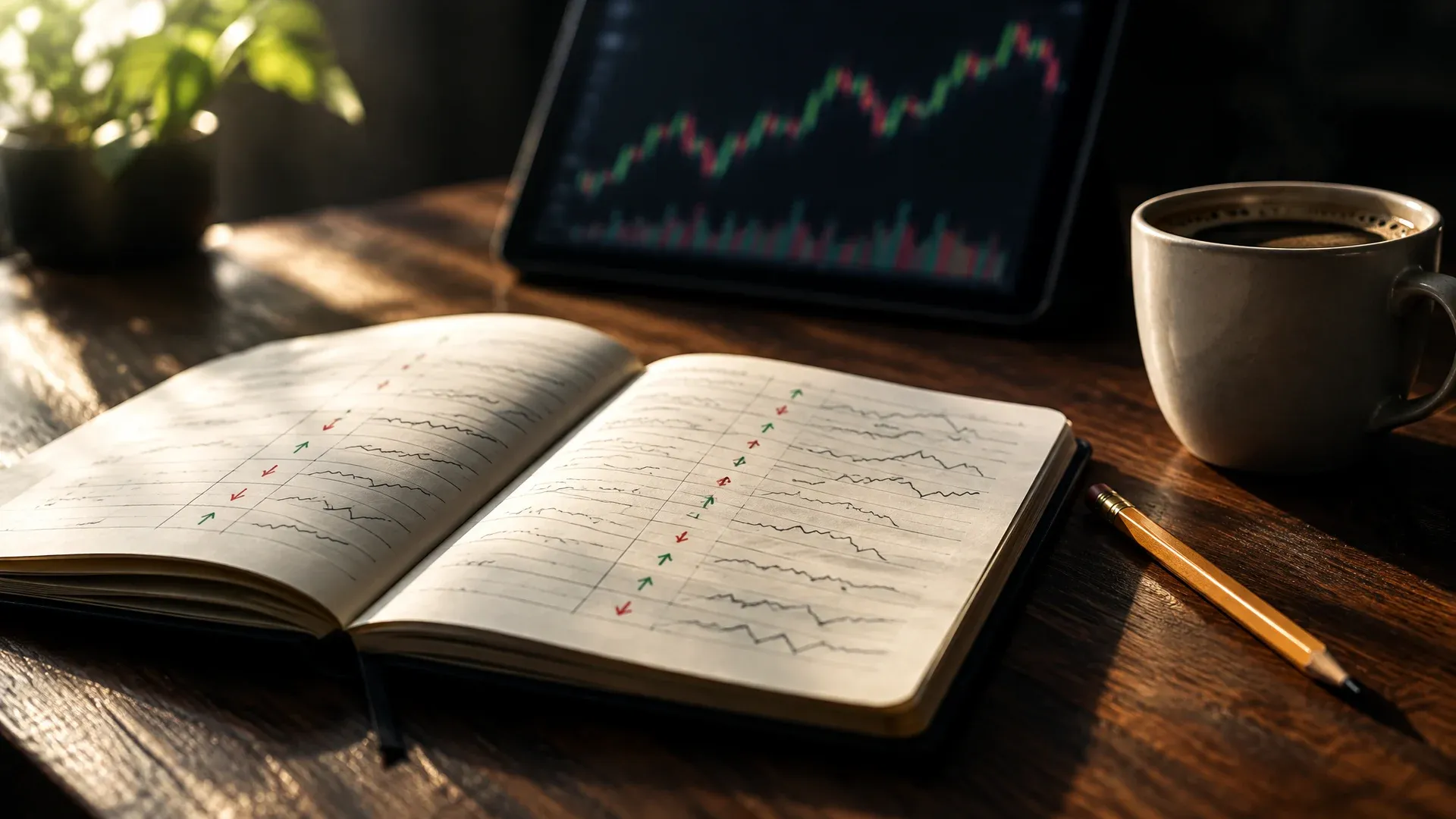
- Keep a journal of 20 trades. Entry, stop-loss, take-profit, leverage, reason and result. Twenty trades show patterns that one lucky trade hides.
- Test the risk tools on purpose. Open one position in isolated and one in cross margin, compare the estimated liquidation prices, and let one stop-loss trigger so you see how it executes.
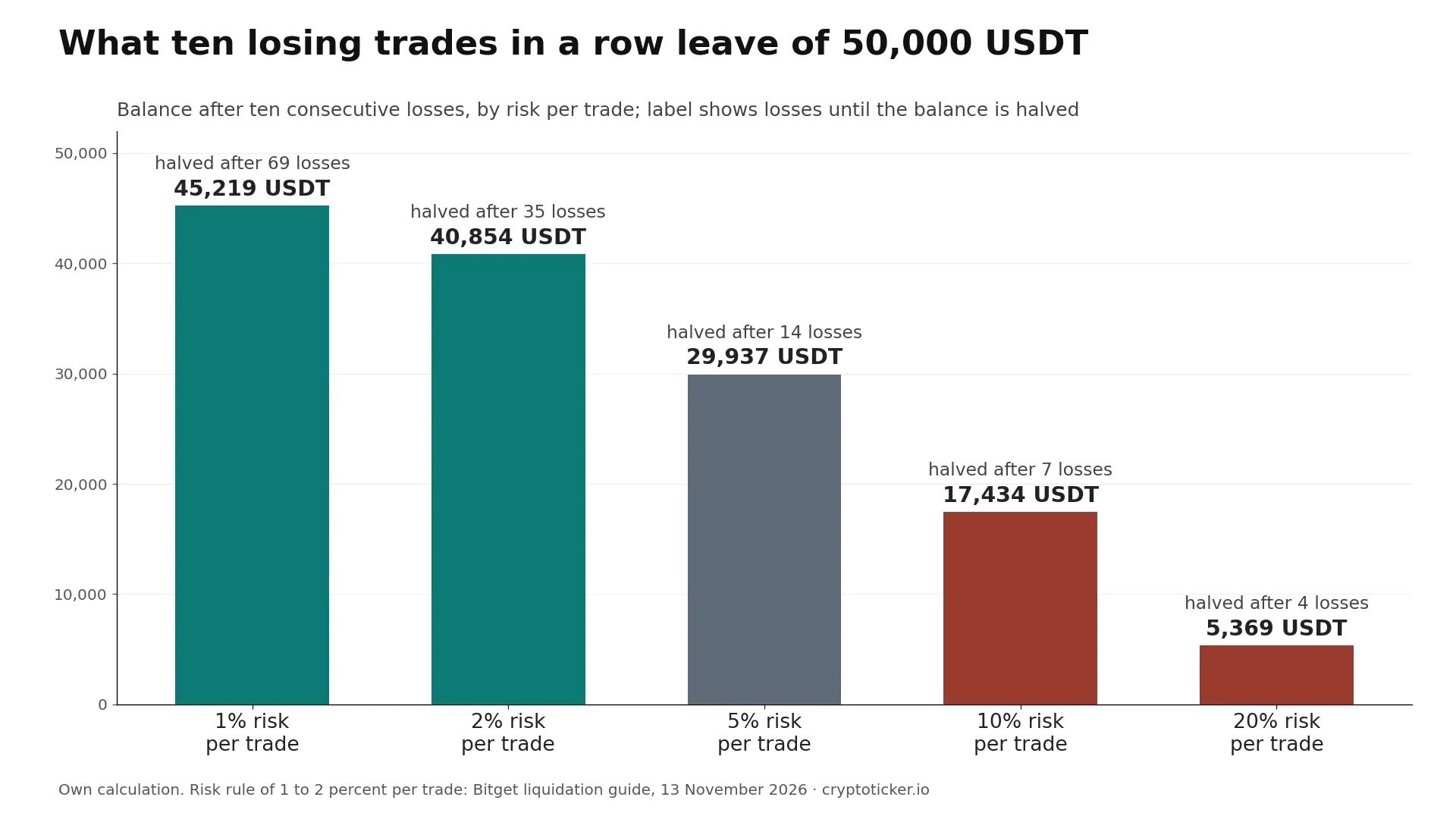
The risk per trade decides how long an account survives a losing streak. Starting from 50,000 virtual USDT, the table shows how many losses in a row halve the balance and what is left after ten losses.
| Risk per trade | Losses in a row until the balance is halved | Balance after 10 losses in a row |
|---|---|---|
| 1% | 69 | 45,219 USDT |
| 2% | 35 | 40,854 USDT |
| 5% | 14 | 29,937 USDT |
| 10% | 7 | 17,434 USDT |
| 20% | 4 | 5,369 USDT |
The difference between the rows is the point of the exercise: at 1 percent risk, ten losses in a row cost a tenth of the account; at 10 percent they cost two thirds.
What futures demo trading teaches about crypto trading, and what it cannot
The demo shortens the learning curve for the mechanics of crypto trading. Within a few sessions you learn and understand how the different types of orders behave, how leverage moves the liquidation price and how funding shows up in your balance. It is also a good place to practice technical analysis: mark a support level, set entry, stop-loss and take-profit, then observe what the market does.
- Test different strategies: a breakout, a range and a trend trade perform differently depending on market trends. The demo lets you compare them over weeks without risking capital and develop a trading strategy that suits you.
- Practice the trading process: checklist, order, stop-loss, journal entry. Repeating the same steps builds the confidence that counts once real money is at stake.
- Explore the risk tools: isolated and cross margin, partial closes and the estimated liquidation price.
What the demo cannot show is how you manage a position when a loss really hurts. Past performance in a demo is not a reliable indicator of live results: virtual fills come without hesitation, and a 20 percent drawdown on virtual money says little about whether you can afford one in real life. For long-term investors who buy and hold Bitcoin, futures demo trading adds little; it is made for traders who want to gain experience with short-term positions.
Bitget demo trading for API strategies and CFDs
The demo is not only for manual trades. Bitget offers a demo trading API, so developers can test automated strategies with virtual funds before they connect a live account. To do so, they create a separate demo API key and add the header paptrading with the value 1 to their REST requests, according to Bitget’s API quick start. Ready-made automation without code, such as a grid bot, is covered in our guide to the Bitget trading bot; independent providers are listed in our comparison of the best crypto trading bots.
Since 15 October 2026 Bitget also runs a separate CFD demo account for its CFD products. According to Bitget’s CFD demo user guide, it works like this:
- Access: you need a Bitget account and a CFD live account; on the web you open CFD demo trading from the TradFi menu, in the app through the three dots on the CFD page (app version 2.94.0 or later). Exit takes you back to live trading.
- Virtual funds: 10,000 USDT at the start; you can increase or reduce the balance at any time under Adjust demo trading funds.
- Markets: all CFD instruments across forex, precious metals such as gold, commodities and indices, on real-time market data.
- Risk rules: the liquidation risk ratio is the same as in live trading, and Bitget sends margin call and liquidation notices by email, app push and site message.
- Validity: a CFD demo account is valid for 30 days; then pending orders are cancelled, positions closed and the account archived until you reactivate it with new demo funds.
Regulated crypto exchanges comparedFrom demo to live: when you are ready to start trading with real money
When your journal shows that you follow your own rules, the step to live trading is small. Start trading with an amount you can afford to lose and keep the leverage you used in the demo.
- Join Bitget: if you do not have an account yet, Bitget’s sign-up page opens with our referral code filled in; the Bitget referral code page explains the welcome pack.
- Fund it: deposit USDT and transfer it from Spot to USDT-M Futures under Assets.
- Know the costs: live futures cost 0.02 percent for maker and 0.06 percent for taker orders at the standard level, plus funding every eight hours. All rates are in our overview of Bitget fees.
- Repeat the first trade: same pair, same stop-loss logic, a tenth of the size. Every step of a live order, from margin mode to liquidation price, is in our guide to Bitget futures trading.
If you would rather compare the futures offers of several platforms before you deposit anywhere, our crypto exchange comparison lists fees and products side by side.
Where you can use Bitget demo trading
The demo is available wherever you can open a Bitget account. That excludes several regions:
- European Union: Bitget is not listed in ESMA’s register of crypto-asset service providers authorised under MiCA (version of 11 November 2026). EU readers find licensed exchanges in our comparison of regulated crypto exchanges.
- Excluded countries: Bitget’s Terms of Use exclude, among others, the United States, Canada, Singapore, Japan, Hong Kong, Germany, France and Austria.
- Australia: ASIC has warned investors that Bitget’s crypto futures are not licensed there; Australians use Bitget for spot trading.
Is Bitget demo trading worth it? Our assessment
Yes, for anyone new to futures trading. The demo costs nothing, runs on live prices and uses the same screen as the real thing, so the clicks you learn there are the clicks you will make later. Its value depends on how you use it: a demo traded with 50,000 virtual USDT and 100x leverage teaches gambling, a demo traded with a realistic balance, a fixed risk per trade and a journal teaches trading.
Demo results do not predict live results, because fear and greed only appear when the money is real. Futures with leverage can wipe out a stake within hours. This guide explains how the practice mode works; it is not investment advice.
FAQ: Bitget demo trading
Partner links: some links on this page are partner links. If you become a customer through one of them, we may earn a commission at no extra cost to you. Selection, ratings and ranking are decided independently by our editorial team. Ethics and Independence · Ownership and Funding
Transparency note: This article was produced with the assistance of artificial intelligence. Figures and claims are based on the primary sources linked in the text. The feature image was generated with AI.
For later? Save this article and find it again in your profile.
Related articles
- Trade Anthropic stock: ANT perpetuals on Bitget, OKX and Kraken, long or short
- Spot trading explained: real coins without leverage and no liquidation price
- Bitget Futures Trading: Your First Trade, Leverage and Risk
- Bitget Trading Bot: Grid, DCA and Futures Bots Explained
- Bitcoin Revolution and celebrity ads: why BaFin warns about these trading apps
Which topics should we dive deeper into?
Select what genuinely interests you. Your picks feed directly into our editorial planning.
Crypto news that's actually worth your time.
Weekly. 60 seconds. Carefully curated by our editors: no hype, no promo flood, no spam.

November 7, 2026 7:38 PM

OKX Fees: Trading, Futures and Withdrawal Fees by Region
OKX charges 0.08 percent maker and 0.10 percent taker on spot and 0.02 or 0.05 percent on futures. All fee tiers, the rates in Europe, the US and Australia, withdrawal, SEPA and card fees, and a comparison with Bitget, Kraken and Coinbase.
November 7, 2026 6:58 PM
Bitget Fees: Spot, Futures and How BGB Lowers Them
Bitget charges 0.1 percent on spot and 0.02 or 0.06 percent on futures. All VIP levels, the BGB discount, funding and withdrawal fees, copy trading costs and a comparison with Bybit and OKX Australia.
November 3, 2026 7:58 AM

Crypto futures trading: perpetual futures explained simply
Crypto futures and perpetual futures explained: how futures trading works, what the funding rate really costs and which exchanges are licensed for it in the EU.
October 29, 2026 9:45 PM

How to Short Bitcoin in the Crash: Step by Step on Bitget and OKX
Bitcoin fell below $79,000 after the Binance hack. If you want to bet on falling prices or hedge, a short does exactly that. How it works on Bitget and, for EU readers, on OKX Europe, a worked example at tonight's price and the risks of shorting after a crash.
October 29, 2026 12:28 AM
Bitget Wallet opens EUR accounts: incoming euros become USDT or USDC
Since October 27, 2026 Bitget Wallet gives its users their own account number in euros and US dollars, and the app converts incoming money automatically into USDT or USDC. What that means for SEPA transfers, the MiCA status of the two stablecoins and the holding period is set out here.
October 19, 2026 7:34 AM
Germany's savings banks start crypto trading: “When a savings bank starts is for it to decide”
The first German savings banks have switched on crypto trading in the App Sparkasse, with Bitcoin, Ethereum, XRP, Solana and Polygon tradable. There is no nationwide launch date, and the private keys stay in trust at DekaBank.

October 15, 2026 7:40 PM

$257.4 million in SHIB futures against $77.5 million spot: EU leverage stops at 2:1
SHIB futures turned over $257.4 million in 24 hours against $77.5 million on the spot market. That is a factor of 3.3, and for leverage Germany applies a hard ceiling.

October 15, 2026 1:34 PM

$489 million in liquidations in one hour: where your leverage breaks first
Forced closures wiped out around $489 million within one hour on 15 October 2026, more than half the daily total of $942 million. Our analysis of OKX futures market data shows why Ether was hit harder than Bitcoin.
October 15, 2026 10:15 AM
XRP open interest down 29.7 percent, 360 long accounts per 100 short
Two moves are running against each other in the XRP derivatives market: open interest has fallen almost 30 percent since September 22, while there are now 360 long accounts for every 100 short accounts. What the thin positioning means for the $1.29 level, and which leverage caps apply in Germany.
October 1, 2026 4:35 AM

Free Stock Market Games: Six Contests Compared, Three of Them With Crypto (2026)
Six free stock market games, three of them with crypto. Who may take part and when, how much virtual money there is, what you can win, and why a leaderboard invites too much risk.
September 29, 2026 1:39 PM
Crypto Paper Trading: Practise Free Without Signing Up, and Where the Simulation Falls Short
Paper trading lets you trade crypto at real prices without real money. What the simulation reveals about your strategy, where it flatters you and how to start without an account.
September 23, 2026 10:19 PM
OKX delists ICX, STORJ and ELF: by when you have to trade or withdraw
OKX is taking DORA, ICX, STORJ, ZEUS and ELF off the market. The euro pairs end on September 30, 2026, the USDT pairs on October 3, withdrawals only on December 23. We sort out the four deadlines and show, from our own measurement of the order book, why a hurried sale can turn expensive.
September 23, 2026 10:11 PM
BitMEX shutdown: what to check now for residual balances and your 2026 tax return
BitMEX halted trading for good at 04:00 UTC on September 23, 2026, force-closing every position still open. What that realises for tax, which account fee now runs on residual balances, and which documents you need to secure.
September 22, 2026 4:26 PM
Trading Demo Account Without Signing Up: Practise Free With Real Prices (2026)
A demo account shows you whether your rule set holds before it costs money. What demo trading can do, where broker demo accounts are steering you, and how to practise at real prices without signing up.
September 12, 2026 4:31 AM
After the BitMEX Closure on September 23: How to Check Whether Your Remaining Balance Can Be Withdrawn at All
As of September 27, 2026: trading on BitMEX ended for good on September 23 at 04:00 UTC. According to the operator, withdrawals remain possible via the website, and an account fee of 1 percent a year, or at least $50, applies to remaining balances. Our own review of the wallet interface on September 11 showed that on 14 of 62 withdrawal routes the network fee reached or exceeded the minimum amount.
September 10, 2026 4:15 PM
BW-Bank Opens Bitcoin Trading Inside the Securities Account: What to Check Before Your First Buy
Since September 9, 2026, BW-Bank customers have been able to trade ten crypto assets through their securities account, executed and held in custody by Bitpanda. The familiar securities-account setting hides three points you should settle before your first order.
September 9, 2026 10:18 AM
Learn Trading Online for Free: Practise With Play Money and Real Prices
The first stage of learning to trade costs nothing if you set it up properly: play money, real prices and fixed rules before the first euro is at stake.

May 31, 2026 12:25 PM
HYPE Token Hits $70 All-Time High: 4 Reasons for the Surge
Hyperliquid ($HYPE) hit a $70 all-time high, entering the top 10 cryptos. Here are the regulatory changes and revenue fundamentals driving the pump.
May 3, 2026 9:28 AM
LAB Token Crash: Why the Multi-Chain Hub Fell 70% in 24 Hours
LAB token plummeted 70% just hours after hitting an all-time high of $3.64. Was this a "sell the news" event or a coordinated exit?
April 18, 2026 5:45 PM
RAVE Token Crash: 4,000% Rally Ends in Violent Dump – What Traders Got Right
RAVE token crashes after a 4,000% rally. Full chart analysis, key levels, and how traders can short or trade RAVE.
April 15, 2026 8:44 PM

TradeEU Global Review 2026: What Traders Should Know Before Signing Up
Is TradeEU Global the right broker for you? We tested the platform, compared account tiers, and reviewed the full trading experience for 2026.
April 15, 2026 12:00 PM
Bitcoin Price Corrects After $76,000 High: Is This a Consolidation or a Crash?
Bitcoin price faces a healthy correction after hitting $76,000. Learn how to trade consolidation phases and use support and resistance levels effectively.
April 15, 2026 10:25 AM
X Unveils "Smart Cashtags": The Timeline is Now a Trading Floor
X launches Smart Cashtags for real-time crypto and stock data. Here's how this new feature integrates trading directly into your social timeline.
April 8, 2026 11:46 PM
BXB Market Review 2026: Platform, Pricing, and What Traders Should Know
Considering using BXB Market? Here's a detailed look at their platform, account tiers, spread discounts, and trading conditions as of 2026.

More from CryptoTicker