
Cardano Slides Below $0.24: What ADA Holders Should Check on Leverage, Liquidation and Holding Period
Cardano has given back its move above $0.25 and trades around seven percent below the high of the past 24 hours. What that means for leveraged positions, the holding period of your tranches and the buying route under MiCA.





Which topics should we dive deeper into?
Select what genuinely interests you. Your picks feed directly into our editorial planning.
Crypto news that's actually worth your time.
Weekly. 60 seconds. Carefully curated by our editors: no hype, no promo flood, no spam.
Cardano trades at around $0.236 on September 24, 2026, roughly seven percent below the high the price had reached within the previous 24 hours. The move above the $0.25 mark has been given back. Anyone holding Cardano need not act because of it. Three things are worth knowing all the same: where the holding period stands for your own tranches, what a leveraged position can withstand within this range, and by what route ADA is regularly bought and held in Germany.
This article lists the figures with source and time, places the decline in its market context, and then works through the checkpoints that can lead an investor in Germany to a concrete action.
Cardano below $0.24: what happened in the last 24 hours
The exchange Kraken reports a last price of $0.2358 for the ADA against US dollar pair on September 24, 2026. The high of the previous 24 hours was $0.2544, the low $0.2329. The volume-weighted average price for the same period was $0.2405. Measured against the high of that range, the decline comes to 7.3 percent.
CoinGecko reports a price of $0.2357 and a change of 7.1 percent against the level 24 hours earlier. On the morning of the same day this figure still stood at 7.6 percent. The divergence between the readings is a question of reference point and not a calculation error. Anyone measuring against the level exactly 24 hours earlier captures the previous day's sell-off in full. Anyone measuring against the opening price of the current UTC day arrives, for the same moment, at just 1.1 percent, because the decline mostly took place the day before.
That distinction has practical consequences. A stated daily loss of seven percent describes, in ADA's case, a move that has essentially already run its course. Between 00:00 UTC and midday on September 24 the price held within a narrow range. Anyone inferring an ongoing slump from the percentage alone is reading the figure against its reference point.
Over the week the balance stays positive. CoinGecko reports a gain of 18.8 percent over seven days and 8.0 percent over 30 days. Market capitalisation stands at $8.85 billion, which corresponds to 17th place, and trading turnover of the past 24 hours at $602 million. The price is around 92 percent away from its all-time high of $3.09 set in September 2021.
The decline therefore hits a price that had risen sharply beforehand. Part of the selling pressure can be read as profit-taking after a strong week, without any news on Cardano itself having to be behind it. No confirmation of that reading by a named source was available at the time of writing. It therefore remains an assessment and is not a statement of fact.
Why the ADA price is giving way now: bond yields and risk appetite
Cardano is not alone in the decline. Almost the entire front of the market gave way over the same period, and the trigger lies outside the crypto markets.
The US Treasury reports a yield on ten-year US government bonds of 5.11 percent in its daily yield curve for September 23, 2026. The day before, the same paper stood at 4.96 percent. A rise of 15 basis points in a single trading day is considerable in this segment.
Our own count of the daily series of the Federal Reserve Bank of St. Louis for the ten-year yield, series DGS10, gives the following picture for the period from January 2, 2007 across 4,935 trading days evaluated: the last closing value of 5.11 percent or higher dates from July 13, 2007. The current level is therefore the highest in a good 19 years. cryptoticker.io conducted this evaluation itself on September 24, 2026. Only daily closing values of that series were examined; intraday values were not available, and the value for September 24 had not yet been published at the time of the evaluation.
The link to the ADA price is not a detour. A higher yield on government bonds raises the return an investor can earn without price risk. That raises the bar for every investment that earns its return only in the future and only under risk. Equities and crypto assets give way together on this logic, and precisely that pattern showed on September 23 and 24.
The interest rate expectation itself and its consequences for leveraged positions were covered by cryptoticker.io on September 24 in a separate article on the expected Fed decision in October. For this article the macro background stays context. The checkpoints below relate to ADA.

Leverage and liquidation on ADA: how a position disappears without a sale
For investors without leverage, a decline of seven percent is a book value. For leveraged positions it is a question of remaining runway. This is exactly where those who can sit the move out part company with those who must not.
Funding rate and liquidation price, briefly explained
A perpetual future, or perp, is a futures contract with no expiry date that tracks the price of an underlying asset through running balancing payments between buyers and sellers. That balancing payment is called the funding rate: it falls due at short intervals and flows from the predominantly positioned side to the other side. If many market participants stand on the buy side, buyers pay sellers.
The liquidation price is the price at which the margin on a leveraged position no longer suffices and the trading platform closes the position of its own accord. That closure is not a sale at your discretion. It happens without consultation and without the option of waiting for a recovery.
At fivefold leverage, a counter-move of around 20 percent arithmetically suffices to consume the margin posted, and around 10 percent at tenfold leverage. The actual threshold sits below that depending on the platform, because fees, funding costs and maintenance margins come on top. ADA's daily range on September 24 ran between $0.2329 and $0.2544, that is 9.2 percent measured against the low. A tenfold leveraged position was already in the danger zone within that range.
What follows from this is arithmetic and not a recommendation: anyone holding a leveraged position can read off their own liquidation price on the platform and hold it against the daily range. If it lies within the range of recent days, the outcome is no longer decided by your own assessment but by the next swing. How the venues for such contracts differ in fees, maintenance margin and safeguard mechanics is shown in the overview of venues for perpetual contracts.
A second point concerns tax, and it is regularly overlooked. In Germany, gains from derivatives on crypto assets do not fall under the one-year holding period for private disposals. They are treated as investment income, with their own logic for offsetting losses. Anyone trading spot holdings and perps in the same year is therefore running two separate tax pots.
 Regulated trading venues compared
Crypto capital gains holding period: when your ADA sale stays tax-free
For privately held crypto assets, the one-year holding period of section 23 of the German Income Tax Act applies. Anyone selling ADA more than a year after acquisition realises a tax-free gain. Anyone selling within the year has a private disposal, taxable at their personal rate, provided the sum of all such gains in the calendar year exceeds the exemption limit.
The period runs per acquisition and not per wallet. Anyone who bought more during last week's upswing has begun a new period for that tranche, while older holdings remain untouched. For allocation, the first-in, first-out method is decisive in practice: the holding acquired first counts as sold first, provided holdings are viewed separately per wallet.
The current decline changes nothing about that mechanism; it only shifts the question. Anyone close to the end of the one-year period loses the tax exemption for that tranche by selling now. Anyone holding the position for more than a year already has that question behind them.
Staking rewards: accrual, valuation and documentation
Cardano is a proof-of-stake blockchain: the rights to produce blocks are distributed not through computing power but through the allocation of coins to a stake pool. That allocation is called delegation. It transfers no ownership, because the coins remain at the holder's disposal.
For tax purposes the rewards accruing from it count as other income and not as disposal gains. They are to be recognised at the moment of accrual at the price prevailing then, even if no conversion into euros takes place. Anyone delegating over months has correspondingly many individual accruals to value.
One point expressly relieves investors here. With its circular of March 6, 2025 on individual questions of the income tax treatment of certain crypto assets, reference IV C 1 - S 2256/00042/064/043, the Federal Ministry of Finance replaced the preceding circular of May 10, 2022 and clarified the requirements for record-keeping and cooperation. On the view set out there, using crypto assets for staking or lending does not extend the disposal period from one year to ten. Delegating your ADA therefore does not extend the holding period.
In practice that means two obligations. The rewards are to be valued per accrual date, and holdings are to be documented so that the acquisition date remains provable per tranche. A portfolio tracker with tax reporting takes over that allocation, but does not replace checking whether the imported prices and timestamps from the exchange match your own records.
Buying ADA under MiCA: which buying route is permitted in Germany
Since the European regulation on markets in crypto-assets, MiCA, became fully applicable, crypto services in Germany may only be provided by authorised firms. Such a firm is called, in the language of the regulation, a crypto-asset service provider, or CASP. The authorisation is granted in one member state and then applies across the entire single market.
For you as a buyer that has three visible consequences. The provider must be identifiable and must identify you, it must keep client funds separate from its own, and it must have a complaints procedure. Unauthorised platforms may no longer actively solicit customers in the European Union, and exchanges without authorisation regularly close access to residents of the EU altogether.
ADA can be traded on practically every authorised venue, which is why the buying route is rarely the problem. Where the venues differ is on cost: trading fee, the spread between bid and ask, deposit and withdrawal costs, and the question of whether withdrawals in ADA to your own wallet are possible at all. The overview of regulated venues for crypto assets lists these items per provider.
One detail is worth checking before your first purchase: some providers hold ADA exclusively as a custodial balance and permit no withdrawal to an external address. Anyone wanting to delegate or self-custody cannot do so with such a provider. That is in the terms of use and not in the fee table.
ADA custody: exchange, software wallet or hardware wallet
Anyone leaving ADA in an account at an exchange holds a claim against that company and not the coin itself. Access depends on the platform being available and solvent. With an authorised provider that is a calculable risk, but it is a different risk from self-custody.
A software wallet holds the keys on a device with an internet connection. It permits delegation to a stake pool and is convenient for ongoing use. A hardware wallet holds the keys on a device without an internet connection and releases transactions only after confirmation on the device. Delegation remains possible, because no transfer of the coins is needed for it.
The recovery phrase is in both cases the real asset. It consists of a fixed sequence of words from which all the wallet's keys can be recalculated. Whoever loses it loses the holding for good; whoever passes it on passes the holding on. An overview of the devices including supported networks and prices is in the hardware wallet comparison.
For tax, the choice of custody is not neutral. A transfer from the exchange to your own wallet is not a sale and triggers no tax, but it breaks the chain of evidence if the acquisition date and acquisition price are not carried along. Those details cannot be reconstructed later.
 Perpetual trading venues compared
What the on-chain figures show on Cardano: supply, treasury and epoch 657
Besides the price, the state of the network can be read directly from the blockchain. A query of the public Koios interface on September 24, 2026 returns number 657 for the current epoch, that is, the fixed five-day period by which Cardano settles its rewards.
For that epoch the query reports a circulating supply of 36.77 billion ADA, a total amount in the protocol of 38.89 billion ADA, a reserve not yet distributed of 6.11 billion ADA, and a balance of the network treasury of 1.36 billion ADA. The treasury is fed from a share of the fees and the reserve and finances projects voted on by the network's delegates.
On circulating supply the sources diverge. CoinGecko reports 37.53 billion ADA, the on-chain query 36.77 billion. The difference of around 760 million ADA is explained by differing definitions: the on-chain figure deducts treasury and reserve from the total holding, while market data providers calculate closer to the tradable amount. For valuing market capitalisation that is a difference of about two percent. Nothing is smoothed here; the two figures stand side by side because they measure different things.
The protocol's cap is 45 billion ADA. Around 6.11 billion of that is not yet in circulation and flows in through the rewards of future epochs. That is not an expansion of the supply beyond the cap; it distributes a stock already fixed.
Levels above and below: how to spot the next ADA move
Levels are not a forecast. They are price levels at which a striking amount of trading took place in the past, and at which experience therefore suggests it is decided whether a move carries.
On the downside the first relevant level is $0.2329, the low of the past 24 hours on Kraken data. Below it begins the area where the price traded before last week's upswing. On the upside the first level is $0.2405, the volume-weighted average of the past 24 hours, and above that $0.2544, the high of the same period. Only above $0.25 would the breakout now given back be restored.
Analyst views on price targets are left out of this article, because no attributable, current assessment could be documented for September 24. An anonymous price target would be worthless to you, because you could not check who holds it and on what grounds.
What you can check instead of a forecast is the composition of your own holding: which tranche was acquired when, which of them has reached the one-year mark, whether a leveraged position is open and where its liquidation price lies. Those four details are in your hands, unlike the price.
Checking the Cardano slide: what to take away
- Check first whether you are leveraged. Read off the liquidation price of every open position and hold it against the daily range of $0.2329 to $0.2544. If it lies within that range, the next swing decides and not your assessment. How the venues differ in maintenance margin and fees is in the overview of venues for perpetual contracts.
- Sort your holdings by acquisition date. Every tranche has its own one-year period, and anyone who bought more during last week's upswing has started afresh for it. Staking rewards come on top as other income per accrual. A portfolio tracker with tax reporting takes the allocation off your hands; checking the imported timestamps stays with you.
- Check the route before you buy more or withdraw. Before a withdrawal, establish whether your provider releases ADA to an external address at all, and compare fee and spread, not just the fee. The terms of the authorised venues are listed in the overview of regulated venues for crypto assets, and the devices for self-custody in the hardware wallet comparison.
The running price data for ADA is published by the exchange Kraken on its Cardano price page; the values named in this article come from its public interface at the time stated.
(As of September 24, 2026. This article is not investment advice. Prices and fee structures change; check the terms with the provider before you buy.)
Transparency note: This article was produced with the assistance of artificial intelligence and reviewed by our editorial team before publication. All figures and claims were checked against the primary sources linked in the text. The feature image was generated with AI.
Related articles
- NEAR Falls Almost 8 Percent After a 62 Percent Week: What to Check on Perps, Buying Route and Holding Period
- Bitcoin Price Prediction: What to Check on Levels, Holding Period and Leverage Before the October 28 Rate Decision
- Solana DEX Trades Overtake the NYSE: What to Check on Swaps, Tax and Oversight
- Trump-Xi Summit at the White House: The Crypto Positions to Check Before the Meeting
- Chainlink Jumps Above $12: What LINK Holders Should Check Now
Which topics should we dive deeper into?
Select what genuinely interests you. Your picks feed directly into our editorial planning.
Crypto news that's actually worth your time.
Weekly. 60 seconds. Carefully curated by our editors: no hype, no promo flood, no spam.

September 26, 2026 7:14 AM
Cardano Before the RealFi Launch on October 1: What ADA Holders Should Check on USDr, MiCA and Tax
On October 1, 2026 the stablecoin platform RealFi goes live on the Cardano mainnet, and ADA has gained 14.67 percent in a week. What is documented about the yield-bearing dollar token USDr, and what investors should settle beforehand.

September 24, 2026 10:36 PM

Ethereum Price Prediction: What to Check on Staking, Leverage and Where You Buy After Three Attempts at $2,800
Ether stands at $2,700 and has bounced off the zone around $2,800 three times in thirty days, without a single daily close above it. What our own count shows, and the three things to settle before the next attempt.
September 22, 2026 7:20 PM

ETH Price Prediction: What to Check at the $2,800 Mark Now
Ether stands at $2,735.96 on September 22, 2026, right below the zone at which it has failed repeatedly. Instead of a target number, you get four checks that count before your next order: holding period, buying route, the staking line and the distance to liquidation.
September 30, 2026 4:14 AM

Bitcoin Price Before the Core PCE at 14:30 CEST: Will the $82,735 Level Hold?
At 14:30 CEST today the Bureau of Economic Analysis publishes the core PCE deflator for August, the inflation gauge the Fed anchors its 28 October rate decision to. Bitcoin stands at $83,329, less than $600 above its daily low, and anyone holding on leverage decides this morning.
September 26, 2026 7:40 AM

The RAIN Token After the Enlivex Termination: What to Check on Access, Forced Sale and Holding Period
Enlivex terminated a share placement of 66,666,667 shares payable in RAIN tokens on September 22, 2026. The token sits 46.4 percent below its all-time high, and at Kraken the withdrawal deadline expired long ago.
September 26, 2026 10:12 PM

Solana Price Above $120: What to Check on Staking Yield, Holding Period and Spread
Solana is trading at $121.00 on September 26, 2026, 8.6 percent above its level a week earlier. What a self-measured staking yield of 5.27 percent is worth, how the one-year holding period applies to staked SOL, and what an order in euros really costs.
September 25, 2026 7:14 PM

Chainlink Above the September High: What Open Interest, Funding Rate and Liquidation Risk Mean for LINK
Chainlink stands at $13.86, 11.2 percent higher than 24 hours ago. Our own query at OKX and Hyperliquid shows funding at the baseline rate, and what that means for leverage, buying route and tax.

September 24, 2026 10:38 AM
Fed Rate Hike in October: What to Check on Leverage, Liquidation and Holding Period After the PMI Jump
The flash US purchasing managers' index has jumped to 58.4 points, its highest level since July 2021, and input prices are rising at a pace last seen in October 2022. The futures market now prices a further Fed rate hike on October 28 at almost 70 percent, and the crypto market is falling broadly.
September 24, 2026 10:19 AM

Uniswap Falls 11.8 Percent After a 114 Percent Month: What to Check on Profit Taking, Holding Period and Leverage
UNI lost 11.75 percent on Wednesday morning but is still up 113.85 percent over the month. Anyone realising gains now almost certainly triggers a taxable disposal in Germany.

September 15, 2026 4:12 AM

Using Hyperliquid from Germany: What Applies to Your Funds Without a MiCA Licence
Hyperliquid is not entered in any EU register as an authorised crypto-asset service provider, and for perpetual futures a MiCA licence would be the wrong paperwork anyway. Here is what that means in concrete terms for your funds, your keys and your tax return.
August 18, 2026 7:13 AM
Bitcoin Tax Reporting in Austria 2026: What Applies
Bitcoin tax reporting in Austria: which data investors can request from crypto exchanges in 2026, and when the report matters for the tax return.
September 27, 2026 1:17 PM
Dogecoin Price: What to Check on Holding Period and Custody Before the Year End
The Dogecoin price stands at $0.0977 on September 27, 2026 and has barely moved in a day. That calm is exactly the moment to work through the holding period, the reporting duty from 2026 and custody without any time pressure.
August 21, 2026 4:24 AM

Forced Sale on a Crypto Exchange: Which Moment Counts for the Holding Period and What You Must Document
At Luno, Kraken and Valour the deadlines are running out, after which the provider realises the remaining holding itself. For tax purposes that is a disposal, and what governs it is the exchange's timestamp.
September 24, 2026 10:12 AM

XRP Falls 9.7 Percent: What to Check on Holding Period and Buying Route
XRP is down around 9.7 percent on the morning of September 24, twice as much as the typical large crypto asset. Our count of 18 coins shows who the pullback hits and which three things hold true regardless of the price.
September 9, 2026 4:22 PM
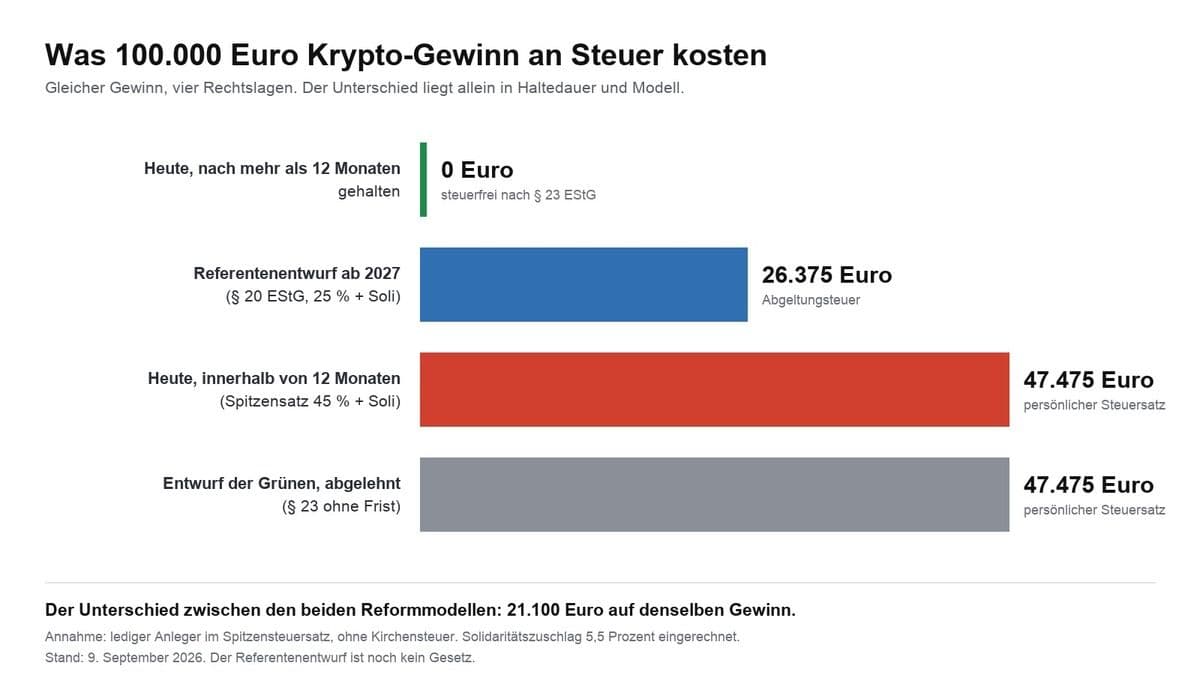
Crypto Tax in Germany: What Applies in 2026 and What Is Set to Change in 2027
Crypto gains are tax-free after twelve months; before that your personal tax rate of up to 45 percent applies. What triggers tax, how the holding period is calculated, what happens with staking and losses, and what the draft bill would change from 2027.
September 27, 2026 10:14 AM
Shiba Inu Price Prediction: What to Check on SHIB Before the December 31 Deadline
SHIB trades at $0.00000592 on September 27, 2026, around 93 percent below its all-time high. For German investors one date matters more than the chart right now: December 31, 2026.
September 12, 2026 10:11 PM

Crypto CFD or Buying Real Coins? How Leverage, Margin Calls and Tax Differ
With a crypto CFD you own a contract; with a direct purchase you own the crypto asset itself. From that one difference follow the 2:1 leverage cap, forced close-out, the tax burden and the question of who is liable for your money if things go wrong.
September 26, 2026 1:19 AM
Germany’s Crypto Holding Period Is Wobbling: What to Check Before December 31
A CDU member of the Bundestag makes it plain: the coalition agreement does not guarantee that the one-year holding period for crypto assets will survive. What that means for purchases made before the planned cutoff date of December 31, 2026.
September 8, 2026 10:21 PM

Crypto Holding Period and Grandfathering: Why December 31, 2026 Becomes the Cut-Off in Germany's Draft Bill
A ministerial draft bill from Germany's finance ministry names a cut-off date for the first time: crypto assets acquired after December 31, 2026 are to fall under the flat-rate withholding tax. What that means for legacy holdings, running savings plans and staking income, and why nothing has been decided yet.
August 20, 2026 4:24 PM
Bitcoin Across Multiple Wallets: How Austria Works Out the Acquisition Cost
Bitcoin spread across several wallets? How Austria works out the acquisition cost and the rolling average price for tax purposes.
September 25, 2026 7:24 PM

Bitcoin Forecast: What to Check on Levels, Holding Period and Buying Route Before the Quarter Ends
Bitcoin stands at $83,877 at 16:40 UTC on September 25, 2026, and the measured volatility of the past 30 days spans a band of $73,600 to $94,200 for the coming month. More important than that band before the quarter ends are three checks: holding period, buying route under MiCA and the reporting duty in force since January 2026.
September 24, 2026 1:11 PM
Stellar Becomes a Payment Rail at Mastercard's BVNK: What XLM Holders Should Check on Buying Route, Memo and Holding Period
BVNK has switched on Stellar as a payment rail for business customers in more than 130 countries. On the same trading day XLM falls by around seven percent — we separate what the news means from what the pullback means for your portfolio.
September 27, 2026 7:14 PM

Solana Price at $121.93: What to Check on Staking Yield, Unstaking and Tax
SOL stands at $121.93 on September 27 at 16:42 UTC, after a 12.7 percent gain over seven days. More important than the weekly move is a calculation almost nobody makes: of the staking yield usually quoted, roughly a quarter is left in real terms, and the epoch decides when you can reach your coins again.
October 2, 2026 10:17 PM
Dogecoin breaks below $0.093: the BWOW fund turns every DOGE into cash on October 14
Dogecoin costs $0.0914 on Friday evening and has lost 3.4 percent in 24 hours. On October 14 the US fund BWOW sells its entire holding, and on the same day the German cabinet takes up the reform of crypto taxation.
September 25, 2026 1:12 PM

XRP Jumps to $1.56: What Holders Should Check on Buying Route, Holding Period and Leverage
XRP trades at $1.56 on September 25, 2026, up 6.85 percent on the day and 16.64 percent on the week. What the on-chain data and the US ETF inflows actually show, and what investors in Germany should check now on buying route, holding period, leverage and custody.
September 20, 2026 4:13 AM
Zcash Above $1,500: What ZEC Holders Should Check on Tax and Custody
Zcash rose above $1,500 on September 19 for the first time since 2016 and, after an intraday high of $1,590.80, trades back at around $1,474. For German holders three questions hang on that jump: the one-year holding period, the planned year-end cut-off and the EU anti-money-laundering regulation from July 2027.
September 19, 2026 1:38 AM

Uniswap jumps above $9: what UNI holders should check on the fee switch now
The UNI price gains 18.67 percent within 24 hours, driven by the active fee switch and a new exemption from the US securities regulator. What of that can be recalculated, what remains pure expectation, and which three things you should settle now as an investor in Germany.
More from CryptoTicker