
Bitcoin Capital Gains Tax in Austria: When Exchanges Withhold 27.5 Percent
When Austrian crypto exchanges deduct 27.5 percent capital gains tax automatically, which Bitcoin gains are affected and when investors have to declare the income themselves.





Which topics should we dive deeper into?
Select what genuinely interests you. Your picks feed directly into our editorial planning.
Crypto news that's actually worth your time.
Weekly. 60 seconds. Carefully curated by our editors: no hype, no promo flood, no spam.
Bitcoin Capital Gains Tax in Austria: When the Exchange Withholds 27.5 Percent Automatically
Anyone selling Bitcoin through an Austrian crypto service provider often no longer has to calculate the tax on the gain and pay it through an income tax return. Since 2024, certain crypto income has been subject to a mandatory capital gains tax of 27.5 percent, which the domestic provider withholds directly and forwards to the tax office.
For investors, the system increasingly resembles a classic Austrian securities account. However, the automatic withholding only works if the statutory conditions are met and the provider holds the necessary tax data.
When Does a Crypto Exchange Withhold Capital Gains Tax Automatically?
For investment income arising after December 31, 2023, domestic debtors and crypto service providers generally have to deduct capital gains tax. The obligation covers both certain ongoing crypto income and realised gains in value.
A typical case is the sale of Bitcoin for euros.
Example:
- acquisition cost of the Bitcoin: 20,000 euros
- later sale: 50,000 euros
- taxable gain: 30,000 euros
- capital gains tax at 27.5 percent: 8,250 euros
If the Austrian provider knows the correct acquisition costs, it can in principle calculate the tax automatically, withhold it and pay it to the tax office.
Once the tax has been withheld, income tax on that gain in private assets is generally settled. As a rule, the investor does not have to report the relevant investment income again in the tax return.

Which Bitcoin Holdings Are Affected?
The current Austrian crypto tax regime generally applies to cryptocurrencies acquired after February 28, 2021. Gains from this so-called new holding are generally subject to the special tax rate of 27.5 percent, regardless of the holding period.
Bitcoin acquired on or before February 28, 2021, by contrast, generally counts as legacy holding. The earlier tax rules continue to apply to it. With legacy holdings, no capital gains tax is therefore withheld automatically under the new crypto tax regime. For certain exchange transactions involving legacy assets, for instance, the Austrian finance ministry states explicitly that no withholding is to be made.
The withholding in the worked example from this article
Bar length relative to the sale proceeds of 50,000 euros (= 100 percent). Source: the worked example and the 27.5 percent capital gains tax rate from this article, as of August 14, 2026.

Not Every Bitcoin Transaction Triggers Capital Gains Tax
What matters is whether a taxable transaction exists at all.
Taxable transactions include in particular:
- selling Bitcoin for euros,
- exchanging it for US dollars or other legal currencies,
- paying for goods with Bitcoin,
- paying for services with Bitcoin.
A direct exchange of Bitcoin for another cryptocurrency, by contrast, is generally tax-neutral. The previous acquisition costs are carried over to the cryptocurrency received. Anyone exchanging Bitcoin directly for Ether or for a stablecoin that qualifies for tax purposes therefore generally does not yet trigger any withholding on the price gain accumulated so far.

The Exchange Needs the Acquisition Costs
One of the biggest practical challenges arises when the Bitcoin was not bought directly from the Austrian provider. Anyone who acquired Bitcoin on a foreign platform and later transferred it to an Austrian exchange brings the coins along, but not automatically their complete tax history.
For the gain to be calculated correctly, the following in particular has to be known:
- when the Bitcoin was acquired,
- how high the acquisition costs were,
- whether tax-neutral crypto-to-crypto exchanges took place in the meantime.
The taxable gain is generally the difference between the sale proceeds and the acquisition costs. If these details are missing, the automatic withholding can deviate from the actual tax result. Investors should therefore file their historical transaction data with the provider and have it checked for plausibility before a sale.
 See the crypto tax tool comparison
Foreign Exchanges Often Do Not Withhold Austrian Capital Gains Tax
The picture is regularly different when Bitcoin is sold through a foreign crypto exchange that does not act as an Austrian withholding agent. The Austrian tax rate of 27.5 percent can still apply, but the tax is not paid automatically on the investor's behalf.
Investment income that is subject to the special tax rate but not to Austrian withholding generally has to be declared through the income tax assessment. This applies to foreign investment income in particular. Choosing a foreign exchange therefore does not make a taxable Bitcoin gain tax-free.
What Applies to Lending Income?
Automatic withholding can affect more than sales. Ongoing income from cryptocurrencies is generally covered by the special tax rate of 27.5 percent as well. This includes, for example, fees for making cryptocurrencies available, that is, certain lending income.
Where an Austrian withholding agent is involved, capital gains tax can be withheld automatically on such income too. With foreign platforms that do not withhold Austrian tax, the investor generally has to check whether the income has to be reported in the tax return.

Tax Reporting Helps With Checking
Since the 2025 calendar year, Austrian withholding agents have had to produce standardised tax reporting for crypto income at the investor's request.
Among other things, it can set out the income earned and the capital gains tax attributable to it. The reporting can be used for a loss offset or for the income tax assessment, for instance.
Investors should check the reporting in particular if they:
- have transferred Bitcoin from external wallets,
- use several crypto exchanges,
- hold both old and new Bitcoin positions,
- have realised losses with other providers,
- have submitted historical acquisition costs themselves.
An automatic tax deduction does not necessarily mean that every personal tax circumstance has already been taken into account.
Conclusion
At Austrian crypto service providers, the tax on Bitcoin gains is now handled automatically in many cases. For taxable new holdings, the special tax rate of 27.5 percent generally applies. The provider calculates the capital gains tax, deducts it and pays it to the tax office.
Correct calculation, however, depends above all on complete acquisition costs and a traceable transaction history. Anyone selling Bitcoin through a foreign exchange should not assume that the Austrian tax has been settled along with it. Where no Austrian withholding takes place, the taxable gain generally has to be reported through the income tax return.
(As of August 12, 2026. This article is not investment advice. Prices and fee structures change; check the terms with the provider before you buy.)
Transparency note: This article was produced with the assistance of artificial intelligence and reviewed by our editorial team before publication. All figures and claims were checked against the primary sources linked in the text.
Related articles
Which topics should we dive deeper into?
Select what genuinely interests you. Your picks feed directly into our editorial planning.
Crypto news that's actually worth your time.
Weekly. 60 seconds. Carefully curated by our editors: no hype, no promo flood, no spam.

August 18, 2026 7:13 AM

Bitcoin Tax Reporting in Austria 2026: What Applies
Bitcoin tax reporting in Austria: which data investors can request from crypto exchanges in 2026, and when the report matters for the tax return.
August 27, 2026 10:16 AM

Bitcoin Tax Return in Austria: When You Must File
Even with a crypto exchange, a tax return can still be necessary in Austria. Foreign platforms, missing capital gains tax withholding and cross-provider losses are the typical triggers.
August 21, 2026 1:33 PM

Bitcoin With No Cost Basis: How Austria Taxes the Sale
Bitcoin purchase price no longer provable? How Austria works out the capital gains tax, when a flat-rate cost basis applies and what investors can do.
August 12, 2026 9:12 AM

Bitcoin Losses and Dividends in Austria: How the Tax Offset Works
Can a Bitcoin loss be offset against dividends? This is how loss offsetting works in Austria. It also shows when a tax return is needed for it.
September 11, 2026 10:18 AM

Bitcoin Tax Audit: What Proof Austria Requires
Which bitcoin records can the Austrian tax office examine? Purchase dates, wallet transfers, acquisition costs and sale proceeds are what count.
August 10, 2026 9:15 PM
Selling Bitcoin at an ATM: Tax Rules in Austria
Selling bitcoin for cash at an ATM: when the 27.5 percent rate applies in Austria and which records you need to keep.
September 10, 2026 7:14 AM

Bitcoin Loan Liquidated: Tax Consequences in Austria
If a lender liquidates Bitcoin pledged as loan collateral, a taxable capital gain can arise in Austria. That holds even when the investor never chose to sell.
September 1, 2026 1:25 PM

Bitcoin Tax Report Wrong: What Austrian Investors Can Do
Errors in a Bitcoin tax report are not unusual. This is the data Austrian investors should check, and how a wrong capital gains tax deduction is put right.
September 4, 2026 1:34 PM

Bitcoin as Loan Collateral: When No Tax Applies in Austria
Pledging Bitcoin as collateral for a loan? As long as the coins are not realised, no sale arises in Austria in principle.
August 24, 2026 10:26 AM

Bitcoin Savings Plan in Austria: How the Purchase Price Is Calculated
Bought bitcoin through a savings plan? For multiple purchases Austria applies the moving average price as a matter of principle when working out taxable gains.
September 7, 2026 10:24 AM

Gifting Bitcoin to Children: Tax Rules in Austria
Giving bitcoin to your children? When a gift notification is required in Austria, and which acquisition costs the child takes over.
August 22, 2026 7:31 AM

Bitcoin Exit Tax in Austria: Which Value Counts?
Anyone emigrating from Austria with Bitcoin can trigger exit tax. What is decisive in principle is the market value at the moment the taxing right is lost.
August 16, 2026 9:11 PM

Swapping Bitcoin for Stablecoins: Does Austria Charge Tax?
Anyone swapping bitcoin for USDT or another stablecoin usually pays no tax in Austria yet. When the swap does become taxable after all.
August 10, 2026 5:15 PM

Bitcoin Lending in Austria: When Tax Falls Due
Lending Bitcoin and earning interest: when lending income is taxed at 27.5 percent in Austria and which exchange rate counts.
September 24, 2026 10:19 PM

Bitcoin for Retirement: What Applies from 2027 and What You Decide Now
Bitcoin is not permitted in any state-subsidised retirement product, including the new retirement savings account from 2027. Anyone who still wants to use crypto assets for their own pension goes through private assets, and there a cutoff date at the end of 2026 is shifting the tax rules right now.
September 14, 2026 1:27 PM

Bitcoin Lost to a Scam: What Counts as a Tax Loss in Austria
Lost bitcoin to a scam? Why Austria generally does not recognise the damage as a tax loss for privately held assets, and when compensation payments start to matter.

August 20, 2024 3:00 PM

New US Senate Proposal Submitted For Crypto Tax Exemption
The US Senate has recently submitted a new proposal to exempt crypto transactions from federal taxes. Here are more details of this submission, and a list of exempted countries it could be joining...
August 28, 2026 10:15 AM

Selling Bitcoin Privately: What Tax Applies in Austria
Selling bitcoin directly to another person? In Austria, private sales can still trigger 27.5 percent tax on the realised gain.
September 3, 2026 10:21 AM

Bitcoin Lost in a Wallet Hack: What Tax Applies in Austria?
Bitcoin lost to hackers? In Austria, the theft of privately held coins generally does not create a capital loss you can use for tax. Only a later payout can change that.
August 20, 2026 4:12 AM

Wrapped Bitcoin in Austria: Is Converting BTC to WBTC Tax-Neutral?
Swapping BTC for Wrapped Bitcoin: when the move to WBTC can be tax-neutral in Austria, and which tax risks investors should know about. Acquisition costs carry over, but the classification of the token decides the outcome.
September 9, 2026 4:22 PM
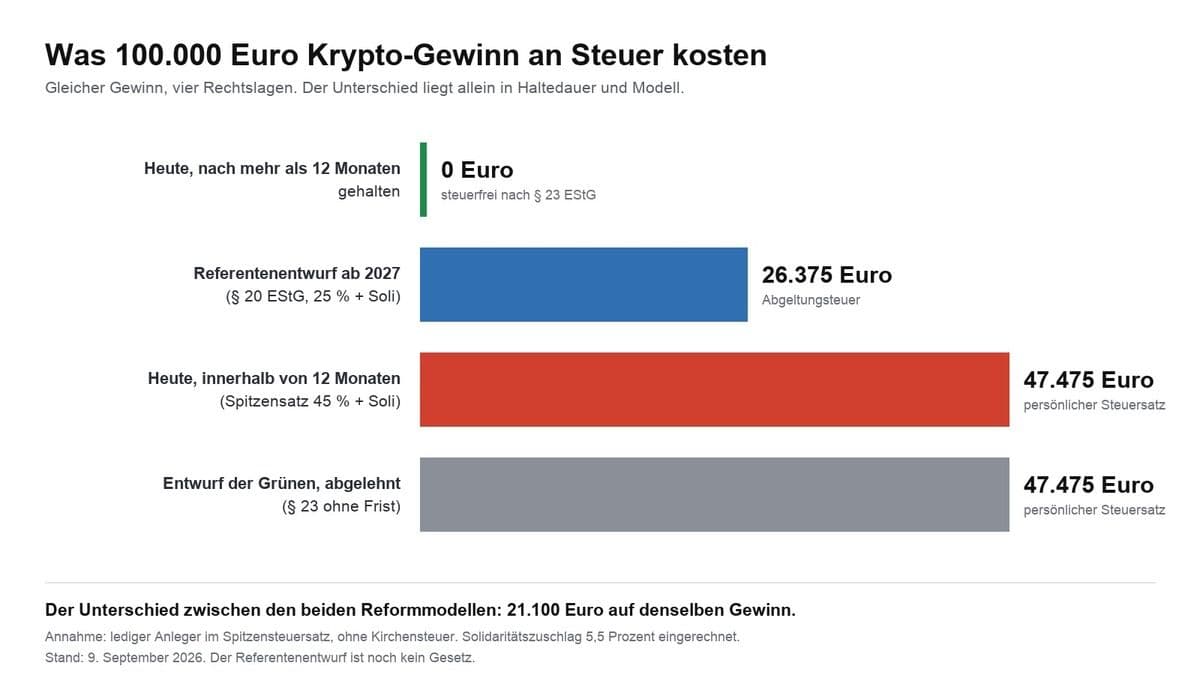
Crypto Tax in Germany: What Applies in 2026 and What Is Set to Change in 2027
Crypto gains are tax-free after twelve months; before that your personal tax rate of up to 45 percent applies. What triggers tax, how the holding period is calculated, what happens with staking and losses, and what the draft bill would change from 2027.
September 26, 2026 1:19 AM

Germany’s Crypto Holding Period Is Wobbling: What to Check Before December 31
A CDU member of the Bundestag makes it plain: the coalition agreement does not guarantee that the one-year holding period for crypto assets will survive. What that means for purchases made before the planned cutoff date of December 31, 2026.
October 1, 2026 7:36 PM

Crypto tax and withholding at source from 2028: what to check now
The German Federal Ministry of Finance’s draft bill goes to cabinet on October 14, 2026. The underexposed part of it is the deduction of tax from 2028: which providers are to withhold the tax on investment income, why self-custody and foreign platforms stay exempt from it, and what you should document by December 31.
August 31, 2026 10:30 PM

Taxing Crypto Lending: Your Personal Rate Instead of Withholding Tax, and the Right Federal Fiscal Court Case Number
According to the only tax court ruling so far, income from crypto lending falls under Section 22(3) of the German Income Tax Act and therefore under your personal tax rate. The appeal is pending at the Federal Fiscal Court under VIII R 22/25, not under the case number given in many professional articles.
September 17, 2026 7:12 PM

Gifting Bitcoin to Children: Allowance, Holding Period and the Tax Office Report
Transferring Bitcoin to your child hands over your holding period and your entry price along with the coins. This guide sets out what really applies in Germany on the allowance, the reporting deadline, representation and custody.
February 13, 2026 9:07 PM

Netherlands Approves 36% Tax on Unrealized Crypto Gains starting 2028
The Dutch House of Representatives has officially passed a controversial 36% tax on unrealized gains for crypto and stocks, effective January 2028.
September 16, 2026 1:20 PM

Crypto Loss Carryforward in Germany: What Happens to Old Losses Under the 2027 Tax Plan
Losses from crypto sales land in a ring-fenced pot and can only be set against gains of the same kind. The draft bill for 2027 moves future gains into a different pot, and we show you what that means for your assessed carryforward and what your tax notice should say.
More from CryptoTicker