
Bitcoin Fork with BLAKE2b: What the September 1, 2026 Launch Means for Your Bitcoin
Supporters of the Bitcoin Knots software plan to launch their own chain on September 1 and to swap the hashing algorithm from SHA-256d to BLAKE2b. For holders that means: move nothing, but check four things.




Which topics should we dive deeper into?
Select what genuinely interests you. Your picks feed directly into our editorial planning.
Crypto news that's actually worth your time.
Weekly. 60 seconds. Carefully curated by our editors: no hype, no promo flood, no spam.
On September 1, 2026, a chain is due to launch that splits away from the Bitcoin blockchain. If you hold bitcoin, you do not need to transfer anything, exchange anything or unlock anything before then. That is what the project's own documentation says, and none of the reports so far contradicts it.
What is unusual is the level at which this fork intervenes. It reaches one layer deeper than the usual points of contention: what changes is the hashing algorithm used to produce blocks in the first place. SHA-256d becomes BLAKE2b. That renders every existing bitcoin mining machine useless for the new chain, and it is precisely at this point that it will be decided whether the new chain comes into existence in practice at all.
This article sets out the case: what is planned for September 1, what the backstory tells us, what risk a chain split actually creates for you, and how German tax law treats coins from a fork if you are ever allocated any. We explained the mechanics of a chain split as such in a separate article on August 20, 2026, on the bitcoin fork and how to secure your coins. Here the subject is this specific case and what sets it apart from earlier forks.
Bitcoin fork with BLAKE2b: what is planned for September 1, 2026
Behind the project are supporters of the bitcoin software Bitcoin Knots. Bitcoin Knots is a separate variant of the bitcoin software that serves the same chain as the widely used Bitcoin Core, but offers stricter rules, for instance against storing arbitrary data in blocks. The driving figure is the developer Luke Dashjr, whose main role is chief technology officer at the mining provider Ocean Mining.
The sequence of events, as crypto.news described it on August 31, 2026: on August 29, Dashjr called on miners to power down their hash rate ahead of a test on August 30. That test was the dress rehearsal for swapping out the hashing algorithm. If it runs without errors, version 29.4.1 of the Knots software can lock in the new chain on September 1. The candidate running in the test was 29.4.1rc4, the fourth release candidate of that version.
An important qualification: September 1 is a target, not an irreversible activation deadline. If technical problems arise, further release candidates and a rollback to the last block under the old algorithm are provided for. On the public record, there is no fixed date at which the chain necessarily comes into being.
In substance, the fork brings a limit alongside the new hashing algorithm: arbitrary data in blocks is temporarily capped at around 300 kilobytes per block. According to the project documentation, this limit is due to expire on September 1, 2027; after that, node operators decide for themselves whether to keep it.
One term up front, because the rest rests on it: a hard fork is a rule change that the old software no longer accepts. From the point of separation onwards, both sides continue their own chain, and both carry the same history up to that point.
Proof of work: why the switch from SHA-256d to BLAKE2b locks out existing miners
Proof of work is the method by which a network secures its blocks: anyone who wants to append a block must solve a computationally expensive task whose result everyone else can verify in a fraction of a second. Bitcoin has used the SHA-256d function for this since 2009.
The machines that solve this task are special-purpose devices. They can do SHA-256d and nothing else. A switch to BLAKE2b therefore means that the entire existing hash rate of the bitcoin network is unavailable to the new chain. Anyone who wants to produce blocks there has to do it with ordinary processors or graphics cards, or have new hardware built.
For the project's supporters, that is the whole point of the exercise. They want to prise block production out of the hands of the large mining operations that set the pace today. The price is a chain that starts out with very little hash power behind it, and that is no side issue: the less hash power secures a chain, the easier it is to rewrite its history after the fact.
The size of the gap can be read off a figure from the public debate reported by the trade outlet CryptoSlate on August 31, 2026: one of the proposed starting difficulties would require around 870 terahash per second. The testnet4 environment under discussion for the purpose was estimated at 50 to 70 terahash per second. How much hash power operators had actually committed was not apparent from the public debate. For comparison: the bitcoin network itself has been operating for years in the range of several hundred thousand petahash per second, that is, many orders of magnitude above it.
 Hardware wallets compared
Bitcoin Knots, BIP-110 and two blocks: the backstory of the fork
The September 1 attempt is not the first. Three weeks earlier, a fork out of the same circle was already under way. It went back to BIP-110, a proposal conceived as a user-activated tightening of the rules: nodes that enforce it reject, from a cut-off date, blocks that do not support it.
On August 8, 2026, those nodes began rejecting. The bulk of the hash rate went on producing blocks under the old rules. According to the reported figures, the enforcing branch reached 2.53 percent miner support, produced two blocks and then came to a halt.
Why a new chain can fail for want of hash power
A blockchain depends on blocks appearing at regular intervals. If the hash power does not materialise, none appear. Balances on such a chain then exist arithmetically but cannot be moved in practice, because no transfer is confirmed. Anyone hoping a fork will hand them a second balance should know about this case before putting effort into it.
On top of that comes the question of who will accept the new coins at all. On the state of reporting, no major exchange, no widely used wallet, no custodian, no block explorer and no Lightning implementation had publicly committed to supporting the BLAKE2b chain shortly before the planned launch. Without a trading venue there is no price, and without a price there is nothing to sell.
Do bitcoin holders need to do anything before September 1?
The project documentation answers this itself, and the answer is unambiguous. It states: “Your addresses, keys, and coins stay the same. You do not need to move bitcoin before the fork.” You can read it in the project's frequently asked questions.
That statement comes from the people running the project and is therefore self-reported. On this point, however, it matches the general mechanics of a chain split: your balance hangs on your keys, and a fork does not change them.
The pressure to act arises somewhere else. Anyone holding their own bitcoin in self-custody should know whether their wallet supports the signature form that prevents a replay attack, and whether it even registers that a second chain exists. Anyone whose bitcoin sits with a provider depends on that provider's decision. Which form of custody keeps control in which situation is shown in our comparison of hardware wallets.
Replay protection in the BLAKE2b fork: why SIGHASH_UNIFIED is optional
A replay attack is the most unpleasant consequence of a chain split. It works like this: you send a transfer on one chain. Because both chains know the same history and the same format, the identical transfer is also valid on the other chain. Someone picks it up there and sends it again. Your balance on the second chain thereby moves to the same recipient without you intending it.
The project documentation names a dedicated signature format called SIGHASH_UNIFIED as the countermeasure. The decisive part is how it is built: by the description, it only takes effect if a wallet actively supports and uses it. That makes it something short of protection that applies in every case. Wallets meant to spend on both chains would have to support the format.
In practice this means: as long as it is unclear whether a second chain exists and whether your wallet knows this format, holding back on larger transfers in the days around a fork is the simpler decision. That is not a rule, but a trade-off between convenience and a mistake that cannot be undone.
Light wallets and block headers: why 164 bytes instead of 80 affect your wallet software
A block header is the short record that uniquely describes a block and chains it to the previous one. In bitcoin it is 80 bytes long. According to the reports, the BLAKE2b chain works with a divergent format of 164 bytes.
That sounds technical but has a very concrete consequence. A light wallet, often called an SPV wallet, does not download the whole blockchain but only these block headers in order to verify payments. It cannot make sense of a different format without an update. Your ordinary phone wallet will therefore not see the new chain by itself.
For hardware wallets, the project documentation distinguishes two cases. Devices that verify the hashing algorithm or the chain identity themselves need new firmware. Ordinary signing of a payment, by contrast, continues to work. Security-relevant firmware updates should only ever be fetched through the manufacturer's official application, as most recently in the case of the Coldcard firmware and the seed that had to be generated anew.
Bitcoin on exchanges: what trading venues do with deposits and withdrawals during a chain split
The project documentation expressly recommends that trading venues suspend deposits and withdrawals across the period of the fork and state publicly which chain they support. That is exactly how exchanges handled earlier splits.
For you this means two things. First, you may be unable to deposit or withdraw for a few hours even though nothing has happened to your balance. Second, the provider decides whether to credit you with coins from a new chain. The terms and conditions of most houses give you no claim to that. Anyone who cares about deciding for themselves in a split needs the private keys in their own hands. Which providers are licensed in Germany and how they have behaved in such situations so far can be found in our overview of the best crypto exchanges.
One practical note: news about a fork reaches you most reliably through your provider's status page. Anyone waiting instead for posts on social networks will mostly see advertising from those who profit from the excitement.
 The best crypto exchanges compared
Node operators: how to tell which software enforces your rules
If you run a node yourself, that is the only place in this article with a genuine need to act before September 1. Check which software is running on your machine and which version. Bitcoin Core and Bitcoin Knots are two different programs with different default settings.
Anyone who wants to follow the new chain needs, according to the project documentation, a version that supports BLAKE2b, and has to set an additional configuration value; the software is distributed via bitcoinknots.org. Anyone who wants to keep following the existing chain need do nothing. That is the reassuring half of this news: doing nothing is a valid decision here, and it means your node follows the chain it follows today.
A node, incidentally, is not a prerequisite for holding bitcoin. It is the means of checking the rules yourself instead of trusting a third party's word. In a contested fork, that is the difference between an answer of your own and a borrowed one.
Fake claim sites: why nobody needs your seed phrase for a fork
Every announced fork brings with it a wave of offers to help you claim the supposed new coins. The pattern has been the same for years: a cleanly designed page, an input field for the seed phrase or a wallet connection with sweeping permissions, and after that the balance is gone.
The rule of thumb is short. A chain split creates balances automatically out of your existing keys. There is nothing to claim, nothing to register and nothing to unlock. Anyone asking for your seed phrase wants your money, no matter how the page looks.
Just as important is the second variant, in which no seed is requested but only a signature. How to recognise such an approval before you grant it is something we described using the example of wallet drainers and their signature prompts.
Tax on a bitcoin fork: what the German finance ministry says about splitting acquisition costs
If coins from a new chain are in fact allocated to you in a fork, that is not a tax non-event in Germany. The Federal Ministry of Finance set out the treatment in its letter of March 6, 2025, on individual questions of the income tax treatment of crypto assets, file reference IV C 1 - S 2256/00042/064/043.
Two points from it are material for private investors. First, the allocation of the new crypto assets counts as an acquisition. Second, the acquisition costs of the coins held before the fork are apportioned between the old and the new assets, in the ratio of their market prices at the time of the fork.
From that follows a question that stays open in the case of a chain without a trading venue: with no market price for the new chain, the yardstick for the apportionment is missing. How the tax office handles that is a question for your tax adviser and not one that can be answered in general terms. What you can do regardless: record the date, block height and balance at the time of a split, because these details are only laboriously reconstructed later. Tools that keep a running record of your holdings can be found in our comparison of crypto tax tools and portfolio trackers.
What is settled about the BLAKE2b fork and what remains open
Settled is the plan: the swap of the hashing algorithm, the test on August 30, the release candidate 29.4.1rc4, September 1 as the target and the temporary data limit until September 1, 2027. Settled too is the backstory with the two blocks in August.
Open is whether a chain comes into being at all on September 1, how much hash power carries it, whether a trading venue can be found and whether the replay protection reaches widely used wallets. Anyone telling you today what such a coin allocation will be worth is going far beyond what is publicly known.
And one distinction that is quickly lost in reports of this kind: the existing bitcoin blockchain is unaffected by the project. It continues to run on SHA-256d, your bitcoin there stay where they are, and neither your addresses nor your keys change.
Making sense of the BLAKE2b fork: what you take away
- Check your custody, do not reshuffle it. Look at whether your coins sit with a provider or in your own custody, and whether your wallet software is up to date. You do not have to move anything before September 1. Which devices take on which job is set out in the hardware wallet comparison.
- Read your trading venue's status page. If your provider suspends deposits and withdrawals, it will say so there and not in a direct message. If in doubt, compare which provider gives clean information in such situations with the overview of the best crypto exchanges.
- Secure your records, never enter your seed. Note the date and your holdings in case an allocation happens, and do not enter your seed phrase on any claim page. The crypto tax tools help with keeping a running record of your holdings.
(As of August 31, 2026. This article is not investment advice. Prices and fee structures change; check the terms with the provider before you buy.)
Transparency note: This article was produced with the assistance of artificial intelligence and reviewed by our editorial team before publication. All figures and claims were checked against the primary sources linked in the text. The feature image was generated with AI.
Related articles
- Bitcoin Fork: What Happens to Your Coins When the Chain Splits
- What are Bitcoin Forks? Here’s a Deep Dive into what Forks are
- Bitcoin From a Foreign Exchange to Austria: Which Tax Data You Need
- Bitcoin Lending in Austria: When Tax Falls Due
- Bitcoin Losses and Dividends in Austria: How the Tax Offset Works
Which topics should we dive deeper into?
Select what genuinely interests you. Your picks feed directly into our editorial planning.
Crypto news that's actually worth your time.
Weekly. 60 seconds. Carefully curated by our editors: no hype, no promo flood, no spam.

September 22, 2026 7:13 PM

CME Lists Bitcoin Cash and Uniswap Futures From October 19: What Retail Investors Must Check With Their Broker
CME Group brings futures on Bitcoin Cash and Uniswap to market on October 19, and BCH jumps 24 percent on the news. For retail investors in Germany, however, a BaFin order decides whether they may trade the contracts at all.

August 8, 2018 8:17 PM

Forking: The New Leap in Cryptocurrency
A hard fork is a mystical event in the cryptocurrency and blockchain technologies. Though, in that case, one cryptocurrency can turn into two.
August 18, 2026 7:13 AM
Bitcoin Tax Reporting in Austria 2026: What Applies
Bitcoin tax reporting in Austria: which data investors can request from crypto exchanges in 2026, and when the report matters for the tax return.
August 10, 2026 9:15 PM
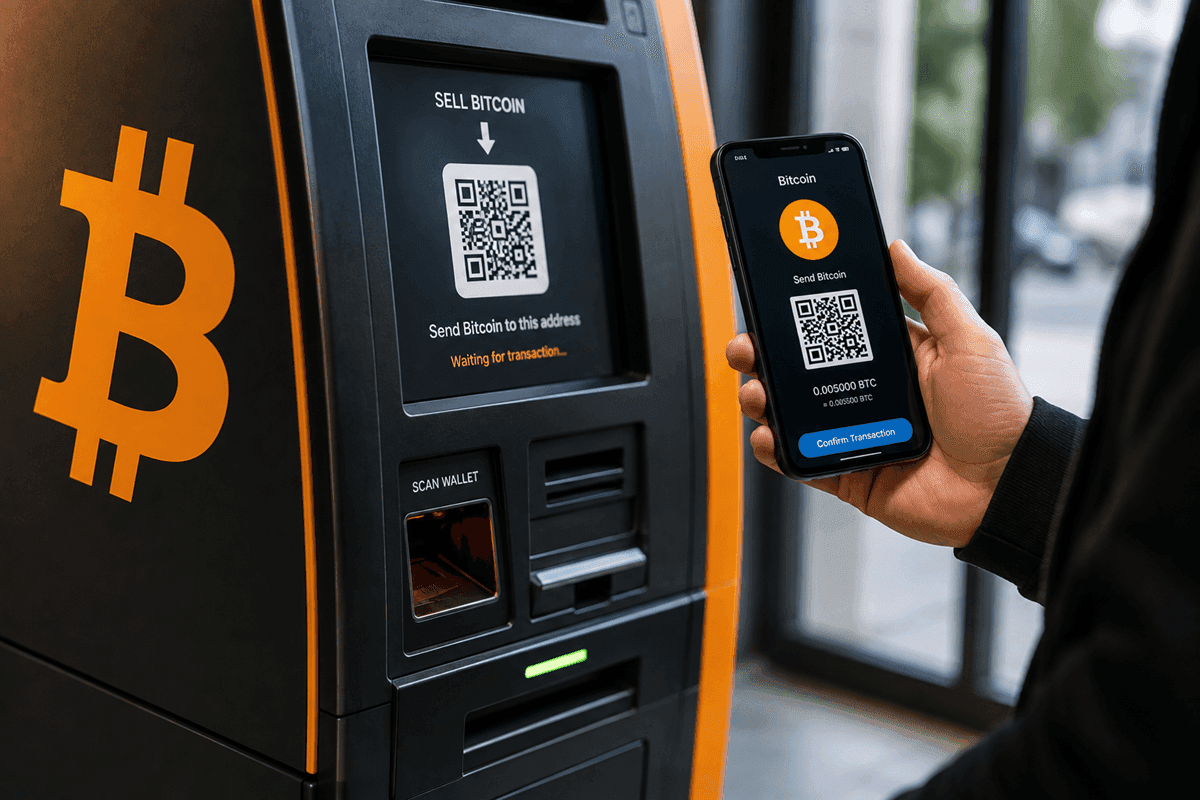
Selling Bitcoin at an ATM: Tax Rules in Austria
Selling bitcoin for cash at an ATM: when the 27.5 percent rate applies in Austria and which records you need to keep.
August 16, 2026 9:11 PM
Swapping Bitcoin for Stablecoins: Does Austria Charge Tax?
Anyone swapping bitcoin for USDT or another stablecoin usually pays no tax in Austria yet. When the swap does become taxable after all.
August 11, 2026 5:14 AM
Bitcoin Bought Before March 2021: Is the Sale Tax-Free in Austria?
Bought Bitcoin before March 2021? Why legacy holdings can still be sold tax-free in Austria in 2026, and which exceptions apply.
September 11, 2026 10:18 AM

Bitcoin Tax Audit: What Proof Austria Requires
Which bitcoin records can the Austrian tax office examine? Purchase dates, wallet transfers, acquisition costs and sale proceeds are what count.
September 9, 2026 4:29 PM
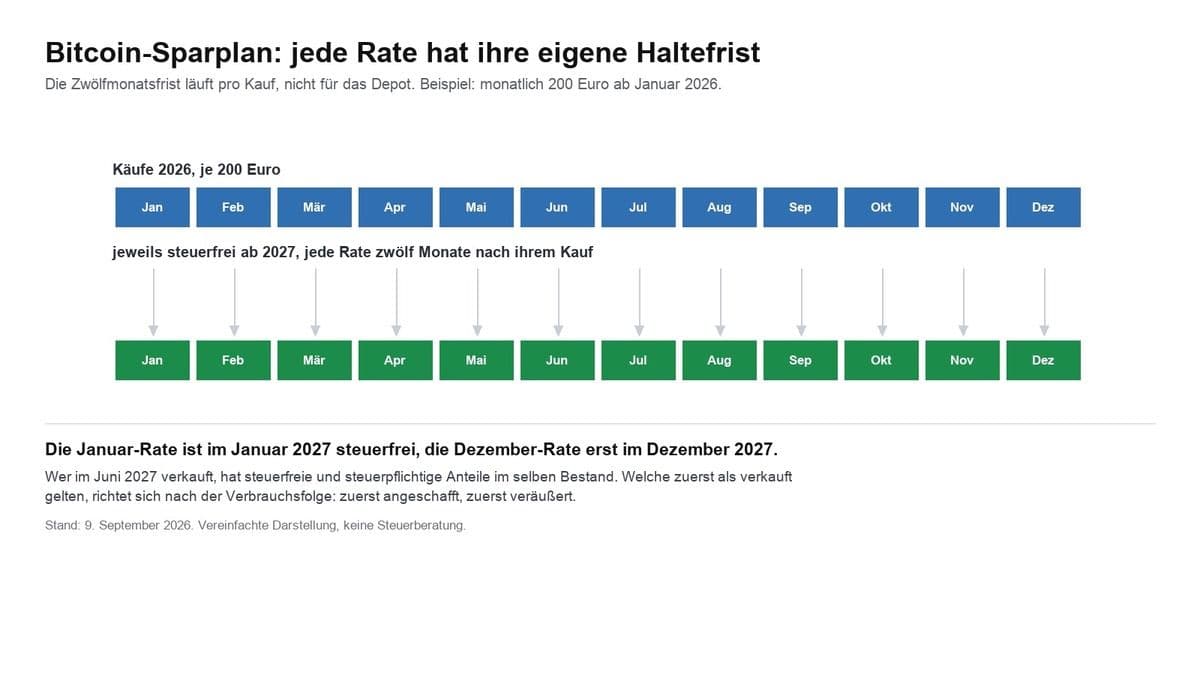
Bitcoin and Taxes in Germany: Holding Period, Savings Plan, ETP and Mining
Bitcoin gains are tax-free after twelve months. What that means for a savings plan with twelve deadlines, why ETPs are taxed differently, and what applies to mining, gifts and losses.
August 28, 2026 10:15 AM

Selling Bitcoin Privately: What Tax Applies in Austria
Selling bitcoin directly to another person? In Austria, private sales can still trigger 27.5 percent tax on the realised gain.
August 21, 2026 1:33 PM

Bitcoin With No Cost Basis: How Austria Taxes the Sale
Bitcoin purchase price no longer provable? How Austria works out the capital gains tax, when a flat-rate cost basis applies and what investors can do.
September 10, 2026 7:14 AM

Bitcoin Loan Liquidated: Tax Consequences in Austria
If a lender liquidates Bitcoin pledged as loan collateral, a taxable capital gain can arise in Austria. That holds even when the investor never chose to sell.
September 1, 2026 1:25 PM

Bitcoin Tax Report Wrong: What Austrian Investors Can Do
Errors in a Bitcoin tax report are not unusual. This is the data Austrian investors should check, and how a wrong capital gains tax deduction is put right.

August 20, 2024 3:00 PM

New US Senate Proposal Submitted For Crypto Tax Exemption
The US Senate has recently submitted a new proposal to exempt crypto transactions from federal taxes. Here are more details of this submission, and a list of exempted countries it could be joining...
August 18, 2026 4:22 AM

Bitcoin for gold: is the swap taxable in Austria?
Swapping bitcoin directly for gold? In Austria this can already trigger 27.5 percent tax on the capital gain. What investors should know.
August 20, 2026 4:24 PM

Bitcoin Across Multiple Wallets: How Austria Works Out the Acquisition Cost
Bitcoin spread across several wallets? How Austria works out the acquisition cost and the rolling average price for tax purposes.
August 11, 2026 1:19 AM
Bitcoin as a Business Asset in Austria: Private Holding or Company Asset?
Bitcoin held by a business owner in Austria is not automatically a business asset. Here is what decides the classification and what it means for tax on sales, withdrawals and contributions.
September 19, 2026 7:12 PM

Bitcoin Sold Without Austrian Tax Withheld: What to Do Next
Sold Bitcoin but no Austrian capital gains tax was withheld? That does not make the sale tax free. When investors have to declare the gain themselves at 27.5 percent.
September 4, 2026 1:34 PM

Bitcoin as Loan Collateral: When No Tax Applies in Austria
Pledging Bitcoin as collateral for a loan? As long as the coins are not realised, no sale arises in Austria in principle.
August 27, 2026 10:16 AM

Bitcoin Tax Return in Austria: When You Must File
Even with a crypto exchange, a tax return can still be necessary in Austria. Foreign platforms, missing capital gains tax withholding and cross-provider losses are the typical triggers.
September 14, 2026 1:27 PM

Bitcoin Lost to a Scam: What Counts as a Tax Loss in Austria
Lost bitcoin to a scam? Why Austria generally does not recognise the damage as a tax loss for privately held assets, and when compensation payments start to matter.
September 3, 2026 10:21 AM
Bitcoin Lost in a Wallet Hack: What Tax Applies in Austria?
Bitcoin lost to hackers? In Austria, the theft of privately held coins generally does not create a capital loss you can use for tax. Only a later payout can change that.
August 26, 2026 10:25 PM
Selling Bitcoin at a Loss: Loss Offsetting in Austria
Sold Bitcoin at a loss? Austria allows the loss to be offset against certain investment income. When loss offsetting is possible and which limits apply.
September 25, 2026 10:14 PM
Sequans sells its last 314 bitcoin: what to check if you hold a treasury stock
Semiconductor maker Sequans has wound down its bitcoin reserve completely, 15 months after setting a target of one hundred thousand coins. What the case reveals about treasury stocks, and which tax rule applies to the share and to the coin.
September 2, 2026 1:39 PM

Bitcoin as Salary in Austria: Which Taxes Arise?
Paid in Bitcoin? In Austria wage tax falls due on the value first. Later Bitcoin price gains can become taxable on top of that.
August 24, 2026 10:26 AM
Bitcoin Savings Plan in Austria: How the Purchase Price Is Calculated
Bought bitcoin through a savings plan? For multiple purchases Austria applies the moving average price as a matter of principle when working out taxable gains.
August 20, 2026 4:12 AM

Wrapped Bitcoin in Austria: Is Converting BTC to WBTC Tax-Neutral?
Swapping BTC for Wrapped Bitcoin: when the move to WBTC can be tax-neutral in Austria, and which tax risks investors should know about. Acquisition costs carry over, but the classification of the token decides the outcome.
September 23, 2026 4:26 PM

Paid in Bitcoin: How to Tax Crypto Income as a Self-Employed Freelancer
A fee in Bitcoin is perfectly ordinary business income, valued at the euro price on the day it reaches you. The decisive trap comes afterwards: business assets carry no one-year holding period, so every later price move stays taxable.
More from CryptoTicker