
ECX live since October 29: claiming and selling the fork coins without putting your bitcoin at risk
Since October 29, every self-custodied bitcoin address has held the same amount of ECX. If you want to claim and sell the fork coins, you first have to separate them with replay protection, or you risk losing your ECX the next time you move bitcoin.


Which topics should we dive deeper into?
Select what genuinely interests you. Your picks feed directly into our editorial planning.
Crypto news that's actually worth your time.
Weekly. 60 seconds. Carefully curated by our editors: no hype, no promo flood, no spam.
ECX belongs to you if you held the private keys to your bitcoin yourself at Bitcoin block 973,728: since the eCash mainnet launched on October 29, the same addresses hold the same amount of ECX. You can claim the coins by separating them from your bitcoin with an eCash wallet and a replay-protected transaction, and you must do so before you move your bitcoin. If your bitcoin sit on an exchange, the exchange alone decides whether you ever receive anything. So far ECX can only be sold on a handful of small platforms.
Our two earlier articles on the subject covered the run-up: how the snapshot at block height 973,728 is calculated and what investors had to watch on custody before the cut-off. This guide picks up from there. It explains the order in which to proceed so that claiming your ECX does not cost you your bitcoin, which software can do the job, where scammers lie in wait and what the German tax office expects when you sell.
ECX after the Bitcoin hard fork: who actually owns the new coins
A hard fork is a split in which a group of developers changes the rules of a blockchain and continues its own chain from a set block onwards. Everything that happened up to that block is shared by both chains. For Bitcoin, this means that every address holding a balance at the fork block has a balance of the same size in ECX on the eCash chain. According to the project website, the ratio is 1:1. Anyone who held 0.5 BTC has 0.5 ECX.
The catch lies in the word "address". A balance on a blockchain belongs to whoever controls the matching private key. If you kept your bitcoin on a hardware wallet or in a software wallet with your own seed phrase, you also control the ECX on the same addresses. If you left them on Binance, Coinbase, Kraken or Bitpanda, the keys belong to the exchange, and so do the ECX on its pooled addresses.
There is no registration and no "claim" in the sense of filling in a form. The coins already exist; you just need to be able to move them. That is exactly where the mistakes happen that the following sections deal with. One important distinction: ECX is not XEC. The older eCash with the ticker XEC comes from the Bitcoin Cash family and has nothing to do with the new project, even though both carry the same name.
Drivechain and BIP 300: Paul Sztorc's project behind eCash
ECX is the work of LayerTwo Labs, the company of developer Paul Sztorc. For years Sztorc has championed Drivechain, a method for attaching so-called sidechains to Bitcoin. A sidechain is a separate blockchain to which you can transfer coins from the main chain and later bring them back. Drivechain is described in Bitcoin Improvement Proposals BIP 300 and BIP 301. Because Bitcoin's developers never adopted these proposals, Sztorc launched his own Bitcoin fork in eCash (ECX).
According to Cointelegraph Magazine, five sidechains went live alongside the mainnet: BitNames, BitAssets, Thunder, Truthcoin and zSide. LayerTwo Labs had previously tested the technology in an alpha and a beta phase on test networks; the beta began at block 967,680. The node software is, according to the project, an offshoot of Bitcoin Core, and consensus remains proof of work with SHA-256. Sztorc himself is combative: Cointelegraph quotes him as saying he wants to actively sabotage the "degrowth" policy that he says is holding Bitcoin back.
For you as a holder, the technical background matters above all in one respect: eCash is a separate chain with its own rules, its own software and its own risks. The ECX fork shares only the transaction history up to the fork block with your bitcoin. And it is precisely this shared past that makes claiming the coins tricky.
Replay attacks explained: why a normal bitcoin transfer takes your ECX with it
A replay is the repetition of a transaction on the other chain. Because Bitcoin and eCash use the same address formats and the same signature technology, an ordinary bitcoin transfer from an address that already held a balance before the fork is valid on both chains. Anyone who sees it on the Bitcoin network can copy it to the eCash network. Your ECX then go to the same recipient as your bitcoin.
LayerTwo Labs therefore warns explicitly: never move your BTC first, because an ordinary, unprotected BTC spend can easily be replayed on the ECX network. If you send bitcoin to an exchange, the exchange may get your ECX for free as well. If you send them to a merchant or to a new address of your own, the ECX end up somewhere you may never be able to reach again.
Replay protection on eCash is optional. The project documentation describes a marker in a transaction's nLockTime field: if it carries the value 499999998 and at least one non-final input, eCash nodes accept the transaction and Bitcoin nodes reject it. The protection only works in this one direction. A Bitcoin transaction cannot be invalidated on eCash. That is why the order matters: move the ECX side first, with protection, so that the old coins are spent there, and any later bitcoin payment goes nowhere on eCash.
ECX coin splitting with replay protection: the process in four steps
Separating the two holdings is called coin splitting. In its coin-splitting guide, the project website describes a process you should follow in this order:
- Create an ECX receiving address. You set up a wallet connected to the eCash mainnet and generate a new receiving address there. This wallet has its own, new seed phrase.
- Sign a protected transaction. In the wallet that holds your old bitcoin keys, you build a transaction with the replay marker that sends the old coins to the new ECX address. It is invalid on the Bitcoin network and gets confirmed on the eCash network.
- Wait for confirmations. Only once the transaction has been confirmed several times on the eCash chain are the two holdings considered separated.
- Only then move your bitcoin. Your BTC remain unchanged on the old addresses. If you want to move them, do so now with a normal bitcoin transaction.
Finally, check in the block explorer of each chain that the balances are where they belong. If you do not trust yourself with the technology, you lose nothing by waiting. The ECX are not going anywhere as long as you leave your bitcoin untouched on the old addresses.
Which wallet software supports ECX and what hardware wallets can do
For ECX itself, eCash.com lists an official mobile wallet for Android and iOS (initially via a test version on iOS) as well as BitWindow, a desktop program for macOS, Windows and Linux that also lets you run your own node and the sidechains. There is also EcashJr, an open-source tool from a third-party developer that, according to the project website, only works with English 12-word BIP39 seeds and one particular account type.
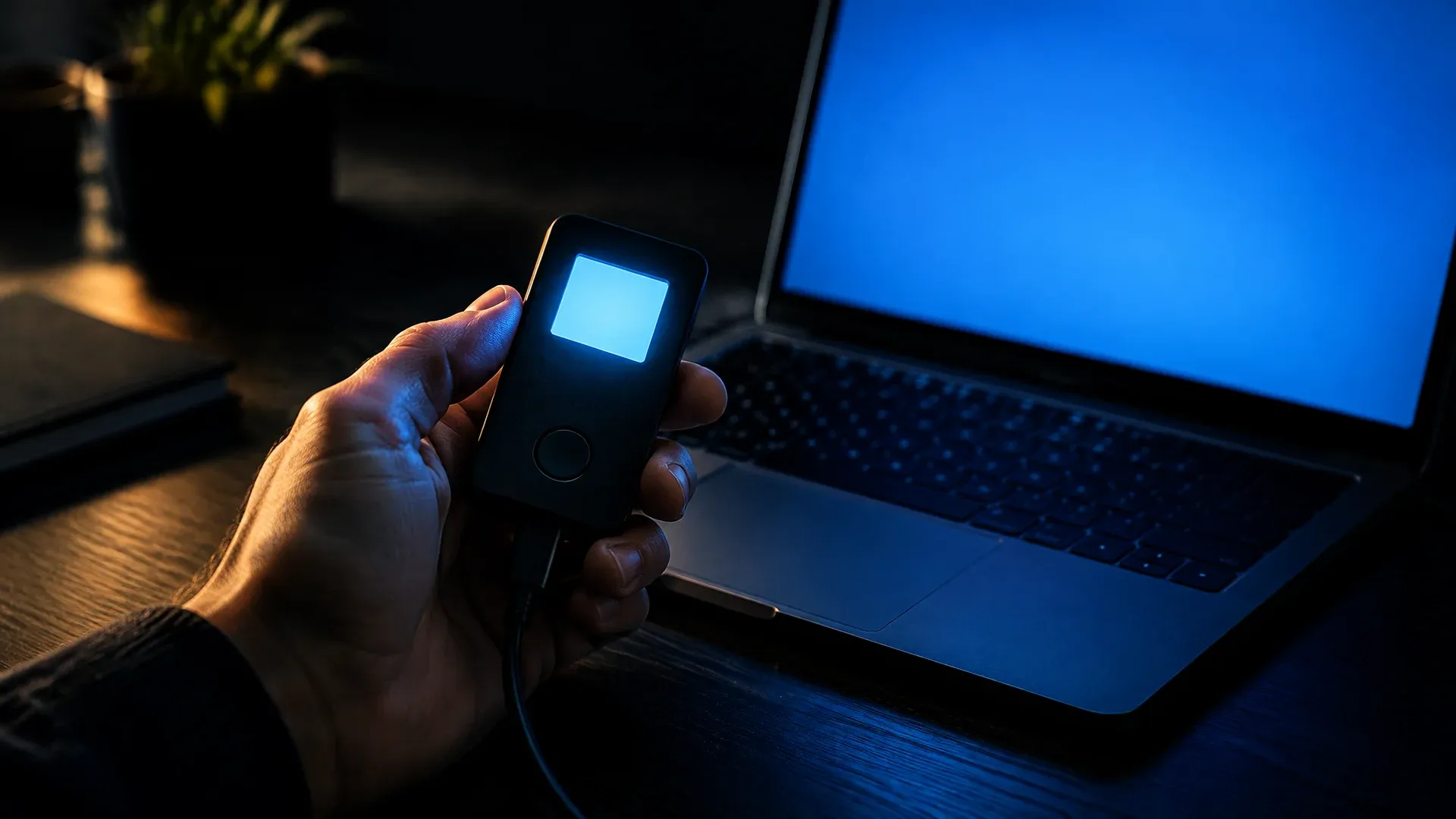
Whether a well-known bitcoin wallet such as Sparrow, Electrum or a device from our hardware wallet comparison can handle ECX is a question the project website answers cautiously: some bitcoin wallets can sign the protected transaction needed for splitting. That does not mean they display ECX balances or connect to the eCash network. The eCash FAQ puts it this way: the fact that eCash reuses Bitcoin's address and key formats does not in itself prove support in a wallet.
In practice, this means your hardware wallet remains the device that holds the old keys and signs the splitting transaction. You receive the ECX in a separate eCash wallet. Ask the manufacturer of your hardware wallet beforehand whether the device signs the required fields unchanged. If it does not, the transaction may reach the network without the marker, and then no replay protection applies.
 Compare crypto exchanges and fees
Seed phrases and claim sites: the scam patterns around the ECX fork
Every fork attracts scammers, because many holders suddenly have a balance they have never moved. The pattern is always the same: a website or app promises to "unlock" the fork coins and asks for your seed phrase in return, the 12 or 24 words from which all the private keys of your wallet are derived. Anyone who enters it loses their bitcoin as well.
The project website itself is clear: never enter a recovery phrase or a private key on a website. Do not send BTC, do not share a seed phrase and do not connect a wallet just because someone tells you it is necessary to unlock ECX. Even with third-party software, eCash.com advises against simply trying out the seed phrase of an existing wallet.
If you have to use software that needs your old keys, there is a clean way to do it: first move your bitcoin to a new address with a new seed phrase, but only after you have separated the ECX. If you move the BTC beforehand, the replay takes the ECX with it. Only download software via the links on the official project website and compare the site's address letter by letter. Also watch out for confusion with XEC: anyone searching for "buy eCash" can quickly end up with the wrong coin.
ECX in exchange accounts: credited only if the custodian decides so
If you held your bitcoin on an exchange on the cut-off date, the ECX were created on its addresses, but that does not give you any claim to them. According to Cointelegraph, exchange customers are "at their mercy" when it comes to distribution. The project website states that eCash cannot promise you will receive ECX; that is entirely up to your exchange. Each exchange decides for itself on listing, crediting, deposits and withdrawals.
Of the major platforms with many customers in Germany, none had announced an ECX credit by the weekend. That applies to Binance, Coinbase, Kraken and Bitpanda. In earlier splits, such as Bitcoin Cash in 2017, many exchanges later credited the new coins to their customers, often after weeks. That does not create a legal entitlement, and for a coin with such thin trading the effort for an exchange is high.
What you can do: check your exchange's announcements for the keywords ECX or eCash, and ask customer service in writing whether a credit is planned. Do not rush to withdraw your bitcoin in order to get ECX after the fact. The snapshot is over, and a withdrawal now will not bring you any ECX. If you want to decide for yourself in future what happens with such allocations, it is worth looking at our comparison of regulated crypto exchanges and their custody models.
Selling ECX: NeoxEX, CoinW and the detour via wrapped ECX
So far ECX can be traded in only a few places. According to Cointelegraph, the NeoxEX exchange opened deposits, withdrawals and trading in native ECX on October 29, with the pairs ECX/USDT, ECX/USDC and ECX/BTC. The CoinW exchange has announced that it will distribute ECX to eligible customers and plans to announce deposits, withdrawals and trading later.
A second route runs via wrapped ECX, or wECX. A wrapped token is a proxy token on another blockchain, backed by real coins that a custodian is supposed to have deposited. wECX runs on Solana and trades through a liquidity pool on the decentralised exchange Orca; eCash.com links to the swap service SideShift for this. For you, that means an additional risk: you then hold not ECX but a promise of ECX.
Before you deposit ECX on a platform, check the public register of the European Securities and Markets Authority (ESMA) to see whether the provider is authorised in the EU as a crypto-asset service provider under MiCA. Authorisation does not protect you against price losses, but it obliges the provider to keep assets segregated and to offer complaint procedures. Deposit only a small portion at first, and expect spreads and fees well above what you are used to with bitcoin in such a young market.
ECX price after the launch: 76 percent below its high on thin trading volume
The market value of ECX collapsed in its first days. According to Bitcoin.com, ECX rose to a high of $134.97 after the launch and was trading just above $32 on November 4, around 76 percent lower. CoinMarketCap listed ECX at $32.63 on November 5 with around $355,000 in 24-hour trading volume, Cointelegraph reports. LayerTwo Labs itself spoke of early prices between $40 and $50, without giving details of market depth.
These figures should be read with caution. Daily turnover of a few hundred thousand dollars is very little for a coin that is supposedly worth hundreds of millions on paper. Even a medium-sized sell order can move the price by double-digit percentages. The price a price portal shows you is therefore not the price you will actually achieve when you sell.
The project website itself notes that a 1:1 balance does not mean equal market value. We deliberately do not offer a price forecast here. If you want to sell ECX, base the timing mainly on the liquidity and security of the platform rather than on the price displayed.

Tax on fork coins in Germany: holding period, acquisition costs and the exemption limit for ECX
For tax purposes, the case is regulated comparatively clearly in Germany. According to the Federal Ministry of Finance (BMF) circular of March 6, 2025 on the income tax treatment of crypto assets, the receipt of new units from a split in private assets does not give rise to income. You therefore do not have to declare the fact that ECX appeared on your addresses as income.
It gets interesting when you sell or swap. Under the BMF circular, the acquisition date of the new units is the acquisition date of the original bitcoin. If you bought your bitcoin more than a year ago, a sale of the ECX is also tax-free under Section 23 of the Income Tax Act. If your bitcoin purchase was less than a year ago, the gain is taxable provided that all private disposal gains for the year together reach the exemption limit of €1,000. Swapping ECX into USDT or into wECX also counts as a disposal.
Under the BMF circular, the acquisition costs of the old bitcoin are divided between the two holdings in proportion to their market prices at the time of the split. If no value can be attributed to the new units, the acquisition costs stay with the old ones, and the ECX have acquisition costs of zero on paper. Because ECX had no reliable price on October 29, this case is the likely one. Document your bitcoin purchase date, the splitting transaction and every sale with date and price. A program from our overview of crypto tax tools makes this easier; for an assessment of your individual case, a tax adviser remains the right contact.
 Compare tax tools for your fork coins
ECX fork: without coin splitting, every bitcoin payment remains a risk
The most important sentence in this guide is a simple one: as long as you have not separated your ECX, every unprotected movement of your old bitcoin is also a movement of your ECX. If you keep that in mind, you can wait calmly until wallets and exchanges support the new coin better. Three steps will help you:
- Check your keys and clarify your device. Establish whether your bitcoin were in self-custody on October 29, and ask the manufacturer of your wallet whether it signs the protected splitting transaction. Our hardware wallet comparison shows which devices are suitable.
- Separate first, then move. Claim the ECX following the project website's guide, wait for the confirmations and only then move your bitcoin. If you want to sell ECX afterwards, check the platform's authorisation, for example with our comparison of regulated crypto exchanges.
- Keep your records. Record the purchase date of your bitcoin, the splitting transaction and every sale so that you can prove the holding period. A tool from our overview of crypto tax tools will do the maths for you.
(As of November 8, 2026. This article is not investment advice. Prices and fee structures change; check the terms with the provider before you buy.)
Frequently asked questions about ECX
Transparency note: This article was produced with the assistance of artificial intelligence and reviewed by our editorial team before publication. All figures and claims were checked against the primary sources linked in the text. The feature image was generated with AI.
More on Bitcoin: All Bitcoin news at a glance
Related articles
- Bitcoin Cash price drops 7.4 percent to $264, its lowest level since September 21
- Trump Media Moves 4,259 Bitcoin: Why 30 November Could Force a Sale
- Trump Midterms Reaction: What the Results Mean for Bitcoin, the Trump Coin and the CLARITY Act
- Mercado Bitcoin halts withdrawals after more than $46 million drained in attack
- Hard fork or soft fork: what happens to your coins in a split?
Which topics should we dive deeper into?
Select what genuinely interests you. Your picks feed directly into our editorial planning.
Crypto news that's actually worth your time.
Weekly. 60 seconds. Carefully curated by our editors: no hype, no promo flood, no spam.

October 22, 2026 1:13 AM
ECX Bitcoin fork on October 30: what investors need to know before the snapshot
The ECX blockchain reads every balance at Bitcoin block height 973,728 at the end of October and assigns a new coin to each one. Anyone whose bitcoin sits at an exchange will only receive it if that firm supports the fork.
October 20, 2026 7:21 PM
BlackRock files a Bitcoin ETF with a 10 percent loss buffer: who is allowed to buy PBIT?
BlackRock registered a Bitcoin fund on October 19 that is meant to cushion the first 10 percent or so of a loss and caps the gain in return. PBIT stays out of reach for retail investors in Germany, and the reason has nothing to do with bitcoin.

October 9, 2026 10:32 PM

Bitcoin Cash Recovers Only 16 Percent of the Slide, Bitcoin 88 Percent: The Level That Decides
Bitcoin Cash is down 7.3 percent at $273.80 while Bitcoin recovers almost all of the October 8 slide. There is no news specific to BCH, and the exchange ratio against Bitcoin falls by 7.9 percent.
September 22, 2026 1:28 PM
Selling Bitcoin and Cashing Out in Euros: How It Works in Germany
Between the sell order and the euros in your current account stand the exchange, your bank and the tax office. Knowing the order of events saves fees, waiting time and, in the best case, the entire tax on the gain.
September 22, 2026 1:12 PM
Buying Bitcoin With PayPal in Germany: What Really Works and What It Costs
PayPal runs no crypto service of its own in Germany, but it works as a deposit route at regulated exchanges. What the detour costs, which withdrawal hold follows it and why buyer protection does not apply here.
September 4, 2026 10:26 PM

Pocket Bitcoin Data Breach: When Name, Home Address and Bitcoin Address Circulate Together
The Swiss Bitcoin service Pocket Bitcoin closed its investigation on September 3, 2026: 5,411 people affected, and for 291 of them the Bitcoin addresses they used along with copies of identity documents. Why this one data pairing has lasting effect, and what you should check with your own provider.
September 2, 2026 10:31 PM
ECX Fork of Bitcoin: When the Snapshot at Block 973,728 Really Lands
Layertwo Labs is copying Bitcoin's ledger onto a new chain and crediting every bitcoin with one ECX. Our own measurement shows the three fork stages hang on difficulty periods, and the snapshot reported for October 31 will most likely fall on November 1.
August 31, 2026 7:27 PM
Bitcoin Fork with BLAKE2b: What the September 1, 2026 Launch Means for Your Bitcoin
Supporters of the Bitcoin Knots software plan to launch their own chain on September 1 and to swap the hashing algorithm from SHA-256d to BLAKE2b. For holders that means: move nothing, but check four things.
August 28, 2026 10:15 AM

Selling Bitcoin Privately: What Tax Applies in Austria
Selling bitcoin directly to another person? In Austria, private sales can still trigger 27.5 percent tax on the realised gain.
August 22, 2026 10:29 AM
Bitcoin Fork: What Happens to Your Coins When the Chain Splits
On October 31, 2026 a new chain called ECX splits off from Bitcoin, and every holder is credited automatically. Who actually receives the coins depends on the private keys, on voluntary replay protection and on a tax rule many overlook.

August 21, 2026 6:07 PM
Bitcoin Cash Explodes 29% In A Day: Why BCH Outperformed BTC?
Bitcoin Cash jumped 29.41% to $288, the biggest daily gain of any major coin. The reason has almost nothing to do with Bitcoin Cash itself.
August 12, 2026 5:53 PM

Bitcoin's Quantum Problem: Why 6.7 Million Coins Could Be Frozen Forever
A third of all Bitcoin sits in addresses a future quantum computer could crack. The proposed fix would lock those coins permanently. Here is the plan.
August 11, 2026 5:14 AM
Bitcoin Bought Before March 2021: Is the Sale Tax-Free in Austria?
Bought Bitcoin before March 2021? Why legacy holdings can still be sold tax-free in Austria in 2026, and which exceptions apply.
June 5, 2026 10:49 AM
Bitcoin Price Breaches $63,000 as Liquidations Deepen, But the Next Move is Worrisome
Bitcoin has breached the critical $63,000 mark as derivative liquidations deepen, signaling a potentially more worrisome structural breakdown ahead.
May 4, 2026 9:40 AM
Bitcoin Price Prediction as BTC Coin Reached 80K this morning
Bitcoin hit $80,000 this morning before settling at $79,740. Here's the latest BTC price prediction and technical analysis following this historic May 2026 breakout.
April 22, 2026 9:11 AM
Bitcoin Price Hits $78,000 as Ceasefire Extension Ignites Bullish Momentum
Bitcoin breaches $78,000 following the US-Iran ceasefire extension and a $2.5 billion MSTR purchase. Here is the weekly BTC chart for key 2026 price targets.
March 25, 2026 10:38 AM

Ethereum News: ETH Targets $2,200 as Geopolitical Tensions Ease and Bitcoin Reclaims $71k
Ethereum nears $2,200 while Bitcoin reclaims $71,000 amid reports of US-Iran peace talks. Here are the latest ETH chart trends and market sentiment for March 2026.
March 20, 2026 10:10 AM
Bitcoin Price News: BTC Holds Key Support as ETF Momentum Builds
Bitcoin holds near $70K as trendline support remains intact and ETF momentum grows. Can BTC push toward $80K next?
February 24, 2026 10:30 AM

4 Altcoins Flashing Major Sell Signals: What Happens if Key Supports Break?
The crypto market is on edge as Bitcoin and major altcoins like ETH, SOL, and XRP approach "make-or-break" support levels. Is a deeper crash imminent?
February 9, 2026 6:30 PM

Ethereum Price Prediction: ETH Coin Might Sink Below $1,900 as Bitcoin Loses $70,000
Ethereum faces heavy pressure as Bitcoin drops below $70,000. Here are the key ETH support levels at $1,950 and $1,880 in our latest price prediction.
February 5, 2026 2:59 PM

Ethereum Price Crash: ETH Coin Might Sink Below $2,000 After Bitcoin's 70K Breach
Ethereum is on the verge of a major breakdown. With Bitcoin below $70K and Vitalik Buterin selling ETH, the $2,000 support is under extreme pressure.
February 1, 2026 6:02 PM

A Day to Remember: Crypto Repeats a Familiar Chapter
A major liquidation wave hits crypto as markets unwind risk. History doesn’t repeat — but this chapter feels familiar.
January 30, 2026 7:20 PM
Copper Price Slides as Gold and Silver Crash — What It Signals for Crypto and Markets
Copper prices are sliding as gold and silver suffer a historic selloff. What copper’s weakness reveals about growth, rates, and crypto.

More from CryptoTicker