
Paid in Bitcoin: How to Tax Crypto Income as a Self-Employed Freelancer
A fee in Bitcoin is perfectly ordinary business income, valued at the euro price on the day it reaches you. The decisive trap comes afterwards: business assets carry no one-year holding period, so every later price move stays taxable.





Which topics should we dive deeper into?
Select what genuinely interests you. Your picks feed directly into our editorial planning.
Crypto news that's actually worth your time.
Weekly. 60 seconds. Carefully curated by our editors: no hype, no promo flood, no spam.
If you accept a fee in Bitcoin as a freelancer or a trader, two separate tax events arise from it, and the second one surprises most people. The first is the inflow: the fee is perfectly ordinary business income, valued at the euro equivalent on the day it reaches you. The second is everything that happens to those coins afterwards. And that is exactly where something different applies to you than to a private investor, because the familiar one-year holding period does not apply to business assets.
This text answers the question for Germany, along the lines of the Income Tax Act, the VAT Act and the two relevant circulars of the Federal Ministry of Finance. It does not replace advice in an individual case, but it shows you which questions to put to your tax adviser and what to document yourself before the first invoice goes out.
Bitcoin as a fee: why the inflow is perfectly ordinary business income
Business income is any accrual of assets in money or money's worth that is occasioned by the business. Bitcoin falls under "money's worth", not under money, and the whole treatment follows from that. For tax purposes, the form of payment does nothing to change the fact that you performed a service and received consideration for it. A graphic designer who builds a campaign has made a sale, whether the client transfers euros or pays in coins.
That accrual is valued at its euro amount at the time of the inflow. Under a cash-basis profit calculation pursuant to Section 4(3) of the Income Tax Act, the inflow principle applies: what counts is the day on which you can economically dispose of the coins, which as a rule means the day they arrive in your wallet and are confirmed. Not the invoice date, and not the day you eventually swap them into euros.
From that follows the first practical piece of advice, and it costs you nothing: record the price at the moment of inflow, ideally with a screenshot, a source and a time of day. That single figure determines two things at once, namely the amount of your business income and the acquisition cost of the coins for everything that comes afterwards. Anyone who fails to document it has to reconstruct it later, and with volatile prices that rarely works out in your favour.
Invoicing in Bitcoin: what really happens for VAT purposes
Here we clear up the most stubborn misunderstanding. It is true that Bitcoin enjoys privileged treatment for VAT, but that concerns the exchange, not your service. Your own service remains subject to VAT, exactly as with any euro invoice. Anyone selling web design for 5,000 euros owes VAT on it, even if the client pays in coins.
The basis for this is the Federal Ministry of Finance circular of February 27, 2018 on the VAT treatment of Bitcoin, which implements a judgment of the European Court of Justice (Hedqvist, C-264/14, judgment of October 22, 2015). Two statements from it are worth knowing:
- Handing over Bitcoin merely to settle a payment is not a taxable transaction. To that extent the use of Bitcoin is treated the same as the use of conventional means of payment. Your client is therefore not supplying you with an additional service by paying in coins.
- The exchange of Bitcoin into conventional currency is exempt, based on Section 4 no. 8(b) of the VAT Act read in conformity with EU law. If you later swap the coins you received into euros, that exchange does not in itself trigger VAT.
That leaves the question of the amount on which you calculate VAT. What counts is the euro equivalent at the time your service is performed, converted at the last published selling rate. In practice that means: your invoice states a euro amount and the VAT attributable to it in euros, and payment in coins is merely the way that amount is settled. An invoice that names only a coin amount is useless to the tax office.

The small business scheme under Section 19 of the VAT Act: when you charge no VAT
If you fall under the small business scheme, the VAT element drops away and matters become considerably simpler. Under the wording of Section 19 of the VAT Act in force since 2025, your turnover is exempt if total turnover in the preceding calendar year did not exceed 25,000 euros and does not exceed 100,000 euros in the current calendar year. If the second threshold is breached during the year, the relief ends from that point.
Two things are not changed by it, though. First, income tax is unaffected: your fee remains business income in full. Second, you still have to establish the euro equivalent cleanly, because that figure is what determines whether you are still within the thresholds at all. With sharply fluctuating prices, that is no detail: a job that was below the threshold when invoiced may be above it on inflow.
 Capture inflows and prices cleanly
The real trap: business assets carry no one-year holding period
This is the point where business and private treatment part company for good, and in practice it costs the most money. As a private investor you know Section 23(1) sentence 1 no. 2 of the Income Tax Act: if more than a year lies between acquisition and sale, the gain stays tax free. That does not apply to crypto-assets held as business assets. There, all changes in value are subject to ongoing taxation, regardless of how long you have held the coins.
A worked example makes the consequence tangible. Suppose you issue an invoice for 10,000 euros and let yourself be paid in Bitcoin. On the day of inflow the coins are worth 10,000 euros, so you book 10,000 euros of business income. Two years later you sell the same coins for 18,000 euros. As a private investor the 8,000 euros of price gain would be tax free once the one-year period had run. As business assets they are a further 8,000 euros of business income and are taxed at your personal rate, and for traders with trade tax on top.
The reverse applies equally, and it is the consolation in this rule: if the value falls between inflow and sale, that loss reduces your business profit without the offsetting restrictions that apply in the private sphere. In private assets, losses from private disposal transactions may only be set against gains of the same kind. In a business they are simply an expense.

Private or business assets: what the allocation turns on
Because so much hangs on this distinction, a closer look pays off. Coins you receive as consideration for a business service enter your business assets upon inflow. That is not a choice you make but a consequence of the transaction, because the coins stem from your business activity. The revised Federal Ministry of Finance circular of March 6, 2025 expressly distinguishes crypto-assets in private and in business assets and places particular weight on the allocation.
If you want to move the coins into private assets, that is a withdrawal, and a withdrawal is valued at going-concern value. Any hidden reserve built up until then is thereby realised and taxed. Switching to the private sphere is therefore not a way to escape business taxation; it merely brings it forward. From the withdrawal onwards, however, the private period does start running, with the withdrawal value as the acquisition cost.
So keep business and private holdings technically separate, ideally in different wallets. Anyone mixing the two in the same address will barely be able to evidence the allocation later, and the burden of proof is on you. It is the same thought that lies behind separating a business account from a private one.
Bookkeeping and records: what you have to capture per payment
The circular of March 6, 2025 considerably expanded the requirements on tax return, cooperation and record-keeping obligations compared with the 2022 predecessor. For you as a self-employed person that means, concretely, that you have to record more per incoming payment than you would for a bank transfer. A fixed set of details you capture every time makes sense:
- Date and time of the inflow, meaning the moment the coins were available, not the moment of the invoice.
- Quantity and type of the crypto-asset, in the unit in which it arrived.
- The price used, together with its source, so the euro figure stays traceable and is not disputed later.
- The euro amount derived from it, which serves both as business income and as acquisition cost.
- The receiving address or account, so the allocation to business assets can be evidenced.
- The associated invoice with the euro amount and separately stated VAT, to the extent you charge any.
Because doing this by hand adds up quickly, software that brings inflows and prices together automatically, and can distinguish between business and private holdings, is worth having. Which tools manage that and where the differences lie is set out in the comparison of crypto tax software and portfolio trackers. When choosing, make sure business holdings can be kept separately, because many programs are cut for private investors and do not know the distinction at all.
Price risk between invoice and payment: what to settle in the contract
Between the day you write the invoice and the day the coins arrive there are often weeks. Over that time the price moves, and without a provision you carry that risk alone. Two routes are customary, and both belong in the contract, not in an arrangement by message.
One route is denominated in euros: you agree a euro amount and record that the client owes the coin amount corresponding to it at the time of payment. Then they carry the price risk, and your bookkeeping stays simple because the invoice amount and the business income agree in euros. The other route is denominated in a fixed quantity of coins. That can make sense if you intend to hold the coins anyway, but it shifts the entire price risk to you and means the invoice amount and the actual inflow diverge.
Also settle which price and which source apply, how long your offer is binding, and who bears the network fee. The network fee is no detail: if less arrives with you because the fee was deducted, the inflow is correspondingly lower, while your claim stood at the full amount.
 Swap your fee into euros reliably
Trader or freelancer: where the difference lies for you
For income tax it initially makes no difference whether you work in a liberal profession under Section 18 of the Income Tax Act or in a trade under Section 15: in both cases the fee is business income, and in both cases the coins belong to business assets with no holding period. The difference lies in trade tax, which falls only on trades and thus burdens the later price gain additionally.
A second difference concerns the method of calculating profit. Members of the liberal professions may use the cash-basis profit calculation regardless of their size, and there the inflow principle applies. If, on the other hand, you are required to keep double-entry books, it is not the inflow that counts but the arising of the receivable, and the crypto-assets have to be valued as at the balance sheet date. That is a different arithmetical world with valuation questions of its own, and at this point at the latest you should not think the matter through alone.
Swap into euros immediately or hold: the practical trade-off
Many self-employed people swap the coins they receive straight into euros. For tax that is the cleanest route, for a simple reason: if inflow and sale take place on the same day at practically the same price, no appreciable change in value arises that you would have to capture and tax separately later. You then have exactly one event instead of two, and the exchange itself is VAT exempt.
If, on the other hand, you want to hold the coins, do so with your eyes open. Every price move afterwards is taxable in the business, you need a solid valuation, and you are tying up business assets in a fluctuating value while your tax liability arises and falls due in euros. Anyone who collects a large fee in the spring and has to pay the tax on it the following year can run into a liquidity gap if the price has fallen, even though they never sold a cent. The tax is measured on the value at inflow, not on today's price.
If you do intend to hold balances for longer, the question of custody belongs with it. Coins that sit permanently in business assets should not be left indefinitely on a trading account.
Taxing Bitcoin received as a fee: what to take away
Three steps with which you set the matter up correctly from the start.
- Agree in euros and document the inflow. Write the invoice for a euro amount with separately stated VAT, and on receipt record the date, time, quantity, price and source. Where you can reliably realise the equivalent in euros is shown by the crypto exchange comparison.
- Separate business and private holdings technically. Use a dedicated address for fees, so the allocation stays provable later and private holdings are not pulled into business taxation. For balances held permanently, a custody solution of its own is worth having; the candidates are in the hardware wallet comparison.
- Plan the tax in euros and decide deliberately about holding. Set the tax portion aside as soon as the fee comes in, and reckon with every later price move remaining taxable in the business. Anyone regularly shifting larger amounts will find the right trading routes in the broker comparison.
You can read the two governing administrative instructions yourself: the income tax treatment in the Federal Ministry of Finance circular of March 6, 2025 on individual questions of the income tax treatment of certain crypto-assets and the VAT side in the Federal Ministry of Finance circular of February 27, 2018 on the VAT treatment of Bitcoin. What the taxation looks like when you receive crypto not as a self-employed person but as an employee is covered in our piece on a salary paid in Bitcoin; the basics for private investors we have written up separately.
(As of September 23, 2026. This article is not investment advice. Prices and fee structures change; check the terms with the provider before you buy.)
Transparency note: This article was produced with the assistance of artificial intelligence and reviewed by our editorial team before publication. All figures and claims were checked against the primary sources linked in the text. The feature image was generated with AI.
Related articles
- Donating bitcoin: when does the full market value count, when only the purchase price?
- Borrowing Against Bitcoin Instead of Selling: When German Tax Still Applies
- 0 euros in acquisition costs in the crypto tax draft: how to check salary paid in Bitcoin
- Bitcoin Abroad: The Tax Duty Austrian Investors Carry Themselves
- Bitcoin as Salary in Austria: Which Taxes Arise?
Which topics should we dive deeper into?
Select what genuinely interests you. Your picks feed directly into our editorial planning.
Crypto news that's actually worth your time.
Weekly. 60 seconds. Carefully curated by our editors: no hype, no promo flood, no spam.

September 26, 2026 7:29 PM

Coins Stolen in an Exchange Hack: What the German Tax Office Accepts as a Loss
After the attack on Bitget on September 24, a question the reports leave out arises for those affected in Germany: can a stolen balance be written off against tax? The answer hangs on a single term in the Income Tax Act, and it is decided by your records.
August 21, 2026 4:24 AM
Forced Sale on a Crypto Exchange: Which Moment Counts for the Holding Period and What You Must Document
At Luno, Kraken and Valour the deadlines are running out, after which the provider realises the remaining holding itself. For tax purposes that is a disposal, and what governs it is the exchange's timestamp.
August 11, 2026 9:13 PM

Germany's Crypto Holding Period Faces Abolition: What Petition 201716 and the Cabinet Decision Mean for Your Tax
Petition 201716 in the German Bundestag calls for the one-year holding period for crypto assets to be kept and has already passed the quorum of 30,000 signatures. This article sets out what the cabinet decision of July 6, 2026 provides for, how much of it is binding and which records you should be pulling together now.
August 10, 2026 5:15 PM

Bitcoin Lending in Austria: When Tax Falls Due
Lending Bitcoin and earning interest: when lending income is taxed at 27.5 percent in Austria and which exchange rate counts.
September 25, 2026 1:29 AM

Bürgergeld and Bitcoin: How Much Crypto Can You Keep?
Bitcoin and other coins count as realisable assets for Bürgergeld and are valued at the price on the day you file. Since the reform your allowance depends on your age, and the old grace period for financial assets is gone.
September 17, 2026 10:22 PM

Selling Bitcoin at a Loss and Buying It Straight Back: What That Does to Your Holding Period
Germany has no wash sale rule: the loss stays deductible even if you buy back immediately. The buyback, however, restarts the one-year period for every new unit.
August 11, 2026 1:19 AM

Bitcoin as a Business Asset in Austria: Private Holding or Company Asset?
Bitcoin held by a business owner in Austria is not automatically a business asset. Here is what decides the classification and what it means for tax on sales, withdrawals and contributions.
September 16, 2026 7:39 PM
Deutsche Bank to Custody Bitcoin and Ether: Why Retail Clients Are Missing and What to Check in Your Own Custody
Deutsche Bank will custody Bitcoin, Ether and three stablecoins, but addresses corporates and institutions only. What the launch under supervisory reservation means, and the four questions you should put to any custody arrangement.

October 12, 2018 1:58 PM

Why Germany Needs a Crypto-Conference
In Germany, Bitcoin and other cryptocurrencies have been one of the hottest topics as of late. Ever since the German Federal Ministry of Finances (Bundesministerium der Finanzen) ruled Bitcoin as tax-exempt, there has been an influx of cryptocurrency entrepreneurs rushing […]
August 10, 2026 9:15 PM
Selling Bitcoin at an ATM: Tax Rules in Austria
Selling bitcoin for cash at an ATM: when the 27.5 percent rate applies in Austria and which records you need to keep.
September 9, 2026 4:22 PM
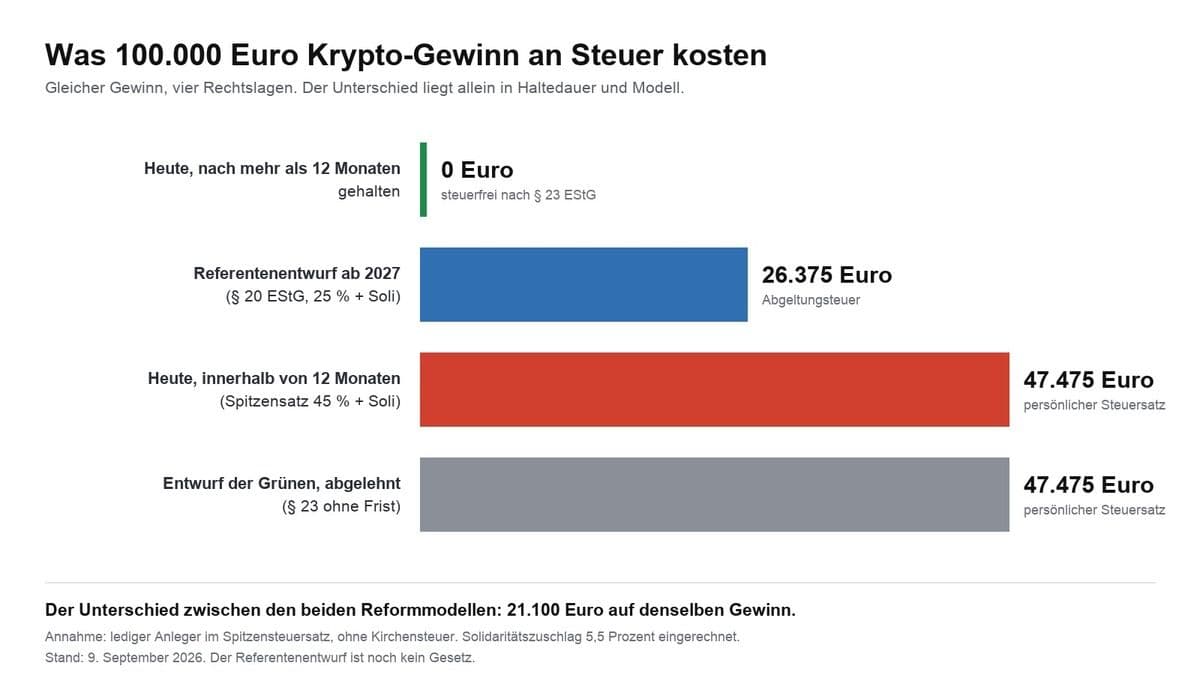
Crypto Tax in Germany: What Applies in 2026 and What Is Set to Change in 2027
Crypto gains are tax-free after twelve months; before that your personal tax rate of up to 45 percent applies. What triggers tax, how the holding period is calculated, what happens with staking and losses, and what the draft bill would change from 2027.
September 26, 2026 1:19 AM

Germany’s Crypto Holding Period Is Wobbling: What to Check Before December 31
A CDU member of the Bundestag makes it plain: the coalition agreement does not guarantee that the one-year holding period for crypto assets will survive. What that means for purchases made before the planned cutoff date of December 31, 2026.
September 19, 2026 7:12 PM

Bitcoin Sold Without Austrian Tax Withheld: What to Do Next
Sold Bitcoin but no Austrian capital gains tax was withheld? That does not make the sale tax free. When investors have to declare the gain themselves at 27.5 percent.

October 13, 2018 8:10 PM

Bitcoin Influences Income Tax Court Ruling
The Supreme Court ruled that stocks cannot be charged income tax - referencing Bitcoin and cryptocurrencies with the progress of how we define money
September 25, 2026 10:14 PM
Sequans sells its last 314 bitcoin: what to check if you hold a treasury stock
Semiconductor maker Sequans has wound down its bitcoin reserve completely, 15 months after setting a target of one hundred thousand coins. What the case reveals about treasury stocks, and which tax rule applies to the share and to the coin.
August 31, 2026 10:30 PM

Taxing Crypto Lending: Your Personal Rate Instead of Withholding Tax, and the Right Federal Fiscal Court Case Number
According to the only tax court ruling so far, income from crypto lending falls under Section 22(3) of the German Income Tax Act and therefore under your personal tax rate. The appeal is pending at the Federal Fiscal Court under VIII R 22/25, not under the case number given in many professional articles.
September 17, 2026 7:12 PM

Gifting Bitcoin to Children: Allowance, Holding Period and the Tax Office Report
Transferring Bitcoin to your child hands over your holding period and your entry price along with the coins. This guide sets out what really applies in Germany on the allowance, the reporting deadline, representation and custody.
September 5, 2026 10:24 PM

Fake German Finance Ministry Letters: Why Nobody May Demand 19 Percent VAT on Your Crypto Purchase
Since September 1, 2026, Germany's Federal Ministry of Finance has been warning about forged letters that demand 19 percent VAT on cryptocurrency purchases while citing real transactions. That tax does not exist, and this is how to spot the forgery.

February 13, 2026 9:07 PM

Netherlands Approves 36% Tax on Unrealized Crypto Gains starting 2028
The Dutch House of Representatives has officially passed a controversial 36% tax on unrealized gains for crypto and stocks, effective January 2028.
September 18, 2026 10:13 AM

Bitcoin and the German Exit Tax: What Applies When You Move Abroad
Anyone emigrating with Bitcoin expects an exit tax on unrealised gains and finds nothing of the sort in the statute. Where the real risks sit is decided at four points: residence, the holding period, the legal form of your investment, and automatic reporting from 2026.
March 27, 2025 5:00 AM
Bitcoin or Stablecoins: Which Is the Best to Hold in 2025?
GameStop adds Bitcoin to its treasury while Fidelity explores launching a new stablecoin. But what's in it for investors, and which is the best to hold in 2025?
September 22, 2026 10:13 AM

Circle Lends Against Bitcoin via cirBTC: Why the Wrapper Can Cost You the German Holding Period
Circle launched loans against deposited bitcoin on September 21, 2026. In Germany, the detour through the cirBTC token is very likely a swap, and a swap restarts your one-year holding period.
September 8, 2026 1:25 PM

Bitcoin Mining in Austria: How Mining Rewards Are Taxed
Bitcoin mining in Austria: when mining rewards are taxed at 27.5 percent, and when a commercial activity brings the progressive income tax rate into play.
September 7, 2026 7:22 AM

German Crypto Holding Period Stays: The Income Tax Reform 2027 Leaves Section 23 Untouched
On September 2, 2026 the German federal cabinet adopted the draft of an Income Tax Reform Act 2027, and crypto assets do not appear in it. The one-year holding period under Section 23 of the Income Tax Act therefore continues to apply unchanged.
October 3, 2026 4:40 PM

Investing in Bitcoin With a Savings Plan or a Lump Sum: What the December 31 Tax Cut-Off Changes
Anyone putting money into Bitcoin now chooses between a lump sum, a monthly instalment and an ETN in a securities account. The German finance ministry’s draft bill would keep the one-year holding period only for holdings bought by December 31, 2026.
July 15, 2026 5:09 PM

Japan Recognizes Crypto as Financial Assets — Are Bitcoin ETFs and a 20% Tax Next?
Japan has passed a landmark crypto law. Could regulated Bitcoin ETFs and a lower 20% tax rate bring billions into the market?
September 25, 2026 10:26 PM

Selling bitcoin privately: the tax in Germany and the records you need
A direct sale to a private individual falls under the same one-year rule as an exchange sale, but there is no tax report to go with it. This guide walks through the calculation, the 1,000 euro threshold and the records the tax office wants to see.
More from CryptoTicker