
Is Uniswap a Good Buy at Current Prices?
Uniswap has cleared both of its main moving averages for the first time in months, yet momentum readings are running hot. We weigh what speaks for and against buying UNI at the current price, using our own calculations.





Which topics should we dive deeper into?
Select what genuinely interests you. Your picks feed directly into our editorial planning.
Crypto news that's actually worth your time.
Weekly. 60 seconds. Carefully curated by our editors: no hype, no promo flood, no spam.
Uniswap (UNI) changes hands at 4.39 US dollars on 25 August 2026, about 59.8 percent below the twelve-month high of 10.93 dollars set on 25 August 2025 and roughly 83.4 percent above the twelve-month low of 2.40 dollars printed on 11 June 2026. A gain of 34.2 percent over seven days has carried the token above both of its main moving averages for the first time in months. The question here is narrower than that move suggests: is Uniswap a good buy at the current price?
cryptoticker.io collected the underlying price data itself on 25 August 2026. Source: market data from CoinMarketCap. Method: 365 daily closing prices from 25 August 2025 to 24 August 2026 plus the current spot quote, with the exponential moving averages and the relative strength index derived from those closes using the standard formulas, the RSI after Wilder. A longer-dated view sits in our Uniswap price prediction.
Uniswap price analysis: where the UNI price stands and which levels matter
Three levels frame the picture. The floor is the twelve-month low at 2.40 dollars, printed on 11 June 2026 and now 83.4 percent below the market. The current zone around 4.39 dollars sits about 18.8 percent above the 50-day exponential moving average of 3.70 dollars and about 10.6 percent above the 200-day exponential moving average of 3.98 dollars. Overhead there is no nearby marker at all: the next reference point of any weight is the twelve-month high of 10.93 dollars, some 149 percent away.
That gap upward is the unusual feature of the chart: between 4.39 dollars and 10.93 dollars the token spent most of the past year falling rather than consolidating, which leaves little price memory in between. The more immediate reference is the pair of averages. The price reclaimed the 200-day line at 3.98 dollars during the advance rather than merely touching it, and the 50-day line at 3.70 dollars now sits below the market as well. Both are beneath the spot price for the first time in this cycle, and both can serve as support rather than resistance.
Is the Uniswap downtrend broken or only interrupted?
By the conventional definition, the downtrend in UNI is broken rather than interrupted. A market trading above both its 50-day and its 200-day average is not in a downtrend on any standard reading, and at 4.39 dollars against 3.70 dollars and 3.98 dollars that condition is met with room to spare.
One qualification belongs next to it. The 50-day average at 3.70 dollars still sits below the 200-day average at 3.98 dollars, the residue of the decline, and it takes weeks of higher prices to unwind. The price has completed the turn; the averages have not yet followed.
That gives a falsification test rather than an opinion. If UNI closes back below 3.98 dollars and holds there for more than a few sessions, the reclaim was a spike inside a continuing downtrend and the case made here is wrong. If the 50-day average instead rises through the 200-day while the price holds above both, the transition is complete.
What RSI and moving averages mean for a Uniswap entry
The 14-day relative strength index stands at 65.5, below the 70 conventionally treated as overbought but in the upper third of the range. An RSI in the mid-sixties after a 34.2 percent week describes a market that has already done most of its repricing in public.
The distance to the averages says the same in a different unit. A price 18.8 percent above its 50-day average of 3.70 dollars is stretched by any standard for this asset, and a return to that line from 4.39 dollars is a decline of roughly 16 percent that would leave the broken downtrend intact. The case for UNI improved materially when the price cleared 3.98 dollars; the case for buying at 4.39 dollars specifically is weaker, and the two are worth keeping apart.
What Uniswap trading volume reveals about demand
Volume is the check on whether a price move reflects real demand or a thin book. Over the past 24 hours UNI turned over about 292.6 million dollars against a twelve-month median of about 225.1 million, roughly 1.3 times normal. The seven-day average is more telling at about 339.8 million dollars, close to 1.5 times that median, against a 30-day average of about 242.0 million.
The rally was therefore accompanied by a sustained rise in turnover rather than a single spike, the pattern that distinguishes a repricing with participation from a drift on a thin book. Against a market capitalisation of about 2.74 billion dollars and rank 32, that liquidity is ample for retail-sized orders.
Which structural factors speak for Uniswap
Three structural features distinguish UNI from the wider field of mid-cap tokens. The first is the protocol behind it. Uniswap is the reference implementation of the automated market maker, the design that made decentralised spot trading work at scale, and it has held a leading share of decentralised exchange volume through several market cycles. Whatever is uncertain about the token, the software is used continuously by parties who are not speculating on it.
The second is the multi-chain footprint. The protocol was built on Ethereum and has since been deployed across the major layer-two networks, where fees make small trades economic in a way they are not on the base layer. That binds its growth to the scaling programme documented in the Ethereum roadmap.
The third factor is the sharpest open question, and it concerns the token rather than the protocol. UNI is a governance token, conferring voting rights over the protocol's parameters and treasury. Whether and how a share of the fees generated by trading activity should reach token holders has been a recurring subject of Uniswap governance rather than a settled feature, and a multi-year view on UNI is a view on how that resolves.
The regulatory frame is developing rather than fixed. In the European Union the markets in crypto-assets regulation governs how venues and issuers operate, and the supervisory position is set out by ESMA on its MiCA pages. A governance token of a decentralised protocol sits less settled under that framework than an asset listed and custodied by a regulated venue, which is a question about classification rather than an allegation about anyone.
What speaks for buying Uniswap at current prices
Three arguments carry weight at 4.39 dollars. The trend evidence is the strongest. The price stands above the 200-day average of 3.98 dollars and above the 50-day average of 3.70 dollars, and most assets that recover from a drawdown of this depth fail at the long average rather than clearing it.
The second argument is that the move is funded. At 339.8 million dollars of average daily turnover over seven days against a twelve-month median of 225.1 million, the advance has been accompanied by participation rather than by a vacuum.
The third is the starting point. At 59.8 percent below the twelve-month high of 10.93 dollars, UNI is priced well beneath its own recent range even after a 34.2 percent week. For an investor whose thesis rests on continued use of the protocol rather than on a near-term move, that discount is the substance of the case.
What speaks against buying Uniswap at current prices
Three arguments cut the other way, and the first two concern timing rather than the asset. Entry price is the immediate objection: a 34.2 percent gain over seven days, an RSI of 65.5 and a distance of 18.8 percent to the 50-day average of 3.70 dollars describe a market that has moved far in a short time, and a return to that line would cost about 16 percent without changing anything structural.
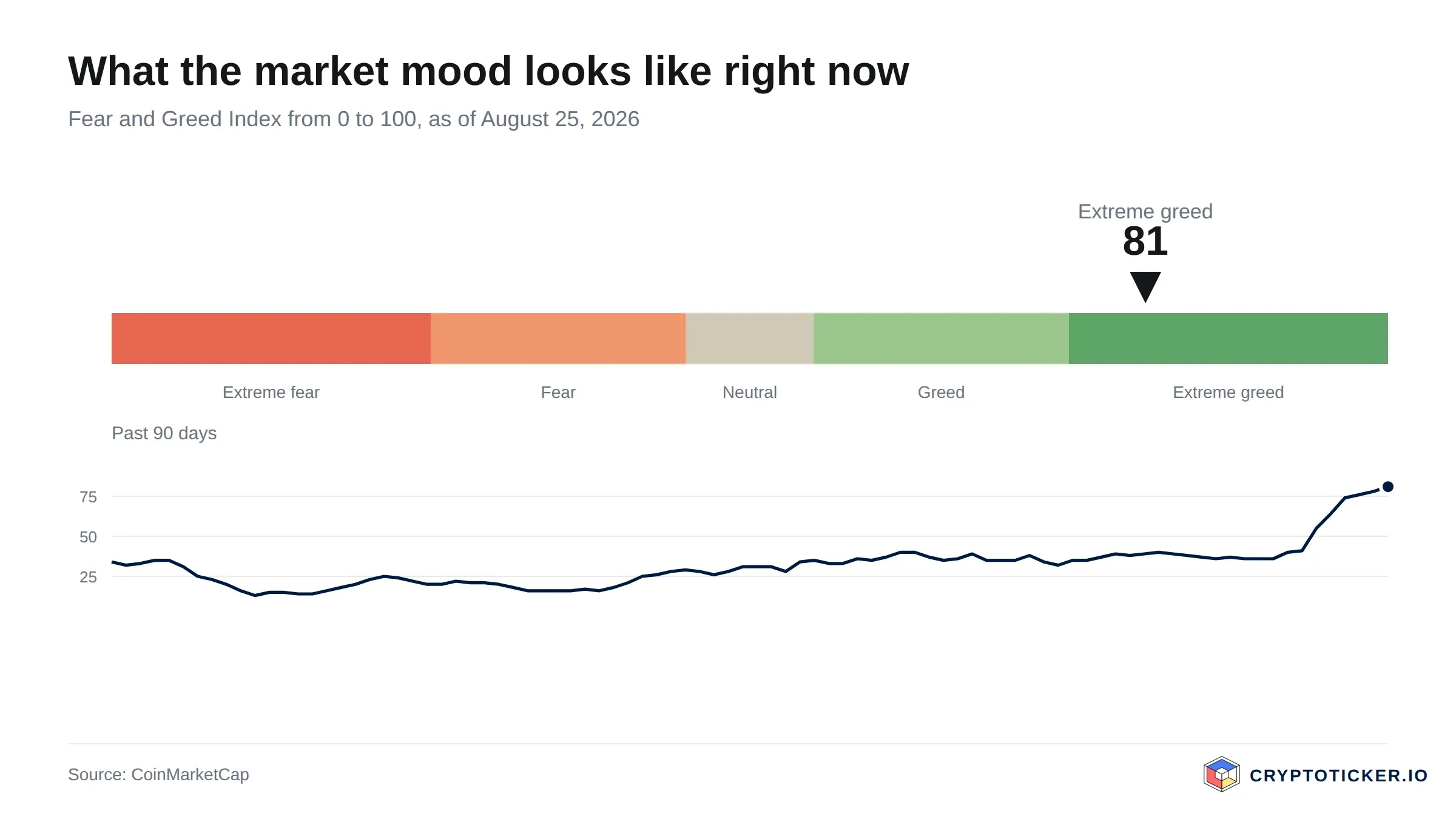
Market sentiment compounds that. The crypto fear and greed index stands at 81 out of 100, in the extreme greed band. The reading is not a forecast, but it describes the environment in which an entry at 4.39 dollars would be made.
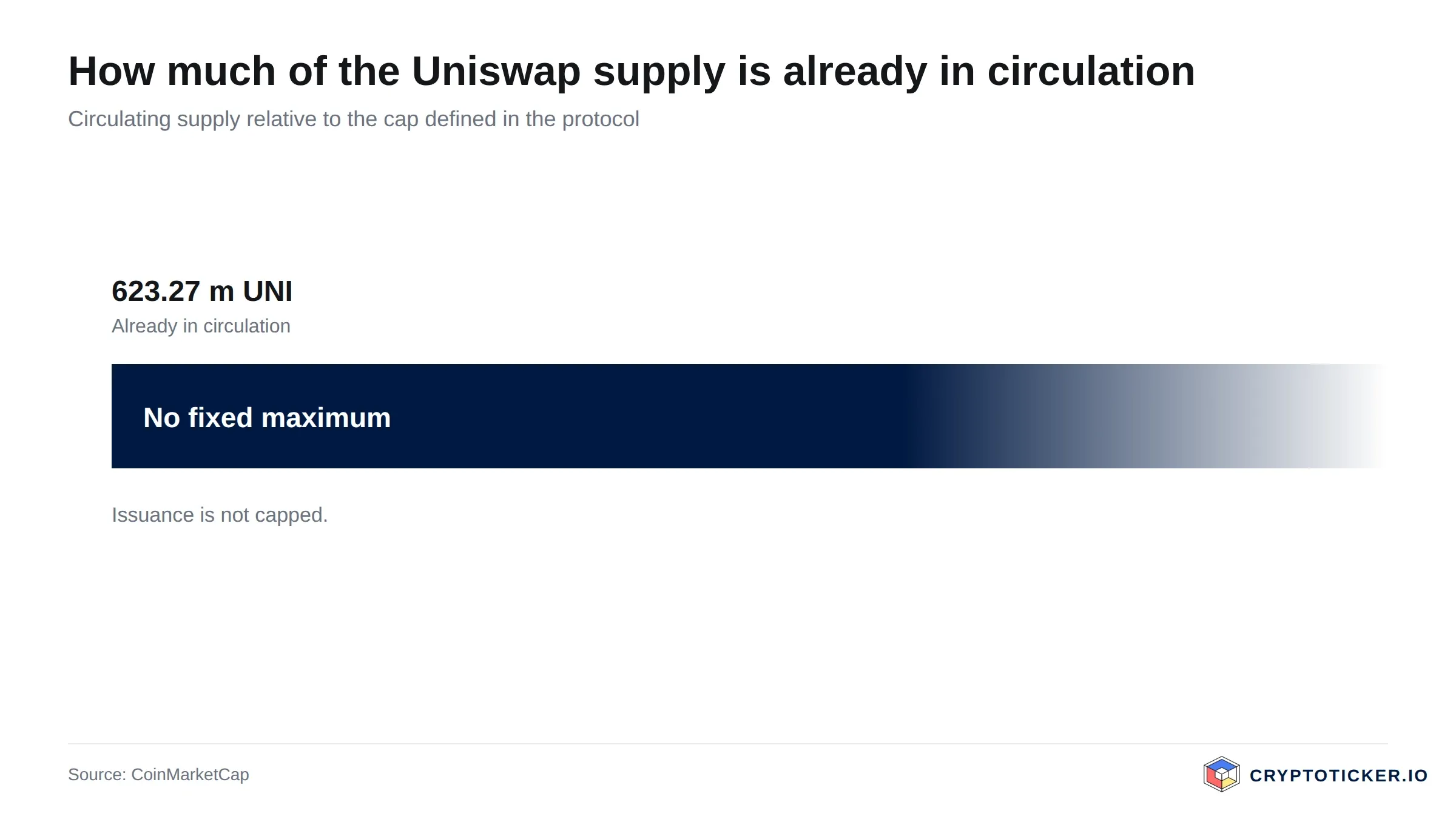
The third objection is specific to the token. About 623.27 million UNI are in circulation out of a total supply of about 890.52 million, and no maximum supply is disclosed in the market data. That gap is a standing consideration for a multi-year position, and it sits alongside the unresolved question of how protocol fees relate to the token. Neither point argues that the protocol is weak; both argue that a claim on its success through UNI is less direct than it appears.
How to buy Uniswap at the current price
UNI is listed on effectively every large regulated exchange serving European investors, so the practical questions are cost, custody and the standing of the venue. On cost, the spread matters more than the headline fee at this liquidity: zero commission with a wider spread can be dearer than a few tenths of a percent charged explicitly. The terms sit side by side in our crypto exchange comparison, and those weighting supervision will find that criterion isolated in the comparison of regulated exchanges. The venues we have examined most closely are covered individually: our Kraken review, the Bitpanda review and the Bitvavo review.
On custody, the decision follows the holding period. For a position to be traded within weeks, exchange custody is a reasonable trade-off; for a multi-year holding it is a counterparty risk taken for no return, and hardware storage is the usual answer. The devices are compared in our hardware wallet comparison. One point is specific to UNI: holding the token confers governance rights, not a share of trading activity, and investors interested in decentralised trading itself may find our perpetual DEX comparison closer to what they want.
Is Uniswap a good buy at current prices, short term and long term?
On a short horizon the evidence argues for patience. An RSI of 65.5, a gain of 34.2 percent in a week, a distance of 18.8 percent to the 50-day average at 3.70 dollars and a sentiment index at 81 all point the same way: the immediate move is largely priced. That does not say the trend fails. It says an entry at 4.39 dollars pays for a repricing already made, and that a test of the 200-day line at 3.98 dollars, an ordinary event in a healthy uptrend, would offer the same exposure roughly 9 percent cheaper. The assessment is wrong if the market runs on without such a test.
On a multi-year horizon the picture is more favourable. A price 59.8 percent below the twelve-month high of 10.93 dollars, a protocol with measurable usage, and turnover at about 1.5 times its twelve-month median describe an asset with a working business behind it trading well below its own recent valuations. The conditions under which that view fails are specific: decentralised exchange volume migrating away from the protocol, or the governance question about fees resolving in a way that leaves the token disconnected from the activity it governs. Neither is visible on a chart.
Neither answer is a recommendation. UNI at 4.39 dollars is an asset in a repaired but stretched position, above its 200-day average of 3.98 dollars, far above its twelve-month low of 2.40 dollars and far below its twelve-month high of 10.93 dollars, with an open question at the token level.
Buying Uniswap: what to take away
- The downtrend is broken but the entry is stretched. UNI at 4.39 dollars trades above the 200-day average of 3.98 dollars and the 50-day average of 3.70 dollars, with an RSI of 65.5 after a 34.2 percent week. The level to watch on a pullback is 3.98 dollars; the venues are set out in our crypto exchange comparison.
- The move is funded by real turnover. Seven-day volume of about 339.8 million dollars against a twelve-month median of about 225.1 million separates this advance from the low-volume bounces that failed earlier in the year. Investors weighting supervision as heavily as cost will find that criterion in our comparison of regulated exchanges.
- The open question sits at the token, not the protocol. With about 623.27 million of a total 890.52 million UNI in circulation and the link between fees and token holders still a matter of governance, a multi-year position needs a view on that and a custody arrangement to match; see our hardware wallet comparison.
Disclosure: Some of the providers mentioned in this article work with us through partner programmes. This has no influence on the price analysis or on the assessment of the chart situation; the price data comes from a public market data source and can be verified there.
(As of 25 August 2026. This article is not investment advice. Prices, fees and terms change; check them with the provider before every purchase. Crypto assets are subject to high price volatility and a total loss is possible.)
Transparency note: This article was produced with the assistance of artificial intelligence and reviewed by our editorial team before publication. All figures and claims were checked against the primary sources linked in the text. The feature image was generated with AI.
Related articles
Which topics should we dive deeper into?
Select what genuinely interests you. Your picks feed directly into our editorial planning.
Crypto news that's actually worth your time.
Weekly. 60 seconds. Carefully curated by our editors: no hype, no promo flood, no spam.

September 23, 2024 8:44 AM
Is it a Good Idea to Buy XRP below $0.60?
With recent XRP price drops positioning it below the $0.60 mark, investors are left pondering. Is it a good idea to buy XRP below $0.60?

September 28, 2026 4:28 AM

Is Quant a Good Buy at the Current Price?
Quant has broken out sharply after a mandate in US payments and stands at its highest level in twelve months. Is QNT a good buy at the current price? We examine the chart situation, volume and supply mechanics with our own data.
September 20, 2026 9:21 AM

Is Ethena a Good Buy at Current Prices?
Ethena has rebounded hard off its twelve-month low and still trades far below its high. Is ENA a good buy at current prices? We check the chart, the supply schedule and the source of the yield with our own price data.
August 27, 2026 11:25 AM

Is Pump.fun a Good Buy at Current Prices?
PUMP has cleared both its 200-day and its 50-day average, yet it still trades well below its twelve-month high. We check with our own price data what argues for and against buying Pump.fun at the current price.
August 27, 2026 6:38 AM

Is NEAR Protocol a Good Buy at Current Prices?
NEAR has worked its way back above both of its moving averages while still trading well below its twelve-month high. We check with our own price data what speaks for and against an entry at current prices.
August 27, 2026 4:31 AM

Is AAVE a Good Buy at Current Prices?
AAVE has worked its way back above both the 200-day and the 50-day moving average, yet still trades far below its twelve-month high. Using our own price data, we examine what speaks for and against an entry at current prices.
August 27, 2026 3:24 AM
Is Hedera a Good Buy at Current Prices?
HBAR has bounced off its twelve-month low but still trades well below its long-term average. We weigh moving averages, RSI and volume to judge whether Hedera is a good buy at the current price.
August 27, 2026 2:21 AM

Is SUI a Good Buy at Current Prices?
SUI has reclaimed its 200-day moving average and trades 79 percent above its twelve-month low. We check whether the coin is a good buy at current prices.
August 16, 2026 12:21 PM

Is Toncoin a Good Buy at Current Prices?
Toncoin has reclaimed both of its moving averages and now goes by the name Gram. We weigh what the chart, the RSI and the recovery in trading volume say for and against buying at current prices.
May 18, 2026 1:07 PM
Is Solana a Good Buy in 2026? SOL Price Analysis and Potential ROI
Solana (SOL) trades at $119.48 after clearing the $100 resistance. Here's how SOL's potential returns stack up against BTC, ETH, and XRP.
May 13, 2026 11:02 AM

Is PEPE Coin worth Buying in 2026?
PEPE has reclaimed both its 50 day and its 200 day average, with trading volume back at its yearly norm. What that means for anyone buying at current prices, and the two levels that settle it.
September 28, 2026 9:47 AM
XRP Price Drops Below $1.50: Where Is Ripple Heading This Week?
XRP price slips under $1.50 after a red weekend. Here is the XRP price analysis with the higher and lower targets that matter this week.
August 23, 2026 1:16 AM

Is PEPE a Good Buy at the Current Price?
PEPE is back above both moving averages and the 50-day has crossed the 200-day. Is the memecoin a good buy at the current price, or is the rally already running on thin volume?
November 27, 2024 7:01 PM

Uniswap Bug Bounty: The 'Largest Bug Bounty in History' ahead of v4 Core Contracts Release
Uniswap Labs has launched the largest bug bounty in crypto history, a groundbreaking $15.5 million bug bounty program to secure its upcoming v4 core contracts. Full details here...
August 31, 2026 11:20 PM

Is Mantle a Good Buy at Current Prices?
Mantle has rebounded hard from its summer low but still trades below its 200-day line, and nearly half the eventual supply has yet to reach the market. We weigh what speaks for and against buying MNT at the current price.
August 24, 2026 12:50 AM
Is Bitcoin Cash a Good Buy at Current Prices?
Bitcoin Cash has rallied hard off its June floor, but it still trades below its long-term trend line with the RSI stretched. We work through what speaks for and against buying BCH at current prices.
August 24, 2026 12:34 AM
Is Monero a Good Buy at Current Prices?
Monero holds above both of its long-term averages after a strong summer, yet still trades far below its twelve-month high. We look at what the trend, the turnover and the regulatory picture mean for anyone weighing a purchase of XMR now.
August 24, 2026 12:19 AM
Is Zcash a Good Buy at Current Prices?
Zcash has run far ahead of its own long-term averages after a week that changed the chart. We look at what the trend, the RSI and the turnover actually support, and under which conditions the case for buying ZEC breaks down.
August 23, 2026 2:21 PM

Is Hyperliquid a Good Buy at Current Prices?
HYPE set its twelve-month high in September and has given part of it back, with the RSI now neutral. We weigh chart, RSI, trading volume and supply mechanics to see what argues for and against buying Hyperliquid at current prices.
August 3, 2026 10:41 AM
Is XRP Coin a Good Buy At Current Prices?
XRP trades at $1.4797 and is holding above the 200-day EMA. Why that line at $1.3894 now decides, as support, whether the reversal holds.

February 24, 2024 5:42 AM

Breaking News: Uniswap Price Soars with Proposed Staking Rewards. What’s Next?
Uniswap (UNI) just got a major boost in its price! Let's take a look at this Uniswap price article in more detail.
September 27, 2022 5:37 PM

Uniswap Price Prediction – Glorious +20% Week! Better Days Ahead?
UNI token grew 20% since last week. Why is Uniswap up? Is Uniswap a good buy? Let's analyze UNI in this Uniswap price prediction article.
September 4, 2024 5:21 PM
Uniswap (UNI) Price Prediction: Here’s Why UNI Price is Rising?
Uniswap's native token, UNI, has seen a significant boost, jumping 5.72% in just the last 24 hours.

April 6, 2026 6:24 PM
Ethereum Price Analysis: ETH Consolidates Between $1,800 and $2,100, What’s Next?
Ethereum price is stuck in a tight range between $1,800 and $2,100. Analysts warn of a decisive breakout or breakdown as volatility reaches a boiling point.
February 26, 2026 4:18 PM
Cardano Price Analysis: ADA Jumps 8% as Bulls Eye $0.30 Breakout
Cardano (ADA) surges 8% to $0.29. Analysts eye the $0.30 resistance as a make-or-break point for the next major price move toward $0.35.

More from CryptoTicker