
Is Cronos a Good Buy at Current Prices?
Cronos has reclaimed its 200-day line for the first time since the spring, and the RSI is back out of overbought. We weigh what speaks for and against buying CRO at the current price.





Which topics should we dive deeper into?
Select what genuinely interests you. Your picks feed directly into our editorial planning.
Crypto news that's actually worth your time.
Weekly. 60 seconds. Carefully curated by our editors: no hype, no promo flood, no spam.
Cronos (CRO) changes hands at 0.0690 US dollars on 1 October 2026. That price sits roughly 68.4 percent below the twelve-month high of 0.2181 dollars set on 3 October 2025, and about 49.4 percent above the twelve-month low of 0.0462 dollars printed on 19 August 2026. A gain of 25.8 percent over 30 days has carried the token above its 200-day average for the first time since the spring. The question here is narrower than the headline move suggests: is Cronos a good buy at the current price?
cryptoticker.io collected the underlying price data itself on 1 October 2026, from the 365 daily closing prices of the preceding year plus the current spot quote. The exponential moving averages and the relative strength index are derived from those closes using the standard formulas. Every figure below refers to that snapshot and will move with the market. A longer-dated view sits in our Cronos price prediction.
Cronos price analysis: where the CRO price stands and which levels matter
Three levels frame the current picture. The floor is the twelve-month low at 0.0462 dollars, set six weeks ago and therefore the most recent point at which sellers ran out of conviction. The current zone around 0.0690 dollars sits about 14.6 percent above the 50-day exponential moving average of 0.0602 dollars, which the price reclaimed in August and has held since. Overhead there is no longer an untouched barrier: the 200-day exponential moving average at 0.0681 dollars now lies 1.4 percent below the spot price, after standing 18 percent above it in the summer.
The distance between the averages tells its own story. With the 50-day line at 0.0602 dollars and the 200-day line at 0.0681 dollars, the shorter average remains 11.6 percent below the longer one, a configuration conventionally read as a market still inside a downtrend however convincing the breakout above the long average looks. The gap is narrowing, though, because the short line is rising while the long one still falls.
The twelve-month range puts the move in proportion. From 0.2181 dollars down to 0.0462 dollars is a drawdown of about 79 percent, and the recovery to 0.0690 dollars retraces only part of it. Cronos is down about 68.4 percent over 365 days, while gaining 13.6 percent over 90 days, 25.8 percent over 30 days and 9.9 percent over seven days.
Is the Cronos downtrend broken or only interrupted?
A downtrend is usually treated as broken when price closes above the long-term average and the sequence of lower highs ends. The first condition is now met, the second is not. At 0.0690 dollars, CRO trades above the 200-day line at 0.0681 dollars, but the margin is 1.4 percent and no higher low has formed above that line yet. The 50-day average at 0.0602 dollars was reclaimed back in August and is no longer the question.
That distinction matters for anyone sizing an entry. An interruption can last weeks and still resolve downward; a break requires measurable follow-through, here several closes above 0.0681 dollars and a pullback that holds there. Until then the prudent description is a young breakout out of a downtrend that is damaged rather than finished.
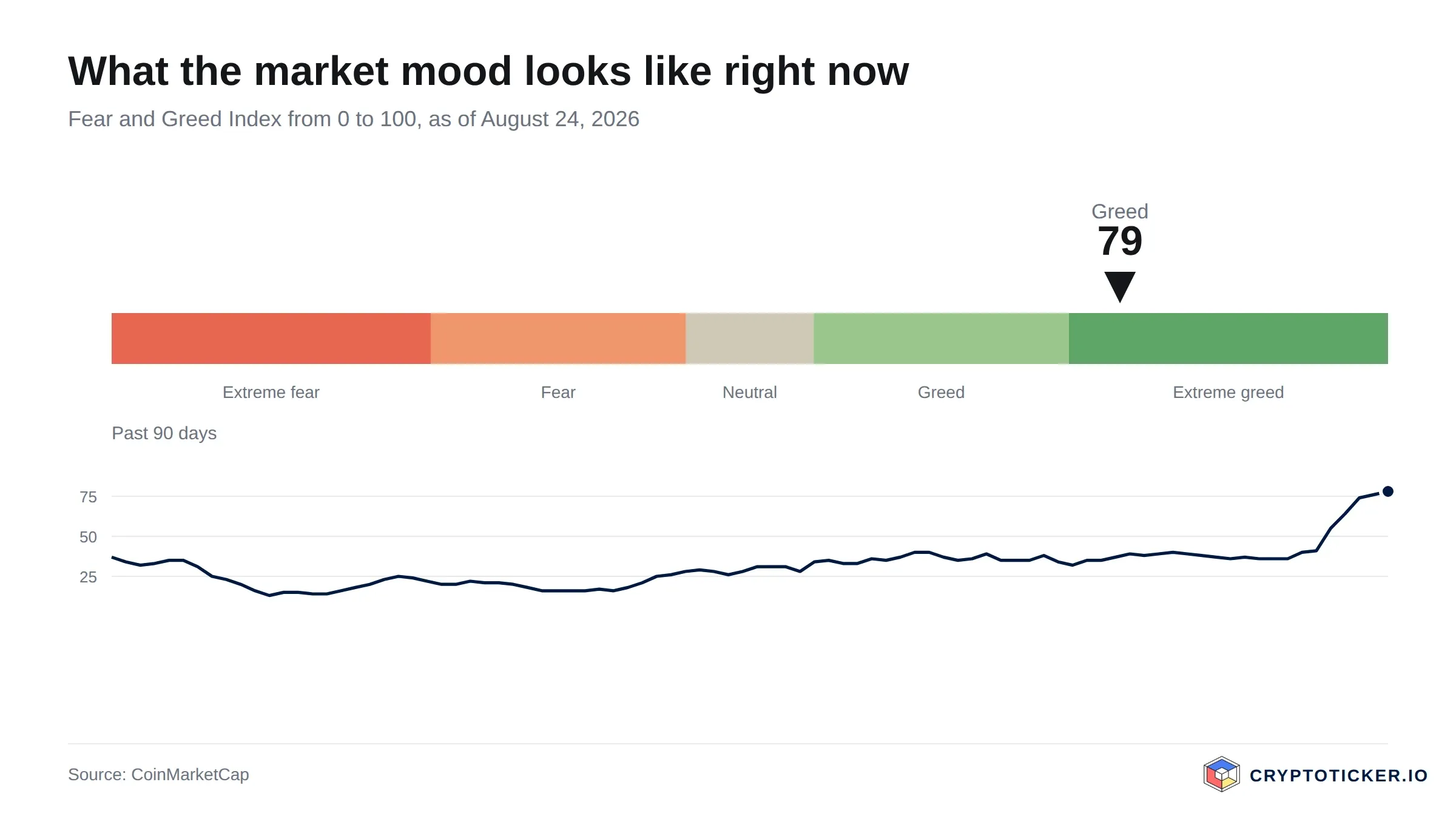
A second reading is worth stating as an inference rather than an observation: much of the 30-day move arrived alongside a broad risk-on phase, with the Fear and Greed reading at 74, in greed territory. Rallies that ride sentiment rather than token-specific news tend to give back ground when sentiment normalises. That is a plausible explanation, not a proven cause.
What RSI and moving averages mean for a Cronos entry
The 14-day relative strength index stands at 62.3. That is the upper half of the neutral band and below the 70 mark at which the indicator is conventionally described as overbought. In August the reading was above that mark while the price was lower, so the token has digested its advance rather than extending it: price higher, indicator lower. In strong trends RSI can stay above 70 for extended stretches; in countertrend bounces it more often marks the upper half of the move.
Combined with the moving averages, the picture is a token that has worked its way through its resistance band and is now sitting on top of it. Entry at 0.0690 dollars means buying about 14.6 percent above the 50-day average at 0.0602 dollars and 1.4 percent above the 200-day average at 0.0681 dollars. The asymmetry has improved since the summer but has not disappeared: the nearest support is the 200-day line a whisker below, then the 50-day line, and beneath both the twelve-month low at 0.0462 dollars, roughly 33 percent below spot.
For a longer horizon the indicator readings carry less weight than the range itself. A buyer at 0.0690 dollars pays less than a third of the 0.2181 dollar high and roughly half again more than the 0.0462 dollar low. Whether that is cheap depends on what the network is worth, which the chart cannot answer.
What Cronos trading volume reveals about demand
Reported 24-hour turnover is about 15.4 million dollars against a market capitalisation of roughly 3.43 billion dollars, which places CRO at rank 36 by size. That ratio, near 0.45 percent, is thin for a token of that capitalisation, and it is the single most important qualifier on everything above.
Thin turnover has two consequences. A rally on low volume moves price further per dollar of buying, which flatters the percentage gain. And an exit in size is harder to execute at the quoted price, because the book that produced the move up is the same one that has to absorb selling. Anyone reading the 25.8 percent monthly gain as broad accumulation should weigh how little capital was required to produce it: the thirty-day average turnover was 11.2 million dollars, and the ninety-day average 9.2 million.
Which structural factors speak for Cronos
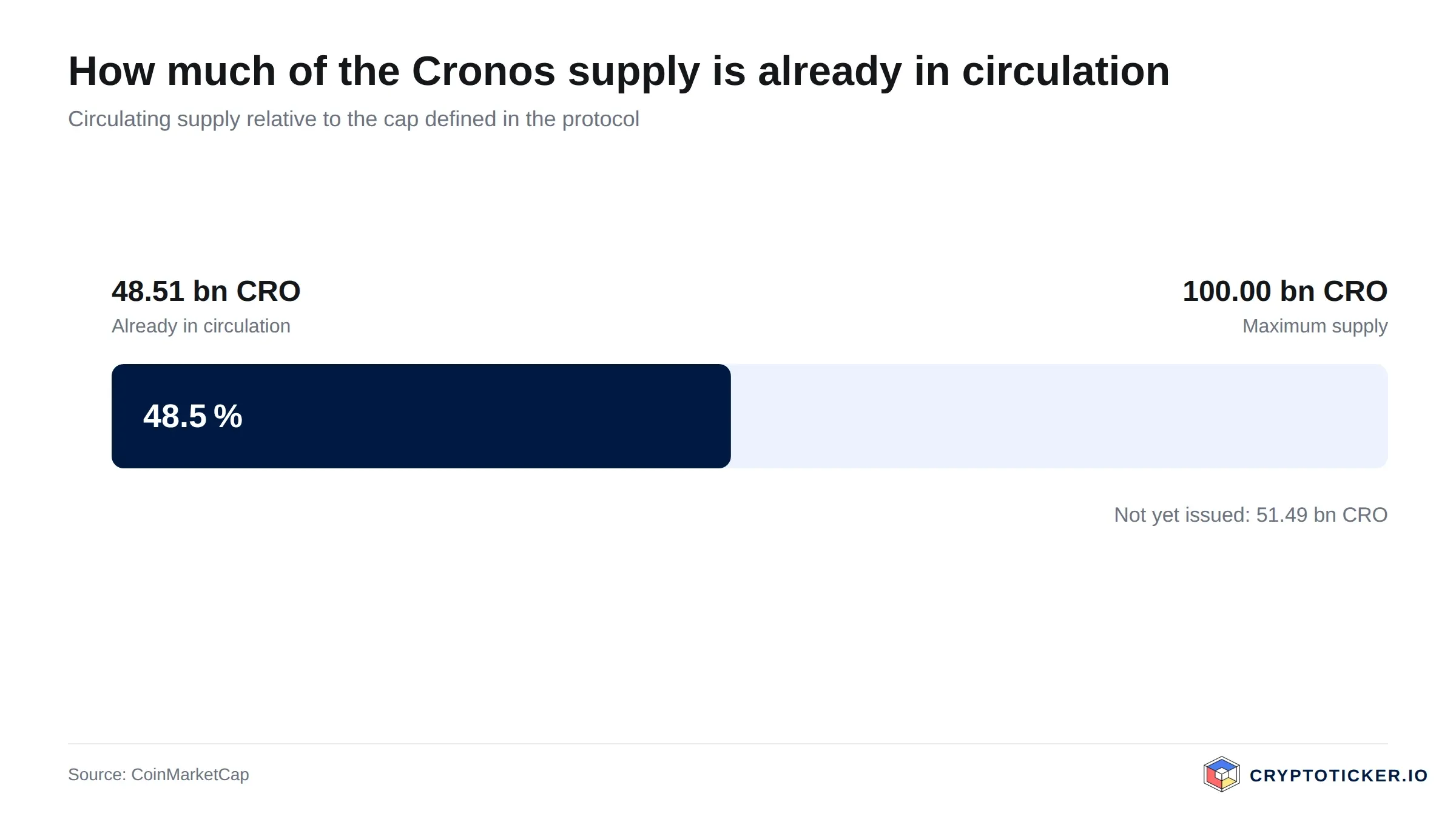
Three structural features distinguish CRO from a pure momentum token. The first is supply mechanics. Circulating supply stands at about 49.75 billion tokens against a total of roughly 98.95 billion and a stated maximum of 100 billion. The float that trades today is therefore a minority of the tokens that could eventually trade. That is a fact about the supply schedule rather than a prediction, and its effect on price depends on release pace and on demand at the time of release.
The second is the chain's technical position. Cronos runs an Ethereum-compatible execution environment, so contracts and tooling written for Ethereum deploy with limited modification. The upside is a developer base the network did not have to build; the downside is direct competition with every other chain making the same offer, on fees and liquidity rather than capability. The ecosystem it borrows from is documented on the Ethereum roadmap.
The third is regulatory placement. CRO is closely associated with a large regulated exchange business operating inside the European framework for crypto-asset markets published by ESMA. That cuts both ways: it lowers the risk of an abrupt delisting across regulated venues, and it ties the token's fortunes to a single commercial entity's performance.
What speaks for buying Cronos at current prices
- The entry sits far below the twelve-month range high. At 0.0690 dollars, buyers pay about 68.4 percent less than at the 0.2181 dollar high of October 2025. For an investor who believes the network retains value, a price this deep in its own range is a materially better starting point than any level over the past year.
- The long-term average has been reclaimed. Closing above the 200-day average at 0.0681 dollars is the condition this recovery still owed in the summer, when the price was 18 percent below that line. It has now been met, and it gives a clearly defined level immediately beneath the current price against which a position can be measured.
- The exchange linkage provides a revenue-bearing anchor. Unlike tokens whose value rests solely on future network usage, CRO is tied to an operating business with fee income and a regulated footprint. That does not guarantee a price floor, but it means the token's fundamental case can be assessed against something observable.
What speaks against buying Cronos at current prices
- The reclaim is wafer-thin. With price at 0.0690 dollars and the 200-day average at 0.0681 dollars, a decline of a couple of percent undoes it, and the 50-day average at 0.0602 dollars still sits below the long one. The 33 percent gap down to the 0.0462 dollar low defines how far a failed breakout can travel.
- Liquidity is thin for the size. Roughly 15.4 million dollars of daily turnover against a 3.43 billion dollar capitalisation makes both the upside move and any future exit less reliable than the headline market rank suggests.
- Half the maximum supply has yet to enter circulation. About 49.75 billion of a possible 100 billion tokens trade today. Any future increase in the circulating float is a headwind that demand has to absorb before price can advance.
How to buy Cronos at the current price
CRO is listed on most large regulated European venues, so the practical differences are fees, spread and custody rather than availability. Spot fees typically fall between 0.1 and 0.5 percent per trade, and the spread on a thinly traded token often costs more than the stated commission. Our exchange comparison sets the current terms side by side, and the shortlist of regulated exchanges narrows it to venues under European supervision. Two of them are covered in our Kraken review and our Bitvavo review.
Custody is the second decision. Leaving tokens on the exchange is convenient and carries that venue's operational risk; self-custody removes it and transfers key management to the holder. For positions held through a full cycle a hardware wallet is the standard answer, and the devices are compared in our hardware wallet comparison. Note that CRO exists on more than one network, and sending it to an address on the wrong one is the most common way holders lose tokens permanently.
Given the liquidity profile described above, a position built in a single market order will pay a wider spread than the same position built in parts. Fees, spreads and terms change; check them at the provider before every purchase.
Is Cronos a good buy at current prices, short term and long term?
Short term, the picture has improved since the summer without becoming comfortable. At 0.0690 dollars the token has already travelled 49.4 percent from its low, but the RSI at 62.3 no longer signals an overbought market, and the 200-day average at 0.0681 dollars has changed sides: it is support now, not resistance. A short-term buyer is paying up for a move that has largely happened, yet with an unusually close level at which to admit being wrong. The reading would change for the worse on a daily close back below 0.0681 dollars, and decisively so below the 50-day average at 0.0602 dollars.
Long term, the assessment turns on the exchange linkage and the supply schedule rather than the chart. At a capitalisation near 3.43 billion dollars the token is priced far below its 2025 valuation, and an investor expecting the associated business to grow inside the European framework buys that expectation at a steep discount to last year's price. That case would be refuted by a sustained fall below the 0.0462 dollar low, by circulating supply expanding materially faster than demand, or by a durable decline in the exchange business the token is tied to.
Neither reading amounts to a recommendation. The short-term technical setup and the long-term structural case have moved closer together than they were in August, but a breakout one and a half percent deep is not yet a trend change, and which reading matters depends on the holding period the buyer actually intends.
Buying Cronos: what to take away
- At 0.0690 dollars CRO trades above its 50-day average of 0.0602 dollars and above its 200-day average of 0.0681 dollars, which describes a young breakout rather than a settled uptrend. The level that would reverse that description is 0.0681 dollars, and the longer-dated view is set out in our Cronos price prediction.
- Roughly 15.4 million dollars of daily turnover against a 3.43 billion dollar capitalisation is thin, which affects both entry and exit. Where you trade therefore matters more than usual, and the current terms are compared in our exchange comparison.
- With about 49.75 billion of a possible 100 billion tokens in circulation, supply expansion is a standing headwind for any multi-year position. Holdings intended for that horizon belong in self-custody, and the devices are compared in our hardware wallet comparison.
Disclosure: Some of the providers mentioned in this article work with us through partner programmes. This has no influence on the price analysis or on the assessment of the chart situation; the price data comes from a public market data source and can be verified there.
(As of 1 October 2026. This article is not investment advice. Prices, fees and terms change; check them with the provider before every purchase. Crypto assets are subject to high price volatility and a total loss is possible.)
Transparency note: This article was produced with the assistance of artificial intelligence and reviewed by our editorial team before publication. All figures and claims were checked against the primary sources linked in the text. The feature image was generated with AI.
Related articles
Which topics should we dive deeper into?
Select what genuinely interests you. Your picks feed directly into our editorial planning.
Crypto news that's actually worth your time.
Weekly. 60 seconds. Carefully curated by our editors: no hype, no promo flood, no spam.

September 23, 2024 8:44 AM
Is it a Good Idea to Buy XRP below $0.60?
With recent XRP price drops positioning it below the $0.60 mark, investors are left pondering. Is it a good idea to buy XRP below $0.60?

October 1, 2026 4:30 AM

228 Million CRO Up for Burning: the Cronos Vote Ends on Saturday
Until early Saturday, CRO stakers are voting on two proposals: a burn of 228 million CRO and a commitment to put all revenue from two products into buybacks. The quorum is reached and there are no votes against. What the figures mean relative to supply, and what investors in Germany should check.

September 28, 2026 4:28 AM

Is Quant a Good Buy at the Current Price?
Quant has broken out sharply after a mandate in US payments and stands at its highest level in twelve months. Is QNT a good buy at the current price? We examine the chart situation, volume and supply mechanics with our own data.
September 20, 2026 9:21 AM

Is Ethena a Good Buy at Current Prices?
Ethena has rebounded hard off its twelve-month low and still trades far below its high. Is ENA a good buy at current prices? We check the chart, the supply schedule and the source of the yield with our own price data.
August 27, 2026 11:25 AM

Is Pump.fun a Good Buy at Current Prices?
PUMP has cleared both its 200-day and its 50-day average, yet it still trades well below its twelve-month high. We check with our own price data what argues for and against buying Pump.fun at the current price.
August 27, 2026 6:38 AM

Is NEAR Protocol a Good Buy at Current Prices?
NEAR has worked its way back above both of its moving averages while still trading well below its twelve-month high. We check with our own price data what speaks for and against an entry at current prices.
August 27, 2026 4:31 AM

Is AAVE a Good Buy at Current Prices?
AAVE has worked its way back above both the 200-day and the 50-day moving average, yet still trades far below its twelve-month high. Using our own price data, we examine what speaks for and against an entry at current prices.
August 27, 2026 3:24 AM

Is Hedera a Good Buy at Current Prices?
HBAR has bounced off its twelve-month low but still trades well below its long-term average. We weigh moving averages, RSI and volume to judge whether Hedera is a good buy at the current price.
August 27, 2026 2:21 AM

Is SUI a Good Buy at Current Prices?
SUI has reclaimed its 200-day moving average and trades 79 percent above its twelve-month low. We check whether the coin is a good buy at current prices.
August 16, 2026 12:21 PM

Is Toncoin a Good Buy at Current Prices?
Toncoin has reclaimed both of its moving averages and now goes by the name Gram. We weigh what the chart, the RSI and the recovery in trading volume say for and against buying at current prices.
May 18, 2026 1:07 PM
Is Solana a Good Buy in 2026? SOL Price Analysis and Potential ROI
Solana (SOL) trades at $119.48 after clearing the $100 resistance. Here's how SOL's potential returns stack up against BTC, ETH, and XRP.
May 13, 2026 11:02 AM

Is PEPE Coin worth Buying in 2026?
PEPE has reclaimed both its 50 day and its 200 day average, with trading volume back at its yearly norm. What that means for anyone buying at current prices, and the two levels that settle it.
September 28, 2026 9:47 AM
XRP Price Drops Below $1.50: Where Is Ripple Heading This Week?
XRP price slips under $1.50 after a red weekend. Here is the XRP price analysis with the higher and lower targets that matter this week.
August 23, 2026 1:16 AM

Is PEPE a Good Buy at the Current Price?
PEPE is back above both moving averages and the 50-day has crossed the 200-day. Is the memecoin a good buy at the current price, or is the rally already running on thin volume?
August 31, 2026 11:20 PM

Is Mantle a Good Buy at Current Prices?
Mantle has rebounded hard from its summer low but still trades below its 200-day line, and nearly half the eventual supply has yet to reach the market. We weigh what speaks for and against buying MNT at the current price.
August 24, 2026 12:50 AM
Is Bitcoin Cash a Good Buy at Current Prices?
Bitcoin Cash has rallied hard off its June floor, but it still trades below its long-term trend line with the RSI stretched. We work through what speaks for and against buying BCH at current prices.
August 24, 2026 12:34 AM
Is Monero a Good Buy at Current Prices?
Monero holds above both of its long-term averages after a strong summer, yet still trades far below its twelve-month high. We look at what the trend, the turnover and the regulatory picture mean for anyone weighing a purchase of XMR now.
August 24, 2026 12:19 AM

Is Zcash a Good Buy at Current Prices?
Zcash has run far ahead of its own long-term averages after a week that changed the chart. We look at what the trend, the RSI and the turnover actually support, and under which conditions the case for buying ZEC breaks down.
August 23, 2026 2:21 PM

Is Hyperliquid a Good Buy at Current Prices?
HYPE set its twelve-month high in September and has given part of it back, with the RSI now neutral. We weigh chart, RSI, trading volume and supply mechanics to see what argues for and against buying Hyperliquid at current prices.
August 3, 2026 10:41 AM
Is XRP Coin a Good Buy At Current Prices?
XRP trades at $1.4797 and is holding above the 200-day EMA. Why that line at $1.3894 now decides, as support, whether the reversal holds.

April 6, 2026 6:24 PM
Ethereum Price Analysis: ETH Consolidates Between $1,800 and $2,100, What’s Next?
Ethereum price is stuck in a tight range between $1,800 and $2,100. Analysts warn of a decisive breakout or breakdown as volatility reaches a boiling point.
February 26, 2026 4:18 PM
Cardano Price Analysis: ADA Jumps 8% as Bulls Eye $0.30 Breakout
Cardano (ADA) surges 8% to $0.29. Analysts eye the $0.30 resistance as a make-or-break point for the next major price move toward $0.35.
July 21, 2025 5:00 AM

Cardano Price Prediction: ADA Finally Wakes Up After Bitcoin ATH
Cardano has been lagging — until now. While Bitcoin topped out weeks ago, ADA is just starting to move. What’s next for the ADA price?
November 12, 2024 1:58 PM
Crypto Market Rally News: EGO and CRO Tokens Lead The Bullish Surge
The global crypto market is on fire, with a 4.25% surge in the last 24 hours. EGO and CRO tokens are among the top performers today. Find out why they are capturing attention in this bullish rally!
May 2, 2026 8:43 AM
Top 5 Cryptocurrencies to Buy in May 2026: Altcoin Season Next?
May 2026 starts with Bitcoin leading the charge above $78k. While some altcoins lag, others present unique accumulation opportunities for investors.
More from CryptoTicker