
Crypto Savings Plans Compared: What Bison, justTRADE and Kraken State on Fees, Minimum Instalment and Interval
Crypto savings plans advertise free execution, yet the price almost always sits in the spread. On August 14, 2026 we retrieved nine provider pages and evaluated which terms actually stand there.




Which topics should we dive deeper into?
Select what genuinely interests you. Your picks feed directly into our editorial planning.
Crypto news that's actually worth your time.
Weekly. 60 seconds. Carefully curated by our editors: no hype, no promo flood, no spam.
A savings plan is the one investment decision you make exactly once. After that the order keeps running without your involvement, month after month, often for years. That is precisely why it barely registers what a single execution costs: on a 50 euro instalment, one percentage point sounds like 50 cents, and after ten years it has become 120 executions.
So we did not ask which crypto savings plan is the best, but which terms the providers publish at all. cryptoticker.io compiled this survey itself on August 14, 2026. The method in one sentence: retrieval of the publicly accessible fee, savings plan and terms pages of nine providers advertised in Germany, and adoption solely of the figures that stood there on the survey date. Nine objects were reviewed: three could be evaluated in full, two in part, four not at all.
Crypto savings plans compared: nine provider pages, three fully documented models
The finding first: only three of the nine providers state figures complete enough on their own pages for the cost of a savings plan execution to be derived from them. Those are Bison, justTRADE and Kraken. Two others, finanzen.net zero and Scalable Capital, name trading terms but no complete savings plan details for crypto assets. For the remaining four, no reliable figure could be obtained on the survey date.
That is already the first practical result. If you want to know what your savings plan costs, a look at the product page is usually not enough. You end up in the help section, in the price and services list as a PDF, or nowhere at all. Anyone wanting to weigh providers against each other will find the continuously maintained overview in the hub buying bitcoin with a savings plan.
Bison: savings plan from 0.01 euros, spread of 1.25 percent on bitcoin
Bison, the app of Boerse Stuttgart, states a proportional spread on its fee page: 1.25 percent on bitcoin, 1.25 percent on ethereum and 1.75 percent on all other cryptocurrencies. No separate order fee is listed there. Account opening, account maintenance, custody including insurance cover, euro withdrawals, crypto withdrawals and deposits and withdrawals by standard and instant SEPA are free of charge according to the same page. For instant deposits by credit card, Apple Pay or Google Pay, Bison names 2.49 percent.
The savings plan page itself names no costs and describes only the mechanics. The plan can be set up from an amount of 0.01 euros, and the purchase can run weekly, monthly or quarterly. With weekly execution the weekday can be chosen; with monthly execution the choice is between the 1st and the 15th of the month; with quarterly execution, between the 1st and the 15th of the new quarter. According to the page, one or several savings plans can be created for each cryptocurrency, and they can be paused or cancelled at any time.

Kraken: one percent on recurring buys, 0.40 percent in the spot order book
In the fee schedule for its app, Kraken states a trading fee of 1 percent on instant and on recurring buys, and 1.5 percent for custom orders. For members of the Kraken+ programme these fees fall away, according to the page, on trading volume up to 10,000 US dollars a month, where it is expressly noted that spreads and card charges still apply. In the spot order book, the schedule starts at 0.40 percent for maker orders and 0.80 percent for taker orders.
The gap between the two routes is the actual finding. A recurring buy through the convenience function costs two and a half times a maker order in the order book, going by the stated schedule. Anyone who values the automation pays for it. The fee page we retrieved carried no figure for a minimum instalment on recurring buys.
 Compare crypto savings plan providers
justTRADE: crypto ETP savings plan from 25 euros with no execution charge
On its savings plan page, justTRADE lists 290 securities eligible for savings plans in total, among them 177 ETF plans, 15 ETC plans, more than 55 wikifolio plans and 43 available crypto ETPs; bitcoin, ethereum and solana are named among others. The minimum instalment is 25 euros according to the page, and the upper limit is 5,000 euros per ISIN and execution. Execution takes place on the first exchange trading day of a month from 16:00. On costs, the page states: 0 euros for the savings plan execution, plus the trading venue spread.
Spread instead of order fee: why a free execution says little about the price
Several of the providers reviewed charge their price mainly through the spread, that is, through the gap between the buying and selling price. This type of cost has an awkward property: no fee line appears in the portfolio statement, only a purchase price. Whether that price sat one and a half percent above the reference price is hard to reconstruct after the fact.
A plain comparison rule follows from this. A provider stating 0 euros in execution charges plus a spread is not thereby cheaper than one naming a 1 percent fee while keeping the spread tight. The models only become comparable once both components are added together, and the second component appears as a fixed figure on the page of none of the nine providers.
How to spot the spread at the moment of purchase
It can be checked all the same, and before the first savings plan rather than after the hundredth. In the app, open the buy and the sell dialogue for the same coin one straight after the other and note both prices. The difference, divided by the buying price, gives the spread at that moment. The measurement takes a few minutes and replaces any estimate from a comparison article, ours included.
Crypto ETP or actual coins: what the difference means for custody and the holding period
The providers reviewed fall into two groups, and that division weighs more than any tenth of a percentage point. Bison and Kraken sell you coins that are held in house and can in principle be withdrawn to an address of your own. justTRADE and Scalable Capital carry crypto ETPs, that is, exchange-traded securities tracking the price. At Scalable Capital, crypto ETPs are expressly named among the tradable categories on the terms page; the order fee via gettex sits at 0.99 euros there, and at 0 euros in the PRIME+ tariff from an order volume of 250 euros. Details on savings plan costs or a minimum instalment did not appear on that page.
For custody this means: an ETP sits in the securities portfolio and cannot be transferred to a wallet. Anyone aiming for self-custody is in the wrong group, and a pure fee comparison reliably hides that. Which houses operate with authorisation in Germany for this is broken down in the hub best regulated crypto exchanges.

Minimum instalment and execution day: where small instalments founder on the small-order surcharge
The minimum instalments sit far apart: 0.01 euros at Bison, 25 euros at justTRADE. finanzen.net zero names a minimum order size of 0.01 euros for crypto trading and advertises that investing is possible from 1 euro. At the same time, a commission of 1 percent plus a reduced spread is stated there, and on orders below 500 euros a small-order surcharge of 1 euro is added. The page lists 59 tradable cryptocurrencies.
This surcharge is why small instalments become expensive where fixed cost components exist. One euro on an instalment of 50 euros is two percent, one euro on an instalment of 400 euros is a quarter of a percent, and the percentage commission comes on top in both cases. Anyone wanting to start small should therefore check first whether the model has a fixed component at all. The crypto page of finanzen.net zero does not make clear whether it offers savings plans on crypto assets.
The execution day is mostly overlooked, and yet it is the setting you most easily control yourself. With monthly execution, Bison leaves the choice between the 1st and the 15th, while justTRADE executes on the first exchange trading day of a month from 16:00. Anyone saving there always buys at the start of the month and cannot move the date.
 Crypto tax tools compared
Bitpanda, Trade Republic and Bitvavo: what remains open in this survey
Four of the nine objects supplied no usable information on August 14, 2026. That belongs in this text just as much as the figures from the other five.
At Bitpanda, no fee page could be found. The address bitpanda.com/de/preise answered with code 200 but showed a price table for shares; the subpage on cryptocurrencies contained explanatory texts on price formation, yet no fee or spread details. Several obvious paths for fees and savings plans ran into error pages. The help area at support.bitpanda.com rejected automated retrieval with code 403, and help.bitpanda.com did not respond at all. This text therefore carries not a single figure on Bitpanda, even though the house advertises savings plans on its pages.
At Trade Republic, the crypto page answered with code 200 but, in the state retrieved, contained only navigation and no terms; the paths checked for the price list and costs did not exist under the expected addresses. Bitvavo and Coinbase each rejected automated retrieval with code 403. In a browser these pages are reachable as normal; our survey could not evaluate them, and we refrained from filling the gaps with figures from other comparison articles.
What stood out methodically in this survey
Clearest of all was a pattern in the page architecture. The savings plan pages explain the mechanics and stay silent on the price, while the fee pages name the price and do not mention the savings plan. Bison shows this most plainly: both pages are complete and public, but only read together do they produce a statement about cost. Anyone opening only the savings plan page is shown a product that appears to be free.
Tax on a crypto savings plan: every instalment starts its own one-year holding period
Over the years, a savings plan produces many individual investments rather than one. Every execution is an acquisition in its own right with its own date, and the tax treatment hangs on that. Section 23 paragraph 1 sentence 1 number 2 of the German Income Tax Act covers, in its wording, "disposals of other economic goods where the period between acquisition and disposal is no more than one year". For directly held coins this means the period runs separately for each instalment, and twelve months after the respective execution that particular instalment falls out of scope.
Section 23 paragraph 3 sentence 5 of the Act sets the exemption limit as follows: "Gains remain tax-free if the total gain achieved from private disposals in the calendar year came to less than 1,000 euros." An exemption limit is not an allowance. Exceed it and the entire gain is taxable, not merely the excess.
With crypto ETPs this framework does not apply as a matter of course, because an ETP is a security rather than the economic good itself. How a specific product is taxed depends on how it is structured; that cannot be answered in a blanket way and belongs settled before the first savings plan. We derived the mechanics of the holding period on monthly purchases on August 11, 2026 in bitcoin savings plans and tax.
Choosing a crypto savings plan: what to take away
- Add both cost components together before you commit. An execution charge of zero euros says nothing about the spread, and a stated percentage says nothing about the price at which the purchase happens. Measure the spread yourself using the method described above, and only compare afterwards. The provider overview sits in the hub buying bitcoin with a savings plan.
- Decide between coin and ETP first, and about the price second. These are different products with different custody and different tax treatment; a price comparison inside the wrong group leads to a cheap savings plan that does not do what you wanted. Which houses offer coins directly is shown by the hub best crypto exchanges.
- Set up the documentation right away, not just before the tax return. Export the execution list monthly or have it collected automatically, so that every instalment is on file with its date and price. Suitable tools sit in the hub crypto tax tools and portfolio trackers.
(As of August 14, 2026. This article is not investment advice. Prices and fee structures change; check the terms with the provider before you buy.)
Transparency note: This article was produced with the assistance of artificial intelligence and reviewed by our editorial team before publication. All figures and claims were checked against the primary sources linked in the text.
Related articles
- 100 Euros Into Bitcoin Without Fees: What Actually Arrives at Five Providers
- Investing in Bitcoin With a Savings Plan or a Lump Sum: What the December 31 Tax Cut-Off Changes
- Bitcoin for Retirement: What Applies from 2027 and What You Decide Now
- Crypto Fees at Neobrokers: Why the PFOF Ban Raises Your Stock Costs but Leaves Your Coin Purchase Untouched
- Bitcoin Savings Plan in Austria: How the Purchase Price Is Calculated
Which topics should we dive deeper into?
Select what genuinely interests you. Your picks feed directly into our editorial planning.
Crypto news that's actually worth your time.
Weekly. 60 seconds. Carefully curated by our editors: no hype, no promo flood, no spam.

September 6, 2026 10:27 PM

Crypto Through Sparkasse and Volksbank: 1.5 Percent Commission Plus a Spread, and No Product Page Names the Price
Crypto trading through your own bank costs twice over: a commission and a spread. A survey of 41 institutions carried out for this article shows that not one of the reachable product pages names a figure.
August 14, 2026 6:23 AM

Bitcoin Savings Plan and Tax: How the Holding Period, FIFO and the Exemption Limit Interact on Monthly Buys
Every savings plan instalment is a separate acquisition for tax purposes, with a holding period of its own. How the exemption limit, the order of disposal and record-keeping duties interact on monthly Bitcoin buys, with the sources from the statute and the Ministry of Finance circular.

September 18, 2026 10:14 PM

Bitcoin Back Above $80,000: Buy More, Hold or Take Profits? What to Check Now
Bitcoin is back above $80,000, for the first time since September 7. Whether you buy more, hold or take profits depends less on the daily price than on three things you can check yourself: your holding period, the way you buy, and where your coins are kept.
October 4, 2026 1:42 AM

Five crypto apps for beginners: costs and custody compared
Fee-free rarely means free of charge with crypto apps: between 0.15 and 2.49 percent per purchase lies a factor of ten. What five apps cost German beginners, who holds the coins and which app permits a transfer to your own wallet.
August 24, 2026 10:29 AM
Buying More Bitcoin at $77,000: Savings Plan or Lump Sum
Bitcoin stands at $77,256 after gaining 22.78 percent in a week. This guide shows you how to buy more cleanly at this price and which method fits which starting position.
September 14, 2026 4:19 AM
Fed Rate Decision of September 16: What It Means for Your Bitcoin Savings Plan
Recap as of September 27, 2026: this article appeared before the US Federal Reserve's rate decision on September 16, 2026, when futures markets mostly expected a hike. It describes what a hike means for your monthly instalment, a running crypto loan and your holding periods.
June 6, 2026 3:56 PM
DCA Crypto: How to Survive Crypto Crashes with Dollar Cost Averaging and Invest for the Long Term
Bitcoin from $120,000 to $60,000? With the DCA strategy, you invest step by step and use crypto crashes as an opportunity instead of selling in a panic.
September 14, 2026 7:40 PM

Bitcoin Order Before the Fed Decision: What Slippage Really Costs You
Two days before the US central bank's rate decision the euro order books are thin, and a market order pays the difference. We measured the order book depth of five exchanges ourselves: between the cheapest and the most expensive execution lay a factor of 31.

September 1, 2026 12:19 PM
Von der Leyen Wants Your Bank Deposits: Here Is How to Keep Control of Them
Brussels wants Europe's 10 trillion euros in deposits funding its companies. What it means for savers, and why Bitcoin savings plans matter.
August 5, 2026 10:33 PM
$130 Million Gone Because the Randomness Was Predictable: Which Hardware Wallet You Can Still Buy
The Coldcard flaw proved the most respected wallet is not the safest. Which vendor has which track record – and why now is the wrong moment to pause your savings plan.
January 12, 2026 12:25 PM

Is This Crypto Cycle Like 2021? The January 2026 Analysis in Hindsight
In January 2026 much spoke against a repeat of 2021. It turned out harsher: Bitcoin lost more than half of its value from the cycle high near $124,700 by July 2026.
August 14, 2026 6:18 PM

Bitcoin From a Foreign Exchange to Austria: Which Tax Data You Need
Transferring Bitcoin from a foreign exchange to an Austrian platform: which tax data can be missing for the withholding tax. And what investors need to watch out for.

July 13, 2026 7:58 AM
XTB Stock Savings Plans: What They Offer and How to Start Investing
XTB offers automated savings plans on thousands of stocks and ETFs — 0% commission up to a set volume. Here's what's on the table and how to start.
September 6, 2026 10:20 PM

Bison App: a 1.25 Percent Spread, 27 Percent of the Staking Rewards and Trading Without an Order Book
The crypto app of Boerse Stuttgart advertises freedom from fees. You pay through the spread instead. What the licences actually cover, why there is no order book, and why the tax report loses its value once you transfer coins out.
May 6, 2025 4:00 AM

Crypto News Today: Bitcoin, Ethereum, and Top Altcoins in May 2025
The crypto market enters May 2025 with mixed signals: Bitcoin stabilizes, Ethereum gas fees drop, XRP nears a rebound, and Cardano eyes recovery. Here’s what you need to know.
October 1, 2026 7:15 PM

Bitpanda fees from 0.99 to 2.49 percent: what is behind it
Bitpanda assigns every coin to one of four price tiers, from 0.99 percent for Bitcoin to 2.49 percent for small caps. What 100 euros costs in and out, why the spread is missing from the mandatory document, and where 0.25 percent is enough under the same roof.
May 18, 2024 2:39 PM

Will Genesis Pay Back The Creditors After Bankruptcy Filing?
Did Genesis Global Capital secure a court approval for its Chapter 11 repayment plan? And what challenges does it face with Digital Currency Group, its parent company?
September 9, 2026 4:29 PM
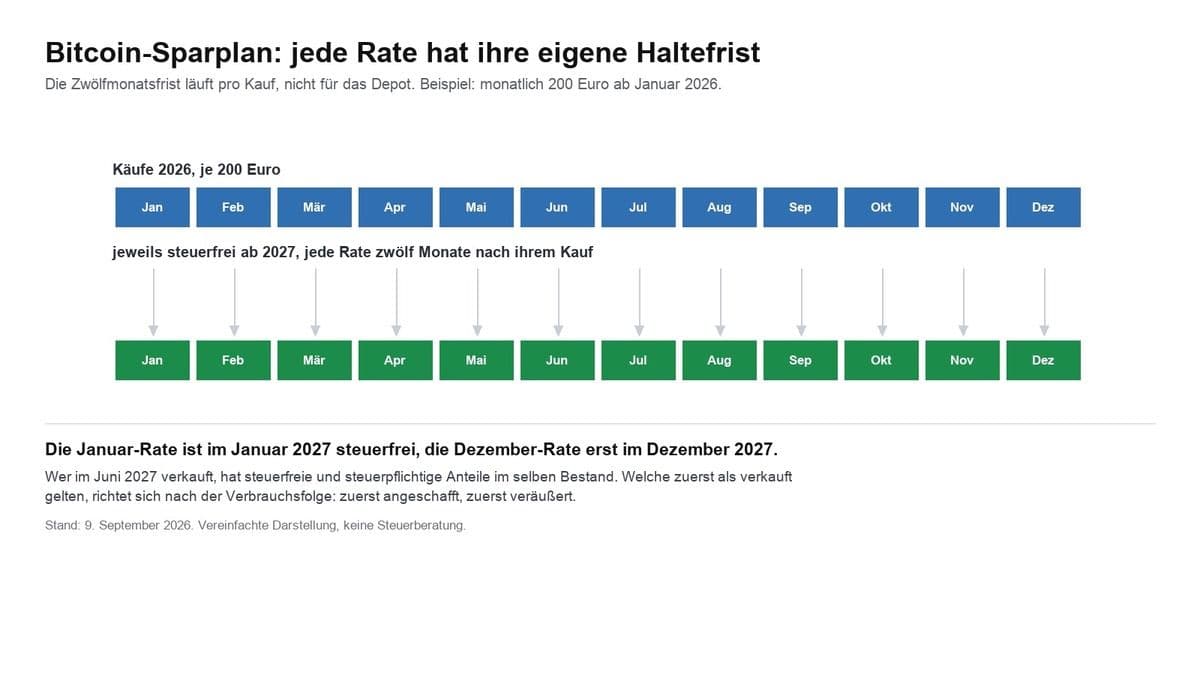
Bitcoin and Taxes in Germany: Holding Period, Savings Plan, ETP and Mining
Bitcoin gains are tax-free after twelve months. What that means for a savings plan with twelve deadlines, why ETPs are taxed differently, and what applies to mining, gifts and losses.
September 20, 2026 10:11 PM
Kraken Review: Fees, MiCA Licence and Withdrawals in Euro
A purchase through Kraken's standard interface costs 1 percent plus spread; on Kraken Pro it is 0.40 to 0.80 percent. What deposits, trading, withdrawals and tax records really cost at the crypto exchange, with the numbers from the official fee schedule.
September 22, 2026 1:27 AM

Bitcoin ATM in Germany: Fees, BaFin Authorisation and Tax
Bitcoin ATMs stand in kiosks and shopping arcades, and buying there costs a multiple of the online route. What BaFin demands of the operator, at what amount your ID becomes due, and how you evidence the purchase for tax.
September 19, 2026 10:35 AM

The Cost Average Effect with Bitcoin: What Twelve Instalments Really Deliver
Twelve monthly instalments of 100 euros produced an average price of 66,472 euros and ran 33.6 percentage points ahead of the lump sum purchase on the same starting day. The calculation also shows when the savings plan is the worse route.
September 1, 2026 10:13 AM

BaFin Crypto Knowledge Survey: Four Assumptions Owners Believe Are True
BaFin has measured what crypto owners know about their products: 57 percent of the answers were correct, 31 percent wrong. Four false assumptions come up especially often, and each of them changes your own investment decision.

September 28, 2023 5:36 AM
Kraken’s Growth in Europe
Explore Kraken's latest strides in Europe as they secure crucial licenses in Ireland and Spain. Dive into the implications for EU crypto enthusiasts and Kraken's strategic vision for the future.
September 20, 2026 7:20 PM

Coinbase Fees: What a Purchase Really Costs, and Where the Spread Is Hidden
The fee Coinbase shows you before a purchase is not the whole price. Alongside it sits the spread, built into the rate, and limit orders add another percent on top. We read the current terms at the source and show the four places where the exchange earns.
September 10, 2026 1:21 AM
Crypto Exchanges Head to Head: Which Pairing Is Cheaper Where
Before opening an account, the question is rarely which exchange is best overall, but whether it should be this one or that one. This article sorts through the most searched head-to-heads, puts the cost per 1,000 euros side by side and explains the most expensive mix-up: one provider with two interfaces and a factor of seventeen between them.
July 27, 2024 2:34 PM

Why Is The Crypto Market Up TODAY?
With the Bitcoin 2024 Conference taking place now in Nashville, the crypto market is showing bullish signals, intriguing traders around the future of Bitcoin and Altcoins.
August 22, 2026 4:30 AM
Setting Crypto Order Types Correctly: Market, Limit and Stop-Loss Compared
A market order buys immediately, a limit order only at your price, and a stop-loss triggers only at a set level. This guide shows which order type fits which situation, and where spread, slippage and the fee model shift your entry price.
More from CryptoTicker