
Crypto Trading Bots and Tax: What Applies With Thousands of Trades a Year
A bot turns one investment decision into hundreds of disposals, and the tax office counts every single one. This guide explains the holding period, FIFO, the exemption limit and the record-keeping duties, and what to set up before the bot makes its first trade.





Which topics should we dive deeper into?
Select what genuinely interests you. Your picks feed directly into our editorial planning.
Crypto news that's actually worth your time.
Weekly. 60 seconds. Carefully curated by our editors: no hype, no promo flood, no spam.
A trading bot does exactly what you switch it on to do: it trades. Twelve decisions a year quickly become twelve hundred, and in Germany every single one of them is a separate event for tax purposes. That is the point at which many bot users start to think twice, usually in March, when the tax return is due and the trading platform's export button produces a file with a four-digit number of rows.
This guide answers the question behind that: what does a crypto trading bot trigger for tax purposes, and what do you have to set up before it makes its first trade? It is about the holding period, about the FIFO allocation rule, about the tax-free threshold, about the line to commercial trading and about the record-keeping duties that the Federal Ministry of Finance has expressly described since March 2025. At the end there is a setup list you can work through.
Why a bot changes your tax position before it makes any profit
The decisive difference between manual and automated trading lies not in the size of the profit but in the number of transactions. Anyone who buys Bitcoin and leaves it alone for three years has two events for tax purposes: a purchase and a sale. A bot that lays a grid of buy and sell orders across a price range may produce a thousand events in the same period.
Not a single rule changes as a result. What changes is the effort required to comply with them, and the likelihood of making a mistake that gets noticed. Whether running a bot pays off at all we have worked through elsewhere, in our piece on whether crypto trading bots are worth it. This text starts one step later: the bot is already running, and now it is about the tax office.
The principle: every swap is a disposal under section 23 of the Income Tax Act
In Germany crypto assets count as other economic goods within the meaning of the Income Tax Act. Gains from their sale therefore fall under private disposal transactions pursuant to section 23 of the Income Tax Act and not under the withholding tax you know from equities and funds. That has two consequences pulling in opposite directions: there is a holding period after which a gain remains tax-free, but within that period the gain is taxed at your personal income tax rate, which can be higher than the flat 25 percent.
A disposal is to be understood more broadly than the word suggests. It covers every swap, not merely a sale for euros: Bitcoin for Ether, Ether for a stablecoin, a stablecoin back into Bitcoin. That is precisely where bot trading is special. A grid bot that shifts back and forth between two coins without ever triggering a payout in euros still produces a tax-relevant event at every step. That nothing arrives in your bank account is irrelevant to this.
The gain per transaction is calculated as the disposal price less the acquisition cost and the directly attributable costs. In a swap, the disposal price is the market value of what you receive, converted into euros at the time of the transaction. That conversion is the point at which a spreadsheet breaks down at a thousand rows.
The one-year holding period and why a bot practically never reaches it
If more than twelve months lie between acquisition and disposal, the gain remains tax-free under section 23 of the Income Tax Act. That period is the reason many German investors hold crypto assets at all rather than trade them.
A bot works structurally against that period. Its job is to capture price moves within hours or days. Every successful trade resets the holding period of the units concerned to zero. In practice that means you will almost always pay the full tax rate on the holdings the bot moves, and you should factor that into your return expectations before switching it on.
From that follows a design rule that sounds simple and is often ignored in practice: separate the holdings the bot is allowed to touch from the holdings you keep for the long term. That is done most cleanly through separate accounts or separate wallets, because units are allocated on a per-wallet basis. If both run through the same pot, the bot also reaches your older units in the calculation, and then you lose holding periods you had already earned.

FIFO: which unit the bot sells is not up to you
If you have bought Bitcoin at five different points in time and the bot sells part of it, the question arises which of those units it gives up in the calculation. Your instinct may say the most expensive one, so that the gain comes out small. That is not how it works.
FIFO stands for first in, first out and means that the unit acquired first always counts as the one disposed of first. The Federal Ministry of Finance provides for this method of allocation, applied to the respective wallet or account. The consequence is uncomfortable: when the bot sells, it reaches your oldest units in the calculation, that is, the ones with possibly the lowest acquisition cost and the highest gain. What exactly distinguishes FIFO from other methods we have taken apart in our explainer on FIFO and LIFO for crypto assets.
For bot operation the same conclusion follows as in the section before, only from a different direction: separate wallets are not tidiness for its own sake but the only lever with which you steer at all which units the bot reaches.
 Trading bots compared
The 1,000 euro threshold, and why an exemption limit is not an allowance
An annual exemption limit applies to private disposal transactions. Since the 2024 assessment period that limit has been 1,000 euros; before that it was 600 euros.
The difference between an exemption limit and an allowance is regularly confused and, in case of doubt, costs real money. An allowance would always stay tax-free, and only the excess would be taxed. With an exemption limit it is different: if it is exceeded by even one euro, the entire gain is taxable, not merely the excess. On an annual gain of 999 euros you pay nothing; on 1,001 euros you are taxed on 1,001 euros.
For bot users that is more relevant than for buy-and-hold investors, because a bot produces many small gains that add up inconspicuously. Anyone close to the limit towards the end of the year has a solid reason to switch the bot off for the final weeks — or, conversely, with accumulated paper losses, a reason to realise those before the turn of the year. Losses from private disposal transactions can, however, only be offset against gains of the same income type, not against your salary and not against equity gains.
When private trading becomes commercial trading
The question that sooner or later comes up with high trade counts: does the trading become commercial at some point, with trade tax, accounting obligations and the loss of the holding period?
There is no fixed number at which that happens. The much-quoted three-object rule comes from property law and does not apply here. For securities trading, case law has developed a fairly generous standard over decades: even a high trading volume and a high number of transactions regularly remain private asset management, as long as you trade for your own account and do not appear in the market like an investment services firm. Signs pointing the other way are, for instance, trading for the account of others, the systematic use of borrowed capital in the manner of a dealer, or an outwardly visible business operation.
Whether that standard can be transferred one to one to crypto assets has not been conclusively settled by the highest courts, and that is precisely why caution is in order with blanket statements — in both directions. Anyone running a bot for third parties, charging fees for it or co-managing several accounts belonging to other people is visibly moving out of private asset management. We have dealt with the delimitation in more detail in our piece on the difference between private and commercial crypto trading. If your set-up comes anywhere near those features, that is the moment for advice and not for an internet search.

Record-keeping duties: what the finance ministry has expressly required since March 2025
With its circular of March 6, 2025, the Federal Ministry of Finance revised its administrative position on crypto assets and replaced the earlier circular from May 2022. The most important addition for bot users concerns the tax return, cooperation and record-keeping duties, which are now described there separately.
The practical core is this: you must be able to evidence your transactions without gaps. That includes the complete transaction statements of the trading venues used, the allocation of holdings to wallets and accounts, the exchange rates at the relevant time and the origin of the funds deployed. If you cannot do that, the tax authority may estimate the basis of assessment. An estimate is not a formality to be smoothed over later but, as a rule, more expensive than the correct declaration would have been.
The catch with automated trading lies in the transience of the data. Trading venues often keep exports available only for a limited time, bot providers disappear from the market, and API keys expire. What you do not secure today may be impossible to obtain in three years — and three years is a short span in tax matters. That is why the export belongs in the monthly rhythm and not in the week before the return is filed. Which tools take that over automatically and connect directly to the trading venues is shown in our overview of crypto tax tools and portfolio trackers.
What running a bot costs and how those costs are classified
Besides the trades, a bot produces running costs of its own: the trading venue's fee per execution, often a monthly subscription for the software, sometimes the cost of a server on which the strategy runs.
Trading fees directly connected with a single transaction reduce the gain on that transaction — so they belong inside the calculation and not on a separate list. Considerably less clear is the treatment of running costs such as the subscription or the server, because they cannot be allocated to any single transaction. Do not count firmly on being able to deduct them in full here, and have the point clarified rather than deciding it yourself. More important than the tax outcome is the commercial question anyway: a bot whose subscription and fee load eats up the gross return is a loss-making exercise even with perfect tax treatment. Which models bill in which way you can set side by side in our comparison of crypto trading bots.
 Document thousands of trades cleanly
What to set up before the bot makes its first trade
Five things can be dealt with in advance, and every one of them is laborious to impossible to catch up on later.
- Separate accounts or wallets for the bot holdings and the long-term holdings. This protects earned holding periods from FIFO access and is the single most effective step of all.
- A monthly, automatic export of all transactions. Store it somewhere that exists independently of the trading venue and of the bot provider.
- A tax tool that connects to the trading venues directly. At four-digit trade counts, manual work is no longer a serious option.
- A note on the strategy and on the period in which the bot ran. A year later you will otherwise no longer know why a hundred trades arose on a particular day.
- A tax reserve kept separate from the trading capital. Gains within the holding period are taxed at your personal rate, and that amount is not available to you for further trading, even if it is sitting in the account.
Trading bots and tax: what to take away
- Separate the holdings before you start the bot. Separate wallets for trading and long-term holdings prevent FIFO from using up your old units that are ripe for the deadline. Which provider allows which account and sub-account structure you can see in the trading bot comparison.
- Set up the monthly export, not the annual one. The record-keeping duties fall on you, not on the trading venue, and exports are available only for as long as the provider keeps them. The suitable tools are in our overview of tax tools.
- Check your annual position against the 1,000 euro threshold before the turn of the year. One euro above makes the entire gain taxable. Where the figures end up in the return later is explained in our piece on where to enter crypto in your tax return.
The authoritative texts in the original: the wording of the law on private disposal transactions in section 23 of the German Income Tax Act and the Federal Ministry of Finance circular of March 6, 2025 on individual questions of the income tax treatment of certain crypto assets.
This text is a general classification and does not replace tax advice. How your case is to be treated depends on your set-up, your volume and your other income; settle that with your tax adviser or your tax office.
(As of September 24, 2026. This article is not investment advice. Prices and fee structures change; check the terms with the provider before you buy.)
Transparency note: This article was produced with the assistance of artificial intelligence and reviewed by our editorial team before publication. All figures and claims were checked against the primary sources linked in the text. The feature image was generated with AI.
Related articles
- Selling XRP After a 53 Percent Week: What the Holding Period Costs
- Take Ethereum Profits or Wait Out the Holding Period? What the Price Jump Means for Your Tax Bill
- Selling bitcoin privately: the tax in Germany and the records you need
- Dogecoin Price: What to Check on Holding Period and Custody Before the Year End
- Bitcoin 29 Percent Below Last Year: Which Crypto Losses You Can Still Use Before the One-Year Holding Period Expires
Which topics should we dive deeper into?
Select what genuinely interests you. Your picks feed directly into our editorial planning.
Crypto news that's actually worth your time.
Weekly. 60 seconds. Carefully curated by our editors: no hype, no promo flood, no spam.

August 14, 2026 6:23 AM

Bitcoin Savings Plan and Tax: How the Holding Period, FIFO and the Exemption Limit Interact on Monthly Buys
Every savings plan instalment is a separate acquisition for tax purposes, with a holding period of its own. How the exemption limit, the order of disposal and record-keeping duties interact on monthly Bitcoin buys, with the sources from the statute and the Ministry of Finance circular.
September 16, 2026 1:20 PM

Crypto Loss Carryforward in Germany: What Happens to Old Losses Under the 2027 Tax Plan
Losses from crypto sales land in a ring-fenced pot and can only be set against gains of the same kind. The draft bill for 2027 moves future gains into a different pot, and we show you what that means for your assessed carryforward and what your tax notice should say.
September 16, 2026 7:12 PM

Borrowing Against Bitcoin Instead of Selling: When German Tax Still Applies
Posting Bitcoin as collateral for a loan is not a sale in Germany, because section 39 of the Fiscal Code keeps the coins attributed to you for tax purposes. Tax arises only when the collateral is liquidated, and then the one thing that decides the bill is how long you held the coins beforehand.
August 21, 2026 1:42 PM

Writing Off a Total Crypto Loss: When the Tax Office Recognises Worthless Coins
A token that has collapsed only reduces your tax once you actually dispose of it. What applies to delisting, exchange insolvency and worthless holdings under Section 23 of the German Income Tax Act, and how you offset losses.
September 9, 2026 4:22 PM
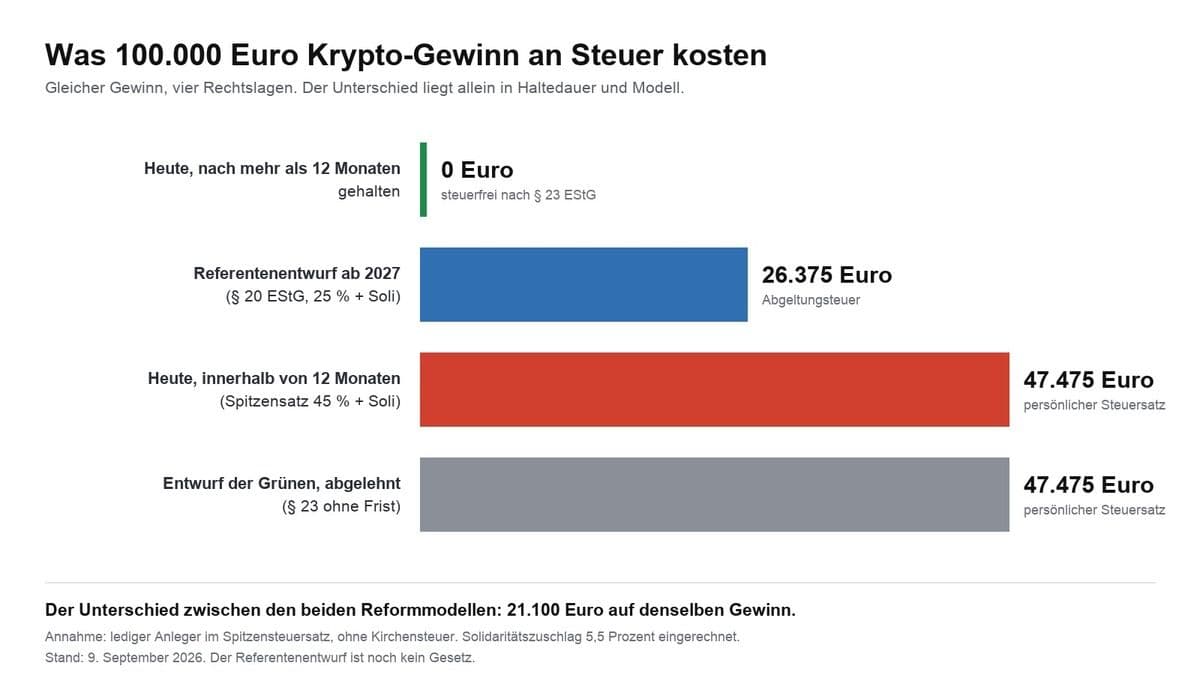
Crypto Tax in Germany: What Applies in 2026 and What Is Set to Change in 2027
Crypto gains are tax-free after twelve months; before that your personal tax rate of up to 45 percent applies. What triggers tax, how the holding period is calculated, what happens with staking and losses, and what the draft bill would change from 2027.
September 7, 2026 7:22 AM

German Crypto Holding Period Stays: The Income Tax Reform 2027 Leaves Section 23 Untouched
On September 2, 2026 the German federal cabinet adopted the draft of an Income Tax Reform Act 2027, and crypto assets do not appear in it. The one-year holding period under Section 23 of the Income Tax Act therefore continues to apply unchanged.
September 17, 2026 7:12 PM

Gifting Bitcoin to Children: Allowance, Holding Period and the Tax Office Report
Transferring Bitcoin to your child hands over your holding period and your entry price along with the coins. This guide sets out what really applies in Germany on the allowance, the reporting deadline, representation and custody.
September 17, 2026 10:22 PM

Selling Bitcoin at a Loss and Buying It Straight Back: What That Does to Your Holding Period
Germany has no wash sale rule: the loss stays deductible even if you buy back immediately. The buyback, however, restarts the one-year period for every new unit.
August 24, 2026 10:16 AM

Crypto Tax: Why You Have to Secure Your Transaction History Before the Exchange Closes Your Account
Deadlines run out at several crypto exchanges by early September, after which accounts close and holdings are sold off by force. Anyone who does not export the trading record beforehand faces the tax return with no proof of acquisition date and purchase price.
September 26, 2026 1:19 AM

Germany’s Crypto Holding Period Is Wobbling: What to Check Before December 31
A CDU member of the Bundestag makes it plain: the coalition agreement does not guarantee that the one-year holding period for crypto assets will survive. What that means for purchases made before the planned cutoff date of December 31, 2026.

August 20, 2024 3:00 PM

New US Senate Proposal Submitted For Crypto Tax Exemption
The US Senate has recently submitted a new proposal to exempt crypto transactions from federal taxes. Here are more details of this submission, and a list of exempted countries it could be joining...
September 8, 2026 10:21 PM

Crypto Holding Period and Grandfathering: Why December 31, 2026 Becomes the Cut-Off in Germany's Draft Bill
A ministerial draft bill from Germany's finance ministry names a cut-off date for the first time: crypto assets acquired after December 31, 2026 are to fall under the flat-rate withholding tax. What that means for legacy holdings, running savings plans and staking income, and why nothing has been decided yet.
September 8, 2026 1:19 AM

Germany's Crypto Holding Period: What Happens Now Signing for Petition 201716 Closed on September 15
Recap as of September 27, 2026: the signature period for German parliamentary petition 201716, which asks for the one-year crypto holding period to be preserved, closed on September 15, 2026. This article explains what ended that day, how the petitions committee proceeds and why no investor has to sell because of it.
September 9, 2026 1:15 AM

Germany's Crypto Tax: 160 Million Euros for a 555-Billion Budget
The German finance ministry's draft bill puts a figure on the crypto tax for the first time: 160 million euros from 2028. What that number means in the 2027 federal budget, how 11.4 billion became 160 million, and what investors can read from it.
August 21, 2026 4:24 AM

Forced Sale on a Crypto Exchange: Which Moment Counts for the Holding Period and What You Must Document
At Luno, Kraken and Valour the deadlines are running out, after which the provider realises the remaining holding itself. For tax purposes that is a disposal, and what governs it is the exchange's timestamp.
October 2, 2026 1:33 PM

Crypto tax before the cabinet on October 14: “Comments are only possible until October 6”
Germany's Federal Ministry of Finance sent the draft bill on crypto taxation to the associations on September 30, 2026, and the cabinet is to decide on October 14. For your holdings one date counts above all: December 31, 2026.
September 19, 2026 7:26 AM

Offsetting Crypto Losses Against Share Gains: What Is Really Allowed in Germany
Crypto losses and share gains sit in separate loss buckets in Germany, and there is no offsetting between them. Where the line runs, why crypto derivatives are the exception, and how you can still use losses through carryback and carryforward.
September 24, 2026 1:13 AM

Solana DEX Trades Overtake the NYSE: What to Check on Swaps, Tax and Oversight
Solana's decentralised exchanges settled roughly 208 million trades in a single week and overtook the New York Stock Exchange for the first time. The figure is real, but it measures something other than the comparison suggests, and for German investors it carries tax duties that no provider takes on.
September 12, 2026 10:11 PM

Crypto CFD or Buying Real Coins? How Leverage, Margin Calls and Tax Differ
With a crypto CFD you own a contract; with a direct purchase you own the crypto asset itself. From that one difference follow the 2:1 leverage cap, forced close-out, the tax burden and the question of who is liable for your money if things go wrong.
September 10, 2026 4:15 PM

BW-Bank Opens Bitcoin Trading Inside the Securities Account: What to Check Before Your First Buy
Since September 9, 2026, BW-Bank customers have been able to trade ten crypto assets through their securities account, executed and held in custody by Bitpanda. The familiar securities-account setting hides three points you should settle before your first order.

September 26, 2026 7:40 AM

The RAIN Token After the Enlivex Termination: What to Check on Access, Forced Sale and Holding Period
Enlivex terminated a share placement of 66,666,667 shares payable in RAIN tokens on September 22, 2026. The token sits 46.4 percent below its all-time high, and at Kraken the withdrawal deadline expired long ago.

September 30, 2026 4:14 AM

Bitcoin Price Before the Core PCE at 14:30 CEST: Will the $82,735 Level Hold?
At 14:30 CEST today the Bureau of Economic Analysis publishes the core PCE deflator for August, the inflation gauge the Fed anchors its 28 October rate decision to. Bitcoin stands at $83,329, less than $600 above its daily low, and anyone holding on leverage decides this morning.
September 27, 2026 10:14 AM

Shiba Inu Price Prediction: What to Check on SHIB Before the December 31 Deadline
SHIB trades at $0.00000592 on September 27, 2026, around 93 percent below its all-time high. For German investors one date matters more than the chart right now: December 31, 2026.
September 24, 2026 10:19 PM

Bitcoin for Retirement: What Applies from 2027 and What You Decide Now
Bitcoin is not permitted in any state-subsidised retirement product, including the new retirement savings account from 2027. Anyone who still wants to use crypto assets for their own pension goes through private assets, and there a cutoff date at the end of 2026 is shifting the tax rules right now.
September 24, 2026 1:34 PM

Cardano Slides Below $0.24: What ADA Holders Should Check on Leverage, Liquidation and Holding Period
Cardano has given back its move above $0.25 and trades around seven percent below the high of the past 24 hours. What that means for leveraged positions, the holding period of your tranches and the buying route under MiCA.
September 16, 2026 1:12 PM
Bitvavo Delisting of Kava, Nano and Ravencoin: What to Do Before Friday, 2 p.m.
Bitvavo drops KAVA, XNO and RVN on September 18, 2026, and three deadlines expire in a single afternoon. Nano has no withdrawal route at all, and the automatic euro conversion on September 28 counts as a sale for tax purposes.
October 2, 2026 10:17 PM
Dogecoin breaks below $0.093: the BWOW fund turns every DOGE into cash on October 14
Dogecoin costs $0.0914 on Friday evening and has lost 3.4 percent in 24 hours. On October 14 the US fund BWOW sells its entire holding, and on the same day the German cabinet takes up the reform of crypto taxation.
More from CryptoTicker