
Germany's Crypto Holding Period Faces Abolition: What Petition 201716 and the Cabinet Decision Mean for Your Tax
Petition 201716 in the German Bundestag calls for the one-year holding period for crypto assets to be kept and has already passed the quorum of 30,000 signatures. This article sets out what the cabinet decision of July 6, 2026 provides for, how much of it is binding and which records you should be pulling together now.





Which topics should we dive deeper into?
Select what genuinely interests you. Your picks feed directly into our editorial planning.
Crypto news that's actually worth your time.
Weekly. 60 seconds. Carefully curated by our editors: no hype, no promo flood, no spam.
Since August 4, 2026, a submission has been open for signature on the German Bundestag's petition portal that bears directly on private crypto investors. Petition 201716 calls for the one-year holding period for crypto assets under Section 23 of the Income Tax Act (EStG) to be kept in place. The quorum of 30,000 signatures was passed within a few days; on August 8, 2026 the portal showed 38,286 online signatures. The deadline runs until September 15, 2026.
The trigger is a decision taken by the federal cabinet on July 6, 2026 on the draft budget for 2027. Under it, crypto assets held as private wealth would in future be assigned to income from capital assets, and the tax exemption after twelve months of holding would fall away.
What the one-year crypto holding period under Section 23 EStG means today
Under the current view of the tax authorities and the case law of the fiscal courts, crypto assets count as “other assets”, so sales fall under the private disposal transactions of Section 23 of the Income Tax Act. Taxable there, under subsection 1 sentence 1 number 2, are transactions “in which the period between acquisition and disposal is not more than one year”. The familiar rule follows by implication: after more than twelve months of holding, the gain stays tax-free.
Sell earlier and the gain is charged at your personal income tax rate, plus the solidarity surcharge and, where applicable, church tax. Depending on your other income, that rate sits between zero and 45 percent. An important secondary rule appears in Section 23 subsection 3 sentence 5: gains stay tax-free if the total gain from private disposal transactions in the calendar year came to less than 1,000 euros. The threshold is often quoted as 600 euros, which reflects the position that applied up to and including 2023. What counts is the current statutory text, which you can read in Section 23 EStG at gesetze-im-internet.de.
This is an exemption limit rather than an allowance. At a total gain of 999 euros the amount stays entirely tax-free; at 1,000 euros it becomes taxable in full, and not merely for the portion above the line. Which unit was acquired when is something the tax authorities routinely allocate on a first-in, first-out basis. We have set out those basics in our explainer on the holding period for cryptocurrencies.
Cabinet decision of July 6, 2026: crypto gains are to become investment income
On July 6, 2026 the federal cabinet adopted the draft federal budget for 2027. Part of that draft is the intention to assign crypto assets held as private wealth to income from capital assets. Federal Finance Minister Lars Klingbeil had already announced a change to crypto taxation at the end of April and is quoted as saying that crypto gains should in future be taxed in the same way as investment income.
In fiscal terms the plan is a consolidation measure. Following the reporting on the cabinet draft, the Federal Ministry of Finance puts the contribution from tackling tax crime together with crypto taxation from 2027 at around one billion euros; in April the figure under discussion was still around two billion euros. The sums therefore do not relate to crypto assets alone.
One point is decisive for placing this in context. A draft budget quantifies expected revenue and states intentions, yet it amends no tax law. As long as Section 23 EStG applies in its present form, the one-year holding period applies.
Withholding tax instead of tax exemption: the crypto tax rate under discussion
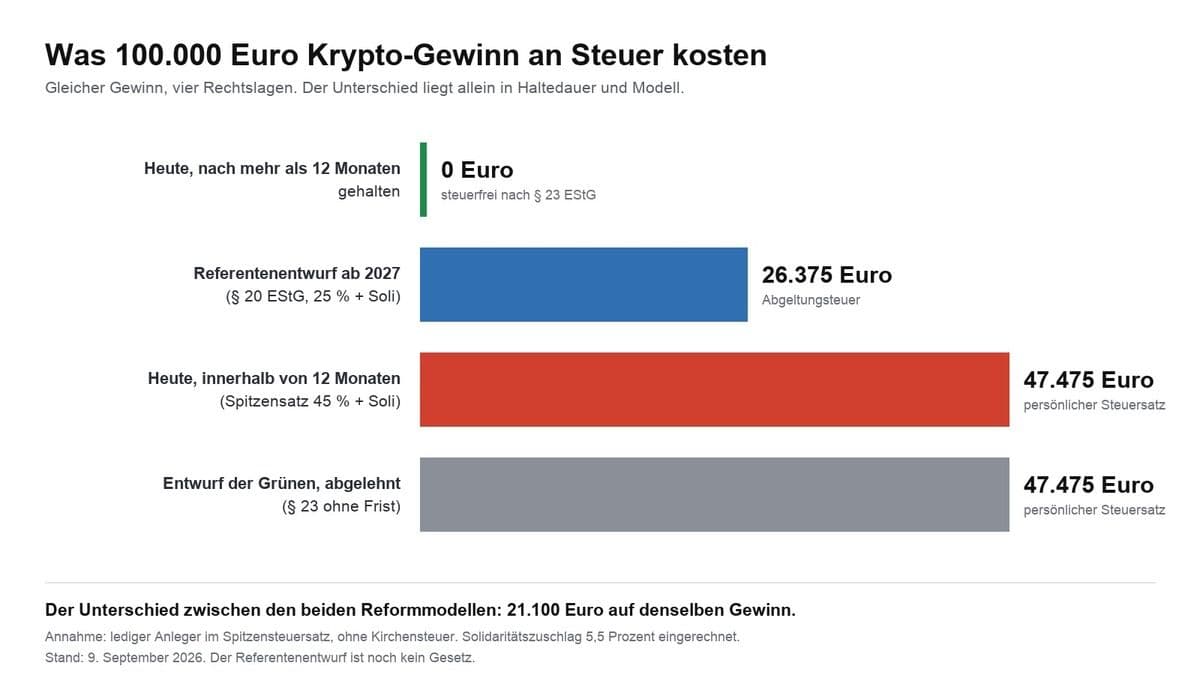
Two figures are circulating in the reporting. The one cited most often is a rate of 26.375 percent, made up of 25 percent withholding tax plus the solidarity surcharge. Add church tax and the burden comes to roughly 28 percent, depending on the federal state. Neither figure has been officially confirmed so far, because the relevant statutory text does not yet exist. We therefore present them as a range and not as a settled quantity.
For investors on a high personal tax rate, the switch would not be a disadvantage in every constellation. Anyone selling within the one-year period on a marginal rate of 42 percent pays more today than 26.375 percent. The deterioration falls above all on those who hold positions for longer than twelve months and have so far been able to sell free of tax. That group is the one behind the petition. Two further questions remain open: whether the 1,000 euro saver's allowance would apply, and how losses would be offset in future. Both follow only from the statutory text.

Petition 201716 in the Bundestag: 38,286 signatures against a quorum of 30,000
The petition carries identification number 201716, is assigned to the income tax subject area and shows May 30, 2026 as its creation date. Its status reads “open for signature”, and it went live on August 4, 2026.
The text of the petition calls for the tax holding period for private disposal transactions in crypto assets under Section 23 EStG to be preserved; in particular, the one-year period after which gains are tax-free should not be abolished. The submission also asks that the classification of crypto assets as “other assets”, in line with the current administrative view and case law, be retained. The petitioners cite legal certainty, protection of legitimate expectations and private wealth formation as their grounds.
On August 8, 2026 the portal showed 38,286 online signatures and an entry of “Yes” in the “quorum reached” field. By its own account the campaign is carried by the initiative prohaltefrist.de, behind which stands an alliance from the German bitcoin scene around the Bitcoin Bundesverband. You will find the full text and the current count in Petition 201716 on the Bundestag portal.
Signature deadline September 15, 2026: how to sign the crypto tax petition
You can sign until September 15, 2026. That requires a one-time registration on the Bundestag's petition portal, where your name and address are stored; the petition can then be supported through the corresponding button. The right of petition under Article 17 of the Basic Law is open to everyone, and participation is possible regardless of nationality and place of residence.
According to the portal's guidance, the committee checks whether the quorum has been reached at regular intervals rather than after each individual signature. Further signatures are counted until the deadline expires. Where the quorum has been reached, a public hearing in the Petitions Committee is normally provided for, which is a hearing format and not a vote on legislation.
Grandfathering for existing holdings: the decisive open question
For investors with older holdings, the financial impact hangs on a question that has gone unanswered so far. Would there be grandfathering for crypto assets acquired before a change in the law? The reporting on the cabinet decision expressly notes that this point is unresolved; neither the draft budget nor the accompanying statements commit either way.
What follows from that is an observation rather than a recommendation. Anyone who sells holdings as a precaution ahead of a possible cut-off date is deciding without knowing the future legal position, and may trigger a tax liability that would not have arisen on holding. Editorial assessment: as long as no ministerial draft exists, the economically right moment for a sale cannot be determined credibly. Individual tax questions belong in the hands of a tax adviser.
From cabinet decision to law: the hurdles still ahead in the Bundestag and Bundesrat
The road from a draft budget to changed taxation is still largely untravelled. So far there is no ministerial draft from the Federal Ministry of Finance, meaning the first fully formulated text with concrete provisions. Without it there is neither a legally reviewable wording nor a consultation of the associations. After that come the government draft, deliberation in the Bundestag and consideration by the Bundesrat. The reporting mentions a first reading in September 2026 and a conclusion in December; those dates have not been officially confirmed.
Politically the outcome is open. A majority would require the support of the CDU/CSU parliamentary group, which had rejected a corresponding change in the finance committee beforehand. Whether a compromise will be found is not foreseeable at present, and this text deliberately offers no forecast of the result.

Documenting acquisition data: why your crypto transaction history now matters more
Whatever the outcome of the legislative process, preparation pays off in every scenario: full documentation of your acquisition dates and acquisition costs. If the holding period survives, that is how you prove the tax exemption to the tax office. If it is abolished, you need the data to calculate the disposal gain. Were grandfathering to come, the acquisition date would decide how each individual position is treated.
In practice that means downloading the transaction histories of your trading venues as CSV exports while the accounts are still active, and storing them outside the platform. Record wallet addresses together with what they belong to, and note transfers between your own addresses so that a transfer is not read later as a sale. With several exchanges and wallets, a spreadsheet quickly reaches its limits; a portfolio tracker with a tax report handles the first-in, first-out allocation automatically. Which providers deliver German tax reports is shown in our comparison of crypto tax tools and portfolio trackers.
A second point concerns the data available to the tax authorities. With the implementation of the EU directive DAC8, crypto service providers have been reporting their customers' transaction data to the tax authorities since January 1, 2026, and the first transmission is scheduled for September 2027. The authorities will therefore hold material to compare against what appears in a tax return. If you are sorting through accounts anyway, check the tax reports of your trading venue; our overview of the best crypto brokers lists the providers along with their terms.
Staking, lending and the ten-year period: what the crypto tax reform could mean for income
Alongside disposal gains there are ongoing earnings. Rewards from staking or lending have so far been treated by the tax authorities as other income under Section 22 number 3 EStG, taxable at the moment of receipt at your personal tax rate and with an exemption limit of 256 euros per calendar year. If you later sell the units received, Section 23 EStG with its one-year period applies again to that sale.
The worry keeps surfacing that using holdings as a source of income extends the holding period to ten years. That extension does appear in the statutory text, yet the tax authorities do not apply it to crypto assets following the Federal Ministry of Finance letter of March 6, 2025; the one-year period remains decisive. Were the assignment to capital income to come, how staking rewards are to be classified would have to be settled afresh. The cabinet decision says nothing on the point. Anyone buying regularly through a savings plan should also bear in mind that under first-in, first-out each instalment forms its own position with its own period.
What you should take away
- Check your acquisition data and close any gaps before the legal position settles. Export the transaction histories of every exchange and wallet and store them away from the platforms. A tool with a German tax report takes the first-in, first-out allocation off your hands; you will find the providers compared in the hub for crypto tax tools and portfolio trackers.
- Decide by September 15, 2026 whether you sign Petition 201716. Registering on the Bundestag's petition portal takes a few minutes, and the deadline is fixed. If you are going through your trading venues anyway, check their tax reports against the terms in the broker comparison.
- Do not take a decision to sell on the strength of the cabinet decision alone. Without a ministerial draft, neither the cut-off date nor any possible grandfathering is known. If you want to keep building a position, you will find the terms for regular purchases in the comparison for bitcoin savings plans; for anything to do with tax in an individual case, a tax adviser is the right port of call.
(As of August 8, 2026. This article is not investment advice. Prices and fee structures change; check the terms with the provider before you buy.)
Transparency note: This article was produced with the assistance of artificial intelligence and reviewed by our editorial team before publication. All figures and claims were checked against the primary sources linked in the text. The feature image was generated with AI.
Related articles
- Germany's Crypto Holding Period: What Happens Now Signing for Petition 201716 Closed on September 15
- Bitcoin 29 Percent Below Last Year: Which Crypto Losses You Can Still Use Before the One-Year Holding Period Expires
- Borrowing Against Bitcoin Instead of Selling: When German Tax Still Applies
- German Crypto Holding Period Stays: The Income Tax Reform 2027 Leaves Section 23 Untouched
- Germany’s Crypto Holding Period Is Wobbling: What to Check Before December 31
Which topics should we dive deeper into?
Select what genuinely interests you. Your picks feed directly into our editorial planning.
Crypto news that's actually worth your time.
Weekly. 60 seconds. Carefully curated by our editors: no hype, no promo flood, no spam.

September 25, 2026 10:26 PM

Selling bitcoin privately: the tax in Germany and the records you need
A direct sale to a private individual falls under the same one-year rule as an exchange sale, but there is no tax report to go with it. This guide walks through the calculation, the 1,000 euro threshold and the records the tax office wants to see.
September 17, 2026 10:22 PM

Selling Bitcoin at a Loss and Buying It Straight Back: What That Does to Your Holding Period
Germany has no wash sale rule: the loss stays deductible even if you buy back immediately. The buyback, however, restarts the one-year period for every new unit.
September 8, 2026 10:21 PM

Crypto Holding Period and Grandfathering: Why December 31, 2026 Becomes the Cut-Off in Germany's Draft Bill
A ministerial draft bill from Germany's finance ministry names a cut-off date for the first time: crypto assets acquired after December 31, 2026 are to fall under the flat-rate withholding tax. What that means for legacy holdings, running savings plans and staking income, and why nothing has been decided yet.
August 21, 2026 4:24 AM

Forced Sale on a Crypto Exchange: Which Moment Counts for the Holding Period and What You Must Document
At Luno, Kraken and Valour the deadlines are running out, after which the provider realises the remaining holding itself. For tax purposes that is a disposal, and what governs it is the exchange's timestamp.
September 22, 2026 10:13 AM

Circle Lends Against Bitcoin via cirBTC: Why the Wrapper Can Cost You the German Holding Period
Circle launched loans against deposited bitcoin on September 21, 2026. In Germany, the detour through the cirBTC token is very likely a swap, and a swap restarts your one-year holding period.
September 9, 2026 4:22 PM
Crypto Tax in Germany: What Applies in 2026 and What Is Set to Change in 2027
Crypto gains are tax-free after twelve months; before that your personal tax rate of up to 45 percent applies. What triggers tax, how the holding period is calculated, what happens with staking and losses, and what the draft bill would change from 2027.
September 24, 2026 1:13 AM

Solana DEX Trades Overtake the NYSE: What to Check on Swaps, Tax and Oversight
Solana's decentralised exchanges settled roughly 208 million trades in a single week and overtook the New York Stock Exchange for the first time. The figure is real, but it measures something other than the comparison suggests, and for German investors it carries tax duties that no provider takes on.

September 27, 2026 1:17 PM

Dogecoin Price: What to Check on Holding Period and Custody Before the Year End
The Dogecoin price stands at $0.0977 on September 27, 2026 and has barely moved in a day. That calm is exactly the moment to work through the holding period, the reporting duty from 2026 and custody without any time pressure.
October 2, 2026 4:39 AM

Donating bitcoin: when does the full market value count, when only the purchase price?
A bitcoin donation to a charitable organisation is deductible as a donation in kind, and the donation itself produces no taxable gain. The size of the deduction turns solely on whether a sale would have been taxable on the day of the transfer.
September 18, 2026 10:13 AM

Bitcoin and the German Exit Tax: What Applies When You Move Abroad
Anyone emigrating with Bitcoin expects an exit tax on unrealised gains and finds nothing of the sort in the statute. Where the real risks sit is decided at four points: residence, the holding period, the legal form of your investment, and automatic reporting from 2026.
September 17, 2026 7:12 PM

Gifting Bitcoin to Children: Allowance, Holding Period and the Tax Office Report
Transferring Bitcoin to your child hands over your holding period and your entry price along with the coins. This guide sets out what really applies in Germany on the allowance, the reporting deadline, representation and custody.
August 12, 2026 6:24 PM

Tokenized Stocks and Tax in Germany: When the One-Year Holding Period Applies and When the Flat Tax Bites
If you buy a tokenized stock, you often apply the crypto rule: hold for a year, then the gain is tax-free. For these products that assumption usually does not hold, and this article shows from the wording of the law which feature decides the tax regime and how to find it in the issuer documents.
September 16, 2026 1:20 PM

Crypto Loss Carryforward in Germany: What Happens to Old Losses Under the 2027 Tax Plan
Losses from crypto sales land in a ring-fenced pot and can only be set against gains of the same kind. The draft bill for 2027 moves future gains into a different pot, and we show you what that means for your assessed carryforward and what your tax notice should say.
October 2, 2026 1:33 PM

Crypto tax before the cabinet on October 14: “Comments are only possible until October 6”
Germany's Federal Ministry of Finance sent the draft bill on crypto taxation to the associations on September 30, 2026, and the cabinet is to decide on October 14. For your holdings one date counts above all: December 31, 2026.
September 19, 2026 7:26 AM

Offsetting Crypto Losses Against Share Gains: What Is Really Allowed in Germany
Crypto losses and share gains sit in separate loss buckets in Germany, and there is no offsetting between them. Where the line runs, why crypto derivatives are the exception, and how you can still use losses through carryback and carryforward.
September 27, 2026 4:12 AM

Bitcoin ETF Inflows Turn 2026 Positive: How to Tell If the Demand Holds
US spot Bitcoin ETFs took in roughly $2.4 billion in the week to September 25, the strongest week since October 2025, and that turns the 2026 year-to-date balance positive. Why the daily inflow fell 87 percent within the same week, and what to check on buying route, holding period and custody.
September 9, 2026 1:15 AM

Germany's Crypto Tax: 160 Million Euros for a 555-Billion Budget
The German finance ministry's draft bill puts a figure on the crypto tax for the first time: 160 million euros from 2028. What that number means in the 2027 federal budget, how 11.4 billion became 160 million, and what investors can read from it.
September 25, 2026 4:20 AM

Crypto as a Down Payment for a German Mortgage: What Banks Require
Since April 2023 a house in Germany can no longer be paid for in Bitcoin; section 16a of the Money Laundering Act bans it outright. Your crypto holdings still work as a down payment, provided you take the route through the euro and prove the origin without gaps.
September 10, 2026 1:13 AM

Staking Taxes in Germany: The Inflow, the 256-Euro Threshold and the Holding Period
Staking is taxed twice: once when the reward arrives and once when you sell it later. This article explains both moments, the threshold of 256 euros, the separate twelve-month period and what applies to liquid staking, restaking and staking ETPs.
August 27, 2026 7:21 AM

Crypto Gains 2026: Why the September 10 Advance Tax Payment Decides Your Interest Bill
The third income tax advance payment falls due on September 10, yet for most crypto investors none was ever set. We checked four provisions in full text and show when the interest period for 2026 starts and how you can shrink it yourself.

September 24, 2026 10:19 AM

Uniswap Falls 11.8 Percent After a 114 Percent Month: What to Check on Profit Taking, Holding Period and Leverage
UNI lost 11.75 percent on Wednesday morning but is still up 113.85 percent over the month. Anyone realising gains now almost certainly triggers a taxable disposal in Germany.
August 31, 2026 10:30 PM

Taxing Crypto Lending: Your Personal Rate Instead of Withholding Tax, and the Right Federal Fiscal Court Case Number
According to the only tax court ruling so far, income from crypto lending falls under Section 22(3) of the German Income Tax Act and therefore under your personal tax rate. The appeal is pending at the Federal Fiscal Court under VIII R 22/25, not under the case number given in many professional articles.
August 21, 2026 1:42 PM

Writing Off a Total Crypto Loss: When the Tax Office Recognises Worthless Coins
A token that has collapsed only reduces your tax once you actually dispose of it. What applies to delisting, exchange insolvency and worthless holdings under Section 23 of the German Income Tax Act, and how you offset losses.
September 26, 2026 7:29 PM

Coins Stolen in an Exchange Hack: What the German Tax Office Accepts as a Loss
After the attack on Bitget on September 24, a question the reports leave out arises for those affected in Germany: can a stolen balance be written off against tax? The answer hangs on a single term in the Income Tax Act, and it is decided by your records.
September 14, 2026 10:23 AM

Take Ethereum Profits or Wait Out the Holding Period? What the Price Jump Means for Your Tax Bill
Ether reached its highest level since the end of January on September 11, 2026, and many are asking whether to sell now. In Germany the answer hangs on the purchase date first: we work out which tranches are tax free and which of them are showing a gain at all.
October 3, 2026 4:40 PM

Investing in Bitcoin With a Savings Plan or a Lump Sum: What the December 31 Tax Cut-Off Changes
Anyone putting money into Bitcoin now chooses between a lump sum, a monthly instalment and an ETN in a securities account. The German finance ministry’s draft bill would keep the one-year holding period only for holdings bought by December 31, 2026.
August 16, 2026 6:14 AM
Crypto Credit Card Tax in Germany: Why Every Payment Is a Disposal
Paying with a crypto credit card means disposing of your coins for tax purposes. What that means for the holding period, the exemption threshold and your record-keeping duties, and which card design keeps the effort small.
More from CryptoTicker