
Solana Price Above $120: What to Check on Staking Yield, Holding Period and Spread
Solana is trading at $121.00 on September 26, 2026, 8.6 percent above its level a week earlier. What a self-measured staking yield of 5.27 percent is worth, how the one-year holding period applies to staked SOL, and what an order in euros really costs.





Which topics should we dive deeper into?
Select what genuinely interests you. Your picks feed directly into our editorial planning.
Crypto news that's actually worth your time.
Weekly. 60 seconds. Carefully curated by our editors: no hype, no promo flood, no spam.
Solana traded at $121.00, or €106.22, on September 26, 2026. That is 8.6 percent more than seven days earlier, and it is the first reading above $120 since January. On an evening like this, the decisive question for a German investor is rarely whether the rally continues. What matters more is what a position in Solana leaves behind once yield, lock-up, tax and trading fees are accounted for. This article works through exactly that, using figures collected on the evening itself.
Solana Price on September 26, 2026: The Measured Numbers
All price data comes from a CoinGecko market snapshot taken on September 26, 2026 at 19:44 UTC, which is 21:44 German time. Solana stands at $121.00. The intraday high was $122.75 and the low $119.89. Over 24 hours that works out at a loss of 0.48 percent, over seven days a gain of 8.6 percent, and over 30 days a gain of 11.82 percent. Market capitalisation is $71.11 billion, and turnover over the past 24 hours came to $3.15 billion.
The distance to the all-time high remains wide. At $293.31, the record sits 58.7 percent above today's level. Anyone who bought Solana in January 2026 is, depending on the entry, still sitting on a loss, and for the tax question further down that matters more than any forecast.
Set against the two heavyweights, the week stands out. Bitcoin comes in at $83,974 in the same snapshot, a weekly gain of 3.11 percent, and Ethereum at $2,681.98, up 1.46 percent. Solana has therefore moved roughly three times as far as bitcoin. Relative strength of that kind rarely lasts long, and on its own it says nothing about the days ahead. It is still the starting point for putting the inflows in context.
Solana ETF Inflows as the Driver: What Is Documented and What Stays Guesswork
Market reports this week agree on the reason for the move: the US spot ETFs on Solana. According to the analysis by AMBCrypto and CoinGape, these products recorded net inflows for ten consecutive weeks and took in more than $360 million in the process; $235.8 million is said to have arrived since September 18 alone. In the same coverage, the analyst Ali Charts names a price target of $160, provided support around $115 holds and the inflows continue.
Two qualifications belong with that. First, this is an analyst opinion and not a fact, and it is quoted here as such. Second, inflows into a security are a snapshot: the same products can post net outflows within days as soon as a larger participant rotates out. An investor in Germany can subscribe to these US products through a local broker only to a limited extent in any case, because they are not approved for distribution in the EU. The inflow is therefore a sentiment indicator for you, not a route to buying.
What you can verify yourself is the chain behind it. Inflows into a spot product mean an issuer has to buy real SOL and have them held in custody. That takes supply off the market. How strongly the effect feeds through depends on how much of the supply is tied up anyway. That figure can be measured, and it appears in the next section.

Solana Staking Yield: 5.27 Percent Gross, Recalculated Here
Staking at Solana means assigning your SOL to a validator, which uses them to confirm blocks and receives a share of the newly issued supply in return. The issuance of new SOL is fixed in the protocol and falls year by year.
For this article the network figures were queried directly from Solana at 19:45 UTC on September 26, 2026, through a public RPC node. The network was in epoch 1043. The reported inflation rate was 3.6298 percent a year. Total supply stood at 634.76 million SOL, of which 587.71 million were in circulation. Bonded to validators were 437.54 million SOL, spread across 676 active and 11 delinquent validators. That amounts to 68.93 percent of total supply.
The gross yield follows almost by itself. The newly issued SOL are distributed among those who stake. If 3.63 percent inflation is spread over 68.93 percent of supply, the arithmetic gives 5.27 percent a year before anyone takes a fee. Anyone who reads a figure of eight or nine percent online should therefore ask which period and which commission were used in that calculation. The process is described in the official Solana staking documentation.
How much of that reaches the investor differs considerably from provider to provider. The terms at a glance can be found in the comparison of staking platforms, including which of them credit rewards daily and which only at the end of an epoch.
 Crypto Exchanges Compared
Validator Commission and Downtime Risk: What Is Left of the 5.27 Percent
The 5.27 percent is a gross figure for the network. The validator's commission comes off first, and at most operators it sits between five and ten percent of rewards. At a commission of eight percent, roughly 4.85 percent remains. Anyone staking through an exchange or a centralised service often pays a second layer: the provider retains a share of its own, and four percent or less then reaches the investor.
On top of that comes an operational risk that appears in no yield figure. Of the 687 validators measured on this evening, eleven were delinquent, meaning they had cast no valid votes recently. Anyone staked with a delinquent validator earns nothing for that period. Unlike Ethereum, Solana so far has no automatic seizure of deposits for misconduct, so the real risk is lost income rather than a loss of capital through a protocol penalty.
In practice that means checking the validator's availability through one of the public network explorers before you delegate, checking the commission in plain terms, and spreading larger amounts across more than one operator. A yield of 4.8 percent that runs reliably is worth more than an advertised 7 percent that drops out twice a quarter.
Solana Epochs: Why Staked SOL Is Not Immediately Available
An epoch at Solana is the network's settlement period, in which validator slots and rewards are fixed, and it spans 432,000 slots. At the 19:45 UTC measurement, epoch 1043 had reached slot 196,318, leaving 235,682 slots to run. At a target time of 0.4 seconds per slot, that is around 26 hours until the epoch ends.
That number is why staking at Solana is not an overnight deposit. A new delegation only becomes active at the next epoch boundary, and an unstaking likewise only takes effect at the next boundary; after that the balance is freely available again. Between the click and a tradable holding there can therefore be more than a day in the worst case. Anyone wanting to react to a sharp fall cannot reach the staked coins in that window.
From that follows a simple split that has proved itself in practice: part of the holding stays liquid so that you remain able to act, and the rest works in the stake. How large the liquid part should be depends on whether you intend to react to price moves at all. Anyone holding for years in any case needs little liquidity buffer.
One alternative is liquid staking tokens, which securitise a claim on the staked holding and remain tradable themselves. That solves the maturity problem but brings counterparty risk and a possible discount to intrinsic value. They are also awkward for tax, because the swap into such a token can be treated as a disposal.
Leverage and Liquidation: Why a Solana Price of $121 Looks Different on Borrowed Money
The daily range from $119.89 to $122.75 amounts to 2.4 percent. That sounds calm, and in a spot holding it is. At ten times leverage the same range becomes a 24 percent move on the capital employed. A position opened with ten percent margin is already close to forced closure on a pullback to today's low.
Anyone working with leverage therefore calculates two figures before the order: the distance between entry price and liquidation price in percent, and the running financing costs. Perpetual contracts usually carry a funding payment every eight hours; at 0.01 percent per payment that is 0.03 percent a day and around eleven percent a year that the price has to earn back first. In Germany, contracts for difference are available to retail investors only with limited leverage and with negative balance protection.

Holding Period and Tax: What the One-Year Rule Really Means for Solana
For private investors in Germany, Solana counts as another asset within the meaning of Section 23 of the Income Tax Act. A sale within one year of purchase is a private disposal transaction, and the gain is charged at the personal income tax rate. Once a year has passed, the gain remains tax free. Since the 2024 assessment period, the exemption limit for all private disposal transactions in a year has been €1,000; from €1,000 the entire amount is taxable, below that it stays tax-free, because it is an exemption limit and not an allowance.
Correction (30 September 2026): An earlier version said the entire gain only becomes taxable once it exceeds 1,000 euros. Under section 23(3) sentence 5 of the German Income Tax Act, total gains from private disposals remain tax-free only if they amount to less than 1,000 euros in the calendar year; from 1,000 euros the entire gain is taxable.
Important for anyone staking: with its circular of March 6, 2025 on the income tax treatment of certain crypto assets, the Federal Ministry of Finance carried forward the line taken in the circular of May 10, 2022. Under it, staking does not extend the holding period to ten years. The tax authorities do not apply the previously debated extension under Section 23(1) no. 2 sentence 4 of the Income Tax Act to crypto assets. The one-year rule therefore remains the one-year rule, including for staked SOL.
The rewards themselves run separately. For tax purposes they count as other income under Section 22 no. 3 of the Income Tax Act at the moment they accrue, valued at the market price on the day of accrual, and they remain untaxed only up to an exemption limit of €256 a year. Each reward received also starts a holding period of its own. Anyone credited with rewards daily therefore accumulates 365 separate acquisition dates in a year, and each of them needs its own price.
That is precisely where the tax return founders in practice. Without clean records, the allocation by year is barely manageable, and the tax office accepts estimates only grudgingly. Which programmes read Solana's epoch credits properly and allocate them on a FIFO basis is shown in the overview of crypto tax tools.
 Staking Platforms Compared
Buying Solana Under MiCA: How to Spot an Authorised Provider
Since the European regulation on markets in crypto assets applied in full, every provider that sells, holds or exchanges crypto assets for retail clients in the EU needs authorisation as a crypto asset service provider. The authorisation is granted by the supervisor of the home member state, in Germany BaFin, and it then applies across the single market.
This can be checked in two steps. The European securities regulator ESMA maintains a public register of authorised providers, and BaFin keeps its own database of supervised companies. If a provider appears in neither register but advertises with a German-language interface and euro deposits, that is a warning sign. A second criterion is custody: authorised custodians must keep client holdings separate from their own assets, and that is exactly what counts in an insolvency.
In practice it also means that switching provider costs effort. Anyone transferring holdings from one platform to the next should take the acquisition data along; without it the one-year period can no longer be evidenced later, and the tax-free status of an old holding is hard to defend against the tax office.
Spread and Fees: What a Solana Order in Euros Really Costs
The most conspicuous cost trap when buying is not the stated order fee but the trading spread between the bid and the ask. To show how large the difference is between a liquid and a narrow market, the order book for the SOL against euro pair was read at Kraken on September 26, 2026. The best bid was €106.36 and the best ask €106.37. The spread therefore came to one cent, or 0.009 percent.
Those 0.009 percent are the yardstick against which you can measure every other offer. Brokers and apps that advertise without an order fee generally earn through a marked-up spread of 0.5 to 1.5 percent. On a purchase of €2,000 that is €10 to €30 which appears nowhere as a fee. A trading venue with a 0.25 percent order fee and a spread close to zero is clearly cheaper in this calculation than a fee-free offer with a one percent mark-up.
Before the order, therefore, work out the total cost: order fee plus half the trading spread plus any deposit and withdrawal costs, once on the purchase and once on the sale. And compare the execution price shown against an independent market price for the same minute; a gap of more than half a percent is a mark-up and not a market price.
Levels Above and Below: The Checkpoints in the Solana Price
On the upside the first level is today's intraday high at $122.75, because that is where this week's move last turned back. Above it lies the zone between $124 and $130, named in the coverage quoted above as the trigger for a continuation. Only beyond that does January's record come back into play.
On the downside $119.89 is the first checkpoint, today's intraday low. The support cited more often sits at around $115; it is also the condition the quoted analyst attaches to his price target. If the price falls below it, the argument for an ETF-driven recovery is neutralised for the moment, and attention turns to the zone around $100, which held several times in August.
What matters is the reasoning behind the levels. A price level only holds as long as trading actually takes place there. Every level therefore calls for a look at volume: today's $3.15 billion of turnover is about 4.4 percent of market capitalisation. As long as that ratio stays stable, the levels carry weight; if turnover dries up, the price slips through without any news.
Custody After the Purchase: Exchange, Own Wallet or Stake
After the purchase comes the question of where the coins sit. On the trading platform they can be sold quickly but are exposed to the provider's default risk. In your own wallet the risk lies with you, but counterparty risk disappears entirely. In the stake the coins work, but they are tied to the epoch boundaries.
A workable split for a mid-sized holding looks like this: the amount you want to move over the coming weeks stays at an authorised trading venue, the long-term core moves to a hardware wallet, and the part that will sit untouched anyway goes into the stake. Hardware wallets now support delegation to validators directly, and the keys do not leave the device in the process.
Record the date, quantity and price for every move. A transfer between your own wallets is not a disposal and triggers no tax, but the acquisition data has to travel with it without gaps, otherwise a tax-free legacy holding turns, in case of doubt, into a taxable new purchase.
Checking the Solana Price: What to Take Away
- Work out the total cost of your order before you buy. Order fee plus half the trading spread, measured against the 0.009 percent from this evening's order book. Which trading venues are authorised in Germany and what they cost is set out in the comparison of crypto exchanges.
- Set up your records before the first reward arrives. Every inflow needs a date, a quantity and the price on the day, and each one starts a holding period of its own. Which programmes read Solana's epoch credits automatically is shown in the overview of crypto tax tools.
- Separate the liquid part from the core. Around 26 hours to the next epoch boundary means staked SOL are not available on a fast-moving day. What stays put for the long term belongs in your own custody, and the devices for that are in the hardware wallet comparison.
The reading of the current inflows comes from the reporting by AMBCrypto on the break above $119.
(As of September 26, 2026. This article is not investment advice. Prices and fee structures change; check the terms with the provider before you buy.)
Transparency note: This article was produced with the assistance of artificial intelligence and reviewed by our editorial team before publication. All figures and claims were checked against the primary sources linked in the text. The feature image was generated with AI.
Related articles
- Solana Price at $121.93: What to Check on Staking Yield, Unstaking and Tax
- Cardano Slides Below $0.24: What ADA Holders Should Check on Leverage, Liquidation and Holding Period
- Chainlink Jumps Above $12: What LINK Holders Should Check Now
- ETH Price Prediction: What to Check at the $2,800 Mark Now
- Ethereum Rises While ETF Money Leaves: What ETH Holders Should Check Now
Which topics should we dive deeper into?
Select what genuinely interests you. Your picks feed directly into our editorial planning.
Crypto news that's actually worth your time.
Weekly. 60 seconds. Carefully curated by our editors: no hype, no promo flood, no spam.

October 2, 2026 10:17 PM
Dogecoin breaks below $0.093: the BWOW fund turns every DOGE into cash on October 14
Dogecoin costs $0.0914 on Friday evening and has lost 3.4 percent in 24 hours. On October 14 the US fund BWOW sells its entire holding, and on the same day the German cabinet takes up the reform of crypto taxation.

September 24, 2026 1:24 PM

NEAR Falls Almost 8 Percent After a 62 Percent Week: What to Check on Perps, Buying Route and Holding Period
NEAR Protocol loses up to 7.9 percent on September 24, 2026 and is still more than 55 percent higher over the week. The rally was carried by a confidential perp offering via Hyperliquid, which raises questions of its own on buying route, leverage and holding period in Germany.
September 27, 2026 4:12 AM
Bitcoin ETF Inflows Turn 2026 Positive: How to Tell If the Demand Holds
US spot Bitcoin ETFs took in roughly $2.4 billion in the week to September 25, the strongest week since October 2025, and that turns the 2026 year-to-date balance positive. Why the daily inflow fell 87 percent within the same week, and what to check on buying route, holding period and custody.
September 24, 2026 10:36 PM

Ethereum Price Prediction: What to Check on Staking, Leverage and Where You Buy After Three Attempts at $2,800
Ether stands at $2,700 and has bounced off the zone around $2,800 three times in thirty days, without a single daily close above it. What our own count shows, and the three things to settle before the next attempt.
September 23, 2026 7:22 PM

Solana Price Holds $114: What Holders Check Five Days Before Alpenglow
SOL stands at $114.55 on September 23, after a 17.7 percent gain in seven days and a 2.2 percent loss on the day. Two deadlines matter more than the daily move: Alpenglow opens on September 28, and every purchase made this week starts a holding period of its own.

October 2, 2026 5:02 PM

Bitcoin or Ethereum in the fourth quarter of 2026: the two largest crypto-assets compared
Bitcoin is scarce by protocol rule, Ethereum only as scarce as its utilisation, and on access and tax in Germany the paths part again. This comparison puts the verifiable figures on supply, usage, staking and purchase route side by side, without making a price call.
September 26, 2026 7:14 AM
Cardano Before the RealFi Launch on October 1: What ADA Holders Should Check on USDr, MiCA and Tax
On October 1, 2026 the stablecoin platform RealFi goes live on the Cardano mainnet, and ADA has gained 14.67 percent in a week. What is documented about the yield-bearing dollar token USDr, and what investors should settle beforehand.
September 27, 2026 1:17 PM

Dogecoin Price: What to Check on Holding Period and Custody Before the Year End
The Dogecoin price stands at $0.0977 on September 27, 2026 and has barely moved in a day. That calm is exactly the moment to work through the holding period, the reporting duty from 2026 and custody without any time pressure.

August 8, 2024 3:57 PM

Solana Major News: Solana Back To The 4th Rank Amid SOL ETF Approval
Solana and its memecoins are under the spotlight with SOL performance leading it to surpass BNB to the 4th rank as well as getting Solana ETF approval. What's more to expect?
June 25, 2024 12:18 PM

After Bitcoin Crash, Will Altcoins Gains Reach 500%?
In the latest Bitcoin News today, and mainly after the Bitcoin Crash, crypto analysts predict a major shift towards altcoins with market corrections near the end and BTC dominance drop. Will the altcoins gain reach 500%?
January 24, 2025 1:30 PM
Solana Price Prediction After the New Trump Crypto Executive Order: SOL ETF NEXT?
Solana price is on the rise following the crypto executive order, fueling speculation about its potential to reach new highs. With all this positive momentum, could a SOL ETF approval come next?
September 24, 2026 10:12 AM

XRP Falls 9.7 Percent: What to Check on Holding Period and Buying Route
XRP is down around 9.7 percent on the morning of September 24, twice as much as the typical large crypto asset. Our count of 18 coins shows who the pullback hits and which three things hold true regardless of the price.
March 26, 2025 4:00 AM
BlackRock NEWS: BUIDL Fund Live on Solana and Bitcoin ETP Launch in Europe
BlackRock's dual crypto push—expanding its BUIDL fund to Solana and launching a Bitcoin ETP in Europe—has ignited market interest. Solana price surged to its best performance this week; so what's next?
March 23, 2026 10:41 AM
SOL Price Prediction: Key Levels to Watch in late March 2026
Solana (SOL) battles $90 resistance as institutional ETF inflows hit $1.45B. Explore key support levels and the impact of the Alpenglow upgrade on SOL price.
September 30, 2026 1:13 PM

Solana Price Prediction: $188 Million Into the US Funds in One Week, What Matters Now
In the week of 21 to 25 September the seven US spot funds on Solana took in $188.21 million, while the price barely moved from $119.21. What this record inflow means for buying, staking and tax in Germany, and which network date is still open.
September 24, 2026 1:13 AM

Solana DEX Trades Overtake the NYSE: What to Check on Swaps, Tax and Oversight
Solana's decentralised exchanges settled roughly 208 million trades in a single week and overtook the New York Stock Exchange for the first time. The figure is real, but it measures something other than the comparison suggests, and for German investors it carries tax duties that no provider takes on.
September 30, 2026 4:14 AM

Bitcoin Price Before the Core PCE at 14:30 CEST: Will the $82,735 Level Hold?
At 14:30 CEST today the Bureau of Economic Analysis publishes the core PCE deflator for August, the inflation gauge the Fed anchors its 28 October rate decision to. Bitcoin stands at $83,329, less than $600 above its daily low, and anyone holding on leverage decides this morning.
September 27, 2026 10:14 AM
Shiba Inu Price Prediction: What to Check on SHIB Before the December 31 Deadline
SHIB trades at $0.00000592 on September 27, 2026, around 93 percent below its all-time high. For German investors one date matters more than the chart right now: December 31, 2026.
September 25, 2026 1:30 PM

NEAR Staking ETP Passes $100 Million: What to Check on Yield, Brokerage Account and Holding Period
The Bitwise NEAR staking ETP has crossed $100 million in assets under management while NEAR climbs to $4.99. Our own retrieval of the issuer's figures shows the price made the jump, not the inflows.
September 24, 2026 4:16 AM

Trump-Xi Summit at the White House: The Crypto Positions to Check Before the Meeting
Xi Jinping is on a state visit to Donald Trump today, and the crypto market comes into the meeting carrying the gains of an exceptionally strong week. What to check on leverage, holding period and custody before the first headline runs.
September 25, 2026 7:24 PM

Bitcoin Forecast: What to Check on Levels, Holding Period and Buying Route Before the Quarter Ends
Bitcoin stands at $83,877 at 16:40 UTC on September 25, 2026, and the measured volatility of the past 30 days spans a band of $73,600 to $94,200 for the coming month. More important than that band before the quarter ends are three checks: holding period, buying route under MiCA and the reporting duty in force since January 2026.
September 24, 2026 1:11 PM

Stellar Becomes a Payment Rail at Mastercard's BVNK: What XLM Holders Should Check on Buying Route, Memo and Holding Period
BVNK has switched on Stellar as a payment rail for business customers in more than 130 countries. On the same trading day XLM falls by around seven percent — we separate what the news means from what the pullback means for your portfolio.
October 2, 2026 4:40 PM

Ethereum price prediction: Citi raises its twelve-month target to $3,028, and what you can do now
Citi has raised its twelve-month target for Ethereum from $2,240 to $3,028. Anyone following that horizon also decides the tax on the gain with the purchase date.
September 24, 2026 10:11 PM

Bitcoin Price Prediction: What to Check on Levels, Holding Period and Leverage Before the October 28 Rate Decision
Bitcoin is trading at around $83,800, a third below its October 2025 high, while the sentiment index reads greed. Which dates, levels and deadlines over the coming weeks really decide your net gain, and which of them you steer yourself.
September 9, 2026 4:22 PM
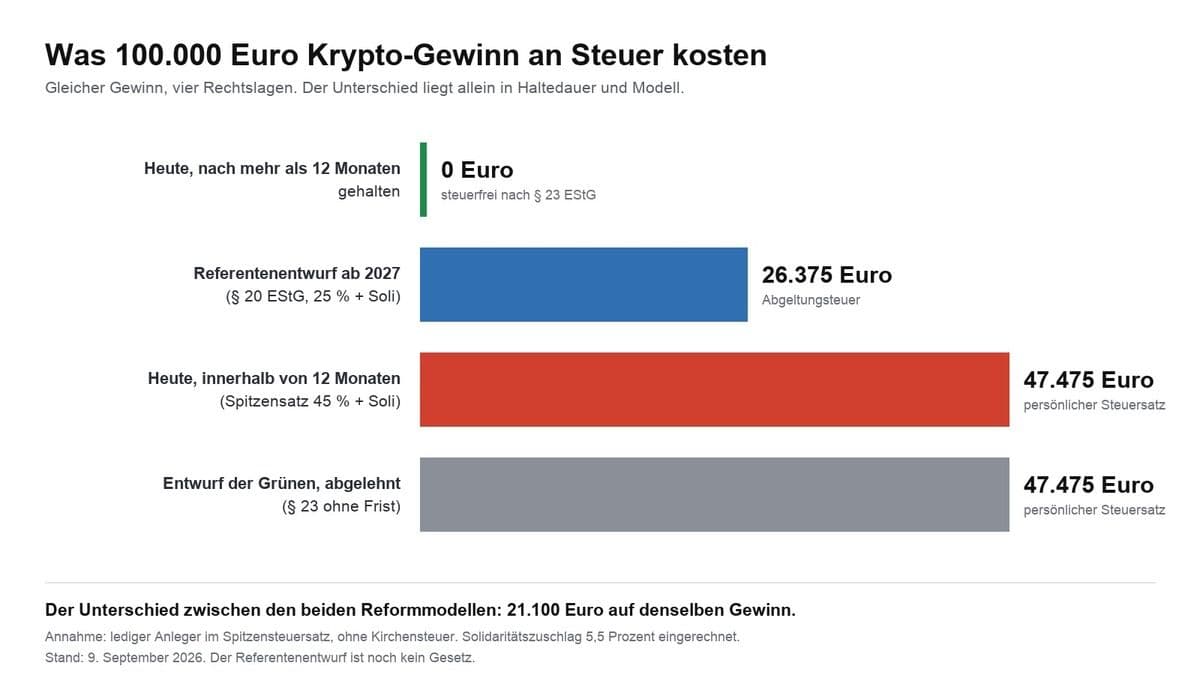
Crypto Tax in Germany: What Applies in 2026 and What Is Set to Change in 2027
Crypto gains are tax-free after twelve months; before that your personal tax rate of up to 45 percent applies. What triggers tax, how the holding period is calculated, what happens with staking and losses, and what the draft bill would change from 2027.
September 2, 2024 9:13 AM

Solana Price Analysis: What Will Happen To SOL Price This September 2024?
With Solana facing significant bearish pressure, what can investors expect in September 2024? Here are the key support and resistance levels that could determine SOL’s next move...
June 5, 2024 5:03 PM

Crypto Market Up: Bitcoin Breaches $71K, Altcoins Follow Suit, Eyes on New Highs
Cryptocurrencies are experiencing a surge, with Bitcoin leading the charge by surpassing $71,000. This bullish trend extends to altcoins, igniting optimism across the market. Will Bitcoin reach new highs?
More from CryptoTicker