
Cardano Before the RealFi Launch on October 1: What ADA Holders Should Check on USDr, MiCA and Tax
On October 1, 2026 the stablecoin platform RealFi goes live on the Cardano mainnet, and ADA has gained 14.67 percent in a week. What is documented about the yield-bearing dollar token USDr, and what investors should settle beforehand.




Which topics should we dive deeper into?
Select what genuinely interests you. Your picks feed directly into our editorial planning.
Crypto news that's actually worth your time.
Weekly. 60 seconds. Carefully curated by our editors: no hype, no promo flood, no spam.
Cardano traded at $0.2622 on September 26, 2026. That is 5.1 percent more than 24 hours earlier and 14.67 percent more than a week ago, measured through CoinGecko's public interface. No single impulse sits behind the rise. A date does: on October 1, 2026 the stablecoin platform RealFi goes live on the Cardano mainnet. That leaves five days in which you can settle three questions, namely access, tax, and whether the yield-bearing product will reach you in the European Union at all.
This article sets out what is documented about the launch, what the issuer itself states, and what remains open. The price levels come at the end, because here they are the consequence and not the occasion. Read only the subheadings and you will still have the checklist together afterwards.
What launches on the Cardano mainnet on October 1, 2026
RealFi is a platform that wants to channel capital from the blockchain into conventional bond and credit markets. It is backed by Input Output Global, the company that also leads the development of Cardano. The project has been running on a public testnet since July 6, 2026. In what it calls the Pioneer Season, more than 3,600 users took part and completed over 40,000 tasks, according to the project.
Two tokens arrive on the network at the mainnet launch. The first is called USDr and tracks the US dollar. The second is called sUSDr and is created when you deposit USDr into the protocol. Together they form a structure that has had its own legal treatment in the EU since MiCA, and this article's most important question for you hangs on exactly that.
Charles Hoskinson, head of Input Output Global, has publicly tied the launch to the expectation that the capital held on Cardano will rise. That is what the provider expects. It is not a measured figure. For context: the capital locked in Cardano applications stood at around $64 million at the time of the most recent reporting, a level that is small by the standards of large networks.
USDr and sUSDr: how the yield-bearing dollar token works
A stablecoin is a crypto token whose price is pegged to a fixed reference value, usually a currency such as the US dollar. USDr is, on the issuer's own account, the liquid base building block, and it generates no return of its own. Anyone who wants a return has to take the second step and lock USDr in the protocol. In exchange they receive sUSDr, and this second token carries the yield.
The split is no accident of product design. It separates the means of payment from the instrument that transports the return. For you as a holder it means one thing above all: these are two different assets with two different risks. USDr carries the risk of the dollar peg, sUSDr carries the risk of the underlying loans and bonds on top of that.
What the reserve consists of, and why the disclosures diverge
In the press release on the testnet dated July 6, 2026, RealFi describes the source of yield as money market funds, floating-rate corporate bonds and direct loans to fintech companies. Later reports on the mainnet launch describe the backing differently and additionally name US Treasuries and private credit. Both descriptions stand side by side, and we are not smoothing them into a single figure here.
For any assessment the difference is substantial. Short-dated government bonds and money market funds count as liquid and low in risk. Direct loans to companies do not: they cannot be sold at book value at any time, and their default risk depends on the solvency of individual borrowers. If you check one single thing about the product before October 1, check the published composition of the reserve and the question of who attests to it.
Up to 9 percent yield: what holds up in that number
The figure that appears most often in the reporting is up to 9 percent a year. It comes from the issuer's announcement on the testnet. The same document carries the qualification: the yields are described as indicative, variable and not guaranteed. John O'Connor, the head of RealFi, justifies the product in that same announcement by arguing that capital parked in stablecoins has so far remained economically unproductive.
A yield figure from a test phase is no commitment for live operation. The number describes what the underlying assets returned in a particular interest rate environment. If the rate level falls, that return falls with it, and the protocol need not have done anything wrong. Treat the 9 percent as the upper bound of a range whose lower end nobody has named.

The backdrop: Mastercard program, payment standard and Fireblocks
The RealFi date does not stand alone. The Cardano Foundation joined Mastercard's crypto partner program on September 15, 2026. On September 21 a connection to a payment standard for automated payments followed. On September 24 the custody provider Fireblocks announced full support for Cardano native tokens.
Those three items explain why the price moved over the week and not over an hour. What they address, though, are institutions. For you as a private investor, a custody solution for funds and companies changes nothing for now about which exchange you buy ADA on and where the tokens sit afterwards.
 Regulated crypto exchanges compared
MiCA and the interest ban: why Article 50 is the decisive hurdle here
A token that tracks a single official currency falls into the category of e-money token under the European regulation on markets in crypto-assets. For that category, Regulation (EU) 2023/1114 contains a rule in Article 50 headed Prohibition of granting interest. Issuers may not grant interest on e-money tokens, and service providers that provide services around such tokens may not do so either. For asset-referenced tokens the same rule sits in Article 40.
What matters is how widely the term interest is drawn there. It covers any remuneration and any other benefit related to the length of time someone holds the token. That applies expressly even where a third party grants the benefit rather than the issuer itself. A structure that passes the return out through a second token is therefore not automatically outside the rule; whether it is caught depends on the specific design.
What follows from this for RealFi is open. Public sources do not show whether USDr is authorised as an e-money token in the EU, whether an authorisation has been applied for, or whether the offering is meant to reach European retail customers at all. This is no verdict on the product's legality. It is an honest description of what could be documented from the outside. We have set out how strictly European supervision frames duties and deadlines for crypto companies in our overview of the MiCA licensing requirements.
Checking the authorisation yourself: where to look before you buy
You do not have to rely on anyone here. For stablecoins that may be issued to retail customers in the EU, the European securities regulator ESMA maintains a public register, and BaFin publishes the institutions authorised in Germany. If a dollar token does not appear there, regulated trading venues may not offer it to European retail customers. It is exactly this mechanism that has led in recent years to individual well-known stablecoins being taken off European trading venues.
In practice that means: if your trading venue does not list USDr after October 1, that is not necessarily a failing on the venue's side. It may be the rule taking effect. You will find an overview of trading venues holding European permission in our comparison of regulated crypto exchanges, and it also states which authority supervises each provider.
Crypto tax in Germany: why swapping ADA into USDr is a sale
This is where it gets concrete for German investors, and this is where the most expensive mistakes arise. Crypto-assets count in Germany as other assets within the meaning of Section 23 of the Income Tax Act. Swapping one crypto-asset for another is, for tax purposes, a disposal of the first and an acquisition of the second. If you swap ADA into USDr, you are selling ADA.
Two consequences hang on that. If your ADA purchase is less than a year old, the gain from that swap is taxable as soon as the total of all private disposals in the year reaches the threshold of 1,000 euros. A threshold of this kind is no tax-free allowance: once it is exceeded, the entire amount is taxable and not merely the excess portion. And for the USDr you receive in exchange, the one-year clock starts again, even though its price by definition barely moves.
Anyone who has already realised gains in the current year should therefore not run the swap as an afterthought. Five days are enough to check where you stand and to assemble your acquisition dates.

Income from sUSDr: why no holding period applies here
Different rules apply to the yield than to a price gain. The one-year holding period does not cover ongoing income, which is taxed in the year it accrues. Which provision applies exactly depends on how the product is structured. Where the return comes from a service you provide, it usually lands in other income under Section 22 number 3 of the Income Tax Act, with a threshold of its own at 256 euros a year. Where the transfer instead has the character of providing capital for consideration, income from capital assets under Section 20 comes into play.
Nobody can take that classification off your hands in the abstract, and with new products it is regularly disputed. What you can do yourself is the documentation: record the time, the amount and the euro equivalent of every credit, starting with the first one. Reconstruct it only in the following year and you will be working with prices you can no longer document.
 Keep your crypto tax under control
Custody: what Cardano native tokens demand of your wallet
USDr and sUSDr run as tokens on Cardano; neither is a blockchain of its own. For both you need a wallet that can carry Cardano native tokens. A hardware wallet that supports Bitcoin only will not do. Before October 1, check whether your device and its software display the token class, and test receiving with a small amount before you move a larger sum.
The Fireblocks announcement of September 24 concerns this point, but it is aimed at institutional custodians. That improves the position for funds and companies and changes nothing about the wallet on your desk.
Cardano price at $0.26: which levels count now
For context, the figures for September 26, 2026 according to CoinGecko: $0.2622, rank 16 by market capitalisation, around $9.84 billion in market value and $736.8 million in trading volume over 24 hours.
To the downside the $0.24 level is the nearest one. ADA had slipped below that value according to our reporting of September 24, 2026, before the current recovery set in; a reclaimed level tends to be tested again. To the upside the specialist outlet Coinpedia names $0.30 as the next target in an analysis dated September 25, 2026. That is this publication's assessment and no forecast from us.
One yardstick for the order of magnitude: ADA remains more than 91 percent below its 2021 high. Anyone who reads the current move as a trend reversal should know that distance.
What can go wrong on October 1
Three things are regularly observed at mainnet launches, and none of them is an accusation against this project. First, dates slip; an announced date is no delivery date. Second, liquidity is thin in the first few days, which leads to noticeable deviations from the expected price when entering and exiting. Third, protocols are especially exposed in the launch phase, because the code carries real money for the first time.
What follows from that is not abstention, but an order of operations: observe first, then use small amounts to check that deposits and withdrawals work, and decide on size only after that.
RealFi launch and ADA: what to take away
- Settle access before the date arrives. Check whether your trading venue holds European permission and which tokens it is allowed to offer you at all. The comparison of the best crypto exchanges shows which providers are open to German customers and how to recognise the supervisor.
- Work the swap through before you execute it. Moving from ADA into a dollar token is a disposal and can trigger tax. A portfolio tracker with a tax function records acquisition dates and holding periods; which tools manage that is set out in the overview of crypto tax software and portfolio trackers.
- Compare the yield with what you can already have. Before you entrust capital to a new product, a look at established routes and their terms is worth the time. Our overview of staking platforms and their returns supplies the benchmark against which a figure of up to 9 percent has to measure itself.
The primary sources for this article: RealFi's announcement on the public testnet of July 6, 2026 and the text of Regulation (EU) 2023/1114 with Articles 40 and 50.
(As of September 26, 2026. This article is not investment advice. Prices and fee structures change; check the terms with the provider before you buy.)
Transparency note: This article was produced with the assistance of artificial intelligence and reviewed by our editorial team before publication. All figures and claims were checked against the primary sources linked in the text. The feature image was generated with AI.
Related articles
- Cardano Slides Below $0.24: What ADA Holders Should Check on Leverage, Liquidation and Holding Period
- Stellar Becomes a Payment Rail at Mastercard's BVNK: What XLM Holders Should Check on Buying Route, Memo and Holding Period
- Zcash Above $1,500: What ZEC Holders Should Check on Tax and Custody
- Uniswap jumps above $9: what UNI holders should check on the fee switch now
- Dogecoin Price: What to Check on Holding Period and Custody Before the Year End
Which topics should we dive deeper into?
Select what genuinely interests you. Your picks feed directly into our editorial planning.
Crypto news that's actually worth your time.
Weekly. 60 seconds. Carefully curated by our editors: no hype, no promo flood, no spam.

September 24, 2026 10:12 AM

XRP Falls 9.7 Percent: What to Check on Holding Period and Buying Route
XRP is down around 9.7 percent on the morning of September 24, twice as much as the typical large crypto asset. Our count of 18 coins shows who the pullback hits and which three things hold true regardless of the price.

September 23, 2026 7:15 AM

SoFi Settles Card Payments in Stablecoin: What Cardholders Should Check
Since September 22, 2026, the US bank SoFi has run its entire card business through its own stablecoin, SoFiUSD, on the Mastercard network. What sets the model apart from a crypto credit card, and which rules would apply if a European provider followed suit.
September 26, 2026 7:40 AM
The RAIN Token After the Enlivex Termination: What to Check on Access, Forced Sale and Holding Period
Enlivex terminated a share placement of 66,666,667 shares payable in RAIN tokens on September 22, 2026. The token sits 46.4 percent below its all-time high, and at Kraken the withdrawal deadline expired long ago.
September 24, 2026 4:16 AM
Trump-Xi Summit at the White House: The Crypto Positions to Check Before the Meeting
Xi Jinping is on a state visit to Donald Trump today, and the crypto market comes into the meeting carrying the gains of an exceptionally strong week. What to check on leverage, holding period and custody before the first headline runs.

September 25, 2026 7:24 PM

Bitcoin Forecast: What to Check on Levels, Holding Period and Buying Route Before the Quarter Ends
Bitcoin stands at $83,877 at 16:40 UTC on September 25, 2026, and the measured volatility of the past 30 days spans a band of $73,600 to $94,200 for the coming month. More important than that band before the quarter ends are three checks: holding period, buying route under MiCA and the reporting duty in force since January 2026.
September 24, 2026 1:24 PM

NEAR Falls Almost 8 Percent After a 62 Percent Week: What to Check on Perps, Buying Route and Holding Period
NEAR Protocol loses up to 7.9 percent on September 24, 2026 and is still more than 55 percent higher over the week. The rally was carried by a confidential perp offering via Hyperliquid, which raises questions of its own on buying route, leverage and holding period in Germany.
September 19, 2026 7:17 AM

Chainlink Jumps Above $12: What LINK Holders Should Check Now
Chainlink trades at $12.34, 7.4 percent higher than yesterday. What part of the move is the broad market rally, what Chainlink itself contributes, and the three things you should check as a LINK holder.
September 24, 2026 10:11 PM

Bitcoin Price Prediction: What to Check on Levels, Holding Period and Leverage Before the October 28 Rate Decision
Bitcoin is trading at around $83,800, a third below its October 2025 high, while the sentiment index reads greed. Which dates, levels and deadlines over the coming weeks really decide your net gain, and which of them you steer yourself.
September 22, 2026 7:20 PM

ETH Price Prediction: What to Check at the $2,800 Mark Now
Ether stands at $2,735.96 on September 22, 2026, right below the zone at which it has failed repeatedly. Instead of a target number, you get four checks that count before your next order: holding period, buying route, the staking line and the distance to liquidation.
August 19, 2026 4:15 PM

Tether Audit by KPMG: What the Unqualified Opinion Means for USDT in the EU
Tether reported the first full audit of its financial statements by KPMG on August 13, 2026, with an unqualified audit opinion for the 2025 financial year. That changes nothing about whether USDT can be traded at authorised providers in the EU, because Article 48 MiCA decides that question.
September 27, 2026 7:14 PM

Solana Price at $121.93: What to Check on Staking Yield, Unstaking and Tax
SOL stands at $121.93 on September 27 at 16:42 UTC, after a 12.7 percent gain over seven days. More important than the weekly move is a calculation almost nobody makes: of the staking yield usually quoted, roughly a quarter is left in real terms, and the epoch decides when you can reach your coins again.
September 26, 2026 10:12 PM

Solana Price Above $120: What to Check on Staking Yield, Holding Period and Spread
Solana is trading at $121.00 on September 26, 2026, 8.6 percent above its level a week earlier. What a self-measured staking yield of 5.27 percent is worth, how the one-year holding period applies to staked SOL, and what an order in euros really costs.
September 24, 2026 10:19 AM

Uniswap Falls 11.8 Percent After a 114 Percent Month: What to Check on Profit Taking, Holding Period and Leverage
UNI lost 11.75 percent on Wednesday morning but is still up 113.85 percent over the month. Anyone realising gains now almost certainly triggers a taxable disposal in Germany.
September 22, 2026 10:15 PM

Stablecoin Reserves: Why the ECB Wants the Bank Deposit Rule Scrapped
The European System of Central Banks filed its response to the MiCA review on September 22 and calls in it for an end to the requirement to hold 30 to 60 percent of stablecoin reserves as a bank deposit. What lies behind it, and what you can check on your own token.
August 19, 2026 7:17 PM

MiCA Register of Stablecoin Issuers: 23 Authorised Firms, 43 White Papers and Two Dead Links
The official ESMA register lists 23 authorised issuers of e-money tokens and 43 notified white papers. We called up every document address stored there ourselves and show where the record leads nowhere.
September 30, 2026 4:14 AM

Bitcoin Price Before the Core PCE at 14:30 CEST: Will the $82,735 Level Hold?
At 14:30 CEST today the Bureau of Economic Analysis publishes the core PCE deflator for August, the inflation gauge the Fed anchors its 28 October rate decision to. Bitcoin stands at $83,329, less than $600 above its daily low, and anyone holding on leverage decides this morning.
September 27, 2026 10:14 AM
Shiba Inu Price Prediction: What to Check on SHIB Before the December 31 Deadline
SHIB trades at $0.00000592 on September 27, 2026, around 93 percent below its all-time high. For German investors one date matters more than the chart right now: December 31, 2026.
October 1, 2026 2:16 PM

Open USD is live but absent from the EU register: what matters now for investors in Europe
The dollar stablecoin Open USD launched on September 30, 2026, backed by Coinbase, Mastercard, Shopify, Stripe and Visa. On October 1, 2026 the token was not notified in the MiCA register, and that decides what you can do with it in Europe.
September 25, 2026 10:22 AM
Fed Rules for Stablecoins: What to Check on Backing and the Redemption Right
The Federal Reserve put forward two proposed rules on backing, capital and redemption of payment stablecoins on September 24, 2026. For your holdings in Germany, however, MiCA is what counts, and different checks follow from it.
September 24, 2026 1:13 AM

Solana DEX Trades Overtake the NYSE: What to Check on Swaps, Tax and Oversight
Solana's decentralised exchanges settled roughly 208 million trades in a single week and overtook the New York Stock Exchange for the first time. The figure is real, but it measures something other than the comparison suggests, and for German investors it carries tax duties that no provider takes on.
September 21, 2026 1:13 PM

Ethereum Rises While ETF Money Leaves: What ETH Holders Should Check Now
US ether funds lost $140 million in the week to September 18, ending four weeks of inflows. The ETH price still gained a good 5 percent.
October 2, 2026 4:40 PM

Ethereum price prediction: Citi raises its twelve-month target to $3,028, and what you can do now
Citi has raised its twelve-month target for Ethereum from $2,240 to $3,028. Anyone following that horizon also decides the tax on the gain with the purchase date.
September 26, 2026 7:24 AM

FF Unlock on September 29: What the End of the Lock-Up at Falcon Finance Means
On September 29, 2026, 203 million FF leave the one-year lock-up at Falcon Finance, which is 6.47 percent of circulating supply. What exactly is released, who receives it, and how to recalculate the release schedule yourself instead of trusting a headline.
September 24, 2026 10:36 PM

Ethereum Price Prediction: What to Check on Staking, Leverage and Where You Buy After Three Attempts at $2,800
Ether stands at $2,700 and has bounced off the zone around $2,800 three times in thirty days, without a single daily close above it. What our own count shows, and the three things to settle before the next attempt.
August 27, 2026 1:12 AM
Revolut Launches the EURR Euro Stablecoin: Why Germany Is Not in the First Wave
Revolut launched the EURR euro stablecoin on August 26, 2026, starting in Denmark, Poland and Portugal. For German customers a different date matters for now: the USDT deadline ends on August 31.
September 9, 2026 4:22 PM
Crypto Tax in Germany: What Applies in 2026 and What Is Set to Change in 2027
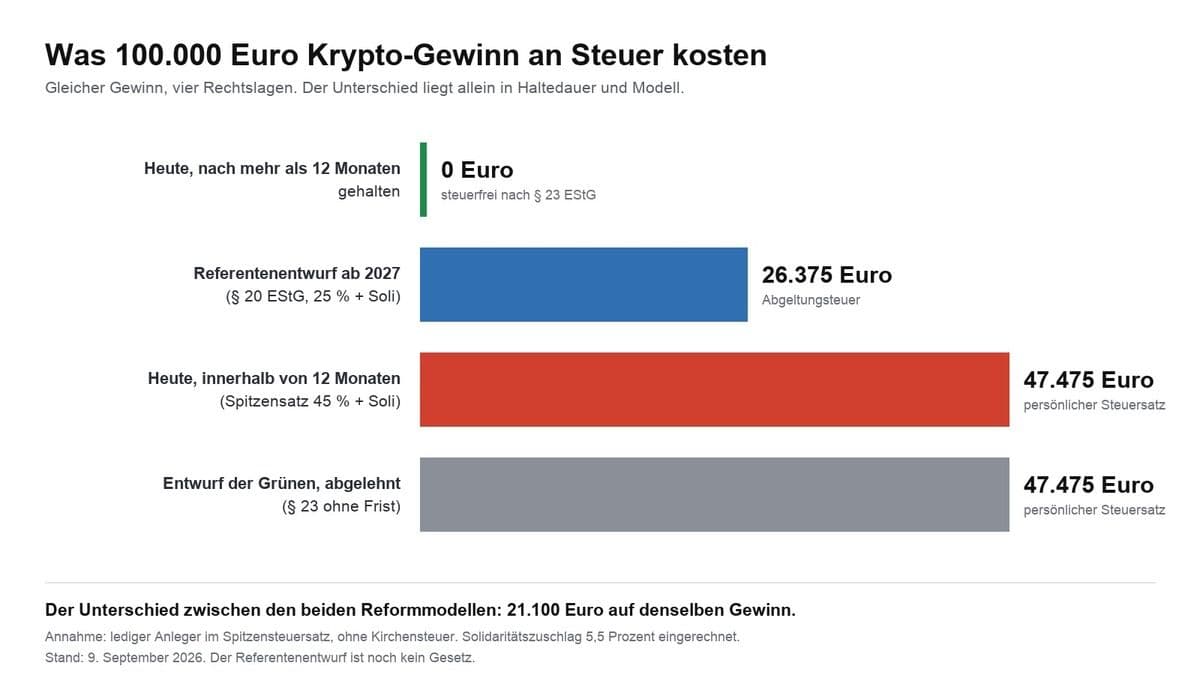
Crypto gains are tax-free after twelve months; before that your personal tax rate of up to 45 percent applies. What triggers tax, how the holding period is calculated, what happens with staking and losses, and what the draft bill would change from 2027.
September 8, 2026 10:21 PM

Crypto Holding Period and Grandfathering: Why December 31, 2026 Becomes the Cut-Off in Germany's Draft Bill
A ministerial draft bill from Germany's finance ministry names a cut-off date for the first time: crypto assets acquired after December 31, 2026 are to fall under the flat-rate withholding tax. What that means for legacy holdings, running savings plans and staking income, and why nothing has been decided yet.
More from CryptoTicker