
BaFin Warnings 2026: 24 Crypto Platform Series With 639 Domains, and How to Check Your Provider
In 2026 BaFin is increasingly warning about entire series of near-identical crypto websites rather than about single providers. Our own count of the complete stock of warnings shows how large the phenomenon has become and which two register checks reliably vet a provider.





Which topics should we dive deeper into?
Select what genuinely interests you. Your picks feed directly into our editorial planning.
Crypto news that's actually worth your time.
Weekly. 60 seconds. Carefully curated by our editors: no hype, no promo flood, no spam.
Germany's Federal Financial Supervisory Authority issued another warning on August 7, 2026 about a group of websites that resemble one another right down to the wording. It was the twenty-fourth warning of its kind this year. Notices like these usually pass unnoticed in the news flow: three or five addresses, a sober two-liner from the regulator, no losses quantified.
Taken together they paint a different picture. We therefore counted BaFin's entire stock of warnings. This analysis was compiled by cryptoticker.io on August 11, 2026. Method: using BaFin's expert search, all 34 results pages of the notice format were retrieved, the consumer notices on unauthorised business were extracted, deduplicated and counted by year, series membership and domains named. That produced 2,194 warnings from the years 2022 to 2026, plus the full text of the 24 series notices published this year.
The finding is of immediate practical use to crypto investors: the number of warnings is no longer growing, but their design is changing. Fraudulent offerings increasingly appear as a series rather than as a single website.
What BaFin calls a platform series and how to spot one
The regulator has coined its own term for the phenomenon. Its consumer notices refer to a „platform series“ or a „series of near-identical websites“: sites so similar in structure, design and advertising copy that BaFin covers them in a single notice.
The core of these notices is always the same sentence, in variants: according to BaFin's findings, the operators are offering banking business, financial services or crypto-asset services there without authorisation. The regulator has granted them no licence.
For you as a user, the series format is more dangerous than the individual case. Anyone who googles an address and finds nothing negative often reads that as reassurance. With a series, that is precisely what you would expect: the domain is new, without history, without reviews, without complaints. The template behind it is old, the specific address is not.
An analysis of 2,194 BaFin warnings: 397 notices in 2026 alone
By our count, the stock of warnings breaks down by year as follows:
| Year | Consumer notices on unauthorised business |
|---|---|
| 2022 | 203 |
| 2023 | 325 |
| 2024 | 560 |
| 2025 | 709 |
| 2026 (to August 11) | 397 |
The low figures for 2022 and 2023 say nothing about conditions at the time; it is more likely that older notices were removed from the stock. Only the two most recent years are therefore reliably comparable.
And there, something emerges that contradicts the widespread impression of a fraud wave growing ever faster. 397 notices in 223 days works out at an annual rate of roughly 650, against 709 in 2025. The number of warnings is stagnating rather than exploding. Within the year it fluctuates markedly: April was strikingly quiet at 33 notices, while July was the strongest month at 69.
24 series notices with 639 domains: the figures from our own count
The design is where it gets interesting. We counted every notice whose title identifies it as a platform series or a series of near-identical websites.
| Year | Series notices | Share of all warnings |
|---|---|---|
| 2024 | 6 | 1.1 percent |
| 2025 | 31 | 4.4 percent |
| 2026 (to August 11) | 24 | 6.0 percent |
While the total number of warnings is edging down, the share of series notices has more than quintupled within two years. Extrapolated, 2026 is heading for around 39 series warnings.
The 24 series notices published this year list 639 domains individually between them. None of them appears in two different notices. The remaining 373 warnings of the year, by contrast, overwhelmingly concern a single provider each.
In at least eight of the 24 series, BaFin explicitly names crypto-asset services in the decisive sentence. In six further cases the sentence could not be assigned automatically because the regulator words it differently. The number of crypto series is therefore higher than eight; exactly how much higher, we were unable to establish.
 Licensed Crypto Exchanges at a Glance
204 of the 639 domains end in .de: why the suffix says nothing about a licence
By our count, the domain endings of the 639 addresses break down as follows: 239 end in .com, 204 in .de, 109 in .net and 69 in .org. The rest are spread across smaller endings such as .pro, .app or .io.
Almost every third address warned about therefore carries the German country suffix. That is the single most important practical finding of this analysis, because many investors read the suffix as an indication of supervision and legal recourse. A .de domain can be had from any registrar; it presupposes neither a German business address nor a BaFin licence. The same applies to a legal notice, a phone number and a euro account.

Licensing requirements for crypto-asset services: what MiCA and the German Crypto Markets Supervision Act demand
Since the European MiCA regulation took full effect and Germany embedded it through the Crypto Markets Supervision Act, the legal position is unambiguous. Anyone offering crypto-asset services commercially in Germany, meaning trading, exchange, custody or intermediation, needs a BaFin licence and then appears in public registers.
That has simplified the check for you. It used to be contested whether an offering fell under German supervision at all. Today the rule is this: a provider targeting German customers that appears in no official register is very probably operating without authorisation. Which providers have actually been through the licensing process is set out in our overview of regulated crypto exchanges.
The licence is not a verdict on fees or usability. The entry says that a company exists, has been vetted and answers to a supervisor you can turn to. What the licensing requirement means for individual products is something we described in detail using the example of staking under MiCA.
The BaFin company database: how to check a licence in minutes
BaFin maintains a public company database listing every supervised institution with its name, registered office and type of licence. The comparison takes less than five minutes and is the only step that reliably separates a legitimate platform from a series copy.
What matters in the comparison
Search for the company name from the legal notice, not for the website's brand name; with unauthorised offerings the two frequently diverge. No result is itself a result. Where there is a hit, compare the registered office and legal form against the legal notice. If anything differs, the register entry prevails.
Pay attention as well to what the database records as the licence. A licence for payment services does not cover crypto trading. That very blurriness is what many questionable offerings work with, invoking a licence that does exist but was granted for something else entirely. The database is available directly from the BaFin company database.
The ESMA register of CASPs: the second check for providers based elsewhere in the EU
Many providers with German customers are licensed in another member state and operate from there under a European passport. These firms do not necessarily appear in the BaFin database, but they do appear in the register of the European Securities and Markets Authority, which lists the licensed crypto service providers of all member states.
In practice that means a miss in the BaFin database is not yet proof. Only when a provider is absent from both registers is the matter settled. Conversely, an entry in the ESMA register confirms the licence alone and says nothing about how your holdings are kept.

The series of March 11, 2026: 248 domains in a single warning
How industrially these offerings are produced is clear from one notice. On March 11, 2026, BaFin warned about a series of near-identical websites and, by our count, listed 248 domains in it. In the decisive sentence the regulator names financial and crypto-asset services said to be offered there without authorisation.
Three further notices this year run to 92, 59 and 48 domains. At the other end are series with only two or three addresses; the median is five. An uncomfortable conclusion follows: putting another copy online costs the operators almost nothing, while every single warning requires investigation, documentation and publication on the regulator's side.
 Hold Your Crypto Safely Yourself
Why a BaFin warning is never complete, and what follows for your own check
BaFin itself points out that its warnings can never be complete, because there are many dubious providers and their methods change constantly. That qualification matters more than it sounds.
It means the absence of a warning proves nothing. Anyone who looks for an address on the warning list and fails to find it has established only that the regulator has not so far commented on that address. With a series platform registered three weeks ago, that is exactly what you would expect.
The check therefore has to run the other way round. The question that holds up is whether a provider appears in a licensing register. The warning list collects individual cases, the register is exhaustive; only the second source allows a firm no. A practical guide to recognising forged payment demands issued in an exchange's name can be found in our article on phishing after the MiCA deadline.
Features that recur in the notices analysed
- An advertising promise in the header that reappears in slightly modified form on other domains.
- A legal notice without a commercial register number, or with a number that cannot be found in the register.
- A sign-up process that demands a deposit before the platform even becomes fully visible.
- An account that displays profits but ties withdrawals to additional payments.
If money has already changed hands: police report, bank and the top-up demand
If you have already paid in, one thing counts above all: make no further payment. Being asked to transfer taxes, fees or a deposit first in order to release a supposed withdrawal is part of the standard repertoire. BaFin explicitly advises consumers to exercise great caution with online investments and to research thoroughly before the first transfer.
Three parallel steps make sense: a report to the police, an immediate notification to your own bank or payment service provider, and a tip-off to BaFin, which feeds such reports into its investigations. With card payments and direct debits there are recovery options that deteriorate by the day. With an international transfer or a payment in cryptocurrency the prospects are slim, but the documentation remains important for investigations and tax questions.
This analysis rests on the regulator's publications, not on loss figures. How much money flowed through the 639 domains, how many people are affected and how many of the addresses are still reachable today does not emerge from the notices and we were unable to verify it. Nor can it be established whether the same operators are behind several of the series.
What to take away
- Check the register, not the warning list. Search for the company name from the legal notice in the BaFin company database and, if the provider is based elsewhere in the EU, in the ESMA register. A provider missing from both is out of the question. Which exchanges pass this check is shown in our overview of regulated crypto exchanges.
- Do not let the suffix or the language reassure you. 204 of the 639 domains warned about this year end in .de. Compare the fees, custody arrangements and registered offices of licensed providers instead, for example in our crypto exchange comparison.
- Separate trading from custody. Keep only what you need in the short term on the trading platform and store the rest yourself. Which devices are suitable and what they cost is set out in our hardware wallet comparison.
You can inspect the basis of this analysis yourself at any time: at the BaFin warning notices.
(As of August 11, 2026. This article is not investment advice. Prices and fee structures change; check the terms with the provider before you buy.)
Transparency note: This article was produced with the assistance of artificial intelligence and reviewed by our editorial team before publication. All figures and claims were checked against the primary sources linked in the text. The feature image was generated with AI.
Related articles
- BaFin Warning Over Identity Misuse: When a Crypto Platform Borrows a Real German Company's Name
- BaFin Warnings in September: How to Check in Three Minutes Whether a Crypto Provider Holds Authorisation
- EU warning list for crypto providers: 167 entries, 165 of them from Italy, none from BaFin
- Your Crypto Exchange Is Telling You to Withdraw: How to Spot Phishing After the MiCA Deadline
- BaFin warns over nova-c-solutions.com: What is behind a genuine registration number
Which topics should we dive deeper into?
Select what genuinely interests you. Your picks feed directly into our editorial planning.
Crypto news that's actually worth your time.
Weekly. 60 seconds. Carefully curated by our editors: no hype, no promo flood, no spam.

September 25, 2026 10:31 AM
BaFin Warning: What Happens When You Enter Your Data on an AI Crypto Platform
On September 23, 2026 BaFin warned about 39 near-identical websites presenting themselves as AI-powered crypto trading platforms. On its findings these pages take no money but pass the data left in their contact form on to unauthorized trading platforms.
September 19, 2026 1:14 AM

Crypto investment fraud: when the tax office taxes phantom gains and what to check now
Between September 11 and 16, 2026, BaFin published thirteen consumer notices, seven of them on crypto-assets. Anyone who has paid into such a platform risks not only the loss but, in some circumstances, a tax demand on gains that never existed.
August 21, 2026 7:46 AM

Crypto Job Offers Using Your Own Bank Account: How the Money Mule Scheme Works and Why Money Laundering Starts With Negligence
On August 18, 2026 BaFin warned about job offers in which applicants are to pass third-party payments through their own account and exchange them into crypto-assets. Anyone taking part risks criminal proceedings for money laundering, and gross negligence is already enough.
August 6, 2026 3:05 PM
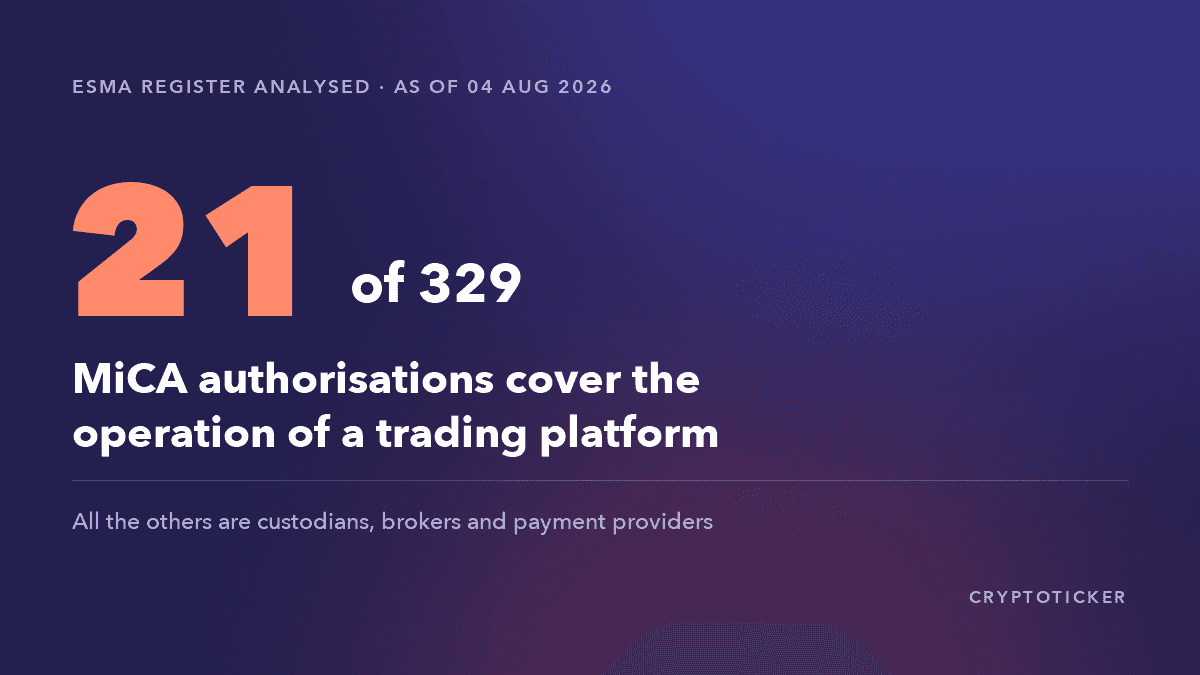
MiCA Register 2026: Only 21 of 329 Licences Are Real Exchanges
ESMA publishes the register of MiCA-authorised providers as an open file. We worked through all of it — and the result is not what the phrase “licensed crypto exchange” suggests.

July 2, 2026 8:59 PM
Binance Is Out of the EU: How to Move to a MiCA-Regulated Exchange
Binance has left the EU market. Which exchanges hold a MiCA licence, how to verify an authorisation is real, and how to move your holdings across step by step.
September 29, 2026 10:33 AM
ESMA puts reverse solicitation on its 2027 watch list: what investors need to know about exchanges without an EU licence
ESMA presented its work programme for 2027 on September 28, 2026 and made reverse solicitation a supervisory priority. What that means if your coins sit with a provider without EU authorisation, and which three steps make sense now.
August 15, 2026 9:31 PM

Crypto Exchange Shutting Down: What to Do Before the Deadline Passes
Binance, BitMart, Luno and Revolut have ended or cut back their European business within seven weeks. This guide shows which deadline expires first, how a forced sale is treated for tax, and what to secure before the account closes.
September 13, 2026 4:33 AM

Your Volksbank's Crypto Licence: Why You Have to Check Custody Separately
14 of the 16 newest CASP entries in the ESMA register were German cooperative banks, and each one carries order execution only. Our count of the BaFin database shows that not one of the 21 cooperative institutions is registered as a crypto custodian.
August 21, 2026 7:17 AM

Checking a MiCAR White Paper: What the First Published MiCA Penalty Against Bitpanda Means for Investors
Austria's FMA has fined Bitpanda GmbH 70,000 euros because a crypto-asset white paper was filed late and advertised before it had been published. We explain what rights this mandatory document gives you, and called up all 972 white papers held in the ESMA register to see whether they can be reached at all.
September 25, 2026 4:11 AM
Bitget Hack of $351 Million: What to Check at Your Crypto Exchange Now
Bitget reports unauthorised outflows of around $351.6 million and has suspended withdrawals. For existing customers in Europe, that closes the one route MiCA had left them.
September 15, 2026 4:12 AM

Using Hyperliquid from Germany: What Applies to Your Funds Without a MiCA Licence
Hyperliquid is not entered in any EU register as an authorised crypto-asset service provider, and for perpetual futures a MiCA licence would be the wrong paperwork anyway. Here is what that means in concrete terms for your funds, your keys and your tax return.
September 26, 2026 4:21 AM
Operation Herakles disconnects 13,888 phone numbers: what to check on crypto investment calls
Six authorities have disconnected 13,888 phone numbers used by investment fraudsters to call their victims in Operation Herakles, 9,304 of them in the past three months alone. What the Federal Network Agency now requires of telecoms providers and which three checks protect you from the scheme.
August 22, 2026 10:13 AM

BaFin Warns Against NC Wallet and ncwallet.net: What Users of the Wallet App Must Check Now
On August 19, 2026, BaFin issued a warning about the NC Wallet app and two websites: on the regulator's findings, the unknown operators offer financial services there without authorisation. Because the wallet is custodial, it is the provider and not you who holds the key to your balance.
August 19, 2026 7:17 PM

MiCA Register of Stablecoin Issuers: 23 Authorised Firms, 43 White Papers and Two Dead Links
The official ESMA register lists 23 authorised issuers of e-money tokens and 43 notified white papers. We called up every document address stored there ourselves and show where the record leads nowhere.
February 24, 2025 6:22 PM

German DekaBank Introduces Cryptocurrency Trading and Custody Services for Institutional Clients
DekaBank, managing $395 billion in assets, launches cryptocurrency trading and custody services for institutional clients, marking a significant step in integrating traditional finance with digital assets.
October 1, 2026 7:32 AM

Starting a crypto company in Germany: legal form, BaFin licence and capital
Setting up a crypto company in Germany: which business models need BaFin authorisation under MiCA, GmbH or UG, how much capital is required and where public support is available.
August 21, 2026 10:27 AM

Complaining About a Crypto Exchange: the Deadlines Article 71 MiCAR Sets and Why BaFin Will Not Decide Your Case
Authorised crypto providers have to run a formal complaints procedure, and Delegated Regulation (EU) 2025/294 sets a hard limit of two months for it. Our own analysis of the ESMA list shows at the same time that no complaints link is on file for Germany to this day.
September 25, 2026 7:11 AM
EU Supervisors Rate Quantum Risk as High: What to Check on Crypto Custody and Exchange Choice
EBA, EIOPA and ESMA name quantum computers explicitly as a threat to blockchain cryptography in their autumn risk picture of September 23. What the paper says, which migration deadlines run to 2030, and three things you can check about your custody.
August 19, 2026 10:37 AM

Who Regulates Crypto in the US? CFTC and SEC Compared
On 20 August 2026 the new innovation advisory committee of the US derivatives regulator CFTC meets for the first time, staffed with the chief executives of Coinbase, Kraken, Gemini and Ripple. What separates the two US agencies, and why MiCA and BaFin still count for your portfolio.
September 30, 2026 10:40 PM

ESMA Calls for Advertising Rules on Crypto Influencers: Six Changes Now Sitting With the EU Commission
The EU securities watchdog filed its response to the MiCA review on the final day of the consultation. Among the demands are disclosure on staking, a licensable DeFi gateway and the power to freeze crypto assets.
October 1, 2026 2:16 PM

Open USD is live but absent from the EU register: what matters now for investors in Europe
The dollar stablecoin Open USD launched on September 30, 2026, backed by Coinbase, Mastercard, Shopify, Stripe and Visa. On October 1, 2026 the token was not notified in the MiCA register, and that decides what you can do with it in Europe.
September 30, 2026 4:45 PM
CFTC Registers Coinbase Clearing for Fully Collateralised Derivatives: What Matters for Investors in Europe
The US regulator CFTC registered Coinbase Clearing as a clearing house on September 28, but only for fully collateralised contracts without leverage. For investors in Europe another decision counts for more: ESMA's CFD classification of perpetual futures.
September 26, 2026 10:23 AM

Trive: Client Funds Frozen - What Holders of Crypto CFDs Can Check Now
The Maltese supervisor MFSA has instructed Trive Financial Services Europe to freeze client funds; BaFin speaks of numerous affected clients in Germany. Why a crypto CFD is treated differently from a coin in your own wallet, and which steps are possible now.
September 1, 2026 4:12 AM

USDT cashback and 7 percent on stablecoins: what the MiCA interest ban means for you
A new payment card advertises up to 10 percent cashback in USDT and up to 7 percent a year on the balance. Article 50 MiCAR explains why a provider licensed in the EU is not allowed to pay you exactly that.

October 29, 2018 7:42 PM

South Korea issues another warning to crypto investors
The FSC warned investors not to be misled into believing that public Cryptocurrency funds represent legal investing tools that comply with Korean regulation
September 19, 2026 4:11 PM

MiCA Consultation Closes September 30: What to Check and Submit Before Then
The European Commission is reviewing the MiCA crypto regulation and will accept submissions until September 30, 2026 at 23:59 CEST. Staking, DeFi, lending, stablecoins and custody are all under examination, and you can take part without a lawyer.
September 1, 2026 10:13 AM

BaFin Crypto Knowledge Survey: Four Assumptions Owners Believe Are True
BaFin has measured what crypto owners know about their products: 57 percent of the answers were correct, 31 percent wrong. Four false assumptions come up especially often, and each of them changes your own investment decision.
More from CryptoTicker