
Operation Herakles disconnects 13,888 phone numbers: what to check on crypto investment calls
Six authorities have disconnected 13,888 phone numbers used by investment fraudsters to call their victims in Operation Herakles, 9,304 of them in the past three months alone. What the Federal Network Agency now requires of telecoms providers and which three checks protect you from the scheme.



Which topics should we dive deeper into?
Select what genuinely interests you. Your picks feed directly into our editorial planning.
Crypto news that's actually worth your time.
Weekly. 60 seconds. Carefully curated by our editors: no hype, no promo flood, no spam.
Six authorities from Germany and Austria published a joint set of figures at 9:35 a.m. on September 25, 2026: over the past three months, Operation Herakles has taken 9,304 German phone numbers out of service, numbers investment fraudsters had used to call their victims. Since the operation began the total stands at 13,888 numbers, 13,397 of them German and 491 Austrian. If a call about a crypto investment reaches you in the coming weeks, that figure is precisely why you should handle the conversation differently than before.
The announcement comes from the Karlsruhe public prosecutor general’s office with its cybercrime centre, the Baden-Württemberg state criminal police office, the Federal Criminal Police Office, the Federal Financial Supervisory Authority, the Federal Network Agency and the Austrian Federal Criminal Police Office. It targets a form of fraud the authorities call cyber trading fraud: simulated trading in crypto-assets, foreign exchange or shares on platforms that never held a licence.
Operation Herakles on September 25, 2026: 9,304 phone numbers disconnected in three months
The figures in the press release are tiered. Over the past three months, 9,304 German phone numbers were taken off the network. The cumulative total since the operation started stands at 13,888 numbers. The authorities state the split explicitly: 13,397 from Germany, 491 from Austria.
Earlier steps of the same operation add to that. In June and October 2025 investigators took more than 2,200 domains offline by their own account, and in December 2025 some 3,500 phone numbers. Operation Herakles is therefore not a single raid but a series of measures running for more than a year, and its pace has picked up lately: the 9,304 numbers of the last quarter are more than double the December action.
Placed within the authorities’ anti-scam strategy, the point is not the criminal prosecution of the people behind the scheme but their tools. That distinction matters for the question of what the operation changes for you, and it comes up again below.
Cyber trading fraud: how the fake trading platform scheme works
Cyber trading fraud describes investment fraud in which a platform merely simulates trading in crypto-assets, foreign exchange or derivatives while the money paid in never reaches a market. The press release puts that core unambiguously: the funds paid in are at no point channelled into any investment.
According to the authorities the sequence follows a fixed pattern. Victims first come across a fraudulent investment platform holding no financial supervisory licence. Brokers from call centres abroad then get in touch by phone and push for larger deposits. The presentation is professional, and the deception holds for months: the gains displayed in the user account rise while the money has long since left through the perpetrators’ account. In the end it is usually lost in full, as investigators describe it.
The phone call is not background noise here but the centrepiece. Without the voice on the line, a made-up platform remains a website that talks nobody into a second deposit. That is exactly why the authorities are going after it.
What separates this scheme from phishing
In phishing, somebody captures your login credentials and empties an existing account. In cyber trading fraud you transfer the money yourself, voluntarily, believing you are paying for an investment. For recovery that is a considerable difference, because an authorised transfer is treated differently from an unauthorised one. How to spot a pretextual check designed to make you connect your wallet is set out in our article on the fake AML check for crypto wallets.
Why the phone number is the point of attack and not the platform
A domain can be registered anew within minutes. A German phone number cannot: it has to be allocated to a telecommunications provider and assigned to a holder. A call starting with a German dialling code is valuable to fraudsters because the people called pick up. A foreign number gets rejected.
So the Federal Network Agency intervenes where that benefit of the doubt arises. As the authorities describe it, the agency has taken supervisory measures against telecommunications companies: providers had to disconnect the numbers concerned and overhaul their registration processes. On top of that they are to vet their sales partners and dealers more strictly, so that numbers do not end up in the same hands again.
That is the genuinely new part of the announcement. Not the number of disconnections, but the requirement on providers to control access to phone numbers differently than before.
 Regulated crypto exchanges compared
Checking licence status: how to tell a licensed crypto exchange from an invented one
In their statement the authorities explicitly recommend verifying the licence status of a financial provider before any money moves. For crypto-asset services in Germany that is a reasonable check to ask of anyone, because the licence is a matter of public record.
Anyone providing crypto-asset services in the European Union needs authorisation under the EU regulation on markets in crypto-assets. Crypto-asset service provider is the legal term for companies that hold, exchange, place or trade crypto-assets on behalf of others. The obligations that come with it, and the way an authorisation granted can be recognised, are matters we have covered separately in our overview of the MiCA licensing duties for crypto companies.
In practice this means looking the provider up in the company database of the financial supervisory authority and in the public list of authorised service providers. Failing to find it there is not proof of fraud in itself, but it is the point at which no deposit may take place. A selection of trading venues whose licensing position we have checked is in our comparison of the best regulated crypto exchanges. The supervisory authority also publishes warnings about individual providers on an ongoing basis, and a look there belongs to the same check.
Matching the name alone is not enough
A recurring pattern from earlier warnings: perpetrators use the name of a genuinely authorised company and rebuild its website. The database entry then really does exist but belongs to a different firm. So compare not only the name but also the domain, the address and the register number in the entry against what has been put in front of you. If the domain differs while the name matches, the matter is settled.
The warning signs in the conversation: time pressure, remote access, document copies
The authorities name three rules of conduct that can be applied on the call itself: do not let yourself be pressured, do not pass on confidential data or copies of documents, and obtain precise information about the platform before registering.
In the conversation itself you recognise the scheme by its dramaturgy. There is an opportunity that ends today. There is a personal adviser who will call back if you hesitate. There is a screen share so that he can help you set things up. And there is the request for a scan of your ID, formally justified by identity verification.
The last point deserves a remark of its own because it looks harmless. Identity verification is indeed mandatory at an authorised provider. There, however, it runs inside the provider’s own closed process, not as a photo you send to a caller by messenger. A scan of your ID in someone else’s hands opens further accounts in your name, and that damage remains even if you never paid anything in.
What a genuine platform never asks of you
Four things do not occur at an authorised service provider, and each one on its own ends the conversation:
- remote access or screen-sharing software you are asked to install in order to open an account
- a deposit into a private account, an account in a third country, or straight into a wallet address read out to you over the phone
- a request to enter your seed phrase or photograph it so that a balance can be released
- a payment so that a gain supposedly already made can be paid out
The last point is the second stage of the fraud. Anyone who has paid once is called again later, this time with the promise of recovering the money lost. Anyone who wants to keep their crypto-assets permanently out of reach of others cannot avoid self-custody; what separates the devices is set out in our hardware wallet comparison.
When money has already moved: criminal complaint, evidence and the time factor
The authorities recommend filing a criminal complaint in the event of fraud, and point to consumer advice centres or independent financial advice. What counts for the complaint is what you can produce.
So secure above all the payment records with date, amount and recipient details, the complete communication including phone numbers and timestamps, the addresses of every wallet you transferred to, and screenshots of the user account with the gains it displayed. The last of these matter more than they look: they document the deception. With a bank transfer, inform your bank in parallel, because recovery is only possible at all within a narrow window of time.
What you have to bear in mind for tax purposes in a case of investment fraud is a separate question, because the tax office may under certain circumstances treat phantom gains as taxable even though no money ever reached you. The details are in our article on phantom gains in crypto investment fraud.
 Hardware wallets compared
What the disconnections achieve, and what they do not
At this point we separate what is documented from our own assessment. Documented is the number of phone numbers disconnected, documented is the requirement imposed on telecommunications providers, documented is the constellation of authorities involved. Everything that follows is our reading and not a statement by the authorities.
A disconnected number ends a call, yet it does not end a call centre. The call centres sit abroad as investigators describe it, and access to new numbers is the bottleneck the Federal Network Agency wants to narrow with tighter registration duties. Whether that holds depends, in our view, on how consistently providers vet their sales partners, and from the outside that can only be read off the next set of figures.
A second expectation follows from the rhythm of the operation, and we state it explicitly as a supposition: after more than 2,200 domains in 2025 and 13,888 phone numbers to date, the pressure is more likely to shift the perpetrators to other channels of contact than to make them stop. Messenger groups and messages on social networks need no allocated phone number. There is no reliable figure for that, which is why we give none.
For you something uncomfortable follows from it. The disconnections do not take the check off your hands. They reduce the number of calls that reach you at all, and they raise the likelihood that a call getting through comes from a newly procured number. The decision still falls in the moment you either check the licence status or fail to.
Austria, Germany and the question of jurisdiction
That 491 of the disconnected numbers are Austrian and that the Austrian Federal Criminal Police Office is involved shows the reach of the operation across the border. For you as an investor in Germany, however, the German financial supervisory authority remains the competent supervisor, and you file your criminal complaint with the German police. A platform domiciled abroad changes none of that.
Putting Operation Herakles in context: what to take away
- Check the licence before you pay, not afterwards. Look the provider up in the supervisory authority’s company database and compare the name, the domain and the address, not just the name. A vetted selection of trading venues is in our comparison of the best crypto exchanges.
- End every conversation that involves time pressure, remote access or a scan of your ID. When in doubt, call back on the provider’s officially published number instead of accepting the call-back. Which exchanges are under supervision is set out in the comparison of regulated crypto exchanges.
- Move your holdings out of reach of others. Anyone holding their own keys cannot grant a release over the phone, because there is nobody who could grant one. The devices and their differences are in the hardware wallet comparison.
The joint press release of the authorities involved can be read in the original; a detailed assessment of the technical side has been published by heise online.
(As of September 25, 2026. This article is not investment advice. Prices and fee structures change; check the terms with the provider before you buy.)
Transparency note: This article was produced with the assistance of artificial intelligence and reviewed by our editorial team before publication. All figures and claims were checked against the primary sources linked in the text. The feature image was generated with AI.
Related articles
- Your Crypto Exchange Is Telling You to Withdraw: How to Spot Phishing After the MiCA Deadline
- Three of the 25 Largest Coins Have No Euro Pair: How to Check Your Buying Route Before the Order
- Binance Is Out of the EU: How to Move to a MiCA-Regulated Exchange
- ESMA puts reverse solicitation on its 2027 watch list: what investors need to know about exchanges without an EU licence
- “We have created the essential conditions …”: bitcoin.de has stood still for three months, the MiCAR licence is missing
Which topics should we dive deeper into?
Select what genuinely interests you. Your picks feed directly into our editorial planning.
Crypto news that's actually worth your time.
Weekly. 60 seconds. Carefully curated by our editors: no hype, no promo flood, no spam.

September 12, 2026 7:13 AM

BaFin Warnings in September: How to Check in Three Minutes Whether a Crypto Provider Holds Authorisation
Twelve consumer notices in ten days, five of them on crypto-asset services and two with the entry point in WhatsApp or Telegram. We evaluated all twelve notices ourselves and show the check that takes you three minutes.
August 6, 2026 3:05 PM
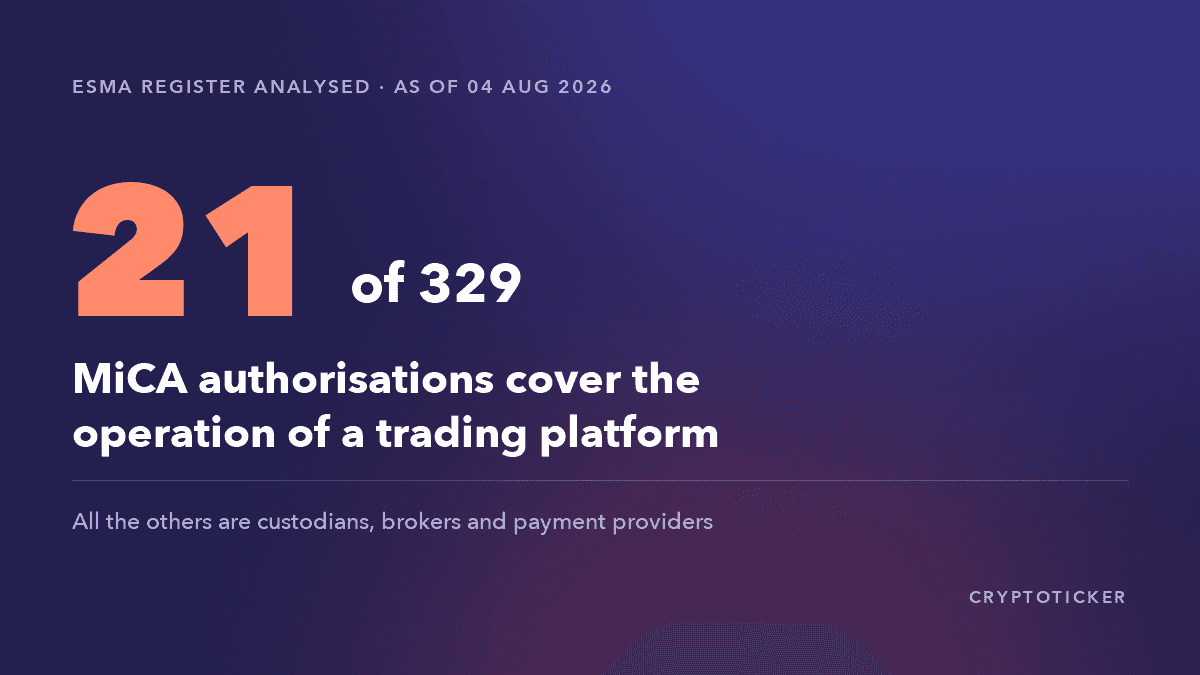
MiCA Register 2026: Only 21 of 329 Licences Are Real Exchanges
ESMA publishes the register of MiCA-authorised providers as an open file. We worked through all of it — and the result is not what the phrase “licensed crypto exchange” suggests.

June 30, 2026 11:20 PM
How to Switch from Binance to a MiCA Regulated Crypto Exchange
Binance is winding down EU services after missing the MiCA deadline. Here's why it's happening and how to move your funds to a regulated platform safely.
September 10, 2026 1:21 AM
Crypto Exchanges Head to Head: Which Pairing Is Cheaper Where
Before opening an account, the question is rarely which exchange is best overall, but whether it should be this one or that one. This article sorts through the most searched head-to-heads, puts the cost per 1,000 euros side by side and explains the most expensive mix-up: one provider with two interfaces and a factor of seventeen between them.

January 31, 2025 11:45 AM
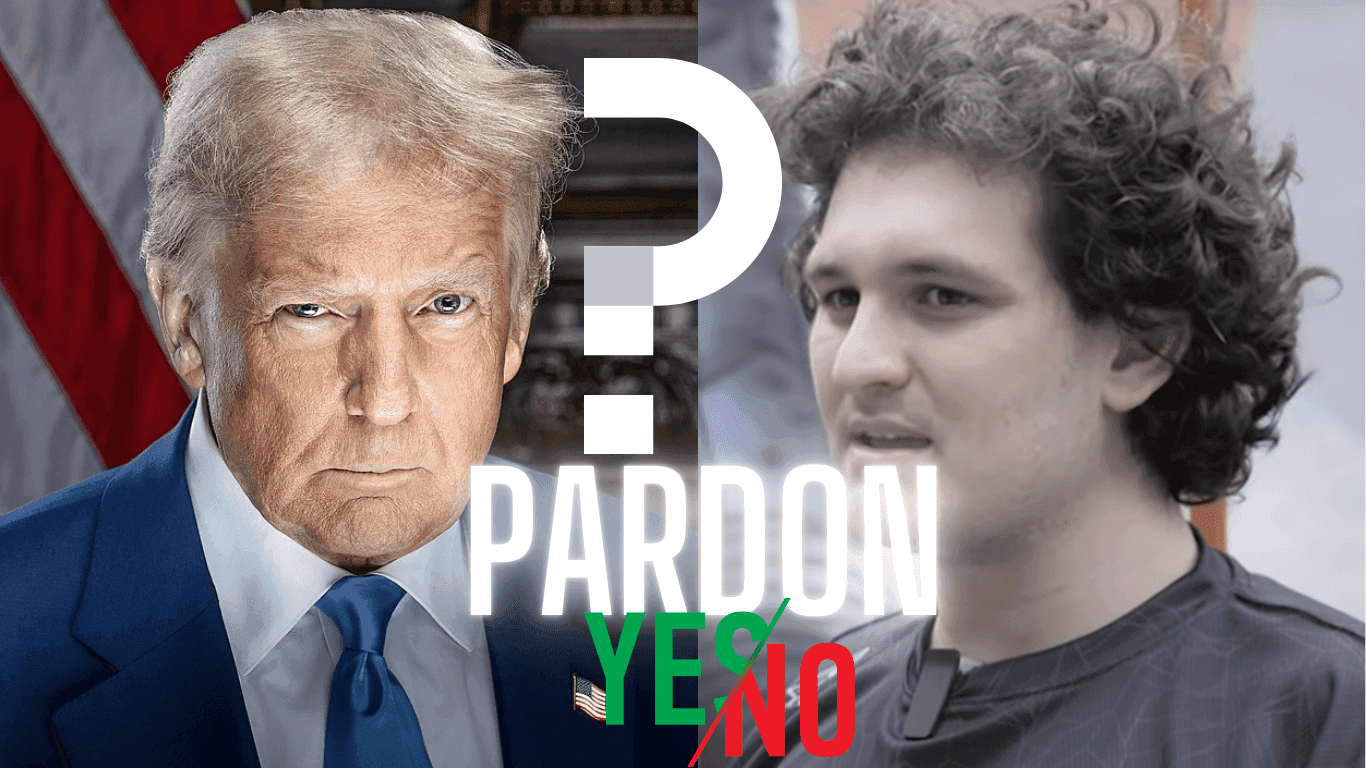
What Happens If Sam Bankman-Fried Gets a Pardon From TRUMP?
The parents of Sam Bankman-Fried are reportedly exploring a presidential pardon from Donald Trump for their son. What would a pardon mean for the crypto industry?
June 26, 2026 5:35 PM
Binance Is Leaving the EU on July 1 — What It Means for Your Funds
Binance will stop serving EU customers from July 1 after failing to secure a MiCA licence. Here's what it means for your funds and your next move.
September 29, 2026 1:15 AM

BaFin warns over nova-c-solutions.com: What is behind a genuine registration number
The BaFin has warned about a website offering crypto-asset services without authorisation and speaks of a presumed identity theft at the expense of a real US company. The case shows why the advice to look a provider up in the register does not carry on its own.
October 1, 2026 7:32 AM
Starting a crypto company in Germany: legal form, BaFin licence and capital
Setting up a crypto company in Germany: which business models need BaFin authorisation under MiCA, GmbH or UG, how much capital is required and where public support is available.
August 15, 2026 9:31 PM
Crypto Exchange Shutting Down: What to Do Before the Deadline Passes
Binance, BitMart, Luno and Revolut have ended or cut back their European business within seven weeks. This guide shows which deadline expires first, how a forced sale is treated for tax, and what to secure before the account closes.
June 3, 2025 7:00 PM

Top 3 Altcoins Under $1 with 10x Potential: Latest Altcoin News Analysis
With several promising altcoins trading under $1, investors are positioning themselves for potential 10x returns. Here are the top 5 that are shortlisted.
September 10, 2023 6:19 PM
This Crypto CEO got Jailed for More than 10,000 Years…Here’s Why!
Thodex Crash: Faruk Fatih Ozer, the CEO and founder of the Turkish crypto exchange Thodex, has been sentenced to 11,196 years in prison.
August 3, 2023 6:25 PM
Just In: Binance Possibly Facing Fraud Charges from U.S. DOJ
The U.S. Department of Justice (DOJ) is weighing charges of fraud against the crypto giant. Is Binance in danger?

April 24, 2023 6:54 AM
3 Types of Scammers in the Crypto World
The recent rise of cryptocurrencies brought about a new threat – scammers. Here are 3 types of scammers in the Wild, Wild West of cryptos.

August 31, 2023 9:24 AM
Top 5 Bitcoin ETFs You Can’t Afford to Miss!
The most optimal Bitcoin exchange-traded funds provide a pricing exposure. This article is all about the top 5 Bitcoin ETFs.
April 30, 2023 11:46 PM
How to Buy Bitcoin on eToro?
eToro is now one of the most popular platforms for trading in assets. The trade in cryptocurrencies has been greatly expanded in recent years. Today we will show you step by step guide on how to trade Bitcoin on eToro. […]
November 8, 2018 11:23 AM
The Three Easiest Ways To Buy Bitcoin
Buying Bitcoin can be simple and smooth. Users should always remember that they should never expect to make a million dollars overnight.
May 18, 2026 8:15 AM
Bitget Review 2026: Is Bitget a Good Crypto Exchange? What You Need to Know
Explore the key insights and safety considerations of trading on Bitget. Make informed decisions before you start trading. Read the full review now!

February 24, 2025 12:51 PM
Top 5 Reasons Why Backpack Crypto Exchange is Crushing It
Whether you're a beginner looking for a seamless entry into trading or an advanced user seeking innovative financial products, Backpack has something for everyone.
September 27, 2026 4:32 AM
Hester Peirce Leaves the SEC: What Now Applies to Your Custody in Germany
The most crypto-friendly voice at the US securities regulator goes on October 2, 2026, and the commission shrinks to two members. For investors in Germany it is still the European rulebook that decides, and there a deadline falls in July 2027.
September 26, 2026 4:14 PM

Bitget Withdrawals Resume on September 28: What to Check on a Residual Balance Now
Bitget is releasing the withdrawals frozen after the September 24 incident in four stages from September 28. For a residual balance held from Germany that is a deadline, not a reason to wait.
September 25, 2026 4:11 AM
Bitget Hack of $351 Million: What to Check at Your Crypto Exchange Now
Bitget reports unauthorised outflows of around $351.6 million and has suspended withdrawals. For existing customers in Europe, that closes the one route MiCA had left them.
September 20, 2026 10:11 PM
Kraken Review: Fees, MiCA Licence and Withdrawals in Euro
A purchase through Kraken's standard interface costs 1 percent plus spread; on Kraken Pro it is 0.40 to 0.80 percent. What deposits, trading, withdrawals and tax records really cost at the crypto exchange, with the numbers from the official fee schedule.
September 1, 2026 4:12 AM

USDT cashback and 7 percent on stablecoins: what the MiCA interest ban means for you
A new payment card advertises up to 10 percent cashback in USDT and up to 7 percent a year on the balance. Article 50 MiCAR explains why a provider licensed in the EU is not allowed to pay you exactly that.
August 25, 2026 10:23 PM
bitcoin.de Stands Still: What the August 28 Shareholder Meeting Means for Your Balance
Trading and deposits at bitcoin.de have been suspended since June 12, while withdrawals continue to run according to the operator. On August 28, Bitcoin Group SE holds its annual general meeting: what the date changes for your balance, and how to tell whether the platform is coming back.
August 23, 2026 4:36 PM
Operation ASTERIX: How a Fake Support Call Delivers a Counterfeit Wallet App
Security researchers analysed an open server on which a phone system, phishing interfaces and cloned wallet programs all came together. The largest list of numbers was the German one.
August 19, 2026 10:30 AM
The bitcoin.de Trading Halt: An Assessment of What the Standstill Means for Your Balance
Trading and deposits at bitcoin.de have been suspended since 12 June 2026, and no new start date has been named so far. This assessment separates the documented from the presumed and shows what you can check yourself for your balance today.

More from CryptoTicker