
XRP Jumps to $1.56: What Holders Should Check on Buying Route, Holding Period and Leverage
XRP trades at $1.56 on September 25, 2026, up 6.85 percent on the day and 16.64 percent on the week. What the on-chain data and the US ETF inflows actually show, and what investors in Germany should check now on buying route, holding period, leverage and custody.




Which topics should we dive deeper into?
Select what genuinely interests you. Your picks feed directly into our editorial planning.
Crypto news that's actually worth your time.
Weekly. 60 seconds. Carefully curated by our editors: no hype, no promo flood, no spam.
XRP trades at around $1.56 on Thursday, September 25, 2026. That is 6.85 percent above where it stood 24 hours ago and 16.64 percent above last week (CoinGecko, retrieved 09:47 UTC). The percentage matters less than the question now on the table: buy, hold, or take profits? Because this article is written for investors in Germany, the answer does not rest on the chart alone. It rests on three things that apply here: the buying route permitted since the MiCA deadline, the one-year holding period, and where the coins sit once you own them. Our running read on the price path is in the XRP price prediction.
XRP Price on September 25, 2026: The Numbers at a Glance
The move is no one-day wonder, and it is no straight line up either. The daily close on September 18 was still $1.295. From there the price climbed in steps: $1.396 on September 19, $1.41 on both September 20 and 21, then the jump to $1.535 on September 22 and $1.571 on September 23. September 24 brought a setback to $1.501, and the price has been working its way higher since (all figures: CoinGecko, daily closes).
Over the past 24 hours XRP moved between $1.45 and $1.56. That is a range of roughly 7.6 percent in a single day — a figure that matters again later in this piece, when leveraged products come up. Market capitalisation sits at about $98 billion, turnover over the past 24 hours at some $4.4 billion. That makes XRP the fifth-largest asset in the market.
What Puts the Move in Context
XRP remains around 57 percent below its all-time high of $3.65 from July 2025. Over 30 days the gain stands at 9.06 percent. The weekly gain of a good 16 percent therefore comes almost entirely from the past seven days, while the three weeks before that went sideways on balance. Anyone reading the move as a trend reversal should know that it has exactly one attempt above $1.57 behind it, followed by a setback.
Whale Moves and New Wallets: What the On-Chain Data Says About the XRP Breakout
Coverage points to two observations as the drivers, both drawn from on-chain data compiled by the analytics firm Santiment. First: on September 23, the count stood at 1,917 XRP transfers worth at least $100,000 each — according to the Blockonomi report of September 24, the heaviest large-value activity in roughly 30 days. Second, 3,647 newly created XRP wallets were registered over the same window.
What a large transaction is: a transfer on the blockchain whose value exceeds a set threshold, here $100,000. It tells you that a lot of money moved. It does not tell you in which direction, or who was behind it.
This is precisely where many reports get loose. A transfer of $100,000 can be a purchase, a deposit to an exchange ahead of a sale, an internal rebooking by a custodian, or a shift between two wallets belonging to the same owner. The number of transfers therefore does not support the conclusion that buying took place on the same scale. The count of new wallets is the sturdier signal of fresh interest, though it too fails to distinguish a new investor from an additional address held by an existing one.
Roughly 62.9 billion XRP are currently in circulation against a total supply of just under 100 billion. The gap between those two figures is wider at XRP than at most other large crypto assets, and it belongs on the list of things you should know before you form a valuation.
XRP ETF Inflows in the US: $1.65 Billion in Assets and What Follows From It
The second documented development is the US spot ETFs on XRP. On September 23 they took in net inflows of $18.04 million, according to data from the provider SoSoValue. Of that, $11.54 million went to the Bitwise fund and $6.5 million to the Franklin Templeton fund XRPZ; the Canary fund recorded no inflows that day. Cumulative net inflows across all US XRP ETFs now stand at around $1.75 billion, with net assets under management of some $1.65 billion, equivalent to roughly 1.77 percent of XRP's market capitalisation (source: The Crypto Basic, September 24, 2026, citing SoSoValue).
September so far stands at $79.91 million in inflows, which would make it the third-best month of the year behind August at $159.18 million and May at $131.94 million.
Why This Only Matters Indirectly for You in Germany
These funds are approved in the United States and tradable there. A German retail investor generally cannot buy them through an ordinary brokerage account at a German bank, because they lack the key information documents required under EU law. What is available in Germany are exchange-traded notes on crypto assets, ETPs and ETNs, which are legally a different instrument from a US fund. Our overview of crypto ETFs in Germany sets out the routes available here and how they differ.
The US inflows still matter for the price: they are demand that was not there before, and they are publicly verifiable. As a reason to buy, however, they only carry so far at this scale. Fund assets of $1.65 billion sit against a market capitalisation of roughly $98 billion, and a daily inflow of $18 million amounts to about 0.4 percent of daily turnover.
 Where to buy XRP through a regulated venue
Buying XRP in Germany: Which Buying Route Is Permitted Since the MiCA Deadline
Here comes the first concrete check. Germany brought forward the transition period of the EU Markets in Crypto-Assets Regulation to December 31, 2025 through its Crypto Markets Supervision Act, a good six months ahead of the EU-wide deadline. Since January 1, 2026, crypto service providers in Germany may only offer their services if they hold a MiCA authorisation as a crypto-asset service provider or are passported in from another EU member state.
What a CASP is: a crypto-asset service provider, meaning a provider authorised under MiCA to offer crypto-asset services, among them custody, the operation of a trading platform, and the exchange of crypto assets for euros.
In practice this means: before you buy XRP, you check whether the provider can show such an authorisation or is permitted to operate in Germany as a passported firm. The disclosure usually appears in the legal notice or in a dedicated regulatory statement. If you cannot find it, you should avoid the provider — the reason is practical rather than a matter of principle, because with an unauthorised service provider you have no route to a German supervisory complaint if a dispute arises. Our comparison of the best crypto exchanges gives a current overview of platforms permitted to trade in Germany.
Three More Points to Check on the Buying Route
- Whether the provider actually delivers XRP as a coin or only offers a contract for difference on it. That changes both the tax treatment and the custody question.
- Whether a withdrawal to your own wallet is possible. Some platforms hold crypto assets internally only.
- Which fee applies when you swap euros for XRP, and whether it is charged as a percentage or built into the spread.
Holding Period and Tax: Why the Purchase Date Decides XRP Tax Exemption
In Germany, crypto assets count as other assets within the meaning of Section 23 of the Income Tax Act. If you sell XRP at a profit within one year of buying it, that profit is taxed at your personal income tax rate as soon as the sum of all private disposal transactions in the year reaches the €1,000 threshold. After a year has passed, the profit is tax-free.
Two details are misread on a regular basis. First, the €1,000 figure is an exemption limit and not an allowance: once it is reached, the entire profit becomes taxable, not merely the portion above the line. Second, the one-year clock runs to the day from the acquisition date and not from the turn of the year. Buy XRP today, on September 25, 2026, and the earliest you can dispose of the position tax-free is September 26, 2027.
The Draft That Could Change the Math
On top of that comes a development that bears on any purchase decision in the autumn of 2026. According to reports, a ministerial draft from the Federal Ministry of Finance has been circulating since September 2026 that would abolish the one-year holding period for new acquisitions and subject crypto gains to the 25 percent flat withholding tax from January 1, 2027. A ministerial draft is an internal working stage of the administration and not law in force; it can be amended in the further process or fail outright. For the 2026 tax year the one-year rule applies unchanged. We covered the possible consequences for long-held positions in more depth on September 24, 2026, in our piece on bitcoin as retirement provision.
Either way, one rule holds: keep a clean record of your purchases from the outset, with date, quantity and acquisition cost. Without that data you can neither document the holding period nor reconstruct the cost-flow method the tax office expects. Tools that automate the work are in our comparison of crypto tax tools.
Leverage and Liquidation: What an XRP Perpetual Costs at Seven Percent Daily Swings
Back to the figure from the opening section: $1.45 to $1.56 in 24 hours, a range of roughly 7.6 percent. That number determines which leverage is viable at all.
What a perpetual is: a futures contract with no expiry date, whose price is tethered to the spot price through a funding rate paid at regular intervals.
The arithmetic is plain. At ten times leverage, an adverse move of around ten percent is enough to wipe out the collateral you put up; forced liquidation usually bites before that, because fees and maintenance margin run alongside. With a daily range of 7.6 percent, the liquidation point of a ten-times leveraged position therefore sits inside the normal swing of a single day. At five times leverage it takes an adverse move of roughly 20 percent, at two times roughly 50 percent.
Then there is the funding rate. It is typically settled every eight hours and flows from long to short positions in a rising market. Hold a leveraged long for weeks and you pay that rate throughout, even on days when the price does not move at all. Three numbers therefore belong on the table before a first leveraged position: the liquidation price, the maintenance margin, and the current funding rate of the contract in question. If you want to trade leveraged products through a regulated provider, the authorised venues are in our broker comparison.
 Leveraged products only through regulated brokers
XRP Staking Does Not Exist: What Is Really Behind Yield Promises on XRP
This point returns in every XRP rally, and it is the most common misconception around this crypto asset. The XRP Ledger does not run on a proof-of-stake mechanism. There is no way to lock up XRP in the protocol and earn a protocol reward for doing so. The network's validators receive no payout for their work.
What staking actually is: locking coins in a proof-of-stake network in order to confirm blocks and earn a reward defined in the protocol. At XRP that mechanism does not exist.
If a provider nonetheless offers you a yield on XRP, what you are being sold is something else in substance: a loan of your coins, a structured product, or a payout from a marketing budget. In all three cases you carry counterparty risk, which genuine staking does not involve. The decisive question is therefore never how high the yield is. It is who has what claim on the coins if the provider becomes insolvent. Where the contract terms give no clear answer, the offer is an unsecured loan to the provider dressed up as a yield product.
Storing XRP: Exchange, Software Wallet or Hardware Wallet
A price rise is the moment the custody question raises itself, because the position grows larger measured in euros. Three routes are available, and what separates them is less convenience than the question of who controls the private key.
Leave the coins with the exchange and the provider controls the key. That is convenient and defensible for small amounts, but it ties you to that firm's survival. A software wallet on your own device hands control back to you while shifting the risk onto the security of that device. A hardware wallet keeps the key in a separate device that never discloses it; the individual models are covered in our hardware wallet comparison.
The XRP Quirk You Need to Know
XRP adds a detail that most other crypto assets do not have: an XRP account must hold a minimum reserve for it to exist in the ledger at all. That amount is locked and cannot be transferred for as long as the account exists. Send a very small amount to your own wallet and the transfer can fail simply because it does not cover the minimum reserve. Check the reserve figure currently in force in the wallet of your choice before you trigger a first test transfer.
A second quirk: many exchanges require a destination tag alongside the address when you deposit XRP, an additional string of digits that assigns your deposit to an account inside a pooled address. A transfer sent without a destination tag, or with the wrong one, can often only be recovered through support, and in some cases not at all. This single point costs more lost XRP than any price slump.
Levels Up and Down: Which XRP Price Levels to Anchor Your Decision On
The levels below are not a forecast. They are points taken from the actual price path of the past week that a decision can be anchored on.
On the upside the nearest level is the weekly high so far at around $1.57, the close of September 23. As long as XRP stays below it, last week's breakout remains unconfirmed, a single attempt followed by a setback. Only a daily close above it would document the second attempt.
On the downside the first level is the 24-hour low at around $1.45, the second at $1.41, the level the price sat on for two days on September 20 and 21 before the jump came. Should XRP fall back below it, last week's move has been worked off in arithmetic terms.
What you make of these levels depends on whether you hold an existing position or want to build a new one. For an existing position the question is whether a partial sale at the current level secures the original capital outlay, and what that sale costs in tax if the one-year clock has not yet run out. For a new position the question is whether you are willing to pay for an entry after a weekly gain of 16 percent, or whether you wait for confirmation above $1.57.
Checking the XRP Breakout: What to Take Away
- Check the buying route before the buying decision. Look up whether your provider can show an authorisation as a crypto-asset service provider since the German MiCA deadline on January 1, 2026, and whether it actually pays out XRP. Where to find them is in the comparison of the best crypto exchanges.
- Record the purchase date before you buy. The one-year clock under Section 23 of the Income Tax Act runs to the day, and the €1,000 figure is an exemption limit, not an allowance. Start the record with your first purchase; suitable tools are in the comparison of crypto tax tools.
- Measure leverage against the daily range, not against gut feel. At a 7.6 percent swing in 24 hours, the liquidation point of a ten-times leveraged position sits inside a normal trading day. Anyone who still wants leverage should take it through a regulated provider from the broker comparison and know the liquidation price, the maintenance margin and the funding rate beforehand.
A fourth point needs no link: a yield promise on XRP is not staking. Treat it as what it is, a loan to the provider. The read on this week's on-chain moves is in the report from Blockonomi dated September 24, 2026.
(As of September 25, 2026. This article is not investment advice. Prices and fee structures change; check the terms with the provider before you buy.)
Transparency note: This article was produced with the assistance of artificial intelligence and reviewed by our editorial team before publication. All figures and claims were checked against the primary sources linked in the text. The feature image was generated with AI.
Related articles
- Nearly $1 Billion Into Bitcoin ETFs: What to Check on ETNs, Portfolio and Holding Period
- Cardano Slides Below $0.24: What ADA Holders Should Check on Leverage, Liquidation and Holding Period
- XRP Falls 9.7 Percent: What to Check on Holding Period and Buying Route
- Solana Price Holds $114: What Holders Check Five Days Before Alpenglow
- XRP price prediction after the release of 1 billion tokens: what to watch now
Which topics should we dive deeper into?
Select what genuinely interests you. Your picks feed directly into our editorial planning.
Crypto news that's actually worth your time.
Weekly. 60 seconds. Carefully curated by our editors: no hype, no promo flood, no spam.

September 27, 2026 4:12 AM
Bitcoin ETF Inflows Turn 2026 Positive: How to Tell If the Demand Holds
US spot Bitcoin ETFs took in roughly $2.4 billion in the week to September 25, the strongest week since October 2025, and that turns the 2026 year-to-date balance positive. Why the daily inflow fell 87 percent within the same week, and what to check on buying route, holding period and custody.
September 26, 2026 10:12 PM
Solana Price Above $120: What to Check on Staking Yield, Holding Period and Spread
Solana is trading at $121.00 on September 26, 2026, 8.6 percent above its level a week earlier. What a self-measured staking yield of 5.27 percent is worth, how the one-year holding period applies to staked SOL, and what an order in euros really costs.

September 24, 2026 4:20 PM
Litecoin Jumps by Double Digits While the Market Falls: Check Buy Route, Holding Period and Leverage Now
Litecoin gains 11.29 percent in a day while Bitcoin, Ether and XRP give ground. What sits behind the jump, and the three points you as an investor in Germany should check right now.
September 22, 2026 7:20 PM

ETH Price Prediction: What to Check at the $2,800 Mark Now
Ether stands at $2,735.96 on September 22, 2026, right below the zone at which it has failed repeatedly. Instead of a target number, you get four checks that count before your next order: holding period, buying route, the staking line and the distance to liquidation.

October 3, 2026 1:41 PM

Dogecoin Price Prediction: $0.10 as the Ceiling, and What to Watch at a 2.5 Percent ETP Fee
Dogecoin trades at $0.0927 on October 3 and therefore sits on its 200-day average. More important than the mark at $0.10 is the route question for German investors: a 2.50 percent fee in the Xetra ETP against the one-year holding period on a direct purchase.
September 29, 2026 4:26 AM
Chainlink reserve tops 6 million LINK as the price climbs above $15
The Chainlink Reserve holds 6,047,498 LINK, with 373,791 tokens added in September alone. The price stands at $15.56, 10.6 percent higher than the day before.
August 24, 2026 10:29 AM
Buying More Bitcoin at $77,000: Savings Plan or Lump Sum
Bitcoin stands at $77,256 after gaining 22.78 percent in a week. This guide shows you how to buy more cleanly at this price and which method fits which starting position.
September 21, 2026 4:13 AM
How to Buy XRP in Germany: Exchange, Destination Tag and Tax
Buying XRP works through a crypto exchange with MiCA authorisation, through a broker, or through an ETP in your securities account. This guide shows what matters on fees, the destination tag, custody and the German holding period.
September 1, 2026 11:14 AM
XRP Price Falls 8% in a Week: Is This Dip Actually Worth Buying?
XRP gave back 8% this week after a violent August melt-up. Here is what really drove that rally, what the chart says now, and what buying here depends on.

May 10, 2026 11:34 AM
XRP Price Prediction: Is XRP Ready to Hit $2 in 2026?
XRP is testing critical resistance at $1.45. Explore our XRP price prediction to see if institutional adoption and ETFs can drive the price to $2 in 2026.
April 9, 2026 2:22 PM
Is XRP Coin Worth it in 2026? Portfolio Analysis and Price Outlook
XRP trades at $1.33 as Q2 2026 begins. We analyze its portfolio value, distance from ATH, and if Ripple’s legal clarity makes it a buy.
September 10, 2026 1:13 AM
Staking Taxes in Germany: The Inflow, the 256-Euro Threshold and the Holding Period
Staking is taxed twice: once when the reward arrives and once when you sell it later. This article explains both moments, the threshold of 256 euros, the separate twelve-month period and what applies to liquid staking, restaking and staking ETPs.
October 1, 2026 11:19 AM

Dogecoin at $0.0946: the level that decides before the ETF closes on October 14
Dogecoin stands at $0.0946 on October 1 and fails once again at the zone around $0.098. At the same time a deadline is running: the US ETF BWOW stops trading on October 14. For investors in Germany, though, it is not the fund that decides but the buying route between a direct purchase and a Xetra ETP.
October 2, 2026 10:17 PM
Dogecoin breaks below $0.093: the BWOW fund turns every DOGE into cash on October 14
Dogecoin costs $0.0914 on Friday evening and has lost 3.4 percent in 24 hours. On October 14 the US fund BWOW sells its entire holding, and on the same day the German cabinet takes up the reform of crypto taxation.
October 3, 2026 10:33 AM

Shiba Inu 93.4 Percent Below Its Record: 31 December 2026 Splits Old and New SHIB
Shiba Inu trades at $0.00000568 on 3 October, 93.4 percent below its record. More important than the day is the German draft bill on crypto tax: it splits your SHIB into grandfathered and new holdings on 31 December 2026.
October 1, 2026 4:28 PM

Solana loses $11.1 million from the US ETFs: here are the reasons
The US spot ETFs on Solana lost a net $11.1 million on September 30, ending a record week of $188 million. The price stands at $117.66, and the switch to Alpenglow runs over epoch boundaries in October rather than a date.
September 27, 2026 10:14 AM
Shiba Inu Price Prediction: What to Check on SHIB Before the December 31 Deadline
SHIB trades at $0.00000592 on September 27, 2026, around 93 percent below its all-time high. For German investors one date matters more than the chart right now: December 31, 2026.
September 26, 2026 4:48 PM
Dogecoin Forecast: Daily New Issuance Exceeds the ETF Inflows
Dogecoin pays out 13.53 million new DOGE every day, around $1.32 million, and that is above the strongest daily ETF inflow of this month. What it means for price targets, marks and your holding period.
September 24, 2026 10:36 PM

Ethereum Price Prediction: What to Check on Staking, Leverage and Where You Buy After Three Attempts at $2,800
Ether stands at $2,700 and has bounced off the zone around $2,800 three times in thirty days, without a single daily close above it. What our own count shows, and the three things to settle before the next attempt.
September 24, 2026 10:11 PM

Bitcoin Price Prediction: What to Check on Levels, Holding Period and Leverage Before the October 28 Rate Decision
Bitcoin is trading at around $83,800, a third below its October 2025 high, while the sentiment index reads greed. Which dates, levels and deadlines over the coming weeks really decide your net gain, and which of them you steer yourself.
September 19, 2026 4:19 AM

Bitcoin Cash Jumps by Double Digits: What the Grayscale ETF Filing Really Means for You in Germany
Bitcoin Cash gained double digits on September 18 because Grayscale wants to convert its BCH trust into an exchange-traded product. The filing itself, however, states that the basis for it has not been approved at all.
September 9, 2026 4:22 PM
Crypto Tax in Germany: What Applies in 2026 and What Is Set to Change in 2027
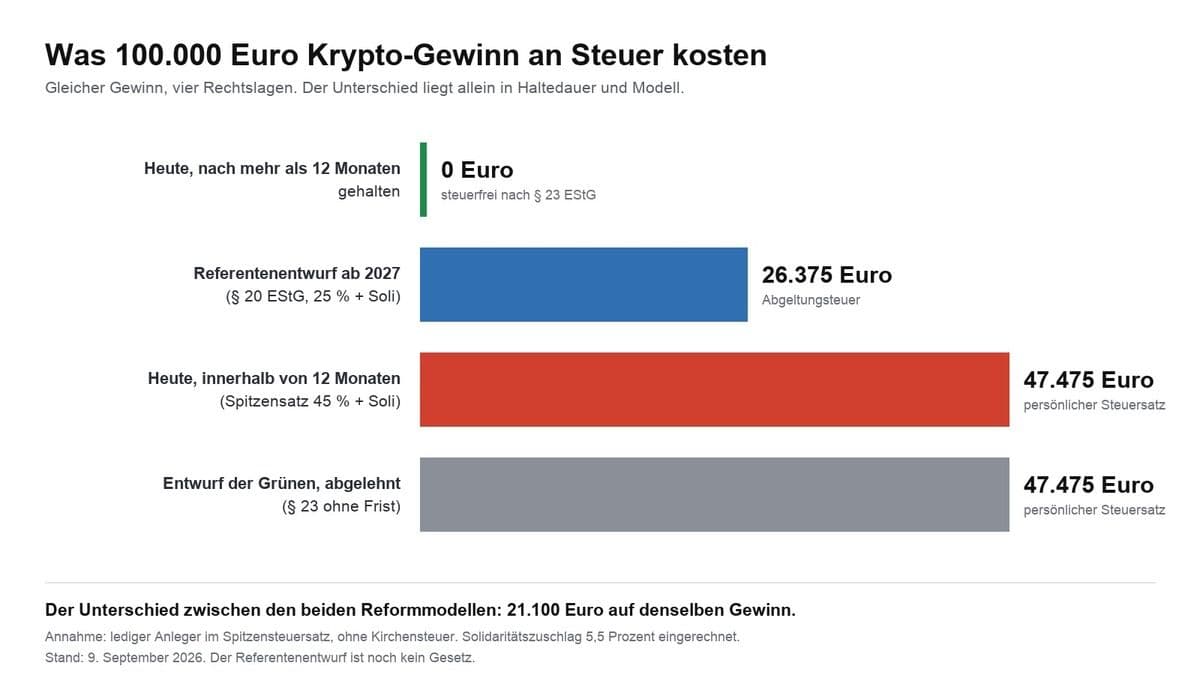
Crypto gains are tax-free after twelve months; before that your personal tax rate of up to 45 percent applies. What triggers tax, how the holding period is calculated, what happens with staking and losses, and what the draft bill would change from 2027.
September 8, 2026 10:21 PM

Crypto Holding Period and Grandfathering: Why December 31, 2026 Becomes the Cut-Off in Germany's Draft Bill
A ministerial draft bill from Germany's finance ministry names a cut-off date for the first time: crypto assets acquired after December 31, 2026 are to fall under the flat-rate withholding tax. What that means for legacy holdings, running savings plans and staking income, and why nothing has been decided yet.
September 26, 2026 1:19 AM
Germany’s Crypto Holding Period Is Wobbling: What to Check Before December 31
A CDU member of the Bundestag makes it plain: the coalition agreement does not guarantee that the one-year holding period for crypto assets will survive. What that means for purchases made before the planned cutoff date of December 31, 2026.
August 20, 2026 4:24 PM
Bitcoin Across Multiple Wallets: How Austria Works Out the Acquisition Cost
Bitcoin spread across several wallets? How Austria works out the acquisition cost and the rolling average price for tax purposes.
September 25, 2026 7:14 PM

Chainlink Above the September High: What Open Interest, Funding Rate and Liquidation Risk Mean for LINK
Chainlink stands at $13.86, 11.2 percent higher than 24 hours ago. Our own query at OKX and Hyperliquid shows funding at the baseline rate, and what that means for leverage, buying route and tax.
September 25, 2026 4:23 PM
Chainlink Jumps 12 Percent to $13.93: What to Check on Buying Route, Holding Period and Staking
Chainlink trades at $13.93 on September 25, 12.21 percent above the previous day; the trigger is the launch of the Paxos token PAXGy, which uses Chainlink's cross-chain rail CCIP as its only route between networks. This piece places the drivers and shows what to check on buying route, holding period, staking, custody and leverage.
More from CryptoTicker