
Litecoin Jumps by Double Digits While the Market Falls: Check Buy Route, Holding Period and Leverage Now
Litecoin gains 11.29 percent in a day while Bitcoin, Ether and XRP give ground. What sits behind the jump, and the three points you as an investor in Germany should check right now.



Which topics should we dive deeper into?
Select what genuinely interests you. Your picks feed directly into our editorial planning.
Crypto news that's actually worth your time.
Weekly. 60 seconds. Carefully curated by our editors: no hype, no promo flood, no spam.
Litecoin is rising while almost everything else falls. If you want to know whether you need to react: the price jump has two documented triggers, a surge in payment activity on its own blockchain and a filing with the US Securities and Exchange Commission dated September 11, 2026. For you in Germany it mainly changes three practical things, the buy route, the holding period and the question of whether to ride a move that has already run into double digits using leveraged products. One at a time.
Litecoin jumps by double digits while Bitcoin and XRP give ground: the numbers
We pulled the price data ourselves from CoinGecko on September 24, 2026. Litecoin stood at $69.48, or €61.11, at that moment, up 11.29 percent on the previous day. Over seven days that is 31.60 percent, over thirty days 35.38 percent. The daily low in the same query was $59.11, so the range of a single trading day spanned a good ten dollars.
The comparison with the rest of the field is what makes the outlier visible. In the same query covering the twenty-five largest cryptocurrencies, Bitcoin was down 2.05 percent, Ether 1.84 percent, Solana 1.66 percent and XRP 4.72 percent. Bitcoin Cash lost 5.44 percent, Dogecoin 5.54 percent, Zcash 7.43 percent. Among the larger names Litecoin was the only one clearly in the green.
Why the percentages diverge depending on the source
CoinDesk reported $66.55 and a gain of 6.55 percent on the same day, and just under eight percent elsewhere in the same piece. That is not a contradiction but a question of timing: the newsroom measured earlier in the day, our query later, and the price kept moving in between. Keep that in mind when you set numbers from two articles side by side on a day like this. A percentage without a timestamp is worth little when the daily range runs to ten dollars. The monthly figure, by contrast, lines up well: CoinDesk cites around 37 percent for September, making it the best month since November 2024.
Where Litecoin stands in the long-run picture
Market capitalisation was $5.39 billion at the time of our query, ranking 24th. Supply in circulation is 77,644,854 Litecoin against a hard-coded cap of 84 million. The all-time high of $410.26 dates from May 9, 2021, leaving the current price 83.1 percent below it. On a one-year view, despite the strong September, the coin is down 34.69 percent. One good quarter does not automatically lift a position out of a loss.
Adjusted economic volume: what the jump in on-chain activity does and does not say
The first trigger came from the Litecoin Foundation itself. According to its figures, more than one billion dollars and over 17 million Litecoin moved across the network within 24 hours. The foundation calls that a clear sign of activity on the chain and of its growing use case.
The metric it used is called adjusted economic volume. The idea is to strip out of total on-chain volume those movements that carry no economic substance, such as change flowing back to the sending address, or an exchange shifting funds internally between its own addresses. What should remain is the portion where value genuinely changes hands.
Two qualifications belong with that, and both argue against a hasty reading. First, the figure is not a yearly high: in May of this year the same analysis put it at $2.51 billion in a single day, two and a half times as much. Second, the number says nothing about who is moving what. Set the 17 million Litecoin against the 77.64 million units in circulation and you get roughly 22 percent of the entire supply in a single day. A reshuffle by a few large holders can produce a ratio like that on its own, without a single new user having joined.
For you that means the metric shows a lot was moved that day, and leaves open whether new demand sits behind it. Keep an eye on it, but do not derive a buy signal from it.
Grayscale, NYSE Arca and the S-3/A of September 11
The second trigger is verifiable, and at the source. We queried the SEC's full-text search ourselves. The hit: the Grayscale Litecoin Trust, ticker LTCN, filed under central index key CIK 0001732406, submitted a Form S-3/A on September 11, 2026, accession number 0001193125-26-389256, registration number 333-290130.
What an S-3/A actually is
An S-3/A is the amended version of a registration statement for securities. It is a necessary step on the way to an exchange-traded product and describes what the security is and which risks it carries. It is not an approval. For shares to trade on an exchange such as NYSE Arca, the exchange must additionally push through a rule change on Form 19b-4, and the SEC decides on that separately. A filed form and a tradable product are two different states.
Why the pattern nonetheless means something
The same full-text search shows Grayscale took the same route shortly beforehand with another fund: for the Grayscale Zcash Trust, ticker ZCSH, S-3/A filings exist dated July 31 and August 18, 2026. And a spot product on Litecoin already exists in the United States. For the Canary Litecoin ETF, CIK 0002039461, EDGAR shows an S-1 dated October 15, 2024, an amended version dated October 7, 2025, and on October 27, 2025 a Form 8-A12B. That last form is the notification of exchange listing, the step immediately before trading begins. A 10-Q dated May 13, 2026 documents that the fund has been running as a reporting company since.
The market is therefore not pricing a first for Litecoin. What it expects is a second and considerably larger provider following suit.

Golden cross and the 2027 halving: two explanations you should keep apart
Two further explanations turn up in the coverage, and they are not equally robust. The first is technical: CoinDesk points to a golden cross, the 50-day line crossing above the 200-day line, and to the break of resistance at $60.60. A golden cross is a description of the past, built from two averages of recent months. It explains why automated strategies step in, and in doing so it creates genuine short-term demand. It yields no statement about the coming weeks.
The second explanation is the next halving. Litecoin halves the reward per block every four years; the fourth halving is due in July of next year according to CoinDesk and cuts the payout from 6.25 to 3.125 Litecoin per block. That prices historically often firm up months ahead of a halving is an observed pattern, not a law. A supply squeeze still ten months away does not justify a daily gain of eleven percent. Anyone arguing that way is describing an expectation that can fulfil itself for as long as enough market participants believe in it.
 Where to buy Litecoin under regulation in Germany
The buy route in Germany: MiCA exchange, crypto ETN or US ETF?
This is where the American news parts company with your practice. The Grayscale filing concerns a US product on a US exchange. For you as a retail investor in Germany it leads to three possible routes, and they differ considerably in access, cost and tax.
The US spot ETF is generally closed to you
A fund launched in the United States does not produce a key information document under the European PRIIPs regulation. Without that document brokers may not offer the purchase to retail investors in the EU, and they block it technically. If your brokerage account does show you a US crypto ETF, the order type is worth a look: a purchase is usually possible only through classification as a professional client, and that requires evidence of wealth, trading experience and professional background.
Crypto ETNs are the usual detour through the securities account
In Europe, comparable products run as exchange traded notes, that is, as collateralised debt securities tradable on German exchanges. They track the price, you need no wallet of your own, and trading runs through your existing account. The price for that is an annual management fee and an issuer risk that does not exist on a direct purchase. Watch the collateralisation: whether the underlying coins are actually deposited, and with whom, is stated in the terms of issue. Which construction suits which purpose is something we have taken apart in our overview of crypto ETFs and ETNs in Germany.
The direct purchase through a regulated exchange
Since the European regulation on markets in crypto assets took full effect, providers targeting German clients need an authorisation as a crypto-asset service provider. Whether yours holds one you can look up in BaFin's register, and that is the first point to settle before an order. After that the hard costs count: trading fee, spread and withdrawal fee in euros. We compare the terms continuously in our overview of the best crypto exchanges. A second point concerns Litecoin in particular: since 2022 the blockchain has carried an optional confidentiality feature, and individual venues have delisted Litecoin in the past because of it. Before a larger purchase, check whether your provider carries the pair permanently.
Tax: the twelve-month period separates tax-free from taxable
On a move of eleven percent this section often decides more about your result than the entry price does.
A direct purchase falls under Section 23 of the Income Tax Act
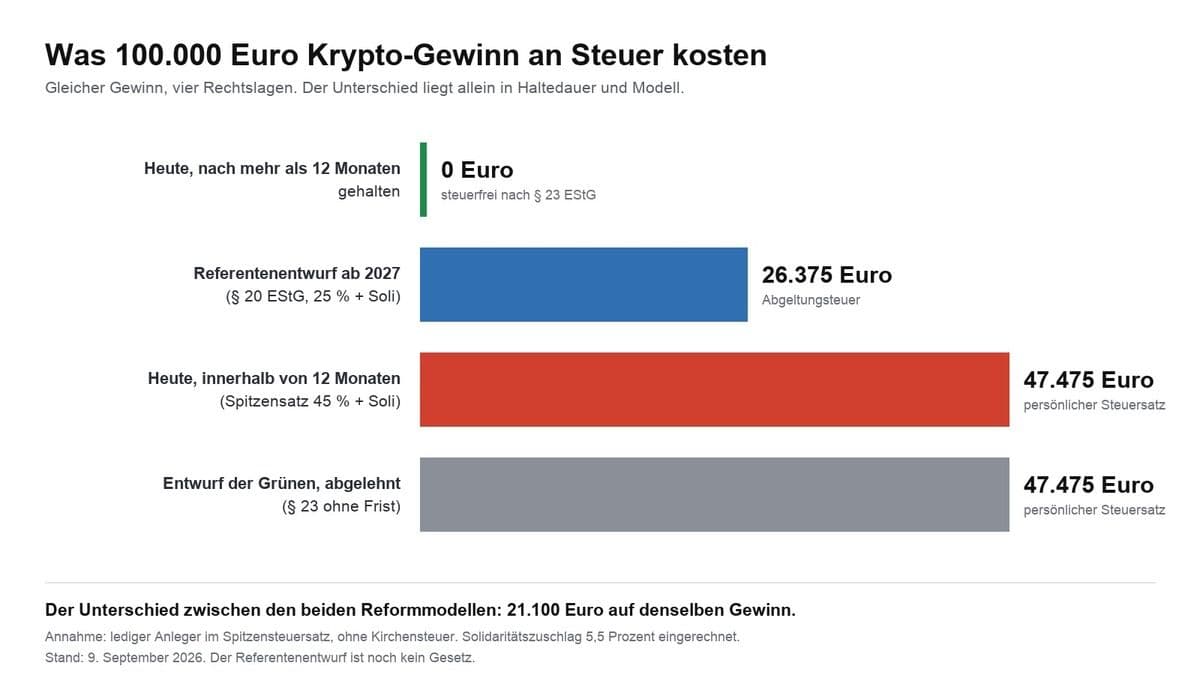
If you buy Litecoin directly and hold it yourself or at an exchange, the sale counts as a private disposal under Section 23 of the German Income Tax Act. Sell within one year of buying and the gain is taxable at your personal income tax rate. Where more than twelve months lie between purchase and sale, the gain remains tax-free regardless of its size. For short-term gains there is an exemption limit of €1,000 per calendar year, and that is a limit, not an allowance: from €1,000 the entire gain is taxable, below that it stays tax-free.
Correction (30 September 2026): An earlier version said the entire gain only becomes taxable once it exceeds 1,000 euros. Under section 23(3) sentence 5 of the German Income Tax Act, total gains from private disposals remain tax-free only if they amount to less than 1,000 euros in the calendar year; from 1,000 euros the entire gain is taxable.
In practice that means that with a purchase date inside the past twelve months you should work out before a sale what the tax office leaves of the price gain. Where there have been several purchases, what matters is the allocation of the units sold, usually under the method that treats the units bought first as sold first, separately per wallet.
ETNs and fund shares work differently
If you hold a security instead, the 25 percent withholding tax plus solidarity surcharge and, where applicable, church tax generally applies, and the one-year holding period does not help you there. For certain physically collateralised ETNs carrying a delivery claim on the deposited coins the treatment is disputed, and the tax authorities have not settled it conclusively. If this point matters for your amounts, clarify it with a tax adviser before the purchase and not after.

Leverage and liquidation: why an eleven percent day is the most expensive invitation
After a day like this, advertising for leveraged products measurably picks up, and that is exactly when the risk is greatest. The mechanism is simple. At leverage of ten, a countermove of ten percent is enough to consume the amount you put in. The daily range, from $59.11 to $69.48, came to roughly 17.5 percent of the daily low on that single day. A position at ten times leverage would have been closed out inside that range, even if the direction had turned out right in the end.
On top of that come running costs. Perpetual futures charge a funding rate at short intervals, and it depends on how the market is predominantly positioned. Where buyers are in the majority, they pay the sellers. In a phase when demand for long positions jumps, that rate can rise sharply, and it runs against you for as long as you stand on the crowded side. Before your first order, settle at what interval settlement occurs and at which price your position would be closed.
 Document your holding period and gains cleanly
Custody: what to watch differently with Litecoin
Technically Litecoin is closely related to Bitcoin, but everyday use has its trip hazards. Blocks follow one another at shorter intervals, which is why a transfer is confirmed faster. That tempts people into looking less closely at a withdrawal.
Two points are concrete. First, several address formats exist for Litecoin historically, and older holdings still sit partly in a format some services no longer offer. Send a small amount as a test before a large withdrawal. Second, the risk of confusion with Bitcoin addresses is real, because the modern formats of both networks resemble each other. A transfer sent to the wrong network is as a rule lost.
If you want to hold a position for months, so as to be able to reach the twelve-month period at all, it does not belong permanently in an exchange account. A trading account is built for trading, not for safekeeping. You keep the recovery words of your own wallet separate from the device, on paper or on metal, never as a photo in cloud storage.
Levels above and below: how to recognise the next stage
A few verifiable reference points, all from the sources named above and without a forecast. On the downside the breakout point cited by CoinDesk at $60.60 is the first level that shows whether the breakout holds. Below it sits the daily low at $59.11. If the price falls back under that zone, the jump was a one-day event and not a turn in trend.
On the upside there is no clean technical point, because the price stands at its highest level since January according to CoinDesk, and above that lies little recent trading history. Two other things carry more information over the coming weeks: whether the network activity figure stays elevated over several days or drops back to its earlier level, and whether the SEC takes a further step in the Grayscale procedure. Both you can look up yourself, the one at the Litecoin Foundation, the other in EDGAR's full-text search.
This analysis was compiled by cryptoticker.io itself on September 24, 2026. Method: retrieval of market data for the twenty-five largest cryptocurrencies and of the individual data set on Litecoin through CoinGecko's public programming interface at 13:50 UTC, plus two full-text queries in the SEC's EDGAR system for filings on Litecoin funds. Twenty-five coins and four filing processes were checked. The raw data behind the adjusted economic volume metric cannot be checked, because the Litecoin Foundation does not disclose the underlying analysis; that figure comes from the coverage and is marked accordingly.
Putting the Litecoin price jump in context: what to take away
- First check whether you need to trade at all. The rise of 11.29 percent in one day is documented; the reasoning behind it only partly. If you are already invested, the day changes nothing about your original reasoning. If you want to enter fresh, do not do it through a leveraged product, because the daily range of 17.5 percent would have stopped out every position at ten times leverage. Anyone using futures products anyway should compare the funding rates and liquidation rules of the venues beforehand, for instance in our overview of the best perp DEXs.
- Decide the buy route before the purchase, not after. The US spot ETF is practically inaccessible to you, a European ETN costs a management fee and carries issuer risk, a direct purchase demands custody of your own. If you want to buy directly and hold longer, you need a solution outside the exchange account; the devices and their differences are in the hardware wallet comparison.
- Note the purchase date and cost basis immediately. On a direct purchase the twelve-month period under Section 23 of the Income Tax Act alone decides whether the gain stays tax-free, and the €1,000 exemption limit tips the entire amount into taxability once gains reach €1,000. Clean records per wallet are unavoidable, but they can be automated; you will find the providers for that under crypto tax tools and portfolio trackers.
Sources to read on: the assessment of network activity at CoinDesk of September 24, 2026 and the filing itself in the SEC's full-text search.
(As of September 24, 2026. This article is not investment advice. Prices and fee structures change; check the terms with the provider before you buy.)
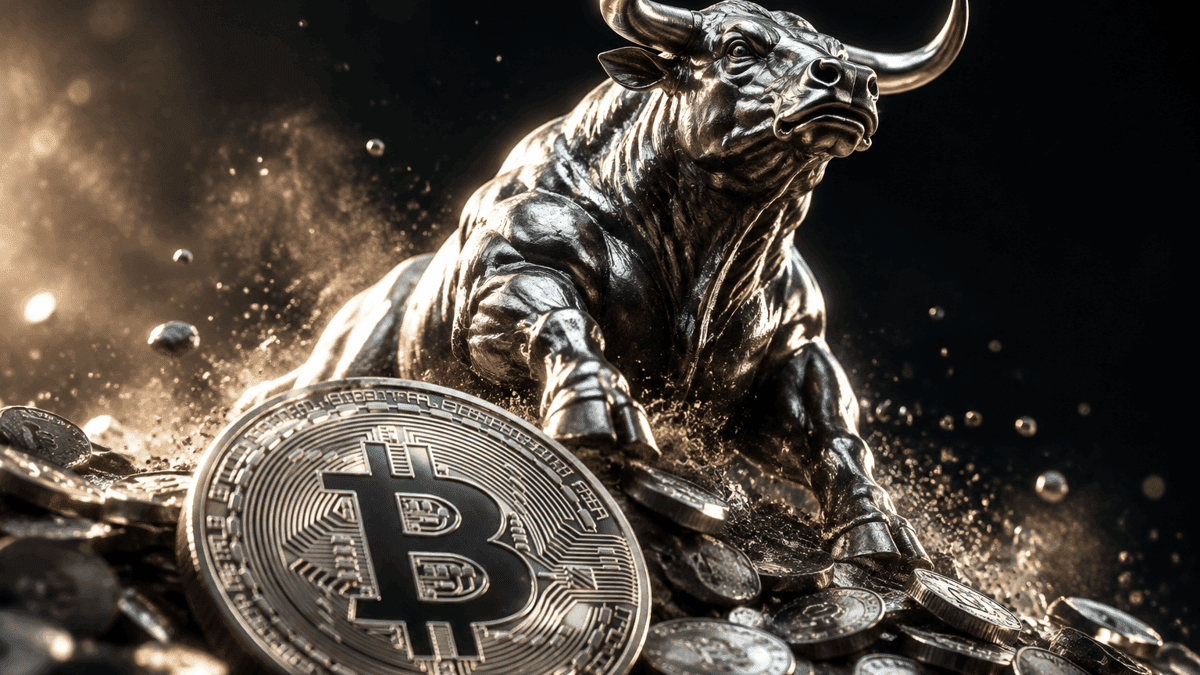
Transparency note: This article was produced with the assistance of artificial intelligence and reviewed by our editorial team before publication. All figures and claims were checked against the primary sources linked in the text. The feature image was generated with AI.
Related articles
- Litecoin Has an ETF, and Almost Nobody Uses It
- Litecoin at $70 with a 5.2 percent daily gain: it outperforms Bitcoin and Ethereum
- XRP Falls 9.7 Percent: What to Check on Holding Period and Buying Route
- Nearly $1 Billion Into Bitcoin ETFs: What to Check on ETNs, Portfolio and Holding Period
- Bitcoin ETF Inflows Turn 2026 Positive: How to Tell If the Demand Holds
Which topics should we dive deeper into?
Select what genuinely interests you. Your picks feed directly into our editorial planning.
Crypto news that's actually worth your time.
Weekly. 60 seconds. Carefully curated by our editors: no hype, no promo flood, no spam.

September 19, 2026 4:19 AM

Bitcoin Cash Jumps by Double Digits: What the Grayscale ETF Filing Really Means for You in Germany
Bitcoin Cash gained double digits on September 18 because Grayscale wants to convert its BCH trust into an exchange-traded product. The filing itself, however, states that the basis for it has not been approved at all.

September 13, 2024 12:23 PM

Ripple, SEC, and Grayscale: The Ripple Effect on XRP Price
This is how Ripple’s legal battles and Grayscale’s XRP Trust launch are shaping the future of XRP and the crypto market...

September 25, 2026 1:12 PM

XRP Jumps to $1.56: What Holders Should Check on Buying Route, Holding Period and Leverage
XRP trades at $1.56 on September 25, 2026, up 6.85 percent on the day and 16.64 percent on the week. What the on-chain data and the US ETF inflows actually show, and what investors in Germany should check now on buying route, holding period, leverage and custody.
September 27, 2026 1:17 PM
Dogecoin Price: What to Check on Holding Period and Custody Before the Year End
The Dogecoin price stands at $0.0977 on September 27, 2026 and has barely moved in a day. That calm is exactly the moment to work through the holding period, the reporting duty from 2026 and custody without any time pressure.
September 21, 2026 1:13 PM

Ethereum Rises While ETF Money Leaves: What ETH Holders Should Check Now
US ether funds lost $140 million in the week to September 18, ending four weeks of inflows. The ETH price still gained a good 5 percent.
May 23, 2024 7:29 PM

Grayscale SEC Approval: Launching Two New Crypto Funds
Grayscale is committed to expanding its portfolio of single-asset cryptocurrency trusts and offering more opportunities for investors, as it announced today the latest trusts launch.

September 27, 2026 10:14 AM
Shiba Inu Price Prediction: What to Check on SHIB Before the December 31 Deadline
SHIB trades at $0.00000592 on September 27, 2026, around 93 percent below its all-time high. For German investors one date matters more than the chart right now: December 31, 2026.
October 2, 2026 10:17 PM
Dogecoin breaks below $0.093: the BWOW fund turns every DOGE into cash on October 14
Dogecoin costs $0.0914 on Friday evening and has lost 3.4 percent in 24 hours. On October 14 the US fund BWOW sells its entire holding, and on the same day the German cabinet takes up the reform of crypto taxation.
September 24, 2026 7:12 AM
Litecoin Runs Against the Market: What MWEB Balances Mean for Exchanges, Holding Periods and AML Rules
Litecoin is the only one of the 19 scored top assets with a clear gain on September 24, 2026, while Uniswap, Dogecoin and XRP fall by double digits or close to it. We put the record balance in the MWEB layer in context and show what to check on deposits, holding periods and EU anti-money laundering law.
September 21, 2026 4:13 AM
How to Buy XRP in Germany: Exchange, Destination Tag and Tax
Buying XRP works through a crypto exchange with MiCA authorisation, through a broker, or through an ETP in your securities account. This guide shows what matters on fees, the destination tag, custody and the German holding period.
September 8, 2026 10:21 PM

Crypto Holding Period and Grandfathering: Why December 31, 2026 Becomes the Cut-Off in Germany's Draft Bill
A ministerial draft bill from Germany's finance ministry names a cut-off date for the first time: crypto assets acquired after December 31, 2026 are to fall under the flat-rate withholding tax. What that means for legacy holdings, running savings plans and staking income, and why nothing has been decided yet.
September 24, 2026 1:11 PM
Stellar Becomes a Payment Rail at Mastercard's BVNK: What XLM Holders Should Check on Buying Route, Memo and Holding Period
BVNK has switched on Stellar as a payment rail for business customers in more than 130 countries. On the same trading day XLM falls by around seven percent — we separate what the news means from what the pullback means for your portfolio.
September 19, 2026 7:17 AM
Chainlink Jumps Above $12: What LINK Holders Should Check Now
Chainlink trades at $12.34, 7.4 percent higher than yesterday. What part of the move is the broad market rally, what Chainlink itself contributes, and the three things you should check as a LINK holder.
October 1, 2026 7:25 PM

Shiba Inu price prediction before the October 4 triangle apex: which levels decide now
Shiba Inu is quoted at 5.73 millionths of a dollar on Thursday afternoon, and the triangle of rising lows and falling highs runs out on October 4 according to an analysis by Blockchain.News. Which levels follow from that, what October seasonality really offers, and which deadline German SHIB holders should still meet before the turn of the year.
September 24, 2026 4:11 PM

Bitcoin Cash Falls 5.5 Percent After a 50 Percent Week: Check Your Buy Route, Leverage and Holding Period
Bitcoin Cash fell to $335.19 on September 24, 2026, after gaining almost 50 percent in seven days. The rally was set off by CME's announcement of September 22; what that means for buy route, leverage, holding period and custody is set out here.
September 22, 2026 7:20 PM

ETH Price Prediction: What to Check at the $2,800 Mark Now
Ether stands at $2,735.96 on September 22, 2026, right below the zone at which it has failed repeatedly. Instead of a target number, you get four checks that count before your next order: holding period, buying route, the staking line and the distance to liquidation.
September 26, 2026 1:19 AM
Germany’s Crypto Holding Period Is Wobbling: What to Check Before December 31
A CDU member of the Bundestag makes it plain: the coalition agreement does not guarantee that the one-year holding period for crypto assets will survive. What that means for purchases made before the planned cutoff date of December 31, 2026.
September 9, 2026 4:22 PM
Crypto Tax in Germany: What Applies in 2026 and What Is Set to Change in 2027
Crypto gains are tax-free after twelve months; before that your personal tax rate of up to 45 percent applies. What triggers tax, how the holding period is calculated, what happens with staking and losses, and what the draft bill would change from 2027.
October 3, 2026 1:41 PM

Dogecoin Price Prediction: $0.10 as the Ceiling, and What to Watch at a 2.5 Percent ETP Fee
Dogecoin trades at $0.0927 on October 3 and therefore sits on its 200-day average. More important than the mark at $0.10 is the route question for German investors: a 2.50 percent fee in the Xetra ETP against the one-year holding period on a direct purchase.
October 3, 2026 10:33 AM

Shiba Inu 93.4 Percent Below Its Record: 31 December 2026 Splits Old and New SHIB
Shiba Inu trades at $0.00000568 on 3 October, 93.4 percent below its record. More important than the day is the German draft bill on crypto tax: it splits your SHIB into grandfathered and new holdings on 31 December 2026.
October 1, 2026 7:38 AM

Buying Ethereum with PayPal: a 72-hour withdrawal lock is the real price of the convenience
PayPal does not trade crypto-assets in Germany, yet it still works as a deposit route at a crypto exchange. What arrives in ether out of 100 euros, why the fee appears only on the final page and what the 72-hour lock means for your ETH.
September 29, 2026 4:13 PM
Dogecoin Price Prediction: 81 Percent of ETF Money Now Sits With One Issuer
The American Dogecoin funds took in a net $2.89 million in the week to September 25, more than ever before. Around 81 percent of the assets now sit with a single provider, while Bitwise winds down its fund on October 14.
September 26, 2026 10:12 PM
Solana Price Above $120: What to Check on Staking Yield, Holding Period and Spread
Solana is trading at $121.00 on September 26, 2026, 8.6 percent above its level a week earlier. What a self-measured staking yield of 5.27 percent is worth, how the one-year holding period applies to staked SOL, and what an order in euros really costs.
September 25, 2026 7:14 PM
Chainlink Above the September High: What Open Interest, Funding Rate and Liquidation Risk Mean for LINK
Chainlink stands at $13.86, 11.2 percent higher than 24 hours ago. Our own query at OKX and Hyperliquid shows funding at the baseline rate, and what that means for leverage, buying route and tax.
September 25, 2026 4:23 PM
Chainlink Jumps 12 Percent to $13.93: What to Check on Buying Route, Holding Period and Staking
Chainlink trades at $13.93 on September 25, 12.21 percent above the previous day; the trigger is the launch of the Paxos token PAXGy, which uses Chainlink's cross-chain rail CCIP as its only route between networks. This piece places the drivers and shows what to check on buying route, holding period, staking, custody and leverage.
September 23, 2026 7:22 PM
Solana Price Holds $114: What Holders Check Five Days Before Alpenglow
SOL stands at $114.55 on September 23, after a 17.7 percent gain in seven days and a 2.2 percent loss on the day. Two deadlines matter more than the daily move: Alpenglow opens on September 28, and every purchase made this week starts a holding period of its own.
September 23, 2026 10:18 AM

Bitcoin Cash jumps 29 percent in a day: we recalculated 49 jumps like it
Bitcoin Cash gained around 29 percent on September 22 and Uniswap 17 percent, both driven by the CME futures listing. We assessed all 49 jump days among the largest coins across two years: after 30 days the median case stood at minus 6.7 percent.
More from CryptoTicker