
Stellar Climbs to $0.22: Why 446 Tokens Are Called USDC and What XLM Holders Must Check Now
Stellar Lumens gains 9.66 percent within 24 hours to $0.2212, carried by almost $4 billion of tokenized real-world assets on the chain. Our own count of September 25 shows at the same time why a stablecoin ticker on Stellar says nothing about its issuer.




Which topics should we dive deeper into?
Select what genuinely interests you. Your picks feed directly into our editorial planning.
Crypto news that's actually worth your time.
Weekly. 60 seconds. Carefully curated by our editors: no hype, no promo flood, no spam.
Stellar Lumens trades at $0.2212, or 0.1945 euros, on September 25, 2026. That is 9.66 percent more than 24 hours earlier according to CoinGecko data, and the strongest daily move among the 25 largest cryptocurrencies. Behind the gain sits a development that has been building for months: the Stellar chain now carries tokenized real-world assets worth billions. Anyone planning to turn that into a purchase should settle three questions first, and none of them has anything to do with the chart. They concern the issuing address of the token, the buying route in Germany and the holding period.
cryptoticker.io collected this analysis itself on September 25, 2026. We queried Stellar's public Horizon interface and counted how many separate issuers carry the same stablecoin ticker there. The result explains why the ticker alone is not enough to base a purchase on.
Stellar Lumens (XLM) climbs to $0.22: the documented numbers
Stellar Lumens (XLM) is quoted at $0.221166 on September 25, 2026, according to CoinGecko. In euros that is 0.1945. Market capitalization stands at $7.73 billion, rank 20 in the overall market. Turnover over the past 24 hours came to $475.2 million.
More revealing than the daily gain is the comparison of two periods. Over seven days the coin is up 18.04 percent, over 30 days 17.97 percent. The two figures are practically level. That means the entire monthly gain was produced in the last seven days; before that the price moved sideways. Jumps of this kind after a long quiet spell matter for the question of entry timing, because they widen the distance to any pullback zone.
XLM remains far from its all-time high. CoinGecko dates that high to January 2, 2018, and the current price sits around 74.6 percent below it. A coin that stands at a quarter of its peak eight years on is not a latecomer catching up, but an asset with a long history of its own. That belongs in any assessment.
 Crypto Exchanges Compared
Tokenized real-world assets on Stellar: from $869 million to almost $4 billion
Tokenized real-world assets, RWA for short, are holdings from traditional finance represented as tokens on a blockchain. Typical examples are short-dated government bonds, money market fund units or corporate loans. The token is the representation, not the value itself; behind it stands an issuer who holds the underlying.
On Stellar this stock has grown sharply in 2026. According to an analysis by Cointelegraph based on a Dune Analytics dashboard maintained by Stellar, the chain's RWA market capitalization stood at $3.996 billion on August 29, 2026. At the end of 2025 it was $868.8 million. That is roughly four and a half times more within eight months. The same analysis puts $438 million of stablecoins with audited reserve backing on the chain.
Further inflows have been announced. The US securities settlement house DTCC intends to connect its tokenization service to Stellar, with tokenized assets due to become available there in the first half of 2027. The platform Tradable has said it will bring private credit of up to $1 billion onto the chain. MoneyGram launched its dollar stablecoin MGUSD on Stellar in June. On September 17, 2026 protocol upgrade 28 also went live on mainnet, which we assessed in a separate article on September 19.
One point matters for context: these sums sit on the chain, they do not sit in the XLM price. The lumen is the network currency used to pay fees and to post account reserves. A growing RWA stock raises the number of accounts and transactions, but it distributes nothing to holders. The link between stock growth and price is therefore indirect and not mechanical.
446 tokens on Stellar carry the name USDC: our count of September 25
For this article we queried Stellar's public Horizon interface on September 25, 2026, specifically the assets endpoint, page by page to the end of each list. We compared the issuing address of every entry against the address published by Circle. All calls returned status 200.
The result for the ticker USDC: 446 separate entries, each with its own issuing address. Exactly one of them comes from Circle. That genuine entry counts 2,431,447 authorized accounts and a total holding of 351,168,048.23 USDC, spread across accounts, smart contracts, liquidity pools and claimable balances. The remaining 445 entries carry the same ticker and have nothing to do with Circle.
The picture for the ticker EURC looks similar, only smaller: 70 entries, one of them from Circle with 40,121 authorized accounts and a holding of 3,678,796.49 EURC. The largest third-party EURC entry reaches 12,809 accounts. That is around 32 percent of the account count of the genuine token, and those accounts have opened a trustline to an address that issues no Circle product.

What we did not examine belongs to the honesty of this analysis: we did not investigate who stands behind the third-party entries or whether any intent to deceive lies behind them. Some of these entries are likely to be tests, learning projects or discontinued legacy assets. Nor did we assess the individual holdings of each third-party entry; the only striking point is that several of them report nominal quantities in the trillions, which suggests empty shells without backing. The figure of 446 is a count, not a verdict on anyone's intentions.
Trustline and issuing address: how to spot the genuine stablecoin on Stellar
A trustline on Stellar is an account's explicit permission to hold a particular token from a particular issuer. Without that line nobody can send you the token. That is precisely where the protection lies, and precisely where the mistake happens: open a trustline to the wrong issuer and you end up holding a token that looks like the well-known one while carrying a claim against nobody.
In practice you check three things before you confirm a trustline. First the complete issuing address, not just its first and last characters. The genuine USDC address on Stellar begins with GA5ZSEJY and can be verified in a public blockchain explorer. Second the linked domain: reputable issuers point to their own corporate domain through a standardized file. Third the order of magnitude, because a token with a handful of accounts is no established stablecoin, even if the ticker matches.
Anyone who buys through an exchange and leaves the coins there meets this question less often, because the exchange manages the trustline. As soon as you withdraw to your own wallet and accept a stablecoin there, the check is yours.
EURC versus USDC on Stellar: why German investors almost always carry dollar risk
Our count shows a clear imbalance. The 351.17 million USDC face 3.68 million EURC. At the conversion rate of September 25, around $1.137 per euro, the euro holding amounts to roughly $4.18 million. That leaves the euro stablecoin at a good one percent of the combined holdings on the chain.
For you as an investor in Germany this has an immediate consequence. If you rotate gains from XLM into a stablecoin to step out of price risk for a while, on this chain you will most likely end up in a dollar asset. You are then trading price risk for currency risk. If the euro-dollar rate moves by five percent, your supposedly stable holding moves with it in euro terms.
The euro stablecoin EURC is authorized as an e-money token under the EU's MiCA regulation, which places its issuer under European supervision. That is an argument for the euro route, but it does not change the fact that liquidity on Stellar sits mostly in the dollar. Anyone who wants to take the euro route should first check whether their provider offers EURC at all and at what spread it converts.
Buying through a regulated exchange: what to watch for with XLM in Germany
XLM is available on the large trading venues licensed in the EU. Since MiCA applies in full, providers targeting customers in Germany need authorization as a crypto service provider; BaFin maintains the German permissions. In practice that means comparing three points before you buy: the trading fee, the spread between bid and ask, and the withdrawal fee if you want to move the coins to your own wallet.
The spread is often underestimated on small order sizes. On a coin priced at 0.19 euros, half a cent of difference looks small yet amounts to a good two percent of the stake. Two percent on the way in and two on the way out make four percent that the price has to recover first. An overview of the terms is in our comparison of the best crypto exchanges, where we set fees, spreads and withdrawal routes side by side.
The network fee itself is no cost factor on Stellar. The base fee at ledger 64,605,268, closed on September 25, 2026 at 04:55 UTC, was 100 stroops, meaning 0.00001 XLM per operation. The median of the fees actually paid was also 100 stroops. Converted, that is fractions of a cent. A transfer on Stellar becomes expensive through the provider's fees, not through the chain.
 Hardware Wallets Compared
Auth revocable and clawback: when an issuer can freeze your stablecoin
Every asset on Stellar carries flags that define which rights the issuer retains. Two of them matter for holders. Auth revocable means the issuer can withdraw an authorization once granted; the balance can then no longer be moved. Clawback means the issuer can pull tokens directly from the account.
Our query of September 25, 2026 shows the following for the genuine Circle tokens on Stellar: for USDC and for EURC, auth revocable is set to active, while clawback is inactive. The issuer can therefore revoke an authorization, yet cannot unilaterally remove your balance. Neither is a scandal; both are the norm for regulated stablecoins, because the issuer has to implement sanctions and anti-money-laundering requirements. For you it does mean that a stablecoin in your own wallet does not have the same independence as the lumen itself.
None of this applies to XLM. The network currency is controlled by no issuer, there is no authorization and no seizure. Anyone who wants to avoid issuer risk entirely therefore holds the coin itself rather than a token issued on top of it.

Storing XLM: hardware wallet, minimum reserve and the cost of a trustline
Anyone moving XLM to their own wallet runs into a Stellar peculiarity: an account has to keep a minimum reserve and cannot be emptied completely. The base reserve at the ledger checked on September 25, 2026 was 0.5 XLM per entry. A new account occupies two entries and must therefore hold 1 XLM permanently. Every additional trustline costs another 0.5 XLM in locked reserve.
At the price of September 25 that is about 19 cents for the account and just under 10 cents per trustline. The amounts are small, but they are locked rather than spent: as soon as you close a trustline again, the reserve is released. Open a dozen trustlines out of curiosity and you tie up correspondingly more, while losing track of which issuers you have actually authorized.
For storing larger holdings a hardware wallet is the usual route, because the private key never leaves the device. Which devices support Stellar and how they differ in handling and price is set out in our hardware wallet comparison. What matters there is less the device than the question of where the recovery words are kept and who besides you could reach them.
Holding period and tax: what is left of an XLM gain in Germany
In Germany cryptocurrencies count as other economic assets. Gains from a sale fall under private disposal transactions in accordance with section 23 of the Income Tax Act. The holding period is decisive: if more than a year lies between acquisition and sale, the gain is tax free. Below that it is taxed at your personal rate, provided the sum of all private disposal gains in the calendar year reaches the exemption threshold of 1,000 euros.
Exemption threshold means: stay below it with a gain of 999 euros and you pay nothing. Land at 1,001 euros and you pay tax on the full amount, not just on the euro above the line. That edge is the reason why it pays to do the arithmetic shortly before the turn of the year.
Swapping XLM into a stablecoin is a sale for tax purposes. Anyone locking in gains in USDC or EURC ahead of a pullback triggers a disposal and starts a fresh period for the stablecoin. This is the point where the two themes of this article converge: the route into the supposedly safe harbor may cost tax, and on Stellar it leads mostly into a foreign currency.
Anyone trading several times a year needs a clean record of every acquisition with date, quantity and price, otherwise the holding period cannot be proven after the fact. The usual route for that is portfolio and tax software that reads the exchanges via an interface.
Levels above and below: what the XLM price is measured against now
Three reference points follow from the documented price data. The current level is $0.2212. Backing out the seven-day move of 18.04 percent puts the price a week ago at around $0.187; because the 30-day move is almost identical, that area also marks the level where the price spent the preceding month. On the downside it is the first area a pullback would run into.
On the upside the available data offers no comparably documented reference point. The all-time high from January 2018 sits around 74.6 percent above today's price and is no guide for the coming weeks. Analyst targets that circulate in phases like this we deliberately leave out as long as they are not attributed by name and reasoned.
What can be observed instead are the inflows on the chain. If the announced DTCC connection actually arrives in 2027, the number of accounts and transactions rises further. If it fails to appear or slips, one of the arguments currently made for the chain falls away. Both are verifiable, and both are a better yardstick than a price target without a sender.
Stellar and the USDC ticker: what to take away
- Settle the buying route before the buying decision. Compare trading fee, spread and withdrawal costs at a provider licensed in the EU before you place an order; on a coin below 20 cents the spread eats proportionally more than it looks. The terms are in the comparison of the best crypto exchanges.
- Check the issuing address before every trustline. 446 entries on Stellar are called USDC, one of them comes from Circle. Match the full address in an explorer before you accept a stablecoin in your own wallet, and keep the number of open trustlines small. For storage itself the hardware wallet comparison helps.
- Record the holding period before you swap. Moving from XLM into a stablecoin is a sale and restarts the one-year clock. Keep every acquisition with date, quantity and price so the period stays provable; suitable tools are in the overview of crypto tax software and portfolio trackers.
(As of September 25, 2026. This article is not investment advice. Prices and fee structures change; check the terms with the provider before you buy.)
Transparency note: This article was produced with the assistance of artificial intelligence and reviewed by our editorial team before publication. All figures and claims were checked against the primary sources linked in the text. The feature image was generated with AI.
Related articles
- Stellar Becomes a Payment Rail at Mastercard's BVNK: What XLM Holders Should Check on Buying Route, Memo and Holding Period
- Dogecoin Price: What to Check on Holding Period and Custody Before the Year End
- BlackRock NEWS: BUIDL Fund Live on Solana and Bitcoin ETP Launch in Europe
- XRP Falls 9.7 Percent: What to Check on Holding Period and Buying Route
- Bitcoin Price Before the Core PCE at 14:30 CEST: Will the $82,735 Level Hold?
Which topics should we dive deeper into?
Select what genuinely interests you. Your picks feed directly into our editorial planning.
Crypto news that's actually worth your time.
Weekly. 60 seconds. Carefully curated by our editors: no hype, no promo flood, no spam.

September 27, 2026 10:14 AM
Shiba Inu Price Prediction: What to Check on SHIB Before the December 31 Deadline
SHIB trades at $0.00000592 on September 27, 2026, around 93 percent below its all-time high. For German investors one date matters more than the chart right now: December 31, 2026.

September 24, 2026 1:34 PM

Cardano Slides Below $0.24: What ADA Holders Should Check on Leverage, Liquidation and Holding Period
Cardano has given back its move above $0.25 and trades around seven percent below the high of the past 24 hours. What that means for leveraged positions, the holding period of your tranches and the buying route under MiCA.
September 24, 2026 4:16 AM
Trump-Xi Summit at the White House: The Crypto Positions to Check Before the Meeting
Xi Jinping is on a state visit to Donald Trump today, and the crypto market comes into the meeting carrying the gains of an exceptionally strong week. What to check on leverage, holding period and custody before the first headline runs.
September 16, 2026 7:12 PM

Borrowing Against Bitcoin Instead of Selling: When German Tax Still Applies
Posting Bitcoin as collateral for a loan is not a sale in Germany, because section 39 of the Fiscal Code keeps the coins attributed to you for tax purposes. Tax arises only when the collateral is liquidated, and then the one thing that decides the bill is how long you held the coins beforehand.
August 21, 2026 4:24 AM

Forced Sale on a Crypto Exchange: Which Moment Counts for the Holding Period and What You Must Document
At Luno, Kraken and Valour the deadlines are running out, after which the provider realises the remaining holding itself. For tax purposes that is a disposal, and what governs it is the exchange's timestamp.

September 25, 2026 7:24 PM

Bitcoin Forecast: What to Check on Levels, Holding Period and Buying Route Before the Quarter Ends
Bitcoin stands at $83,877 at 16:40 UTC on September 25, 2026, and the measured volatility of the past 30 days spans a band of $73,600 to $94,200 for the coming month. More important than that band before the quarter ends are three checks: holding period, buying route under MiCA and the reporting duty in force since January 2026.
September 24, 2026 1:24 PM

NEAR Falls Almost 8 Percent After a 62 Percent Week: What to Check on Perps, Buying Route and Holding Period
NEAR Protocol loses up to 7.9 percent on September 24, 2026 and is still more than 55 percent higher over the week. The rally was carried by a confidential perp offering via Hyperliquid, which raises questions of its own on buying route, leverage and holding period in Germany.
September 21, 2026 1:13 PM

Ethereum Rises While ETF Money Leaves: What ETH Holders Should Check Now
US ether funds lost $140 million in the week to September 18, ending four weeks of inflows. The ETH price still gained a good 5 percent.
September 19, 2026 7:17 AM
Chainlink Jumps Above $12: What LINK Holders Should Check Now
Chainlink trades at $12.34, 7.4 percent higher than yesterday. What part of the move is the broad market rally, what Chainlink itself contributes, and the three things you should check as a LINK holder.
October 2, 2026 4:40 PM

Ethereum price prediction: Citi raises its twelve-month target to $3,028, and what you can do now
Citi has raised its twelve-month target for Ethereum from $2,240 to $3,028. Anyone following that horizon also decides the tax on the gain with the purchase date.
September 24, 2026 10:36 PM

Ethereum Price Prediction: What to Check on Staking, Leverage and Where You Buy After Three Attempts at $2,800
Ether stands at $2,700 and has bounced off the zone around $2,800 three times in thirty days, without a single daily close above it. What our own count shows, and the three things to settle before the next attempt.
September 24, 2026 10:11 PM

Bitcoin Price Prediction: What to Check on Levels, Holding Period and Leverage Before the October 28 Rate Decision
Bitcoin is trading at around $83,800, a third below its October 2025 high, while the sentiment index reads greed. Which dates, levels and deadlines over the coming weeks really decide your net gain, and which of them you steer yourself.
September 22, 2026 7:20 PM

ETH Price Prediction: What to Check at the $2,800 Mark Now
Ether stands at $2,735.96 on September 22, 2026, right below the zone at which it has failed repeatedly. Instead of a target number, you get four checks that count before your next order: holding period, buying route, the staking line and the distance to liquidation.
September 9, 2026 4:22 PM
Crypto Tax in Germany: What Applies in 2026 and What Is Set to Change in 2027
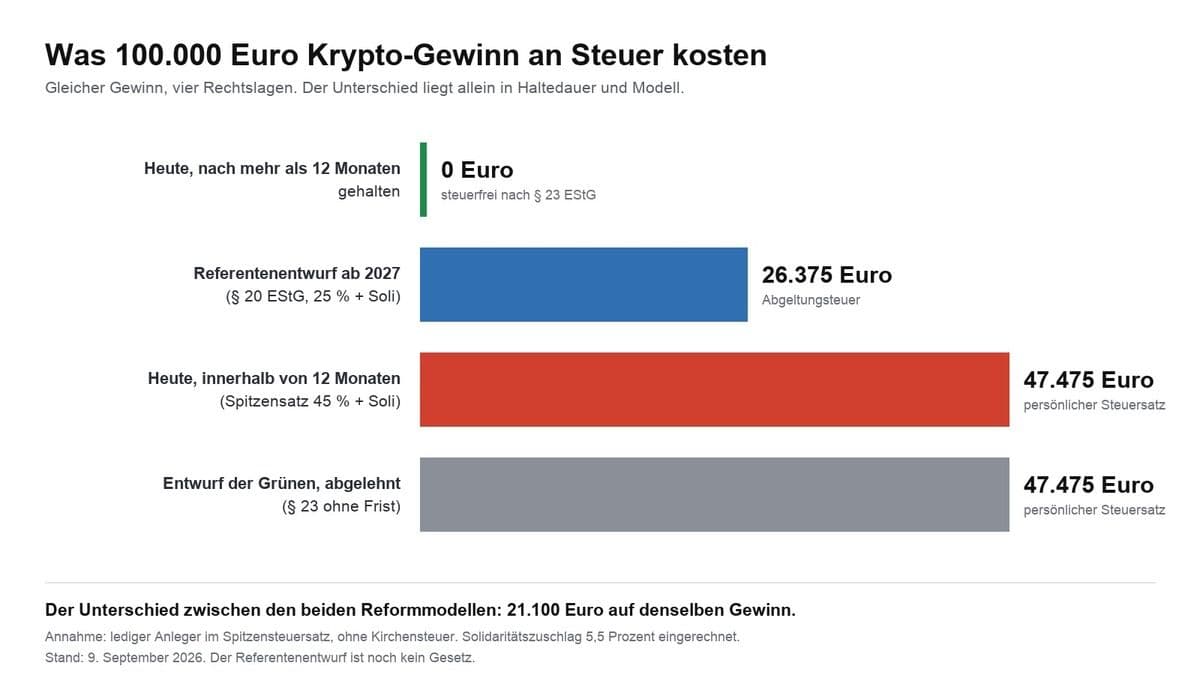
Crypto gains are tax-free after twelve months; before that your personal tax rate of up to 45 percent applies. What triggers tax, how the holding period is calculated, what happens with staking and losses, and what the draft bill would change from 2027.
September 8, 2026 10:21 PM

Crypto Holding Period and Grandfathering: Why December 31, 2026 Becomes the Cut-Off in Germany's Draft Bill
A ministerial draft bill from Germany's finance ministry names a cut-off date for the first time: crypto assets acquired after December 31, 2026 are to fall under the flat-rate withholding tax. What that means for legacy holdings, running savings plans and staking income, and why nothing has been decided yet.
October 2, 2026 10:17 PM
Dogecoin breaks below $0.093: the BWOW fund turns every DOGE into cash on October 14
Dogecoin costs $0.0914 on Friday evening and has lost 3.4 percent in 24 hours. On October 14 the US fund BWOW sells its entire holding, and on the same day the German cabinet takes up the reform of crypto taxation.
September 27, 2026 7:14 PM

Solana Price at $121.93: What to Check on Staking Yield, Unstaking and Tax
SOL stands at $121.93 on September 27 at 16:42 UTC, after a 12.7 percent gain over seven days. More important than the weekly move is a calculation almost nobody makes: of the staking yield usually quoted, roughly a quarter is left in real terms, and the epoch decides when you can reach your coins again.
September 26, 2026 10:12 PM

Solana Price Above $120: What to Check on Staking Yield, Holding Period and Spread
Solana is trading at $121.00 on September 26, 2026, 8.6 percent above its level a week earlier. What a self-measured staking yield of 5.27 percent is worth, how the one-year holding period applies to staked SOL, and what an order in euros really costs.
September 26, 2026 7:14 AM
Cardano Before the RealFi Launch on October 1: What ADA Holders Should Check on USDr, MiCA and Tax
On October 1, 2026 the stablecoin platform RealFi goes live on the Cardano mainnet, and ADA has gained 14.67 percent in a week. What is documented about the yield-bearing dollar token USDr, and what investors should settle beforehand.
September 25, 2026 7:14 PM
Chainlink Above the September High: What Open Interest, Funding Rate and Liquidation Risk Mean for LINK
Chainlink stands at $13.86, 11.2 percent higher than 24 hours ago. Our own query at OKX and Hyperliquid shows funding at the baseline rate, and what that means for leverage, buying route and tax.

September 24, 2026 10:38 AM
Fed Rate Hike in October: What to Check on Leverage, Liquidation and Holding Period After the PMI Jump
The flash US purchasing managers' index has jumped to 58.4 points, its highest level since July 2021, and input prices are rising at a pace last seen in October 2022. The futures market now prices a further Fed rate hike on October 28 at almost 70 percent, and the crypto market is falling broadly.
September 24, 2026 10:19 AM

Uniswap Falls 11.8 Percent After a 114 Percent Month: What to Check on Profit Taking, Holding Period and Leverage
UNI lost 11.75 percent on Wednesday morning but is still up 113.85 percent over the month. Anyone realising gains now almost certainly triggers a taxable disposal in Germany.
September 20, 2026 1:11 PM
Bitcoin Golden Cross: What Twelve Signals Since 2014 Really Show
Bitcoin's 50-day line has crossed its 200-day line. We evaluated all twelve golden crosses since 2014 ourselves and measured what happened afterwards. The result argues against the common reading of the signal.
September 20, 2026 4:13 AM
Zcash Above $1,500: What ZEC Holders Should Check on Tax and Custody
Zcash rose above $1,500 on September 19 for the first time since 2016 and, after an intraday high of $1,590.80, trades back at around $1,474. For German holders three questions hang on that jump: the one-year holding period, the planned year-end cut-off and the EU anti-money-laundering regulation from July 2027.
September 19, 2026 1:38 AM

Uniswap jumps above $9: what UNI holders should check on the fee switch now
The UNI price gains 18.67 percent within 24 hours, driven by the active fee switch and a new exemption from the US securities regulator. What of that can be recalculated, what remains pure expectation, and which three things you should settle now as an investor in Germany.
September 18, 2026 10:14 PM

Bitcoin Back Above $80,000: Buy More, Hold or Take Profits? What to Check Now
Bitcoin is back above $80,000, for the first time since September 7. Whether you buy more, hold or take profits depends less on the daily price than on three things you can check yourself: your holding period, the way you buy, and where your coins are kept.
September 26, 2026 1:19 AM
Germany’s Crypto Holding Period Is Wobbling: What to Check Before December 31
A CDU member of the Bundestag makes it plain: the coalition agreement does not guarantee that the one-year holding period for crypto assets will survive. What that means for purchases made before the planned cutoff date of December 31, 2026.
More from CryptoTicker