
Solana Price at $121.93: What to Check on Staking Yield, Unstaking and Tax
SOL stands at $121.93 on September 27 at 16:42 UTC, after a 12.7 percent gain over seven days. More important than the weekly move is a calculation almost nobody makes: of the staking yield usually quoted, roughly a quarter is left in real terms, and the epoch decides when you can reach your coins again.





Which topics should we dive deeper into?
Select what genuinely interests you. Your picks feed directly into our editorial planning.
Crypto news that's actually worth your time.
Weekly. 60 seconds. Carefully curated by our editors: no hype, no promo flood, no spam.
Solana traded at $121.93 on Saturday, September 27, 2026. That is 12.7 percent above the level of seven days ago and 14.5 percent above the level of 30 days ago; on the day itself the price barely moved, up 0.3 percent between a low of $120.11 and a high of $124.77 (source: CoinGecko, retrieved September 27, 2026). Market capitalisation stands at $71.7 billion, daily turnover at $3.7 billion.
Anyone holding Solana has had a good week. The question the price does not answer is a different one: what your stake actually earns, how long you are locked out of your coins once you end a delegation, and which part of all this belongs in your tax return. Those three points can be answered with hard numbers today, because the data comes straight from the network and not from a marketing page.
Solana Price on September 27: $121.93 and What the Week Really Showed
A weekly gain of 12.7 percent reads well, but it loses weight once you put the distance to the all-time high beside it. That high stands at $293.31 and dates from January 19, 2025 (CoinGecko, retrieved September 27, 2026). From today's level, 58.4 percent are still missing. Over the same period Bitcoin rose to $84,449 and Ethereum to $2,686.81, both with far flatter weekly moves than SOL.
One data point of our own helps to place the move. In our article of September 23, 2026, SOL stood at $114.55. A good four days have passed since then and roughly 6.4 percent have been added. That is an advance with momentum, yet not one that justifies haste. For you as a holder it changes nothing about the three points below, because yield, lock-up and tax treatment do not hang on the price.
Solana Staking Yield: Why 5.2 Percent Nominal Becomes 1.3 Percent Real
Nominal staking yield means the number of additional SOL you receive over a year, measured against your holding. Real yield means how much larger your share of total supply is afterwards. At Solana, half the return sits between those two figures, and that is exactly where most yield quotes stop.
The numbers for the calculation come from a query of the public mainnet node on September 27, 2026, at 16:43 UTC. The annual inflation rate is 3.6278 percent and goes entirely to validators; the foundation's share is zero. Total supply amounts to 634,841,599 SOL, of which 440,549,807 SOL are delegated, or 69.4 percent. Newly created coins are calculated on total supply but distributed only among stakers.
The gross yield follows from this: 3.6278 percent times 634,841,599 divided by 440,549,807 gives 5.23 percent a year. From that the validator deducts its commission; the median across the 675 active validators is 5 percent. After commission, 4.97 percent nominal remain.
Now the second half of the calculation. Anyone who does not stake loses 3.63 percent of their share of total supply to that same inflation. Your real advantage is therefore 4.97 minus 3.63, which is 1.34 percentage points a year. On a holding of 100 SOL that works out at 1.34 SOL of headroom, roughly $163 at today's price. Staking at Solana is not an income model; it is first of all protection against dilution.
Check the Validator Commission: Five Percent Is the Median, Not the Rule
The 5 percent commission is the midpoint of the distribution rather than a requirement. There are validators at 0 percent and validators at 100 percent, where your entire return stays with the operator. On a gross yield of 5.23 percent that difference is not cosmetic: between 0 and 10 percent commission lie 0.52 percentage points nominal, and measured against the real advantage of 1.34 percentage points that is a good third.
So check three values before you delegate, all of which any Solana block explorer publishes. First, the commission in percent. Second, whether the validator is listed as active in the current epoch; on September 27, 675 validators were active and 8 were marked delinquent. A delinquent validator no longer votes and earns you nothing while that lasts. Third, the delegated stake: a very large validator does not improve your yield, it only worsens the distribution across the network.
Which providers in Germany offer staking as a finished product, and what they charge for it, we have set out in our comparison of staking platforms. One point matters there: a platform fee comes on top of the validator commission, it does not replace it.

Solana Unstaking Period: The Epoch Is the Clock That Matters
An epoch is Solana's settlement period; it comprises a fixed 432,000 slots. When you end your delegation, it is not released immediately but only at the close of the epoch under way. After that the coins are available again; until then they are not.
The usual rule of thumb says two to three days. That calculation does not hold at present. The query on September 27 at 16:43 UTC returned epoch 1044 at slot 46,039 of 432,000. The actual slot time, measured across 250,000 slots from the block timestamps, is 0.268 seconds instead of the 0.4 seconds given as the target. A full epoch therefore runs for roughly 32 hours, and at the time of measurement about 29 hours remained until the end of the current one.
Two things follow for you. The waiting time is shorter than most guides claim, but it is not zero and it cannot be planned to the hour: end a delegation shortly after an epoch begins and you wait almost a day and a half; end it shortly before the close and it is a matter of minutes. Anyone who wants to sell into a price level should therefore start the unstaking before that level is reached.
The slot time needs one qualification. The figure is a snapshot and not a constant; it moves with network load and with the share of skipped slots. Work with a full epoch as the upper bound and check the current state yourself before you end a delegation.
Alpenglow and Epoch Logic: What Changes on September 28 and What Does Not
For September 28, 2026, the schedule of client version Agave 4.3 names the start of feature activation on mainnet. Alpenglow, the rebuild of the consensus mechanism aimed at finality in the range of 100 to 150 milliseconds, has been running on the public testnet since September 24 and on devnet since September 25. On the current state of information there is no confirmed date for activation on mainnet; the statements on that are attributable to developer announcements and should not be read as settled. What this means for delegators we have written up in our overview of Alpenglow and staking.
What you need from it today: finality and epoch length are two different things. Faster confirmation of individual transactions does not shorten the 432,000 slots after which your stake is released. Anyone waiting on an upgrade to reach their coins sooner is waiting on the wrong number.
 Staking platforms compared
Liquid Staking Instead of Waiting: The Swap Is the Catch, Not the Yield
Liquid staking removes the waiting time: you hand SOL to a protocol and receive a tradable claim token in return, one that grows in value with the stake. You can sell it at any moment without waiting for an epoch to close. The price is an additional fee layer charged by the protocol and an additional technical risk, because a contract on the chain now sits between you and your stake.
The real catch lies elsewhere, and it is a tax matter. The German tax authorities treat the exchange of one crypto asset for another as a disposal of the asset given up; that is set out in the Federal Ministry of Finance circular of March 6, 2025, on the income tax treatment of crypto assets. Whether the acquisition of a liquid staking token falls under this, or is to be treated as a mere reallocation of the same economic value, has not been conclusively settled in practice and is answered differently by different advisers.
Only the cautious reading is therefore reliable: assume that moving into a liquid staking token can start a new holding period, and clarify that before the swap rather than after it. If your SOL are close to the end of the one-year period, that is a concrete reason to postpone the move.
Staking Rewards and German Tax: Section 22 No. 3 EStG and the 256-Euro Threshold
Passive staking, meaning delegation to a validator without running a node of your own, counts for the tax authorities as drawing fruits from private asset management. The rewards therefore fall under Section 22 No. 3 of the German Income Tax Act (EStG) as other income from services. Your personal income tax rate applies, not the 25 percent flat withholding tax.
Three points decide how much you pay. First, the de minimis threshold of 256 euros per calendar year: if the sum of all income from services stays below it, that income is tax free. A threshold of this kind is not an allowance. At 255 euros you pay nothing; at 256 euros you are taxed on the full amount, not merely on the part above the line.
Second, the valuation date. Every reward that accrues is valued at the market price at the moment it accrues, which in simple terms means the price when it is credited to your wallet. At Solana that means one valuation per epoch, and with an epoch length of roughly 32 hours, some 270 valuation events a year. That cannot be kept by hand, and it is precisely where most returns come apart; which tools record it automatically is set out in our comparison of crypto tax tools.
Third, the accrual itself. Under the administrative view, rewards are deemed to have accrued by the end of the year at the latest, even if you never actively claimed them. Anyone who simply leaves rewards where they are and assumes that nothing happens for tax purposes is mistaken. Build December 31 into your planning as a fixed cut-off date.

Holding Period After Staking: Why the Ten Years Are Not Coming
For a long time it was an open question whether the one-year speculation period extends to ten years as soon as coins are used to generate income. For cryptocurrencies as payment tokens, that has not happened. The Federal Ministry of Finance circular of March 6, 2025, states in margin number 48 that staking and lending do not extend the holding period; it remains one year under Section 23 EStG.
For your staked SOL this means the clock keeps running while they are staked. If you buy today, on September 27, 2026, and delegate straight away, a sale is tax free from September 28, 2027, regardless of how long the coins were delegated. For the rewards themselves, a separate one-year period starts with each accrual, and their value at accrual is at the same time the acquisition cost for any later disposal.
For gains from private disposal transactions, a threshold of 1,000 euros per calendar year has applied since 2024. That too is a threshold and not an allowance: a gain of 1,001 euros is taxable in full. Both limits, the 256 euros and the 1,000 euros, run side by side and may not be netted against each other.
Buying Under MiCA: How to Recognise an Authorised Provider
Since the European regulation on markets in crypto assets became fully applicable, trading platforms serving retail clients in the EU need authorisation as crypto asset service providers. For you as a buyer that is no formality. It is the difference between a supervised custodian and a provider where, in a dispute, no German supervisory authority has jurisdiction.
Check three things before your first purchase. Whether the provider holds a MiCA authorisation in an EU member state, and in which one; that is usually stated in the imprint and in the small print of the terms of use. Whether staking is offered as the provider's own product or passed on to a third party, because in the second case your claim depends on a further counterparty. And whether the provider supplies you with an annual statement showing the accrual time and the price for each reward. Without that statement you do the work from the previous section by hand. An overview of the regulated trading venues available in Germany can be found in our exchange comparison.
Custody While Delegating: Your Stake Does Not Leave Your Wallet
A widespread misconception is that delegating means handing your coins over. With native staking on Solana your SOL stays in a stake account controlled by your key; the validator receives only the voting right, not access. You can therefore set up and manage the delegation from a hardware wallet without ever exposing the private key to software.
It looks different when you use staking as an exchange product. The coins then sit with the provider and you hold a claim against it. That is convenient, but it shifts the default risk from the network to a company. Which devices support Solana delegation directly, and what to watch during setup, we have gathered in our hardware wallet comparison.
Levels Above and Below: What the Data Supports and What It Does Not
Only measured values carry weight at this point. The daily range on September 27 ran between $120.11 and $124.77; the daily low is therefore the nearest level below, where buyers last showed up. Above, the daily high is the first hurdle, followed by the area around $130, which follows from the weekly advance of 12.7 percent if it continues at the same pace.
What these numbers are not is a forecast. Price targets circulating in analyses belong to those who set them and are not a statement by this publication. Readers looking for a fuller account of the scenarios will find it on our Solana price prediction page. For the decisions in this article the price plays the smaller part in any case: the epoch period, the commission and the two tax thresholds work regardless of whether SOL trades at $120 or at $130.
Solana Price and Staking: What to Take Away
- Calculate your yield in real terms, not nominal ones. With inflation at 3.63 percent and a staking ratio of 69.4 percent, a commission of 5 percent leaves roughly 1.34 percentage points of genuine headroom a year. Check your validator's commission and set it against the terms in our staking comparison before you delegate.
- Plan your unstaking along the epoch. A full epoch runs for roughly 32 hours at the slot time measured on September 27. Start the process before you need the sale, and not once your level has been reached. If you need liquidity without the wait, clarify the tax treatment of the liquid staking swap with your tax adviser beforehand.
- Record accruals from the first reward onwards. Every accrual counts at the price at the moment it is credited, the threshold is 256 euros a year, and the period for the coins you put to work stays at one year. A tool from our tax tool comparison takes some 270 valuation events a year off your hands; by hand, none of it can be made up in December.
On the sources: the network figures reflect the state of the Solana mainnet on 27.09.2026, the prices come from CoinGecko. The tax statements follow the Federal Ministry of Finance circular of 06.03.2025 on the income tax treatment of crypto assets. The technical basics of delegating and of epochs are described in Solana's staking documentation.
(As of September 27, 2026. This article is not investment advice. Prices and fee structures change; check the terms with the provider before you buy.)
 Crypto tax tools compared
Transparency note: This article was produced with the assistance of artificial intelligence and reviewed by our editorial team before publication. All figures and claims were checked against the primary sources linked in the text. The feature image was generated with AI.
Related articles
- Solana Price Above $120: What to Check on Staking Yield, Holding Period and Spread
- Cardano Slides Below $0.24: What ADA Holders Should Check on Leverage, Liquidation and Holding Period
- NEAR Falls Almost 8 Percent After a 62 Percent Week: What to Check on Perps, Buying Route and Holding Period
- Chainlink Jumps Above $12: What LINK Holders Should Check Now
- Ethereum Price Prediction: What to Check on Staking, Leverage and Where You Buy After Three Attempts at $2,800
Which topics should we dive deeper into?
Select what genuinely interests you. Your picks feed directly into our editorial planning.
Crypto news that's actually worth your time.
Weekly. 60 seconds. Carefully curated by our editors: no hype, no promo flood, no spam.

September 23, 2026 7:22 PM

Solana Price Holds $114: What Holders Check Five Days Before Alpenglow
SOL stands at $114.55 on September 23, after a 17.7 percent gain in seven days and a 2.2 percent loss on the day. Two deadlines matter more than the daily move: Alpenglow opens on September 28, and every purchase made this week starts a holding period of its own.
September 22, 2026 7:20 PM

ETH Price Prediction: What to Check at the $2,800 Mark Now
Ether stands at $2,735.96 on September 22, 2026, right below the zone at which it has failed repeatedly. Instead of a target number, you get four checks that count before your next order: holding period, buying route, the staking line and the distance to liquidation.

October 2, 2026 5:02 PM

Bitcoin or Ethereum in the fourth quarter of 2026: the two largest crypto-assets compared
Bitcoin is scarce by protocol rule, Ethereum only as scarce as its utilisation, and on access and tax in Germany the paths part again. This comparison puts the verifiable figures on supply, usage, staking and purchase route side by side, without making a price call.

September 26, 2026 7:14 AM
Cardano Before the RealFi Launch on October 1: What ADA Holders Should Check on USDr, MiCA and Tax
On October 1, 2026 the stablecoin platform RealFi goes live on the Cardano mainnet, and ADA has gained 14.67 percent in a week. What is documented about the yield-bearing dollar token USDr, and what investors should settle beforehand.
September 27, 2026 1:17 PM

Dogecoin Price: What to Check on Holding Period and Custody Before the Year End
The Dogecoin price stands at $0.0977 on September 27, 2026 and has barely moved in a day. That calm is exactly the moment to work through the holding period, the reporting duty from 2026 and custody without any time pressure.
September 24, 2026 10:12 AM

XRP Falls 9.7 Percent: What to Check on Holding Period and Buying Route
XRP is down around 9.7 percent on the morning of September 24, twice as much as the typical large crypto asset. Our count of 18 coins shows who the pullback hits and which three things hold true regardless of the price.
September 24, 2026 1:13 AM

Solana DEX Trades Overtake the NYSE: What to Check on Swaps, Tax and Oversight
Solana's decentralised exchanges settled roughly 208 million trades in a single week and overtook the New York Stock Exchange for the first time. The figure is real, but it measures something other than the comparison suggests, and for German investors it carries tax duties that no provider takes on.
September 30, 2026 4:14 AM

Bitcoin Price Before the Core PCE at 14:30 CEST: Will the $82,735 Level Hold?
At 14:30 CEST today the Bureau of Economic Analysis publishes the core PCE deflator for August, the inflation gauge the Fed anchors its 28 October rate decision to. Bitcoin stands at $83,329, less than $600 above its daily low, and anyone holding on leverage decides this morning.
September 27, 2026 10:14 AM

Shiba Inu Price Prediction: What to Check on SHIB Before the December 31 Deadline
SHIB trades at $0.00000592 on September 27, 2026, around 93 percent below its all-time high. For German investors one date matters more than the chart right now: December 31, 2026.
September 25, 2026 1:30 PM

NEAR Staking ETP Passes $100 Million: What to Check on Yield, Brokerage Account and Holding Period
The Bitwise NEAR staking ETP has crossed $100 million in assets under management while NEAR climbs to $4.99. Our own retrieval of the issuer's figures shows the price made the jump, not the inflows.
September 24, 2026 4:16 AM

Trump-Xi Summit at the White House: The Crypto Positions to Check Before the Meeting
Xi Jinping is on a state visit to Donald Trump today, and the crypto market comes into the meeting carrying the gains of an exceptionally strong week. What to check on leverage, holding period and custody before the first headline runs.
October 2, 2026 4:40 PM

Ethereum price prediction: Citi raises its twelve-month target to $3,028, and what you can do now
Citi has raised its twelve-month target for Ethereum from $2,240 to $3,028. Anyone following that horizon also decides the tax on the gain with the purchase date.
September 25, 2026 7:24 PM

Bitcoin Forecast: What to Check on Levels, Holding Period and Buying Route Before the Quarter Ends
Bitcoin stands at $83,877 at 16:40 UTC on September 25, 2026, and the measured volatility of the past 30 days spans a band of $73,600 to $94,200 for the coming month. More important than that band before the quarter ends are three checks: holding period, buying route under MiCA and the reporting duty in force since January 2026.
September 24, 2026 10:11 PM

Bitcoin Price Prediction: What to Check on Levels, Holding Period and Leverage Before the October 28 Rate Decision
Bitcoin is trading at around $83,800, a third below its October 2025 high, while the sentiment index reads greed. Which dates, levels and deadlines over the coming weeks really decide your net gain, and which of them you steer yourself.
September 24, 2026 1:11 PM

Stellar Becomes a Payment Rail at Mastercard's BVNK: What XLM Holders Should Check on Buying Route, Memo and Holding Period
BVNK has switched on Stellar as a payment rail for business customers in more than 130 countries. On the same trading day XLM falls by around seven percent — we separate what the news means from what the pullback means for your portfolio.
September 21, 2026 1:13 PM

Ethereum Rises While ETF Money Leaves: What ETH Holders Should Check Now
US ether funds lost $140 million in the week to September 18, ending four weeks of inflows. The ETH price still gained a good 5 percent.
September 9, 2026 4:22 PM
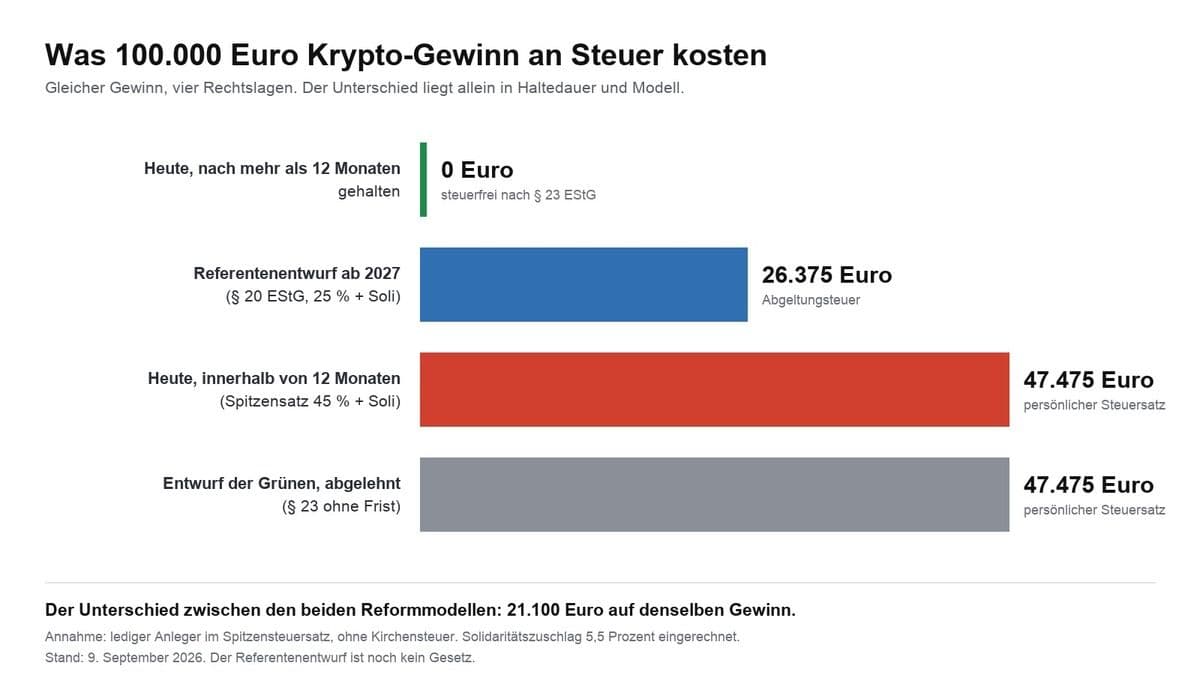
Crypto Tax in Germany: What Applies in 2026 and What Is Set to Change in 2027
Crypto gains are tax-free after twelve months; before that your personal tax rate of up to 45 percent applies. What triggers tax, how the holding period is calculated, what happens with staking and losses, and what the draft bill would change from 2027.

August 26, 2024 8:49 AM

Solana Price Prediction: A Surge Amid SOL Declining Network Activity
Solana's price shows potential for a significant surge, but a decline in network activity raises concerns. So, what lies ahead for SOL price at the beginning of September?
September 8, 2026 10:21 PM

Crypto Holding Period and Grandfathering: Why December 31, 2026 Becomes the Cut-Off in Germany's Draft Bill
A ministerial draft bill from Germany's finance ministry names a cut-off date for the first time: crypto assets acquired after December 31, 2026 are to fall under the flat-rate withholding tax. What that means for legacy holdings, running savings plans and staking income, and why nothing has been decided yet.
October 2, 2026 10:17 PM
Dogecoin breaks below $0.093: the BWOW fund turns every DOGE into cash on October 14
Dogecoin costs $0.0914 on Friday evening and has lost 3.4 percent in 24 hours. On October 14 the US fund BWOW sells its entire holding, and on the same day the German cabinet takes up the reform of crypto taxation.
September 25, 2026 7:14 PM

Chainlink Above the September High: What Open Interest, Funding Rate and Liquidation Risk Mean for LINK
Chainlink stands at $13.86, 11.2 percent higher than 24 hours ago. Our own query at OKX and Hyperliquid shows funding at the baseline rate, and what that means for leverage, buying route and tax.
September 25, 2026 10:11 AM

Stellar Climbs to $0.22: Why 446 Tokens Are Called USDC and What XLM Holders Must Check Now
Stellar Lumens gains 9.66 percent within 24 hours to $0.2212, carried by almost $4 billion of tokenized real-world assets on the chain. Our own count of September 25 shows at the same time why a stablecoin ticker on Stellar says nothing about its issuer.
September 24, 2026 10:38 AM
Fed Rate Hike in October: What to Check on Leverage, Liquidation and Holding Period After the PMI Jump
The flash US purchasing managers' index has jumped to 58.4 points, its highest level since July 2021, and input prices are rising at a pace last seen in October 2022. The futures market now prices a further Fed rate hike on October 28 at almost 70 percent, and the crypto market is falling broadly.
September 24, 2026 10:19 AM

Uniswap Falls 11.8 Percent After a 114 Percent Month: What to Check on Profit Taking, Holding Period and Leverage
UNI lost 11.75 percent on Wednesday morning but is still up 113.85 percent over the month. Anyone realising gains now almost certainly triggers a taxable disposal in Germany.
September 20, 2026 1:11 PM

Bitcoin Golden Cross: What Twelve Signals Since 2014 Really Show
Bitcoin's 50-day line has crossed its 200-day line. We evaluated all twelve golden crosses since 2014 ourselves and measured what happened afterwards. The result argues against the common reading of the signal.
September 20, 2026 4:13 AM

Zcash Above $1,500: What ZEC Holders Should Check on Tax and Custody
Zcash rose above $1,500 on September 19 for the first time since 2016 and, after an intraday high of $1,590.80, trades back at around $1,474. For German holders three questions hang on that jump: the one-year holding period, the planned year-end cut-off and the EU anti-money-laundering regulation from July 2027.
September 19, 2026 1:38 AM

Uniswap jumps above $9: what UNI holders should check on the fee switch now
The UNI price gains 18.67 percent within 24 hours, driven by the active fee switch and a new exemption from the US securities regulator. What of that can be recalculated, what remains pure expectation, and which three things you should settle now as an investor in Germany.
More from CryptoTicker